What's inside
- Where to Buy a 24-Inch Gas Range for an Off-Grid Kitchen, and the Ignition Question That Decides Everything
- Key Takeaways
- Quick Picks
- How Did We Grade Ranges for a Life Beyond the Wires?
- Ignition, Fuel, and Fit: The Six at a Glance
- Battery, Piezo, or Electronic: How Do the Three Ignitions Really Differ?
- How Do You Size Propane for a Cabin Range?
- What Does Baking Look Like in a Two-Cubic-Foot Oven?
- What Should a Winterising and Safety Routine Look Like?
- How Do You Cook a Whole Day’s Meals on One Small Range?
- How Do You Verify an Ignition Claim Before You Buy?
- Mistakes That Leave an Off-Grid Kitchen Cold
- Final Recommendation
- Frequently Asked Questions
- Related Guides
As an Amazon Associate I earn from qualifying purchases. This post may contain affiliate links at no extra cost to you.
cottageverdict.com is reader-supported. When you buy through links on our site, we may earn an affiliate commission.
Where to Buy a 24-Inch Gas Range for an Off-Grid Kitchen, and the Ignition Question That Decides Everything
The best 24-inch gas ranges for off-grid kitchens are chosen by one question before all others: how does the burner light? A range in a cabin, a homestead, or an RV runs on propane and independence, and a model whose ignition needs mains electricity has quietly surrendered the independence it was bought for. This guide grades its six picks on exactly that axis, stated pick by pick, because the listings themselves split honestly along it. One pick — the Summit — is a true battery-start off-grid range. The others are LP-friendly compact ranges whose electronic ignition, convection fans, or displays assume some electricity in the building, and each entry says so in plain words. Every linked pick is sold through Amazon, and each name leads to its listing so you can check price on Amazon and confirm the details — above all the ignition detail, which on two of these listings the title states outright and on the others the product page must be made to answer for.
Learn the three ignition families before the picks, because the whole guide uses them. Battery start uses a small battery to spark the burners and oven — no mains, no generator, full function in a blackout or a bush cabin. Piezo ignition makes its spark mechanically from the pressure of a click or a turning knob, needing no electricity at all, though it usually lights burners one deliberate click at a time. Electronic ignition draws on household current to spark automatically and to run the oven light, the clock, and any fan or display — convenient on the grid, and a dependency off it. A range can be propane-fuelled and still be grid-dependent; fuel and ignition are separate questions, and off-grid buyers must ask both, in that order, before they ask about finishes, grates, or the view through the oven door.
The 24-inch width is the other half of the brief. These ranges fit the cabins, tiny houses, RVs, and small cottages where off-grid life actually happens, and their ovens — from 1.9 to 2.92 cu. ft. across this guide — are sized for the households those buildings hold. Propane is the assumed fuel: several picks state LP convertibility or arrive propane-ready, and the RecPro is an RV propane range outright. Read each pick’s ignition line the way you would read a contract, because off-grid, it is one. The signature at the bottom of that contract is your own winter: the nights when the lane is impassable, the array is snowed under, and the house runs on what it stored — wood, water, propane, and a battery the size of a thumb, standing between the cook and a cold stove.
Key Takeaways
- Ignition is the deciding axis: battery start works with no mains at all, piezo needs no electricity, and electronic ignition depends on household current.
- The Summit WLM610P is the only true battery-start pick here — the one range in the guide built for a fully off-grid kitchen as listed.
- The Avanti states automatic electronic ignition in its title, and the Cosmo and Rangaire run convection fans and electronics that need power — all three are LP-capable but not mains-free.
- The RecPro is an RV propane range, designed for the RV context of levelling legs and a vehicle’s propane system.
- Propane readiness and off-grid readiness are different claims; several picks offer the first without the second, and this guide never merges them.
- At 24 inches, oven space runs 1.9 to 2.92 cu. ft. — the Summit also happens to hold the largest cavity here.
Quick Picks
| Pick | Badge | Why it earns its place |
|---|---|---|
| Summit 24-Inch Propane Gas Range, Battery Start WLM610P | Best true off-grid pick | Battery start ignition, propane fuel, and a 2.92 cu. ft. off-grid oven — the guide’s only fully mains-free range. |
| Avanti 24-Inch Compact Gas Range, Stainless | Best sealed-burner compact | Four sealed burners and a 2.6 cu. ft. oven, with automatic electronic ignition that assumes household power. |
| Frigidaire 24-Inch Gas Range, 1.9 Cu. Ft. | Best ADA-conscious compact | Continuous cast iron grates and ADA compliance in a white 24-inch body; ignition type to confirm on the listing. |
| Cosmo Nebula 24-Inch Gas Range COS-244AGC | Best convection pick with power | Convection, a timer display, and LP convertibility — excellent where solar or generator power is available. |
| Rangaire 24-Inch Gas Range RRG241TS | Best easy-reach compact | Sealed burners, a convection fan, and easy reach racks; the fan means this one wants electricity too. |
| RecPro RV 24-Inch Propane Gas Range | Best RV propane range | Built for RV life: propane fuel, four burners, and levelling legs for uneven ground. |
How Did We Grade Ranges for a Life Beyond the Wires?
We scored ignition before capacity, and fuel before finish. Each pick’s entry states what its listing supports about how it lights and what it burns, and where a listing is silent — the Frigidaire’s title names no ignition type, and the RecPro’s title names propane without detailing ignition — we say the figure is unstated and direct you to the product page rather than guessing. In an off-grid guide, a guessed ignition type is not a small error; it is the difference between dinner and a cold cabin, so this guide would rather print a gap than a fiction.
We also separated the two meanings of off-grid that listings blur. A propane range suits off-grid fuel logistics, because propane arrives in tanks and stores indefinitely. But a propane range with electronic ignition, a convection fan, and a digital display still drinks electricity with every use — trivially little from a solar array or a running generator, and absolutely unavailable in a blackout cabin with neither. Both kinds of pick earn their place here, because real off-grid households range from solar-powered homesteads to genuinely wire-free cabins; the guide’s job is to label which is which, and it does, pick by pick.
Finally, we kept the width honest: every pick is a 24-inch range with a real oven, not a cooktop or a countertop box. Readers furnishing a fully wired kitchen at the opposite scale can browse our guide to the Best 4-Door Refrigerators for the cold side of a conventional remodel; this page stays out where the wires end, among the tanks, the batteries, and the wood piles, where a range is not an appliance in a system but the system itself.

Summit 24-Inch Propane Gas Range, Battery Start WLM610P — Best true off-grid pick
The Summit WLM610P is the reason this guide exists. Its listing states the combination no other pick here can match: propane fuel, battery start ignition, an oven described as an off-grid oven, four open burners, and a 2.92 cu. ft. capacity — the largest oven in this guide — in a white 24-inch body. Battery start means the spark comes from a battery the range carries, not from the wall. No mains, no generator, no inverter: turn, spark, cook, in a cabin that has never seen a power line.
Understand what that independence includes. The oven lights from the same battery system, which is the detail that separates a true off-grid range from a cooktop with ambitions — baking off-grid is the hard part, and this range is built for it. Open burners, rather than sealed, fit the philosophy too: a simple, serviceable design with parts a handy owner can clean and maintain far from a service network. The white finish and compact body suit the cabins and small homes it will serve, and Summit’s long specialism in compact and off-grid appliances stands behind the concept.
The ownership rhythm is a battery rhythm. Keep a spare set of the correct batteries with the range the way you keep matches by a wood stove, and the ignition will never be the reason dinner is late. Propane consumption follows ordinary compact-range patterns; the independence is in the spark, not in any exotic fuel economy. For the homestead, the hunting cabin, the island cottage, or the household that simply refuses to let a blackout cancel dinner, this is the pick the whole category is measured against.
Its compromises are the honest kind. No convection fan evens the oven — a fan needs power the design refuses to assume — so baking uses the small-oven skills: one tray, middle rack, a turn halfway. No display counts down; a mechanical timer or a clock on the wall does that work. Buyers who find those absences charming rather than lacking have understood off-grid cooking exactly, and they will find this range less a compromise than a manifesto.
Winter is its examination season, and worth picturing. The generator stays silent to save fuel, the solar array sleeps under snow, and the cabin’s whole electrical world is a lantern and a radio — while the Summit roasts a chicken, bakes the bread, and keeps a kettle at a shiver on the back ring. That scene is the product. Every other pick in this guide cooks beautifully inside a system; the Summit cooks when the system is off, and households that live beyond the wires buy exactly that difference.
- Width stated in the listing: 24 inches
- Ignition stated in the listing: battery start
- Fuel stated in the listing: propane
- Oven capacity stated in the listing: 2.92 cu. ft., described as an off-grid oven
- Burners stated in the listing: 4 open burners
- Where to buy: the Summit 24-Inch Propane Gas Range, Battery Start WLM610P listing on Amazon — check price on Amazon
Strengths
- Battery start lights burners and oven with no mains electricity at all.
- The 2.92 cu. ft. oven is the largest in this guide despite the off-grid design.
- A simple open-burner layout suits owner maintenance far from service networks.
Trade-offs
- No convection fan, so even baking relies on single-tray discipline and turning.
- Ignition depends on keeping the correct spare batteries in the cabin.
- Open burners let spills travel further than sealed designs contain them.
Best for: wire-free cabins, homesteads, and blackout-proof kitchens that cook on propane. Not suited for: cooks who want convection, displays, and sealed-burner convenience.

Avanti 24-Inch Compact Gas Range, Stainless — Best sealed-burner compact
The Avanti is an excellent compact gas range that this guide includes with its dependency printed in large type: its listing states automatic electronic ignition. That means the spark, the oven light, and the convenience layer run on household current. In a solar homestead with an inverter, a generator-backed cabin, or a small grid-connected cottage, that is no hardship at all — the draw is tiny, the burners are sealed, the oven holds 2.6 cu. ft., and a storage drawer and glass door complete a specification many compact ranges would envy. Off-grid with wires available part-time is still off-grid living, and this range serves it well.
What the Avanti must not be sold as is a blackout-proof cooker. When the power dies, electronic ignition dies with it; burners on many such designs can be lit with a match by a careful adult, but the oven’s safety systems may not cooperate, and this guide will not promise workarounds a listing does not state. Buy the Avanti for its sealed burners — spills contained on the surface, cleaning reduced to a wipe — and its stainless compact competence, in a building whose electricity is reliable enough for your cooking hours.
Within those terms it is a genuinely attractive pick. Avanti’s compact experience shows in the proportions: four sealed burners that accept real pans, a glass door that keeps oven checks heat-saving, a drawer for the pans a 24-inch kitchen cannot cupboard. A smallholding with a solar array sized for lights and a fridge will run this range’s ignition without noticing the draw, and will enjoy a more polished cooker than the wire-free Summit in every daily touch except independence.
Choose between the Summit and the Avanti by answering one question truthfully: when the power is out for three days, do you still need the oven? If yes, the Summit is your range and there is no second choice in this guide. If your power is solar, generated, or simply reliable, the Avanti’s sealed, stainless polish becomes available to you — and the guide’s remaining picks open up on the same terms.
There is a middle household worth naming: the grid-connected cottage that loses power often enough to plan around it. For that kitchen the Avanti cooks superbly fifty weeks a year, and the outage weeks are met with a camping stove on the porch and no resentment. Not every buyer needs blackout-proof baking; some need a good range and a sense of humour about the grid. The Avanti serves them honestly, provided the listing’s ignition line was read before the order rather than after the first outage.
- Width stated in the listing: 24 inches
- Ignition stated in the listing: automatic electronic ignition — needs household power
- Burners stated in the listing: 4 sealed burners
- Oven capacity stated in the listing: 2.6 cu. ft.
- Extras stated in the listing: storage drawer, glass door, oven light
- Where to buy: the Avanti 24-Inch Compact Gas Range, Stainless listing on Amazon — check price on Amazon
Strengths
- Sealed burners contain spills and make the top a one-wipe clean.
- A 2.6 cu. ft. oven with a glass door and light suits heat-saving baking checks.
- The storage drawer answers the compact kitchen’s pan problem.
Trade-offs
- Electronic ignition depends on household electricity — not a wire-free range.
- The oven light and ignition draw are small but absolute: no power, no spark.
- Stainless shows marks more readily than the white finishes here.
Best for: solar or generator-backed small homes wanting sealed-burner polish. A poor fit for: cabins with no electricity at all, where only battery start truly serves.

Frigidaire 24-Inch Gas Range, 1.9 Cu. Ft. — Best ADA-conscious compact
The Frigidaire brings a mainstream badge and two stated distinctions to the 24-inch field: continuous cast iron grates and ADA compliance, around a 1.9 cu. ft. oven in a white body. Continuous grates let a heavy pot slide from a fierce ring to a gentle one without lifting — a kindness to every cook and a genuine accessibility feature alongside the ADA design, which concerns itself with reach and control effort. For a small home where a cook with limited strength or mobility works, those stated details matter more than a tenth of a cubic foot.
Now the honest gap: the listing’s title does not state an ignition type. Many compact ranges from mainstream makers use electronic ignition, but this guide does not convert likelihood into a claim. If wire-free cooking is your purpose, treat the Frigidaire as unproven until the product page or the manufacturer confirms how it lights — and if it proves electronic, file it with the Avanti as a power-assuming pick. If your off-grid home has solar or a generator, the question matters less and the grates and the badge can lead the decision.
At 1.9 cu. ft. the oven is the smallest here, sized for one or two people’s real cooking: a small roast, a tray of vegetables, a loaf. Frigidaire’s service network is the widest in this guide, which for a remote property cuts both ways — parts travel well through mainstream channels, even if the nearest technician is a county away. A buyer who values that trail, cooks small, and has power for whatever ignition the page confirms will find this the most conventionally reassuring pick in the line-up.
The white finish suits the cottage brief, and cast iron grates give the top a substance that belies the range’s size. Just enter the purchase with the ignition question open and the product page bookmarked: in this guide, an unanswered question is a task, not a verdict.
The ADA thread deserves its closing emphasis, because remote and small homes are often where ageing cooks live independently longest. A range whose grates slide a pot instead of demanding it be lifted, in a body designed with reach in mind, is independence equipment in the truest sense — it extends the years a person can cook for themselves in their own kitchen. That value never appears in a capacity figure, and for the right household it outweighs every other line in this section.
- Width stated in the listing: 24 inches
- Oven capacity stated in the listing: 1.9 cu. ft.
- Grates stated in the listing: continuous cast iron grates
- Design stated in the listing: ADA compliant
- Ignition: not stated in the title — confirm on the product page before off-grid use
- Where to buy: the Frigidaire 24-Inch Gas Range, 1.9 Cu. Ft. listing on Amazon — check price on Amazon
Strengths
- Continuous cast iron grates let heavy pots slide instead of being lifted.
- ADA compliance signals reach-and-effort thought in the controls and layout.
- A mainstream badge brings the widest parts and service trail in this guide.
Trade-offs
- The 1.9 cu. ft. oven is the guide’s smallest.
- Ignition type is unstated in the title and must be confirmed before wire-free plans.
- No LP convertibility is stated in the title, so propane buyers must verify.
Best for: accessibility-minded small households with some power available. Not the right match for: wire-free buyers until its ignition is confirmed in writing.
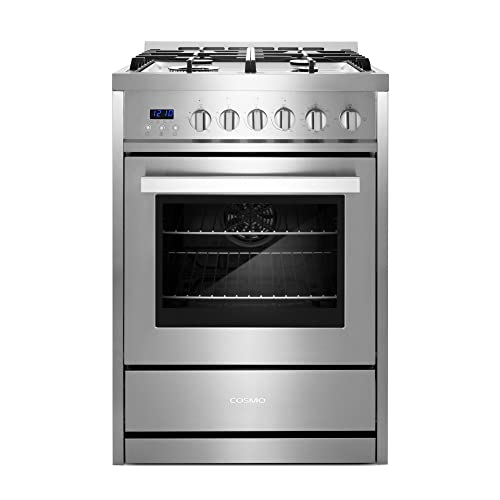
Cosmo Nebula 24-Inch Gas Range COS-244AGC — Best convection pick with power
The Cosmo Nebula COS-244AGC is the most conventionally capable cooker in this guide: a 2.7 cu. ft. convection oven with fan circulation, four burners over cast iron grates, a digital display with timer, and liquid propane convertibility stated in the listing. It is also, by the same listing, a range that expects electricity — a convection fan, a digital display, and electronic controls do not run on propane and good intentions. This guide places it proudly in the solar-homestead column: where panels and an inverter hum in the background, the Cosmo cooks better than anything else here.
Convection is worth its power draw in a small oven. A 2.7 cu. ft. cavity develops hot corners quickly, and fan circulation irons them out, so the tray of scones browns as a batch. The timer display keeps the door shut and the timing honest. LP convertibility, stated outright, means the fuel side of the off-grid brief is fully honoured — propane from the tank, converted properly — while the spark and the fan draw their small share from the house system.
The household this suits is increasingly the typical off-grid household: not wire-free, but wire-independent, with solar generation, battery storage, and an inverter sized for lights, refrigeration, and small appliance loads. A range’s ignition and fan are trivial loads in that budget, easily carried through the evening. What such a household cannot do is run the Cosmo through a multi-day outage once the batteries are spent — and for that scenario, the Summit remains the guide’s answer.
Stainless steel and cast iron give the Nebula a grown-up presence in a small kitchen, and its specification reads like a checklist written by a comparison shopper. If your off-grid life includes reliable generated power, this is the pick that asks the fewest cooking compromises. If it does not, admire it and scroll back to the battery start — the guide’s honesty exists so that admiration and purchase stay separate decisions.
One more household fits the Cosmo precisely: the off-grid home that is off-grid by geography but modern by design — the architect’s cabin with a serious solar roof, battery wall, and an inverter that has never once been the limit. That kitchen wants appliances that behave like city appliances, and the Nebula is the only pick here that fully does: fan-evened baking, a display that counts down, burners over cast iron. Independence, in that house, means generating its own power, and this range spends a little of it very well.
- Width stated in the listing: 24 inches
- Oven capacity stated in the listing: 2.7 cu. ft.
- Burners stated in the listing: 4 burners
- Oven help stated in the listing: convection with fan circulation — needs household power
- Extras stated in the listing: cast iron grates, digital display with timer, LP convertible
- Where to buy: the Cosmo Nebula 24-Inch Gas Range COS-244AGC listing on Amazon — check price on Amazon
Strengths
- Convection fan circulation evens a compact cavity’s hot corners for baking.
- Stated LP convertibility honours the fuel half of the off-grid brief completely.
- A timer display and cast iron grates make it the most polished cooker here.
Trade-offs
- The fan, display, and ignition all assume electricity the wire-free cabin lacks.
- Electronics in a remote kitchen are harder to service than a battery spark.
- Stainless in a rustic cabin is a styling choice some will love and some won’t.
Best for: solar and inverter homesteads wanting convection baking on propane. Poorly suited to: cabins with no electrical system whatsoever.

Rangaire 24-Inch Gas Range RRG241TS — Best easy-reach compact
The Rangaire RRG241TS builds its case on the oven’s ergonomics and the top’s containment: sealed burners, a convection fan, easy reach racks, and a timer, in stainless steel at 24 inches. Easy reach racks are the feature to linger on — racks designed to come forward reduce the lean into a hot cavity, which in a small kitchen where the cook stands close is a daily comfort and a safety margin at once. Sealed burners keep the top’s cleaning to a wipe, the way a working cabin kitchen needs it to be.
The power honesty applies here as it did to the Cosmo: a convection fan and a timer run on electricity, so the Rangaire belongs to the wired-or-solar column of this guide, not the wire-free one. Its listing does not headline an ignition type alongside those features, so confirm the ignition detail on the product page as you would for the Frigidaire — with the fan already establishing that some power is assumed, the practical question is only how much of the range rests during an outage, and the page is where that answer lives.
For the household with a generator that runs at cooking hours, or a modest solar system, the Rangaire offers a well-judged middle: more oven help than the Summit, less display-driven polish than the Cosmo, and racks that respect the cook’s back. Rangaire is a range-focused name rather than a generalist badge, and the RRG241TS reads like that focus — a compact cooker specified by people thinking about racks, seals, and fans rather than about a catalogue’s breadth.
Its stainless finish and tidy proportions suit the renovated small kitchen — the in-law suite, the garden flat, the cottage with a modest solar roof. Enter it with the same question as every pick after the Summit: what happens in your house when the power stops? If the answer is a generator’s hum or a battery bank’s patience, the Rangaire’s comforts are honestly available to you.
The racks deserve the last word, because they compound. A cook pulls a tray forward a thousand times a year; a rack designed to travel toward the cook, smoothly and far, turns each of those pulls from a lean-and-lift into a slide-and-check. In a small kitchen, where the cook stands close and the oven is opened often, that ergonomic mercy is felt more than any headline feature — and it is why a range-focused maker’s quiet detail earns this pick its place over louder rivals.
- Width stated in the listing: 24 inches
- Burners stated in the listing: sealed burners
- Oven help stated in the listing: convection fan — needs household power
- Oven details stated in the listing: easy reach racks, timer
- Finish stated in the listing: stainless steel
- Where to buy: the Rangaire 24-Inch Gas Range RRG241TS listing on Amazon — check price on Amazon
Strengths
- Easy reach racks shorten the lean into a hot cavity — comfort and safety together.
- Sealed burners keep daily cleaning to a single wipe of the surface.
- Convection fan support evens the compact oven for baking.
Trade-offs
- The fan and timer assume electricity, excluding wire-free cabins.
- Ignition type is not headlined in the title; confirm it on the product page.
- Oven capacity is not stated in the title, so verify the figure before ordering.
Best for: generator or solar households valuing rack ergonomics and sealed burners. Not suited for: wire-free kitchens, where only the Summit’s battery start qualifies.

RecPro RV 24-Inch Propane Gas Range — Best RV propane range
The RecPro belongs to a different building entirely — one on wheels. Its listing states the RV brief plainly: a 24-inch stainless freestanding gas range fuelled by propane, four burners, a stated 12,000 BTU figure, and four levelling legs. Those legs are the tell. An RV parks on grass, gravel, and sloping pitches, and a range that can be levelled to its site cooks with level pans and even flames wherever the vehicle stops; a home range assumes a floor that someone else levelled permanently.
In the RV context, the off-grid questions rearrange themselves. The vehicle’s propane system is the fuel infrastructure, sized and regulated for appliances exactly like this, and the range’s job is to turn that stored propane into real meals — not the hotplate compromises of campsite cooking, but a four-burner top and an oven in a body designed for the vehicle’s cabinetry. For full-time RVers and serious tourers, that is the difference between travelling with a kitchen and travelling with a kettle.
The listing does not detail an ignition type in its title, so the same discipline applies: confirm on the product page how it lights and what, if anything, it draws from the vehicle’s electrical system. RV electrical systems — house batteries and inverters — make small draws manageable in a way a wire-free cabin cannot, but the confirmation belongs in the purchase, not in an assumption. RecPro specialises in RV equipment, and that specialism, plus the levelling legs and propane-native design, is the substance of this pick.
Could it serve a tiny cabin? Physically it is a 24-inch propane range, and a cabin on a propane system resembles an RV more than either resembles a suburban kitchen. But buy it for the context it names: a vehicle, or a dwelling that shares a vehicle’s virtues and constraints — small, level-challenged, propane-fed, and proud of it.
Touring cooks develop a liturgy the RecPro fits: level the vehicle, light the range, and cook the meal the day’s market offered, in a kitchen that was a highway an hour ago. A range with levelling legs and a propane appetite sized to a vehicle’s tank respects that liturgy in a way a domestic range, however compact, never quite does. The road is a building material here, and this is the only pick in the guide built from it.
- Width stated in the listing: 24 inches
- Setting stated in the listing: RV range
- Fuel stated in the listing: propane
- Figure stated in the listing: 12,000 BTU
- Details stated in the listing: 4 burners, 4 levelling legs, stainless steel
- Where to buy: the RecPro RV 24-Inch Propane Gas Range listing on Amazon — check price on Amazon
Strengths
- Levelling legs suit the uneven pitches an RV actually parks on.
- Propane-native design matches an RV’s existing fuel system directly.
- A real four-burner range and oven replace campsite cooking compromises.
Trade-offs
- Ignition type is not stated in the title; confirm its power needs on the page.
- An RV-first design may lack home-kitchen features like a storage drawer.
- Its stated figure is modest beside home ranges — sized for a vehicle’s supply.
Best for: RV owners wanting a genuine range on the vehicle’s propane system. A poor fit for: wire-free cabins, where the Summit’s battery start is the honest answer.
Ignition, Fuel, and Fit: The Six at a Glance
| Model | How it lights | Fuel as listed | Off-grid verdict |
|---|---|---|---|
| Summit 24-Inch Propane Gas Range, Battery Start WLM610P | Battery start | Propane | Fully mains-free |
| Avanti 24-Inch Compact Gas Range, Stainless | Automatic electronic ignition | Gas, per listing | Needs household power |
| Frigidaire 24-Inch Gas Range, 1.9 Cu. Ft. | Confirm on listing | Gas, per listing | Unproven until confirmed |
| Cosmo Nebula 24-Inch Gas Range COS-244AGC | Electronic, with fan and display | LP convertible | Needs household power |
| Rangaire 24-Inch Gas Range RRG241TS | Confirm on listing; fan fitted | Gas, per listing | Needs household power |
| RecPro RV 24-Inch Propane Gas Range | Confirm on listing | Propane | RV system context |
Battery, Piezo, or Electronic: How Do the Three Ignitions Really Differ?
Battery start keeps a small battery in the range whose only job is the spark. Press or turn, and the igniter clicks with a vigour mains systems match, lighting burners and — crucially — the oven, because the whole ignition circuit is self-contained. The battery lasts a long while at spark-sized draws, and replacing it is a drawer-and-minutes task. This is the Summit’s system, and it is the only one of the three that makes a range a fully independent appliance.
Piezo ignition makes its spark from mechanics: a spring-loaded hammer strikes a crystal, and the crystal’s jolt becomes the spark. No battery to exhaust, no mains to miss — but the spark is one click at a time, usually lighting one burner per press, and oven lighting by piezo is less common. Piezo suits cooktops and simple ranges beautifully and appears across the wider off-grid world, even though none of this guide’s six titles names it; knowing the family helps you read other listings you will meet in this search, where a piezo model may be exactly right for a burner-focused cabin.
Electronic ignition is the grid’s convenience: automatic sparking, often with the oven light, clock, fan, and display riding the same supply. Its draw is small, which tempts off-grid buyers to shrug — and on a solar system the shrug is justified. But small is not none, and the failure mode is total: no power, no spark, and an oven whose controls may not function at all. Grade your own electrical reliability honestly, and the right family chooses itself. Households building the rest of an off-grid room can find the same independence-first thinking in our guide to the Best Comfortable Heavy-Duty Office Chairs — a different category entirely, but the same discipline of matching equipment to the life it will actually live.
How Do You Size Propane for a Cabin Range?
A compact gas range sips propane by the standards of heating appliances, but the supply still deserves arithmetic. The tank must be sized for your refill rhythm — a remote cabin refilled monthly lives differently from one visited twice a year — and the regulator and line must be matched to the range by the fitter who connects it. Propane’s great off-grid virtue is storage: unlike petrol for a generator, it keeps indefinitely in the tank without degrading, so a large tank filled in autumn is a winter of cooking assured.
Altitude and cold both whisper at the margins. Propane vaporises less eagerly in deep cold, which is a tank-placement consideration in northern cabins — a fitter who works your valley will know the local answers. Keep the tank’s route, the shut-off, and the connection accessible in snow, because the one service visit you will eventually need should not begin with an excavation.
Safety scales with independence. A carbon monoxide alarm and a combustible-gas alarm cost little, run on batteries for years, and belong in any sleeping cabin with a gas appliance — arguably more than in a wired house, because the cabin’s occupants are their own monitoring service. Ventilation while cooking matters too: a cracked window near the range is the off-grid hood, and in a small airtight cabin it is not optional garnish but part of the appliance’s operating instructions.
What Does Baking Look Like in a Two-Cubic-Foot Oven?
Small ovens bake in single layers and small batches, and they do it quickly — a compact cavity reaches temperature fast and returns to it fast after the door closes. The repertoire that thrives is the cabin repertoire: a loaf, a tray of biscuits, a small roast with its vegetables around it, a crumble. Two-tray baking is where compact ovens protest, because the trays shadow each other and the cavity’s corners run hot; bake in rounds instead, and the rounds come out better than a crowded single batch ever did.
Without convection — the Summit’s honest situation — rack position becomes the skill. The middle rack is home; a tray that needs top browning rises for its final minutes; a delicate base drops a level to escape the fiercest heat. An oven thermometer earns its hook on the rack, because small gas cavities swing around their set point and the dial’s opinion is approximate. None of this is deprivation; it is the traditional grammar of small-oven cooking, practised for a century before fans arrived.
Vessel choice completes the adaptation. Low, wide pans beat tall ones; a lidded cast iron pot turns the small oven into a slow-cooking chamber for beans and braises that barely sip propane; and a baking stone or steel, sized to the cavity, steadies the temperature swings with thermal mass. Equip the small oven as its own cuisine rather than as a shrunken large one, and it stops feeling like a compromise by the second week. Cooks furnishing a cabin’s floor space with the same honesty might enjoy our guide to the Best Floor Chairs for Bedrooms, another study in small-footprint living.
What Should a Winterising and Safety Routine Look Like?
An off-grid range lives in buildings that are sometimes empty, sometimes frozen, and always their own utility company. The seasonal routine reflects that: propane connections checked with soapy water at the season’s start, the tank’s level read before the long weekends, batteries for the ignition — and for the alarms — replaced on a calendar rather than on a failure. A range that lights first time in November is a range whose owner spent twenty minutes on it in October.
Rodents and ranges deserve a plain sentence. Cabins left empty invite tenants, and a range’s warm cavities and the space beneath it are prime real estate; a check inside the drawer and around the base at each arrival is rural housekeeping, not paranoia. Keep the area beneath the range clean of stored paper and cloth — a rule in any kitchen, and a law in one heated by open flame an hour from the fire station.
Carbon monoxide discipline completes the routine. The alarm belongs on the wall where the instructions say, its battery belongs on the same replacement calendar as the ignition’s, and any headache-and-nausea pattern among occupants is treated as the alarm that speaks. Off-grid living’s romance is self-reliance; self-reliance, practised properly, is mostly checklists — and the range rewards every one of them with another season of dinners.
How Do You Cook a Whole Day’s Meals on One Small Range?
Off-grid cooking organises itself around the tank and the day’s rhythm. Morning is the top’s hour: porridge, eggs, coffee, the kettle cycling. Midday is light — the range rests while the sun does the work elsewhere. Evening is the oven’s performance, and the skilled cabin cook loads it like a train: the roast first, the vegetables in its juices, the crumble riding the falling heat afterwards, and tomorrow’s bread dough proving in the warmth the oven sheds into the room. One firing, three courses, and a kitchen warmed as a by-product.
Residual heat is the off-grid cook’s second fuel. A compact gas oven cools slowly enough to warm plates, soften butter, dry herbs on the open door’s ledge, and keep a second helping at serving temperature while the first is eaten. Households new to small ranges often discover this economy by accident and then plan for it: the menu becomes a sequence designed around one heating, which is how farmhouse kitchens always cooked before energy was too cheap to notice.
None of this requires the Summit specifically — any pick here can run the rhythm in a powered house — but the wire-free cabin feels the logic most purely, because every firing is a decision about stored fuel. Cook in sequences, bake in the falling heat, and keep the kettle’s counsel: a small range, used in the right order, feeds a household as grandly as its owners actually live.
How Do You Verify an Ignition Claim Before You Buy?
Read the listing the way this guide did: ignition is a stated fact or it is an open question. Search the product page for the words battery, piezo, and electronic, and treat the answer as belonging to the exact model and variant in your basket, because compact ranges often sell in several ignition configurations under one family name. If the page stays silent, the manufacturer’s specification sheet for the model number is the next document, and a question to the seller — answered in writing — is the third.
Ask the outage question explicitly: what works when the power is cut? A seller who knows the product can answer in one sentence, and the answer distinguishes a spark-only dependency from a control dependency. On the Summit the answer is everything works, because the listing says battery start; on a range with a fan and a display, expect the honest answer to be that the burners may light while the oven’s electronics rest, and plan accordingly.
Keep the evidence. Screenshot the specification that decided you, and keep it with the range’s manual at the property. Years later, when a part is needed or a guest asks why the cabin’s cooker lights with the generator off, that small archive will answer. Off-grid households run on documentation more than wired ones do, because there is no utility to telephone for the record.
Mistakes That Leave an Off-Grid Kitchen Cold
The founding mistake is buying propane readiness and assuming ignition independence — the two are separate systems, and this guide’s table exists to keep them separate in your mind. A range that cannot light in an outage, in a cabin whose purpose is outages, is the wrong range however well it cooks in October. Read the ignition line of any listing as carefully as the price line.
Second, buyers forget the oven. A cooktop that lights by match in a blackout feels like resilience until the first meal that needs baking; oven ignition is where off-grid claims go to be tested, and only a stated system — battery start here — should be trusted. Third, the propane supply gets sized by optimism: a tank that empties in February, at a cabin reachable by sledge, teaches arithmetic the hard way.
Fourth, ventilation and alarms get skipped because the cabin feels airy in summer; winter seals it, and winter is when the range works hardest. Fifth, RV ranges get bought for houses and house ranges for RVs, ignoring the levelling, supply, and context each was designed around. Match the range to the building’s actual life, and the mistakes mostly prevent themselves.
Final Recommendation
If your kitchen is truly beyond the wires, the decision is already made: the Summit WLM610P, battery start and propane, with the largest oven here as a bonus — it is the only pick that keeps its promises in a blackout. If your off-grid home runs solar or a generator, the field opens: the Cosmo for convection baking, the Rangaire for its racks and sealed top, the Avanti for sealed-burner polish, and the Frigidaire for its grates and accessibility once its ignition is confirmed. If your kitchen has wheels, the RecPro was built for it and nothing else here was. Ask the ignition question first, the fuel question second, and the finish question last, and the range you install will still be cooking on the darkest night of the year — which is, after all, the entire point of going off-grid well.
Trust the labels, including the gaps in them. A guide that tells you which pick it cannot verify is a guide whose verifications you can build a cabin on — and a range bought on stated facts, fitted by a proper fitter, and fed by a well-kept tank will repay that care every time the lane is snowed in and dinner is, nonetheless, at six.
Frequently Asked Questions
What does battery start actually mean on the Summit?
The range carries a battery that powers its ignition spark for both burners and oven, so no household electricity is involved in lighting or running the cooker. The propane provides the heat; the battery provides only the spark. Keeping a spare set of the correct batteries at the cabin makes the system effectively permanent.
Can I light an electronic-ignition range with a match during an outage?
Burners can often be lit by a careful adult with a match on many designs, but oven systems with electronic controls and safety valves may not operate without power, and listings rarely promise outage behaviour. Treat any range whose ignition is electronic as a powered appliance for planning purposes — if outage cooking matters, choose battery start instead of a workaround.
Is piezo ignition as good as battery start?
It is equally independent — a piezo spark is mechanical and needs no electricity or battery — but it lights one burner per click and is less commonly fitted to ovens. For a cooktop-focused cabin it can be ideal. None of this guide’s six titles names piezo, so if you meet it in another listing, verify the oven’s lighting method separately before trusting it off-grid.
How much electricity do the powered picks actually use?
Very little — ignition sparks, a small fan, a light, and a display are trivial loads beside a fridge or a pump. On a solar system with an inverter they are easily carried. The issue is never the amount; it is the absoluteness. When the power is gone entirely, a trivial load is as unavailable as a large one, which is why the wire-free cabin needs battery start.
Can the RecPro work in a tiny house or cabin?
Physically it is a 24-inch propane range, and its levelling legs even suit an imperfect floor. But it is designed and listed for RV use, with an RV’s supply assumptions, so a cabin installation should be confirmed with the maker and a fitter first. Cabins that stay put are usually better served by the Summit for independence or the Avanti class for polish.
A last practical note on spares. Remote kitchens should hold what the range consumes: the correct ignition batteries, a spare oven knob if the design uses a removable one, the manual printed rather than bookmarked, and the fitter’s number written inside a cupboard door. None of it costs much, and all of it converts a future failure from an expedition into an errand. The off-grid premium is never the appliance; it is the distance — and spares are how a household buys the distance down.
Do I need a special regulator or fitting for propane?
Propane appliances must be connected with the correct regulator, pressure, and fittings for the supply, and LP-convertible models need their conversion performed properly. This is qualified-fitter work in every jurisdiction, and it is doubly worth doing right in a remote property where a return visit is an expedition. Budget the fitting as part of the range.
Related Guides
The natural companion to this guide is our piece on the Best Hand Clothes Washers — laundry with no electricity at all, for the same cabins and homesteads. Together with the compact electric and dual fuel guides in this series, they furnish a kitchen at every distance from the grid.


