What's inside
- Where to Buy an American-Made Refrigerator, and What This Guide Will Not Pretend
- Key Takeaways
- Quick Picks
- How Did We Choose Picks for a Claim the Listings Do Not Make?
- The Six Entries Side by Side: Programme, Format and Capacity
- How Do You Verify a Refrigerator’s Country of Origin, Step by Step?
- Why Does Assembly Location Matter to Buyers Beyond Patriotism?
- What Is the Difference Between Assembled, Made and Sourced?
- How Should an Origin-Led Buyer Furnish the Rest of the Room?
- How Has American Appliance Assembly Changed, and Why Does Per-Model Checking Exist?
- How Do You Keep the Origin File Useful for a Decade?
- What Questions Should You Ask a Seller Before Ordering?
- How Do the Five Linked Picks Divide by Household?
- How Do You Read a Manufacturer’s Made-in-America Page Like an Auditor?
- What Mistakes Do Origin-Conscious Buyers Most Often Make?
- Final Recommendation
- Frequently Asked Questions
- Related Guides
As an Amazon Associate I earn from qualifying purchases. This post may contain affiliate links at no extra cost to you.
cottageverdict.com is reader-supported. When you buy through links on our site, we may earn an affiliate commission.
Where to Buy an American-Made Refrigerator, and What This Guide Will Not Pretend
The best American-made refrigerators begin with an admission, printed here rather than buried: not one of the listings in this guide states a country of origin in its title. Search the titles yourself — they give capacities, finishes, dispensers and model numbers, and on the question of where each machine was made, they are silent. So this guide does the honest thing instead. The linked picks are models from GE Appliances and Whirlpool, the two manufacturers whose American refrigerator assembly programmes are public and long-standing — GE Appliances assembling in Louisville, Kentucky, Whirlpool building refrigerators in American plants — and the article teaches you, step by step, how to verify the country-of-origin label on the rating plate of the exact model you receive, because that label, and nothing else, is the proof for the specific machine in your kitchen.
That discipline matters because origin claims decay. A brand’s programme is a general truth; a model’s assembly plant is a specific one, and production moves between plants across a model’s life. Any guide that stamps a specific refrigerator “made in USA” on the strength of a brand’s reputation is selling you a story. This guide sells you a method instead: choose from manufacturers with genuine American assembly operations, then verify the unit in front of you, on its rating plate and against the manufacturer’s own made-in-America documentation for that model, before the delivery crew leaves.
The sixth entry is prose-only and proud of it: the built-in specialists such as Sub-Zero and True, whose American manufacturing is their identity, sell through dealers rather than marketplace listings, so they appear here as a described channel with no link, no image and no invented specification. Everything else below — five linked GE and Whirlpool models from 11.6 to 21.9 cubic feet — is sold through Amazon, where each linked name leads to the listing and you can check price on Amazon in the ordinary way.
Key Takeaways
- No listing title in this guide states a country of origin — this article says so openly and builds its method around that fact.
- The linked picks come from GE Appliances and Whirlpool, manufacturers with public, long-standing American refrigerator assembly programmes.
- Origin must be verified per exact model: read the country-of-origin line on the unit’s rating plate and the manufacturer’s documentation for that model.
- No spec box in this guide claims a specific model is made in USA; each states that origin is not in the title and must be verified.
- The prose-only entry covers dealer-channel American built-ins such as Sub-Zero and True, which have no family-refrigerator Amazon listing here.
- Capacities span 11.6 to 21.9 cubic feet across top-freezer, bottom-freezer and French-door formats.
Quick Picks
| Pick | Badge | Why it stands out |
|---|---|---|
| GE 20.6 Cu. Ft. Counter-Depth French Door Refrigerator GYE21JYMFS | Counter-Depth French Door | A 20.6-cubic-foot GE Appliances French-door in fingerprint-resistant stainless. |
| GE 17.7 Cu. Ft. Bottom-Freezer Refrigerator, Counter Depth | Counter-Depth Bottom-Freezer | GE Appliances’ 17.7-cubic-foot bottom-freezer with a fitted stance. |
| GE Profile 21.9 Cu. Ft. Counter-Depth French Door Refrigerator | Largest Linked Pick | The set’s biggest cabinet, a GE Profile French-door with an internal dispenser. |
| GE 11.6 Cu. Ft. Top-Freezer Refrigerator GPE12FGKWW | Compact Top-Freezer | An 11.6-cubic-foot GE top-freezer whose listing notes its energy star designation. |
| Whirlpool 18.5 Cu. Ft. Bottom-Freezer Refrigerator WRB329DMBM | The Whirlpool Entry | Whirlpool’s 18.5-cubic-foot stainless bottom-freezer, the second American programme in the guide. |
| Sub-Zero / True built-in refrigeration (dealer channel) | American Built-In Route | Premium American-built built-ins sold through dealers, described qualitatively with no listing. |
How Did We Choose Picks for a Claim the Listings Do Not Make?
By separating two questions that weaker guides merge. Question one: which manufacturers genuinely assemble refrigerators in the United States, as a matter of public record? GE Appliances’ Louisville, Kentucky operation is one of the largest appliance assembly complexes in the country, and Whirlpool’s American refrigerator plants are equally documented; both companies publish made-in-America material describing these programmes. Question two: is the specific model in a specific listing American-assembled? That question can only be answered per model, per unit, from the rating plate and the manufacturer’s model-level documentation — which is why this guide teaches the verification instead of asserting the answer.
Within those two manufacturers’ ranges, we chose for spread: French-door and bottom-freezer and top-freezer, counter-depth and compact, 11.6 through 21.9 cubic feet, so that a buyer committed to American assembly can still choose by kitchen and household rather than by flag alone. Every specification in the boxes below comes from the listing titles. Every origin statement is framed as programme-level context plus a verification instruction. Readers who watched us apply the same evidence rules to width claims in our guide to Best 10 Cu. Ft. Refrigerators‘ neighbouring class will recognise the method — there, widths; here, origins; in both, the listing’s silence is reported, never filled.

GE 20.6 Cu. Ft. Counter-Depth French Door Refrigerator GYE21JYMFS — Counter-Depth French Door
The GYE21JYMFS is the balanced centre of this guide: a 20.6-cubic-foot French-door refrigerator in counter-depth format and fingerprint-resistant stainless, from GE Appliances. As a product proposition it needs no flag to sell it — counter-depth French doors at this capacity are the mainstream’s favourite format for fitted kitchens, and the fingerprint-resistant finish suits the family traffic the format attracts. The American-assembly context is the reason it appears in this article rather than another: it is a current GE Appliances model, and GE Appliances’ refrigerator assembly is centred on its Louisville, Kentucky complex, a matter of public record the company itself publicises.
Now the verification, applied to this exact model as it must be to all five. When the machine arrives — or before, through the seller’s documentation — find the rating plate inside the fresh-food cabinet and read its country-of-origin line for the GYE21JYMFS specifically. Cross-check against GE Appliances’ own model documentation and its made-in-America materials. If the plate and the paperwork agree with the programme, your purchase is verified, not assumed. If a seller cannot produce model-level origin information at all, that absence is itself information, and the other picks in this guide remain open to you.
As a refrigerator, expect the counter-depth bargain described throughout this batch of guides: a cabinet that aligns with the worktop run and keeps everything within easy reach, in exchange for depth a standard cabinet would spend on cavernous shelves. Twenty point six cubic feet is honest family capacity for weekly shoppers. The French doors keep the fresh section’s swing modest, and the whole machine presents in stainless that will sit beside any mainstream range without argument.
Buyers renovating a kitchen around American-made principles often pair a purchase like this with American-assembled laundry and cooking appliances from the same programme families, building a suite whose origin story is consistent rather than accidental. The GYE21JYMFS is the easiest starting point for that suite in this guide: the format every kitchen understands, from the programme every origin-conscious buyer checks first.
Think about the verification as a feature of ownership rather than a hurdle before it. The buyer who photographs this GE’s rating plate on delivery day owns something beyond the machine: a documented appliance, whose identity can be produced for insurers, for the next buyer of the house, and for any future question about the unit’s making. Households that keep such files find every subsequent appliance transaction easier, because the evidence habit, once formed, applies itself.
And if the plate surprises you — programmes evolve, and this guide has been frank about that from its first paragraph — the surprise arrives while remedies still exist. That is the entire practical case for the method, and this model, as the guide’s centre, is where the method is best learned.
- Capacity, from the listing title: 20.6 cu. ft.
- Format, from the listing title: counter-depth French door
- Finish, from the listing title: fingerprint-resistant stainless
- Model, from the listing title: GYE21JYMFS
- Origin: NOT stated in the listing title — GE Appliances assembles refrigerators in Louisville, Kentucky as a public programme; verify the country-of-origin label on the rating plate of the exact model before purchase
- Where to buy: the GE 20.6 Cu. Ft. Counter-Depth French Door Refrigerator GYE21JYMFS listing on Amazon — check price on Amazon
Strengths
- Mainstream counter-depth French-door format at family capacity.
- Fingerprint-resistant finish suits busy households.
- From the GE Appliances programme centred on Louisville assembly.
Trade-offs
- Origin is not stated in the listing and must be verified per model.
- Counter depth trades away some shelf depth.
- No dispenser feature is named in the listing title.
Best for: families wanting a fitted French-door fridge from an American assembly programme, willing to verify origin on the rating plate. Not suited for: buyers who want an origin guarantee printed in a headline — no honest guide can offer one.

GE 17.7 Cu. Ft. Bottom-Freezer Refrigerator, Counter Depth — Counter-Depth Bottom-Freezer
GE Appliances’ 17.7-cubic-foot bottom-freezer is the ergonomist’s pick in this guide: fresh food at eye level, the freezer below, and a counter-depth cabinet that keeps a fitted kitchen’s lines unbroken. Its listing title carries the manufacturer’s full name — GE Appliances — along with the capacity, the bottom-freezer format, the counter-depth stance and the fingerprint-resistant stainless finish. It does not carry an origin claim, and this section will not add one; the programme context and the verification method from the previous pick apply here identically.
Seventeen point seven cubic feet in counter-depth form suits couples and small families who cook fresh and shop twice a week. The bottom-freezer arrangement concentrates daily traffic in the upper cabinet, and in a household of two the freezer below is a reserves drawer rather than a warehouse — exactly the duty cycle this format handles best. The fingerprint-resistant finish earns its keep in smaller kitchens especially, where the fridge front is also the surface everyone brushes past with shopping bags and school bags.
There is a quiet design coherence to choosing this model within an American-programme kitchen: GE Appliances’ bottom-freezers are among the Louisville operation’s signature products, with a parts and documentation ecosystem to match. Verify the rating plate on your unit, as with every pick here, and then enjoy the most posture-friendly format in the guide from the programme that popularised it.
Who should step elsewhere? Households that need through-door ice should note the listing names no dispenser, and bulk freezers should look at the Profile below for capacity. But for the two-to-three-person household in a fitted kitchen, this is the guide’s most harmonious combination of format, finish and programme.
Bottom-freezer buyers should also weigh a small, unglamorous truth: the format’s freezer is visited with both hands and a moment’s planning, which suits households that cook from a plan. If your household grazes the freezer hourly, a French door’s divided lower section — like the GYE21JYMFS above — may match your rhythm better, within the same programme and with the same verification. The origin brief does not dictate the format; it merely insists the format you choose be checked properly once chosen.
- Capacity, from the listing title: 17.7 cu. ft.
- Format, from the listing title: bottom freezer, counter depth
- Finish, from the listing title: fingerprint-resistant stainless steel
- Maker as named in the listing title: GE Appliances
- Origin: NOT stated in the listing title — verify the country-of-origin label on the rating plate of the exact model before purchase
- Where to buy: the GE 17.7 Cu. Ft. Bottom-Freezer Refrigerator, Counter Depth listing on Amazon — check price on Amazon
Strengths
- Eye-level fresh storage with a fitted counter-depth stance.
- Fingerprint-resistant finish for high-traffic small kitchens.
- Deep GE Appliances parts and documentation ecosystem.
Trade-offs
- Origin must be verified per model; the title is silent.
- Capacity is modest for large or bulk-shopping households.
- No dispenser is named in the listing.
Best for: couples and small families in fitted kitchens who prioritise the GE Appliances programme. A poor fit for: bulk shoppers and dispenser devotees.

GE Profile 21.9 Cu. Ft. Counter-Depth French Door Refrigerator — Largest Linked Pick
The GE Profile entry is the largest linked refrigerator in this guide at 21.9 cubic feet, a counter-depth French-door with an internal dispenser, in fingerprint-resistant stainless. The internal dispenser is a considered choice worth explaining: it delivers chilled water and ice access inside the cabinet, preserving the clean exterior line that counter-depth buyers are paying for, at the cost of opening the door to fetch a glass. Households split genuinely on this trade, and the Profile’s answer suits the design-led half of the argument.
Profile is GE Appliances’ premium tier, and within an origin-focused guide its role is to show that choosing an American assembly programme does not mean choosing austerity. The same Louisville-centred programme context applies; the same rating-plate verification applies; what changes is the tier of finish and feature the buyer is shopping in. This guide will not claim this specific model’s assembly plant, because the listing does not state it and the programme-level truth is the strongest claim the evidence supports — verify the plate, as ever.
At 21.9 cubic feet, this is the family flagship of the five: the weekly shop, the entertaining reserves and the everyday traffic all fit, arranged behind French doors in a cabinet that still respects the counter line. Families assembling an American-programme kitchen around a premium anchor will find this the natural centrepiece, with the smaller GE picks above and below it serving narrower briefs.
Delivery discipline matters at this size even in counter-depth form. Walk the route, confirm the swing against islands, and have the rating-plate photograph on your list of first-day tasks — for the origin file this guide has you keeping, and for every warranty and parts conversation that follows in the machine’s life.
The Profile also makes the guide’s point about tiers most clearly. Origin-conscious buying is sometimes caricatured as austere — a hair-shirt preference for the worthy over the enjoyable. A premium counter-depth French door with an internal dispenser, bought from a verified programme, refutes the caricature in stainless steel. The discipline in this article is about evidence, not about denying yourself the machine you actually want.
- Capacity, from the listing title: 21.9 cu. ft.
- Format, from the listing title: counter-depth French door
- Dispenser, from the listing title: internal dispenser
- Finish, from the listing title: fingerprint-resistant stainless
- Origin: NOT stated in the listing title — GE Profile sits within GE Appliances’ American assembly programme; verify per exact model on the rating plate
- Where to buy: the GE Profile 21.9 Cu. Ft. Counter-Depth French Door Refrigerator listing on Amazon — check price on Amazon
Strengths
- Largest linked capacity in this guide.
- Internal dispenser preserves the clean counter-depth front.
- Premium GE Profile tier within the GE Appliances programme.
Trade-offs
- Internal dispenser requires opening the door for water.
- Origin verification remains the buyer’s task, as throughout.
- Premium positioning within this line-up, qualitatively.
Best for: families wanting the premium tier of an American assembly programme. Not the right match for: through-door dispenser households.
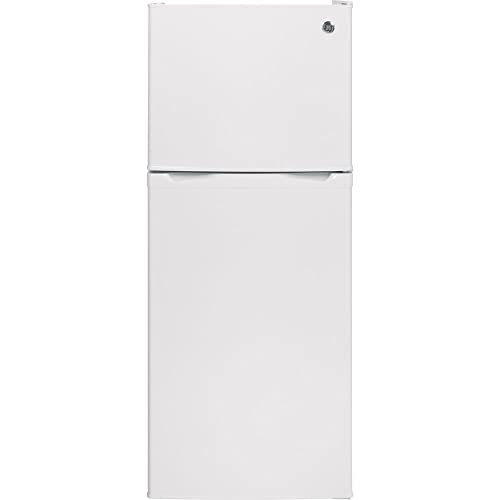
GE 11.6 Cu. Ft. Top-Freezer Refrigerator GPE12FGKWW — Compact Top-Freezer
The GPE12FGKWW is the guide’s compact conscience: an 11.6-cubic-foot top-freezer from GE whose listing title carries its energy star designation in plain words. Small households, offices, workshops and second kitchens run on machines like this, and an origin-conscious buyer furnishing any of those spaces will meet this model early. It belongs in this guide because it belongs to the same GE Appliances programme family as the flagships above — with the identical instruction to verify the exact unit’s rating plate rather than inherit a claim from its bigger siblings.
The top-freezer format at this size is the most proven refrigeration layout in existence: freezer above, fresh below, no dispensers, no drawers on rails, nothing between the household and a decade of unremarkable service. The listing’s energy star wording matters for a machine that may run in a garage office or a rental where its consumption is someone else’s bill; as with every title-derived fact in this guide, we report the designation as the listing states it and add nothing beyond it.
Eleven point six cubic feet asks for the small-household rhythm — shop little and often, freeze in flat packs, keep the fresh section turning over. In return, the cabinet fits openings and budgets the French doors cannot approach, and its simplicity makes it the easiest machine in this guide to install, level and forget. For a first flat furnished on American-programme principles, it is the pick that proves the principle scales down as well as up.
Note the model identity carefully when verifying: GPE12FGKWW is printed in the listing title, and it is that exact string whose documentation and rating plate carry the origin information. Model families share brochures; rating plates do not share models. The distinction is this entire article in miniature.
Small machines have one more origin virtue worth noting: they are the appliances most often bought for someone else — a parent’s flat, a child’s first home, an office kitchen the buyer is responsible for. Verifying the little GE’s plate before it settles into that other household extends the same care you would apply at home, and the photograph in your files answers the recipient’s questions before they think to ask them. Diligence, like the machine itself, scales down gracefully.
- Capacity, from the listing title: 11.6 cu. ft.
- Format, from the listing title: top freezer
- Designation, from the listing title: energy star (as printed in the title)
- Model, from the listing title: GPE12FGKWW
- Origin: NOT stated in the listing title — verify the country-of-origin label on the rating plate of the exact model before purchase
- Where to buy: the GE 11.6 Cu. Ft. Top-Freezer Refrigerator GPE12FGKWW listing on Amazon — check price on Amazon
Strengths
- Compact, proven top-freezer format for small spaces.
- Energy star designation printed in its own listing title.
- Simplest installation and ownership in this guide.
Trade-offs
- Small capacity excludes family and bulk use.
- Top-freezer layout means bending for fresh food.
- Origin is, as throughout, a verification task, not a headline.
Best for: singles, offices, second kitchens and small flats within the GE programme. Poorly suited to: families and anyone who freezes in volume.
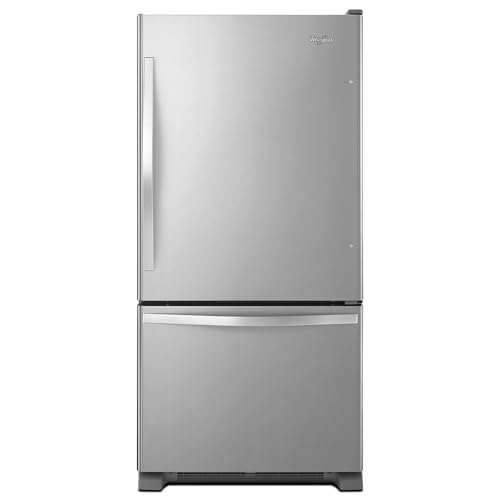
Whirlpool 18.5 Cu. Ft. Bottom-Freezer Refrigerator WRB329DMBM — The Whirlpool Entry
Whirlpool’s WRB329DMBM keeps this guide honest in a second way: it proves the American-assembly conversation is not a one-company story. Whirlpool’s refrigerator production in American plants is a matter of public record, and the company publishes made-in-America material about its United States manufacturing footprint. This 18.5-cubic-foot bottom-freezer in stainless steel is the guide’s representative of that programme — and, exactly as with the GE picks, its listing title states capacity, format and finish while saying nothing about origin, so the verification method governs here too.
As a refrigerator, the proposition is mainstream and well-judged: bottom-freezer ergonomics, 18.5 cubic feet sized for couples and small families, a stainless front that suits standard suites. Whirlpool’s service ecosystem is among the deepest in American appliances, which matters for a machine bought partly on programme loyalty — the loyalty should be repaid in year eight, with a gasket or a shelf ordered against the WRB329DMBM’s model identity without drama.
Buyers cross-shopping the two programmes should treat the choice as they would any other: by format, capacity, finish and the feel of the machine, with the origin verification applied equally to whichever they choose. The programmes are both genuine; the per-model label is the proof; the kitchen’s needs are the decider. That ordering — evidence, then verification, then preference — is the whole method of this article, and the Whirlpool is where it becomes a real choice rather than a single-brand default.
One more consideration favours including a second programme: resilience. Assembly programmes evolve, models move between plants across production years, and a buyer who understands two programmes can follow the evidence wherever it leads for the exact model year they are purchasing. Read the rating plate, check Whirlpool’s model documentation, and the WRB329DMBM stands or falls on facts you gathered yourself — the only basis this guide endorses.
There is a household-type this Whirlpool suits particularly: the one replacing a long-serving Whirlpool with its descendant. Brand continuity in a kitchen is not mere habit — the shelf logic, the control idiom and the service relationships carry over, and the household’s learning curve flattens to nothing. If the outgoing machine served fifteen years from the same programme family, its 18.5-cubic-foot successor begins with a presumption of competence that the verification then confirms or corrects. Either way, the decision is made on the record, which is all this guide ever asks.
- Capacity, from the listing title: 18.5 cu. ft.
- Format, from the listing title: bottom freezer
- Finish, from the listing title: stainless steel
- Model, from the listing title: WRB329DMBM
- Origin: NOT stated in the listing title — Whirlpool builds refrigerators in American plants as a public programme; verify the country-of-origin label on the rating plate of the exact model before purchase
- Where to buy: the Whirlpool 18.5 Cu. Ft. Bottom-Freezer Refrigerator WRB329DMBM listing on Amazon — check price on Amazon
Strengths
- Represents Whirlpool’s American refrigerator programme.
- Mainstream bottom-freezer format at a versatile capacity.
- Deep national service and parts ecosystem.
Trade-offs
- No origin statement in the listing; verification required.
- No dispenser feature is named in the title.
- Capacity sits below the GE Profile for growing families.
Best for: buyers who want the Whirlpool programme with classic bottom-freezer ergonomics. A poor fit for: buyers seeking a printed origin guarantee in the listing itself.
Sub-Zero and True Built-In Refrigeration (Dealer Channel) — American Built-In Route
The prose-only entry in this guide names the channel where American manufacturing is not a programme but an identity. Sub-Zero’s built-in refrigeration and True’s residential built-ins are American-built premium products sold through authorised dealers, with showrooms, site surveys and specialist installation — and without the kind of family-refrigerator marketplace listing this guide links. They appear here without an ASIN, an image or a specification, because none can be verified from a listing, and because their buyers are not comparison-shopping on capacity tables.
Position the channel qualitatively: it is the premium tier of American refrigeration, chosen during renovations by households for whom the origin question and the built-in question have the same answer. Dealer conversations for these brands will include origin documentation as a matter of course — ask for it, per model, exactly as this guide teaches for the linked picks, because the verification habit should not be retired just because the showroom is beautiful.
For everyone else — which is most readers — the five linked picks above deliver the substance of the American-assembly brief at freestanding tiers, with delivery this week rather than a renovation calendar. The dealer route is recorded here so the guide is complete, not because it is the recommendation for a household replacing a fridge.
Renovators considering this channel should also ask about lead times and about how the dealer handles the interval between the old kitchen’s removal and the new cabinet’s commissioning — the weeks when a household lives on a borrowed compact fridge. Experienced dealers plan that interval with you; it is one of the services the premium actually buys, alongside the survey and the installation. A dealer whose plan for those weeks is a shrug is telling you how the rest of the project will feel.
- Channel: authorised dealers — no Amazon listing, no link
- Tier positioning: premium, renovation-led
- Format: built-in refrigeration, American-built programmes
- Specifications and origin documents: obtain per exact model from the dealer
- Where to buy: through an authorised dealer — qualitative guidance only
Strengths
- American building is the brands’ core identity.
- Dealer survey, delivery and installation are integral.
- Built-in integration at the highest tier of finish.
Trade-offs
- Premium tier in cost and commitment.
- Renovation timelines, not replacement timelines.
- No marketplace listing to verify against independently.
Best for: renovators specifying an American-built kitchen at the premium tier. Not suited for: straightforward replacements or freestanding budgets.
The Six Entries Side by Side: Programme, Format and Capacity
| Entry | Programme context | Format | Capacity |
|---|---|---|---|
| GE GYE21JYMFS | GE Appliances, Louisville-centred | Counter-depth French door | 20.6 cu. ft. |
| GE 17.7 Bottom-Freezer | GE Appliances, Louisville-centred | Counter-depth bottom-freezer | 17.7 cu. ft. |
| GE Profile 21.9 | GE Appliances, Louisville-centred | Counter-depth French door, internal dispenser | 21.9 cu. ft. |
| GE GPE12FGKWW | GE Appliances programme | Top-freezer | 11.6 cu. ft. |
| Whirlpool WRB329DMBM | Whirlpool, American plants | Bottom-freezer | 18.5 cu. ft. |
| Sub-Zero / True route | American-built dealer brands | Built-in | Per dealer model |
How Do You Verify a Refrigerator’s Country of Origin, Step by Step?
Step one: locate the rating plate. On most refrigerators it sits inside the fresh-food cabinet, on a side wall or near the top, and it carries the model number, the serial number and the manufacturer’s regulatory information — including, on units sold in the United States, the country-of-origin marking. Photograph it. Step two: read the origin line for that exact model and serial, not for the brand in general. Step three: cross-check against the manufacturer’s own documentation for that model — the maker’s made-in-America pages and model literature describe which models their American programmes cover.
Step four: do as much of this as possible before the purchase is final. Ask the seller for the model-level origin information in writing; reputable sellers answer the question routinely, because origin-conscious buyers ask it constantly. Step five: repeat the plate check on the delivered unit before the crew leaves, because the delivered machine — not the listing, not the brochure — is the one whose origin you are actually buying. If the plate disagrees with what you were told, you have a conversation while everyone is still in the room, which is the only time that conversation is easy.
Keep the photograph and the paperwork with the appliance file. Origin documentation has a long tail of usefulness: resale particulars, warranty conversations, and the next buyer’s identical question, a decade from now, answered in one minute instead of twenty.
Why Does Assembly Location Matter to Buyers Beyond Patriotism?
For many readers the reason is practical before it is sentimental. Domestic assembly programmes tend to come with deep domestic parts networks, documentation in the market’s language and regulatory idiom, and service ecosystems built around the models the programme produces. A refrigerator assembled within a large home-market programme is a machine whose gaskets, shelves and controls stay orderable, and whose repair knowledge is widespread among independent technicians.
For others the reason is economic participation: a major appliance is one of the largest manufacturing purchases a household makes, and directing it toward domestic assembly employment is a legitimate preference that needs no apology. And for some it is supply resilience — the memory of recent years, when long supply chains delivered long delays, made the geography of manufacture a practical specification in its own right. This guide takes no side among those motivations. It insists only that the claim be verified per model, whichever motivation brings you to it.
There is also a neighbourhood-scale reason that rarely gets printed. Assembly plants anchor supplier networks, apprenticeships and service trades in the regions that host them; Louisville’s appliance complex is the standing example in this category, supporting generations of manufacturing households around it. A buyer who values that ecology is not indulging nostalgia — they are participating, at household scale, in the economics that keep such regions skilled. Whether or not that reasoning moves you, it belongs in the honest ledger alongside parts availability and supply resilience, because for many readers of this guide it is the reason they arrived here at all.
And one more, the simplest: some households simply like knowing where their things were made, the way they like knowing where their food was grown. Knowledge of origin is a form of attention, and attention is the beginning of every other virtue in a home — maintenance, longevity, gratitude for objects that serve well. This guide’s method is attention, formalised into five steps and a photograph.
What Is the Difference Between Assembled, Made and Sourced?
Vocabulary is where origin shopping is won and lost, so learn the distinctions before reading any label. Assembly describes where the finished appliance was put together. Component sourcing describes where its parts — compressors, electronics, steel — originated, and in a global industry those origins are always plural. A manufacturer’s American programme is a statement about assembly operations and investment; the rating plate’s country-of-origin line is the regulatory statement for the finished unit. Neither is a promise that every screw shares the same birthplace, and buyers who understand that distinction cannot be disappointed by it later.
Labels and marketing phrases sit on a spectrum of strictness defined by regulators, and the same words can carry different legal weight in different contexts. That is precisely why this guide anchors on the two hardest forms of evidence available to a buyer: the manufacturer’s published programme documentation, and the physical unit’s own rating plate. Everything softer — badges, slogans, a salesperson’s summary — is commentary, and commentary is not verification.
How Should an Origin-Led Buyer Furnish the Rest of the Room?
Consistently, and with the same per-item discipline. The families furnishing a nursery or a child’s study on these principles will find our guide to Best Ergonomic Chairs for Kids applies the same evidence-first reading to a very different purchase. In the kitchen itself, extend the method appliance by appliance: programme first, model documentation second, unit-level label third. A kitchen assembled that way has an origin story that survives scrutiny, which is the only kind worth having.
Outdoor and leisure spaces follow the same rule when the household extends its standards there — our guide to Best Inexpensive Hanging Porch Chairs is, like this one, an exercise in reading what a listing actually claims before paying for what it merely suggests. The habit transfers because the habit is the product: verify, then buy.
How Has American Appliance Assembly Changed, and Why Does Per-Model Checking Exist?
A generation ago, a brand’s refrigerator range typically came from one or two plants, and a programme-level claim was nearly a model-level one. Modern appliance ranges are wider, production is allocated flexibly across plants in more than one country, and a single model name can be built in different places across its production life or even concurrently. Nothing about that is sinister; it is how global manufacturing breathes. But it is the mechanical reason this guide refuses to convert programme truth into model claims: the conversion was safe in 1985 and is not safe now.
The encouraging half of the story is that verification has become easier as claims have become looser. Model documentation is published online, sellers answer origin questions daily, and the rating plate remains exactly where it always was, carrying the answer in print. The buyer’s task shrank to asking and looking. Guides that skip the asking and looking, and print the claim anyway, are optimising for the headline at the reader’s expense — and the reader discovers the optimisation on delivery day, in the worst seat in the house.
How Do You Keep the Origin File Useful for a Decade?
Treat the appliance file as part of the house’s paperwork, not the kitchen’s junk drawer. It holds four things: the rating-plate photograph, the seller’s origin confirmation, the programme documentation you relied on, and the purchase record. Add to it over the years — service visits, parts orders, the manual’s key pages — and the file becomes the machine’s biography, the document that answers every future question about the refrigerator in one place.
That biography pays for itself at resale, at insurance time, and at the moment a part must be matched to a production variant. It also disciplines the next purchase: a household that files its evidence buys its next appliance the same way, and the method compounds into a house whose major objects are all known quantities. Origin-led buying, sustained across a decade of purchases, is less a shopping preference than a way of keeping house — and it begins, as this guide began, with reading what is actually printed and verifying what is not.
What Questions Should You Ask a Seller Before Ordering?
Ask them in writing, and keep the answers. The essential three: Does the manufacturer’s documentation list this exact model among its American-assembled products? Can you confirm the country-of-origin marking that will appear on the delivered unit’s rating plate? And if the delivered unit’s plate differs from the confirmation, what is your remedy? A seller who deals in these programmes answers all three without friction, because origin-led buyers are a recognised, routine customer type in this market.
Add two practical questions while you have the seller’s attention. First, the delivery inspection: confirm you may photograph the rating plate and check it before signing, and that the crew will wait the two minutes it takes. Second, the documentation pack: ask that the model’s literature accompany the machine, so your appliance file starts complete. Neither request is exotic; both signal a buyer who will be easy to deal with precisely because everything is agreed in advance.
If a seller cannot answer the origin questions for a model in this guide, do not argue — simply move to a seller who can, or to another pick whose documentation is producible. The programmes are real and their paperwork exists; a gap in one shop’s knowledge is not a gap in the evidence itself.
How Do the Five Linked Picks Divide by Household?
Strip the origin layer away for a moment and the five are an ordinary, well-spread refrigerator guide — which is exactly what an origin-led buyer deserves. Families belong with the Profile’s 21.9 cubic feet or the GYE21JYMFS’s 20.6, the choice turning on whether an internal dispenser’s clean front matters to their kitchen’s design. Couples and small families divide between the GE 17.7 bottom-freezer’s ergonomics and the Whirlpool’s 18.5 with its second programme and deep service bench. Small spaces, offices and second kitchens take the GPE12FGKWW and stop apologising for it.
Now restore the origin layer, and notice what it did not do: it did not force a single household into the wrong format for the sake of the brief. That is the test of a mature buying criterion. A preference that can only be satisfied by misfitting the appliance is a preference that will be abandoned at the first inconvenience; a preference satisfied across five formats and two programmes, with one verification habit, is a preference a household can keep for every appliance it ever buys. This guide was assembled to be the second kind.
How Do You Read a Manufacturer’s Made-in-America Page Like an Auditor?
Open the page with three questions in mind. First: does it name models, or only values? A page that lists the specific models and product families its American operations produce is evidence; a page of flags and adjectives is atmosphere. Second: does it distinguish assembly from the wider supply chain honestly? Programmes that acknowledge global components while specifying their American assembly are describing the real world, and their precision about the boundary is a reason to trust the claim inside it. Third: is the page current? Programmes are investments with dates; a living programme’s documentation is maintained, dated and specific, while a retired claim often lingers on unmaintained pages like a sign on a closed shop.
Then do the thing almost no buyer does: save the page. Print it or archive it with your appliance file, dated, so that the basis of your purchase decision is preserved as it stood when you made it. Programmes change, pages are rewritten, and your file is the only copy of the evidence that will certainly survive. Auditors call this a paper trail; households can call it the same, without embarrassment.
Apply the auditor’s reading to this guide itself, while you are at it. Every claim above is labelled with its evidence class — listing title, programme record, or verification instruction — and the article’s central refusal, to stamp specific models with an origin their listings do not state, is printed in its first paragraph rather than its footnotes. That is what the standard looks like from the inside. Hold every other guide you read this year to it, and watch how many suddenly have less to say.
What Mistakes Do Origin-Conscious Buyers Most Often Make?
The first is trusting a brand-level claim for a model-level purchase — the exact error this guide’s structure exists to prevent. The second is checking origin after delivery, when the conversation is hardest. The third is confusing a company’s headquarters, history or ownership with a specific model’s assembly, three different facts that marketing happily blurs. The fourth is assuming the dealer channel needs no verification because it is premium; ask there too. The fifth is the mirror error — dismissing the entire exercise because perfection is unavailable, and buying on finish alone. Programme plus plate is not perfection, but it is evidence, and evidence is what separates an informed preference from a slogan.
Final Recommendation
Choose the format and capacity your kitchen needs from the five linked picks, then run the verification this guide teaches, in order: programme documentation for the model, seller confirmation in writing, rating plate on the delivered unit. On that basis, the GE Profile is the family flagship, the GYE21JYMFS the balanced counter-depth choice, the 17.7 bottom-freezer the ergonomist’s pick, the Whirlpool the second programme’s standard-bearer, and the little GPE12FGKWW the proof that the principle scales down. Buy American assembly the way you would buy anything that matters — on evidence you gathered yourself — and the refrigerator in your kitchen will carry an origin you know, rather than one you were merely told.
And if the verification ever fails for a model you loved — if the plate tells a different story than the programme led you to hope — treat that not as the method’s failure but as its finest hour. You will have learned the truth while learning it was still free: before the signing, before the levelling, before the decade. The next pick in this guide is one click away, the method travels with you, and the kitchen you finally assemble will be built on facts that survived inspection. That is the only kind of patriotism a purchase can honestly express, and it expresses it completely.
A closing observation for the reader who has followed the method this far: the verification habit, once practised on a refrigerator, becomes difficult to switch off, and that is a good thing. It will serve you on the range, the washer and the water heater, and it will quietly change how you read every product claim for the rest of your buying life. The six entries above are this guide’s answer for refrigerators. The habit is its answer for everything else — take both, and the kitchen you assemble will be one whose story you can tell accurately, appliance by appliance, plate by plate.
Frequently Asked Questions
Can I tell a refrigerator’s origin from its listing?
Not from the titles in this guide — none of them states one. The listing gives you the exact model identity, which is the key to the manufacturer’s model documentation; the delivered unit’s rating plate then gives the definitive per-unit answer. Treat any headline origin claim, anywhere, as a prompt to verify rather than a conclusion.
What exactly is a rating plate?
It is the manufacturer’s label fixed inside the appliance, carrying the model and serial numbers and regulatory information, including the country-of-origin marking for units sold in the United States. Photograph it on delivery day; every future parts, warranty and origin question starts there.
Does American assembly mean every component is American?
No, and no honest source claims it does. Assembly location describes where the finished appliance was built; components in any modern appliance come from a global supply chain. The programme documentation and the rating plate describe the assembly claim precisely — read them for what they say, not for more.
Are GE Appliances and Whirlpool the only American programmes?
They are the two with the largest public refrigerator assembly programmes represented by marketplace listings, which is why they anchor this guide. The dealer channel adds the built-in specialists covered in the prose entry, and smaller makers exist at the margins; the verification method in this article applies to any of them.
Should origin outrank capacity and format when I choose?
No — it should constrain the field, not pick the winner. Decide the format and capacity your kitchen needs, choose among the models that meet them from programmes you trust, then verify. A refrigerator that fits your life and verifies cleanly beats a verified refrigerator that fits your life badly, every day of the decade it serves.
Does buying from an American programme cost more?
Tiers vary by model and moment, and this guide prints no prices, so compare the listings against your own shortlist directly. What can be said qualitatively is that the five linked picks span the mainstream tiers of their formats — the programme preference does not confine you to a premium shelf, as the compact top-freezer and the mid-range bottom-freezers in this guide demonstrate.
How long does the verification actually take?
Minutes. The programme documentation is published, the seller’s confirmation is one exchange, and the rating-plate check is a photograph and a read on delivery day. The method in this guide is deliberately sized to real life: an evening’s reading and a two-minute inspection, standing between you and a claim you can repeat with confidence.
What if the rating plate and the seller’s claim disagree?
Believe the plate, and raise the disagreement before accepting delivery if origin is a condition of your purchase. A reputable seller will resolve it — by documentation, exchange or refund — and the time to discover it is while the machine is still on the truck’s tailboard, not after it is plumbed and levelled.
One practical postscript on delivery day, applicable to every pick in this guide: schedule the inspection into the appointment rather than improvising it at the door. Tell the seller in advance that you will photograph the rating plate before signing, keep your phone charged and a torch handy, and read the plate while the machine is still accessible — before it is pushed into the alcove, levelled and connected. Two planned minutes on the day replace an afternoon of telephone calls in the week after, and the crew, forewarned, will treat the check as the routine it has become among origin-led buyers.
Finally, a note to the reader who came here sceptical that any of this can be known at all: it can, and the proof is that this article’s claims are all checkable by you, tonight, with the listings open in one tab and the manufacturers’ programme pages in another. A guide whose every assertion invites its own audit is a guide that expects to survive one. That expectation — not a flag, not a slogan — is the ground this article stands on, and it is solid.
Share the method when you share the recommendation, too. The neighbour who admires your kitchen and asks where the fridge was made deserves the honest answer this guide modelled — the programme, the documentation, the plate you photographed — rather than a slogan repeated at second hand. Origin knowledge passed on accurately multiplies; passed on as folklore, it decays into exactly the kind of claim this article was written to correct. Be the neighbour whose answer can be checked, and the standard rises one kitchen at a time.
And keep the file open after delivery, because programmes publish updates and models accumulate documentation across their lives. A household that revisits its evidence once — when a part is needed, when a sibling appliance is bought — keeps its knowledge current at almost no cost, and buys the next machine from a position of documented experience rather than fresh hope.
Related Guides
Origin and longevity are cousins: a machine bought for its making is usually bought to be kept. Our live guide to Best Long-Lasting Electric Dryers pursues the keeping half of that philosophy in the laundry room, with the same insistence on evidence over slogans.


