What's inside
- Key Takeaways
- Quick Picks
- How did we choose washers for well-water homes?
- Six routes, one water supply: comparison
- How do you protect any washer from sediment, in plain plumbing steps?
- What do iron and hardness do, and whose problem are they?
- Pressure, pumps and the washer’s fill: what to watch
- Well-household washer mistakes
- How do you test your water before you shop?
- What does a wash day look like on a well, done well?
- How do drought, freezing and power cuts change laundry on a well?
- What should a well household ask at the appliance store?
- How does line-drying culture change the washer brief?
- What happens when a new washer meets an old well house?
- How do you keep whites white on iron-bearing water?
- What about renting, cabins and seasonal wells?
- How do you budget honestly for laundry on a well?
- A maintenance calendar a well household can actually keep
- What should be in the well house’s laundry folder?
- How do you choose between the two portables, honestly?
- What changes when the well also feeds a septic system?
- One last perspective: the washer as the well’s ambassador
- What does the first season teach a new well household?
- How do you hand this system to the next owner or tenant?
- A closing note on expectations
- What if the laundry must move indoors from a porch or pump room?
- And when the machine finally retires?
- Final Recommendation
- Frequently Asked Questions
- Related Guides
As an Amazon Associate I earn from qualifying purchases. This post may contain affiliate links at no extra cost to you.
cottageverdict.com is reader-supported. When you buy through links on our site, we may earn an affiliate commission.
Where to buy: the four machines with listings below are linked so you can check price on Amazon; the two prose-only classes are bought through normal appliance channels, and their sections explain the verification each one needs. Start with the truth that shapes this whole guide: there is no such thing as a well-water washer. No maker builds a model for private wells, and shoppers hunting the best washers for well water will not find a category waiting for them — they will find ordinary washers that differ in how gracefully they live with what a well actually delivers. Well water is not one thing. It can carry sediment that silts up inlet screens, iron that freckles laundry rust-orange, hardness that dulls detergent and scales components, and pressure that swings as the pump cycles. A washer cannot fix any of that — filtration and treatment upstream do that work — but a washer can be chosen to tolerate it: a stainless steel drum that shrugs off mineral contact, simple mechanics with fewer delicate sensors to foul, and inlet screens you can actually reach and clean.
That tolerance axis decides the six places below. Two linked portables and two full-size top-loaders earned their spots on drum material and mechanical simplicity as printed in their verified titles. The filtration conversation — the sediment filter on the supply line, the softener question, the iron filter — is handled in this guide’s how-to sections as household plumbing guidance, in prose, because filters are not picks here and never appear as products. What the washer owes a well household is narrower and more honest: keep washing well for years on water that municipal customers never think about, and make its own maintenance — screens, hoses, drum care — easy enough that it actually happens.
Key Takeaways
- No washer is built specifically for well water; the winning traits are stainless drums, simple mechanics and reachable inlet screens.
- The Panda 1.34 and ROVSUN 25LBS portables both carry stainless steel drums in their verified titles — unusual durability for small machines on raw well supplies.
- The Amana NTW4516FW represents the simple-mechanics full-size philosophy: a mainstream top-loader with little delicate technology to foul.
- The Midea 4.1 in gray gives a full-size 4.1 cu. ft. option whose documentation should be checked for drum material before purchase.
- Sediment belongs to an upstream filter on the supply line — plumbing guidance covered in prose in this guide, never sold here as a pick.
- Screen cleaning is the well household’s core washer ritual; a machine that makes it a five-minute job will be maintained, and one that buries it will not.
Quick Picks
| Machine | Badge | Why it suits a well household |
|---|---|---|
| Panda 1.34 Portable Washer Stainless Drum | Stainless portable anchor | Stainless drum, quick-connect adapter and built-in drain pump — a small machine built for imperfect supplies. |
| ROVSUN 25LBS Portable Washer Stainless Drum | Bigger portable sibling | Twenty-five pounds of stainless-drum capacity with a drain pump, for households washing more than delicates. |
| Midea 4.1 Top Load Washer Gray | Full-size capacity route | A 4.1 cu. ft. full-size top-loader for households whose laundry has outgrown portables. |
| Amana NTW4516FW 3.5 Top Load Washer | Simple-mechanics favourite | A mainstream 3.5 cu. ft. top-loader whose straightforward design philosophy suits water that punishes delicacy. |
| Stainless impeller top-load class | Dealer-verified upgrade | Full-size impeller machines with stainless drums confirmed on the maker’s sheet, for buyers wanting modern metering. |
| Stainless front-load class | Gentle-format route | Front-loaders with stainless inner drums, verified per model, for fabric care on treated well water. |
How did we choose washers for well-water homes?
The selection rule was drum-and-simplicity. From the verified pool, we favoured listings whose titles print a stainless steel drum — the Panda and the ROVSUN both do — because stainless tolerates mineral-bearing water without the coating chips that eventually rust and mark laundry. We favoured mechanical simplicity for the same reason a well household favours it in a pump: fewer fine sensors and delicate valves means fewer components for sediment and scale to bully. The Amana embodies that philosophy at full size; the Midea earns its place as the larger-capacity option, with a standing instruction to confirm its drum material on the maker’s documentation since its verified title does not print it. Nothing in this guide claims any machine treats water. Treatment happens upstream, in the how-to sections below, as prose plumbing guidance — a sediment filter protecting the whole laundry supply benefits every machine equally and is therefore advice, not a product pick.
We also weighted the realities of well plumbing: pressure that varies with pump cycles, supplies that run through a pressure tank, and homes where the laundry shares a line with everything else. Machines that fill straightforwardly and screens that clean easily matter more than app features in that world. Households whose well feeds a property on a septic system carry both conversations at once, and the sizing discipline for bulky loads in our guide to Best Washers for King Bedding pairs naturally with this one — big drums tempt big fills, and well pressure at the end of a long line has opinions about that.

Panda 1.34 Portable Washer Stainless Drum — Stainless portable anchor
The Panda 1.34 is this guide’s small-machine anchor, and its verified title reads like it was written for a well household: a 1.34 cu. ft. portable washing machine, fully automatic, with a stainless steel drum, a quick connect adapter included, a built-in drain pump, in top-load format for apartments, RVs and dorms. Take the elements in well order. Stainless drum first — the surface that lives in your mineral water every wash is the surface least likely to chip, pit or shed rust freckles onto whites. Quick connect second — well homes are often older homes with idiosyncratic faucets, and an included adapter designed for the job beats a hardware-store improvisation. Drain pump third — a portable that pumps out positively handles the variable drainage of real houses better than gravity arrangements.
Fully automatic operation matters more on a well than in a city flat, because well households often wash with one ear on the pump and the pressure tank; a machine that fills, washes, rinses and spins through its own program lets the household attend to the system rather than babysitting a twin-tub. The capacity is honestly small — this is a machine for a couple’s daily clothes, a cabin’s weekend laundry, a single person’s week in modest loads — and its septic-and-well double relevance is real: small loads sip from the well and deliver gently to any drain field downstream. Screen care is the owner’s side of the bargain, and on a portable the screens live at the inlet connection where you attach it, which makes the five-minute clean genuinely five minutes.
Buy it as what it is — a durable small instrument for imperfect water — and it will out-serve machines twice its size that were designed for municipal assumptions. Ask it to be a family washer and it will be found out by the second bedding day.
- Format: portable top-load washer, fully automatic
- Capacity: 1.34 cu. ft. per the verified title
- Drum: stainless steel
- Connection: quick connect adapter included; built-in drain pump
- Where to buy: the Panda 1.34 Portable Washer Stainless Drum listing on Amazon — check price on Amazon
Strengths
- Stainless drum tolerates mineral water that ages coated drums.
- Included quick-connect adapter suits older, non-standard faucets.
- Small loads are gentle on both well pump and any downstream septic.
Trade-offs
- Capacity is a couple’s machine, not a family’s.
- Portable hookup routine applies at every washday.
- Delicate electronic features are few — simplicity is the design, for better and worse.
Best for: small households, cabins and RV living on well supplies. Not suited for: families needing bedding and bulk washed at home.

ROVSUN 25LBS Portable Washer Stainless Drum — Bigger portable sibling
The ROVSUN answers the Panda’s obvious limitation — size — while keeping the well-relevant core. Its verified title describes a 25 lbs portable washing machine, full-automatic, with a stainless steel drum, functioning as a washer and spin dryer combo with a drain pump, for home and apartment use. Twenty-five pounds is the portable class’s grown-up territory: a real load of clothes, a respectable pile of towels, the laundry of a small household rather than a single person’s delicates. The stainless drum carries over, which matters more as loads grow — more fabric, more water contact, more years of mineral exposure for the surface at the centre of it all.
The spin-dryer combo wording in the title deserves a plain reading: like most full-automatic portables, the machine spins the load as part of its cycle, extracting water so line-drying or a small dryer finishes the job. On a well property that often pairs with line-drying — a clothesline costs no electricity and no water — an effective spin is worth real money across a year. The drain pump again earns its mention for houses whose laundry point is a utility sink or a standpipe at an awkward height; positive drainage forgives plumbing that gravity would argue with.
Position it honestly in the household: this is the largest portable step before a plumbed full-size machine becomes the sensible answer. Well households in that in-between zone — a farmhouse annex, a converted barn flat, a cottage becoming a home — are exactly its constituency, particularly where the supply line is a single cold-and-hot pair at a sink and a permanent installation is next year’s project.
- Format: portable washer with spin, full-automatic
- Capacity: 25 lbs per the verified title
- Drum: stainless steel
- Drainage: built-in drain pump
- Where to buy: the ROVSUN 25LBS Portable Washer Stainless Drum listing on Amazon — check price on Amazon
Strengths
- Grown-up portable capacity without surrendering the stainless drum.
- Effective spin supports line-drying households.
- Drain pump forgives awkward real-world drainage points.
Trade-offs
- Still a faucet-and-sink routine, not a plumbed installation.
- Heavier loads on a well mean watching pump cycling on long wash days.
- Bedding for larger beds remains beyond sensible reach.
Best for: small households washing real loads on well water without a laundry room. A poor fit for: anyone ready for — and plumbed for — a permanent full-size installation.
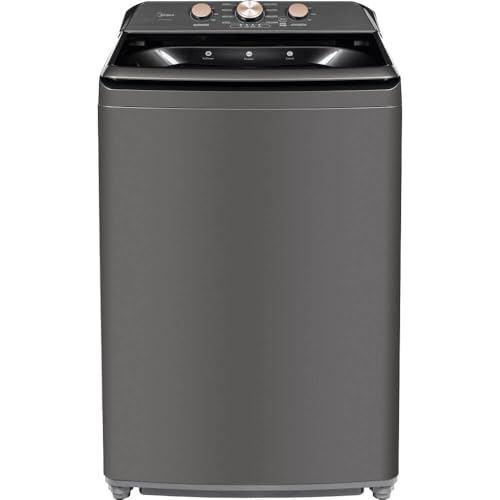
Midea 4.1 Top Load Washer Gray — Full-size capacity route
The Midea MLTW41A1BMG is the guide’s full-size capacity answer: its verified title states a 4.1 cu. ft. gray top-load washer, and that brevity shapes this review’s honesty. What the title establishes is format and scale — a proper plumbed top-loader with family-sized capacity in a gray finish. What it does not establish is drum material, cycle detail or efficiency certification, and a well household should treat those as pre-purchase homework on the maker’s documentation for this exact model, with drum material at the top of the list for the reasons this whole guide exists. We include the machine because households on wells have family laundry too, and the verified pool’s full-size options are limited; we flag its verification homework rather than laundering guesses into claims.
A 4.1 cu. ft. plumbed machine changes a well household’s relationship with its pump. Fills are larger, so fills are events: run the washer when the household’s other big draws — showers, irrigation, a filling bath — are quiet, and the pressure tank will thank you with steadier pressure and fewer short cycles. That scheduling instinct, plus an inlet screen on a cleaning calendar, is most of what “well-friendly” means at full size. The gray finish is a small domestic pleasure in a working laundry room and hides the scuffs of baskets and boots better than white.
If the maker’s documentation confirms a stainless drum, this becomes a straightforwardly strong well pick; if it reveals a coated drum, the household decision shifts to price-versus-longevity with eyes open. Either way, the homework is ten minutes, and this guide would rather send you to do it than pretend the title said more than it did.
- Format: full-size top-load washer, gray
- Capacity: 4.1 cu. ft. per the verified title
- Model: MLTW41A1BMG per the verified title
- Verify before buying: drum material and cycle detail on the maker’s documentation
- Where to buy: the Midea 4.1 Top Load Washer Gray listing on Amazon — check price on Amazon
Strengths
- True family capacity in a plumbed top-load format.
- Gray finish wears a working laundry room gracefully.
- Mainstream model with documentation a buyer can actually check.
Trade-offs
- Its title prints no drum material — verification is on the buyer.
- Large fills ask for scheduling sense around other household water draws.
- No efficiency certification is claimed in the title.
Best for: well households whose laundry volume has outgrown portables and who will do ten minutes of document checking. Not the right match for: buyers wanting every specification confirmed inside the listing itself.

Amana NTW4516FW 3.5 Top Load Washer — Simple-mechanics favourite
The Amana NTW4516FW is the pick for the well household whose philosophy is that water with personality should meet a machine without pretensions. Its verified title is as plain as the machine’s reputation: a 3.5 cu. ft. white top-load washer. Amana’s place in the market is the straightforward end of a mainstream maker’s range — machines bought for utility, priced for sanity, and designed around controls and mechanics a local technician anywhere can service. On a rural property an hour from the nearest big-box store, that serviceability is a specification, whatever the brochures say: the machine your county’s appliance repairer knows by heart is the machine that gets fixed in days rather than weeks.
Simple mechanics tolerate well water’s moods in specific ways. Fewer fine metering components means sediment has fewer delicate targets; a wash system built on generous, uncomplicated action keeps working when pressure swings mid-fill in a way that can confuse fussier designs. The 3.5 cu. ft. capacity sits in the honest middle — family-capable for couples and small households, without the mega-drum temptation to run heroic fills that drain a pressure tank in one go. Drum material is, again, a documentation check for this model rather than a title claim, and the same ten-minute homework applies.
There is a temperament match here worth naming. Well households tend to be maintenance households — they test water, service pumps, and keep a filter calendar — and a washer that rewards the same temperament, with reachable screens and unglamorous reliability, fits the house it will live in. The Amana is that fit at full size.
- Format: full-size top-load washer, white
- Capacity: 3.5 cu. ft. per the verified title
- Model: NTW4516FW per the verified title
- Verify before buying: drum material on the maker’s documentation
- Where to buy: the Amana NTW4516FW 3.5 Top Load Washer listing on Amazon — check price on Amazon
Strengths
- Straightforward mechanics with few delicate components for sediment to bully.
- Mainstream serviceability — rural technicians know this class of machine.
- Mid-size drum discourages pressure-tank-draining mega-fills.
Trade-offs
- Feature depth is modest; households wanting programs and connectivity should look elsewhere.
- Drum material needs the same documentation check as the Midea.
- Capacity will pinch a large family’s weekly volume.
Best for: rural households valuing serviceability and simplicity over features. Poorly suited to: technology-led households wanting smart cycles and app control.
Stainless impeller top-load class — Dealer-verified upgrade
Households wanting modern water metering at full size, without surrendering the stainless requirement, should shop the class of impeller top-loaders whose makers print a stainless steel drum in their specifications. No verified listing from that class sits in this pool, so the class is covered in prose with its method attached: shortlist by drum material on the maker’s own specification sheet, then confirm inlet screen accessibility in the manual — the diagram that shows the screen’s location tells you whether cleaning it is a five-minute job or a service call. Impeller washing suits well homes in one more way: metered fills draw on the pressure tank in smaller, steadier sips than deep-fill designs, which is kinder to pump cycling across a wash day.
When the laundry is plumbed beside a matching dryer, appearance and format coordination start to matter to households as well, and our guide to Best Dryers That Match Front-Load Washers covers the pairing logic for the front-load side of the family.
- Format: full-size impeller top-load class, appliance retail channels
- Verify before buying: stainless drum on the spec sheet; screen location in the manual
- Where to buy: through the maker’s authorised retailers, documents checked for the exact model first
Strengths
- Metered fills are gentle on pressure tanks and pump cycles.
- Stainless drums verified in print, not assumed.
- Impeller space suits bulky items without an agitator post.
Trade-offs
- The document homework is the price of admission.
- Metering electronics are a step more delicate than the Amana’s philosophy.
- Model-by-model variation inside the class is wide.
Best for: well households wanting modern efficiency with the drum question answered in writing. A weak match for: buyers who distrust metering electronics on principle.
Stainless front-load class — Gentle-format route
The final class serves households whose well water is already treated — softened, filtered, civilised — and whose remaining priority is fabric care. Front-loaders with stainless inner drums are a mainstream class; the well-specific work is verifying, per model, the drum material and the inlet screen arrangement, and confirming the machine’s fill behaviour suits a pressure-tank supply. No verified listing from the class sits in this pool, hence prose. Tumbling washes gently, meters water kindly, and pairs with the stacked, closet-friendly installations smaller rural homes often need when the laundry moves indoors from a porch or outbuilding.
The standing caution is the front-load one: a door seal that stays wet grows odour in any water, and well households — often diligent about every other system in the house — should simply add the seal wipe to the same calendar as the filter checks. Connectivity-led households may also enjoy pairing a smart washer with the machines in our guide to Best WiFi Dryers, where the drying side’s connected features are the subject.
- Format: front-load class, appliance retail channels
- Verify before buying: stainless inner drum, screen access, fill behaviour on tank pressure
- Where to buy: through appliance retailers, with installation that includes a supervised first fill
Strengths
- Gentlest mainstream wash action for good clothes.
- Metered water suits wells and pressure tanks alike.
- Stacking opens indoor laundry corners in small homes.
Trade-offs
- Seal care joins the household maintenance calendar.
- Verification per model is required; no listing is linked here.
- Long cycles test households with heavy daily volume.
Best for: treated-water households prioritising fabric care. Not suited for: raw, sediment-heavy supplies without upstream filtration — fix the water first.
Six routes, one water supply: comparison
| Pick | Drum evidence | Scale | Well trait that matters |
|---|---|---|---|
| Panda 1.34 | Stainless, in title | Portable | Quick-connect and pump for imperfect plumbing |
| ROVSUN 25LBS | Stainless, in title | Large portable | Real loads on a sink-fed supply |
| Midea 4.1 | Check documents | Full-size | Family capacity, scheduled fills |
| Amana 3.5 | Check documents | Full-size | Simple, serviceable mechanics |
| Impeller class | Verify on spec sheet | Full-size | Metered sips from the pressure tank |
| Front-load class | Verify per model | Full-size | Gentle action on treated water |
How do you protect any washer from sediment, in plain plumbing steps?
This is the how-to heart of the guide, given as prose because the equipment involved is household plumbing, not a pick. Step one is a sediment filter on the supply line feeding the laundry — a whole-house unit at the pressure tank protects everything, while a laundry-point unit protects the washer specifically; either way, its job is to catch the grit before the washer’s inlet screens become the filter. Step two is a filter calendar: cartridges are cheap and forgotten cartridges are worse than none, since a clogged filter starves pressure. Step three is the washer’s own screens, cleaned on the same calendar — unscrew the inlet hoses with the valves closed, rinse the mesh cups, and note how much they caught, because that sediment diary tells you whether the upstream filter is sized and scheduled honestly. Step four is a flush after any well work: pump service, a new pressure tank or a dry-spell recovery all stir the supply, and the first laundry after such events should be a forgiving load, not whites.
None of this requires a plumber’s licence for the routine parts, and all of it pays out in the currency well households actually spend: uninterrupted years.
What do iron and hardness do, and whose problem are they?
Iron announces itself as rust-toned freckling on whites and a metallic note to the water; hardness announces itself as detergent that will not lather, fabric that turns board-stiff, and scale freckling heating components across the house. Both are water-treatment conversations — oxidation and filtration for iron, softening for hardness — and both belong upstream of every appliance, not inside a washer buying decision. What the washer shopper should take from them is narrower: stainless drums tolerate the journey better while treatment is being arranged, detergent dosing on hard water follows the detergent maker’s hard-water guidance rather than the box’s standard dose, and a household that treats its water will find every machine in this guide performs closer to its municipal promise. Buy the washer for mechanics; fix the water for chemistry.
Pressure, pumps and the washer’s fill: what to watch
A well pump cycles to maintain pressure in a tank, and a washer’s fill is one of the house’s bigger single draws. Two fills that coincide with a shower and a dishwasher can drag pressure to the bottom of the tank’s range, and some machines respond to a weak fill with longer fill times or an error that refills from scratch — wasting both water and the pump’s work. The household countermeasures are scheduling and observation: stagger the big draws, notice if the washer’s fill sounds strained at particular hours, and if short-cycling or pressure sag is chronic, that is a pressure-tank conversation for your well servicer, not a washer fault. A machine that fills cleanly at your system’s ordinary pressure — confirmed during a supervised first cycle — will fill cleanly for years.
Well-household washer mistakes
The first is shopping for a “well water model” that does not exist and paying a premium for the phrase. The second is ignoring the inlet screens until a fill slows to a confession. Third, running the first load after well servicing with the household’s best whites. Fourth, blaming the washer for iron or hardness that belongs to the water. Fifth, sizing a mega-drum and running mega-fills that bully the pressure tank daily. And sixth, forgetting that a well is a system with a calendar — filters, tests, pump checks — into which the washer should be enrolled like every other appliance the house depends on.
How do you test your water before you shop?
A washer decision made on a water test beats one made on folklore, and testing a well is neither expensive nor exotic. A basic panel — hardness, iron, sediment character, pH — tells you which of this guide’s concerns are yours and which belong to other people’s wells. Iron present argues for treatment before it argues for any washer; heavy sediment argues for filtration capacity ahead of the laundry; simple hardness argues for dosing discipline and a softener conversation at leisure. Keep the results with the house documents: they inform the washer purchase, the water heater’s expectations and every future plumbing conversation, and they give a servicer in year five the baseline that makes diagnosis fast. Households that skip the test end up treating symptoms at appliance prices; households that test treat causes at plumbing prices, which are usually smaller and always more honest.
Retest after changes — a new pump, a neighbour’s new well, a drought year — because wells are geology in motion and last decade’s panel is a historical document, not a current one.
What does a wash day look like on a well, done well?
It looks unremarkable, which is the point. The first load goes on when the house’s other big draws are quiet — not during the morning shower rush — and fills at full, confident pressure. Loads follow at a civilised spacing that lets the pressure tank recover and, in dry months, lets the well itself rest between demands; a well is a reservoir with a recharge rate, and a household that washes five loads back-to-back in a drought August is borrowing against it. The sediment filter’s gauge or calendar is checked the way a driver checks fuel — occasionally, without drama. Whites are not scheduled immediately after any plumbing disturbance. By evening the laundry is done, the pump has cycled a sane number of times, and nobody in the house has thought about water at all — the defining luxury of a well run properly.
How do drought, freezing and power cuts change laundry on a well?
A municipal customer loses laundry when the machine breaks; a well customer can lose it when the weather turns. Drought lowers recharge and argues for load consolidation and against decorative washing. Freezing threatens the pipes between well and washer, and a laundry point in an unheated space wants insulation and a shutoff the household can reach in the dark. Power cuts stop the pump entirely — there is no water pressure in a well house without electricity — which argues for keeping the laundry roughly current rather than hoarded, so an outage never strands a household with no clean clothes and a full basket. None of these are washer specifications; all of them are reasons the well household’s laundry system, machine included, should be simple, robust and sized with margin. The picks in this guide were weighted with exactly that resilience in mind.
What should a well household ask at the appliance store?
Bring your water test and four questions. Where are this model’s inlet screens, and can I see the manual page that shows cleaning them? What is the drum made of, printed where? How does the machine behave on a low-pressure fill — does it error, extend, or simply take longer? And who services it out here, with what parts pipeline? The answers sort sellers as reliably as machines: a dealer who reaches for documents is selling you a decade; one who reaches for adjectives is selling you a weekend. If the store cannot answer the drum question for a model you like, the maker’s specification line can — the homework is always available to the household willing to do it, and on a well, willingness is the whole game.
How does line-drying culture change the washer brief?
Well properties line-dry at higher rates than city homes — the space exists, the air is clean, and the habit predates the appliances. That shifts the washer brief toward spin effectiveness and gentle handling of items that will dry flat and stiff if abused: a load spun well dries in an afternoon breeze, while a load spun poorly drips through the evening. It also raises the value of a thorough rinse, since line-dried fabric keeps whatever the rinse left in it, without a dryer’s tumbling to soften the evidence. Households that line-dry should weight rinse behaviour and spin in their reading of every pick here, and should treat the occasional extra rinse on towels and bedding as the cheapest softness available to them.
What happens when a new washer meets an old well house?
The first supervised cycle is a diagnostic for the whole property, and well households should treat it that way. Watch the fill: a strong, steady fill says the supply, screens and pressure are cooperating; a fill that pulses weakly says something upstream wants attention before the machine is blamed. Listen to the pump during the cycle and count its cycles across a wash day — a pump that starts constantly is reporting a tank problem in the only language it has. Check the drain’s manners too, particularly in older houses where the laundry drains into plumbing sized for smaller machines. A calm first cycle predicts calm years; a troubled one is a gift of early information, cheap at the price of an hour’s attention.
Keep the old machine’s hoses out of the new installation. Hoses age from the inside, well water ages them faster, and reusing them to save a small sum against a machine bought for a decade is the falsest economy in the laundry room.
How do you keep whites white on iron-bearing water?
Honestly and upstream, mostly. Iron’s freckling happens in the water, not the washer, so the durable fix is treatment — but laundry practice can stop making it worse. Do not let iron-bearing loads sit wet in the drum, where contact time deepens marks; move them out promptly. Wash whites separately from the loads most likely to carry sediment after any plumbing disturbance, and schedule the whitest loads for the household’s calmest water moments — mid-morning, system settled, no one mid-shower stirring the lines. Where treatment is being planned, tell the treatment professional that laundry whites are a priority symptom; it helps them size and select the system, and it turns a cosmetic complaint into diagnostic evidence. The washer’s contribution remains its drum and its rinse: stainless to avoid adding rust of its own, and a thorough rinse to carry loosened mineral away rather than redepositing it.
What about renting, cabins and seasonal wells?
Seasonal properties add a rhythm of their own: a well that sits idle all winter delivers its first water of spring carrying whatever the idle months settled, and the season’s first laundry should be a forgiving load after the system has been flushed and run clear — never the household’s whites, and ideally after the sediment filter has had its spring cartridge. Portables earn a special place in this world, which is why two of them anchor this guide: a cabin machine that can be drained, disconnected and stored safely against freezing is worth more than a plumbed machine whose lines freeze in February. For seasonal shutdowns, drain the machine as its manual directs, leave its lid open, close its supply valves and add “washer drained” to the property’s closing checklist, in ink, between the water heater and the pipes.
Rental cabins on wells should brief guests in one line — the laundry card again — because a guest’s unfamiliar mega-load at midnight is how seasonal systems meet their worst hour.
How do you budget honestly for laundry on a well?
Count the system, not the sticker. The true cost of washing on a well includes the machine, the sediment filtration that protects it, the cartridges that filtration consumes, the pump wear that wash volume represents, and the occasional servicer visit that keeps the whole arrangement honest. A cheaper machine behind no filter is not cheaper; it is a slower purchase of the same reliability at a worse exchange rate. Conversely, the modest portables in this guide behind a maintained filter can deliver a decade of laundry for less total outlay than a flagship machine starved of protection. Budget the partnership — machine plus water care — and the numbers stop surprising you, which on a well is the closest thing to luxury the laundry room offers.
A maintenance calendar a well household can actually keep
Tape it inside the laundry cupboard. Monthly: glance at the sediment filter’s condition or pressure behaviour, and wipe the machine’s lid and controls. Quarterly: clean the washer’s inlet screens and note what they caught; run an empty maintenance cycle; check hoses for stiffness or bulging by hand. Annually: replace filter cartridges on schedule rather than on suspicion, review the water test if the supply’s character seems to have shifted, and confirm the shutoff valves still turn freely — a valve that cannot close converts a small leak into a big story. At any well servicing: flush before laundry, forgive the first load, and log what was done in the house folder. None of these tasks takes more than minutes; together they are the difference between a laundry that ages gracefully on difficult water and one that fails in interesting, expensive ways.
What should be in the well house’s laundry folder?
The water test results, current and historical. The washer’s manual pages for screen cleaning, printed rather than hoped for online. The filter model and cartridge size, so a replacement is a purchase and not a research project. The well servicer’s number and the appliance repairer’s number, side by side, because laundry problems on a well are diagnosed by deciding which of those two crafts owns them. And a one-line log of anomalies — slow fill in March, cleared by screen clean — that turns future troubleshooting from archaeology into pattern-matching. This folder is the household’s memory, and wells reward households with long memories.
How do you choose between the two portables, honestly?
Panda or ROVSUN is a load-size question wearing a brand costume. Count a real week of the laundry the portable will actually carry. If it is one person’s clothes and the occasional towel set, the Panda’s 1.34 cu. ft. drum will turn it over happily, sip water and pressure, and store in a corner the ROVSUN would dominate. If it is a couple’s full weekly clothes plus household linens for a small home, the ROVSUN’s 25 lbs is the proportionate tool and the Panda would run so often that its efficiency advantage dissolves into pump cycles. Both share the traits this guide cares about — stainless drums, drain pumps, full-automatic programs — so the decision can be made on arithmetic alone, which is a compliment to both. Measure the laundry, not the marketing, and the choice makes itself.
What changes when the well also feeds a septic system?
Many rural properties stack the two systems, and the household then lives at the intersection of this guide and the septic one: water drawn carefully from below ground, returned carefully to it. The combined discipline is coherent rather than doubled — modest loads, honest spacing, filtration upstream, volume awareness downstream — and the small-format picks in both guides exist for exactly these properties. If your home is one of them, read the two guides as one document and let the arithmetic from each check the other: the well’s recharge rate above, the field’s absorption rate below, and your laundry flowing between them at a pace both can sustain indefinitely.
One last perspective: the washer as the well’s ambassador
Of all the appliances in a well house, the washer has the most intimate relationship with the water: it drinks the most, the most often, in the most visible way. That makes it the household’s early-warning instrument. A washer that begins filling slowly is reporting on screens, filters or pressure before any other appliance notices. A washer whose whites shift tone is reporting on iron before the kettle furs. Households that learn to read their washer as an instrument — rather than merely operate it as an appliance — catch well problems in the cheap chapter of their stories. Keep its screens clean so its reports stay truthful, keep its log in the house folder, and let the humblest machine in the utility room do this second job for free. It is already plumbed into the evidence; all the household has to supply is attention.
What does the first season teach a new well household?
Season one is calibration. The household learns its water’s moods — the sediment that arrives with spring melt, the iron that deepens in a dry August, the pressure personality of its own pump — and the washer’s place inside them. Screens cleaned in month two teach how much the supply carries; the log started in month one becomes, by month twelve, the document that makes every later decision faster. Households moving from municipal water consistently report the same surprise: laundry on a well is not harder, it is merely attended — a system of small notices rather than a utility taken for granted. The machines in this guide were picked to reward that attention with longevity, and the households that supply the attention rarely regret either the well or the washer. That reciprocity — careful water, careful machine, careful household — is the real product being bought, and it is worth more than any single specification in any title quoted here.
How do you hand this system to the next owner or tenant?
Wells outlive their households’ tenures, and the laundry knowledge should transfer with the keys. Leave the folder: water tests, filter sizes, screen-cleaning notes, the servicers’ numbers and the one-page laundry card. A buyer or tenant who inherits that folder inherits a working system; one who inherits silence inherits a season of avoidable mistakes, some of which — a frozen line, a starved pump, a stained wardrobe — cost real money. If you are the incoming household and no folder exists, this guide is your reconstruction kit: test the water, find the screens, start the log, and within a season the system will be yours in the only sense that matters, which is understood.
A closing note on expectations
Set the expectation correctly and every pick in this guide can meet it: a washer on a well will not make the water better, and it should not be asked to. It will wash — reliably, for years, on water with character — provided the household holds up its side with filtration, screen care and scheduling sense. That division of labour, machine and household each doing their half, is the entire philosophy of laundry on private water, and it is why the households who adopt it stop describing their supply as a problem and start describing it as simply theirs.
What if the laundry must move indoors from a porch or pump room?
Many well houses begin with the washer beside the pressure tank in a utility space and later dream of an indoor laundry. The move is worth planning around the water rather than around the cabinetry: the new position wants a supply taken after the sediment filter, a drain that does not share its trap with anything temperamental, and floor protection sized for the reality that laundry connections eventually weep. Keep the old shutoffs accessible rather than buried behind the renovation, and let the machine’s first cycle in its new home be the supervised diagnostic described earlier. A relocated washer on the same well is a small system redesign; treat it with the same respect as the original installation and it will behave like one.
And when the machine finally retires?
A washer that served a well house for years has earned an informed replacement, not a hurried one. Its log — screens, fills, the seasons it reported — is the shopping brief for its successor: buy for the water you actually have, measured, rather than the water the new brochure assumes. That continuity is the final dividend of the attended household.
Final Recommendation
For small households on raw well supplies, the Panda 1.34 is the most honestly suited machine in this guide — stainless drum, quick-connect, pump drainage — with the ROVSUN 25LBS as its grown-up sibling when loads are real. Full-size households should start with the Amana’s simple, serviceable philosophy, consider the Midea 4.1 where capacity rules, and do the drum-material homework on either before ordering. Above every pick sits the same sentence: the washer tolerates the water, the filter civilises it, and the household that keeps both halves of that bargain will find its laundry as uneventful as any city cousin’s — which, on a well, is the whole achievement.
Frequently Asked Questions
Is there a washer designed for well water?
No — no maker builds one, and this guide says so at the top because the honest shopping axis is tolerance: stainless drums, simple mechanics and cleanable screens. Water treatment itself happens upstream, in filtration and softening equipment that is plumbing, not a washer feature.
Why does a stainless drum matter so much here?
Mineral-bearing water works on drum surfaces every cycle for years. Stainless resists the chipping and pitting that expose coated drums to rust, and rust eventually marks laundry. Two of this guide’s linked titles print stainless drums outright; the full-size picks ask you to verify the material on maker documents.
How often should inlet screens be cleaned on a well?
On the same calendar as your sediment filter service, and sooner if a fill slows noticeably. The screens’ sediment load is also your diagnostic: heavy catching means the upstream filter wants attention.
What is the single most valuable habit a new well owner can adopt?
Keep the log. One notebook page per season — screen cleanings, filter changes, anything the washer did that surprised you — turns a private water supply from a mystery into a managed system, and it makes every professional conversation shorter and cheaper. Machines are replaced; the log is the household’s permanent asset.
Is a top-loader or front-loader kinder to a pressure tank?
Metered machines of either format sip more gently than deep-fill designs; between the two plumbed formats the difference is smaller than the difference good scheduling makes. Choose format for fabric and space, and manage the tank with timing — stagger the big draws and any washer in this guide will live peacefully with the pump.
Can well pressure damage a washer?
Ordinary tank-pressure variation is within what washers are built to drink; chronic sag or water hammer are plumbing conditions to fix at the system level. Confirm a clean, unstrained fill during the supervised first cycle and raise persistent problems with your well servicer.
Does a portable washer make sense as a well cabin’s only machine?
For genuinely small laundry volumes, yes — and the two portables here were chosen with cabins in mind: stainless drums for the water, drain pumps for the plumbing, and sizes that drain and store safely between seasons. The boundary is bedding and volume; a cabin hosting six guests weekly has outgrown the format and should plumb a full-size machine with the same stainless-and-simplicity brief.
My water smells of sulphur. Does the washer choice change?
The smell belongs to the water, not the machine, and its remedy is treatment chosen with a professional after a test. What the household can do meanwhile is laundry-side: do not let wet loads sit in a closed drum, where any water odour concentrates into fabric, and air the machine between washdays. No pick in this guide claims to fix source water, and a salesperson who suggests one can should be thanked and left.
Should I soften water just for the laundry?
Softening is a whole-house chemistry decision with costs and maintenance of its own; households usually soften for the whole property or not at all. Take the question to a water-treatment professional with a test of your actual water — and never let a washer salesperson answer it.
Related Guides
For the broader portable and compact landscape these small machines live in, read Best Portable Washing Machines and Compact Washers alongside this guide.



[…] water systems, incidentally, will find a kindred simplicity-first philosophy in our guide to Best Washers for Well Water, where matching the machine to the household’s real conditions matters more than feature […]
[…] main face the mirror-image problem — sediment instead of volume — and our companion guide to Best Washers for Well Water takes that side of rural laundry in […]