What's inside
- Key Takeaways
- Quick Picks
- How did we choose front-load washers by width?
- The 24-inch field compared
- How do you measure a space for a 24-inch machine?
- Stacked, under-counter or freestanding: which compact life is yours?
- What can a 2.2 to 2.7 cu. ft. drum actually wash?
- Compact ownership mistakes
- What should you know about spin speeds in small cabinets?
- How does the compact dryer decision interact with the washer?
- What does installation day look like in a tight space?
- How do compact machines behave on boats and in RVs underway?
- What is the long-term cost picture of the compact class?
- How do you keep a compact washer fresh in a small, warm home?
- What questions should a renter ask a landlord before ordering?
- How does a compact serve a household that later upsizes?
- What does a week of laundry look like in a 24-inch household?
- How do you choose between the two 2.7 machines in the end?
- What about noise through thin walls — the compact etiquette?
- How should ADUs, granny flats and garden suites shop this class?
- A note on detergents and dosing in small drums
- What should be in the compact household’s spares drawer?
- How do warranties and service differ in the compact niche?
- What does the second-hand compact market teach new buyers?
- How do you decide the class is simply too small?
- A last check of the tape, the door and the plan
- How do compact machines handle the delicate end of the wardrobe?
- And if the space is 24 inches wide but the household is growing?
- One more virtue of the width: it disciplines the whole purchase
- Final Recommendation
- Frequently Asked Questions
- Related Guides
As an Amazon Associate I earn from qualifying purchases. This post may contain affiliate links at no extra cost to you.
cottageverdict.com is reader-supported. When you buy through links on our site, we may earn an affiliate commission.
Where to buy: five machines below carry Amazon listings where you can check price on Amazon, and the sixth — a premium compact class sold through dealers — is covered in prose with its route explained. This guide has one axis and it is locked: width. Every linked pick in the best front-load washers in compact sizes roundup belongs to the 24-inch width class, the cabinet size that fits the closets, under-counter bays and narrow laundry nooks that standard 27-inch machines cannot enter. That distinguishes it deliberately from our earlier guide to small front-load washers, which sorted machines by drum capacity, and from the 3.9 cu. ft. article, which did the same. A washer can be small in capacity and wide in the cabinet, or generous in capacity and narrow — the two axes cross — and a household with a 25-inch doorway does not care how the capacity league table ranks its problem. Measure your space first; this guide is for the households whose measurement came back at twenty-four inches and no more.
Within that width, the field is richer than most shoppers expect. The verified pool spans 2.2 to 2.7 cu. ft. of drum, spin speeds up to 1400 RPM printed in titles, steam in one listing, an RV-and-marine combo with a vent kit, and a retailer-style Bosch listing whose title leads with its series rather than its brand. Each pick below is judged on the compact household’s real criteria: does it fit, does it wash a small household’s week without heroics, does it stack or slide where the space demands, and does its documentation tell the truth about dimensions — because in this class, the specification that rules them all is a tape-measure number, and it must be right.
Key Takeaways
- Width is the locked axis: every linked pick is a 24-inch-class front-loader, whatever its drum holds.
- The CONTOURE WH-2700T and KoolMore 24-inch both reach 2.7 cu. ft. — the most drum this width offers in the pool.
- The Bosch 300 Series listing, titled by series, brings an Energy Star compact at 2.2 cu. ft. for the tightest, most efficiency-minded installs.
- The LG 24-inch adds steam cleaning and an AI fabric sensor at 2.4 cu. ft. — the feature-richest verified compact here.
- The Splendide combo is the vented all-in-one for RV, marine and tiny-home briefs, sold with its vent kit and detergent in the listing.
- The Miele W1 compact class is covered prose-only as the premium dealer route in this width.
Quick Picks
| Compact washer | Badge | Its 24-inch case |
|---|---|---|
| CONTOURE WH-2700T 24in Stackable Washer | Most drum in the width | 2.7 cu. ft., 1400 RPM, sixteen cycles and five temperatures in a stackable titanium cabinet. |
| KoolMore 24in Front Load Washer | Value in the width | The same 2.7 cu. ft. with a 20-minute quick wash and a quiet inverter motor. |
| Bosch 300 Series 24in Washer | Certified compact | Energy Star printed in its title, 2.2 cu. ft., stackable — the efficiency-first 24-inch route. |
| LG 24in Compact Stackable Front Load Washer | Feature leader | Steam cleaning, an AI fabric sensor and smart pairing at 2.4 cu. ft. |
| Splendide Washer Dryer Combo Vented | One-box traveller | A vented 15 lb all-in-one with vent kit included, built for RV, marine and tiny homes. |
| Miele W1 compact class | Premium dealer route | The high-end 24-inch class, verified and bought through the brand’s dealer network. |
How did we choose front-load washers by width?
By refusing every machine that failed the tape. The pool search surfaced standard-width washers with small drums — capacity-axis machines that belong to the earlier small-washer guide — and they were excluded however attractive their other numbers looked, because a 27-inch cabinet does not fit a 24-inch brief no matter how modest its drum. What remained were listings whose titles print the 24-inch class or a compact stackable format in that width family: the two 2.7 cu. ft. machines, the Bosch and LG compacts, and the Splendide combo, whose entire design brief is confined spaces. Specifications quoted below come only from those verified titles — widths, capacities, spin speeds, cycle counts, temperature settings — and where a title is silent, the review says what to verify rather than guessing.
We also kept the household in frame. A 24-inch washer serves apartments, ADUs, closet laundries, boats and RVs, and those settings differ in everything except the tape measure: stacking versus under-counter, vented versus ventless drying next door, 120V convenience versus wired-in permanence. The picks spread across those settings deliberately. At the opposite end of the laundry universe sit the households upsizing to matched large-capacity sets, and our guide to Best Large-Capacity Washers and Dryers covers that direction for readers whose space problem is abundance rather than constraint.
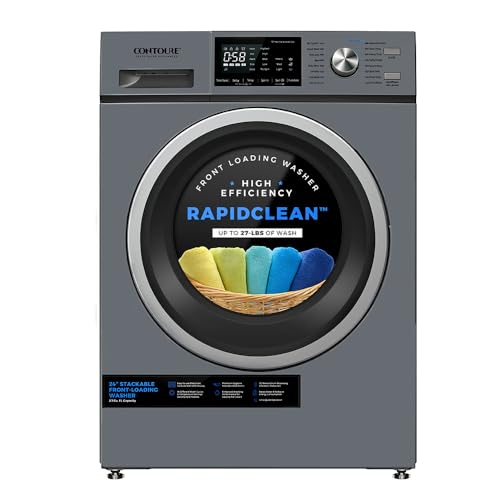
CONTOURE WH-2700T 24in Stackable Washer — Most drum in the width
The CONTOURE WH-2700T makes the strongest pure-numbers case in the class. Its verified title describes a 24-inch stackable front-load washer of 2.7 cu. ft. in titanium, spinning at 1400 RPM, with sixteen wash cycles, five temperature settings, LED touch controls, a stainless steel drum and high-efficiency design, model WH-2700T. Begin with the drum: 2.7 cu. ft. is the ceiling of what this pool offers at 24 inches, and it changes the household maths — a couple’s full weekly clothes, a set of towels, bedding for a double bed all become single loads rather than relays. The 1400 RPM spin is the other headline, because compact households line-dry and use small dryers at high rates, and a spin that thorough hands the drying stage a load already most of the way there.
Sixteen cycles and five temperatures give this small machine an unusually grown-up menu. The practical reading is flexibility across a mixed wardrobe — the temperatures matter more than the cycle count, since compact households wash everything in one machine, from gym kit to the good shirts, and temperature choice is where fabric care is actually decided. LED touch controls suit the stacked and under-counter positions these machines live in, where a knob’s throw can foul a counter edge or a door above. The stainless drum carries the durability argument this batch of guides keeps making: small machines work proportionally hard, and their drums deserve the material that ages best.
CONTOURE’s RV heritage — the brand appears elsewhere in this batch in motorhome contexts — should be read as a clue rather than a limitation: machines designed for vehicles are designed for vibration, variable installations and owners who maintain their own equipment, and those virtues transfer intact to a city closet. Households choosing between this and the KoolMore below are choosing between the richest specification and the value presentation of the same 2.7 idea.
- Width class: 24 inches, stackable, titanium finish
- Capacity: 2.7 cu. ft. per the verified title
- Spin: 1400 RPM maximum
- Programs: 16 wash cycles, 5 temperature settings
- Controls and drum: LED touch controls; stainless steel drum
- Where to buy: the CONTOURE WH-2700T 24in Stackable Washer listing on Amazon — check price on Amazon
Strengths
- Largest verified drum in the 24-inch class here, with the fastest spin to match.
- Five temperature settings give real fabric-care range in a single-machine home.
- Stainless drum and stackable format suit both closets and under-counter bays.
Trade-offs
- Touch controls ask for dry fingers and offer no tactile shortcut for gloved or hurried hands.
- A 1400 RPM spin demands honest levelling; small cabinets telegraph vibration.
- The brand’s service network is thinner than the mainstream makers’ — ask locally before buying.
Best for: compact households wanting the maximum washing capability the 24-inch width allows. Not suited for: buyers who rank a national dealer network above specification.

KoolMore 24in Front Load Washer — Value in the width
The KoolMore FLW-3CWH reaches the same capacity summit by a friendlier road. Its verified title states a 24-inch front-load washing machine of 2.7 cu. ft., a space-saving unit with a 20-minute quick wash, twelve washing cycles and a quiet inverter motor, in white, at 120V. The 120V detail deserves first attention in this class: compact spaces are often older spaces, and a machine that runs on ordinary household current removes an entire category of installation negotiation — no new circuit, no electrician’s visit standing between the delivery and the first load. For renters in pre-war buildings and owners of modest ADUs, that single title line can be the whole decision.
The quiet inverter motor claim pairs with the quick wash to describe this machine’s intended life: frequent, unobtrusive, woven into a small home’s day rather than scheduled around. Twelve cycles is a sane menu — enough to separate the wardrobe’s personalities without a touchscreen safari — and the 20-minute program is the one compact households actually live on, refreshing the small loads that a 2.7 drum encourages. Inverter motors also tend to deliver their spin smoothly, which matters when the machine’s neighbours are a bedroom wall and a downstairs ceiling.
Against the CONTOURE, the KoolMore trades specification glitter — fewer cycles, no printed spin figure or drum material in its title — for position and price-class appeal, and buyers should confirm drum material and spin speed on the maker’s documentation before treating the two as equivalents. What the title does print is enough to recommend it to the household it describes: small space, ordinary power, quiet frequent washing.
- Width class: 24 inches, space-saving format, white
- Capacity: 2.7 cu. ft. per the verified title
- Programs: 12 washing cycles, including a 20-minute quick wash
- Motor and power: quiet inverter motor; 120V
- Model: FLW-3CWH per the verified title
- Where to buy: the KoolMore 24in Front Load Washer listing on Amazon — check price on Amazon
Strengths
- Full 2.7 capacity on ordinary 120V power — a rare and practical combination.
- Quick wash and quiet-motor design suit the small-home daily rhythm.
- Twelve cycles cover a wardrobe without menu sprawl.
Trade-offs
- Title omits spin speed and drum material; verify both on maker documents.
- Fewer temperatures and cycles than the CONTOURE for fabric-care perfectionists.
- White-only presentation in this listing.
Best for: renters and small homes needing full compact capacity on standard power. A poor fit for: specification maximalists who want every figure printed before purchase.

Bosch 300 Series 24in Washer — Certified compact
This pick requires a naming note before anything else: its verified listing title is retailer-style and leads with the series rather than the brand, reading “300 Series 24 in. 2.2 cu. ft. High-Efficiency Stackable Front Load Washer in White, Energy Star” — the 300 Series compact line sold under the Bosch name, and it is referred to throughout this guide by that full fetched title’s identity. What the title establishes is compact-class pedigree: 24 inches wide, 2.2 cu. ft., high-efficiency, stackable, white, and Energy Star certified. That certification is the pick’s headline for the same reason it led the septic guide — it is published, checkable evidence about consumption, and compact households are disproportionately metered households in apartments and ADUs where efficiency is rent by another name.
The 2.2 cu. ft. drum is the smallest among the full washers here, and its household is correspondingly specific: one or two people, washing frequently in small loads, valuing the established compact engineering of a European-format machine. This class of washer has served small European flats for decades, and its virtues are rhythm virtues — modest loads, thorough washing, a machine that disappears under a counter or into a stacked tower and asks little. Buyers should verify cycle and spin details on the maker’s documentation, since the title’s brevity is a retailer habit rather than a specification; the documents for this series are thorough and worth the read.
Position it as the efficiency-and-pedigree choice of the five linked picks: least drum, most certification, and a brand whose compact lineage is the longest in the room.
- Width class: 24 inches, stackable, white
- Capacity: 2.2 cu. ft. per the verified title
- Efficiency: high-efficiency design; Energy Star named in the title
- Series: 300 Series per the verified title
- Where to buy: the Bosch 300 Series 24in Washer listing on Amazon — check price on Amazon
Strengths
- Energy Star evidence printed in the listing itself.
- European compact pedigree — the format’s most established lineage here.
- Stackable design suits the classic 24-inch tower installation.
Trade-offs
- Smallest drum of the full washers in this guide; couples only, honestly.
- Retailer-style title leaves cycle details to the maker’s documents.
- Premium-class pricing expectations apply even without a printed figure here.
Best for: one- and two-person households valuing certified efficiency and compact pedigree. Not the right match for: anyone washing family volumes in a narrow space — that is the 2.7 pair’s brief.

LG 24in Compact Stackable Front Load Washer — Feature leader
LG’s compact argues that narrow need not mean basic. The verified title describes a 24-inch-wide, 2.4 cu. ft. compact stackable front-load washer in white with steam cleaning, an AI fabric sensor and smart pairing compatibility. The capacity sits mid-class — more than the Bosch, less than the 2.7 pair — and the feature set is the richest printed in this pool: steam at compact scale is genuinely unusual, and a fabric sensor that weighs and reads the load addresses the compact household’s core inefficiency, which is running full programs for the small, mixed loads that dominate small-home laundry. Smart pairing compatibility points at the matched compact dryer ecosystem, relevant to households building a 24-inch tower as a system rather than as two strangers.
Steam’s honest place in a compact is the occasional refresh-and-deep-clean program for the items a small household cannot easily send out — the interview shirt, the musty guest towels — rather than a daily driver, and the cycle chart will show where LG intends it to be used. The sensor’s value compounds quietly: right-sized water and time on hundreds of small loads is the compact version of efficiency, complementing the Bosch’s certification story with a behavioural one.
Choose the LG when the household’s laundry is varied, frequent and fabric-conscious, and when a matching smart dryer is part of the plan. Drying is half of any compact tower’s life, and our general guide to Best Clothes Dryers gives the wider field for households mixing brands instead.
- Width class: 24 inches, compact stackable, white
- Capacity: 2.4 cu. ft. per the verified title
- Features named in title: steam cleaning, AI fabric sensor, smart pairing compatible
- Where to buy: the LG 24in Compact Stackable Front Load Washer listing on Amazon — check price on Amazon
Strengths
- Steam and load sensing at compact scale — the fullest feature print here.
- Sensor metering suits the small mixed loads that dominate compact life.
- Smart pairing suits households building a matched 24-inch tower.
Trade-offs
- Mid-class drum; the 2.7 machines hold more per load.
- Feature richness means more to learn and more electronics to age.
- Steam’s value depends on the household actually using refresh programs.
Best for: fabric-conscious small households building a smart compact tower. Poorly suited to: minimalists who want the simplest possible compact and no ecosystem.
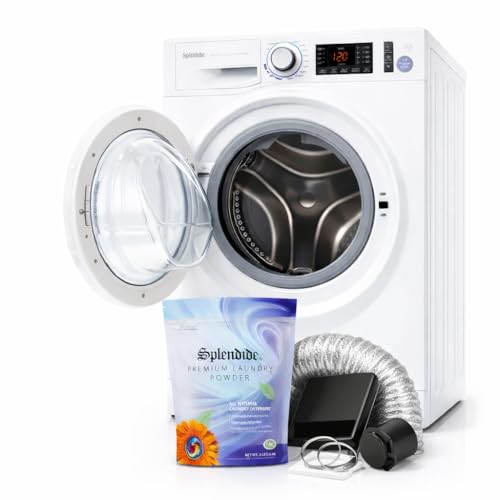
Splendide Washer Dryer Combo Vented — One-box traveller
The Splendide WDV2200XCD is the pick that leaves the apartment entirely. Its verified title describes a washer dryer combo for RV use — vented, 15 lb, all-in-one compact, supplied with a complete vent kit and detergent, model WDV2200XCD, aimed at marine, boat, apartment and tiny-home settings. It earns its place in a width-locked guide because its entire existence is a confined-space brief: one cabinet that washes and dries, in the footprint a boat’s or motorhome’s laundry locker allows. The vented design matters and distinguishes it from ventless combos — vented drying is faster and sheds moisture outside the living space, a real consideration in a hull or a small cabin where every litre of vapour must go somewhere, and the included vent kit means the installation’s hardest part arrives in the box.
Fifteen pounds is the honest scale: a few days’ clothes for a travelling couple, run in the rhythm vehicle life imposes. Nobody should buy this machine to do a family’s land-based laundry, and this guide will not pretend otherwise; equally, no apartment washer in this list can do what it does, which is disappear into a moving home and handle its laundry end-to-end. The detergent in the listing is a starter courtesy, not a specification. Buyers should confirm the cabinet’s exact dimensions against their locker — in this class the tape measure is not a formality but the purchase itself — and confirm the electrical supply their vehicle offers matches the machine’s needs on the maker’s sheet.
For tiny homes on foundations, the same logic applies at rest: one vented box, modest loads, no laundry room. It is the specialist’s specialist, and within its brief it has few rivals in this pool.
- Format: vented washer-dryer combo, all-in-one compact
- Capacity: 15 lb per the verified title
- Included: complete vent kit and detergent per the title
- Model: WDV2200XCD; settings named: RV, marine, boat, apartment, tiny home
- Where to buy: the Splendide Washer Dryer Combo Vented listing on Amazon — check price on Amazon
Strengths
- Washes and dries in one confined-space cabinet — the complete vehicle brief.
- Vented drying with the kit included; moisture leaves the living space.
- A long-established name in the RV and marine niche.
Trade-offs
- Fifteen-pound loads are a traveller’s rhythm, not a family’s.
- Combo cycles are sequential and long compared with separate machines.
- Exact locker dimensions and vehicle electrics must be verified before ordering.
Best for: RV, boat and tiny-home households needing one box that does everything. A weak match for: apartment families, who should take the 2.7 cu. ft. washers and a separate dryer.
Miele W1 compact class — Premium dealer route
The sixth place belongs to the class compact buyers research even when they buy something else: Miele’s W1 compact line, the premium end of the 24-inch world. No verified listing for the class sits in this guide’s pool, so it is covered in prose — no link, no quoted figures, no model claims — with the buying route stated plainly: this class is sold and installed through the brand’s dealer network, and its specifications live on the maker’s documents for the exact model a dealer quotes. The class’s reputation rests on build ambition and longevity in the European compact format, and households cross-shopping it against the Bosch above are comparing the two longest compact pedigrees in the business.
The honest guidance is procedural. Bring the tape-measure numbers of your space to the dealer, ask for the model’s printed dimensions and capacity rather than the range’s, and weigh the dealer’s installation and service story as part of the price, because at this level the relationship is half the product. Households whose journey started with the format’s foundations may enjoy our guide to Best Front-Load Clothes Washers, where the full-size front-load field shows what the compact class is a distillation of.
- Format: premium 24-inch compact class, dealer channel
- Verify before buying: printed dimensions and capacity for the exact quoted model
- Where to buy: through the brand’s authorised dealers, with installation arranged as part of the order
Strengths
- The premium compact pedigree, with dealer installation and service built in.
- Suits buyers furnishing a long-term home rather than a temporary flat.
- Dealer documents give exact dimensions for a width-critical purchase.
Trade-offs
- No marketplace listing — comparison takes showroom effort.
- Premium positioning prices the class above this guide’s linked picks.
- Nothing is verified here; every figure must come from dealer documents.
Best for: long-horizon households wanting the premium compact with a service relationship. Not suited for: renters or movers who need a machine ordered tonight and installed this week.
The 24-inch field compared
| Pick | Drum | Printed headline | Setting it serves |
|---|---|---|---|
| CONTOURE WH-2700T | 2.7 cu. ft. | 1400 RPM, 16 cycles, 5 temperatures | Maximum-capability closets |
| KoolMore FLW-3CWH | 2.7 cu. ft. | 20-minute quick wash, 120V | Rentals and older buildings |
| Bosch 300 Series | 2.2 cu. ft. | Energy Star in title | Efficiency-first couples |
| LG compact | 2.4 cu. ft. | Steam, AI fabric sensor | Smart compact towers |
| Splendide combo | 15 lb | Vented, vent kit included | RV, marine, tiny homes |
| Miele W1 class | Verify per model | Dealer documents | Premium long-term installs |
How do you measure a space for a 24-inch machine?
Measure like an installer, not like an optimist. Width first, at three heights — floor, counter and top — because old walls lean and the narrowest point rules. Then depth, remembering that the printed cabinet depth excludes the door’s bow, the hoses’ bend radius behind the machine and the plug’s body; a compact wedged flush against its connections is a compact that cannot be serviced. Height matters in stacks and under counters, including the counter’s underside obstructions — a sink bowl or a drawer box can steal the inches the brochure assumes. Finally, measure the journey: doorways, hallway turns, stair landings and the elevator’s honest diagonal, because a 24-inch machine is usually bought for a building that makes delivery interesting. Photograph every measurement with the tape in frame. Households that arrive at ordering with those photographs buy once; the rest buy a delivery surcharge and a story.
Stacked, under-counter or freestanding: which compact life is yours?
Stacking a matched dryer above the washer is the classic 24-inch tower, and it converts one floor footprint into a complete laundry — provided the ceiling height, the stacking kit for the exact pair and your willingness to load a dryer at chest height all agree. Under-counter installation hides the machine in a kitchen or bathroom run, which demands the depth honesty above and a plinth or panel decision made before delivery, not during it. Freestanding in a closet is the flexible option and the one renters should default to, since it leaves with you. Each arrangement has a maintenance shadow: stacked machines are harder to pull out for hose service, under-counter machines hide slow leaks longer, and closet machines need ventilation thought. Choose with the tenth year in mind, not just the first photograph.
What can a 2.2 to 2.7 cu. ft. drum actually wash?
Translate the numbers into wardrobes. At 2.7 cu. ft., a couple’s week of ordinary clothes is one or two loads, towels and bed linen for a double bed are single loads, and a queen duvet is a possible — if snug — event. At 2.2, the same life runs as more, smaller loads, which suits households that prefer washing little and often and own compact wardrobes. What neither size does is king bedding, bulk hoarding or a sports team’s kit; compact ownership is a rhythm of frequency over volume, and households that accept the rhythm find the machines generous, while households that fight it with stuffed drums find them sullen. The drum also disciplines detergent and water use downward across a year — small machines run small loads at small cost, which is the quiet economic argument underneath the spatial one.
Compact ownership mistakes
The defining mistake is buying on capacity because the width “should be fine” — the error this guide’s locked axis exists to prevent; measure first, admire drums second. Next is ignoring depth and door swing, the dimensions that actually veto installations. Third, stuffing the drum to avoid a second load, which washes neither load. Fourth, stacking unmatched machines without the maker’s kit for the pair. Fifth, forgetting the delivery path in a building whose stairs were built before appliances. And sixth, in RV and marine cases, ordering before confirming the vehicle’s electrical and locker realities against the maker’s sheet — the Splendide’s brief is precise, and precision must be met halfway.
What should you know about spin speeds in small cabinets?
The CONTOURE’s printed 1400 RPM is a headline worth understanding rather than merely admiring. High spin extraction is worth the most to exactly the households that buy compact machines: line-driers, small-dryer owners and anyone whose energy budget prefers water removed mechanically over water evaporated thermally. But a small, light cabinet spinning fast is also a vibration instrument, and its behaviour depends on the floor beneath it more than on any specification — a compact on a solid ground floor is serene, while the same machine on a sprung upper floor will audition for the percussion section unless it is levelled with unusual care and, where needed, set on proper pads. During the supervised first cycle, run the spin empty and then loaded, and judge the machine in its real home rather than in the showroom’s concrete. A compact that spins calmly in place will do so for years; one that travels across the closet on day one is reporting a floor problem that no brand swap will fix.
How does the compact dryer decision interact with the washer?
Half the tower is the dryer, and compact households should spec it with the same width discipline. A washer chosen for a 24-inch bay deserves a dryer that shares the footprint — ventless condensing and heat-pump compact dryers exist precisely because small flats often cannot vent, while the Splendide’s vented route suits vehicles with an outside wall an arm’s length away. Capacity matching matters in miniature just as it did in the king-bedding guide: a dryer drum notably smaller than the washer’s turns every second load into a queue. Where the washer is the LG, its smart pairing story is designed for the matched compact dryer; where brands mix, confirm the stacking kit question in writing, because towers built on improvised brackets are how compact laundry earns its horror stories.
What does installation day look like in a tight space?
Slower, and that is fine. The machine arrives through the measured path, packaging is broken down outside the small room rather than inside it, and the cabinet is walked into position with its hoses attached before the final push — because once a compact is home in a 24-inch bay, reaching behind it becomes a yoga discipline. Levelling is done with the machine in its true position, all four feet loaded, and the test cycle runs with the door closed and the household listening from the next room, which is where the machine will actually be heard for the next decade. Keep the transit bolts, the manual and the stacking documentation in the house folder; compact machines move house more often than standard ones, and the bolts are the difference between a safe move and a drum damaged in a van.
How do compact machines behave on boats and in RVs underway?
The Splendide’s world deserves its own paragraph of honesty. Machines in vehicles wash at rest, not underway — marinas and campsites are the laundry’s natural habitat, with shore power and stillness — and their water comes from tanks or hookups whose capacity the load plan must respect. A 15 lb load is sized to that reality. Owners winterise these machines as they winterise the vehicle’s plumbing, draining and protecting them against the freeze that cracks the unwary. None of this diminishes the pick; it defines the competence it offers, which is a complete laundry inside a moving home, maintained with the same seasonal rituals as every other system aboard.
What is the long-term cost picture of the compact class?
Small machines use small amounts of water and energy per load and run more loads; across a year the totals land close to a standard machine serving the same household, with the balance tipped by rhythm rather than by badge. The real compact economics live elsewhere: in rent not spent on a larger flat, in a laundry room that fits a flat at all, in the avoided laundromat subscription of money and Saturdays. Against those, the class’s known premium — compact machines cost more per cubic foot than standard ones — is usually the cheapest line in the household’s spreadsheet. Buy the width you need, keep the machine maintained, and the arithmetic will not trouble you again.
How do you keep a compact washer fresh in a small, warm home?
Small homes run warm and their laundry corners warmer, which makes the front-load freshness routine more important here than in a airy utility room. The seal wipe after the last load of the day, the door left ajar rather than clicked shut, the dispenser dried when the machine will sit for a weekend — these thirty-second habits are the whole programme, and they matter doubly in a machine whose drum is small enough that any odour perfumes the entire load. The LG’s steam and the class’s hot programs offer a periodic refresh for the machine itself where the maker’s manual endorses one. Households in humid climates should treat the ajar door as non-negotiable architecture: prop it, don’t seal it, and let the small drum breathe the way its full-size cousins are told to.
What questions should a renter ask a landlord before ordering?
Three, in writing. May a washing machine be installed in the unit at all — some leases forbid them over leak liability, and a compact’s size does not exempt it. Whose insurance answers if a hose fails — a question that argues for new braided hoses and a drip pan as the machine’s welcome gifts to the flat. And may the installation touch the plumbing — a freestanding compact on existing taps is a different request from a plumbed under-counter fit, and landlords approve them at different speeds. Get the yeses before the delivery is booked, keep the original faucet fittings for move-out day, and the compact becomes the most portable major appliance a renter owns — which, in a rental life, is a genuine part of its value.
How does a compact serve a household that later upsizes?
Gracefully, usually. The 24-inch machine that served a first flat becomes the second machine in a later house — the delicates-and-small-loads specialist beside a full-size washer — or sells into a strong second-hand market of exactly the households this guide addresses, or follows its owners to a cabin or an in-law suite. Few appliances have so reliable a second act, which softens the class’s price-per-capacity premium at purchase time: you are not buying a disposable answer to a temporary space, you are buying the most re-deployable washer format made. Keep the transit bolts and the manual, and the machine’s options stay open for a decade.
What does a week of laundry look like in a 24-inch household?
It looks like rhythm rather than event. A small load most days — the quick wash earning its keep on gym kit and work clothes — a towel load midweek, bedding for the household’s bed at the weekend in one considered run, and the machine dark and ajar in between. Total human attention is perhaps an hour across the week, none of it spent travelling to a laundromat or negotiating a shared laundry room’s timetable. That rhythm is the compact class’s true product: not washed clothes, which any machine promises, but washed clothes inside a small home’s own walls and hours. Households that have lived the alternative — the basement laundry room, the Sunday laundromat — consistently describe the first compact as the purchase that made a small home feel complete, and the description survives every specification argument in this guide.
How do you choose between the two 2.7 machines in the end?
By the documents and the dwelling. Put the CONTOURE’s printed richness — spin, temperatures, drum — against the KoolMore’s printed practicality — 120V, quick wash, inverter quiet — and ask which list describes your building. A newer flat with proper circuits and a household of fabric-care enthusiasts leans CONTOURE; an older building, a renter’s horizon and a life lived at quick-wash tempo leans KoolMore. Then do the verification pass this guide keeps assigning: drum material and spin on the KoolMore’s documents, service reality on the CONTOURE’s brand in your postcode. The drum is the same size; the decade around it is where they part, and the documents, not the listings, hold the deciding pages.
What about noise through thin walls — the compact etiquette?
Compact machines live close to neighbours in every direction, and their social licence depends on spin manners. Level the machine as if the downstairs ceiling were your own, because it is someone’s. Keep the heavy spin loads inside civilised hours where the building’s life allows, and use the quick, gentle programs for the late-evening refresh. Anti-vibration pads under a compact are not an upsell but a courtesy with a return address — the household below hears your machine more clearly than you do. The KoolMore’s quiet-motor claim and the class’s inverter designs help, but etiquette is a setting no factory installs: it is chosen nightly, and buildings remember the households that choose it.
How should ADUs, granny flats and garden suites shop this class?
Secondary dwellings are the 24-inch class’s heartland, and they shop with two extra questions. First, whose meter pays — a suite on the main house’s circuits argues for the efficiency-documented picks and for honest load rhythm, since the laundry’s cost lands on a shared bill and shared goodwill. Second, who maintains — a suite occupied by an older parent argues for the simplest controls in the class and a machine the wider family can troubleshoot by phone. Get those two answers and the pick usually names itself from the six above; skip them and the machine becomes a small monthly negotiation instead of an appliance.
A note on detergents and dosing in small drums
Small drums punish the dosing habits formed in big ones. A compact load needs a compact dose — the scoop that served a 4.5 cu. ft. machine will leave a 2.4 drum’s load rinsing in its own residue, and the symptoms (stiff fabric, a drum that smells of product rather than of nothing) get blamed on the machine with metronomic regularity. Measure for the drum you own, treat pre-dosed pods as the full-size units they usually are unless the maker says otherwise, and let the rinse be the judge for the first month: fabric that emerges slick is asking for less product, not more washing. The sensor-equipped LG narrows the margin for error by sizing water to load; the discipline remains the household’s to learn, and it is learned in a fortnight of honest observation.
What should be in the compact household’s spares drawer?
A short list with a long memory: the stacking kit’s documentation, the transit bolts in a labelled bag, one spare set of inlet screens or the knowledge of their exact size, the faucet adapters the installation used, and the delivery photographs of the machine in place. Compact households move, rearrange and hand machines on more than any other class; the drawer is what makes those transitions afternoons rather than expeditions. Add the dealer’s and servicer’s numbers, and the drawer becomes the machine’s entire support infrastructure in a shoebox — proportionate, like everything else in the 24-inch world.
How do warranties and service differ in the compact niche?
Compact machines sit in a specialist corner of the appliance trade, and service reality varies more by brand than by model. The mainstream makers in this guide — the Bosch-titled series, the LG — plug into wide service networks; the niche names plug into smaller, sometimes more devoted ones, and the RV-bred Splendide is serviced in a world of marine and motorhome technicians as much as appliance shops. Before ordering any of them, make the call this batch of guides keeps prescribing: name the model to a local servicer and ask whether they see it, stock for it and like it. In a width-locked purchase you cannot simply swap to a different machine when service disappoints — the space forbids substitutes — so the service question carries more weight here than in any standard-width guide.
What does the second-hand compact market teach new buyers?
That these machines hold their usefulness — and that their weak point is paperwork. Used compacts circulate constantly among students, renters and boat owners, and the listings that sell fastest are the ones with manuals, transit bolts and honest dimensions attached. A new buyer should read that as instructions for ownership from day one: keep everything, photograph the installation, log the model’s exact suffix. It also offers a legitimate budget route into the class — a used mainstream compact with its documents can serve a first flat admirably — provided the buyer runs the same width, drum and service checks this guide applies to new machines, and budgets for fresh hoses as a non-negotiable first act.
How do you decide the class is simply too small?
Some households measure their lives and find the honest answer is a standard machine and a different room arrangement — a garage corner plumbed, a utility space reclaimed. The tell-tale signs: laundry for four or more people, bedding that includes king sizes, a home business generating textile volume. Compact machines forgive many things but not arithmetic. If the weekly volume divided by 2.7 cu. ft. produces a load count that fills the calendar, the constraint to solve is the space plan, not the washer catalogue — and the full-size guides in this batch will welcome you with drums that match your life.
A last check of the tape, the door and the plan
Before ordering, run the three confirmations that close every successful compact purchase. The tape: width, depth and height of the space, measured at their narrowest, against the chosen model’s printed dimensions with hose room added. The door: swing, swing and swing again — the machine’s door, the closet’s door and the room’s door, choreographed together, because a washer you cannot fully open is a washer you cannot fully load. The plan: who delivers, who levels, who services, and where the transit bolts live afterward. Three confirmations, ten minutes, and the 24-inch machine arrives as a solution rather than as a puzzle. That is the whole method of this guide in miniature — the width decides the field, the documents decide the model, and the household’s rhythm decides the rest.
How do compact machines handle the delicate end of the wardrobe?
Small drums are secretly kind to delicates: loads are modest, tumbling distances are short, and the household that owns one machine for everything learns its gentle programs intimately rather than treating them as novelties. The LG’s sensor and steam, the CONTOURE’s five temperatures and the class’s general preference for frequent small loads all serve the silk blouse and the wool jumper better than a cavernous drum run half-empty on a default program. The standing disciplines apply — mesh bags for the fragile, zips closed, the gentlest program that still counts as washing — but the format itself is an ally, one more reason the compact class’s owners tend to become its evangelists.
And if the space is 24 inches wide but the household is growing?
Buy the 2.7 end of the class and buy it once. A household expecting a partner, a child or a parent to join within the machine’s early years should weight capacity inside the width as heavily as the width itself, because the replacement cycle in a fitted compact space is disruptive out of proportion to the machine’s size. The CONTOURE and KoolMore exist in this guide precisely for that household — the tape measure is satisfied today and the drum has headroom for the life that is coming. Planning one size of life ahead, inside a locked width, is the compact shopper’s version of buying the bigger house: cheaper done at purchase than at crisis.
One more virtue of the width: it disciplines the whole purchase
Standard-width shopping drowns in choice — dozens of near-identical cabinets separated by screen sizes and marketing nouns. The 24-inch constraint burns that fog away. The field is small, the differences are legible — drum, spin, certification, features, channel — and a household can hold the entire class in mind at once, as this guide has done. Constraints, honestly accepted, are a shopper’s friend; the tape measure that looked like a limitation at the start of the search turns out to have been the best buying advice in it.
Final Recommendation
Most 24-inch households should start with the CONTOURE WH-2700T for its class-leading drum and spin, or the KoolMore where 120V power and value lead the brief — the two 2.7 machines are the width’s centre of gravity. Choose the Bosch 300 Series for certified efficiency in the smallest full-washer drum, the LG for steam and sensing in a smart tower, the Splendide when the home has wheels or a hull, and the Miele class when the purchase is a decade-long installation with a dealer relationship attached. Whatever arrives, let the tape measure have the last word before the first wash: in the compact class, the right width is not a preference but the entire foundation, and a machine that fits its space exactly will be forgiven almost anything else.
Frequently Asked Questions
How is this guide different from your small front-load washer guide?
That guide sorted by drum capacity; this one is locked to the 24-inch width class regardless of drum size. The axes cross — a washer can be small-drum and wide, or narrow with a relatively generous drum — and households should shop the axis their space dictates. If your constraint is a tape measure, you are in the right guide.
Can a 24-inch washer serve a family of three?
At 2.7 cu. ft., yes, with rhythm: more frequent loads, bedding for the largest bed handled selectively, and no weekly hoarding. At 2.2, a family of three will feel the relay. Be honest about which household you are before choosing the drum.
Do compact washers need special plumbing?
Most install on standard supplies; the KoolMore’s 120V operation even simplifies the electrical side. The compact-specific checks are dimensional — depth for hoses, door swing, stacking kits — rather than exotic plumbing. Confirm the exact model’s requirements on its installation sheet before ordering.
Is the Splendide a real alternative to a separate washer and dryer?
Within its brief — vehicles, boats, tiny homes — yes, completely; that is what it is engineered for. As a land-based family solution its 15 lb sequential cycles would bottleneck, and this guide positions it honestly as the traveller’s instrument.
How long do compact washers typically serve?
Longevity in this class follows the same law as everywhere else in this batch: maintenance and load discipline matter more than badge. A compact washed within its drum’s honest volume, kept level, aired between washdays and fed clean screens will serve for years of daily small loads; the same machine stuffed nightly and sealed wet will age in dog years. The premium dealer class sells longevity as its headline, but the household’s habits write most of the story for every pick here.
Can I put a 24-inch washer under a kitchen counter?
That is one of the format’s classic homes, provided three measurements agree: the counter’s clear height against the machine’s, the depth including hoses against the cabinet run’s, and a worktop or plinth arrangement the installer approves. Keep the machine’s door swing clear of the opposite run, put a drip tray under it as insurance the downstairs neighbour will appreciate, and confirm the model you choose is documented by its maker for built-under use rather than assuming every compact is.
What spin speed should a compact household actually want?
Enough to serve your drying method. Line-driers and small-dryer owners benefit most from the high end printed in this guide; households with a good vented dryer and delicate wardrobes can live happily lower. Match the spin to the drying stage you own, and level the machine as though the number were higher than it is — floors forgive nothing.
Why is one pick referred to by a series name instead of a brand?
Because its verified listing title is retailer-style and leads with the series — “300 Series 24 in. 2.2 cu. ft. High-Efficiency Stackable Front Load Washer in White, Energy Star” — and this guide refers to picks by the titles it verified rather than tidying them into claims the listing did not print.
Related Guides
Renters and small-flat households should also read Best Compact Clothes Washers for Apartments, which covers the wider compact field beyond the front-load width class.


