What's inside
- Where to Buy Washers and Dryers for a Salon and Spa Without Pretending Portables Are Laundromat Machines
- Key Takeaways
- Quick Picks
- How Did We Sort Salon Laundry Equipment Into Honest Classes?
- Salon Options by Class and Capacity
- What Does a Towel Day Actually Look Like in a Small Salon?
- How Should a Salon Set Up a Back-Room Laundry Corner?
- Which Salon Laundry Mistakes Cost the Most?
- How Do You Keep Delicate Items Safe in Hard-Working Machines?
- What Should a Salon Owner Measure in the First Month?
- How Should Staff Be Trained on Machines They Did Not Choose?
- Final Recommendation
- How Should a Salon Handle Hygiene-Critical Loads?
- What Does the Rotation System Look Like in Practice?
- Which Costs Should a Salon Budget Beyond the Machine?
- How Do Salons Handle the Laundry During a Machine Failure?
- How Does a Salon Choose Between One Good Machine and Two Modest Ones?
- Frequently Asked Questions
- Related Guides
As an Amazon Associate I earn from qualifying purchases. This post may contain affiliate links at no extra cost to you.
cottageverdict.com is reader-supported. When you buy through links on our site, we may earn an affiliate commission.
Where to Buy Washers and Dryers for a Salon and Spa Without Pretending Portables Are Laundromat Machines
The best washers and dryers for a salon and spa depend entirely on which kind of salon you run, and this guide begins with the honesty the keyword deserves. A salon’s laundry is relentless in a specific way: towels, capes, and robes cycle all day, every day, in loads that are small, hot, and constant rather than large and occasional. The verified marketplace pool for that need is not a row of gleaming commercial laundromat machines. It is, with one exception, a set of portable and compact machines — plus a single genuinely commercial 220V unit — and this guide reviews exactly that pool, framed for the small salon, the home studio, and the spa room where those machines honestly belong.
So the limits go on the record now. Portable washers and compact dryer sets are built for household duty cycles: a few loads a day, with rest between them, in homes where a failure means inconvenience. A salon running towels from open to close multiplies those loads several times over, and no portable in this guide should be bought believing it carries a laundromat’s constitution. What they can do — genuinely, usefully — is serve a small operation’s overflow, a home-based studio’s full needs, or a treatment room’s dedicated towel stream, provided the owner plans for rotation, spares, and eventual replacement. The one commercial unit here, the DINENOVATE, is a different class of machine with a different class of electrical demand, and its review says so in detail.
One more framing note before the picks. Salon laundry equipment is bought against a moving target: client volume grows, services change, and a massage practice that adds a sauna inherits a robe stream it never planned for. The wisest purchases in this guide are therefore the ones that degrade gracefully into a supporting role when the business outgrows them — the set that becomes the second set, the twin tub that becomes the hand-towel machine. Equipment chosen for its first job alone tends to be sold at a loss; equipment chosen with its second job in mind tends to be kept for a decade.
Towels themselves are not picks in this guide, however often they appear in search results beside these machines. The subject is the equipment: six verified listings, each read for what its title actually claims about capacity, voltage, and construction.
Key Takeaways
- Five of six picks are portable or compact household-duty machines; only the DINENOVATE is a commercial unit, and it needs 220V single-phase power.
- Frame these picks for small salons and home studios — portable sets are not laundromat-grade and should never be sold to yourself as such.
- Capacities are quoted in pounds on most portable titles: 8 to 48 lbs across the sets, against the DINENOVATE’s 33 lb commercial load.
- Duty cycle is the deciding spec no title prints: plan rotation and a backup path for any machine a business depends on.
- The Auertech twin tub is semi-automatic — a person moves laundry between tubs — which suits steady towel streams surprisingly well.
- The Hamilton Beach combo washes and dries in one drum on ordinary 120V power, trading speed for simplicity.
Quick Picks
| Pick | Badge | Why it earns its place |
|---|---|---|
| DINENOVATE Commercial Industrial Washer Dryer 3-in-1 | The one true commercial unit | A 220V wash-spin-dry machine with a 33 lb load and stainless drum, built for hotels, hospitals, and laundry rooms. |
| ROVSUN 30LBS Washer and 3.5 Cu Ft Dryer Set | Largest portable set | A 30 lb automatic washer with a separate 3.5 cu. ft. dryer — the fullest portable pairing in this guide. |
| ROVSUN 25LBS Washer and 2.6 Cu Ft Dryer Set | Mid-size portable set | The same two-machine logic at 25 lbs and 2.6 cu. ft., for smaller studios and tighter corners. |
| Giantex Portable Washer and Dryer Combo | Smallest footprint | An 8 lb full-automatic washer with spin drying and a built-in drain pump, for a single treatment room. |
| Auertech 48lbs Twin Tub Washer | Twin-tub towel workhorse | A 30 lb wash tub beside an 18 lb spinner, semi-automatic, moving towels through in a continuous rhythm. |
| Hamilton Beach 2.65 All-in-One Washer Dryer Combo | One-drum simplicity, 120V | A front-load combo that washes and dries in a single drum on household power, with delay start. |
How Did We Sort Salon Laundry Equipment Into Honest Classes?
Class came before capacity. We separated the pool into the one commercial machine, the two-machine portable sets, the twin tub, the micro combo, and the all-in-one, because a salon owner comparing across those classes without labels is comparing a bicycle to a van on price per seat. Within each class, we then read the title’s own numbers — pounds of capacity, dryer volume, voltage — and held every claim to what the title prints.
Duty honesty formed the second filter. Salon laundry is hot, frequent, and chemically interesting: bleach, massage oils, hair colour, and disinfectants all pass through these drums. Household-duty portables can handle the chemistry of ordinary loads, but their motors, pumps, and timers are not specified for continuous commercial cycling, and this guide refuses to imply otherwise. The practical consequence, repeated in the body below, is that a small salon buying portables should buy them as a rotation — two modest machines alternating will outserve one machine run without rest — and should keep a laundromat or laundry service as the overflow valve for the busiest weeks. Owners speccing true pay-per-load equipment will find the neighbouring category in Best Coin-Operated Washers and Dryers, where every linked machine is a commercial washer built for exactly that life.
We also read for the salon’s unspoken requirement: repeatability by whoever is on shift. A machine whose correct operation lives in one person’s head is a liability in a business with staff rotation, so simple controls, visible water, and forgiving cycles earned quiet credit throughout the reviews below, while anything requiring delicate interpretation was marked down as a training cost the salon would pay weekly.
Electrical reality formed the third filter. The DINENOVATE’s 220V single-phase demand, with heating power stated in kilowatts in its title, places it in electrician territory for most small premises. The portables, by contrast, live on ordinary outlets and sink-or-tub drainage, which is precisely why they tempt salon owners — and precisely why their limits must be understood before they are asked to carry a business.

DINENOVATE Commercial Industrial Washer Dryer 3-in-1 — The one true commercial unit
Everything else in this guide is a household machine invited into a business; the DINENOVATE is a business machine, full stop. Its title describes a commercial industrial washer-dryer that washes, spins, and dries in one unit, takes a 33 lb load, builds its drum from 304 stainless steel, runs LCD programs, and is aimed by its own maker at hotels, hospitals, and laundry rooms. For a salon or spa whose towel volume has outgrown portables — a multi-chair salon with a massage practice attached, a day spa cycling robes all weekend — this is the pick that matches the workload’s nature.
The electrical line in the title must be read as a project, not a footnote: 220V single-phase power, with 6KW of heating and 6KW of drying stated. That is a dedicated circuit, professionally installed, in premises whose panel can carry it — closer to fitting a commercial kitchen appliance than to plugging in a washer. A home studio in a converted garage may or may not have that capacity; a leased salon unit needs the landlord in the conversation. Budget the installation as part of the machine, because a commercial unit waiting on an electrician washes nothing.
The 3-in-1 sequence deserves a clear-eyed word as well. A single drum that washes, spins, and dries keeps towels moving without transfers, and the stainless construction suits the chemical reality of salon loads. But one drum also means one load in process at a time, start to finish; a busy spa should model its towel turnaround against that serial rhythm, and may still pair the unit with a portable for the small in-between loads. Commercial buyers will recognise that planning instinct — throughput is a system, not a machine.
For the right premises, though, this is the only pick here whose design brief actually says commercial on it, and that alignment between brief and burden is what a business should pay for first.
- Class: commercial industrial washer-dryer, wash + spin + dry in one unit
- Electrical: 220V single phase; 6KW heat and 6KW dry stated in the title
- Load: 33 lbs; drum of 304 stainless steel
- Controls: LCD programs
- Maker’s stated settings: hotels, hospitals, laundry rooms
- Where to buy: the DINENOVATE Commercial Industrial Washer Dryer 3-in-1 listing on Amazon — check price on Amazon
Strengths
- The only pick designed and described for commercial duty.
- Stainless drum construction suits bleach-and-oil salon chemistry.
- One unit washes, spins, and dries, simplifying a small laundry corner.
Trade-offs
- 220V power with kilowatt-scale heating demands a professional installation project.
- A single drum processes loads serially, which caps peak-hour turnaround.
- Commercial scale and cost overshoot what a one-room studio needs.
One operational note belongs to spas in particular. A wash-spin-dry unit that heats its own water and drying air gives the establishment control over the whole towel process in a way that outsourced laundry never does — the scent, the softness, the temperature of the wash — and for a business selling sensory experience, that control is part of the product. It is also a responsibility: the machine’s programs become the spa’s hygiene routine, and they should be chosen deliberately and documented like any other treatment protocol.
Best for: established salons and spas whose towel volume has outgrown portable machines. Not suited for: home studios without 220V capacity or the panel room to add it.
ROVSUN 30LBS Washer and 3.5 Cu Ft Dryer Set — Largest portable set
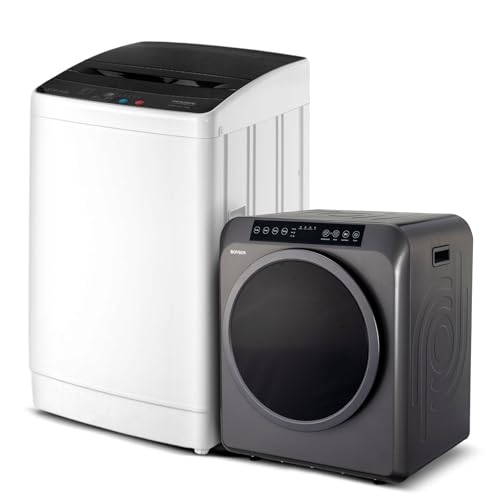
The larger ROVSUN set is the portable class at its most complete: a 30 lb full-automatic washing machine and a separate 3.5 cu. ft. portable electric dryer, the washer’s inner tub in stainless steel, sold as a pair for apartments, dorms, and homes — the settings its title names. Brought into a small salon, that translates to the most capable non-commercial arrangement in this guide: a washer that takes a proper stack of towels at once, and a real tumble dryer beside it rather than a spin tub, so finished towels come out dry and foldable, not merely less wet.
Two separate machines also give a small business its cheapest form of resilience. When the washer and dryer are independent, a failure in one leaves the other working and the salon limping rather than stopped; towels can be washed and line-finished, or dried from a laundromat wash, while a part is sourced. In a one-drum combo, every failure is total. For a salon whose Saturday cannot pause, that independence is worth the extra footprint.
The duty-cycle warning applies here in full. Thirty pounds is a household-large load, and the set is built and priced for household rhythms; a salon should run it as the senior partner in a rotation, not as an eight-hour continuous line. Kept to a few cycles a day with rest between, a set like this can carry a two-chair salon’s towels or a massage practice’s sheets-and-towels stream for a long while. Asked to run open-to-close without pause, it will age in dog years, and the honest owner plans the replacement horizon accordingly.
Placement is the set’s other practical virtue: portable machines forgive imperfect premises. A utility sink, a floor drain, and ordinary outlets are the whole infrastructure ask, which is why sets like this colonise the back rooms of small studios that could never host the DINENOVATE’s electrical project.
- Class: two-machine portable set, washer plus separate tumble dryer
- Washer: 30 lbs, full-automatic, stainless steel inner tub
- Dryer: 3.5 cu. ft., portable electric
- Maker’s stated settings: apartment, dorms, home
- Duty note: household-duty construction — plan rotation in business use
- Where to buy: the ROVSUN 30LBS Washer and 3.5 Cu Ft Dryer Set listing on Amazon — check price on Amazon
Strengths
- The largest portable washer here, with a genuine separate tumble dryer.
- Independent machines degrade gracefully — one failure does not stop the salon.
- Ordinary outlets and simple drainage keep installation trivial.
Trade-offs
- Household duty cycle underlies the whole set; continuous salon use shortens its life.
- Two machines take the most floor space of the portable picks.
- No commercial service network stands behind a set of this class.
A word on water temperature, since salon towels carry oils that cold water merely relocates. Portable sets fill from the premises’ taps, so the wash temperature available is the building’s hot water, delivered as fast as its heater allows. A small salon running several hot loads should check that its water heater recovers between clients’ appointments and the laundry’s demands — the machines will only ever be as hot as the supply behind them, and a lukewarm third load is a plumbing fact, not a machine fault.
Best for: small salons and studios needing real wash-and-tumble capacity without an electrical project. A poor fit for: high-volume spas cycling towels continuously all day.

ROVSUN 25LBS Washer and 2.6 Cu Ft Dryer Set — Mid-size portable set
The smaller ROVSUN set repeats the two-machine formula at a gentler scale: a 25 lb full-automatic washer with a stainless inner tub, and a 2.6 cu. ft. portable dryer. In salon terms, this is the set for the single-room practice — the lash studio, the two-table massage room, the barber with a hot-towel ritual — where the daily laundry is a few modest loads and the back room is a cupboard with ambitions.
Its best salon role may actually be as the second set. A practice that already owns the larger ROVSUN or a household pair often discovers that the bottleneck is not capacity but contention: the robe load waiting behind the towel load while a client waits in the room. A compact set dedicated to one stream — hand towels only, say, or the day’s capes — breaks that contention cheaply, and its modest appetite for space and power lets it live where the main machines cannot.
Everything said about duty cycles applies unchanged. The set is household equipment; run within a small practice’s natural rhythm, with gaps between loads built into the appointment book, it is well matched. Run as the sole laundry for a busy multi-chair salon, it will be out of its depth by the second month, and the failure will arrive, as failures do, on the fully booked Saturday.
The dryer’s 2.6 cu. ft. drum sets the set’s true pace. Towels dry in small, frequent batches rather than in one heroic load, which suits the appointment rhythm: a batch per gap between clients, folded warm, restocked continuously. Owners who think in batches will find the set adequate; owners who think in bulk should step up to its larger sibling or to the commercial unit.
- Class: two-machine portable set, washer plus separate tumble dryer
- Washer: 25 lbs, full-automatic, stainless steel inner tub
- Dryer: 2.6 cu. ft., portable electric
- Maker’s stated settings: apartment, dorms, home
- Duty note: household-duty construction — best as a primary set for tiny practices or a second set for larger ones
- Where to buy: the ROVSUN 25LBS Washer and 2.6 Cu Ft Dryer Set listing on Amazon — check price on Amazon
Strengths
- Compact two-machine independence for very small premises.
- An ideal dedicated second set for one towel or cape stream.
- Batch-sized dryer matches the appointment-book rhythm of a studio.
Trade-offs
- Capacities cap out quickly if the practice grows.
- Household duty cycle, with the same rotation planning required.
- The small dryer drum is the set’s pacing constraint.
There is also a client-facing argument for a dedicated small set. A practice that washes its own linens on-site can say so, and clients of intimate services — massage, facials, lashes — register fresh-laundered-in-house as a quality signal in a way they never register a laundry service’s invoice. The little set in the corner is therefore partly a marketing asset, provided it is kept visibly clean and its corner stays as tidy as the treatment room it serves.
Best for: single-room practices and as a dedicated second set in larger salons. Not the right match for: any salon expecting it to carry a full multi-chair towel load alone.
Giantex Portable Washer and Dryer Combo — Smallest footprint
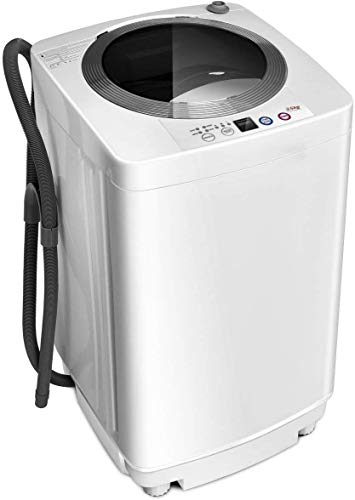
The Giantex is the minimalist of the guide: a full-automatic portable washer of 8 lbs capacity with spin drying and a built-in pump drain, described by its title as a washer and dryer combo for apartments, RVs, and dorms. Precision matters here — its “dryer” is a spin dryer, which extracts water centrifugally rather than tumbling laundry in heated air. Towels leave it damp, not dry, and a salon planning around it must plan the finishing step too: a rack, a radiator, or a separate small dryer.
Within that honest definition, the little machine has a real salon niche. A single treatment room generating a handful of hand towels and face cloths a day can wash them in the corner, spin them nearly dry, and finish them on a rack overnight, without plumbing work — the built-in pump pushes water to a sink rather than demanding a floor drain. For a home-studio practitioner, that is the entire laundry department in the footprint of a waste bin.
What it cannot do is scale. Eight pounds is a few towels and a cape; a day spa’s robe stream would pass through it in endless relays, each relay wearing a household motor that was never promised for the work. Buy the Giantex for the stream it fits, and it is a tidy solution. Buy it as a spa’s main engine, and the mismatch will announce itself quickly.
Its full-automatic operation is the counterweight to its size: unlike the twin tub below, it asks for no attendance between loading and unloading, which suits a practitioner who washes between clients and cannot supervise a transfer step.
- Class: compact portable washer with spin drying — not a heated tumble dryer
- Capacity: 8 lbs, full-automatic operation
- Drainage: built-in pump drain, suited to sink drainage
- Maker’s stated settings: apartment, RV, dorm
- Duty note: household-duty; finishing step (rack or separate dryer) required for towels
- Where to buy: the Giantex Portable Washer and Dryer Combo listing on Amazon — check price on Amazon
Strengths
- The smallest footprint here, with pump drainage that needs no floor drain.
- Full-automatic cycles need no attendance between clients.
- A tidy dedicated machine for hand towels and face cloths in one room.
Trade-offs
- Spin drying leaves towels damp; a finishing method is mandatory.
- Eight pounds is a stream, not a salon’s whole laundry.
- Household construction under a business workload ages quickly.
Noise and vibration deserve a mention for a machine that may work metres from a treatment table. Small portables on hard floors can wander and chatter at spin speed; a level surface, a mat beneath, and loads balanced by size keep the little Giantex civilised. In a home studio where the treatment room and the laundry corner share a wall, those small courtesies protect the calm the client is paying for.
Best for: home studios and single rooms washing small cloth items daily. Poorly suited to: robe and bath-towel volumes, or anyone expecting heated drying from it.

Auertech 48lbs Twin Tub Washer — Twin-tub towel workhorse
The Auertech twin tub is the oldest idea in this guide and, for salon towels specifically, one of the cleverest. One tub washes up to 30 lbs; the second spins up to 18 lbs; a drain pump empties the wash side; and the whole arrangement is semi-automatic, meaning a person lifts laundry from wash tub to spinner. That human step is the price, and the continuous rhythm it enables is the payoff: while one batch spins, the next is already washing, so towels flow through the machine in a pipeline instead of a queue.
Salon work suits that pipeline unusually well. Towels arrive in a steady trickle all day rather than in one evening avalanche, and a twin tub converts the trickle into finished, spun towels at the same pace, with no load ever waiting for a full cycle to end. The wash water can also serve more than one batch for lightly soiled items — a practice as old as the twin tub itself — which trims water and detergent across a day of hand towels, though hygiene-critical loads in a spa should always get fresh water and the establishment’s own protocols govern that judgement, not this guide.
Like the Giantex, the Auertech’s finishing step is a spin, not heated drying; towels will still want air or a dryer to reach shelf-dry. And the semi-automatic design demands a person’s hands every cycle, which in a staffed salon is a feature — someone is always there — and in a solo practice is a genuine cost in attention. The 48 lb headline is the sum of both tubs, so read the split, 30 washing and 18 spinning, as the machine’s true shape.
For a salon owner who thinks in flow rather than in loads, this is the portable pick with a business rhythm hiding inside a household price class.
- Class: twin-tub portable washer, semi-automatic
- Wash tub: 30 lbs; spin tub: 18 lbs (48 lbs combined headline)
- Drainage: drain pump fitted
- Operation: manual transfer between tubs; wash and spin can overlap
- Duty note: household-duty construction; finishing air-dry or tumble step still required
- Where to buy: the Auertech 48lbs Twin Tub Washer listing on Amazon — check price on Amazon
Strengths
- Pipelined washing and spinning matches a salon’s steady towel trickle.
- The largest wash-side capacity of any portable here.
- Simple mechanics and a drain pump keep installation and upkeep easy.
Trade-offs
- Every cycle needs a person’s hands for the transfer step.
- Spin finishing is not heated drying; towels still need air or a dryer.
- The combined 48 lb headline overstates any single tub’s capacity.
Maintenance on a twin tub is refreshingly legible. There are no boards to diagnose and few mysteries: lint is gathered by hand, tubs are wiped down, and the machine’s whole state is visible at a glance. For a salon owner who is also the maintenance department, that transparency has real value — a machine you can understand is a machine you can keep, and a machine you can keep is capacity you do not have to buy twice.
Best for: staffed salons with a continuous towel stream and someone always nearby. A weak match for: solo practitioners who need laundry to run unattended.

Hamilton Beach 2.65 All-in-One Washer Dryer Combo — One-drum simplicity, 120V
The Hamilton Beach combo takes the opposite route from the twin tub: one front-load drum of 2.65 cu. ft. that washes and then dries the same load, with more than a dozen wash programs, an LED display, delay start, an 800 RPM spin, and ordinary 120V power. For a salon, its charm is administrative — load it, set it, and collect finished, dry towels hours later without a transfer, a second machine, or any electrical work beyond a normal outlet.
Delay start is the feature a studio should notice. A practitioner can load the day’s towels at close of business, set the combo to run in the small hours, and open to a drum of dry towels. That overnight rhythm is how a small machine serves a business bigger than itself: it works the shift nobody else wants. The same trick serves the morning, with a load finishing as the first client arrives.
The honest costs are the combo class’s own. One drum doing both jobs takes longer end-to-end than two machines working in parallel, and the drying capacity of a combo is effectively a part-load of its washing capacity, so towels should be washed in modest batches for the drying half to keep its promise. An 800 RPM spin is also gentle by modern standards, leaving more water for the drying stage to remove. None of this disqualifies the machine for a small salon; all of it argues for batch discipline.
Judged as a home-studio appliance that happens to serve a business, the Hamilton Beach is the most set-and-forget option here — and for many one-room practices, set-and-forget is the whole requirement.
- Class: all-in-one front-load washer dryer combo, single drum
- Capacity: 2.65 cu. ft.; spin speed 800 RPM
- Power: 120V, standard household outlet
- Programs: 12+ wash programs, LED display, delay start
- Duty note: household-duty; drying works best with part-loads of the wash capacity
- Where to buy: the Hamilton Beach 2.65 All-in-One Washer Dryer Combo listing on Amazon — check price on Amazon
Strengths
- Washes and dries in one drum with no transfer and no second machine.
- Delay start lets towels run overnight and greet the first client dry.
- Ordinary 120V power keeps installation at zero-project level.
Trade-offs
- Serial wash-then-dry cycles are slower than parallel two-machine sets.
- Effective drying capacity is a part-load of the wash drum.
- A single drum is a single point of failure for the whole laundry.
The combo’s gentleness with space extends to plumbing. A single water connection and a single drain serve both halves of the process, which is why combos colonise apartments and small studios where every extra hose run is a negotiation with the building. A salon corner built around one combo can be dismantled and moved in an afternoon — a real consideration for leased premises and for practitioners whose studio may migrate rooms as the business grows.
Best for: one-room practices that value unattended, overnight laundry above speed. Not suited for: salons needing towels turned around within the hour at volume.
Salon Options by Class and Capacity
| Pick | Class | Capacity as titled | Power and finishing |
|---|---|---|---|
| DINENOVATE Commercial Industrial Washer Dryer 3-in-1 | Commercial 3-in-1 | 33 lbs | 220V single phase; heated drying in-unit |
| ROVSUN 30LBS Washer and 3.5 Cu Ft Dryer Set | Portable two-machine set | 30 lbs washer; 3.5 cu. ft. dryer | Household outlets; true tumble drying |
| ROVSUN 25LBS Washer and 2.6 Cu Ft Dryer Set | Portable two-machine set | 25 lbs washer; 2.6 cu. ft. dryer | Household outlets; true tumble drying |
| Giantex Portable Washer and Dryer Combo | Compact washer, spin dry | 8 lbs | Pump drain; spin finishing only |
| Auertech 48lbs Twin Tub Washer | Twin tub, semi-automatic | 30 lbs wash; 18 lbs spin | Drain pump; spin finishing only |
| Hamilton Beach 2.65 All-in-One Washer Dryer Combo | All-in-one combo | 2.65 cu. ft. | 120V; heated drying in one drum |
What Does a Towel Day Actually Look Like in a Small Salon?
Count it before you buy anything. A two-chair salon with a steady book might soil forty hand towels, a dozen large towels, and a few capes in a day; a massage practice adds sheets and face-cradle covers; a day spa multiplies everything by robes. In weight, the two-chair day is perhaps three portable-sized loads — well inside the larger ROVSUN set’s comfortable rhythm, feasible for the twin tub’s pipeline, and a full relay race for the Giantex. The day spa’s robe-heavy count is a different country, and its honest destinations are the DINENOVATE or a laundry service, with portables as support rather than as the plan.
The counting exercise also reveals where a salon’s laundry pain actually lives. For most small operations it is not raw capacity but turnaround at the peak: the 4 p.m. hour when the towel shelf empties faster than any machine refills it. Solutions live in stock as much as in machinery — owning three days of towels converts a laundry emergency into a laundry schedule — and in the rotation discipline that keeps two modest machines alternating instead of one machine sprinting. Salons that prize a quiet back room while clients relax will also want the placement thinking in Best Quiet Tumble Dryers, where noise is treated as the design problem it becomes in a spa.
How Should a Salon Set Up a Back-Room Laundry Corner?
Start with water’s whole journey. Portable washers fill from a tap or a hose connection and drain by pump or gravity, so the corner needs a water source, a drain point that can take sudsy flow at the machine’s pace, and a floor that forgives the occasional spill — because in a working salon, the spill is a when, not an if. Keep the detergent and salon chemicals shelved above the machines rather than beside them, both for safety and because heat and vibration walk bottles off edges.
Then plan the towel logistics as a one-way street: soiled bin at the door, machines along the wall, folding surface, clean shelf. A corner arranged so a stylist can drop, load, and collect without crossing their own path will be used correctly at the busiest moment; a corner that requires choreography will be bypassed, and bypassed laundry becomes the owner’s evening job. Ventilation matters more than salons expect — several machines drying in a small room will fog it — and a simple exhaust path keeps both the room and the machines healthier.
Which Salon Laundry Mistakes Cost the Most?
The expensive mistake is category confusion: buying a portable set with a laundromat’s expectations and discovering the difference during the first fully booked week. The second is ignoring the electrical line — ordering the commercial unit for premises that cannot feed it, or assuming a leased unit’s panel is yours to expand. Third is forgetting the finishing step on spin-only machines, whose towels emerge damp to an owner who planned for dry.
Fourth, salons underbuy towels and overbuy machinery, when the arithmetic usually runs the other way: linen stock is the cheapest capacity there is. Fifth is neglecting the water story — a portable draining into an undersized sink will flood a back room with grey water at the worst possible moment. Each of these mistakes is a planning failure rather than a product failure, which is good news: planning is free, and this guide exists to front-load it.
How Do You Keep Delicate Items Safe in Hard-Working Machines?
Salon laundry is mostly towels, but the exceptions matter: a client’s garment entrusted to you, the delicate robe a spa charges a premium for, the therapist’s own kit. Hard-working machines earn their keep on the bulk stream, and the delicate stream deserves its own gentler logic — lower agitation, cooler water, and a cycle chosen for fabric rather than for speed. The principles behind that gentler logic are laid out for washers generally in Best Washers With a Handwash Cycle, which salon owners can borrow wholesale for their exception loads, even though the machines differ.
What Should a Salon Owner Measure in the First Month?
Three numbers will tell you whether the purchase was right. Loads per day, counted honestly for a fortnight, reveals the true duty you are imposing. Minutes of staff time per load — including transfers, folding, and restocking — reveals what the laundry actually costs in the currency a salon sells. And towel turnaround at the peak hour reveals whether the system or the stock is the constraint. Machines are bought on the first number, staffed on the second, and judged by clients on the third.
Write the numbers where the next purchasing decision will find them. When the practice grows and the commercial question returns, that month of evidence — not the memory of a busy Saturday — should size the next machine. Salons that measure their laundry stop arguing about it, and the argument was always the most expensive part.
How Should Staff Be Trained on Machines They Did Not Choose?
Briefly, in writing, at the machine. A laminated card with the salon’s two standard cycles, the dose marks for its detergent, and the rule for what never enters the drum will outperform any amount of verbal tradition, because salons have turnover and machines outlast memories. Include the failure drill on the same card: who to call, where the emergency laundry path is written, and which reserve shelf to open. Training is the cheapest reliability a salon can buy, and it compounds every time a new hire’s first solo Saturday goes quietly.
Assign the laundry a named owner on each shift, even if the work is shared. Diffuse responsibility is how loads sit wet, lint traps fill, and small faults go unreported until they are large ones. A named owner takes ninety seconds to confirm the corner is reset at close — machines empty, doors ajar where the design wants it, clean stock shelved — and that ninety seconds is the difference between a laundry system and a laundry habit.
Final Recommendation
Match the machine to the business you actually run. A one-room practice should take the Hamilton Beach for its unattended overnight rhythm or the smaller ROVSUN set for true tumble drying in batches. A staffed salon with a steady towel river should look hard at the Auertech twin tub’s pipeline, and a growing multi-chair operation should buy the larger ROVSUN set as a rotation partner — or step honestly to the DINENOVATE when the towel count, and the electrical panel, both say it is time. The Giantex serves the smallest stream with the smallest footprint. Whichever you choose, choose it with the duty cycle in plain view, and your busiest Saturday will feel like a system working rather than a machine coping.
How Should a Salon Handle Hygiene-Critical Loads?
With a written routine rather than with hope. Towels and linens that contact skin all day deserve the hottest wash the fabric tolerates, a full measured dose of detergent, and complete drying before storage, because a towel stored damp is a towel re-soiled. This guide deliberately makes no medical claims for any machine here — the listings name temperatures and programs, not sterilisation — and establishments bound by local health codes should treat those codes, not a buying guide, as the authority on their process.
The machinery supports the routine in specific ways worth using. The commercial unit’s programmable cycles let a spa standardise its towel wash so every staff member runs the same process. The twin tub’s visible water lets an owner judge a load’s state at a glance. The combo’s delay start lets the hot wash happen fresh each morning rather than sitting overnight. None of these is a hygiene guarantee; all of them are tools a deliberate routine can use well.
What Does the Rotation System Look Like in Practice?
Two machines, alternating days or alternating loads, with a third path for emergencies. In practice: the larger set takes Monday’s towels while the smaller rests, they swap on Tuesday, and the local laundromat’s number lives on the wall for the week a machine is down or the book overflows. Rotation halves each machine’s duty, spreads wear across two warranties, and converts a breakdown from a closure into an inconvenience. It is the single most valuable idea a small salon can take from this guide, and it costs less than one commercial machine’s installation.
Rotation also disciplines purchasing. Buy the first set for the stream you have, learn its true pace for a season, and let the second purchase be sized by evidence rather than by opening-week optimism. Salons grow into their laundry the way they grow into their premises — in stages, with the second stage bought smarter than the first.
Which Costs Should a Salon Budget Beyond the Machine?
The machine is the visible fraction. Behind it stand the installation (trivial for portables, a project for the commercial unit), the linen stock discussed above, water heating sized for the laundry’s appetite, detergent in trade quantities, and the floor’s forgiveness — a drain, a waterproof surface, and ventilation that keeps a small room from becoming a steam cabinet. There is also the owner’s time, which semi-automatic and small-batch machines spend freely; a twin tub’s low purchase price is partly paid in attendance, and a combo’s convenience is partly bought with cycle time. Honest budgeting counts all of it, because a salon’s laundry is a small production line and production lines are costed whole.
Replacement belongs in the same ledger. A portable set worked at business pace should be budgeted as a consumable with a horizon, not as a fixture; the salon that prices its treatments knowing the laundry equipment renews on a cycle will never be ambushed by that renewal. The commercial unit inverts the logic — a fixture with a service life — and its higher entry cost is the price of moving laundry from the consumables ledger to the capital one. Neither ledger is wrong; confusing them is.
How Do Salons Handle the Laundry During a Machine Failure?
By having decided before it happens. The resilient small salon keeps three assets ready: a relationship with a nearby laundromat or laundry service that can take a bagged emergency load, a reserve of clean towels deep enough to trade a day for a repair, and machines bought in a configuration — two-piece sets, a rotation partner — where one failure degrades service instead of ending it. The failure itself is unremarkable; every machine in this guide will eventually have one. What separates businesses is whether the failure was rehearsed.
Practically, that means keeping the emergency path’s details written down: the laundromat’s hours, the service’s collection minimum, the spare machine’s location if one is stored. It also means not letting a limping machine limp for months, because a washer run while a fault develops tends to convert a repair into a replacement at the least convenient moment on the calendar.
How Does a Salon Choose Between One Good Machine and Two Modest Ones?
By asking what failure costs. One good machine — the commercial unit, properly installed — offers the best per-load process and the worst failure mode: everything stops. Two modest machines offer a worse per-load process and a graceful failure mode: half the laundry continues. A salon whose clients can be rescheduled tolerates the first risk; a salon booked solid for weddings cannot. There is no universal answer, only the discipline of pricing your own downtime honestly before the market prices it for you.
Growth argues in stages. Most small salons should begin with the modest-and-redundant pattern, because it matches uncertain early volumes and preserves cash, then graduate the senior machine to commercial class when the towel count proves the need for a season rather than a week. The portable set that graduates out of the senior role rarely leaves the business — it becomes the rotation partner, the delicate-stream machine, or the home studio’s set when the owner expands. Equipment bought honestly for its class tends to keep finding work.
Frequently Asked Questions
Can a portable washer really handle a salon’s towels?
A small salon’s, yes — with rotation, rest between loads, and a backup plan. Portable machines are household-duty equipment; a two-chair salon’s few daily loads sit within that duty, while a day spa’s continuous robe stream does not. The guide frames each pick by the scale it can honestly serve.
What does the DINENOVATE’s 220V requirement mean in practice?
It means an electrician, a dedicated single-phase 220V circuit, and a panel that can carry kilowatt-scale heating loads — an installation project to budget alongside the machine. Premises that cannot support it should choose among the portable picks, which run on ordinary outlets.
Is a twin tub practical for a business, or just old-fashioned?
Practical, for the right business. The twin tub’s wash-and-spin pipeline matches a salon’s steady towel trickle, and its simplicity is a virtue in a back room. Its costs are human attendance every cycle and spin-only finishing, so staffed salons benefit most.
Do any of these machines dry towels completely?
Three do: the DINENOVATE dries in-unit, both ROVSUN sets include true tumble dryers, and the Hamilton Beach combo dries in its single drum. The Giantex and the Auertech spin water out but leave towels damp, so they need air finishing or a separate dryer.
How many towels should a small salon own?
Enough that laundry is a schedule rather than an emergency — commonly around three days’ worth for the busiest service, so one day is in use, one is in the wash stream, and one is clean in reserve. Stock is the cheapest laundry capacity a salon can buy.
What is the best setup for a home-based spa studio?
Usually the Hamilton Beach combo for unattended overnight cycles, or the smaller ROVSUN set where a separate dryer can live. Both run on household power, fit domestic corners, and keep a solo practitioner’s towel stream inside the house rather than at a laundromat.
Should a salon wash towels at the hottest setting every time?
Follow the fabric and your local code. Towels tolerate heat that robes and delicate items do not, and the establishment’s own hygiene routine — set by its licensing rules, not by a machine’s marketing — decides the standard cycle. What the machines here offer is the ability to run that cycle consistently, which is the part equipment controls.
Can these portable sets run on a generator or in a mobile salon?
The titles do not speak to generator use, and this guide will not invent the claim. Portable machines need the stable power their listings assume; a mobile operation should confirm electrical requirements with the maker before building a service around any of them.
Is it cheaper to use a laundry service instead?
For some volumes, yes — services convert laundry into a per-bag cost with no machinery, no duty cycle, and no back-room space consumed. The crossover arrives when a salon’s weekly service bill approaches the running cost of the rotation system described in this guide, or when turnaround control matters more than the arithmetic. Count your loads for a month and compare honestly.
Where should the laundry corner go in a leased salon?
Near water, obviously — but also where its inevitable small leaks and hums do the least harm: away from treatment rooms, off the client’s path, and on a floor the lease lets you protect. Confirm with the landlord before any plumbing is touched, and keep portable machines’ flexibility as your negotiating friend.
How long will a portable set last in salon service?
No honest number exists, because it depends on loads per day, water, and care — but plan on a horizon measured in a few years of business use rather than the decade a household might see, and budget the replacement from the first month. A set that is rotated, rested, and kept clean will land at the kind end of that range.
What is the first upgrade a growing salon should make?
Usually stock, then a second machine, then commercial class — in that order. Towel depth hides a multitude of capacity sins, a rotation partner halves every machine’s burden, and only a proven, sustained volume justifies the electrical project the commercial unit requires.
Related Guides
Owners weighing whether a home-grade commercial-style machine could bridge the gap between portables and the DINENOVATE should read Best Commercial Washers for Home Use, which takes that in-between class on its own terms.


