What's inside
- Key Takeaways
- Quick Picks
- How did we judge commercial washers for a home shortlist?
- How do the six commercial routes compare?
- What actually makes a washer commercial rather than domestic?
- What do you give up when a commercial washer comes home?
- How does repairability change the true cost of a washer?
- Who should not buy a commercial washer for home use?
- How should you set up a commercial washer for a long home life?
- How do commercial machines handle water, energy, and detergent?
- What questions should you ask before buying commercial for home?
- How does a commercial washer change a household’s relationship with laundry?
- What does the second-hand and inheritance picture look like?
- What mistakes do home buyers of commercial washers make?
- Final Recommendation
- Frequently Asked Questions
- Related Guides
As an Amazon Associate I earn from qualifying purchases. This post may contain affiliate links at no extra cost to you.
cottageverdict.com is reader-supported. When you buy through links on our site, we may earn an affiliate commission.
Where to buy: the linked machines below sit on Amazon under the heading names shown, so read each listing’s control and tub details with a sceptic’s care, and check price on Amazon once the commercial proposition survives your scrutiny.
The best commercial washers for home use are bought by people who have stopped believing in features. Somewhere in their past stands a domestic machine that died young under honest work, a control board that failed expensively, a plastic component that met a heavy load and lost, and the lesson hardened into a purchasing philosophy: buy the machine built for a laundromat’s duty cycle, accept fewer programmes and more noise, and expect the thing to outlast the fashion cycle several times over. This guide serves that philosophy seriously, including its costs.
Commercial-grade, as a phrase, needs policing before any pick is named, because marketing has stretched it over machines that merely look industrial. In this guide the term is reserved for washers whose design lineage is genuinely commercial: built by makers who supply laundromats and institutions, constructed around metal components where domestic machines use plastic, driven by simpler, heavier mechanisms, and controlled with a directness that assumes a user who wants washing done rather than an experience curated. Speed Queen dominates the linked picks because Speed Queen dominates that definition in the American market, and pretending otherwise for variety’s sake would mislead the very buyers this category exists for.
The three linked picks are all Speed Queen top-loaders of 3.2 cubic feet: an ADA model in matte black billed as ultra-quiet, the TR5003WN with knob control and a stainless tub, and the TR7003WN with digital controls, eight wash cycles, and the same stainless construction. Three prose-only slots then cover the commercial routes that reach homes without clean marketplace listings: Maytag’s commercial-technology home range, true coin-operated-grade machines adapted for home use through commercial suppliers, and Huebsch’s commercial line. No warranty duration is stated anywhere in this guide, because no listing title here prints one, and commercial reputations do not license invented numbers.
Expect the trade-offs to be stated as plainly as the virtues. These machines are smaller in the tub than family domestic flagships, louder in character even when a title says ultra-quiet, plainer in their programmes, and positioned at premium tiers for their size. What they offer instead is the thing their buyers actually want: mechanical honesty, repairability, and the deep calm of a machine that regards a household’s weekly laundry as a light shift compared with the work it was designed to survive.
Key Takeaways
- Commercial here means laundromat lineage, metal where it matters, and controls built for work rather than theatre.
- All three linked picks are Speed Queen top-loaders of 3.2 cubic feet, differing in controls, finish, and cycle count.
- No warranty figure appears in this guide because no listing title prints one; reputation is not a number.
- The tub is smaller than domestic flagships, the tier is premium for the size, and the programmes are deliberately plain.
- Three prose-only routes cover Maytag’s commercial-technology range, coin-op-grade suppliers, and Huebsch’s line.
- Repairability is the category’s real dividend: machines designed to be serviced get serviced, for decades.
Quick Picks
| Pick | Badge | Why it earns its place |
|---|---|---|
| Speed Queen 3.2 Cu. Ft. Top Load Washer, Matte Black | Quiet-running commercial, ADA | An ADA-designated 3.2 cubic foot Speed Queen in matte black whose title promises ultra-quiet running, a rare courtesy in this class. |
| Speed Queen TR5003WN Top Load Washer | Knob-control traditionalist | A 26-inch, 3.2 cubic foot machine with knob control, a stainless tub, and an 840 RPM spin: the purist’s commercial washer. |
| Speed Queen TR7003WN Top Load Washer | Digital commercial, eight cycles | The same commercial bones as its sibling with digital controls and eight wash cycles, for households wanting a modern panel. |
| Maytag’s Commercial-Technology Home Range (Prose-Only) | Prose-only mainstream route | Maytag sells home machines built around its commercial technology story through dealers, covered qualitatively without figures. |
| Coin-Operated-Grade Machines Adapted for Home Use (Prose-Only) | Prose-only supplier route | True commercial hardware reaches some homes through laundry suppliers, minus the coin box, described here without specifications. |
| Huebsch’s Commercial Laundry Range (Prose-Only) | Prose-only second commercial brand | Huebsch is the other commercial-native name in American laundry, reaching homes through its dealer network, covered qualitatively. |
How did we judge commercial washers for a home shortlist?
The first test was lineage. A pick needed a credible claim to commercial design, a maker supplying institutional laundry, a model family sold into laundromats, or a construction story that survives inspection. That test is why one brand fills the linked slots: the verified pool for this batch contains Speed Queen’s home-sold commercial machines and no comparable listings from rival commercial makers, whose routes to homes run through dealers and suppliers and are therefore covered, honestly, as prose-only. A guide that diluted the linked list with domestic machines wearing industrial styling would betray the category’s entire premise.
The second test was evidence discipline, and it bites hardest on durability claims. Commercial machines attract numerical folklore, cycle counts, year figures, warranty spans repeated from forum to forum until they harden into fact. None of that appears here. What the listing titles state is what the reviews use: capacities of 3.2 cubic feet, spin of 840 RPM on the two TR models, a stainless steel tub on both, knob control on one, digital controls and eight cycles on the other, an ADA designation and an ultra-quiet claim on the matte black model. Where a title is silent, the review is silent, and the buyer’s verification errand is named instead of a number being invented.
Third, the picks were weighed on home suitability rather than on commercial purity alone. A machine can be impeccably commercial and wrong for a house: too loud for a kitchen-adjacent laundry, too plain for a household that genuinely uses varied cycles, too small for a family’s bedding. The reviews therefore grade each pick as a domestic citizen, noise, size, control feel, and all, because the reader’s question is not which machine would survive a laundromat. It is which machine will serve a home, daily, for a very long time, without making the home feel like a laundromat.
A final note on the prose-only trio: they were chosen to represent the three real alternative doors into this category, a mainstream maker’s commercial-technology line sold through dealers, genuine coin-op hardware adapted by commercial suppliers, and a second commercial-native brand. Each review describes the door, its costs, and its questions, with no specifications claimed for any of them.
Selection also excluded, deliberately, several domestic machines whose listings borrow commercial vocabulary for styling purposes. Their absence is not a judgement on their quality as domestic washers; it is a judgement that this particular shelf is reserved for machines whose commercial claim survives the construction questions this guide keeps asking.
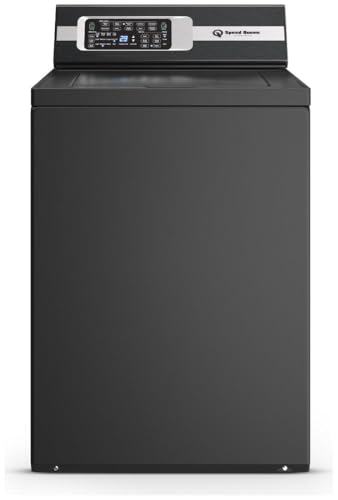
Speed Queen 3.2 Cu. Ft. Top Load Washer, Matte Black — Quiet-running commercial, ADA
Commercial machines are not famous for courtesy, which makes this model’s title worth reading twice: a Speed Queen ADA top-load washer of 3.2 cubic feet in matte black, described as ultra-quiet. The ADA designation signals accessibility-minded design, controls and reach considered for users whom standard machines underserve, and the quiet claim addresses the commercial category’s commonest domestic objection head-on. A machine built for laundromat duty that also promises to behave acoustically in a home is aiming at exactly the buyer this guide serves: durability first, but not at the price of a household’s peace.
The matte black finish deserves a sentence in a category that usually stops at white. Commercial buyers are presumed indifferent to appearance, yet a home laundry is not a laundromat, and a machine that will stand in a visible room for a very long time may as well be handsome in it. Matte black also hides the working grime of a utility space more forgivingly than gloss finishes, though it will show pale lint the way every dark finish in this batch does, and a weekly wipe remains the small standing arrangement.
What the title does not state matters to this review’s honesty: no spin figure, no cycle count, no tub material is printed for this model, so none is claimed. Buyers comparing it against the two TR models below, whose titles are more forthcoming, should open this listing’s specification section and confirm the tub construction and cycle list before deciding, because in this category those construction facts, not the feature list, are the purchase. The brand’s commercial design language suggests the answers will satisfy, but suggestion is not evidence, and this guide trades in evidence.
Choose the matte black model if accessibility, quiet, and appearance rank alongside durability in your household’s brief, and verify its construction details on the listing as part of the order. It is the commercial pick for homes that want the laundromat’s stamina without importing the laundromat’s atmosphere, and that combination is rarer in this category than it should be.
- Capacity printed in the listing title: 3.2 cu. ft.
- Designation in the title: ADA top load washer
- Running character claimed in the title: ultra-quiet
- Finish named in the title: matte black
- Details to verify on the listing: tub material, cycles, spin
Strengths
- Quiet claim suits kitchen-adjacent home laundry
- ADA designation serves users standard machines underserve
- Matte black finish suits visible rooms and hides grime
Trade-offs
- Title omits tub, cycle, and spin details entirely
- Commercial tub size trails domestic family flagships
- Premium positioning for a modest capacity figure
Best for: an accessibility-aware household wanting commercial stamina with domestic manners.
A poor fit for: a buyer who wants every construction fact stated in the title.

Speed Queen TR5003WN Top Load Washer — Knob-control traditionalist
If the commercial philosophy has a purest expression in this set, it is the TR5003WN, and its listing title reads like a manifesto: a 26-inch top-load washer with 3.2 cubic feet of capacity, an 840 RPM maximum spin, knob control, a stainless steel tub, in white. Every element of that sentence is a refusal of something fashionable. Knob control refuses the touchscreen. The stainless tub refuses coated alternatives. The stated spin figure refuses vagueness. Even the 26-inch width refuses the modern cabinet’s slow growth, keeping the machine slimmer than the domestic standard its buyers are replacing.
Knob control deserves defence as engineering rather than nostalgia. A rotary control can be operated with wet hands, with gloves, by touch without looking, and by users whose eyesight makes flat panels a daily negotiation. It also ages differently: a knob’s failure modes are mechanical and legible, while a touch panel’s are electronic and total. In a category whose buyers are purchasing decades, the control that a technician can understand at a glance is not a retro affectation. It is a longevity decision wearing a simple shape.
The stainless tub and the stated spin complete the working specification. Stainless resists the chipping and corrosion pathways that end lesser tubs’ lives, and 840 RPM is an honest, moderate extraction figure, chosen, one suspects, for balance and drivetrain kindness rather than for brochure drama; laundry emerges ready for the dryer or the line without the machine having shaken itself heroically to achieve it. Households coming from a high-spin domestic machine should expect slightly damper loads and slightly longer drying, the small recurring tax on a drivetrain built to be kind to itself.
Buy the TR5003WN if your household’s ideal control is a knob, your laundry’s soil is honest work dirt, and your planning horizon is measured in decades. It will not steam, it will not connect, and it will not apologise. It will wash, spin, and submit to servicing with a grace its feature-laden rivals can only envy, which is the entire point of its existence.
- Width and capacity in the title: 26 inches, 3.2 cu. ft.
- Maximum spin stated in the title: 840 RPM
- Controls named in the title: knob control
- Tub material in the title: stainless steel
- Model and finish in the title: TR5003WN, white
Strengths
- Knob control works with wet hands and weak eyesight
- Stainless tub refuses corrosion and chipping pathways
- Slimmer cabinet fits older, narrower laundry spaces
Trade-offs
- Moderate spin leaves loads damper than domestic rivals
- Programme variety is deliberately minimal
- Capacity is modest for large-family bedding
Best for: a traditionalist household buying a washer for the next several decades.
Not suited for: a feature-seeker who wants steam, connectivity, or cycle theatre.

Speed Queen TR7003WN Top Load Washer — Digital commercial, eight cycles
The TR7003WN is the bridge machine of the set: commercial construction for households that nevertheless live in the present. Its title mirrors its sibling’s foundations, a 26-inch top-load washer of 3.2 cubic feet with an 840 RPM maximum spin and a stainless steel tub in white, then changes the interface and the vocabulary: digital controls and eight wash cycles. That pairing is the model’s whole argument. The drivetrain and tub stay in the commercial tradition, while the panel acknowledges that many households genuinely use a spread of programmes and prefer selecting them on a display they can read at a glance.
Eight cycles, in this category, is a considered number rather than a stingy one. Commercial design assumes that laundry sorts into a handful of honest categories, work clothes, everyday loads, heavy items, delicates, and that a machine offering dozens of programmes is offering permutations rather than capabilities. Eight well-chosen cycles cover a household’s real distribution without burying the everyday programmes under novelty. Households arriving from a thirty-cycle domestic machine should audit their actual habits before mourning: most discover they lived on four programmes and visited the rest as tourists.
Digital controls in a commercial frame also change the service conversation in a way buyers should weigh calmly. A display can communicate fault information that a knob cannot, which can shorten a technician’s diagnosis, while the panel itself becomes an electronic component in a machine otherwise proud of mechanical simplicity. Neither consideration decides the purchase alone. Households with strong eyesight, dry hands, and a love of precise programme selection will prefer this panel; households sharing the TR5003WN’s values will prefer its knob, and the brand, wisely, sells both philosophies in the same bones.
Choose the TR7003WN if you want commercial construction without giving up a modern interface or a reasonable cycle vocabulary. It is the pick for the buyer who cross-shopped domestic flagships, admired their panels, distrusted their longevity, and went looking for a machine that splits the difference without splitting its own drivetrain.
- Width and capacity in the title: 26 inches, 3.2 cu. ft.
- Maximum spin stated in the title: 840 RPM
- Controls named in the title: digital controls
- Cycles stated in the title: 8 wash cycles
- Tub material in the title: stainless steel, white finish
Strengths
- Commercial bones with a contemporary interface
- Eight cycles cover real household laundry honestly
- Display can communicate faults to a technician
Trade-offs
- Panel adds an electronic component to a mechanical brief
- Spin remains moderate beside domestic flagships
- Same modest capacity as its knob-controlled sibling
Best for: a modern household wanting commercial stamina with digital manners.
Not suited for: a purist who believes a washer’s panel should be a knob.
Maytag’s Commercial-Technology Home Range (Prose-Only) — Prose-only mainstream route
Maytag’s route into this category runs through the showroom rather than the marketplace, and it speaks to a buyer the Speed Queen list does not fully reach: the household that wants commercial thinking inside a mainstream brand’s ecosystem, with its familiar dealer network, its domestic styling, and its service arrangements. The range is covered here as prose-only because this batch’s verified pool holds no clean listing for it, and the review therefore claims no capacities, cycles, or warranty terms. What can be said is that the brand explicitly markets a commercial-technology lineage for these home machines, a heavier-duty design story than its standard domestic line tells.
That positioning needs a buyer’s scepticism kept in proportion. Commercial technology in a home machine means selected commercial ideas, components, and design priorities carried into a domestic product, which is a different promise from a laundromat machine sold for the home, and the difference is worth a direct showroom question: which specific components and structures does the commercial claim rest on for the exact model being quoted? A dealer who answers concretely, naming parts and construction, is selling a real lineage. A dealer who answers with atmosphere is selling a badge, and badges do not survive loads.
The range’s practical advantages are the mainstream ones, and they are genuine. Dealer distribution means delivery, installation, and haul-away bundled by people who will also service the machine, and the brand’s parts ecosystem is as deep as any in American laundry. For households far from metropolitan service hubs, that ecosystem can rationally outweigh the purer commercial lineage of a less locally supported machine, because a washer’s durability is only ever as real as the service that stands behind it.
Pursue this range if your local Maytag dealer’s answers are concrete and its service story is strong, and compare its complete delivered figure against the Speed Queen picks’ verified listings. Let the comparison be decided by construction answers and service depth rather than by the word commercial itself, which this range uses more loosely than the linked picks earn it.
- Buying route: mainstream retail, with the commercial-technology line checked by model
- Route described: dealer-sold home range, commercial-technology story
- No capacity, cycle, or warranty figure is claimed for this range
- Verification advice: ask which components carry the claim
- Positioning described in words only: mainstream to premium tier
Strengths
- Mainstream dealer network bundles delivery and service
- Familiar brand ecosystem simplifies parts and repairs
- Domestic styling suits homes wary of industrial looks
Trade-offs
- Commercial claim is a lineage story, not laundromat hardware
- No listing means claims rest on the dealer’s answers
- Exact models vary, so quotes need configuration detail
Best for: a service-first buyer whose local dealer answers construction questions concretely.
Not suited for: a purist who wants a machine designed for laundromats themselves.
Coin-Operated-Grade Machines Adapted for Home Use (Prose-Only) — Prose-only supplier route
The most literal route into this category never passes through a consumer listing at all. Commercial laundry suppliers sell the same top-load hardware that serves laundromats to institutions, landlords, and occasionally to households, in versions without the coin mechanism, or with it disabled, for installation in a home laundry. No such machine sits in this batch’s verified pool, so the route is covered as prose-only, with no model or figure claimed. It is included because for a certain buyer, the mechanically minded, the rural, the owner of a smallholding or a multi-unit property, it is not an exotic option but the obvious one.
The hardware’s character follows from its workplace. Machines built to be paid for by the load, serviced by route technicians, and abused by strangers are engineered for access panels that open sensibly, components that swap rather than entomb, and controls that survive indifference. Brought home, that character translates into a washer that a competent owner can understand deeply, maintain personally where permitted, and keep running across timescales domestic appliances rarely contemplate. The coin-op lineage is the commercial category’s source code, and buying near the source has a logic no badge can imitate.
The route’s costs are equally characteristic. Suppliers sell to trade rhythms: delivery may mean a pallet at the kerb, installation advice may assume a plumber already engaged, and the machine’s domestic manners, noise, programme subtlety, water temperament, will be exactly as uncompromised as its workplace intended. Warranty and support arrangements follow commercial practice rather than consumer custom, and a household should have those terms in writing, understood, before money moves, because assumptions imported from domestic retail will mislead in both directions.
Choose this door if you have the skills or the tradespeople to meet it halfway, and if the machine’s workplace honesty appeals more than any showroom’s polish. It is the connoisseur’s route into commercial laundry, demanding the most of its buyer and, in the right hands, returning the most across the longest horizon this guide can imagine.
- Buying route: commercial laundry suppliers, quoted with home installation in mind
- Route described: commercial laundry suppliers, trade terms
- Hardware character described: coin-op lineage without the coin box
- No capacity, cycle, or warranty figure is claimed for this route
- Buyer requirement: installation and service arranged by the household
Strengths
- Purest commercial construction available to a home
- Design assumes servicing, so servicing is easy
- Route suits rural and multi-unit property owners
Trade-offs
- Delivery and installation follow trade, not retail, custom
- Domestic manners are entirely uncompromised
- Support terms must be captured in writing first
Best for: a mechanically confident household buying near the commercial source.
Not suited for: a buyer expecting retail delivery, setup, and hand-holding.
Huebsch’s Commercial Laundry Range (Prose-Only) — Prose-only second commercial brand
American commercial laundry has a second native name that informed buyers speak in the same breath as the linked brand on this page, and a guide to the category would be incomplete without it. Huebsch builds laundry equipment for laundromats and institutions, and its machines reach homes through commercial dealer networks rather than through consumer listings, which is why this slot is prose-only: no verified listing in the pool, no model named, and no specification claimed. The range’s identity, in general terms, is the institutional one, equipment designed for throughput, service access, and indifference to fashion.
For a home buyer, the range’s interest lies in what a second commercial-native source does to the decision. It proves the category is a market rather than a monopoly, gives the buyer a comparison to draw in dealer conversations, and offers an alternative service ecosystem where its network is locally stronger. Commercial equipment lives or dies by its regional support, and there are territories where the Huebsch dealer’s bench, parts shelf, and reputation exceed the alternatives. In those territories, the locally stronger commercial brand is the rational commercial purchase, whatever national folklore says.
The showroom discipline for this range mirrors the rest of the guide, sharpened by the trade setting. Establish that the machine quoted is genuinely from the commercial line rather than a domestic stablemate, have the configuration and its construction described in writing, and clarify the support arrangement’s terms before comparing figures. Then set the complete delivered proposition beside the linked Speed Queen listings and the Maytag route, and let service depth, construction answers, and total cost argue it out on paper.
If Huebsch wins that argument in your region, buy it with the same expectations this guide sets for the whole category: a smaller tub than domestic flagships, plainer programmes, a premium tier for the size, and in exchange a machine whose design assumes it will be serviced and kept, not replaced. That assumption, honoured by a good local dealer, is the closest thing laundry offers to permanence.
- Buying route: commercial laundry dealers; a commercial line sold for long service
- Route described: commercial dealer networks
- Identity described generally: institutional laundry equipment
- No capacity, cycle, or warranty figure is claimed for this range
- Decision factor named: regional service strength
Strengths
- Second commercial-native source enables real comparison
- Institutional design assumes service and longevity
- Regional networks can exceed rivals locally
Trade-offs
- Trade channels resist casual consumer browsing
- No listing transparency for home verification
- Home suitability varies by exact commercial model
Best for: a buyer whose region is served strongly by its dealer network.
Not suited for: a shopper who wants a checkable consumer listing tonight.
How do the six commercial routes compare?
| Pick | At a glance |
|---|---|
| Speed Queen 3.2 Cu. Ft. Top Load Washer, Matte Black | 3.2 cu. ft., matte black, ADA, ultra-quiet claim. |
| Speed Queen TR5003WN Top Load Washer | 3.2 cu. ft., knob control, stainless tub, 840 RPM. |
| Speed Queen TR7003WN Top Load Washer | 3.2 cu. ft., digital controls, 8 cycles, 840 RPM. |
| Maytag’s Commercial-Technology Home Range (Prose-Only) | Prose-only dealer range; commercial-technology story. |
| Coin-Operated-Grade Machines Adapted for Home Use (Prose-Only) | Prose-only supplier route; coin-op lineage, no figures. |
| Huebsch’s Commercial Laundry Range (Prose-Only) | Prose-only dealer range; institutional, no figures. |
What actually makes a washer commercial rather than domestic?
Strip the marketing away and four differences remain, all of them physical. First, duty cycle: a commercial machine is designed for many loads a day, every day, so its motor, bearings, and suspension are specified for a workload a domestic machine meets only in its brochures. Second, materials: metal appears where domestic design uses plastic, in components whose failure ends machines, because a laundromat cannot tolerate the downtime that a household merely resents. Third, serviceability: panels open, parts swap, and a technician’s hour is respected by the design, since the machine’s owners pay for that hour by the visit. Fourth, control philosophy: the machine assumes its user wants laundry washed, so its programmes are few, legible, and hard to misuse.
Notice what is absent from that list: size, speed, and spectacle. Commercial tubs are often smaller than domestic flagships, their spins moderate, their cycle counts short, because their workplace values throughput and survival over any single load’s pampering. A home buyer importing commercial values must import that whole philosophy, not cherry-pick durability while expecting flagship capacity and theatre alongside it. The machines in this guide are honest examples of the philosophy, which is why their reviews keep returning to the same ledger: less of almost everything visible, more of everything structural.
There is a fifth, quieter difference worth naming: documentation and parts culture. Commercial equipment lives inside an ecosystem that expects repair manuals to exist, parts to remain orderable, and technicians to know the platform across many years. A domestic flagship may be a finer machine in its first year and an orphan in its ninth, when its board is discontinued and its maker’s attention has moved to a newer line. Commercial buyers are purchasing the ecosystem as much as the appliance, and on a twenty-year view the ecosystem is frequently the better half of the bargain.
What do you give up when a commercial washer comes home?
Capacity heads the honest list. At 3.2 cubic feet, every linked pick here asks a family to rethink loads it currently throws at a five-cubic-foot domestic tub: bedding travels singly and more often, weekly clothing splits into more cycles, and the household’s rhythm shifts from bulk to frequency. For singles, couples, and small households the shift is painless. For a large family it may be disqualifying, and this guide would rather lose that reader here than have them discover the arithmetic across a winter of bedding.
Programmes and gentleness follow. Commercial cycles are built for the laundry of strangers: robust, general, and uninterested in the biography of a vintage blouse. Households with significant delicate, technical, or heirloom wardrobes will find the commercial vocabulary blunt, and should plan a division of labour, the commercial machine for the household’s heavy ninety percent, hand care or a gentler route for the rest. Steam, soak theatre, and app-based cycle downloads are likewise absent, not as oversights but as philosophy: every omitted feature is a component that cannot fail at year eleven.
Noise and finish complete the ledger, with nuance. Commercial machines carry a working acoustic character, pumps and drivetrains audible as machinery rather than as ambience, though the matte black pick’s ultra-quiet claim shows the category learning domestic manners. Finishes are workmanlike, white enamel and the occasional dark option, chosen for the room the machine will actually inhabit. Buyers should want these trades consciously. The commercial purchase fails only when its costs arrive as surprises, and this section exists so that none of them do.
How does repairability change the true cost of a washer?
A washer’s purchase price is the first instalment of its cost, not the total, and repairability decides the instalments that follow. A machine designed for service converts its failures into events: a pump replaced in an hour, a belt renewed on a schedule, a control swapped by a technician who has done it fifty times. A machine designed against service converts the same failures into verdicts, because the labour to reach a cheap part exceeds the machine’s remaining value and the whole appliance is discarded for a component worth a fraction of its price. Across two decades, the serviceable machine’s ledger wins even when its first instalment was the larger one.
Owners can audit repairability before buying with three questions. Are the wear components, pump, belt, suspension, reachable without dismantling the machine’s soul? Does the maker publish or supply parts through channels a local independent technician actually uses? And does that technician, asked directly, speak of the platform with familiarity or with a sigh? The third question is the most informative and the cheapest to ask, and commercial platforms, built for route service, tend to pass it with the ease of long practice.
There is also a household-level dividend that never appears in cost comparisons: continuity. A repairable washer keeps its place, its dimensions, its hookups, and its habits across decades, sparing the household the repeated tax of remeasuring rooms, relearning controls, and renegotiating delivery for each replacement. Families underestimate that tax because it is paid in afternoons rather than in currency. The commercial buyer pays it once, and then, with ordinary luck and honest maintenance, stops paying it for a very long time.
Who should not buy a commercial washer for home use?
Large families with bedding-heavy laundry should think hardest, because the category’s modest tubs tax exactly their load profile, and no amount of drivetrain virtue compensates for a duvet that must be washed in shifts. Households that cherish programme variety, steam rituals, and connected conveniences should also pass, not because those things are frivolous but because this category’s machines will frustrate a legitimate preference daily, and a purchase resented daily is a bad purchase at any durability. The commercial philosophy serves those who share it; it converts nobody.
Renters and short-horizon owners form the second group. A machine bought for decades is a poor investment for a two-year tenancy, its premium unrecovered and its virtues unharvested, and a good domestic compact will serve that chapter better. Likewise, households whose laundry room doubles as a nursery-adjacent quiet zone should weigh the category’s working acoustics honestly against the one title here that promises quiet, and verify that promise against the listing and, if possible, a showroom’s ears before generalising it to the class.
Finally, buyers who want the word commercial as a talisman, without the philosophy’s disciplines, should save their money. These machines still require level installation, honest loading, measured detergent, and periodic maintenance, and they punish neglect with the same physics as any washer, merely across a longer fuse. The category rewards owners who maintain things. It offers no miracles to owners who do not, and a guide that pretended otherwise would be selling the talisman itself.
How should you set up a commercial washer for a long home life?
Installation is destiny for a machine expected to serve for decades, so spend effort there disproportionately. A solid, level footing matters more than any other single act: the floor should be the most rigid available, the feet adjusted until the cabinet is dead level in both axes, and the first spin observed in person. Supply hoses should be new and of quality, the drain secured so a working pump cannot walk it free, and the machine given the ventilation and access clearance its service future will one day require. An extra hour at installation is repaid across every year the machine serves.
Establish the maintenance rhythm in the first month, while motivation is high. A monthly tub-clean cycle or hottest empty wash, a wipe of the lid and dispenser areas, a glance at hoses and floor, and a quarterly check of levelling as floors settle and feet compress. Commercial machines tolerate workload superbly and neglect merely well, and the small rhythm keeps them in the first category. Record the machine’s exact model identity and purchase paperwork in the household’s durable place, because a twenty-year appliance will outlive several filing systems if its owners let it.
Load discipline completes the setup, and in this category it has a specific flavour: respect the modest tub. Three point two cubic feet loaded loosely and often will out-clean and out-last the same tub stuffed in optimism, because balance and circulation are the machine’s working conditions, not suggestions. Teach every user the fill line once, kindly, and the machine’s next decades are largely written. Commercial longevity is not a property the machine keeps despite its household; it is a collaboration, and the household’s half is neither difficult nor optional.
How do commercial machines handle water, energy, and detergent?
Commercial top-loaders carry a reputation for thirst that deserves updating rather than repeating. Their workplace cares about time per load above almost everything, and their wash design follows that priority, using water as a working medium rather than as a scarce resource to be minimised. A home buyer should therefore expect consumption closer to traditional top-load practice than to the high-efficiency frontier explored elsewhere in this batch, and should weigh that honestly against the machine’s longevity dividend. For a household washing modest volumes, the lifetime arithmetic can still favour the commercial machine comfortably. For a high-volume household on metered water, the calculation deserves actual numbers from the listing and the utility bill rather than a gesture.
Detergent follows the same traditional logic. These machines work in fuller water with robust action, so they neither demand the low-sudsing discipline of high-efficiency designs nor forgive careless overdosing, which still coats, still foams, and still wastes. Measured dosing by the load’s soil, the habit this batch recommends in every category, serves commercial machines exactly as it serves efficient ones, because chemistry respects measurement everywhere.
Energy completes the picture with a spin-related nuance. The moderate extraction figures stated for the TR models mean the dryer inherits more moisture than a high-spin domestic machine would leave, so the household’s total laundry energy should be judged as a system. Pair a commercial washer with an efficient, well-maintained dryer, keep loads honestly sized so spins stay balanced, and the system’s ledger stays respectable. Judge any single machine’s consumption in isolation and you will misjudge every machine in this guide, commercial or otherwise.
What questions should you ask before buying commercial for home?
Ask first about the machine itself, in writing where possible: the exact model identity, its tub construction, its stated spin, and its cycle list, the facts this guide drew from titles and the facts, like the matte black model’s tub, that a buyer must draw from the listing’s specification section. Ask second about the support behind it: who services this platform locally, are its common parts stocked or orderable without drama, and what do the support terms actually say, read rather than summarised. In this category the second set of answers is worth as much as the first, and a seller reluctant to provide either set has answered a third question you did not have to ask.
Ask third about your own home, and answer with a tape measure and a photograph rather than with confidence: the space, the route, the hookups, and the floor’s rigidity. Commercial machines are heavier in spirit and often in fact than the domestic boxes they replace, and a delivery that fails at a doorway is an expensive education. Ask finally about your household’s true laundry, its volume, its soil, its delicates, its noise tolerance, and match the answers against the trade-off ledger in this guide’s earlier sections. The commercial purchase succeeds when all four question sets are answered before the order, and it rarely succeeds when any one of them is skipped.
How does a commercial washer change a household’s relationship with laundry?
Something subtle happens in homes that adopt these machines: laundry stops being a technology experience and becomes a chore again, in the honourable sense. There is no app to update, no cycle library to explore, no panel to learn after every firmware change. There is a tub, a control, and work that gets done, and households that have tired of appliances demanding attention often describe the simplicity as relief. The machine recedes into the background of domestic life, which is where infrastructure belongs, and stays there, functioning, while more theatrical appliances cycle through their novelties in the foreground.
That recession has a planning consequence worth stating. A household that stops replacing its washer stops re-solving the laundry room: dimensions stay settled, hookups stay undisturbed, habits stay formed. Years that would have gone to researching successors go elsewhere, and the machine’s premium, amortised across that calm, shrinks toward irrelevance. This is the commercial proposition stated in its most human form: not merely a washer that lasts, but a question that stays answered.
What does the second-hand and inheritance picture look like?
Commercial machines hold a peculiar place in the used market: because their value lies in structure rather than in features, age erodes them more slowly in buyers’ eyes, and a well-kept example with a known history attracts the same philosophy’s second generation. Households selling a home sometimes find the commercial washer negotiated over like a fixture, and households inheriting one, in a purchased house or a family property, often discover it simply continues, outlasting the appliances that arrived with fanfare around it.
If you inherit or buy such a machine second-hand, the audit is mechanical rather than digital: levelling, hoses, tub condition, suspension feel during a supervised spin, and the local technician’s opinion, which in this category can be had for the price of a service call and is worth several times that in certainty. A machine that passes those checks has years priced into it that no feature list could advertise, which is precisely why this category’s devotees rarely leave it once they have arrived.
What mistakes do home buyers of commercial washers make?
Buying the word instead of the lineage is the founding error. Industrial styling, a grey cabinet, and the adjective commercial in a headline do not make a laundromat machine, and buyers who skip the construction questions discover the difference at the first serious repair. Ask what the machine is made of, who else uses the platform, and who services it, and let those answers, not the vocabulary, define the category for your money.
Expecting flagship capacity from a commercial tub comes second. The linked machines here hold 3.2 cubic feet because their workplace values other things, and a household that buys one while privately assuming it will swallow a family duvet like a five-cubic-foot domestic model has scheduled its own disappointment. Read the capacity, re-plan the bedding rhythm, and buy only if the new rhythm is acceptable in advance.
Third, owners neglect the maintenance collaboration, believing commercial construction means immunity. It means tolerance, not immunity, and the machine still wants levelling, hoses, cleaning cycles, and honest loads. The buyers who get legendary service from this category are the ones who perform its small rituals; the ones who get ordinary service are the ones who believed the legend excused them from participating in it.
Finally, shoppers skip the support audit and buy the platform their region cannot service. A commercial machine’s durability is a partnership between its construction and its local technicians, and the finest drivetrain in the catalogue is a stranded asset where nobody stocks its parts. Ask the local question first, and let the answer draw your shortlist’s borders before any listing does.
One more mistake deserves its line: assuming a commercial machine needs no delivery planning because it is smaller in the tub. These machines are built heavily, their cabinets are dense with intent, and the route into the house deserves the same tape-measure respect as any flagship receives.
Final Recommendation
For most households drawn to this category, the choice narrows to a panel: the TR5003WN’s knob for the purists, the TR7003WN’s digital controls and eight cycles for the modern, and the matte black ADA model for homes that need quiet and accessibility woven into the same commercial cloth. Around those linked picks stand the prose-only doors, Maytag’s dealer range for the mainstream service buyer, the supplier route for the mechanically confident, and Huebsch where its network runs strong, each respectable, each demanding its questions be asked.
Buy commercial when your horizon is long, your loads are honest, and your respect for machinery is the maintaining kind, and the machine will meet you more than halfway, washing without theatre or complaint through years that will see several generations of feature-laden rivals come and go, which is, in the end, the only specification that ever mattered to the people this category was built for.
Ask the construction questions, audit the local service carefully, respect the modest tub, and then stop shopping for washers for a very long time indeed; that cessation, more than any single cycle or specification, is what you are actually buying here.
Frequently Asked Questions
Are commercial washers too loud for a house?
They carry a working acoustic character, though design varies and one pick here claims ultra-quiet running in its title. Judge the specific model, install it level on a solid floor, and treat any class-wide promise, in either direction, with suspicion.
Why are commercial tubs smaller than domestic ones?
Their workplace values throughput, balance, and survival over single-load volume, so the tubs stay moderate while the structure around them grows heavier. Home buyers should re-plan bedding as dedicated loads and judge the size against their real rhythm before ordering.
Do commercial washers need special plumbing or power?
Home-sold commercial models are built to install in houses, but every listing’s requirements deserve direct confirmation before purchase, supplies, drain, and outlet included. Supplier-route machines follow trade practice, so their installation terms should be captured in writing in advance.
How many cycles does a home actually need?
Most households live on a handful of programmes covering everyday loads, heavy items, and gentler washes. Eight considered cycles, as on the TR7003WN, serve that reality fully, and a longer list mostly adds permutations rather than capability.
Is a knob control really better than a digital panel?
Better is the wrong word; they serve different users. A knob works with wet hands and weak eyesight and fails mechanically and legibly, while a digital panel offers precise selection and fault communication. Choose for the hands and eyes that will use the machine daily.
What warranty should I expect from a commercial washer?
Expect only what the specific listing or dealer states in writing, and be wary of figures repeated without a source. This guide states no warranty durations because none of its listing titles print one, and a buyer’s protection comes from the document, not from the category’s folklore.
Related Guides
Complete the picture of the hard-working laundry room and the linens it serves: proceed to the high-capacity portable machines in Best Portable Washing Machines and Compact Washers Best Gas Dryers With Moisture Sensors Best 110V Hot Tubs Best 100% Turkish Cotton Bath Towels.


