What's inside
- Key Takeaways
- Quick Picks
- How Did We Judge Robots Made for Above-Ground Pools?
- How Do the Six Options Compare at a Glance?
- Why Can’t Most Robots Climb an Above-Ground Pool’s Walls?
- How Should You Size a Robot to Your Pool and Its Runtime?
- What Should You Do Before and After Each Robot Run?
- What Mistakes Do Above-Ground Pool Owners Make with Robots?
- What Kinds of Debris Do Above-Ground Pools Actually Collect?
- How Does a Season of Ownership Differ Between the Options?
- What Should You Know About Batteries, Charging and Winter Storage?
- How Do the Cost Tiers Divide Across All Six Options?
- Which Pool Shapes and Sizes Suit Which of the Three Robots?
- What Does the Weekly Rhythm of a Robot Owner Look Like?
- What Should You Check When a Robot’s Cleaning Disappoints?
- What Safety Habits Belong with a Cordless Pool Robot?
- Final Recommendation
- Frequently Asked Questions
- Related Guides
As an Amazon Associate I earn from qualifying purchases. This post may contain affiliate links at no extra cost to you.
cottageverdict.com is reader-supported. When you buy through links on our site, we may earn an affiliate commission.
Where to buy: the three robots reviewed in detail below are sold on Amazon, and their linked names lead to the listings where you can check price on Amazon and confirm the pool-size guidance against the diameter of your own pool wall to wall.
Anyone shopping for the best robotic vacuums for above-ground pools has usually just finished a session with the old ritual: pole in hand, hose primed, walking slow circles on hot decking while the vacuum head loses suction at the exact moment a leaf drifts into reach. Above-ground pools invite that chore more than most, because they sit in gardens, under trees, beside lawns — everywhere the wind delivers its daily tribute of leaves, pollen, grit and insects. A robot promises to take the tribute collection off your shoulders entirely.
The promise needs examining before it deserves your money, because robots built for above-ground pools are a different species from the wall-climbing machines sold for in-ground pools. The three linked picks in this guide are floor specialists. Their listings describe suction, runtime and coverage for the pool bottom, and none of them claims to scale the vertical walls of a soft-sided pool — a surface many robots physically cannot grip. That is not a failure of the category; it is the category. Above-ground liners are thinner, walls flex, and the debris overwhelmingly settles on the floor, which is exactly where these machines work.
Honesty about limits runs through everything below. Runtime figures must be read against pool size: a robot that lasts 100 minutes in an 860-square-foot pool is describing a different workload from the same minutes in a small ring pool. Soft-wall pools with deep wrinkles challenge every wheel and brush. Ladders, thermometers and inflatable toys are obstacles a floor robot navigates around rather than through, and the last strip of dirt along the wall seam is where owners still occasionally lend a hand. We would rather tell you that here than let a listing’s optimism tell you otherwise in August.
Alongside the three robots, this guide includes three prose-only alternatives — suction-side cleaners, manual vacuum heads and battery handheld pool vacuums — because for some pools and some budgets the robot is not the right answer, and a buyer’s guide that hides that fact is merely a catalogue. The robots earn the top of the page on merit: they clean while you do something else. But the alternatives frame what the robots must beat, and in a couple of specific situations, they still win. Keep your own pool’s diameter, its trees and its weekly swimming load in mind as you read, because in this category the correct answer is a fit, not a trophy.
Key Takeaways
- Above-ground robots are floor cleaners first; none of the three linked picks claims wall climbing, and soft pool walls would defeat most climbing designs anyway.
- Match runtime to pool size using the listings’ own coverage figures — 860 and 1,100 square feet are the anchors offered here.
- The WYBOT A1 lists the longest runtime at 130 minutes plus four cleaning modes and dual-layer filtration.
- Self-parking, as on the AIPER Seagull SE, matters more than it sounds when retrieval means leaning over a pool wall.
- Liner wrinkles, ladders and toys still need owner help; a robot reduces the pool chore rather than abolishing it.
- Suction-side and manual options remain rational for tiny pools, tight budgets and owners who enjoy the ritual.
Quick Picks
| Pick | Badge | Why it made the list |
|---|---|---|
| AIPER Seagull SE Robotic Pool Vacuum | Easiest retrieval | Smart self-parking brings it back to the wall’s edge instead of stranding it mid-pool. |
| Aiper Cordless Robotic Pool Cleaner for Above Ground Pools | Dual-mode flexibility | Two cleaning modes and dual motors suit pools up to 40 feet across per its listing. |
| WYBOT A1 Cordless Pool Vacuum | Longest listed runtime | A claimed 130 minutes, four modes and dual-layer filtration cover bigger above-ground pools. |
| Suction-Side Pool Cleaners | Prose-only alternative | They borrow the filter pump’s power and cost little, at the price of hoses and supervision. |
| Manual Vacuum Heads and Poles | Prose-only alternative | The cheapest route to a clean floor, paid for entirely in your own time and shoulders. |
| Battery Handheld Pool Vacuums | Prose-only alternative | Spot-cleaners for steps and small pools that ask too little to justify a robot’s keep. |
How Did We Judge Robots Made for Above-Ground Pools?
We began by excluding ambition that does not fit the pool. Robots marketed on wall climbing, waterline scrubbing and in-ground navigation were set aside, however impressive, because an above-ground liner rewards a lighter touch and punishes weight and grip experiments. What remained were cordless floor robots whose listings speak directly to above-ground use — and cordless matters here, since a trailing cable around a metal-walled pool with swimmers nearby is a complication nobody needs.
Coverage claims were then read as a set, never alone. A runtime in minutes means little until it stands beside the pool area the maker pairs it with, so we favoured listings that state both: the Seagull SE’s 100 minutes beside its 860 square feet, the WYBOT A1’s 130 minutes beside its 1,100 square feet, the Aiper cleaner’s 90 minutes beside pools up to 40 feet. Those pairings let you scale honestly to your own pool instead of guessing from a single shiny number.
Retrieval and filtration completed the picture. A robot that parks itself at the wall, like the Seagull SE claims to, saves the fishing-with-a-hook ritual that quietly annoys owners weekly. Filtration decides what the robot actually removes: fine silt needs finer media than leaf collection, and the WYBOT’s dual-layer approach speaks directly to pools under trees that drop both leaves and dust. Finally we kept the three prose-only alternatives in the frame, because a guide that cannot say when not to buy a robot has no business recommending one. Everything that follows is written from the listings’ own claims, read conservatively: where a maker states a figure we use it, where a maker is silent we do not fill the silence with flattering invention, and where the whole category shares a limit — walls, wrinkles, ladders — we say so once, clearly, rather than letting each pick pretend to be the exception.
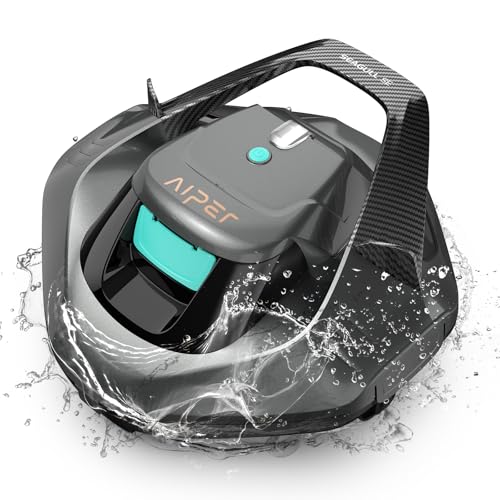
AIPER Seagull SE Robotic Pool Vacuum — Easiest retrieval
The Seagull SE understands the least glamorous moment of robot ownership: getting the thing back out. Its listing highlights smart self-parking, which means the robot returns to rest near the pool wall when its cycle ends or its battery fades, instead of expiring in the middle where retrieval becomes a performance involving a pole, a stretch and occasionally a swim you had not planned. Anyone who has fished for a stranded cleaner in October water will recognise self-parking not as a luxury but as the feature that decides whether the robot gets used weekly or abandoned by midsummer.
Aiper quotes powerful suction of 1320GPH — a flow figure, gallons per hour, which describes how much water the machine moves through its filter rather than a vacuum strength in the household sense — and a runtime of 100 minutes, paired with suitability for above-ground pools up to 860 square feet. That pairing describes the heart of the above-ground market: the popular round and oval pools in family gardens, large enough to gather serious debris, small enough for one charge to cover the floor properly. Within that territory the Seagull SE’s proposition is beautifully simple: drop it in, let it wander its pattern, lift it out by the wall.
Now the honest limits. The listing speaks of floor cleaning for above-ground pools and claims no wall climbing, so the waterline ring and the vertical walls remain yours to brush — a two-minute job with a soft brush while the robot works below, but yours nonetheless. Soft-wall pools with pronounced floor wrinkles will slow any robot, this one included, and the deepest wrinkle valleys can trap silt that wheels pass over. And 860 square feet is a ceiling, not a target: owners of the largest above-ground pools should expect the robot to need a second run or a recharge between areas rather than a single heroic sweep.
- Format: cordless robotic floor cleaner for above-ground pools
- Flow: 1320GPH suction figure per the listing
- Runtime: lasts 100 minutes per the listing
- Coverage: above-ground pools up to 860 square feet
- Signature trait: smart self-parking at the pool wall
Strengths
- Self-parking removes the mid-pool fishing expedition from weekly ownership.
- Runtime and coverage are stated together, making sizing honest and simple.
- Cordless design keeps cables away from swimmers and metal pool walls.
Trade-offs
- Floor-only cleaning leaves walls and waterline to the owner’s brush.
- Pools beyond its coverage figure will need split sessions or recharges.
- Deep liner wrinkles can shelter silt from its cleaning path.
Best for: family above-ground pools of small to mid size cleaned weekly. Not suited for: the largest pools wanting one unattended whole-floor session.

Aiper Cordless Robotic Pool Cleaner for Above Ground Pools — Dual-mode flexibility
Aiper’s second entry in this guide takes a subtly different brief: pools up to 40 feet, dual motors and dual cleaning modes, with a 90-minute runtime. The 40-foot figure deserves attention because it describes diameter rather than area, and a 40-foot round above-ground pool is a serious body of water — the top end of what residential above-ground installations attempt. A robot whose listing addresses that scale is aiming at owners whom smaller cleaners underserve, the ones whose pools gather a weekend’s worth of leaves across a floor the size of a room.
Dual motors matter in that context for a practical reason: drive and suction each get their own power, so the machine keeps moving purposefully while it collects, rather than trading travel for pickup. The two cleaning modes let the owner choose the pattern of attack — a fuller session when the pool has been neglected or storm-blown, a lighter pass for maintenance between swims. Mode choice is also battery honesty in disguise: it lets you spend the 90 minutes where your pool’s dirt actually is, instead of watching a single fixed programme lavish attention on clean corners.
The limits mirror its sibling’s, with one addition. Ninety minutes is the shortest runtime among the three robots here, and in the largest pools it will define the session: plan on the robot covering the floor in a deliberate pattern and accept that a very large, very dirty pool may want a second deployment after charging. Like the Seagull SE, it is a floor machine in its listing’s own words — walls, steps and the waterline stay on your list. Within those declared boundaries, it is the most scale-conscious choice of the three for owners whose above-ground pool is genuinely big.
- Format: cordless robotic cleaner with dual motors
- Modes: dual-cleaning modes per the listing
- Runtime: 90 minutes per the listing
- Coverage: above-ground pools up to 40 feet
- Finish: charcoal and teal
Strengths
- Sizing language addresses the largest above-ground pools directly.
- Dual motors keep travel and collection from competing for power.
- Two modes let owners match effort to the week’s actual dirt.
Trade-offs
- The 90-minute runtime is the shortest among the three robots here.
- Very large and dirty pools may need a recharge before finishing.
- Walls and waterline remain manual work, as with every pick here.
Best for: owners of large above-ground pools wanting mode control. Not suited for: small pools where its scale and price tier buy unused capacity.

WYBOT A1 Cordless Pool Vacuum — Longest listed runtime
The WYBOT A1 arrives with the most complete specification of the three: 130 minutes of runtime, cleaning coverage up to 1,100 square feet, four cleaning modes and dual-layer filtration. Each element answers a real above-ground complaint. The runtime answers pools at the larger end. The four modes answer the difference between a post-storm rescue and a Tuesday tidy. And the dual-layer filtration answers the two kinds of dirt these pools collect — the visible leaves and insects that any mesh catches, and the fine silt and dust that cloud water and settle into a grey film cheap filters pass straight through.
Filtration deserves the emphasis, because it is where budget pool robots most often disappoint. A single coarse basket fills with leaves while the silt that actually makes a floor look dirty recirculates and resettles an hour later, leaving owners convinced the robot merely rearranges their problem. A dual-layer arrangement — coarse capture backed by finer media — is the design that breaks that cycle, and for pools beneath trees, near paths or in breezy gardens, it is arguably a more important specification than raw runtime. The A1’s listing leads with exactly that pairing of stamina and filtration, which suggests WYBOT knows where its rivals get returned.
Its limits are the category’s limits, stated plainly. The listing frames it as a robot for above-ground pools and claims coverage of floors up to its area figure; it does not promise wall climbing, and on flexible soft walls no honest robot should. Runtime and pool size still negotiate: at the very top of its coverage range, in a pool carrying a heavy debris load, expect the session to be thorough rather than swift, and expect steps, ladders and the tight seam where floor meets wall to welcome a final human pass. Judged inside those truths, the A1 is the pick for owners who want the most complete single-robot answer this category currently offers.
- Format: cordless pool vacuum robot for above-ground pools
- Runtime: 130 minutes per the listing
- Coverage: cleaning up to 1,100 square feet
- Modes: 4 cleaning modes per the listing
- Filtration: dual-layer design for leaves and fine silt
Strengths
- Longest runtime and largest coverage figure among the three robots.
- Dual-layer filtration tackles the silt that makes floors look uncleaned.
- Four modes span rescue cleans and light maintenance passes.
Trade-offs
- Capability this complete sits in the category’s upper tier of commitment.
- Steps and ladder zones still benefit from an owner’s finishing pass.
- Fine filtration media needs rinsing discipline to keep flow strong.
Best for: larger above-ground pools under trees or near dusty paths. Not suited for: tiny splash pools whose cleaning needs are five minutes weekly.
Suction-Side Pool Cleaners — Prose-only alternative
Suction-side cleaners are the old alliance between a pool and its own plumbing: a simple cleaner head connects by hose to the skimmer or a suction port, and the filter pump’s draw drags it wandering across the floor while debris travels to the pump basket and filter. Discussed generically, their appeal is a budget-tier purchase with almost nothing to wear out — no battery to age, no motor to drown, just seals, hoses and a diaphragm or gear set that tolerates seasons of neglect. For a small above-ground pool whose pump runs daily anyway, the marginal effort of ownership can be close to zero.
Their weaknesses are structural. The cleaner’s appetite is the pump’s appetite, so debris loads the main filter and asks for backwashing or cartridge rinsing more often; long hoses tangle, coil and occasionally trap the cleaner in a corner it patrols for an hour; and the wandering pattern is famously unmethodical, covering some patches repeatedly while neglecting others until the hose length is adjusted. Above-ground pumps, often modest in power, may also give a suction cleaner a lazier gait than the same unit shows on a stronger in-ground system. Owners who value cheap and simple over thorough and finished still choose them happily — but they choose supervision as part of the deal.
- Format: hose-connected cleaner powered by the pool’s filter pump
- Tier: budget, with minimal moving parts to maintain
- Debris path: leaves and grit travel to the pump basket and filter
- Pattern: wandering rather than mapped or systematic
- Needs: adequate pump strength and hose length matched to the pool
Strengths
- Lowest commitment of any powered option, with little to break.
- Runs whenever the pump runs, so cleaning piggybacks on filtration.
- No battery to charge, store or replace over the years.
Trade-offs
- Debris loads the main filter, increasing backwash and rinsing chores.
- Wandering coverage leaves patches until hose length is tuned.
- Hoses tangle and can park the cleaner in one corner.
Best for: small pools with willing pumps and owners nearby. Not suited for: anyone wanting a finished, unattended, whole-floor result.
Manual Vacuum Heads and Poles — Prose-only alternative
The manual vacuum head on a telescopic pole is the baseline against which every robot justifies itself, and it remains undefeated at two things: price and precision. As a generic class it costs a budget-tier fraction of any robot, stores on two hooks, never needs charging, and goes exactly where your hand sends it — into the corner where the ladder meets the wall, along the seam where silt gathers, over the one patch of algae-slick floor that needs three slow passes. For a small pool, a careful owner can produce a visibly perfect floor in twenty minutes.
The catch is that those twenty minutes are yours, every time, in the sun, leaning over a wall at an angle your shoulders will describe to you later. Manual vacuuming also stirs as it cleans if rushed; a head moved too quickly billows silt into the water, which then resettles, so the technique demands a slowness that tests patience on larger floors. And because the chore is effortful, it gets postponed — the true cost of manual cleaning is measured in the weeks it did not happen. Robots exist because owners are human. The manual head stays in this guide as the honest floor of the market: cheapest, most precise, and entirely dependent on your diary.
- Format: vacuum head on a telescopic pole, hose to skimmer or pump
- Tier: the lowest-cost route into pool floor cleaning
- Precision: total, directed entirely by the owner’s hand
- Effort: the owner’s shoulders, weekly, in all weathers
- Technique: slow passes to avoid billowing silt back into suspension
Strengths
- Unmatched precision in corners, seams and around ladders.
- Nothing to charge, programme or retrieve from mid-pool.
- Purchase commitment is the smallest in this entire guide.
Trade-offs
- Every clean is paid for in the owner’s time and posture.
- Rushed technique stirs silt that resettles across the floor.
- Effort invites postponement, and postponed cleans compound.
Best for: small pools and owners who genuinely enjoy the ritual. Not suited for: large pools, bad backs or households short on summer time.
Battery Handheld Pool Vacuums — Prose-only alternative
Battery handheld pool vacuums occupy the niche between the pole and the robot: self-contained units, some on short poles of their own, that carry a small motor and debris chamber and work wherever the owner points them. Generically, they shine at the jobs robots handle worst — the steps, the shallow shelf, the ring pool’s modest floor, the hot tub, the corner behind the ladder. A quick deployment with no hose and no pump involvement makes them the spot-cleaner of the pool world, ideal for the pre-party ten minutes when guests are coming and a drift of leaves has settled on the steps.
Their chamber size writes their limits. A handheld’s debris cup fills in minutes under a real leaf fall, and its suction, while respectable at the nozzle, is not built to process a whole large floor before its battery or your arm gives out. Owners who buy one as a robot substitute for a big pool discover the mismatch within a fortnight. Owners who buy one as a complement — robot for the floor, handheld for steps and spots — often describe the pairing as the first setup that finally covers everything. Tier-wise they sit between manual heads and robots, and judged as specialists rather than substitutes, they earn that place comfortably.
- Format: self-contained battery unit with its own debris chamber
- Tier: mid, between manual heads and full robots
- Home ground: steps, shelves, spas and small ring pools
- Deployment: no hose, no pump, no setup ceremony
- Limit: chamber capacity suits spots, not whole large floors
Strengths
- Instant spot-cleaning for steps and shallow features.
- Works in spas and tiny pools no robot can serve.
- Pairs with a floor robot to cover a pool completely.
Trade-offs
- Small chambers empty often under heavy debris loads.
- Whole-floor cleaning of a large pool outlasts battery and arm.
- Another battery joins the household’s charging roster.
Best for: step, spa and spot duty alongside a main cleaning method. Not suited for: serving as the only cleaner for a large above-ground pool.
How Do the Six Options Compare at a Glance?
| Pick | Type | Effort from owner | Best territory |
|---|---|---|---|
| AIPER Seagull SE Robotic Pool Vacuum | Cordless robot, 100 minutes | Drop in, lift out at the wall | Pools up to 860 square feet |
| Aiper Cordless Robotic Pool Cleaner for Above Ground Pools | Cordless robot, dual modes | Choose a mode, retrieve after | Pools up to 40 feet across |
| WYBOT A1 Cordless Pool Vacuum | Cordless robot, 130 minutes | Rinse dual-layer filter after | Pools up to 1,100 square feet |
| Suction-Side Pool Cleaners | Pump-powered, hose-fed | Supervise and untangle | Small pools with strong pumps |
| Manual Vacuum Heads and Poles | Owner-powered | The entire clean, personally | Small floors and precise corners |
| Battery Handheld Pool Vacuums | Battery spot cleaner | Short guided sessions | Steps, spas and spot duty |
The pattern in the table is the whole argument of this guide: as owner effort falls, coverage and filtration intelligence rise, and the three robots divide that high ground between them by retrieval, scale and stamina. Choose where on the effort line your household honestly lives, and be honest about the summers behind you rather than the owner you intend to become.
Why Can’t Most Robots Climb an Above-Ground Pool’s Walls?
Because the walls move. An in-ground pool’s wall is rigid plaster, tile or concrete-backed vinyl, and a climbing robot presses its tracks or wheels against that firmness with confidence. An above-ground wall is a flexible membrane held by water pressure and a metal or resin frame; press a climbing machine against it and the surface gives, traction breaks, and the robot slides back to the floor it understands. Soft-sided and ring pools flex most of all, which is why listings for above-ground robots speak of floors and stay silent about walls.
There is also the question of weight at the waterline. A robot that climbs must carry enough body to house climbing drive, and hauling that body over a soft wall’s rim — or risking it snagging a liner seam — is a hazard category designers of above-ground machines sensibly decline. The floor-only brief is therefore not a corner cut; it is an engineering answer to the pool you actually own. Brush the walls yourself fortnightly, skim the waterline when you pass with a drink in hand, and let the robot own the ninety percent of the dirt that settles downward.
How Should You Size a Robot to Your Pool and Its Runtime?
Measure your pool’s floor honestly first: length by width for rectangles and ovals approximated generously, diameter squared and discounted for rounds. Then hold that figure against the coverage in the listings — up to 860 square feet for the Seagull SE, up to 1,100 for the WYBOT A1, up to 40 feet across for the dual-mode Aiper. Buying at the very edge of a robot’s stated range is buying a machine that will work at its limit every session; a step of headroom makes cleans faster, gentler on the battery and more forgiving of a storm week’s extra debris.
Runtime interacts with dirt as much as with size. A clean pool’s floor can be maintained in a fraction of a charge, while the first clean after a windy week asks for the whole battery and perhaps a second deployment. Plan your purchase for the dirty week, not the tidy one, and remember that batteries age: a robot whose runtime barely suffices when new will fall short in its third summer. Headroom, again, is the cheapest insurance in this category.
What Should You Do Before and After Each Robot Run?
Before: lift out the ladder if it removes easily, or accept the robot will patrol around it; clear floating toys and thermometers; and give the waterline a quick skim so surface debris does not sink mid-clean to become floor debris. A thirty-second brush down of the walls sends wall dust to the floor where the robot can collect it — the single most effective cooperation between owner and machine. Check the filter basket starts empty, because a robot that begins full finishes nothing.
After: retrieve at the wall — the Seagull SE’s self-parking exists for this moment — and lift by the handle with the unit draining back into the pool for a few seconds rather than across your decking. Rinse the filter media until the water runs clear, especially the fine layer on dual-layer designs, and let it dry in shade. Charge the robot out of direct sun, store it off its wheels if the maker suggests, and glance at the intake for the hair, string and leaf stems that wrap there quietly. Five unglamorous minutes, and the next run starts at full strength.
What Mistakes Do Above-Ground Pool Owners Make with Robots?
Expecting wall climbing from a floor robot heads the list, usually because an in-ground advertisement shaped the expectation. Read your shortlist’s listings for what they claim, not what the category’s flagships promise elsewhere. The second mistake is sizing by hope — buying the smallest robot for the largest pool because the difference looked small on the page. In the water, that difference is measured in unfinished floors and a battery worked to exhaustion weekly, which shortens its life.
Third comes neglect of the filter: a robot with a choked basket still drives around importantly while collecting nothing, and owners blame the machine for a maintenance debt. Fourth, running the robot during swimming — it is not designed as a toy or a footrest, and swimmers stir the silt it is trying to collect. Fifth, winter storage with a flat battery in a freezing shed, which punishes lithium cells. Charge before storage, store in the house’s milder air, and the robot will greet spring ready rather than retired.
What Kinds of Debris Do Above-Ground Pools Actually Collect?
Leaves are the visible enemy, arriving by tree and hedge in quantities that peak after wind and in autumn, and any of the three robots swallows them without drama until the basket fills. The subtler load is silt: wind-blown dust, soil tracked from paths, pollen that sinks after a day afloat, and the grey film that reassembles on the floor within days of a clean. Silt is the debris that separates filtration designs, because it passes through coarse baskets and resettles, and it is why the WYBOT A1’s dual-layer media earns its emphasis in this guide.
Insects form the third category — surface casualties that sink once waterlogged, plus the crawling visitors that fall from overhanging branches. They collect in corners and along the wall seam, exactly where a floor robot’s pattern is least precise, which is why even robot owners keep a small net and a handheld within reach. Sand and grit arrive on feet from patios and play areas, settling into the liner’s texture where suction must be direct to lift it; robots handle it well on their passes, while manual heads handle it best of all because a human can linger.
Finally there is the organic film that is not quite debris: the slippery precursor of algae that coats a floor before the water shows any green. No vacuum of any type treats the cause, which lives in the water’s chemistry, but regular removal of the settled organic matter it feeds on genuinely slows its return. A robot running twice weekly is, in this sense, part of the pool’s sanitation system — not by disinfecting anything, but by exporting the food supply before it establishes. That quiet, compounding benefit is easy to miss in a specification table and impossible to miss by September.
How Does a Season of Ownership Differ Between the Options?
Spring opening tells the first truth. A pool uncovered after winter holds a debris load that embarrasses every method: the manual owner spends an afternoon, the suction-side owner babysits a clogging filter, and the robot owner runs cycle after cycle, emptying the basket between each, watching the floor reappear in strips. The robot still wins the day, but owners who expect a single deployment to perform the resurrection learn the season’s first lesson — robots maintain beautifully and rescue gradually.
High summer is the robot’s home turf. Debris arrives in a steady drizzle rather than a flood, swimmers stir the water daily, and a twice-weekly unattended run keeps the floor at a standard the manual owner only matches in the week guests are expected. This is also when the alternatives quietly re-enter: the handheld owns the steps before every swim, the manual head wins the corner behind the ladder, and the wise owner’s system is revealed as a small team rather than a single machine.
Autumn reverses spring. Leaf fall can fill a robot’s basket in a single run, and owners near trees learn to skim first and robot second, or to run the machine daily in short shifts. The suction-side cleaner suffers most here, since every leaf it gathers lands in the main filter. By closing time, the robot owner’s remaining chore is the walls and a final deep pass — and the machine that was charged, rinsed and stored properly in October is the one that works first time when the cover comes off again.
What Should You Know About Batteries, Charging and Winter Storage?
All three robots here are cordless lithium machines, and their batteries share the family temperament: they dislike being stored empty, dislike heat, and lose capacity fastest when worked to exhaustion in hot water under a heavy load. The practical habits are simple. Charge after each run rather than before the next, so the machine never sits flat; keep the charger in shade, since a robot baking on a sunny deck ages its cells while it refuels; and treat the listed runtimes as new-battery figures that will soften gently year by year.
Retrieval interacts with battery care more than owners expect. A robot that self-parks at the wall, like the Seagull SE, spends its last energy on positioning rather than dying mid-pool, and a machine lifted out promptly is a machine whose battery is not sitting discharged in warm water. If a run ends while you are out, no harm follows once — but a pattern of flat-in-the-pool afternoons is a pattern of shortened battery life.
Winter deserves its own paragraph because more pool robots die in sheds than in water. Clean and dry the unit thoroughly, charge the battery to a healthy middle-to-full state as the maker directs, and store the robot indoors where frost cannot reach it — a garage corner that stays above freezing, not the metal shed at the garden’s end. Check the charge once mid-winter if the manual suggests it. Five minutes of storage discipline in October buys an entire extra season at the other end.
How Do the Cost Tiers Divide Across All Six Options?
Printed figures would expire before this guide did, so tiers must carry the argument. The manual head and pole sit at the floor of the market — a small, one-time, budget-tier commitment that buys precision at the price of your Saturdays. Suction-side cleaners live a step above, still budget-friendly, their true cost appearing instead as filter wear and supervision time. Battery handhelds occupy the middle ground: a moderate purchase whose value depends entirely on whether your pool has the steps and spots they specialise in.
The three robots form the premium tier of this category, and the honest question is what the premium purchases. Not cleanliness in the abstract — a patient manual owner matches any robot’s best day. It purchases frequency: cleans that happen because they cost nothing to start, on weekday evenings, before guests, after storms, all season long. A pool cleaned twenty times by a robot is cleaner across the summer than a pool cleaned heroically six times by hand, and it is that arithmetic, not any specification, that justifies the tier.
Within the robots, the tier ladder follows capability: the Seagull SE’s self-parking convenience at one level, the dual-mode Aiper’s scale above it, the WYBOT A1’s runtime and filtration at the top of these three. Check price on Amazon for each at the moment you decide, because pool equipment pricing swings hard between spring demand and autumn clearance — the same machine can occupy different value positions in April and September, and a patient buyer shops the calendar as well as the catalogue.
Which Pool Shapes and Sizes Suit Which of the Three Robots?
Small round pools — the twelve-to-eighteen-foot family staples — are the Seagull SE’s parish. Their floors gather debris in a predictable ring, their area sits comfortably inside its 860-square-foot guidance, and their owners benefit most from self-parking because the wall is never far and the retrieval is never a production. In these pools the robot’s whole cycle can finish inside an hour of a summer evening, and the machine spends more of its life charged and ready than working.
Mid-sized ovals and rectangles reward the WYBOT A1’s stamina. Corners collect silt where a round pool’s curve would keep it moving, and the longer floor runs of an oval punish a short battery; 130 minutes and the largest coverage figure translate directly into fewer split sessions. The dual-layer filtration also matters more as area grows, because a bigger floor under the same trees collects proportionally more of the fine dust that single-layer baskets recycle.
The genuinely large above-ground pools — the long ovals and the rounds approaching the dual-mode Aiper’s 40-foot language — are where mode choice earns its place. A full programme after a storm, a lighter maintenance pattern midweek, and dual motors keeping the pace honest across a floor that takes real time to cross: that is a workload shaped for the Aiper’s particular brief. Owners of such pools should still budget for the occasional second deployment, but they will need it least often with a machine sized for their water from the start.
Frame pools and soft-sided pools cut across all three recommendations with one caution: smooth the floor. Every robot here travels on the liner, and the liner of a soft pool wrinkles at the seams and edges. Ten minutes spent pulling the worst folds flat before the season’s first run improves every subsequent clean more than any setting on any machine. Steep cove transitions where floor meets wall will also collect a dirt line no floor robot fully erases — a brush owns that line, whatever you buy.
What Does the Weekly Rhythm of a Robot Owner Look Like?
Twice a week is the rhythm most owners settle into, and it asks remarkably little. The first run lands after the weekend’s swimming has stirred everything loose — out comes the ladder if it lifts, in goes the robot, and by the time the evening meal is cleared the floor has been patrolled and the machine is at the wall waiting to be lifted, rinsed and plugged in. The whole human contribution fits inside the time a kettle takes, twice over.
The second run is the pre-weekend polish, timed so the pool greets Saturday already clean. Owners with trees add a third, shorter intervention in leaf season, or lean on the skimmer net for the surface while the robot handles the floor. Around those runs sit the owner’s remaining micro-jobs: a brush down the walls once a week while standing in the water, a glance at the waterline, a handheld pass over the steps if the house has one. Total human effort across a week commonly lands under half an hour.
Compare that honestly with the manual rhythm it replaced: a weekly session of forty minutes or more, postponed whenever the weekend filled up, with the pool’s cleanliness peaking the day after the clean and fading until the next. The robot’s gift is not a cleaner best day; it is a higher average week. Water clarity, swimmer comfort and the simple willingness to use the pool on a Tuesday all track that average — which is why owners who convert rarely convert back.
What Should You Check When a Robot’s Cleaning Disappoints?
Start with the filter, because nine disappointments in ten live there. A basket rinsed until the water runs clear restores flow that a grey, loaded basket silently strangles; on dual-layer designs the fine layer clogs first and complains least visibly. If the robot drives with enthusiasm but collects little, flow — not suction, not programming — is the first suspect, and the fix takes four minutes at the garden tap.
Look next at the floor itself. A robot cannot collect what the water keeps suspended, so a pool cleaned immediately after vigorous swimming shows a mysteriously poor result: the silt was stirred, not settled. Run the machine in the calm of morning or evening and the same unit looks twice as effective. Wrinkles deserve the same inspection — a robot that repeatedly leaves one valley dirty is reporting a liner fold, and smoothing that fold outperforms any amount of re-running.
Then examine the pattern of what remains. Dirt left in a ring near the wall usually marks the boundary of the robot’s turning behaviour and responds to the owner’s brush sweeping it inward before a run. Dirt left behind the ladder marks an obstacle shadow, solved by removing the ladder. Dirt left everywhere in a fine, even film marks filtration or chemistry — either the fine layer needs rinsing or the water is carrying an algae bloom that no vacuum can outpace, in which case the pool shop, not the robot manual, holds the answer.
Finally, respect the battery’s testimony. A robot that once finished the pool and now fades at two-thirds is not misbehaving; it is ageing, or it has been stored flat, or its sessions have grown heavier as a tree matured over the water. Shorten the circuit by cleaning more often, restore the storage habits described above, and accept that a battery in its later seasons asks for a smaller pool of work per charge — the same bargain every cordless tool in this world eventually offers.
What Safety Habits Belong with a Cordless Pool Robot?
Cordless design removes the gravest electrical worry — no mains cable trails into the water — but it does not remove the need for ordinary care. Charge on a dry surface away from the pool’s splash zone, with the charger under cover; a charger lives its whole life outdoors-adjacent, and rain plus electricity is a combination to schedule around rather than test. Inspect the charging contacts for corrosion at the season’s start and end, since a green contact charges slowly and heats quietly.
Swimmers and robots do not share the water. Beyond the silt-stirring problem, a robot is a moving machine with intakes, and the rule in every manual — remove the cleaner before swimming, replace it after — exists because feet, hair and curiosity all find machinery interesting. Children especially should learn that the robot is a tool that works alone, not a pool toy with a personality, however much its wandering encourages the comparison.
Lifting deserves a sentence of its own: a water-filled robot is heavier than its dry weight suggests, so lift with both hands on the handle, let it drain over the pool, and never haul it out by any cable, brush or appendage. The pool wall of an above-ground installation is not a leaning post either — retrieve from a stable stance on the deck or ground, not balanced against the rim. Small disciplines, all of them, and together they are the difference between a machine that serves five summers and one that ends its career with a cracked housing in July.
Final Recommendation
For most above-ground pools, the WYBOT A1 is the robot to beat: the longest runtime, the largest coverage and the dual-layer filtration that decides whether a floor looks cleaned or merely visited. Owners of the biggest pools who value mode control should look closely at the dual-motor Aiper, while the Seagull SE wins the weekly-ownership argument for small and mid-sized pools through the simple mercy of parking itself where your hand can reach. Keep a brush for the walls and a handheld for the steps, and the pool floor — the chore that used to own your Saturday mornings — becomes the one that quietly handles itself while the water warms and the garden does its worst.
Frequently Asked Questions
Will these robots work in a soft-sided or inflatable ring pool?
Generally yes on the floor, with patience: flexible floors wrinkle, and wrinkles slow wheels and shelter silt, so expect a good rather than perfect result and smooth the liner’s worst folds before the run. Very small ring pools may be better served by a handheld, since a robot needs room to travel and turn.
How long does a charge actually last in a real pool?
The listings promise 90 to 130 minutes depending on model, and calm water with a light debris load gets closest to those figures. Heavy leaf loads, cold water and an ageing battery all trim the session, which is why sizing with headroom matters more than chasing the biggest number.
Can a robot handle algae on the pool floor?
It can collect loose algae and the silt algae feeds on, but a slimy established film needs brushing first to break its grip, and the water itself needs proper sanitising — a robot is a cleaning tool, not a water treatment. Brush, let the robot collect, and treat the water chemistry separately.
Do I still need my pool’s filter pump running?
Yes. The robot handles settled debris on the floor, while the pump and filter handle suspended particles, circulation and sanitation. The two systems divide the water between them; switching the pump off to favour the robot leaves half the job undone.
What happens when the robot meets the ladder?
It treats the ladder as an obstacle, cleaning around its feet and moving on, which leaves a small shadow of dirt behind the rails. Removing a lift-out ladder before a run solves it; otherwise a handheld or brush finishes that patch in a minute.
Related Guides
Readers comparing every style of cleaner rather than robots alone should continue to Best Above-Ground Pool Vacuums, and those planning the bathroom end of a home refresh may enjoy Best American-Made Bathroom Vanities alongside Best 60-Inch Porcelain Bathtubs. Indoors, our published guide to Best Air Purifiers for a 500 Sq Ft Room covers the same dust problem from the other side of the patio door.


