What's inside
- Key Takeaways
- Quick Picks
- How We Chose These Picks
- Fabric First: A Side-by-Side of the Six Seats
- Why Do Readers Leave Leather in the First Place?
- Chenille or Linen: The Sibling Decision, Made Properly
- How Should a Fabric Reading Chair Be Looked After?
- What Does a Stated Capacity Figure Actually Tell You?
- Small Spaces and Apartments: Where These Chairs Actually Live
- Colour in a Reading Chair: Olive, Grey, Beige, Green, and Blue
- A Short History of Sitting Softly: Why Fabric Won the Reading Room
- Testing a Fabric Chair in the First Week: What to Sit, Spill, and Check
- What About Allergies, Pets, and the Dust Question?
- One Chair or Two? The Pair Question, Considered Slowly
- Reading Light and Fabric: A Note Nobody Gives You
- The Throw, the Cushion, and the Lamp: Finishing a Fabric Corner
- How Long Should a Fabric Reading Chair Last?
- Mistakes Fabric-Chair Buyers Keep Making
- Final Recommendation
- Frequently Asked Questions
- Related Guides
As an Amazon Associate I earn from qualifying purchases. This post may contain affiliate links at no extra cost to you.
cottageverdict.com is reader-supported. When you buy through links on our site, we may earn an affiliate commission.
Where to buy: The five linked chairs below lead to their Amazon listings, where you can check price on Amazon and read the full fabric and dimension details; the sixth entry is a fabric class discussed in words, because no verified listing for it sits in this guide’s pool.
The best non-leather reading chairs begin with a simple observation about how reading actually feels. A book is held for hours, often by a reader in short sleeves or pyjamas, in a warm room, in the last relaxed hour of the day. Against skin, in warmth, for hours, woven fabric behaves more kindly than leather and its imitations: it breathes a little, it does not grab at bare arms, and it never delivers that first cold shock on a winter evening. Readers arrive at this category for many reasons — a household that avoids leather, a room that needs softness, a budget that prefers honesty — but they stay for that tactile argument, and this guide takes it seriously enough to name every fabric precisely.
Precision is the discipline of the whole selection. Each pick below is called by the exact fabric its verified title states: chenille on the first VINGLI, linen on the second VINGLI, linen again on the Bonnlo pair and the KEIKI vintage chair, and the upholstery the Kromax title leaves simply as an upholstered armchair, described here without inventing a weave for it. Two of the picks deserve an upfront disclosure: the chenille and linen chairs are two fabric listings from the same VINGLI line, sharing a mid-century shape, a stated 380-pound capacity, a washable cover, and easy assembly. They are reviewed as siblings, not as strangers, because a reader choosing between them is really choosing a fabric, and the reviews say so.
The sixth seat in this guide is different in kind. Wool-blend upholstery is the fabric class experienced readers ask about most and verified pools offer least, so it is covered here as a class — what it feels like, what it costs in care, who should hunt for it — without a purchase link, because inventing a listing would betray the honesty the rest of the guide is built on. Readers choosing for younger readers in the same household will find the safety-first selection in Best Kids’ Reading Chairs a useful companion once the grown-up chair itself is chosen.
Key Takeaways
- Every linked pick is named by the fabric in its verified title — chenille once, linen three times — and nothing here is described with a fabric its title does not state.
- The two VINGLI chairs are one maker’s line in two fabrics; choosing between them is choosing chenille’s softness against linen’s crispness.
- Both VINGLI titles state a 380 LBS capacity, a washable cover, and easy assembly, a rare trio in this category.
- The Bonnlo entry is a set of two dark green linen chairs on solid wood, the only pair in the guide.
- The KEIKI is the traditionalist’s pick: blue linen, nailhead trim, turned legs, a solid wood frame, and high density foam.
- Wool-blend upholstery is covered as a sixth, unlinked class because no verified listing for it sits in this guide’s pool.
Quick Picks
| Chair | Badge | Why it earns its place |
|---|---|---|
| VINGLI Chenille Upholstered Armchair | Softest fabric here | An olive green chenille mid-century reading chair with a stated 380 LBS capacity and a washable cover. |
| VINGLI Linen Upholstered Armchair | Crispest fabric here | The same VINGLI line in light grey linen, for readers who prefer a cooler, flatter hand to the weave. |
| Kromax Accent Chair No-Screw Assembly | Easiest build here | A beige mid-century reading chair that assembles with no screws, on sturdy legs. |
| Bonnlo Linen Accent Chairs Set of 2 Dark Green | Only pair in the guide | Two dark green linen farmhouse armchairs with solid wood construction for matched corners. |
| KEIKI Vintage Armchair Linen Fabric Nailhead | Most traditional build | A blue linen vintage armchair with nailhead trim, turned legs, and a solid wood frame. |
| Wool-Blend Upholstery as a Fabric Class | The connoisseur’s route | The warm, hard-wearing weave discussed in full below for readers willing to hunt beyond this pool. |
How We Chose These Picks
The first filter was the title itself. A chair entered this guide only if its verified listing title named a fabric that is plainly not leather, or described an upholstered chair whose fabric identity could be discussed honestly from the title’s own words. That filter is stricter than it sounds: a great many attractive reading chairs wear blends, coatings, and bonded materials whose titles stay conveniently vague, and vagueness has no place in a guide whose entire premise is knowing what touches your skin for three hours an evening.
The second filter was reading suitability, judged as this site always judges it: seat comfort for long sessions, a back that supports a relaxed slump, arms at a height a book can rest against, and dimensions or positioning that suit the small spaces and bedrooms these chairs are titled for. The third filter was ownership — washable covers, sane assembly, solid wood where a title claims it — because a fabric chair’s life is a laundry and maintenance story as much as a comfort story. The wool-blend class was then added deliberately, clearly separated from the linked picks, because a guide to non-leather fabrics that ignored wool would be answering only the easy half of the reader’s question.

VINGLI Chenille Upholstered Armchair — Softest fabric here
Chenille is the fabric readers reach for when the reading chair doubles as the household’s comfort object, and this olive green VINGLI is the guide’s fullest expression of it. The chair is a mid-century reading armchair positioned for living rooms, bedrooms, and small spaces, and its title carries an unusually complete ownership brief: chenille upholstery, a stated capacity of 380 LBS, a washable cover, and easy assembly. Any one of those would be welcome; together they describe a chair designed by someone who understood that a fabric reading chair is bought for evenings and kept or returned on housekeeping.
The colour deserves attention. Olive green sits in the narrow band of shades that behave like a neutral while still being a colour — it calms a pale room, warms a grey one, and hides the evidence of daily reading better than any light upholstery in this guide. Chenille’s soft pile is the kindest surface here against bare arms, and its slight texture keeps a reader from sliding during the slow slump of a long chapter. The mid-century outline keeps the softness presentable: this is a chair that can receive guests at four and a novel at nine without changing its character.
Its sibling relationship with the next pick should be stated plainly, because it shapes the choice. This chenille chair and the linen chair that follows are two fabric listings of the same VINGLI line — same shape family, same stated capacity, same washable cover promise. A reader who loves the chair but not the fabric is not choosing between rivals; they are choosing a surface. Chenille is the warmer, softer, more forgiving surface, and for a dedicated reading corner in a lived-in home, it is this guide’s first recommendation.
- Fabric: chenille, per listing title
- Colour: olive green
- Capacity: 380 LBS, as stated in the title
- Cover: washable, per listing title
- Where to buy: the VINGLI Chenille Upholstered Armchair listing on Amazon — check price on Amazon
Strengths
- Chenille pile is the softest skin contact in the guide.
- Washable cover answers fabric’s biggest ownership fear.
- Olive tone hides daily evidence while staying warm.
Trade-offs
- Chenille pile can snag on zips, rings, and pet claws.
- Warm fabric runs hot in uncooled summer rooms.
- Shares its shape with the linen sibling; fabric is the difference.
Best for: dedicated reading corners in lived-in homes that want softness with a washable safety net. Not suited for: households with claw-happy cats and no throw discipline.
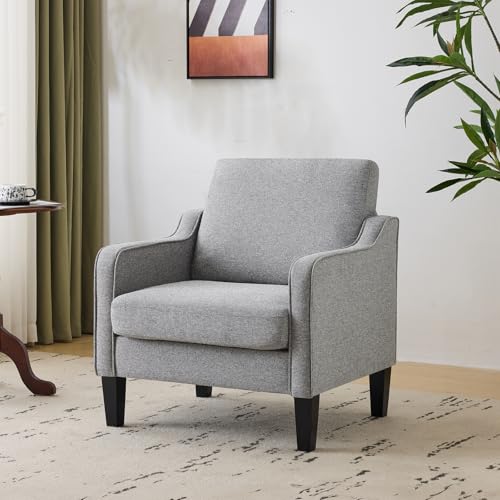
VINGLI Linen Upholstered Armchair — Crispest fabric here
The linen VINGLI takes the same chair — mid-century reading armchair, stated 380 LBS capacity, washable cover, easy assembly — and dresses it in light grey linen, which changes the reading experience more than a colour change should. Linen has a cooler, flatter hand than chenille: it feels crisp against the arm, breathes in warm rooms, and holds a neater silhouette across a long evening because the weave does not pile or drift. Readers who read in summer, in warm flats, or simply with a personal thermostat set higher than their partner’s will feel the difference within one chapter.
Light grey is the most adaptable colour in this guide. It disappears into pale Scandinavian rooms, steadies colourful ones, and pairs with any bedding or curtain a bedroom already owns. Where the olive chenille brings a mood, the light grey linen brings a truce — the chair stops arguing with the room and lets the books provide the colour. That neutrality also makes this the better gift of the two siblings and the safer choice for a guest bedroom, where the chair must please readers whose tastes are unknown.
The shared cautions of the line apply: the capacity figure is the maker’s stated number, to be read as a title claim, and easy assembly still means an evening’s small task rather than no task at all. Linen’s own caution is creasing and marking — a flatter weave shows a spill’s outline more readily than a pile does, which is why the washable cover matters even more here than on its sibling. Choose this chair when coolness, neatness, and neutrality outrank plushness in your reading life, and the VINGLI line will serve you in its crispest form.
- Fabric: linen, per listing title
- Colour: light grey
- Capacity: 380 LBS, as stated in the title
- Cover: washable, per listing title
- Where to buy: the VINGLI Linen Upholstered Armchair listing on Amazon — check price on Amazon
Strengths
- Linen weave stays cooler through warm-evening reading.
- Light grey neutrality fits almost any existing room.
- Same washable cover and stated capacity as its sibling.
Trade-offs
- Flat weave shows spill outlines more than chenille pile.
- Crisp hand is less cocooning than its sibling’s softness.
- Light colour needs the cover washed, not just owned.
Best for: warm rooms, pale interiors, and readers who prefer a neat, cool seat. A poor fit for: anyone chasing the plush nest feeling of a piled fabric.
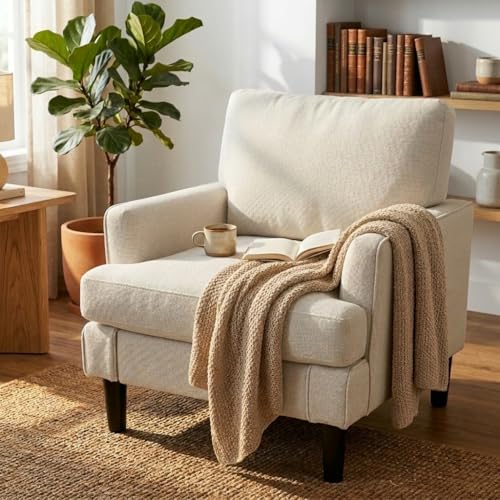
Kromax Accent Chair No-Screw Assembly — Easiest build here
The Kromax makes its pitch in the space most furniture listings whisper: assembly. Its title promises a beige mid-century reading chair for the bedroom that requires no screws to assemble, on sturdy legs, as a single sofa chair for apartments. Anyone who has spent a Sunday on the floor with an Allen key, a mislabelled cam lock, and a marriage under strain will understand why that promise earns a pick of its own. A reading chair should begin its life with a book, not a hardware audit, and the Kromax is built for the reader who wants the corner finished the evening the box arrives.
Beige and mid-century are safe words, and here they are also accurate ones: the chair’s job is to be the quiet, well-proportioned seat that a small bedroom or apartment can absorb without redecorating. Its title describes it as comfy and upholstered without naming a specific weave, and this review respects that limit — the fabric should be confirmed on the listing’s detail panel by any reader for whom the exact weave is decisive, because this guide names fabrics only where titles state them. What the title does state, sturdy legs, matters more to a reading chair than it might appear: a chair that is climbed into daily, shifted for the light, and occasionally dragged toward a window earns its keep through its legs.
The no-screw design invites one honest question, which is how any tool-free joint behaves in year three. The listing is the place to examine the joining method before ordering, and a reader who moves house often may actually prefer a chair designed to come apart without a hardware bag to lose. Judged on its brief — the fastest, calmest route from box to reading corner in this guide — the Kromax is coherent, likeable, and aimed squarely at renters and first-flat readers.
- Colour: beige, per listing title
- Assembly: no screws required
- Legs: described as sturdy in the title
- Positioning: mid-century single sofa chair for bedroom and apartment
- Where to buy: the Kromax Accent Chair No-Screw Assembly listing on Amazon — check price on Amazon
Strengths
- Tool-free assembly makes the corner usable the same evening.
- Neutral beige absorbs into small rooms without a fight.
- Sturdy-leg emphasis suits a chair moved toward the light.
Trade-offs
- Title does not name the upholstery weave; check the listing.
- Tool-free joints deserve a look at the listing’s method.
- Quiet styling will not anchor a room that needs character.
Best for: renters, movers, and anyone allergic to flat-pack Sundays. Not the right match for: fabric purists who need the weave named before anything else.

Bonnlo Linen Accent Chairs Set of 2 Dark Green — Only pair in the guide
The Bonnlo entry breaks the guide’s one-chair pattern deliberately: this is a set of two dark green linen accent chairs, mid-century modern lounge fabric chairs with solid wood farmhouse construction, titled for living room, bedroom, and guest room. A matched pair solves problems a single chair cannot. Two reading corners in one large room, a chair each for a couple who read together, a reading chair and its twin waiting in the guest room — pairs create symmetry that single purchases spend years failing to imitate, because a second chair bought later is never quite the same dye lot, the same wear, or the same chair.
Dark green linen over solid wood gives the pair a farmhouse-modern character distinct from everything else here: deeper in colour than the VINGLI olive, crisper in weave than the chenille, and grounded by wood that the title names as solid. In a living room the pair flanks a fireplace or a window with an intentionality that reads as designed rather than accumulated. In a main bedroom, one chair takes the reading corner and the other takes the dressing side, and the room gains a coherence that mismatched singles rarely achieve.
The cautions are the pair’s own. Two chairs need two corners, or one corner and a genuine plan for the second; a spare chair parked without purpose becomes the household’s clothes horse within a month. The set also doubles the commitment to one fabric and colour, so the dark green must be loved, not merely liked. Readers whose homes can absorb a pair, though, are buying the cheapest route to a finished room in this entire guide — two chairs, one decision, no second hunt.
- Set: two accent chairs, per listing title
- Fabric: linen
- Colour: dark green
- Construction: solid wood, farmhouse styling
- Where to buy: the Bonnlo Linen Accent Chairs Set of 2 Dark Green listing on Amazon — check price on Amazon
Strengths
- Matched pair creates symmetry no later single can imitate.
- Solid wood construction grounds the fabric seats.
- Two corners furnished in a single decision.
Trade-offs
- Second chair needs a real home or becomes a clothes horse.
- One fabric and colour, committed twice over.
- Pair footprint exceeds most single-corner bedrooms.
Best for: couples, large rooms, and anyone furnishing a reading corner and a guest room together. A weak match for: small bedrooms with exactly one corner to give.

KEIKI Vintage Armchair Linen Fabric Nailhead — Most traditional build
The KEIKI is the chair for readers whose ideal reading room has a fireplace, a globe, and opinions. It is a vintage armchair in blue linen fabric with nailhead trim, turned legs, a solid wood frame, and a high density foam cushion, titled for the living room, bedroom, and reading nook, with easy assembly promised. Every element of that description belongs to an older furniture language than the rest of this guide speaks: nailhead trim is decoration with a hammer behind it, turned legs are made on a lathe rather than extruded, and a solid wood frame is a promise about decades rather than seasons.
Blue linen is a handsome, serious fabric — the colour of a library chair rather than a nursery one — and the vintage detailing lets this chair hold a traditional room in a way the mid-century picks cannot. The high density foam cushion named in its title is the modern concession inside the traditional shell: density is what keeps a seat’s shape and support through years of nightly chapters, and its explicit mention distinguishes this chair from vintage-styled chairs whose cushions are styled more carefully than they are filled.
Its trade-offs are temperament and upkeep. Nailhead trim and turned legs ask for a room that respects them; in a stark modern interior this chair will look like an heirloom that wandered in, which some readers will love and others will not. Linen in a mid-blue shows pale lint and pet hair with documentary enthusiasm, so the lint roller becomes part of the chair’s furniture. For the reader building a traditional nook — the leather-free library corner this chair seems designed to anchor — those are small rents on a long tenancy.
- Fabric: linen, per listing title
- Colour: blue
- Details: nailhead trim, turned legs
- Frame: solid wood, with high density foam cushion
- Where to buy: the KEIKI Vintage Armchair Linen Fabric Nailhead listing on Amazon — check price on Amazon
Strengths
- Solid wood frame and turned legs promise a long life.
- High density foam cushion is named, not assumed.
- Vintage detailing anchors traditional reading rooms.
Trade-offs
- Mid-blue linen displays lint and pale pet hair clearly.
- Traditional styling fights stark modern interiors.
- Ornamented legs and trim need gentler dusting.
Best for: traditional nooks and library corners built to last. Poorly suited to: minimalist rooms and low-maintenance households.
Wool-Blend Upholstery as a Fabric Class — The connoisseur’s route
The sixth seat in this guide has no link, and the reason is the guide’s honesty rule rather than an oversight: no verified listing in this batch’s pool offers a wool-blend reading chair, so the class is discussed here in words, for the many readers who ask about it, without a purchase path being invented for it. Wool-blend upholstery — wool woven with a synthetic partner for strength — is the fabric traditional upholsterers reach for when a chair must survive decades of evenings. It is warm without being plush, naturally textured, and famously forgiving of wear: wool fibres recover from compression, resist soiling longer than most plant weaves, and give a seat a matte, serious finish that suits book-lined rooms.
As a reading surface, a wool blend sits between this guide’s linen and chenille in character. It lacks chenille’s pile and linen’s cool crispness, offering instead a dense, warm steadiness that readers in cooler houses and northern rooms tend to prefer instinctively. Its costs are equally characteristic: wool blends usually sit at a premium tier beside the fabrics linked here, they dislike harsh washing, and they are typically sold through furniture channels rather than the marketplace listings this guide verifies. A reader set on wool should shop it as furniture, not as a listing — examining the weave in person, asking the seller for the blend’s exact composition, and budgeting for professional cleaning across the chair’s long life.
Why include an unbuyable class at all? Because the reader comparing fabrics deserves the full map, including the territory this pool does not cover, and because a guide that only praised what it could link would be a catalogue rather than advice. If a verified wool-blend reading chair enters a future pool, it will be reviewed here with the same title-bound discipline as the five linked picks. Until then, the class stands as the benchmark of durability against which chenille and linen should be judged — and, for most households, the linked chairs’ washable covers answer the same ownership fears with far less ceremony.
- Fabric class: wool blended with a synthetic partner weave
- Character: warm, dense, matte, and highly wear-resistant
- Care expectation: gentle, often professional cleaning
- Positioning: premium tier beside the linked fabrics
- Seek it through furniture sellers who state the blend composition plainly
Strengths
- Exceptional recovery from compression and daily wear.
- Warm, steady hand suited to cooler rooms and houses.
- Matte finish belongs naturally among book-lined walls.
Trade-offs
- Premium pricing beside the linked chenille and linen picks.
- Cleaning is gentle or professional, never a quick wash.
- Sold mainly through furniture channels, not verified listings here.
Best for: patient traditionalists furnishing a long-term library corner. Not suited for: anyone who wants the chair ordered, washed, and sat in this week.
Fabric First: A Side-by-Side of the Six Seats
| Seat | Fabric as titled | Colour | Ownership note |
|---|---|---|---|
| VINGLI Chenille Upholstered Armchair | Chenille | Olive green | Washable cover |
| VINGLI Linen Upholstered Armchair | Linen | Light grey | Washable cover |
| Kromax Accent Chair No-Screw Assembly | Upholstered; weave not named in title | Beige | No-screw assembly |
| Bonnlo Linen Accent Chairs Set of 2 Dark Green | Linen | Dark green | Sold as a pair |
| KEIKI Vintage Armchair Linen Fabric Nailhead | Linen | Blue | Solid wood frame |
| Wool-Blend Upholstery as a Fabric Class | Wool blend | Varies by maker | Gentle or professional cleaning |
Why Do Readers Leave Leather in the First Place?
The reasons cluster, and naming them helps a reader recognise their own. The largest group is tactile: readers who simply prefer how woven fabric feels during long, warm, still sessions, and who find leather and its imitations alternately cold, sticky, and distracting against skin. The second group is principled — households that avoid animal products furnishing-wide, for whom a reading chair is one decision among many consistent ones. The third is practical: fabric chairs at this level tend to offer washable covers, lighter weight for rearranging, and colours and patterns that leather rarely attempts. The fourth group arrives by room rather than by chair: soft, layered, cottage-style interiors in which a leather seat would strike the one hard note in an otherwise woven room.
None of these reasons requires an argument against leather itself, and this guide makes none. Readers furnishing a study or a television room may well land on hide with this site’s blessing — the structured, task-focused end of the seating world makes its case in Best Compact Desk Chairs and the categories beyond it. The claim here is narrower: for the specific act of reading, in the specific rooms readers read in, woven upholstery has real advantages, and those advantages are worth choosing deliberately rather than by default.
Chenille or Linen: The Sibling Decision, Made Properly
Because two of this guide’s picks are one chair in two fabrics, the chenille-versus-linen decision deserves its own honest treatment. Chenille is a piled yarn: its fibres stand up from the weave, which is why it feels soft, looks deep, and hides the creases and minor marks of daily life inside its own texture. It is the warmer fabric, in hand and in appearance, and the more forgiving one. Its weaknesses are mechanical — pile can be pulled by sharp hardware and claws — and thermal, since a piled fabric in a hot room adds warmth a summer reader may not want.
Linen is the opposite construction: a flat, crisp weave that shows its structure, breathes in heat, and keeps a tailored outline through a long sit. It feels cooler and neater, and it photographs tidier, but it returns every spill and crease to view and asks its washable cover to do real work. The decision, reduced to one line, is climate plus temperament: warm, forgiving, and cosy points to chenille; cool, crisp, and tidy points to linen. The VINGLI line’s kindness is that the chair underneath does not change, so the reader is free to decide on fabric alone — the way this category should always be chosen, and so rarely is.
How Should a Fabric Reading Chair Be Looked After?
Fabric care is where non-leather chairs repay or punish their owners, and the routines are simpler than the fear of them. Weekly, a soft brush or a vacuum with an upholstery nozzle lifts the dust that otherwise grinds into a weave under a reader’s weight; the five minutes this takes is the cheapest year of chair life available anywhere. The washable covers on the VINGLI pair convert bigger accidents into laundry: remove, wash as the maker’s instructions direct, dry fully, and refit before the foam beneath meets the evening. A cover refitted damp will smell of its mistake for a week.
Sunlight is the slow enemy. A reading corner beside a bright window is a joy in January and a fading machine by August, and woven fabrics show fading honestly. A throw over the sun-facing side, or a quarter-turn of the chair each season, evens the exposure at trivial cost. Spills follow one rule across every fabric here: blot, never rub, because rubbing drives the mark into the weave and frays the surface in the same motion. Readers who keep these few habits will find that a fabric chair ages like a favourite jumper — softer, more personal, and entirely respectable — rather than like a compromise they once made.
What Does a Stated Capacity Figure Actually Tell You?
Both VINGLI titles state a capacity of 380 LBS, and this guide reports that figure exactly as what it is: the maker’s claim, printed in the title. A stated capacity is useful — it signals the frame and joinery were specified with a load in mind, and it gives larger readers a starting point for comparison — but it is not a laboratory certificate, and the careful buyer treats it as the beginning of verification rather than the end. The listing’s detail panel, the frame material, and the leg construction are where a capacity claim is corroborated, and a reader near any chair’s stated limit should examine those details with the seriousness the purchase deserves.
The wider lesson applies across this site’s seating coverage, where capacities are likewise quoted from titles and treated as claims to verify: a number in a title is a promise by a seller, and promises are checked against construction. For the reader of ordinary build, the VINGLI figure simply means the question need not dominate the decision; fabric, colour, and cover can lead, as this guide has arranged them. For every reader, the honest sequence is the same — title claim first, listing evidence second, purchase third — and it is the sequence this guide models in every review it publishes. Readers shopping the heavy-duty end of another category altogether can watch the same discipline applied at appliance scale in Best 36-Inch Column Refrigerators, where width claims receive the same title-bound scrutiny.
Small Spaces and Apartments: Where These Chairs Actually Live
Notice how often the titles in this guide name small spaces, apartments, and bedrooms, because that is the honest market for a fabric reading chair. A woven armchair is lighter to move than a leather equivalent, kinder to rental walls and floors in spirit, and sized here for the corners that flats actually contain. The VINGLI pair were titled for small spaces explicitly, the Kromax calls itself a single sofa chair for apartments, and even the Bonnlo pair — the largest purchase here — divides into two modest chairs that can furnish two small rooms in a flat-share far more gracefully than one oversized statement could.
Apartment reading has its own physics. Sound carries, so a chair that creaks is a neighbourly offence; floor space is rented by the square foot, so a chair that sprawls must justify its rent nightly; and light is often borrowed from one window, so a chair light enough to migrate toward it through the seasons earns an advantage no specification sheet records. Fabric chairs win on all three counts, which is why this category and small homes have always belonged together. The reader in a studio should still measure — small rooms punish the unmeasured purchase fastest — but they are shopping in the right category, and the picks here were filtered with their floor plans in mind.
Colour in a Reading Chair: Olive, Grey, Beige, Green, and Blue
This guide accidentally became a colour seminar, because its five linked chairs arrive in five different shades, and each shade does different work in a room. Olive green, on the chenille VINGLI, is the introvert’s colour: present but calm, warm without sweetness, and uniquely good at hiding the grey dust that reading corners accumulate. Light grey, on its linen sibling, is the diplomat — the shade that ends arguments between bedding, curtains, and rugs by refusing to have one. Beige, on the Kromax, is the landlord’s friend and the renter’s camouflage, a colour that asks nothing of a room and gives back a clean outline.
The Bonnlo’s dark green is the romantic of the set: deep enough to read as serious, green enough to change a room’s temperature, and at its best against pale walls, natural wood, and brass light. The KEIKI’s blue is the scholar’s colour, the one that belongs with shelves and lamplight, and the one that demands the most housekeeping in return for its gravitas. None of these is the correct colour; each is the correct colour for a different room and a different reader’s eye. What this guide insists on is choosing colour as a decision — made against the room’s existing palette and light — rather than as the leftover of a fabric choice, because the reader will look at the chair ten thousand times for every once they examine its weave.
A Short History of Sitting Softly: Why Fabric Won the Reading Room
It is worth remembering that the fabric reading chair is not a compromise invented by modern budgets; it is the historical norm. The deep, upholstered library chairs of the nineteenth century were woven and stuffed because weaving was what upholstery meant, and the twentieth century’s great reading chairs — the wing chairs, the club chairs in cloth, the fireside armchairs of a thousand novels — carried that tradition forward in wool, cotton, and linen. Leather ruled the study’s desk chair and the club’s public rooms, where durability against strangers mattered; the private reading corner, where one known reader sits for decades, has always belonged to cloth.
Modern fabrics have quietly improved the inheritance. Washable covers answer the old objection that cloth could not be cleaned; contemporary weaves resist fading and abrasion at levels Victorian upholsterers would have traded a workshop for; and stated capacities and solid wood frames bring engineering honesty to shapes that once relied on reputation. The chairs in this guide are therefore not substitutes for some leather ideal. They are the current chapter of the oldest reading-furniture story there is, and choosing among them by weave, colour, and construction is exactly how the choice has always been made by readers who intended to keep the chair.
Testing a Fabric Chair in the First Week: What to Sit, Spill, and Check
A fabric chair’s first week at home is its audition, and it should be conducted deliberately rather than drifted through. Sit the full sessions you bought it for — not ten polite minutes but the whole evening — and judge the exit as much as the entrance: a fabric seat that feels wonderful at page ten and argumentative at page two hundred has told you its truth while returns are still possible. Test the arms with a hardback resting against them, test the back with the slump you actually read in, and test the rise with tired legs at midnight, because that is the rise you will perform a thousand times.
Then test the ownership claims while they can still be acted on. Remove the washable cover, if the chair has one, and put it back: a cover that requires two people and a vocabulary of complaint will not be washed as often as its owner imagines, and it is better to learn that in week one. Check the Kromax-style joints for any give, run a hand along the KEIKI’s nailhead line for a proud stud, and look at every fabric in the room’s worst light — the grey morning light that flatters nothing — rather than the lamplight that flatters everything. A chair that passes a deliberate first week rarely surprises its owner afterwards; a chair bought on a photograph and never auditioned keeps its secrets until they are expensive.
What About Allergies, Pets, and the Dust Question?
Fabric invites two honest questions that leather marketing loves to ask, and this guide answers them without defensiveness. The first is dust: woven upholstery holds more household dust at its surface than a sealed surface does, which is precisely why the weekly brush-and-vacuum routine in this guide is a routine and not a suggestion — a fabric chair that is vacuumed weekly presents a very different surface from one that is never touched, and readers with dust sensitivities should treat that habit as part of the purchase, or choose their seating with professional advice where health is concerned. This guide makes no medical claims for any chair; it simply refuses to pretend the dust question does not exist.
The second question is pets, and the answer is fabric-specific. Chenille’s pile can be pulled by claws and should be throw-guarded in a cat household. Linen’s flat weave gives claws less to catch and lint-rollers beautifully after dogs. Dark green and olive hide pet evidence between cleans; light grey and blue document it faithfully. None of the five linked chairs is a pet-proof chair, because no upholstered chair is, but a household that chooses its weave with its animals in mind — and keeps the throw treaty described in this guide — will find fabric and pets perfectly compatible across a chair’s whole life.
One Chair or Two? The Pair Question, Considered Slowly
The Bonnlo set raises a question that single-chair guides dodge: when is a pair the right purchase? The case for two is strongest where reading is a shared household ritual — two readers, one long room, evenings that run in parallel — because a matched pair turns parallel reading into a furnished activity rather than a negotiation over the good chair. The case is nearly as strong in a house with two reading rooms, where a pair bought once furnishes both at a coherence no staggered purchases achieve, and in the guest-room scenario, where the second chair is not spare but stationed.
The case against is floor space and commitment, and it should be heard respectfully. A pair doubles the delivery, the footprint, and the consequences of choosing the wrong colour, and it halves the buyer’s freedom to change direction when the room evolves. Households in transition — new flat, new baby, new city pending — should buy one excellent chair and keep their options, while settled households in settled rooms can take the pair’s bargain with confidence. The question, like every question in this guide, is answered by the reader’s actual life rather than by the listing’s arithmetic, and the Bonnlo pair will wait patiently on its listing for the households it genuinely fits.
Reading Light and Fabric: A Note Nobody Gives You
One small, practical truth closes the advice sections: fabric colour changes how a reading corner must be lit. Dark upholstery — the Bonnlo’s green, the KEIKI’s blue — absorbs light, so the page needs a lamp that is aimed and adequate rather than ambient and hopeful, and the corner will feel dimmer than its measurements suggest. Pale upholstery — the light grey linen, the beige Kromax — reflects light back into the corner, forgiving a weaker lamp and brightening the reader’s whole field. This is not an argument for pale chairs; it is an argument for budgeting the lamp with the chair, in the same decision, sized to the fabric you have chosen. Readers who have ever blamed a chair for eye strain that belonged to a dim bulb will recognise the wisdom cheaply bought.
The Throw, the Cushion, and the Lamp: Finishing a Fabric Corner
A fabric reading chair is the centre of its corner, not the whole of it, and three companions finish the job. The throw comes first, because it is simultaneously the chair’s blanket, its pet treaty, its sun shield, and its winter layer — four jobs that make it the hardest-working textile in the room. Choose it washable without ceremony, because a throw that fears the machine will be preserved instead of used. The cushion comes second, sized to the reader’s back rather than the chair’s styling: fabric chairs invite a slump, and one firm cushion behind the shoulders converts that slump into support without changing the chair. The lamp comes third and largest in consequence, placed behind the shoulder, aimed at the page, and bright enough that the fabric’s colour — dark or pale, as the previous section warned — is accounted for in its strength. A corner finished this way stops looking like a chair that landed somewhere and starts looking like a place that was meant, and readers settle into meant places for decades.
How Long Should a Fabric Reading Chair Last?
Expectations deserve one honest paragraph. A well-built fabric chair in nightly use should give years of faithful service, and the signals of that build are visible in this guide’s titles: solid wood frames and legs where claimed, high density foam where named, and covers that can be washed or eventually replaced, which is the fabric chair’s secret longevity advantage — its most worn surface is also its most renewable one. What shortens a fabric chair’s life is rarely the weave; it is the unbrushed dust grinding under weight, the spill left to set, the sun fading one side unturned, and the joint left loose until it works itself apart. Every one of those is a habit, not a fate, which means the lifespan of the chairs in this guide is substantially in their owners’ hands — a responsibility this guide considers a fair price for furniture that feels this kind against the skin at the end of a long day.
Mistakes Fabric-Chair Buyers Keep Making
The commonest mistake is choosing the fabric from a photograph’s colour and never considering its construction — pile or flat, warm or cool — until the first long evening delivers the verdict. The second is treating a washable cover as a decorative phrase rather than a feature to verify: where the cover is, how it removes, and what its washing instructions actually say are listing details worth two minutes. Third is buying the pair before measuring for the second chair, a Bonnlo-specific hazard with a clothes horse at the end of it. Fourth is assuming all linen behaves alike; the three linen picks here differ in colour, construction, and character enough that the word alone settles nothing. And fifth is forgetting that fabric chairs live by small habits — the weekly brush, the prompt blot, the seasonal turn — and buying one for a household that will perform none of them, then blaming the weave.
Final Recommendation
Start with the VINGLI siblings, because between them they cover most readers honestly: chenille in olive for the warm, soft, forgiving corner, linen in light grey for the cool, crisp, neutral one, both with a washable cover and a stated capacity that removes a worry. Take the Kromax when assembly dread is the real obstacle, the Bonnlo pair when two corners need furnishing in one decision, and the KEIKI when the room is traditional and the chair must be built like furniture rather than filled like a cushion. Keep the wool-blend class in mind as the durability benchmark, and hunt it through furniture channels if nothing linked here satisfies. Name the fabric, verify the claim, and buy the weave your evenings actually touch. A non-leather chair chosen at that level of care and honesty will not feel like a substitute for anything else at all; it will feel like the first chair that was chosen, deliberately and well, for the quiet act of reading itself alone.
Frequently Asked Questions
Are the two VINGLI chairs really the same chair in different fabrics?
They are two fabric listings of one maker line: both titles describe a mid-century reading armchair for small spaces with a stated 380 LBS capacity, a washable cover, and easy assembly. The chenille is olive green and piled; the linen is light grey and flat-woven. Choose the surface, not between strangers.
Is linen or chenille easier to keep clean?
Chenille hides daily evidence better inside its pile, while linen shows marks sooner but feels cooler and neater. Both VINGLI listings state a washable cover, which matters more than the weave difference: whichever you choose, the cover is the cleaning system.
Why is there no link on the wool-blend entry?
Because no verified listing for a wool-blend reading chair sits in this guide’s pool, and this site does not invent listings. The class is discussed honestly — its feel, durability, premium positioning, and care — so readers can hunt it through furniture sellers with their eyes open.
Which fabric suits a north-facing, cooler room?
Chenille, and it is not close. A piled fabric in a cool room adds warmth at every contact point, and the olive VINGLI’s colour deepens pleasantly in soft northern light. Linen comes into its own in the opposite case — bright, warm, south-facing rooms where its cool, flat hand and pale options keep the corner feeling fresh through a summer afternoon. Readers between the two cases should decide by the season in which they read most, because a chair is bought for the majority of evenings, not the exceptional ones, and the fabric that serves the majority will be forgiven its minority discomforts.
Does non-leather mean the chairs are less durable?
Not inherently. Durability lives in frame and construction: the KEIKI’s solid wood frame and the Bonnlo pair’s solid wood build are long-life signals, while fabric wear is managed by the habits in this guide — brushing, blotting, turning, and washing covers where provided.
Can I trust the 380 LBS figure on the VINGLI chairs?
Treat it as the maker’s stated claim, printed in both titles, and corroborate it on the listing’s detail panel — frame and leg construction — before relying on it, especially if you are near the figure. That is the same title-first, verify-second sequence this guide applies to every specification.
Related Guides
For the framed, club-style end of fabric seating and the comfortable, traditional rooms it suits best of all, continue to Best Club Chairs, where upholstery is again chosen carefully for long, lamplit evenings rather than for first impressions in a showroom.



[…] There is also a furnishing argument for the smallest machine in a tight condo: the closet that holds a 1.6 cu. ft. combo often has room left for the shelf, the ironing board or the vacuum that a larger machine would evict. In small homes, the space a machine does not take is a feature of the machine. Buyers furnishing compact rooms generally — where every piece must justify its footprint in two currencies, function and fabric — tend to think the same way about seating, choosing non-leather upholstery that survives close quarters gracefully, a line of thought explored in Best Non-Leather Reading Chairs. […]