What's inside
- Key Takeaways
- Quick Picks
- How We Chose These Picks
- The Six Compared: Fill, Surface, and Signature Detail
- “Cover Only”: The Two Words That Decide Whether You Bought a Chair
- Beads, Foam, or Stuffing: Which Filling Serves Which Reader?
- Placing and Keeping a Playroom Bean Bag
- The Playroom Laundry Question: Covers, Throws, and Constant Washing
- Bean Bags at Parties, Sleepovers, and Other Stress Tests
- One Chair, Many Rooms: The Bean Bag’s Migration Pattern
- Reading Postures of the Under-Ten: A Field Guide for the Adults Buying
- What Size Is Right? Reading the Numbers Like a Parent
- The Second Chair Problem: Siblings, Spares, and Fair Shares
- A Short Defence of the Bean Bag, Addressed to the Sceptical Adult
- Storage When the Playroom Must Become Another Room
- Mistakes Playroom Buyers Keep Making
- Final Recommendation
- Frequently Asked Questions
- Related Guides
As an Amazon Associate I earn from qualifying purchases. This post may contain affiliate links at no extra cost to you.
cottageverdict.com is reader-supported. When you buy through links on our site, we may earn an affiliate commission.
Where to buy: Every chair below links to its Amazon listing, where you can check price on Amazon — and where you should read the listing’s wording carefully for the two words this guide warns about below.
Safety opens this guide, as it should any guide to children’s furniture. The best kids’ bean bag chairs for playrooms are soft, low, and forgiving by design, and they still deserve the same three rules applied throughout this site’s children’s coverage. Stability first: a bean bag sits broadly on the floor with no legs to fold and no frame to tip, which is the safest geometry a chair can have, provided it is placed on a flat floor away from stairs and not stacked, climbed, or used as a launch pad toward anything higher. Supervision second: toddlers belong within a supervising adult’s sight on any soft, moulding seat, and a bean bag is a lounging chair, not a sleep space for the very young. Age honesty third: this guide states ages only where a title prints them — the HAPPYMONT chair’s stated 4-12 years and the DAICO chair’s stated 3-6 years — and leaves every other chair’s audience to its maker’s listing guidance, exactly as printed there.
Now the warning this category uniquely requires, because it catches real buyers every week. Some listings in the bean bag world sell a cover only — an empty shell, no filling inside — and the photographs rarely confess it, because an empty cover photographed well looks exactly like a chair. A cover-only listing is not a pick in this guide, never has a link here, and is mentioned for one reason: so that you read every bean bag listing for the words “cover only” before ordering, and understand that a suspiciously light, suspiciously cheap “chair” may be a chair-shaped bag awaiting a filling you must buy separately. All six picks below are complete chairs as their titles describe them — filled, stuffed, or foam-built — and their filling type is reported only where the title states it.
What remains, once safety and honesty are settled, is the playroom’s favourite furniture question: which soft seat will a child claim for reading, gaming, sprawling, and hosting stuffed animals? The six answers below divide by filling and surface — classic refillable fill in the Big Joe, memory foam in the Hobestluk and ENBAOHUI, a stuffed build in the MAXYOYO, faux fur softness in two directions — and by the small details, handles and pockets and washable covers, that decide a chair’s life in a room where juice is a weather condition. Families furnishing the grown-up end of the same house, where soft seating scales up dramatically, will find the sizing discipline in Best Oversized Leather Chairs an instructive contrast in how honest dimensions anchor a guide.
Key Takeaways
- Read every bean bag listing for the words “cover only” — an empty shell is not a chair, and no cover-only listing is a pick in this guide.
- Safety rules stand: flat floor, away from stairs, adult supervision for toddlers, and bean bags are for lounging, not for unsupervised sleep.
- Ages are stated only where titles print them: HAPPYMONT at 4-12 years and DAICO at 3-6 years; all other audiences come from each maker’s listing.
- Fillings divide the six: refillable classic fill, memory foam in two picks, and a stuffed build in the MAXYOYO.
- Handles appear on the DAICO and ENBAOHUI, and a pocket on the MAXYOYO — the details that move a chair from object to territory.
- Washable covers on the DAICO and Hobestluk are the playroom’s best insurance policy.
Quick Picks
| Chair | Badge | Why it earns its place |
|---|---|---|
| Big Joe Classic Bean Bag Chair for Kids | Best classic refillable | A 2-foot sapphire bean bag in durable nylon polyester blend, easy-clean and refillable. |
| HAPPYMONT 31in Kids Bean Bag Chair | Best stated school-age fit | A 31-inch faux rabbit fur chair in rose red, titled for ages 4-12 years. |
| DAICO Kids Bean Bag Chair | Best for ages as titled | A pink bean bag sofa with a handle and washable cover, titled for ages 3-6 years. |
| Hobestluk Bean Bag Chair for Kids 2ft Velvet | Best memory foam compact | A 2-foot blue velvet chair with memory foam and a washable cover. |
| ENBAOHUI Bean Bag Chair with Memory Foam | Best handled foam chair | A navy faux fur memory foam chair with a handle, for kids, teens, and toddlers as titled. |
| MAXYOYO Kids Bean Bag Chair Beige | Best with a pocket | A stuffed beige bean bag sofa with a side pocket, for gaming and reading. |
How We Chose These Picks
The first screen was completeness: only chairs whose titles describe a finished seat — filled, stuffed, or foam-cored — were eligible, and cover-only listings were excluded by design and discussed as a warning instead. The second screen was the safety framing that opens this guide: a broad floor-based form, child-appropriate scale, and details an adult can verify, with ages reported strictly where titles print them. The third screen was playroom reality, judged unsentimentally. A playroom chair is dragged, jumped toward, read in, gamed in, spilled on, and occasionally slept in against all guidance, so surfaces that clean, covers that wash, handles that help small owners move their own furniture, and fillings that can be restored or that hold their shape all scored heavily.
Filling type was treated as a first-class decision rather than a detail, because it decides how the chair ages. Classic bead-style fill, where a title calls a chair refillable, can be topped up as it settles; memory foam, named in two titles here, trades that restorability for a slower, more supportive settle that many readers prefer; a stuffed build, as the MAXYOYO’s title describes, sits between the two in character. Every filling claim below comes from the verified title of that chair, and where a title does not name a filling, the review says so rather than guessing at what is inside.
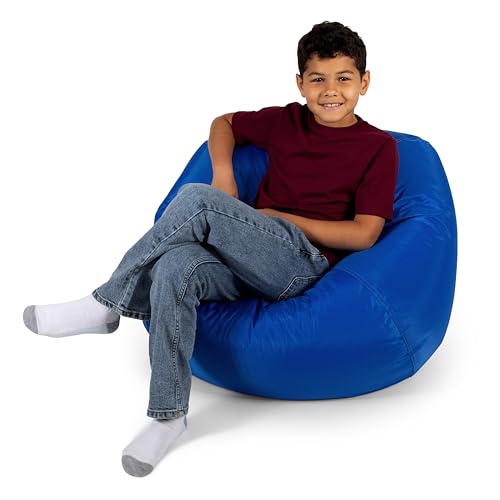
Big Joe Classic Bean Bag Chair for Kids — Best classic refillable
The Big Joe Classic is the category’s reference point: a 2-foot bean bag chair for a child’s bedroom or reading nook, in easy-clean sapphire, made from a durable nylon polyester blend, and refillable. Two feet is the honest child scale — a seat a young reader can own completely, carry between rooms with determination, and sink into without disappearing — and the classic construction brings the classic advantage this guide keeps returning to: when the fill settles, as all classic fill does, an adult can restore the chair rather than replace it. In a category full of disposable softness, refillable is a philosophy.
The sapphire colour and the nylon polyester blend suit the playroom’s terms of service. The fabric is described in its title as durable and easy-clean, which translates to the two operations a playroom chair undergoes weekly: being wiped, and being dragged. Its reading character is the bean bag’s traditional moulding hug, best in a defined nook with a lamp and a small shelf, where its 2-foot footprint leaves the playroom’s centre free for the activities that require a run-up. As a first bean bag — the chair that teaches a child what a bean bag is — it has no superior in this guide.
Safety notes follow the standing pattern: the chair’s broad, floor-hugging form is stable by geometry; it belongs on a flat floor away from stairs; toddlers using it belong in a supervising adult’s sight; and its seams and closure deserve the periodic adult check described later in this guide, with any refilling done by an adult. The title states no age range, so the maker’s listing guidance governs who it suits. Within those rules, the Classic is exactly what its name claims — the standard against which the five more specialised chairs below should be measured.
- Size: 2 feet, per listing title
- Fabric: nylon polyester blend, sapphire
- Fill: refillable, per listing title
- Care: described as easy-clean in the title
- Where to buy: the Big Joe Classic Bean Bag Chair for Kids listing on Amazon — check price on Amazon
Strengths
- Refillable fill makes its comfort restorable for years.
- Easy-clean durable fabric suits playroom service.
- True child scale that a young reader can move and own.
Trade-offs
- Classic fill settles and will need an adult’s refill.
- No handle or pocket for the owner’s treasures.
- No age range in the title; check the maker’s guidance.
Best for: a first bean bag and a defined reading nook in bedroom or playroom. Not suited for: older children who need a larger seat, or unsupervised toddler use.

HAPPYMONT 31in Kids Bean Bag Chair — Best stated school-age fit
The HAPPYMONT speaks to the playroom’s older half. It is a 31-inch kids’ bean bag chair with a faux rabbit fur cover in rose red, described as a comfy lazy chair and a toddler couch for teens and kids, and titled for ages 4-12 years — the widest printed age band in this guide, and one this review repeats exactly as printed. Thirty-one inches is a genuinely larger seat than the 2-foot picks, sized for the school-age reader whose legs have outgrown the toddler chairs and whose reading has graduated to chapter books consumed in long, sprawled sessions.
Faux rabbit fur is the surface decision, and it is a deliberate one: plush, warm, and unmistakably a comfort object, the kind of chair a child chooses for the reading that is also resting. Rose red gives the playroom a colour it will organise itself around, for better or worse — this is not a chair that blends, and households should buy it as the accent it intends to be. Its title’s own breadth, naming living room and bedroom alongside its reader positioning, matches its size: at 31 inches it can serve as the child’s seat in a family room without looking like equipment that escaped the playroom.
The safety framing scales with its audience: the stated band begins at four years, and younger siblings should be supervised around it as with any soft seat, with the chair placed flat and away from stairs in the usual way. The title does not name its filling, so this guide does not either — the listing’s detail panel is where a buyer confirms what is inside before ordering, a check this guide recommends for every chair whose title leaves the question open. For the school-age reader it names, the HAPPYMONT is the guide’s most complete bigger-kid answer.
- Size: 31 inches, per listing title
- Stated audience: aged 4-12 years, per listing title
- Cover: faux rabbit fur, rose red
- Positioning: reader, living room, and bedroom use as titled
- Where to buy: the HAPPYMONT 31in Kids Bean Bag Chair listing on Amazon — check price on Amazon
Strengths
- Printed 4-12 years band matches real school-age readers.
- Larger 31-inch seat fits growing legs and long books.
- Faux rabbit fur is the plushest surface in the guide.
Trade-offs
- What fills the bag is left off the title; the listing details name the fill, so read them first.
- Rose red commits the room’s palette around it.
- Plush fur holds crumbs and needs regular shaking.
Best for: school-age readers who have outgrown toddler chairs and read in long sessions. A poor fit for: children under the stated band without close supervision.

DAICO Kids Bean Bag Chair — Best for ages as titled
The DAICO is the guide’s youngest-directed complete package: a kids’ bean bag chair and comfy bean bag sofa for gaming and reading, with a handle, a washable cover in pink, and a stated audience of 3-6 years old, printed in its title and repeated here exactly. That combination — printed ages, a handle the child can use, a cover the parent can wash — reads like a design brief written by someone who has actually run a playroom. The handle matters more than its size suggests: a three-to-six-year-old who can carry their own chair to the reading spot, the game, or the sunny patch is a child whose furniture is building their independence along with their library.
Its working character is the playroom all-rounder. The title names gaming and reading together, which is honest scheduling for this age band — the chair that hosts a picture book at ten hosts a game at eleven, and a seat that serves both without moving rooms earns its floor twice. Pink is the stated colour of the washable-cover listing verified here, and the washable cover is the detail parents should weight heaviest: at ages three to six, the cover will meet every substance a playroom contains, and the difference between a washable chair and a wipeable hope is measured in months of service.
Safety for this youngest band follows the guide’s rules at their most attentive: flat floor, stable placement, no stair proximity, and children at the younger end of the stated band within a supervising adult’s sight while they lounge, as with every soft seat in this guide. The title does not name the filling, so the listing check applies before ordering. Judged as a complete, age-stated, washable, carryable package for the early-years playroom, the DAICO is the most parent-literate pick of the six.
- Stated audience: 3-6 years old, per listing title
- Details: handle for carrying
- Cover: washable, in pink
- Uses named in title: gaming and reading, playroom or bedroom
- Where to buy: the DAICO Kids Bean Bag Chair listing on Amazon — check price on Amazon
Strengths
- Printed 3-6 years band removes the sizing guess.
- Handle lets the owner move their own chair.
- Washable cover answers the age band’s realities.
Trade-offs
- Filling is not named in the title; check the listing.
- Stated band means a planned outgrowing.
- Pink colourway narrows its second-life audience.
Best for: children in the stated 3-6 years band and the playrooms they rule. Not the right match for: older kids, or any toddler use beyond a supervising adult’s sight.

Hobestluk Bean Bag Chair for Kids 2ft Velvet — Best memory foam compact
The Hobestluk changes the filling conversation. It is a 2-foot bean bag chair for kids in blue velvet fabric, built with memory foam, a washable cover, and a skin-friendly billing in its title, positioned for classroom, playroom, reading, lounging, and gaming. Memory foam is the considered reader’s filling: instead of shifting beads that flow away from pressure, foam yields slowly and holds a shape, so the seat a child settles into at page one is recognisably the same seat at page forty. For the reader who stays — the one this category ultimately serves — that steadiness is a real and purchasable difference.
Velvet over foam gives the chair a composed, almost grown-up character that suits its classroom billing: this is the bean bag a teacher can put in a reading corner without the room looking like a soft-play centre, and the one a parent can leave in a living room corner without apologising. The washable cover completes the practical brief — a foam chair cannot be refilled like the Big Joe, so its hygiene must come from its cover, and the title duly provides one. At 2 feet it shares the true child scale of the Classic, suiting younger and smaller readers and the tighter corners of real playrooms.
Its cautions are foam’s own. Memory foam cannot be topped up, so the chair’s long-term shape is the foam’s to keep, and a household that prefers restorable furniture should look to the refillable pick. The title states no age range, so the maker’s listing guidance governs its audience, and the standing supervision and placement rules apply as always. For the settled, staying reader in a classroom or playroom corner, though, the Hobestluk is the most composed seat in this guide — the bean bag that behaves like furniture.
- Size: 2 feet, per listing title
- Filling: memory foam, per listing title
- Fabric: velvet, in blue
- Cover: washable, per listing title
- Where to buy: the Hobestluk Bean Bag Chair for Kids 2ft Velvet listing on Amazon — check price on Amazon
Strengths
- Memory foam holds a settled reading shape steadily.
- Washable cover carries the hygiene for a foam build.
- Velvet finish suits classrooms and living-room corners.
Trade-offs
- Foam cannot be refilled when it eventually tires.
- No age range in the title; rely on the listing.
- Composed character may bore a child wanting plush chaos.
Best for: settled readers, classroom corners, and tidy playrooms. A weak match for: households that prefer refillable, restorable furniture.

ENBAOHUI Bean Bag Chair with Memory Foam — Best handled foam chair
The ENBAOHUI pairs the Hobestluk’s filling logic with the DAICO’s carrying sense: a bean bag chair with memory foam, in navy blue faux fur, with a handle, titled for kids, teens, and toddlers alike. The handle on a foam chair is a small liberation — memory foam chairs are denser than their bead-filled cousins, and a handle turns a drag into a carry for the child who relocates their seat by the hour, following the sun, the game, or the household’s centre of gravity. Navy faux fur is the diplomatic surface: plush like the HAPPYMONT’s, but in a colour that hides a playroom’s evidence and survives a transfer to an older child’s room without a colour argument.
Its title’s audience breadth — kids, teens, and toddler named together — should be read as the maker’s positioning rather than a sizing promise, and this guide’s rule applies: the listing’s own guidance governs who should use it, and toddlers belong in a supervising adult’s sight on it as on every soft seat here. What the breadth does signal is intent: a chair meant to stay in service as its owner grows, with the foam’s steady support suiting the longer reading and gaming sessions of older children as naturally as the short sprawls of younger ones.
Against the Hobestluk, its sibling in filling, the choice is surface and logistics: velvet and washable cover there, faux fur and handle here. The ENBAOHUI’s title does not claim a washable cover, so its cleaning story should be checked on the listing before ordering — in a playroom, that check is worth the minute it takes. With that verified, it stands as the most portable foam chair in the guide and the natural pick for the child whose seat must follow them everywhere.
- Filling: memory foam, per listing title
- Surface: faux fur, navy blue
- Detail: handle for carrying
- Audience as titled: kids, teens, and toddler — see listing guidance
- Where to buy: the ENBAOHUI Bean Bag Chair with Memory Foam listing on Amazon — check price on Amazon
Strengths
- Handle makes the denser foam build genuinely portable.
- Navy faux fur hides playroom evidence gracefully.
- Foam support suits longer sessions as readers grow.
Trade-offs
- Washable cover is not claimed in the title; verify care.
- Broad titled audience still needs listing guidance.
- Foam weight is more than a bead chair’s for small carriers.
Best for: mobile readers whose chair follows them around the house. Poorly suited to: buyers who need the cover’s washability confirmed in the title itself.

MAXYOYO Kids Bean Bag Chair Beige — Best with a pocket
The MAXYOYO closes the six with the detail this guide’s sibling article celebrated in a toddler couch: a pocket. It is a stuffed bean bag sofa in beige, standard size, with a pocket, described as a lazy floor chair for gaming and reading, for boys and girls. Stuffed is its filling word — the title’s own description of a chair that arrives filled and ready — and the pocket is its personality: the place the current book, the controller, and the non-negotiable small toy live when their owner is in residence. A chair with a pocket is a chair with a household system, and children run such systems with a seriousness adults should respect.
Beige is the playroom peacemaker. In a room already loud with colour, a beige chair calms the corner and pairs with any bedding, rug, or sibling chair the household already owns; it is also the colour most likely to graduate to a family room or a grandparent’s house without a redecoration summit. Its floor-chair positioning suits the playroom’s ground-level civilisation, where much of life — games, puzzles, picture books, negotiations — happens within a foot of the carpet, and a low stuffed sofa meets that civilisation on its own terms.
Its cautions are the quiet ones: the title states no age range and no washable cover, so both the audience and the cleaning story belong to the listing check this guide keeps recommending, and beige will show the playroom’s evidence more honestly than navy or sapphire — a household at peace with a visible history will not mind, and others should choose their colour with eyes open. The standing safety rules apply in full. As the pocketed, stuffed, go-anywhere closing pick, it is the chair most likely to become a particular child’s particular place, which is the highest praise this category offers.
- Build: stuffed bean bag sofa, per listing title
- Colour: beige, standard size
- Detail: side pocket
- Uses named in title: gaming and reading, floor chair
- Where to buy: the MAXYOYO Kids Bean Bag Chair Beige listing on Amazon — check price on Amazon
Strengths
- Pocket gives the owner’s book and treasures a home.
- Beige neutrality graduates to any room in the house.
- Stuffed build arrives filled and ready, no setup.
Trade-offs
- No age range or washable cover claimed in the title.
- Beige shows playroom evidence honestly and early.
- Floor-chair lowness suits sprawlers, not upright sitters.
Best for: a child whose chair must hold their book, game, and treasures in one territory. Not suited for: households needing the cleaning story settled by the title alone.
The Six Compared: Fill, Surface, and Signature Detail
| Chair | Filling as titled | Surface | Signature detail |
|---|---|---|---|
| Big Joe Classic Bean Bag Chair for Kids | Refillable classic fill | Nylon polyester blend | Easy-clean sapphire |
| HAPPYMONT 31in Kids Bean Bag Chair | Not named in title | Faux rabbit fur | Stated 4-12 years |
| DAICO Kids Bean Bag Chair | Not named in title | Pink, washable cover | Handle; stated 3-6 years |
| Hobestluk Bean Bag Chair for Kids 2ft Velvet | Memory foam | Blue velvet | Washable cover |
| ENBAOHUI Bean Bag Chair with Memory Foam | Memory foam | Navy faux fur | Handle |
| MAXYOYO Kids Bean Bag Chair Beige | Stuffed | Beige | Side pocket |
“Cover Only”: The Two Words That Decide Whether You Bought a Chair
This warning earned its own section because it is the single most expensive reading-comprehension test in children’s furniture. A cover-only listing sells the shell of a bean bag — the shaped, zippered fabric — with nothing inside it. The photographs show a plump chair because photographs of shells are taken filled, borrowed, or rendered, and the price seems like a bargain because a shell costs a fraction of a chair. The buyer discovers the truth at delivery, in a flat parcel, and then discovers the second truth: filling is sold separately, in volumes measured in litres, and the finished cost of shell plus fill frequently exceeds the complete chairs in this guide.
The defence is a ten-second habit. Before ordering any bean bag, search the listing’s title and description for “cover only”, “no filler”, “filling not included”, and their cousins; check the parcel’s weight if it is published, because a filled child’s chair and an empty shell differ by kilos, not grams; and treat any bean bag priced like a cushion as a cushion until proven otherwise. Every pick linked in this guide was screened against exactly this test — each title describes a complete chair, filled, stuffed, or foam-built — and the habit is offered to the reader for every future purchase, because the playroom will need a second chair someday, and it may not come from a guide as careful as this one.
Beads, Foam, or Stuffing: Which Filling Serves Which Reader?
Filling is destiny in a bean bag, because it decides how the chair feels in month one and whether it still feels that way in year two. Classic fill — the light beads inside the Big Joe’s refillable design — gives the traditional bean bag experience: the chair flows around its reader, moulds instantly, and weighs almost nothing, which is why small children can move it themselves. Its tax is settling; the fill compresses with use and the seat sits lower by degrees, which the refillable design answers honestly by letting an adult restore it. A household willing to perform that small service owns a chair that can be kept at its best indefinitely.
Memory foam, in the Hobestluk and the ENBAOHUI, serves the reader who stays still longer: it yields slowly, holds the shape it is given, and supports a settled sprawl without the constant micro-shifting of beads. Its tax is finality — foam cannot be topped up, so the chair’s lifespan is the foam’s lifespan — and weight, since a foam chair is the heavier carry, handles notwithstanding. Stuffing, the MAXYOYO’s build, sits between: a filled softness that arrives ready, behaves predictably, and asks nothing. None of the three is the correct filling; each is the correct filling for a different reader, and choosing among them by the reader’s habits — wiggly or still, mover or settler — is the most consequential decision in this guide after safety itself. Adult readers applying the same filling logic at porch scale will recognise it in Best Outdoor Patio Rocking Chairs, where materials are likewise chosen for the weather they will actually meet.
Placing and Keeping a Playroom Bean Bag
Placement follows the safety frame: a flat floor, clear space around the chair for the sprawl and the inevitable dramatic collapse into it, away from stairs, and out of the route between a running child and anything breakable. Within those lines, put the chair where the reading is meant to happen — facing the room’s light, near the book basket, within sight of the adult territory — because a bean bag exiled to a corner behind the toy storage will be used as toy storage. Playrooms also benefit from a chair-per-child peace settlement wherever siblings are concerned; a single bean bag between two readers is a border dispute with upholstery.
Keeping is a rhythm of small acts. Shake the chair outside weekly to evict the crumbs that migrate to its seams. Plump it — a bean bag that is never plumped slowly becomes a floor cushion with ambitions — and check seams and closures monthly, with any refill handled by an adult. Wash the washable covers as their makers direct and dry them fully; wipe the easy-clean surfaces before evidence sets. And retire or repair any chair whose filling escapes or whose seams no longer close as designed, because the stability and containment this guide opened with are conditions to maintain, not features bought once. A playroom chair maintained on this rhythm will outlast several growth spurts and at least one redecoration of the room around it.
The Playroom Laundry Question: Covers, Throws, and Constant Washing
A playroom with bean bags is a laundry-generating household, and it is worth planning for honestly. Washable covers go into the wash on rotation; throws that live over the chairs follow them; and the playroom’s soft furnishings generally produce a steady, unglamorous stream of loads that the household’s machines must absorb without complaint. This is the domestic backdrop against which two of this guide’s picks — the DAICO and the Hobestluk, with their washable covers — earn a practical advantage that has nothing to do with sitting: they were designed for a room whose furniture is expected to be washed, in a house whose laundry system is expected to keep up. Households upgrading that system alongside the playroom will find the certification discipline in Best Energy Star Dryers worth reading, where efficiency claims are verified against titles with the same strictness this guide applies to fillings.
The routine itself is simple and worth stating once. Covers wash on a gentle cycle as their makers direct, dry fully before refitting — a damp cover refitted over foam or fill is a smell waiting to happen — and rotate with a throw so the chair is never out of service on a reading day. Keeping one spare throw in the playroom drawer converts every spill from an emergency into a swap, and it is the cheapest quality-of-life purchase in this entire article. The chair that can always be sat in is the chair that gets read in, and laundry, unglamorous as it is, is what keeps it that way.
Bean Bags at Parties, Sleepovers, and Other Stress Tests
Every playroom chair eventually faces its examination: the birthday party, the sleepover, the rainy Saturday when the whole street’s children are indoors. Bean bags pass these tests in a particular way — they multiply the room’s seating without multiplying its hard edges, they absorb the energy of children who would otherwise be climbing the furniture that has legs, and they forgive the juice incidents that a party guarantees. The handles and lightweight builds in this guide earn their keep here, because party seating is rearranged seating, and chairs that children can move themselves get moved to where the party actually is.
The morning after delivers the counter-lesson, and it belongs in a buying guide: check the chairs. Party service loosens seams, tests zippers, and drives crumbs into places the weekly shake never reaches, and the monthly soundness check described in this guide should be promoted to the day after any event. A chair that survives the inspection is ready for another term of ordinary service; a chair with a strained seam is repaired or retired before its filling begins a tour of the playroom floor. Parties are also where the cover-only warning returns in disguise — the spare “chair” a well-meaning relative produces may be a shell — and the household that has read this guide will know to check before a child sits down in good faith.
One Chair, Many Rooms: The Bean Bag’s Migration Pattern
Track a child’s bean bag across a year and it draws a map of the household: playroom in the morning, living room for the family film, bedroom for the bedtime chapter, garden-adjacent conservatory on the first warm weekend — always supervised where the young are concerned, always on a flat floor, but otherwise gloriously mobile. This migration is the bean bag’s structural advantage over every framed chair in this site’s children’s coverage, and it is why the small logistics details in the titles — the DAICO’s and ENBAOHUI’s handles, the Big Joe’s featherweight classic build, the MAXYOYO’s pocket that keeps the cargo with the chair — matter out of proportion to their size. A chair that travels well is a chair that is present for more reading, in more lights, across more of the child’s day.
The migration has one rule worth teaching the chair’s owner early: the chair comes home. Bean bags left in other rooms become other rooms’ furniture, claimed by siblings, absorbed into dens, sat on by the dog, and the reading corner loses its centre. Households that establish the home-corner custom — the chair sleeps in its corner, wherever it spent the day — keep the ritual intact, and the child who carries their chair home at bedtime is rehearsing, in miniature, the care of their own things. It is a small discipline with a long shadow, and it begins, like everything in this guide, with a chair worth carrying.
Reading Postures of the Under-Ten: A Field Guide for the Adults Buying
Adults buy bean bags imagining a child sitting in one. Children use them as a base camp for postures no furniture designer has ever catalogued: sideways across the top with the book on the floor, upside down with feet on the chair and head off it, inside a fort whose walls are the chair and a blanket, and — occasionally, miraculously — seated, upright, reading, in the manner of the brochure. The bean bag is the only chair in this site’s coverage that survives all of these uses without argument, because it has no correct orientation to violate. That is its deepest suitability for the playroom, and it reframes the buying question: not which chair will my child sit in properly, but which chair will still be comfortable, stable, and intact after being used improperly in forty inventive ways before lunch.
Judged on that question, the picks sort themselves naturally. The classic refillable Big Joe forgives everything and can be restored after it. The foam chairs hold a more defined shape for the reader who does settle, and their steadiness rewards the child who reads in long, still stretches. The stuffed MAXYOYO splits the difference and adds the pocket for the expedition’s supplies. None of them should be expected to enforce posture, teach sitting, or improve anything about a child except the comfort of their reading hour — this guide makes no such claims for any chair — but all of them will host the full theatre of childhood reading without breaking, tipping, or complaining, and that is the whole job.
What Size Is Right? Reading the Numbers Like a Parent
The sizes in this guide’s titles — 2 feet, 31 inches — are the buyer’s compass, and they deserve a paragraph of translation. A 2-foot chair is a young child’s chair: it fits the under-six body, the toddler-to-early-reader span, and it will be outgrown by a tall seven-year-old as surely as shoes are. A 31-inch chair is the next country: school-age territory, with room for the legs and the sprawl that chapter books demand. The stated age bands, where titles print them, draw the same map from the other direction — DAICO’s 3-6 years at the small end, HAPPYMONT’s 4-12 years spanning the school years — and where the two maps agree, the buyer can proceed with confidence.
Where a title offers neither size nor age, the listing’s dimension panel is not optional reading; it is the purchase. Measure the child, if the child will hold still, or measure the chair they currently overflow, and compare like with like: seat width against hips, seat height against the sprawl. And buy for the child of this year with a little headroom, not for the teenager of 2032 — a bean bag that fits now will be used daily, while a bean bag bought for someday will be climbed over on the way to a chair that fits, until someday arrives and finds it already flattened by the waiting.
The Second Chair Problem: Siblings, Spares, and Fair Shares
Playrooms teach arithmetic with furniture: one beloved bean bag plus two children equals a negotiation that recurs daily at reading time. The households that solve it cheapest solve it at the first purchase, because a second bean bag bought in the same order — even a humbler one — costs less than the same chair bought later in a separate delivery, and infinitely less than the peace it purchases. The natural pairing logic follows this guide’s own structure: a featured chair for the elder reader at their scale, a 2-foot classic for the younger at theirs, with the understanding that chairs will be traded, claimed, and occasionally occupied by the wrong child entirely, which is not a failure of the system but the system working. Where a second chair is genuinely impossible, the rota and the timer are the honest tools, and the bean bag’s lack of a fixed owner-facing orientation makes it the fairest shared seat in the house: nobody’s name is moulded into it, and it refits each child in turn without memory of the last.
A Short Defence of the Bean Bag, Addressed to the Sceptical Adult
Some adults regard the bean bag as furniture’s surrender — a chair that gave up on structure, posture, and dignity simultaneously. This guide, having spent several thousand words on the category, offers the counter-case in one paragraph. For a child, a chair’s job is not to model adult sitting; it is to make the floor-level world of childhood comfortable enough that a book can compete with everything else in it. The bean bag does that job with no hard edges to fall against, no legs to fold or break, no correct orientation to enforce, and a moulding welcome that refits itself to a growing, wriggling reader at every sitting. It is also, not incidentally, the chair children choose for themselves when every chair in the house is available — and a guide that ignored the reader’s own vote would be a poor guide indeed. Sceptics are invited to conduct the experiment honestly: put any pick from this guide in a playroom for a week, and count the hours it is occupied against every other seat in the house. The bean bag rests its case on the result.
Storage When the Playroom Must Become Another Room
Playrooms in real houses double as guest rooms, offices, and overflow dining at holidays, and the bean bag’s behaviour during those conversions is a final, practical virtue. A 2-foot chair tucks into a wardrobe, under a high bed, or behind a door without tools, disassembly, or a second adult; the 31-inch chair demands a corner but still moves in one trip, by its handle where it has one. Foam chairs stack less willingly than classic-fill ones, which squash obligingly into odd spaces and recover with a shake. Households that convert their playroom monthly should weight this storage behaviour alongside comfort — a chair that stores gracefully gets stored, while a chair that stores awkwardly gets left in the middle of the guest room, where it will be sat on by a visiting uncle who will then ask where it came from. Which, in its way, is also a recommendation.
Mistakes Playroom Buyers Keep Making
The first and costliest is the cover-only purchase, covered above because it deserves the repetition: read for the two words before the price seduces you. The second is buying by the photograph’s scale — a bean bag that looks generous against a photographed child may be toddler-sized against yours, so the stated sizes and age bands in the titles, 2 feet, 31 inches, 4-12 years, 3-6 years, are the buyer’s real friends. Third is ignoring the cleaning story in the room where cleaning matters most; a chair without a washable cover or an easy-clean surface is a countdown. Fourth is forgetting supervision and placement in the excitement of the soft, safe-looking object — soft is not the same as unsupervised, especially for the youngest. And fifth is buying one chair for two children and calling the ensuing negotiations character-building.
Final Recommendation
Start with the reader’s age and habits, because this guide was organised around them. For the classic first bean bag, the Big Joe’s refillable 2-foot design remains the standard: durable, easy-clean, restorable. For the stated school-age band, the HAPPYMONT’s 31 inches and faux rabbit fur serve the long-session reader; for the stated 3-6 years band, the DAICO adds a handle and a washable cover to its printed promise. The Hobestluk is the composed choice — memory foam, velvet, washable cover — for classrooms and settled readers, the ENBAOHUI the portable foam choice with its handle and navy fur, and the MAXYOYO the territory chair, pocketed and beige, for the child whose seat must hold their whole world. Check every listing for “cover only”, place the chair flat and supervised, and keep its cover washed and its seams sound. A playroom bean bag chosen that carefully — complete rather than a shell, sized to its reader, filled for their habits, and placed by the safety rules — will be sat on, read in, dragged between rooms, fought over by siblings, and loved exactly as hard as it was designed to be, for as many childhoods as its seams, its cover, and its filling can collectively hold together in proud service.
Frequently Asked Questions
How can I tell if a bean bag listing is cover only?
Search the title and description for “cover only”, “no filler”, or “filling not included”, and be suspicious of a chair-priced-like-a-cushion or a parcel weight measured in grams. Every pick in this guide is a complete chair as its title describes — filled, stuffed, or foam-built — and cover-only listings were excluded by design.
Which filling lasts longest?
Each ages differently. Classic refillable fill settles but can be restored by an adult, giving it the longest potential service. Memory foam holds its support steadily but cannot be topped up. Stuffed builds sit between. Longevity depends as much on the shaking, plumping, and seam checks in this guide as on the filling chosen.
What ages are these chairs for?
Only where titles print them: the HAPPYMONT states 4-12 years and the DAICO states 3-6 years. For the other picks, each maker’s listing guidance is the authority. Whatever the band, toddlers belong within a supervising adult’s sight on any soft seat.
Are bean bag chairs safe for toddlers?
They are low, broad, and floor-based, which is stable geometry, and they are lounging furniture to be used under adult supervision — placed on a flat floor, away from stairs, and not used as an unsupervised sleep space. Seams and closures should be checked regularly by an adult, as this guide describes. Parents should also keep the chair out of any position where a toddler could climb from it onto higher furniture, because the hazard in a playroom is rarely the soft chair itself but the adventure a determined small person can build on top of it with enough time and imagination combined.
How do I plump a bean bag back into shape?
Pick it up by its seams, shake it vigorously outside or over a hard floor, and knead the filling back toward the seat’s centre — a minute’s work that restores the loft a week of sitting compresses. Classic-fill chairs respond best and can be topped up by an adult when shaking stops being enough, which is the refillable design’s whole purpose. Foam chairs should be shaken and left unoccupied for a while to recover their shape. Make the weekly shake part of the playroom tidy, ideally performed by the chair’s owner, whose arms are exactly the right size for the job and whose chair it is.
Can these chairs go in a classroom?
The Hobestluk’s title names classroom use explicitly, and its velvet, memory foam build suits a reading corner. Any classroom use should follow the school’s own furniture and supervision policies, and the chair’s washable cover is a practical asset in that setting.
Related Guides
When the playroom’s readers inevitably outgrow the 2-foot scale and start asking for furniture at their new size, the natural graduation is Best Large Bean Bag Chairs, where the same filling questions are argued, with the same honesty about sizes and covers, at full adult size.


