What's inside
- Where to buy these picks
- Quick picks at a glance
- How these picks were chosen
- The six picks in detail
- Side-by-side comparison
- How do you choose a grass area rug that fits your ground?
- Laying turf rug so it stays flat, dry and put
- What a season of weather does to synthetic grass
- Common mistakes
- Final recommendation
- Frequently asked questions
As an Amazon Associate I earn from qualifying purchases. This post may contain affiliate links at no extra cost to you.
As an Amazon Associate, cottageverdict.com earns from qualifying purchases.
Let us be plain at the start: every pick in this guide to the best grass area rugs is artificial turf — synthetic grass matting sold in rug-sized pieces — and none of them is a woven seagrass rug, despite how often the two get mixed up in search results. Seagrass is a natural fibre floor covering for indoors; what follows is fake lawn you unroll on a patio, a balcony, a deck or a tired patch of garden where real grass will not grow, will not stay green, or is more work than the space deserves.
That distinction changes how you should shop. A turf rug is judged on footprint, blade height, backing behaviour and what happens when rain lands on it, not on weave or fibre softness. Drainage matters here the way it matters on any outdoor surface: water that cannot pass through or run off will sit on the backing, and a rug that stays soggy underfoot is a rug you stop using. Several listings below call out drainage holes directly, and that is an outdoor-surface feature worth weighing, not a detail to skip past.
The six pieces below run from a compact 3×5 mat to two long 7×15 rolls, with blade heights of 0.4 and 0.8 inches where the listings state them. Some lean realistic, some lean practical, and one is deliberately described by its maker as a lighter-weight version. Read the sizes against your own tape-measure numbers before anything else, because with turf the footprint is the decision: a rug that stops a foot short of the furniture line looks like a mistake every single day.
One expectation is worth setting before the reviews: artificial grass does not feel like a lawn underfoot in spring, and it does not try to. It feels like a firm, springy, always-tidy surface that never needs a Saturday. Buyers who make peace with that trade in advance tend to love these products for years; buyers who secretly expect turf to be grass with the work removed tend to blame the rug for a decision they made. The six below are judged as what they are — synthetic surfaces with stated sizes, stated blades where given, and jobs to do.
Where to buy these picks
All six are sold on Amazon, and each one earns its place here for a different patch of ground.
- Garland Artificial Grass Rug 7×10: the straightforward 7×10 starter piece, sized for a standard patio seating set and described as lush, durable and low-maintenance.
- Artificial Grass Turf Rug 7×10: the other 7×10, which leans harder on realism and a non-slip character for mixed indoor and outdoor spots like balconies.
- LITA Artificial Grass Turf 7×15: the long 7×15 roll with the shortest stated blade, a neat 0.4-inch mat for runs of ground rather than square seating zones.
- Heyroll Artificial Turf 7×15: the second 7×15, but with a taller 0.8-inch blade and a custom-size option for awkward landscape shapes.
- Ottomanson Artificial Grass Rug Lite: the lighter 5’3″ x 8’2″ piece that pairs drainage holes with UV resistance for decks that bake in afternoon sun.
- LOOBANI Artificial Grass 3×5: the small 3×5 mat with drainage holes, the one to reach for when only a doorway strip or balcony corner needs covering.
Quick picks at a glance
Notice what the table does not contain: no natural fibre, no indoor-only rug, and no piece pretending to be lawn in a roll wider than it is. Sizes and blade heights below come straight from the listings.
| Pick | Best for | Standout detail from the listing |
|---|---|---|
| Garland Artificial Grass Rug 7×10 | A standard patio seating set that needs one uncomplicated green rectangle | 7×10 indoor/outdoor format billed as lush green, durable and low-maintenance |
| Artificial Grass Turf Rug 7×10 | Balconies and mixed indoor-outdoor corners where staying put matters | Realistic turf with a non-slip claim and an unusually wide list of named settings |
| LITA Artificial Grass Turf 7×15 | Long runs of ground — side yards, dog runs and narrow garden strips | The short-blade option: a 7×15 synthetic mat with a stated 0.4″ height |
| Heyroll Artificial Turf 7×15 | Backyard landscape pieces where the grass has to look like grass | Tallest stated blade here at 0.8 inch, with a custom-size option |
| Ottomanson Artificial Grass Rug Lite | Sun-exposed decks that need water to escape and colour to stay | The only pick pairing drainage holes with stated UV resistance |
| LOOBANI Artificial Grass 3×5 | Thresholds, balcony corners and small test patches of green | The compact 3×5 with drainage holes and a realistic billing |
How these picks were chosen
The shortlist was built by spreading the sizes first. Shoppers for turf rugs fall into two camps — people dressing a defined seating rectangle and people covering a run of ground — so the six had to include honest examples of both: three squarish area sizes (7×10 twice, plus the 5’3″ x 8’2″ Lite) and two long 7×15 rolls, with the 3×5 mat kept because small balconies and door thresholds are where turf often gets bought first. Any listing that could not state its dimensions clearly never made the cut.
Blade height was the second filter, applied only where listings volunteer it. The LITA states 0.4 inch and the Heyroll states 0.8 inch, and that gap is the difference between a mat that behaves like a putting surface and one that reads as meadow from the kitchen window. Where a listing gives no blade height, the review says so rather than guessing from photographs, and the same discipline applies to backing construction and fibre material, which most of these titles leave unstated.
If the green is going down in a child’s space rather than on the patio, the companion guide to Best Kids Room Rugs covers the soft indoor side of that decision.
The six picks in detail
Each review sticks to what its listing actually states — footprint, blade height where given, and the jobs the maker names — and flags honestly where a listing stays silent, because turf listings are not equally forthcoming.

Garland Artificial Grass Rug 7×10
The Garland is the reference size in this guide: 7 feet by 10 feet of artificial grass in a lush green, sold for patios and lawns and described by its maker as durable and low-maintenance. It makes no claims about drainage holes or blade height, and that plainness is part of its character — this is the turf rug for a buyer who wants the classic rectangle and nothing fussy around it.
Listing facts at a glance
- Size: 7 ft x 10 ft
- Colour: Lush green
- Use: Indoor and outdoor — patios, lawns and more, per the listing
- Blade height: The listing title does not give a figure
- Drainage: No drainage feature is mentioned in the title
Strengths
- The 7×10 footprint matches the classic patio rug proportion, so furniture legs sit on it the way they sit on a woven rug
- Sold for both indoor and outdoor use, which suits a sunroom-to-deck layout
- Low-maintenance positioning fits owners who are done with mowing a small patch
Trade-offs
- No blade height in the title, so realism has to be judged from listing photos alone
- No drainage holes are claimed, a gap next to the Ottomanson and LOOBANI below
- The title names no backing type, so grip on smooth decking is unconfirmed
Seventy square feet is the size at which a turf rug stops being a mat and starts organising a space. A 7×10 lets a four-seat patio set stand fully on the green with a border to spare, and it covers the worn rectangle in front of most sliding doors without leaving a bald frame of concrete showing. Garland sells this piece for lawns as well as patios, which hints at its intended second job: laying over a patch of real ground that has given up — under a trampoline, say, or in the shaded strip where the grass thinned to mud years ago and reseeding never took.
Because the listing stays quiet on drainage, placement does the work that holes would otherwise do. On a slab that slopes even slightly, water will sheet off a 7×10 in ordinary rain; on a dead-flat balcony it can linger underneath, so lifting a corner after the first storm is a sensible habit with this particular rug. Indoors, the same piece under a mudroom bench or in a garage gym corner asks nothing but a shake outside now and then. Treat it as the low-fuss option it claims to be, and its silences matter less.
Durability in this class is mostly a story of edges and sun. A 7×10 that lives under furniture is protected by its own layout; the corners take the weather and the chair legs take the centre. Garland’s low-maintenance claim will be tested most at those corners, where owners should expect to brush the blades back into line occasionally. Nothing in the listing promises more than durability in general terms, and judged in those terms — a big, plain, hard-wearing green rectangle — this is the pick the fewest buyers will have a complicated relationship with.
Best for: patio owners who want the standard rectangle, a lush green read, and minimal specification drama.
Not suited for: shoppers who need confirmed drainage holes or a stated blade height before they commit.
Measure your slab, and if 7×10 is the honest fit, check the Garland 7×10 on Amazon
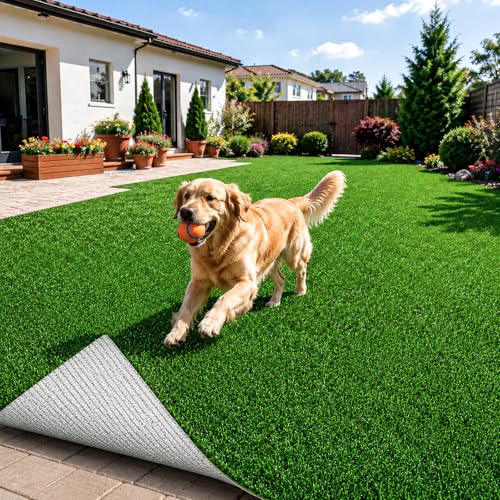
Artificial Grass Turf Rug 7×10
This second 7×10 takes a different angle from the Garland: its listing leads with realism, calls the turf pet-friendly, describes it as non slip, and names more settings than any other pick here — patio, balcony, garden, backyard and indoors. It is the generalist of the group, aimed at buyers whose green patch has to behave in several places over its life.
What the listing states
- Size: 7×10 ft
- Look: Realistic grass turf, green
- Grip: Described as non slip in the listing title
- Use: Patio, balcony, garden, backyard and indoor
- Blade height: No figure appears in the title
Strengths
- Non-slip positioning suits balconies and smooth surfaces where the Garland stays silent
- The widest setting list in the guide, from garden to indoor floor
- Pet-friendly billing matches households whose dogs treat the patio as a room
Trade-offs
- Realism is a listing claim with no blade height published to back it up
- No drainage holes are mentioned despite the outdoor pitch
- With so many named uses, it is a generalist rather than the best at any single one
The non-slip claim is what separates this rug from its same-size rival above. Turf on a balcony slab or a tiled terrace lives or dies by whether it creeps when a chair leg drags or a dog lands at speed, and a listing that puts non slip in its title is at least answering the right question. Pair that with the indoor mention and you get a piece that can winter inside — under a play tent, say, or as a green zone in a basement family room — then go back out in spring without the move feeling like a demotion.
Realism deserves a cooler eye. The listing promises a realistic read but publishes no blade height and no thatch detail, so the honest expectation is a convincing green surface at conversational distance rather than a lawn that fools anyone at arm’s length. For a balcony photographed from the sofa or a backyard corner seen from the kitchen, that is usually enough. Garden use raises the drainage question again: on soil, water passes around and under any rug, but on slabs this piece, like the Garland, relies on slope rather than holes.
There is a social use for this rug that its listing hints at with its long setting list: it is the piece that turns a bare rental balcony or a plain backyard slab into a place guests read as intentional. Green is the colour of effort in a garden, and a realistic-enough 7×10 supplies the signal without the gardening. The non-slip claim supports that social life, because a rug under a drinks table and four chairs cannot be allowed to travel. Expect to be asked where it came from; expect the honest answer to involve the word synthetic within the first minute.
Best for: renters and balcony owners who want one 7×10 that grips, travels indoors, and tolerates pets.
Not suited for: buyers chasing the tallest, most lawn-like blade — the Heyroll states its height and this one does not.
For a balcony or a pet-shared patio, look at this non-slip 7×10 turf rug on Amazon
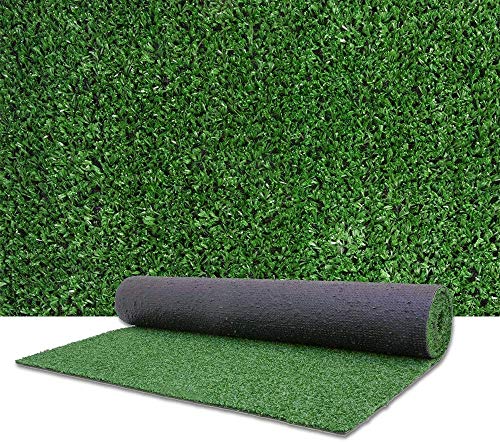
LITA Artificial Grass Turf 7×15
The LITA stretches the format to 7 by 15 feet and keeps the blade short and honest about it: 0.4 inch, stated right in the title. Its listing calls it a synthetic grass mat for indoor and outdoor use, and the combination of length plus low blade gives it a tidy, almost athletic character — less meadow, more green runway.
Specification snapshot
- Size: 7 ft x 15 ft
- Blade height: 0.4″ — the shortest stated in this guide
- Form: Synthetic grass mat / rug
- Use: Indoor and outdoor
- Drainage: The title is silent on drainage
Strengths
- The 15-foot length covers side-yard runs in one piece instead of seamed offcuts
- A stated 0.4-inch blade sweeps and hoses clean more easily than tall turf
- Short pile reads neat along paths and under garden furniture
Trade-offs
- 0.4 inch will not fool anyone into thinking it is a grown lawn
- No drainage or backing detail in the title
- The long format is wasted on a square patio, where it would need cutting
Think of the jobs that are long rather than wide: the side return between house and fence, the run behind a shed, the strip under a clothesline, a dedicated dog run along a boundary. A 7×15 covers those in a single unroll, and the short blade suits them, because tall turf along a working path gets flattened into sad lanes within a season while a 0.4-inch mat keeps its line. The same logic applies indoors in a long utility room or a garage where a green strip softens concrete without becoming a trip edge.
Short blade also changes the cleaning maths. Leaves, blossom and dog hair sit on top of a 0.4-inch surface instead of lodging down in it, so a stiff broom genuinely restores it, where taller turf wants a rake and patience. What the listing does not discuss is drainage, and on a 15-foot run that matters at the low end: lay it so the fall of the ground carries water along and off, not into a pooling corner. Owners who want the meadow look should keep scrolling to the Heyroll; owners who want order should stop here.
Indoors is where the LITA’s short blade quietly shines a second time. A 0.4-inch surface under a home gym’s walking pad area, a basement play zone or a long utility room adds colour and a forgiving layer without the sponginess that tall turf brings to tasks needing a firm base. It also vacuums like a mat rather than a lawn, which in an indoor setting is the difference between a surface that is maintained and one that is merely owned. The 15-foot length, awkward outdoors in small gardens, is often exactly right along an indoor wall.
Best for: side yards, dog runs and path-side strips that need one long, low, tidy piece.
Not suited for: anyone buying turf primarily to imitate a lush lawn at close range.
If your problem patch is long and narrow, see the LITA 7×15 short-blade mat on Amazon

Heyroll Artificial Turf 7×15
The Heyroll matches the LITA’s 7×15 footprint and doubles its blade: 0.8 inch, stated in the title, on a synthetic turf the listing calls realistic. It is pitched at patios, landscape work and backyards, names dogs and pets, works indoors too, and adds something none of the other five offer — a custom size option for ground that refuses to be a rectangle.
The listing in brief
- Size: 7×15 ft, with custom size offered in the listing
- Blade height: 0.8 in — the tallest stated in this guide
- Look: Realistic artificial grass, per the listing
- Use: Patio, landscape, backyard and indoor; dog and pet lawn mat
- Drainage: Not addressed in the title
Strengths
- 0.8-inch blade gives the most lawn-like read of the six
- Custom sizing answers L-shaped or curved landscape beds
- The long format plus tall blade suits a full backyard feature area
Trade-offs
- Tall blades trap leaves and need raking rather than a quick broom pass
- No drainage holes are claimed for a piece aimed at open ground
- Custom sizes complicate returns, so measuring has to be right first time
Blade height is the realism dial on turf, and 0.8 inch is where a synthetic surface starts to behave visually like grass rather than carpet: it catches light unevenly, hides its own backing, and lets a bare foot press in instead of skating across. Spread over 105 square feet, that makes the Heyroll the pick for a backyard that is meant to be looked at — the green centre of a landscape scheme, the play lawn that never needs reseeding, the dog area that should not read as a dog area from the house.
The custom-size option deserves more attention than it usually gets. Landscape beds curve, patios have chimney breasts and step-outs, and a turf piece cut at the factory to your outline arrives without the frayed DIY edge that home trimming can leave. The trade is commitment: a bespoke piece is bought once, so the template has to be honest. Day to day, expect the tall blade to collect windfall — blossom in spring, leaves in autumn — and budget a leaf rake as part of ownership rather than resenting it.
The custom-size option changes the buying process as much as the product. Instead of choosing a rectangle and designing the garden around it, the garden’s own outline becomes the specification — the curved bed, the L-shaped terrace, the wedge beside the steps. That is a landscaper’s way of buying, and it suits the Heyroll’s realistic brief, because realism fails fastest at the edges where a wrong shape announces itself. Measure with a hose laid along the intended outline, photograph it from above, and let the factory do the cutting.
Best for: backyard landscapers who want height, realism and a made-to-measure escape hatch.
Not suited for: path and run owners, who will fight the tall blade’s upkeep every week.
For the most lawn-like surface in this guide, view the Heyroll 0.8-inch turf on Amazon

Ottomanson Artificial Grass Rug Lite
The Ottomanson Lite is the engineer’s pick of the six: a 5’3″ x 8’2″ fake grass carpet for patio and deck, sold as a pet turf area, with two functional claims the others mostly skip — drainage holes through the backing and UV resistance for the colour. The word Lite in its name signals a lighter build, and the listing wears that as a feature rather than an apology.
Facts taken from the title
- Size: 5’3″ x 8’2″
- Drainage: Drainage holes — stated in the title
- Sun exposure: UV resistant, per the listing
- Use: Patio and deck, indoor and outdoor; pet turf area
- Blade height: No figure given in the title
Strengths
- Drainage holes answer the standing-water problem directly
- UV resistance targets the fading that ruins south-facing deck turf
- The mid size suits apartment patios the 7x10s would swamp
Trade-offs
- Lite build implies a thinner feel underfoot than the tall-blade picks
- At roughly 43 square feet it is too small for a full family seating set
- Blade height is unpublished, so softness is a judgement call from photos
Drainage holes sound like a footnote until you have owned turf without them on a flat deck. Rain that lands on a hole-free rug travels to the edges or sits; rain on this Ottomanson can pass through the backing and reach the deck’s own fall, which is how the surface dries in hours instead of days. For pet owners that same through-flow is what makes rinsing the area a real cleaning method rather than a way of moving the problem to the rug’s border. It is the most practically specified listing in this guide.
UV resistance is the other half of deck ownership. A green that fades to a grey-green ghost by August makes the whole terrace look tired, and the listing’s UV claim is aimed squarely at that failure. The Lite build cuts both ways: a lighter rug is easier to lift for the seasonal clean underneath and easier to store, but it will not have the planted, heavy feel of a tall turf carpet, and on a windy exposed deck a lighter piece asks for furniture weight or edge fixing to keep it honest.
Deck owners should think about what happens under the rug as much as on it. Drainage holes let water through, but a deck also needs air; a Lite rug that is light enough to lift monthly lets the boards beneath dry and be inspected, which on timber decking is genuine maintenance, not fussiness. The Ottomanson’s whole specification — holes, UV resistance, lighter build — coheres around that ownership rhythm. It is the pick for people who maintain things, offered at a size that makes maintaining it pleasant rather than heroic.
Best for: deck and apartment-patio owners, especially with dogs, in strong sun.
Not suited for: buyers who want maximum blade height and a heavy, planted feel.
If standing water or fading has killed turf for you before, check the Ottomanson Lite with drainage holes on Amazon

LOOBANI Artificial Grass 3×5
The LOOBANI is the small one: 3 by 5 feet of synthetic turf with drainage holes, described as realistic, for indoor and outdoor use across balconies, gardens and landscape decoration. Its listing also pitches it as a replacement grass mat sized for dog potty setups, which tells you the scale honestly — this is a mat for a defined small zone, not a lawn substitute, and it is best judged as one.
Title facts, plainly
- Size: 3×5 ft
- Drainage: Drainage holes — stated in the title
- Look: Realistic fake grass, per the listing
- Use: Balcony, garden and landscape decoration; sized as a replacement mat
- Blade height: Not published in the title
Strengths
- The 3×5 footprint fits thresholds and balcony corners the big rolls cannot
- Drainage holes in a small mat make hosing it down genuinely effective
- A low-commitment way to test turf before buying a full patio piece
Trade-offs
- Fifteen square feet disappears under anything but a bistro set or a single chair
- Realism is claimed without a stated blade height
- As a replacement-size mat, edges and fit matter more than with a loose rug
Small turf pieces have their own honest jobs. A 3×5 at a garden door catches the transition between lawn and house; the same size on a balcony gives one chair and a plant stand a green footing that changes the feel of the whole rail-side strip; in a landscape bed it can edge a path or ring a small tree where mulch looks scruffy. The drainage holes suit all three jobs, because a small mat gets fully saturated by a single watering can accident, and through-drainage is what lets it dry before the smell of damp backing sets in.
There is also a strategic way to buy this rug: as the audition. Turf divides households, and a 3×5 lets you live with the look, the feel underfoot and the cleaning routine for a season before committing to a 7×15 roll of anything. If the mat earns its place, its size still works somewhere in almost every home — a doorway, a utility corner, under a pet’s outdoor bed. If it does not, you have learned cheaply. What it cannot do is anchor a seating area; buyers who picture a dining set on it should jump straight to the 7x10s.
Finally, the small mat has one more job its size suits perfectly: the audition for a sceptical household member. Turf debates are rarely settled by photographs, because the questions are tactile — how does it feel, how does it look at breakfast, how annoying is the sweeping really. A 3×5 answers all three for the price of a doormat, in the exact light of the exact balcony in question. If it wins the argument, it retires to the doorway when the big piece arrives, and nothing about the purchase was wasted.
Best for: balcony corners, door thresholds and first-time turf buyers testing the idea.
Not suited for: any seating area larger than a bistro set — the footprint simply runs out.
Starting small or dressing a threshold, see the LOOBANI 3×5 grass mat on Amazon
Side-by-side comparison
Read across each row and the turf decision becomes a size-and-blade decision: the columns separate the seating rectangles from the runs, and the stated heights from the listings that leave height unsaid.
| Pick | Size or format | Surface and pile | Care and backing notes from the listing |
|---|---|---|---|
| Garland Artificial Grass Rug 7×10 | 7 ft x 10 ft | Artificial grass, lush green; height left out of the title | Indoor/outdoor; low-maintenance per listing; drainage absent from the title |
| Artificial Grass Turf Rug 7×10 | 7×10 ft | Realistic green turf; blade height not stated | Non slip per listing; pet-friendly; no drainage holes mentioned |
| LITA Artificial Grass Turf 7×15 | 7 ft x 15 ft | Synthetic turf, 0.4″ blade | Indoor/outdoor mat; drainage left out of the title |
| Heyroll Artificial Turf 7×15 | 7×15 ft (custom size offered) | Synthetic turf, 0.8″ blade, realistic per listing | Pet lawn mat positioning; drainage absent from the title |
| Ottomanson Artificial Grass Rug Lite | 5’3″ x 8’2″ | Fake grass carpet, Lite build; height left out of the title | Drainage holes and UV resistance stated; pet turf area |
| LOOBANI Artificial Grass 3×5 | 3×5 ft | Synthetic turf, realistic per listing; height absent from the title | Drainage holes stated; indoor/outdoor use |
Where two rows look alike — the two 7x10s, the two 7x15s — the care and backing column is the tiebreaker, because drainage and grip are what owners actually live with after the green has faded into the background of the garden.
How do you choose a grass area rug that fits your ground?
Five questions, asked in the order that eliminates the most wrong rugs fastest.
Start with the tape measure, not the colour chart
Turf rugs fail on footprint more than on any other ground. Measure the area, then subtract what furniture legs actually need: a seating set wants the rug to extend beyond the chairs on at least the sides guests see, while a run wants length above all. In this guide that logic sorts itself — 3×5 for thresholds, the Ottomanson’s 5’3″ x 8’2″ for apartment patios, 7×10 for classic seating rectangles, and the two 7×15 rolls for runs and landscape features. Buying a size up and trimming is a false economy on pieces not sold as custom; the Heyroll’s custom option exists precisely because outlines matter.
Chalk lines help here too: mark the candidate footprint, then place the actual furniture on the chalk for an hour. Chairs pulled out to their real dining position routinely need a foot more rug than chairs tucked in, and turf bought to the tucked measurement looks mean every day it is used.
How tall should the blade stand?
Blade height controls both looks and labour. The stated range here runs from the LITA’s 0.4 inch to the Heyroll’s 0.8, and the short end sweeps clean, dries fast and reads as a neat mat, while the tall end looks like grass and hides its backing but collects leaves and needs raking. Where a listing gives no height — the Garland, the second 7×10, the Ottomanson, the LOOBANI — accept that you are judging realism from photographs and weight your decision toward size and drainage instead.
A useful tiebreaker between the stated heights is the household’s leaf situation. A garden under trees punishes tall blades out of all proportion to their beauty, because every autumn week becomes a raking week. Bare, open plots reverse the verdict entirely — there, the tall blade’s upkeep is nearly free and its realism is pure gain.
Where will the rain go?
Stand where the rug will lie and ask where water currently ends up. On a sloped slab, any of the six will shed a storm. On flat decking, a balcony with a lazy drain, or soil that puddles, the two listings with drainage holes — Ottomanson and LOOBANI — have a structural answer the other four do not claim. No turf rug fixes bad ground levels, but holes at least let the surface dry from above instead of trapping a permanent damp layer against the backing.
If the ground pools in one known corner, that corner decides the rug more than the rest of the plot combined. Either the piece drains, or it is laid so the pool forms beyond its edge, or the ground itself gets five minutes with a rake and a bag of sharp sand before the rug arrives. Turf laid over an ignored puddle becomes a puddle with a green lid.
What will actually happen on it?
Name the real traffic. Dogs mean rinsing, and rinsing means drainage and a surface that releases hair — short blade or holed backing. Dining chairs mean a blade that will not tangle castors or chair feet, which again favours the lower profiles. Pure looking — a landscape feature seen from the house — is the one job where tall blade realism should win outright. A rug bought for an imagined use and punished by the real one is the most common turf disappointment there is.
Children shift the answer toward the forgiving end of every scale. A play lawn gets fallen on, picnicked on and hosed down; short blades and drainage stop mattering less than how the surface treats knees and how fast it dries after the paddling pool incident. The pet-friendly and non-slip claims in these listings are aimed at exactly this household arithmetic.
Indoors, outdoors, or both?
Four of these listings claim indoor use alongside outdoor, and that flexibility is worth having if the piece will winter inside or serve a sunroom. Indoors, drainage holes matter less and blade behaviour under furniture matters more; outdoors, UV exposure enters the picture, and only the Ottomanson states UV resistance. If the rug will live permanently in hard sun, that single line in a listing title outweighs a great deal of lush photography.
Renters should weight removability as a first-class feature. A rug that lifts, rolls and leaves the slab as found is a deposit-safe improvement; a custom-cut or heavily fixed piece belongs to owner-occupied ground. The smaller and mid sizes here travel well between homes, which quietly extends their value beyond the first balcony they green.
Laying turf rug so it stays flat, dry and put
Unroll any turf rug and give it sun before you judge it. Synthetic blades ship compressed and a new piece can look creased and sullen straight from the roll; a few hours laid flat in warmth lets the pile relax and the edges settle, and brushing against the nap with a stiff broom lifts the blades into their working direction. Decide the nap direction deliberately, because turf reads darker or lighter depending on whether you look into the blades or across them — face the nap toward the main viewpoint, usually the house, for the richest green.
Edges decide whether a turf rug looks installed or abandoned. On soil, the piece wants a defined border — timber, stone or a cut edge in the ground — so the eye reads intention. On slabs and decking, furniture weight is the usual anchor, and a light piece on an exposed balcony may need its corners secured. Leave the rug’s own fall aligned with the ground’s fall; fighting the slope with a rug creates the puddle you were trying to avoid, whatever the backing does.
Anchoring deserves one more distinction: weight versus fixing. Furniture weight is the honest anchor for seating layouts, because it holds the rug where life actually happens and releases it the day the layout changes. Fixing — tape, pins on soil, edge battens — belongs to exposed, furniture-free pieces, where wind is the opponent. Mixing the two up produces the classic failure: a fixed rug under a moved chair layout, wrinkling at the new traffic line. Decide which opponent you have, wind or movement, and anchor for that one.
Grass underfoot is one way to green a small space; for the fabrics that warm the rooms beyond the patio door, the guide to Best Velvet Blankets is the indoor counterpart.
What a season of weather does to synthetic grass
Synthetic turf does not grow, but it is not weatherproof in the sense of being weather-indifferent. Summer heat makes any artificial surface warmer underfoot than living grass — a fact worth knowing before a barefoot household commits a whole play area to it — and strong sun tests colour, which is why a stated UV resistance claim carries weight for open decks. In autumn the tall-blade pieces collect leaf fall down in the pile where a broom cannot reach, and a rake or blower becomes part of the kit; short-blade mats shrug the same leaves off in seconds.
Winter asks less. These rugs do not need feeding, mowing or reseeding, and most owners simply sweep them and let the season pass, though a piece on soil benefits from being lifted once so the ground beneath can dry and reset. The honest summary is that turf swaps the lawn’s calendar of chores for a shorter one of sweeping, rinsing and occasional lifting — less work, differently shaped, and the buyers who thrive with it are the ones who expected that trade rather than a mythical zero.
A note on heat, since it decides barefoot households. On a still, hot afternoon a synthetic surface can become genuinely warm — warmer than the slab beside it in some exposures — and a household planning a barefoot play lawn in a sun-trap garden should test any turf with a hand at two o’clock before committing the whole area. Partial shade, a lighter traffic pattern of use in the heat of the day, or simply accepting shoes at noon are all workable answers; surprise is the only bad one. The rugs themselves do not suffer in the heat — it is feet that file the complaint.
One more sizing habit is worth adopting before any of these six is ordered: chalk the rug’s outline on the ground at full size and live with the chalk for a day. Walk the route you actually walk, pull a chair out to its real position, open the door that swings over the space. Turf footprints that looked generous on a product page regularly shrink in the chalk test, and the reverse happens too — owners discover the 7×15 run they feared would dominate a side yard in fact disappears into it. Five minutes with chalk has saved more turf returns than any review.
Colour deserves a similarly practical test. Every listing here sells some version of green, but green is a wide church: lush, realistic and plain green in these titles are marketing words, not shades, and the same rug reads differently against grey decking, red brick or pale render. Judge the listing photographs against your own surfaces rather than against an ideal lawn, and remember that a slightly deeper green usually survives strong sun visually longer, because fading shows first as a loss of depth. Where a household disagrees about the shade, the smaller pieces settle the argument for the price of a mat.
There is a middle path for households torn between the two 7×15 rolls: buy the short-blade LITA for the working run and accept the meadow look only where it is looked at. Gardens are read in zones, and the zone grammar that applies to planting applies to turf — order near the paths, softness near the seats, realism where the eye rests. A single product asked to speak every dialect of green usually ends up fluent in none of them.
Neighbours, it should be said, are part of the turf calculation in terraced and balcony living. A green balcony reads as care from the street and lifts the whole building’s face; a curling, wind-lifted piece reads as the opposite. The minutes spent anchoring edges and brushing blades are visible from further away than any other gardening you will do at this scale, which makes turf, oddly, the highest-visibility low-effort planting there is.
Winter storage decides whether a turf rug greets spring as an asset or a science project. Roll it dry, blades outward if the maker gives no direction, and store it somewhere air moves; a rug rolled damp in a sealed shed will announce the mistake the moment it is unrolled. The smaller pieces here store almost anywhere, which is one more quiet argument for the mat sizes in households short on dry storage.
Common mistakes
Turf rugs are simple products, which is exactly why the same handful of buying errors keeps recurring.
Ordering by room name instead of measurements. A listing that says patio will be pictured on a patio three times your size. The six footprints in this guide differ by a factor of seven between smallest and largest, and the only defence is your own tape measure applied to your own ground before the size is chosen.
Assuming grass rug means natural fibre. Shoppers searching for seagrass or jute land on synthetic turf listings constantly, and the disappointment runs both ways — the natural-fibre buyer gets plastic, the turf buyer nearly orders a woven rug for a wet deck. Check which product you actually have before anything else in the listing is read.
Ignoring where water goes. A hole-free rug laid dead flat on a balcony becomes a shallow pond liner after the first storm. Either choose a listing with drainage holes or lay on a genuine slope; hoping the problem away is not a third option that has ever worked.
Buying tall blade for a working path. The lushest turf makes the worst walkway. Tall blades flatten into lanes under daily feet, trap debris, and turn a five-minute sweep into a raking session. Paths, runs and door routes belong to the short-blade pieces.
Leaving a light rug unsecured in the wind. A Lite or small-format rug on an exposed balcony or deck can travel in a storm, folding itself into a corner or over a rail. Furniture weight, edge fixing or bringing the small pieces in during severe weather is part of owning them.
Buying turf to fix a drainage problem. A rug is not a land drain. Turf laid over ground that floods will float, silt and smell, and the rug will be blamed for hydrology. Sort the water first, even crudely, and then let the rug do the job it is actually for.
Final recommendation
Match the footprint first and the argument mostly settles itself. For the classic patio rectangle, the Garland 7×10 is the calm default, and its non-slip, pet-friendly 7×10 rival is the better call when the surface is smooth or the rug will migrate indoors. The two 7×15 rolls split cleanly by blade: LITA’s 0.4 inch for runs and paths that must stay tidy, Heyroll’s 0.8 inch — with custom sizing behind it — for landscape pieces that must look like lawn.
The Ottomanson Lite is the specialist recommendation of this guide: drainage holes plus stated UV resistance make it the deck owner’s rug, and the LOOBANI 3×5 closes the list as the threshold mat and the cheap audition for households still deciding whether turf belongs in their lives at all. None of the six asks for mowing, feeding or reseeding; each asks only to be sized honestly and laid where its stated strengths apply.
One last sizing thought: if your measurements land between two of these footprints, choose by the furniture, not the tape. A rug that carries the seating fully will always look more generous than a technically larger piece that strands the chairs at its edge. The green is the easy part; the rectangle is the decision.
While the outdoor rooms are being sorted, the towels that handle the indoor end of summer are compared in Best Towels To Use For Curly Hair — a different kind of fibre decision entirely.
Frequently asked questions
Is a grass area rug the same as a seagrass rug?
No, and the confusion is worth clearing up before money moves. Seagrass is a natural woven fibre for indoor floors. Every pick in this guide is artificial turf — synthetic grass matting for patios, decks, balconies and garden ground — chosen, sized and drained like an outdoor surface, not woven like a natural rug.
Which of these rugs handles rain best?
On the evidence of the listings, the two that state drainage holes: the Ottomanson Lite and the LOOBANI 3×5. Holes let water pass through the backing instead of travelling to the edges. The other four rely on the slope of the ground beneath them, which is adequate on a genuinely sloped slab and inadequate on a dead-flat one.
What blade height looks most like real grass?
Of the heights actually stated here, the Heyroll’s 0.8 inch reads most like a lawn, because taller blades hide the backing and catch light unevenly. The LITA’s 0.4 inch looks neater and more mat-like. Four listings publish no height at all, so their realism can only be judged from photographs.
Can these rugs stay outside all year?
They are sold as outdoor rugs, and the Ottomanson adds a UV resistance claim for sun exposure. Year-round life still means seasonal housekeeping: sweeping leaf fall out of tall blades, rinsing pet areas, and lifting a piece occasionally so the ground beneath dries. None of them needs the feeding or reseeding a real lawn demands.
Are grass rugs suitable around dogs?
Several listings say so directly — the second 7×10 calls itself pet-friendly, the Heyroll names dogs and pets, and the Ottomanson is sold as a pet turf area. In practice the dog-friendly combination is drainage plus a blade short enough to rinse clean, which is why the holed, lower-profile pieces suit dog corners best.
How long does artificial grass carpet last outdoors?
These listings do not publish lifespan figures, so no number is quoted here. In practice, a turf rug’s life is set by sun exposure, traffic and how it is stored in winter — the Ottomanson’s stated UV resistance addresses the first of those directly. Expect the surface to tire at its edges and traffic lanes first, and expect any of these pieces to outlast a natural lawn’s good years in the same unloved spot, which is the comparison that matters.
Choose the footprint your ground actually has, and the green will look after itself.


