What's inside
- Key Takeaways
- Quick Picks
- What qualified a hood for outdoor duty in this guide?
- Outdoor field compared: output, width, and material as titled
- Covered patio or open air: where does an outdoor hood actually work?
- What does outdoor duty demand from materials and maintenance?
- How much power does grilling actually need?
- How do you plan the duct and structure for an outdoor hood?
- What size outdoor kitchen justifies which pick in this guide?
- Grill placement, wind, and the hood: how do you arrange the whole station?
- How do outdoor hoods change winter and shoulder-season cooking?
- A short checklist for the outdoor-hood decision
- What goes wrong with outdoor hood projects?
- Final Recommendation
- Frequently Asked Questions
- Related Guides
As an Amazon Associate I earn from qualifying purchases. This post may contain affiliate links at no extra cost to you.
cottageverdict.com is reader-supported. When you buy through links on our site, we may earn an affiliate commission.
All six outdoor hoods below link to their own Amazon listings, where you can check price on Amazon and confirm dimensions against your grill station. Five are wall-mount formats and one is an insert format for a custom outdoor structure.
The best outdoor range hoods exist because grilling smoke is only charming for the first ten minutes. After that it is in the cook’s eyes, under the patio cover, drifting through the open sliding door, and settling into the cushions. An outdoor kitchen concentrates serious heat under some kind of roof or pergola, and that structure traps smoke exactly the way a ceiling does indoors, with the added complication of cross-breezes that push the plume sideways. The verified picks here answer with scale: stated airflow of 1600, 1400, 1050, 1050, and 1000 CFM across the set, widths of 36 and 48 inches, and the deep capture bodies that grill plumes demand. One pick, the ZLINE KB-304, carries an outdoor-approved designation in its title instead of a CFM figure, a different kind of claim that matters in its own way, because outdoor duty is as much about surviving weather as moving air.
Materials discipline is strict in this guide. Stainless grade 304 is claimed only where a title states it: the SINDA outdoor hood states 304 stainless steel outright, and the CT Copper Tailor outdoor insert states it as well. The other picks are described as stainless per their titles without a grade being invented for them. That restraint matters outdoors, where the difference between grades is the difference between a hood that weathers a coastal decade and one that freckles in two seasons. Read the picks with your own exposure in mind: covered patio or open air, inland or salt breeze, weekend grill or a built-in outdoor kitchen that cooks all summer. The right hood is the one whose stated claims match the weather it will actually meet.
Key Takeaways
- Stated airflow runs from 1000 to 1600 CFM among the picks that publish it; the ZLINE KB-304 instead states outdoor-approved status.
- Grade 304 stainless is claimed only for the SINDA and the CT Copper Tailor insert, the two titles that state it.
- Widths split between 36 inches for standard grill stations and 48 inches for wide built-in setups.
- The CT Copper Tailor pick is an insert format for a custom structure; the other five are wall-mount hoods.
- Outdoor capture fights cross-breezes as well as smoke, so depth and width matter even more than indoors.
Quick Picks
| Pick | Badge | Why it earned its place |
|---|---|---|
| 48-Inch Outdoor Wall Mount Range Hood (1600 CFM) | Maximum stated outdoor draw | The strongest stated figure outdoors here: 1600 CFM at 48 inches, six speeds, gesture control, and baffle filters. |
| ZLINE 36-Inch Outdoor Approved Wall Mount Hood (KB-304) | Outdoor approved by name | A 36-inch wall hood whose title carries the explicit designation outdoor approved, model KB-304. |
| BRANO 48-Inch Outdoor Range Hood (1400 CFM) | Twin-turbine, voice control | 1400 CFM stated from a twin-turbine DC motor at 48 inches, with voice, gesture, and touch control. |
| SINDA 36-Inch Outdoor BBQ Range Hood (1050 CFM) | Stated 304 stainless | 1050 CFM stated with 304 stainless steel in the title, commercial baffles, and adjustable LED lighting. |
| Blaze 36-Inch Outdoor Vent Hood (1000 CFM) | Extra-deep grill coverage | An outdoor specialist’s hood stating 1000 CFM with an extra-deep design for full grill coverage and commercial baffles. |
| CT Copper Tailor 36-Inch Outdoor Kitchen Vent Hood (1050 CFM) | 304 insert for custom builds | An insert-format outdoor hood stating 1050 CFM and 304 stainless, for a custom patio or backyard structure. |
What qualified a hood for outdoor duty in this guide?
A pick had to be positioned by its own title for outdoor, BBQ, or grill work, not merely be a strong indoor hood we felt like exiling to the patio. Within that set we weighed stated airflow, because grill plumes are dense and greasy; width and depth, because outdoor capture surfaces must be generous to survive breezes; and any explicit material or approval language, quoted exactly and never upgraded. The result spans the outdoor market’s real shapes: two 48-inch high-output wall hoods for built-in grill islands, three 36-inch wall hoods at different balances of power and pedigree, and one 36-inch insert for a custom masonry or framed structure.
We also kept the placement conversation honest. A covered patio, where a roof traps smoke and a wall gives the hood its mounting and duct path, is the environment these wall-mount picks are built for. Truly open-air cooking, with no structure above, defeats any hood some days, and no pick here is promised as a cure for wind. If your grill lives under cover and the smoke has nowhere to go, these hoods give it somewhere to go. The insert route, for readers building the structure itself, connects naturally to the broader insert discussion in Best Range Hood Inserts, though the outdoor version answers to weather as well as cabinetry.
One more distinction quietly organized this list: the difference between a hood built for a grill station and a hood built for an outdoor kitchen. A grill station is an appliance on a patio, used in fair weather by a cook who can step out of the smoke. An outdoor kitchen is a room without walls, with counters, refrigeration, guests, and a ceiling, where smoke has nowhere acceptable to go. The 36-inch wall picks serve the serious station; the 48-inch pair and the custom insert serve the room. Naming which one you are building, before you shop, is the cheapest accuracy in the whole project, and every pick below is labeled for the life it expects to live.
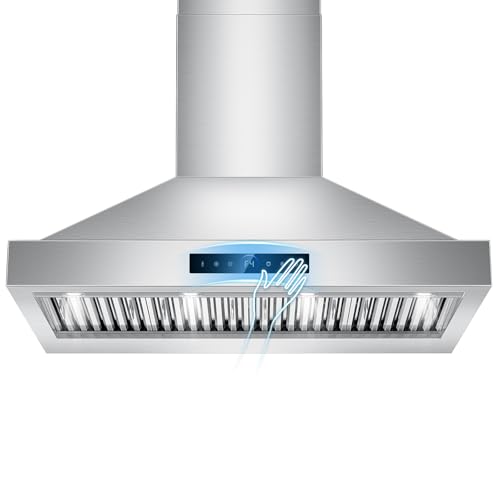
48-Inch Outdoor Wall Mount Range Hood (1600 CFM) — Maximum stated outdoor draw
This 48-inch wall-mount hood states 1600 CFM, the largest figure in the outdoor set, with six-speed gesture and touch control, four LED lights, a time setting, and dishwasher-safe baffle filters in stainless steel. The specification is aimed at the wide built-in grill island, where a broad cooking surface under a patio cover can fill the whole structure with smoke in one lid-lift. Six speeds matter at this scale, because the same hood must also handle a quiet evening of vegetables without sounding like a jet spooling up; the range lets the draw match the menu. Gesture control earns its place outdoors, where the cook’s hands are perpetually occupied.
The title states stainless steel without a grade, so coastal buyers should verify the material specification on the listing before committing, as this guide advises wherever a grade is unstated. What is stated is the working package: serious width, serious draw, washable baffles for grill grease, and timed running to finish clearing after the platters go in. For a covered outdoor kitchen that cooks big and often, this is the set’s maximum-coverage answer, provided the structure gives it a duct route worthy of its output.
The time setting on this hood is the feature that fits outdoor entertaining best. Grill smoke lingers after the last burger, drifting across the seating exactly when everyone settles with a drink, and a fan that keeps clearing on a timer defends the party without the host hovering at the controls. Four LED lights cover a wide grill’s full surface after dark, which in shoulder seasons is most dinners. For the household whose outdoor kitchen is its summer living room, this hood’s combination of width, draw, speeds, and timed follow-through reads as a specification written by someone who has hosted through a smoky August and taken notes.
- Mounting: wall mount, 48 inches wide
- Airflow: 1600 CFM, as stated in the manufacturer title
- Controls: 6 speeds, gesture sensing and touch control, time setting
- Filters and lights: dishwasher-safe baffle filters, four LED lights
- Material: stainless steel, grade not stated in the title
- Where to buy: the 48-Inch Outdoor Wall Mount Range Hood (1600 CFM) listing on Amazon — check price on Amazon
Strengths
- Highest stated airflow in the outdoor set
- Wide 48-inch capture for grill islands
- Six speeds civilize the power for small cooks
Trade-offs
- Stainless grade not stated in the title
- Needs a substantial duct and structure
- Oversized for a standard 36-inch grill
Best for: wide built-in grill islands under covered outdoor kitchens.
Not suited for: a compact patio grill, where its width and draw are never used.
Where to buy: the 48-Inch Outdoor Wall Mount Range Hood (1600 CFM) listing on Amazon — check price on Amazon.

ZLINE 36-Inch Outdoor Approved Wall Mount Hood (KB-304) — Outdoor approved by name
ZLINE’s KB-304 makes a different kind of claim from its rivals here: not a number, but a designation. Its title calls it an outdoor approved wall mount range hood, convertible vent, in stainless steel, at 36 inches. In a category where buyers worry, rightly, about whether an appliance is truly meant to live outside, a maker printing outdoor approval in the model’s own title is meaningful evidence of intent, and the model name’s 304 suffix is noted here exactly as printed, as part of the model designation. No airflow figure is stated, so this guide quotes none and directs output questions to the listing’s specifications.
The convertible vent design suits the variety of outdoor structures, from a walled patio kitchen to a semi-open pavilion where the duct route needs options. ZLINE’s broader reputation in pro-style indoor hoods carries into this model, and for a buyer whose first question is will it survive outside rather than how large a number can it print, the KB-304 is the set’s most direct answer. Verify the stated specifications on the listing, confirm the finish care the maker recommends, and this is the conservative, designation-first choice for a standard 36-inch outdoor station.
An outdoor-approved designation also simplifies conversations beyond shopping. Builders, electricians, and inspectors working on an outdoor kitchen all respond to a product positioned by its maker for the environment, and a convertible vent gives those trades the flexibility they ask for when the structure holds surprises. ZLINE’s indoor pro-style reputation means the controls and construction language will feel familiar to anyone who has specified the brand inside. For a project being built by professionals on a schedule, the KB-304’s clarity about its purpose may be worth more than a larger unverified number on a vaguer listing.
- Designation: outdoor approved, as stated in the manufacturer title
- Mounting: wall mount, 36 inches wide
- Venting: convertible vent
- Material: stainless steel, grade not stated in the title
- Model: KB-304-36, per title
- Where to buy: the ZLINE 36-Inch Outdoor Approved Wall Mount Hood (KB-304) listing on Amazon — check price on Amazon
Strengths
- Outdoor approval stated in the title itself
- Convertible venting suits varied structures
- Established maker’s outdoor-specific model
Trade-offs
- No airflow figure in the title
- Material grade not stated in the title
- Specification homework required on the listing
Best for: standard outdoor stations where rated outdoor suitability comes first.
A poor fit for: a numbers-first buyer who wants output settled by the title.
Where to buy: the ZLINE 36-Inch Outdoor Approved Wall Mount Hood (KB-304) listing on Amazon — check price on Amazon.

BRANO 48-Inch Outdoor Range Hood (1400 CFM) — Twin-turbine, voice control
BRANO’s 48-inch outdoor hood states 1400 CFM from a twin-turbine DC motor, with voice, gesture, and touch control, a six-speed fan, memory mode, LED lights, and dishwasher-safe filters. The twin-turbine layout spreads draw across the wide body the way dual motors do indoors, and DC motor design brings the smooth low-speed manners that keep a big hood pleasant on small-cook evenings. Voice control is the headline convenience: at a grill, the moment you most need the fan is the moment both hands hold tools and meat, and a spoken command is the only control guaranteed to be free.
Memory mode quietly supports the theater of outdoor cooking, restoring your usual setting instead of a default, so the hood behaves like a member of the household. The title states no stainless grade, so the listing’s material details deserve the same coastal scrutiny this guide applies throughout. On stated power per width and control richness, the BRANO stands beside the set’s maximum-draw pick as the 48-inch alternative for cooks who value the interface as much as the airflow, in a kitchen where the interface gets used with sauce on its hands.
BRANO’s memory mode suits the ritual nature of grilling more than it first appears. Most grill masters run one beloved setting for most of the cook, the draw that handles a loaded grate without pulling the heat sideways, and a hood that returns to that setting on its own removes a small friction from every session. The twin-turbine layout supports the ritual with even draw across a wide grate, so the far corners of a 48-inch grill smoke into moving air rather than into the cook’s face. In a social outdoor kitchen, where the grill is a stage, that evenness is the difference between performing and enduring.
- Mounting: wall format, 48 inches wide
- Airflow: 1400 CFM, as stated in the manufacturer title
- Motor: twin-turbine DC motor
- Controls: voice, gesture, and touch, 6 speeds, memory mode
- Filters and lights: dishwasher-safe filters, LED lights
- Where to buy: the BRANO 48-Inch Outdoor Range Hood (1400 CFM) listing on Amazon — check price on Amazon
Strengths
- Strong stated draw across a full 48-inch span
- Voice control suits hands-full grilling
- DC twin-turbine design favors smooth low speeds
Trade-offs
- Stainless grade not stated in the title
- Smart controls add complexity outdoors
- Wide format needs a wide grill to justify it
Best for: wide grill islands cooked by hosts who entertain while they grill.
Not the right match for: a small covered patio with a standard grill.
Where to buy: the BRANO 48-Inch Outdoor Range Hood (1400 CFM) listing on Amazon — check price on Amazon.

SINDA 36-Inch Outdoor BBQ Range Hood (1050 CFM) — Stated 304 stainless
SINDA’s outdoor BBQ hood states the two things a coastal buyer most wants to read: 304 stainless steel and 1050 CFM, in a 36-inch body with four-speed fan control, a single blower, adjustable LED lights, and commercial baffles. The grade claim is the headline. Where rivals in this set say stainless and stop, SINDA names the grade associated with outdoor and marine-adjacent service, and pairs it with commercial baffle filtration built for grill grease rather than stovetop vapor. A single blower at this output keeps the design simpler than twin-motor rivals, with four speeds covering the realistic range from warming to full sear.
Adjustable lighting is a thoughtful outdoor feature, since patio cooking runs from bright afternoons to dark winter evenings and the hood’s lights are the grill’s work lights. SINDA’s presence in this guide’s copper set as well suggests a maker comfortable with metal as a craft, and the outdoor hood reads as the same philosophy in a weather grade. For a 36-inch outdoor station, especially anywhere salt is in the air, this is the materials-first recommendation: verified grade language, honest output, and filtration that matches the cooking.
Commercial baffles on the SINDA deserve their adjective. Grill grease is not stovetop grease; it arrives in volume, laden with char, and it coats whatever it touches with a film that outdoor weather then bakes on. Baffles built to commercial patterns shed that load into channels and wash clean without degrading, which is why they anchor both of this guide’s stated-304 picks’ philosophies in different ways. The SINDA pairs them with a single blower and four speeds, a deliberately simple mechanical story: fewer novelties, more metal, and a grade of steel chosen for the postcode as much as the patio.
- Material: 304 stainless steel, as stated in the manufacturer title
- Airflow: 1050 CFM single blower, as stated in the title
- Width: 36 inches, outdoor BBQ format
- Controls: 4-speed fan control
- Filters and lights: commercial baffles, adjustable LED lights
- Where to buy: the SINDA 36-Inch Outdoor BBQ Range Hood (1050 CFM) listing on Amazon — check price on Amazon
Strengths
- 304 stainless stated outright
- Commercial baffles suit heavy grill grease
- Output well matched to a 36-inch station
Trade-offs
- Single blower rather than a twin layout
- Four speeds give coarser steps
- 36-inch width only
Best for: coastal and four-season outdoor kitchens at standard grill width.
Poorly suited to: a wide island grill, which needs a 48-inch capture surface.
Where to buy: the SINDA 36-Inch Outdoor BBQ Range Hood (1050 CFM) listing on Amazon — check price on Amazon.

Blaze 36-Inch Outdoor Vent Hood (1000 CFM) — Extra-deep grill coverage
Blaze builds for the outdoor kitchen trade, and its 36-inch vent hood, model BLZ-36-VHOOD, states 1000 CFM from a four-speed blower with an extra-deep design for full grill coverage, commercial baffles, and LED control lighting. The depth is the engineering headline. Grill plumes rise from a broad, hot surface and billow forward as lids open; a deeper hood body reaches over that forward roll in a way a shallow canopy cannot, which is capture geometry doing the work that raw airflow gets credit for. Commercial baffles complete the working brief, channeling heavy grease into washable steel.
A specialist maker’s hood also tends to integrate with the rest of an outdoor kitchen’s ecosystem of grills and refrigeration, which matters in a designed build. The title states stainless steel without a grade, so apply the usual listing check if your air is salty. Within its stated claims, the Blaze is the depth-first pick of the 36-inch group: slightly less stated airflow than the SINDA, answered with a body shape designed around how grill smoke actually behaves. For a covered station where flare-ups roll smoke toward the cook, that depth is worth more than a larger number on a shallower hood.
Blaze’s extra-deep body also changes the cook’s physical experience in a way specifications miss. A deeper hood lets the cook stand closer to the grill without entering the rising column of heat and smoke, because the capture surface reaches out to meet the plume instead of asking the plume to travel back to the wall. Under a low patio cover, where every inch of mounting height is argued over, depth buys capture that height cannot. That is a specialist’s insight, earned from building for outdoor kitchens exclusively, and it is why this hood belongs in the conversation even where a rival prints a larger airflow figure.
- Model: BLZ-36-VHOOD, per title
- Airflow: 1000 CFM, 4-speed blower, as stated in the manufacturer title
- Design: extra-deep design for full grill coverage
- Filters: commercial baffles
- Material and lights: stainless steel, grade not stated; LED control lighting
- Where to buy: the Blaze 36-Inch Outdoor Vent Hood (1000 CFM) listing on Amazon — check price on Amazon
Strengths
- Extra-deep body captures rolling grill plumes
- Outdoor specialist maker
- Commercial baffles handle heavy grease
Trade-offs
- Stainless grade not stated in the title
- Slightly lower stated output than 36-inch rivals
- Depth needs mounting room under the cover
Best for: covered grill stations plagued by forward-rolling smoke.
A weak match for: an open, shallow structure where the deep body cannot be mounted well.
Where to buy: the Blaze 36-Inch Outdoor Vent Hood (1000 CFM) listing on Amazon — check price on Amazon.

CT Copper Tailor 36-Inch Outdoor Kitchen Vent Hood (1050 CFM) — 304 insert for custom builds
CT Copper Tailor appears in this guide twice, and outdoors it brings an insert: a 36-inch outdoor kitchen vent hood for BBQ grills stating 1050 CFM, built as a range hood insert in 304 stainless steel with a four-speed exhaust fan, LED lights, baffle filters, and ducted installation, for patio and backyard use. The insert format is the point. Outdoor kitchens are often built as architecture, in masonry, stucco, or timber structures that no finished canopy matches, and an insert lets the structure be designed freely while the ventilation remains a specified, weather-grade appliance with stated steel and stated output.
The stated 304 grade pairs with the SINDA as the set’s verified-material picks, and the baffle filtration and four speeds complete a workmanlike specification with no wasted claims. Because it is an insert, the buying questions are build questions: the structure’s opening dimensions, the duct path through it, and the mounting height over the grill must be designed around this unit from the start. For a custom outdoor kitchen project, that is not a drawback but the correct order of operations, and CT Copper Tailor’s craft background in metalwork makes it a natural citizen of a built structure.
An insert also future-proofs an outdoor kitchen in a way a finished hood cannot. Structures outlast appliances; masonry and framing built today will see two or three generations of machinery, and an insert format means the next upgrade is a unit swap inside a known opening rather than a redesign of the whole feature. CT Copper Tailor’s stated grade and output make the current generation a strong one, and the baffle-and-LED package keeps the working surface simple for the household that maintains it. For a property being built to be sold, rented, or inherited, that serviceable permanence is a genuine asset, not a footnote.
- Format: range hood insert, 36 inches wide, ducted
- Material: 304 stainless steel, as stated in the manufacturer title
- Airflow: 1050 CFM, as stated in the title
- Fan: 4-speed exhaust fan
- Filters and lights: baffle filters, LED lights
- Where to buy: the CT Copper Tailor 36-Inch Outdoor Kitchen Vent Hood (1050 CFM) listing on Amazon — check price on Amazon
Strengths
- Stated 304 stainless for outdoor service
- Insert format frees the structure’s design
- Complete stated specification, nothing vague
Trade-offs
- Requires a custom structure to install
- Not a finished decorative hood on its own
- Build planning must precede ordering
Best for: custom masonry or framed outdoor kitchens in any climate.
Think twice if: a freestanding grill with no structure to build into.
Where to buy: the CT Copper Tailor 36-Inch Outdoor Kitchen Vent Hood (1050 CFM) listing on Amazon — check price on Amazon.
Outdoor field compared: output, width, and material as titled
Material claims are reproduced only where titles state them. A blank grade means the title says stainless without a number, and outdoors that distinction is worth real money.
| Model | Format and width | Stated airflow | Material, as titled | Controls per title |
|---|---|---|---|---|
| 48-Inch Outdoor Wall Mount Range Hood (1600 CFM) | Wall mount, 48 inch | 1600 CFM | Stainless steel, grade not stated | Gesture and touch, 6 speeds |
| ZLINE 36-Inch Outdoor Approved Wall Mount Hood (KB-304) | Wall mount, 36 inch | Not stated; outdoor approved | Stainless steel, grade not stated | Convertible vent design |
| BRANO 48-Inch Outdoor Range Hood (1400 CFM) | Wall mount, 48 inch | 1400 CFM | Stainless steel, grade not stated | Voice, gesture, and touch, 6 speeds |
| SINDA 36-Inch Outdoor BBQ Range Hood (1050 CFM) | Wall mount, 36 inch | 1050 CFM | 304 stainless steel | 4-speed fan control |
| Blaze 36-Inch Outdoor Vent Hood (1000 CFM) | Wall mount, 36 inch | 1000 CFM | Stainless steel, grade not stated | 4-speed blower |
| CT Copper Tailor 36-Inch Outdoor Kitchen Vent Hood (1050 CFM) | Insert, 36 inch | 1050 CFM | 304 stainless steel | 4-speed exhaust fan |
Covered patio or open air: where does an outdoor hood actually work?
An outdoor hood needs two allies: a structure to mount on and air calm enough to let a plume rise. A covered patio or outdoor kitchen with a back wall is the ideal posting, because the cover that traps the smoke also shelters the capture zone, and the wall carries the hood and hides its duct. Under a pergola with open sides, the hood still helps on still evenings and struggles when a cross-breeze shears the plume sideways before it rises; cooking position and wind direction become part of the technique, the way they are at a campfire. In fully open air with no cover, be honest: no hood in this guide will civilize a windy day, and your money is better spent on placement of the grill itself.
Within a covered space, mount for capture the way you would indoors, only more so. Grill plumes are hotter, faster, and greasier than stovetop plumes, and they billow wider. Width at least equal to the grill, depth reaching over the front of the grates, and the lowest mounting height the maker allows all pay off outdoors. The 48-inch picks exist because built-in grill islands run wide; a 36-inch hood centered over a 48-inch grill leaves both ends smoking freely. Match the spans as you would indoors, then add margin for the breeze. Height clearances to combustible covers and the duct’s route through the patio roof are builder questions, settled before the hood arrives, not while it sits in its crate.
What does outdoor duty demand from materials and maintenance?
Weather is a slow opponent. Rain drives into seams, sun bakes finishes, salt air hunts for weakness, and grease from grilling is heavier and stickier than anything a stovetop produces. This is why the guide is strict about stainless grades: 304, stated by the SINDA and the CT Copper Tailor insert, is the grade with the corrosion reputation for outdoor and coastal service, while unstated grades ask you to trust the listing’s broader specification or accept an inland service life. Where a title says outdoor approved, as ZLINE’s KB-304 does, that designation is the maker’s own claim of suitability, worth weighing alongside any grade language you can verify on the listing.
Maintenance outdoors is a rhythm, not an event. Baffle filters across this set are largely dishwasher-safe, which suits grill grease, but outdoor baffles load faster and should cycle through cleaning more often than indoor ones. Wipe exterior surfaces down as part of grill cleanup, before salt and grease sit through a wet week together. Check the duct cap and damper seasonally, because outdoor terminations host wasps, leaves, and weather in ways indoor caps never meet. High-heat commercial cooking, like the conveyor work in Best Conveyor Pizza Ovens, taught the food world that exhaust systems fail by accumulation; an outdoor hood is a small exhaust system, and the same law applies at patio scale. Clean little and often, and the hood will look and draw like new for years.
How much power does grilling actually need?
More than stovetop cooking, delivered over a wider area. A grill’s entire surface is a burner, often run at full output with the lid opening in bursts that release a rolling cloud of smoke and steam. The stated figures in this set, from 1000 CFM up to 1600 CFM, are sized for that reality and for the dilution that outdoor air movement causes. Speed control is how that power stays livable: six-speed fans on the two 48-inch picks let you run a gentle draw for vegetables and a full pull for a fatty brisket flat, while four-speed designs cover the same range in bigger steps. Voice and gesture control, offered by the BRANO, sound like novelties until your hands are full of tongs, sauce, and a platter at the exact moment the flare-up starts.
Do not overlook the electrical and structural side of big outdoor power. These are substantial appliances that want a proper circuit, a rigid duct, and mounting that respects their weight, all in a structure that may be masonry, timber, or steel framing. The insert pick moves those questions into your build design, where the structure is created around the hood’s dimensions. Either way, the planning sequence is the same as indoors, only weatherproofed: structure first, duct second, hood third, and the first cook under clear air as the reward for doing it in that order.
How do you plan the duct and structure for an outdoor hood?
Outdoor ductwork lives a harder life than indoor ductwork and must be planned as building, not appliance fitting. The run usually rises through a patio roof or cover, which means flashing, weather sealing, and a termination that sheds rain while opening freely under airflow, a combination that cheap caps fail within a season. Keep the run short and vertical where the structure allows, in rigid metal, with joints sealed against the grease-laden moisture that will condense inside on cool evenings. Every elbow outdoors is also a place for weather and wildlife to test the system, so the straightest route is doubly rewarded. The structure carrying the hood must be honest about weight and wind load: these are large steel objects mounted high, in rooms that storms visit.
Electrical planning follows the same weatherproof logic: a proper outdoor-rated supply, protected connections, and controls positioned where the cook stands rather than where the drawings looked tidy. If the project includes the insert pick, the structure’s opening, backing, and duct path are framed around the unit’s dimensions from the first day of the build, and the wise builder dry-fits the insert before the finish surfaces close. Commission the finished system with the grill at full burn and every burner lit, watching where the plume goes at each speed. An outdoor hood that has only been tested with the fan’s hum has not been tested at all; smoke is the examiner, and it grades on the spot.
Finally, plan the winter. In cold climates an outdoor kitchen’s hood faces months of idle weather, and a cover routine, a damper check, and a pre-season baffle wash turn spring’s first cook into a pleasure instead of a recommissioning. In warm climates the season never ends, which simply moves the same maintenance onto a quarterly rhythm. Either way, the hood that is planned as part of the building, with its duct, power, and care designed in, will outlast and outperform the hood that was hung as an afterthought on a finished patio, however impressive its carton looked.
What size outdoor kitchen justifies which pick in this guide?
Work through three honest questions. First, how wide is the cooking surface, truly, including side burners and the griddle that joined the family last summer? That width sets the hood’s minimum span, and it is why the guide splits at 36 and 48 inches rather than pretending one size serves all. Second, how enclosed is the space? A three-sided outdoor room traps smoke like a kitchen and rewards the strongest draw you can duct; a breezy pergola sheds some smoke for free and asks the hood mainly to defend the cook’s position and the ceiling’s cleanliness. Third, how often does it cook? A weekly four-season outdoor kitchen amortizes commercial baffles, stated 304 steel, and six-speed refinement quickly; a summer-weekend station is honestly served by the simpler four-speed picks.
The answers assemble the shortlist by themselves. Wide and enclosed and constant: the 48-inch pair, chosen between maximum stated draw and twin-turbine control richness. Standard width with salt in the air: the SINDA’s stated grade. Standard width with rolling smoke under a low cover: the Blaze’s depth. A designation-first project built by trades: the ZLINE. A structure still on the drawing board: the CT Copper Tailor insert, designed in from the frame. This is the same matching discipline the indoor guides in this batch apply, translated for weather: the best outdoor hood is not the strongest one in the abstract, but the one whose stated claims line up with your width, your enclosure, and your climate, all three at once.
Grill placement, wind, and the hood: how do you arrange the whole station?
An outdoor hood can only capture what the grill gives it, and grill placement decides what that is. Set the grill so its back is to the prevailing breeze where possible, letting wind push the plume toward the hood and the wall rather than across the cook’s face and out from under the cover. Keep the cooking surface centered under the hood’s span, with the hood’s depth reaching over the grill’s front edge, because the plume from a opened lid rolls forward first and rises second. Side burners and secondary grills placed outside the hood’s span will smoke freely no matter what the specification says, so the station’s layout should be drawn around the capture zone, not decorated around it afterwards.
The cook’s own position is part of the arrangement. A station designed so the cook stands to the side of the plume’s path, with landing counters within a turn rather than a walk, keeps the human out of the smoke the hood is removing and shortens every trip that grease and heat make across the patio. Lighting follows the same logic: the hood’s LEDs are the grill’s work light, and a station planned so no shadow of the cook falls across the grates cooks better after dark. Guests, finally, should be seated downwind of nothing: place the gathering where the duct’s termination and the breeze carry the exhaust away from the conversation, and the party never knows the system is working.
None of this requires the strongest hood in this guide. It requires the hood, the grill, the structure, and the furniture to be thought about as one composition, the outdoor equivalent of the indoor chain of matched decisions. The picks here span the sizes and formats that composition can call for, from a 36-inch station hood to a 48-inch island canopy to an insert inside architecture. Draw the station first, with the wind in the drawing, and the correct pick usually selects itself, which is how you know the planning was done in the right order.
How do outdoor hoods change winter and shoulder-season cooking?
The outdoor kitchen’s enemy was never only smoke; it is the calendar. In spring and autumn the grill comes out under a cover while the air is still cold enough to make smoke hang low and dense, and in those conditions an unvented covered patio becomes unusable faster than in summer, because cold air holds the plume down at face height instead of letting it rise and disperse. A proper outdoor hood rewrites those seasons. With the draw established before the lid opens, the low-hanging cloud has somewhere assigned to go, and the cook can work a brisk October evening in the same comfort as July. For households in four-season climates, that extension of the grilling year, weeks at both ends, is the hood’s largest single dividend, larger than any individual smoky dinner it rescues in August.
Winter adds a second, quieter benefit: the house stays clean. Shoulder-season grilling without a hood drives cooks to crack the patio door for relief, and the smoke obligingly migrates indoors, seasoning the soft furnishings until spring. A ducted outdoor hood keeps the boundary where it belongs, and the indoor kitchen’s own hood is spared work it was never sized for. The equipment asks for seasonal reciprocity. Before the cold sets in, wash the baffles, check the termination cap against leaves and nests, and confirm the damper moves freely after weeks of damp idleness; in spring, repeat the ritual before the first big cook. Outdoor machinery that is inspected at the season’s turns rarely fails during them.
There is also a social transformation worth naming. A covered patio with working ventilation becomes a genuine room for more of the year, the place where the household gathers while dinner is made rather than a station the cook visits alone and returns from smelling of smoke. Guests linger near the grill because the air lets them. That is the same return the quiet indoor hoods in this batch deliver to open-plan rooms, translated for weather: ventilation, done properly, is not about the appliance at all. It is about who gets to be present while the cooking happens, and for how much of the year the invitation stands.
A short checklist for the outdoor-hood decision
Start with the structure, because outdoors the structure is half the appliance. Is there a cover above the grill, a wall behind it, and a duct route through that cover that a builder can flash and seal? If the answer to any part is no, the project is a building project first and a hood purchase second, and the insert pick in this guide may be the honest starting point. Next, measure the grill’s true width, side burners and all, and refuse any hood narrower than that number, however attractive its other claims, because outdoor capture forgives undersizing even less than indoor capture does. Then read the material language with this guide’s strictness: a stated 304 grade is a fact, an outdoor-approved designation is a fact, and the word stainless alone is a question to carry to the listing.
Finish with the climate’s own checklist. Salt air argues for the stated-grade picks and a wipe-down rhythm. Four seasons argue for a damper and termination that will be inspected at each turn of the year. Frequent entertaining argues for the speeds, lights, and timed clearing that keep the cook at the party instead of at the controls. Match those answers to the six picks and the choice narrows itself, usually to one hood whose stated claims read like they were written for your patio. That is the sensation of a correct appliance purchase in any category, and outdoors, where mistakes weather in public, it is worth the extra page of notes before the order is placed.
One last habit will decide whether the chosen hood still performs in its fifth summer: treat its cleaning as part of grilling rather than as a separate chore appended to it. The baffles that go through the wash on the same weekend the grates are scraped never become the crusted archaeology that makes owners avoid the job entirely, and the exterior wiped while the grill cools never accumulates the baked film that outdoor weather makes permanent. Five minutes folded into a ritual you already keep is sustainable in a way that a dedicated maintenance day, perpetually postponed, is not. Outdoor kitchens reward rhythm over effort in every system they contain, from the fire to the refrigeration, and the hood is simply the system where that law is easiest to obey.
Consider, finally, what the hood does for the property beyond the patio. An outdoor kitchen with real ventilation reads, to any future buyer walking the garden, as a room that was engineered rather than assembled, and the difference registers before a single specification is discussed. It also protects the investment around it: covers and ceilings that stay clean, cushions that do not carry last season’s smoke, a house exterior free of the grease halo that unvented grills paint above themselves over years. Those are slow, compounding returns, invisible in any single summer and unmistakable across five. The hood is the least glamorous object in the outdoor kitchen and, by the arithmetic of preservation, possibly the hardest-working one in the entire property.
Stand in the finished patio, finally, and judge the system the way a guest would: not by the hood at all, but by the absence it creates. No smoke in the eyes during the first drink, no retreat indoors when the lid opens, no smell of the menu in the cushions the next morning. That absence is the product, and it is strangely easy to undervalue precisely because nothing happening is hard to photograph. Every pick in this guide was chosen to produce that nothing reliably, across widths, climates, and structures, and the checklist above exists to match the nothing to your particular patio. When the first gathering ends and nobody has mentioned the air even once, the outdoor hood has done the finest work any appliance in this batch can do.
Keep that guest’s-eye test as the annual standard, run at the first big cook of the season, and correct whatever has drifted, a damper, a baffle, a cap, while the fix is still a chore rather than a project.
What goes wrong with outdoor hood projects?
The commonest failure is installing an indoor hood outdoors because its numbers looked strong. Indoor construction, electronics, and finishes are not promised against weather, and the failure arrives as corrosion and electrical trouble rather than a dramatic event. The second mistake is undersizing the width to save money, leaving the grill’s ends outside the capture zone. The third is mounting high to clear a tall cook’s view under a low patio cover, which surrenders the plume to the breeze. The fourth is neglecting the grease: outdoor baffles load quickly, and a neglected outdoor hood drips, smells, and draws poorly. The fifth is forgetting the duct termination, which outdoors must shed weather and discourage wildlife while opening freely every time the fan starts.
There is also a wardrobe-level mistake worth naming for the cooks themselves: outdoor kitchens are social stages, and the cook stands in the smoke path that the hood is trying to clear, as anyone who has outfitted people for long smoky evenings around fires, in the spirit of Best Camping Quilts for Women, already knows. Position the cook’s station out of the drift, let the hood take the plume, and the evening’s host stops smelling like the menu. The hood’s job is the air; yours is simply to stand where the air is already clean.
Final Recommendation
For a wide built-in grill island, the 48-inch pair lead: the 1600 CFM wall hood for maximum stated draw and the BRANO at 1400 CFM with the richest control set. At 36 inches, the SINDA brings stated 304 stainless and 1050 CFM, the Blaze brings an extra-deep body and 1000 CFM from an outdoor specialist, and the ZLINE KB-304 brings an explicit outdoor-approved designation. The CT Copper Tailor insert, with stated 304 steel and 1050 CFM, is the pick for a custom structure being built around the hood.
Give the grill a hood as serious as the fire beneath it, and the smoke will leave by the duct like a guest who knows the way out — promptly, quietly, and without drifting through the house.
Frequently Asked Questions
Can I use a regular indoor range hood outside?
It is not recommended. Outdoor duty adds rain, humidity, temperature swings, and heavier grease, and indoor hoods are not built or warranted for that exposure. Every pick in this guide is positioned by its maker for outdoor, BBQ, or grill use. The price difference is smaller than the cost of replacing a corroded indoor hood and its electrics after two wet seasons.
Why does 304 stainless steel matter outdoors?
It is the grade with the established corrosion resistance for outdoor and coastal environments, resisting the rust freckling that lesser grades develop under salt and moisture. In this guide it is claimed only where the title states it, for the SINDA hood and the CT Copper Tailor insert. Inland and sheltered installations can live happily with other stainless grades, but coastal buyers should treat the 304 claim as a headline feature.
How wide should an outdoor hood be?
At least as wide as the grill, and wider if the budget and structure allow, because outdoor plumes spread in moving air. That is why this set splits between 36-inch hoods for standard grill stations and 48-inch hoods for wide built-in islands. A hood narrower than the grill will always leave the ends smoking, no matter how strong its fan is.
Does an outdoor hood need a duct, or can it recirculate?
Outdoor hoods are ducted appliances in spirit and in these picks’ designs. Grill smoke and grease volumes overwhelm recirculation quickly, and there is no ceiling of room air to protect in the same way; the point is to move the plume away from the covered space entirely. Plan a real duct with a weather-shedding termination as part of the project.
What is an outdoor insert hood for?
An insert, like the CT Copper Tailor pick here, is the working machinery that fits inside a custom structure: a masonry chimney breast, a framed and finished surround, or a built outdoor kitchen feature. It lets the visible architecture match the property while the ventilation is a specified appliance. Choose it when you are building the structure, not replacing a finished hood.
Related Guides
An outdoor hood completes a serious open-air cooking station, and if that station sits beyond the reach of the house’s utilities, Best 24-Inch Gas Ranges for Off-Grid Kitchens is a fitting companion read. However your grill is fueled, the principle is the same: capture the smoke at the source and the patio stays a place to gather.



[…] through open doors — a load worth remembering when reading the ventilation territory covered by Best Outdoor Range Hoods, where moving hot air at its source is the entire […]