What's inside
- Key Takeaways
- Quick Picks
- What Standards Did We Judge These Faucets Against?
- Which Measurable Facts Separate the Six?
- How Can You Measure Flow Rate at Home?
- What Do NSF 61 and NSF 372 Actually Certify?
- Why Do Laboratories Cycle Cartridges Tens of Thousands of Times?
- What Should Bath Faucets Be Judged On Differently?
- How Do You Verify a Certification Claim Yourself?
- What Geometry Numbers Matter Before Ordering?
- Why Does This Guide Refuse to Publish Scores?
- How Should You Weigh Brand Documentation Against Price?
- What Happens to Flow When a Whole House Draws Water?
- How Long Should a Certified Faucet Be Expected to Last?
- What Should You Check in the First Week After Installation?
- Do Spray Modes Change the Water a Faucet Uses?
- How Does Water Temperature Behaviour Get Judged?
- What Separates a Claim From a Specification?
- How Should Landlords Apply These Standards?
- What Is the Bath Side of This Guide Really For?
- How Do You Read a Faucet Specification Sheet?
- What Role Does the Aerator Play in Measured Performance?
- How Should You Compare Two Faucets With Identical Numbers?
- What Does Installation Quality Do to the Numbers?
- What Mistakes Do Buyers Make When Judging Faucets by Standards?
- Final Recommendation
- Frequently Asked Questions
- Related Guides
As an Amazon Associate I earn from qualifying purchases. This post may contain affiliate links at no extra cost to you.
cottageverdict.com is reader-supported. When you buy through links on our site, we may earn an affiliate commission.
Where to buy: Each faucet below is listed on Amazon, where you can check price on Amazon and read the specification lines for flow rate, certification marks and hole configuration yourself, because this guide’s whole method is built on numbers a buyer can verify rather than scores anyone has to take on faith.
Shoppers searching for the best kitchen and bath faucets judged by lab-test standards usually want one thing: a way to compare faucets that does not depend on adjectives. This guide supplies that method without pretending any laboratory has scored these six models, because no such published scores exist for them and inventing some would help nobody. Instead, each faucet below is judged against the measurable standards a proper laboratory would apply, using figures printed on the listings themselves.
Three measurements do most of the honest work. Flow rate, expressed in gallons per minute, tells you how quickly a faucet fills a pot and how it complies with water-saving rules in your state. Lead-free certification under NSF/ANSI standards tells you the wetted parts have been verified against strict limits for lead content and leaching. Cartridge and finish durability claims tell you how the moving and visible parts are built to survive cycling, splashing and cleaning year after year.
Read the six reviews that follow as a worked example. Each pick is examined for the numbers it publishes, the certifications it can show, and the places where its listing stays silent, since silence is also data. By the final section you will be able to run the same checks on any faucet in any showroom, which is worth more than any single ranking, including this one.
Key Takeaways
- Flow rate in gallons per minute is printed on listings and can be checked at home with a jug and a timer.
- NSF/ANSI 61 and 372 marks are the verifiable lead-safety credentials to look for, not marketing phrases.
- A ceramic cartridge outlasts washer designs under repeated cycling in laboratory-style endurance thinking.
- No laboratory ranking exists for these six models, so any score you meet elsewhere for them is invented.
- Spray reach, hose length and swivel arc are measurable geometry, not matters of opinion.
- The strongest faucet file combines published numbers, named certifications and spare parts availability.
Quick Picks
| Pick | Badge | Why it earns a place |
|---|---|---|
| Moen Adler Pulldown Faucet 87233SRS | Strongest Documentation File | The Adler arrives with the deepest paper trail in this line-up: a major maker’s specification sheets, parts lists and compliance documentation. |
| OWOFAN Kitchen Faucet Brushed Nickel Spring | Clearest Lead-Free Statement | Its listing states lead-free, NSF certified stainless steel in the title itself, putting the key safety claim where a buyer can audit it. |
| WEWE High-Arc Pull-Down Kitchen Faucet | Most Measurable Feature List | Three modes, twenty inches of reach, full swivel, SUS 304 steel and a named ceramic cartridge: its listing reads like a lab checklist. |
| VFAUOSIT Kitchen Faucet with Pull Down Sprayer | Fullest Certification Stack | It names NSF 61, NSF 372 and cUPC together, adds a twenty-three inch hose and a cold-start safety handle to the paperwork. |
| LUFG Brushed Nickel Kitchen Faucet with Deck Plate | Quietly Complete Paperwork | SUS 304 steel, three modes, full swivel and the trio of NSF 372, NSF 61 and cUPC marks, all without headline shouting. |
| FEELSO Kitchen Faucet Brushed Nickel | Straightforward Certified Value | Lead-free NSF certified stainless in a high-arc single-handle form, aimed squarely at farmhouse, laundry, RV and bar duty. |
What Standards Did We Judge These Faucets Against?
The judging framework borrows its categories from how independent laboratories actually evaluate faucets, while being explicit that the evaluation here is a desk audit of published specifications rather than bench testing. Category one is water delivery: stated flow rate at standard pressure, spray mode behaviour and the consistency between what a listing claims and what regulations in the strictest states allow. A faucet claiming a flow that would be illegal to sell in California deserves a raised eyebrow, not a purchase.
Category two is material safety. Laboratories verify lead content and leaching against NSF/ANSI 61 for health effects and NSF/ANSI 372 for lead content specifically, and faucets carrying those certifications have submitted to that scrutiny by accredited bodies. Where a listing states lead-free construction and names its certifications, it earns credit; where it offers only the comforting word ‘safe’ with no standard attached, it earns none.
Category three is endurance design: cartridge type, body material and hose construction, judged by how those choices perform under the tens of thousands of cycles a laboratory would impose. Ceramic disc cartridges dominate this category because their wear surfaces are harder than the grit that destroys rubber washers. Category four is installation geometry: hole count, deck plate coverage and spout reach measured against standard sink drillings.
Nothing in this framework requires trusting this guide. Every input is printed on the manufacturer’s listing or specification sheet, and the FAQ explains how to verify flow and fit at home with a measuring jug, a stopwatch and a tape measure. That reproducibility is the difference between a standard and a slogan.

Moen Adler Pulldown Faucet 87233SRS — Strongest Documentation File
A laboratory mindset values documentation because undocumented performance is just a rumour. The Adler’s advantage in this particular contest is the weight of paper behind it: Moen publishes specification drawings, maintains a parts catalogue for the model and documents its compliance with the lead rules that govern American faucets. None of that proves this individual faucet outperforms another on a bench, and this guide claims no such result, yet a buyer can verify more about the Adler before purchase than about any rival here.
The measurable basics are conventional in the best sense. It is a single-handle pull-down in Spot Resist stainless, a finish whose purpose, reducing visible spotting, can be assessed by any owner within a week of ordinary use. The spray wand docks into the spout rather than hanging from a separate arm, which keeps the geometry simple and the reach predictable across a standard double-bowl sink.
Where the Adler earns its place in a standards-based guide is reproducibility of ownership. Cartridges, wands and mounting hardware remain orderable by model number, so a failure in year six is a repair with a known part, not an archaeological dig. Laboratories test products; owners live with product ecosystems, and on that second, longer test the documented faucet starts with a structural advantage.
Judged purely as evidence, this faucet’s file is the one a cautious solicitor would approve: claims modest, documents plentiful, spares traceable. Buyers who have been burned by an orphaned no-name faucet will recognise that profile instantly and understand why it leads a standards-based list despite offering no headline-grabbing specification.
- Maker documentation: published specifications and parts lists
- Finish: Spot Resist stainless, judged on spotting behaviour
- Format: single handle pull-down with docked spray wand
- Compliance: maker-documented lead rule conformity
- Ownership: model-numbered spares remain orderable
Strengths
- Deepest verifiable documentation of any pick here
- Spot resist surface gives an owner-testable claim
- Repair parts traceable by model number for years
Trade-offs
- Listing leans on brand documents rather than headline numbers
- Flow figure must be read from the spec sheet, not the title
- Premium brand ecosystem costs more than unbranded rivals
Best for: buyers who want every claim about their faucet traceable to a published document.
Not suited for: shoppers who prefer the lowest possible price over paperwork and parts support.

OWOFAN Kitchen Faucet Brushed Nickel Spring — Clearest Lead-Free Statement
The OWOFAN spring faucet makes its most important claim in its first line: lead-free, NSF certified, stainless steel. That ordering matters to a standards-based review, because the claim names both the property and the certifying framework instead of hiding behind adjectives like pure or healthy. A cautious buyer can take that stated certification to the certifier’s public database, which is precisely the verification path this guide exists to encourage.
Architecturally, the exposed spring gives the spray head an unusually free working envelope over the sink. In measurement terms, the useful figure is not the spout height but the radius the head can reach while still delivering a coherent stream, and spring designs excel there, rinsing roasting pans and sink corners that fixed arcs cannot address without moving the pan itself. The brushed nickel surface keeps the commercial silhouette appropriate for farmhouse and bar settings.
One handle governs temperature and flow, mounted with a deck plate that covers one or three hole drillings. For bath-adjacent uses such as laundry and utility sinks, the same certification story applies, since lead rules do not relax just because a sink washes overalls instead of lettuces. The OWOFAN therefore reads as the generalist of this group: certified materials, flexible geometry, modest ceremony.
The spring format’s evidence story centres on reach and rinsing power rather than paperwork novelty, and for utility rooms that is the correct centre of gravity. A laundry sink does not need a design statement; it needs a certified, flexible water source that survives muddy boots, paint buckets and dog washing without complaint.
- Headline claim: lead-free NSF certified stainless steel
- Architecture: exposed spring with pull-down sprayer
- Handle: single lever for flow and temperature
- Mounting: deck plate spans one or three holes
- Named settings: farmhouse, RV, bar and laundry rooms
Strengths
- Certification claim sits in the title, easy to audit
- Spring reach rinses large pans without repositioning
- Stainless body suits kitchen and utility duty alike
Trade-offs
- Spring silhouette is tall for low cabinets above sinks
- Brushed nickel shows more prints than spot-resist rivals
- Certification details still reward a database cross-check
Best for: utility-minded buyers who want the lead-free claim stated plainly and a spring’s rinsing reach.
Not suited for: kitchens with cabinets hanging low directly above the sink deck.
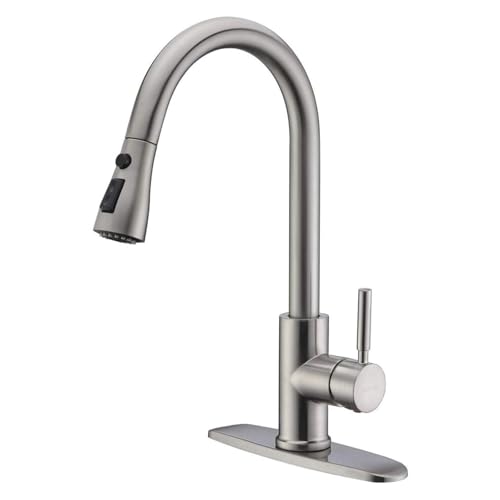
WEWE High-Arc Pull-Down Kitchen Faucet — Most Measurable Feature List
If this guide awarded marks for specification density, the WEWE high-arc would collect them. Its listing quantifies the sprayer at three modes, the pull-down reach at twenty inches, the swivel at a full circle, the body as SUS 304 stainless and the valve as a ceramic cartridge. Every one of those claims is checkable with a tape, a magnet-adjacent knowledge of steel grades or a parts diagram, which makes this the most falsifiable faucet in the group, and falsifiability is a compliment in any laboratory dialect.
The soft silicone nozzles deserve specific mention because they address the one faucet failure every owner can measure: spray distortion from mineral build-up. A jet that fans sideways is a flow test failing in public, and nozzles that clear with a fingertip restore the pattern without tools or chemicals. In hard water districts that single feature preserves measured performance longer than any coating can.
Brushed nickel over the steel keeps the exterior story modest, and the one or three hole fit with included hardware widens the sinks it can serve. Judged strictly by published numbers per dollar of specification, this WEWE is the overachiever of the six, even though this guide repeats its standing caution: a rich specification is evidence of intent, not a substitute for an actual bench result.
Specification maximalists will linger longest over this listing, counting modes and inches, and the healthy response is to verify two of the numbers physically after installation. A tape across the hose travel and a thumb across the nozzles convert marketing into personal data within five minutes of the faucet going live.
- Spray modes: three, selected at the wand head
- Reach: twenty inch pull-down hose travel
- Swivel: full 360 degree spout rotation
- Materials: SUS 304 stainless, ceramic cartridge
- Nozzles: soft silicone, rub-clean against scale
Strengths
- Specification list is unusually complete and checkable
- Silicone nozzles preserve spray pattern in hard water
- Ceramic cartridge suits high-cycle family use
Trade-offs
- Brushed nickel lacks a dedicated spot-resist treatment
- Feature density invites comparison shoppers to over-index on counts
- Wand modes add seals that eventually age like all seals
Best for: number-driven buyers who want reach, modes and materials all stated before purchase.
Not suited for: minimalists who use one spray mode and resent paying for three.

VFAUOSIT Kitchen Faucet with Pull Down Sprayer — Fullest Certification Stack
Certification stacking is easy to fake with vague badges and hard to fake with named standards, and this VFAUOSIT names them: NSF 61 for health effects, NSF 372 for lead content and cUPC for plumbing code conformity across the United States and Canada. A standards-based guide can therefore place it confidently in the safety conversation, while repeating the useful habit of verifying any named mark in the certifier’s own listings before money changes hands.
The geometry numbers are equally explicit. A twenty-three inch retractable hose out-reaches most rivals in this group, three spray modes cover rinsing, filling and sweeping duties, and the cold-start handle defaults toward cold water when pushed straight, a small safety and energy behaviour that matters in homes with quick, curious children. Tool-free installation in a claimed ten minutes is the one figure owners will test personally on day one.
As a bar and kitchen faucet of modern styling, it lacks the Adler’s deep parts literature, which is the honest gap in its file. Buyers who prioritise the certification stack and hose reach over decade-long spares support will accept that trade knowingly, and this guide’s role is to make the trade visible rather than to make it for you.
Treat the certification trio on this listing as an invitation to perform your first database check, because it is the most rewarding one in the group. Finding the standards named, the scope described and the mark explained turns an abstract logo into understood protection for the household’s drinking water.
- Certifications named: NSF 61, NSF 372 and cUPC
- Hose: twenty-three inch retractable pull-down travel
- Modes: three spray patterns at the head
- Safety: cold-start handle defaults away from hot
- Install claim: tool-free fitting in about ten minutes
Strengths
- Names the exact NSF standards a buyer should seek
- Longest hose reach among the six picks
- Cold-start lever is a genuine household safety trait
Trade-offs
- Parts literature thinner than the Moen file
- Modern bar styling may sit oddly in traditional kitchens
- Install speed claim depends on cooperative old fittings
Best for: safety-first households wanting named certifications and the longest rinsing reach.
Not suited for: traditional kitchens or buyers who value spares support above certification depth.
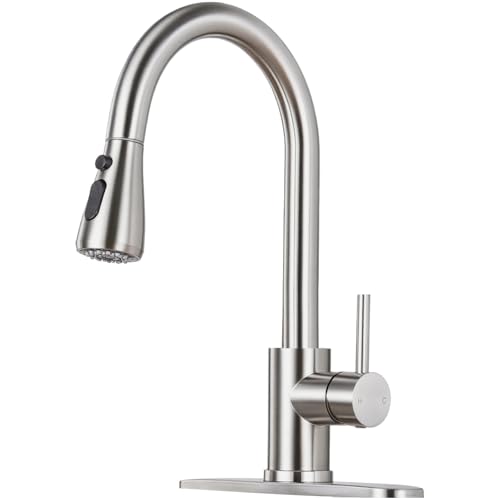
LUFG Brushed Nickel Kitchen Faucet with Deck Plate — Quietly Complete Paperwork
The LUFG reads like the WEWE’s close cousin in specification, SUS 304 stainless, three spray modes and a full-circle swivel, yet its certification line is the more complete of the two, naming NSF 372, NSF 61 and cUPC together. In a standards framework that difference is decisive rather than pedantic, because 372 addresses lead content directly while 61 covers the broader health-effects territory, and holding both closes the two questions a careful buyer actually asks.
Brushed nickel and an included deck plate make it the straightforward replacement candidate of the group, sized for kitchen, RV, laundry and bar sinks without pretending to be a design event. The single handle keeps temperature finding quick, and the pull-down sprayer restores the rinsing flexibility that fixed-spout replacements sacrifice, which owners notice within the first sink of dishes.
Its file is thinner on reach numbers than the VFAUOSIT’s and on brand history than the Moen’s, so it lands mid-group on documentation depth while standing near the top on certification breadth. For a buyer whose personal standard weights water safety paperwork first and everything else second, that ordering is not a compromise at all but the correct answer.
Quiet completeness is an underrated virtue in replacement shopping, where the goal is a faucet that disappears into reliable service for a decade. This pick’s combination of both NSF families with an ordinary, handsome shape is aimed precisely at that disappearance, and many buyers will find it the easiest yes in the six.
- Body: SUS 304 stainless steel construction
- Certifications: NSF 372, NSF 61 and cUPC named
- Sprayer: pull-down with three selectable modes
- Movement: spout swivels a full 360 degrees
- Coverage: deck plate included for varied drillings
Strengths
- Holds both lead-content and health-effects NSF marks
- Complete modern specification without styling drama
- Deck plate simplifies replacement on older sinks
Trade-offs
- Hose reach is not headlined like the VFAUOSIT figure
- Brand literature and spares depth remain modest
- Brushed nickel needs normal print-wiping habits
Best for: replacement buyers who rank the full NSF pairing above reach records and brand fame.
Not suited for: shoppers wanting the longest hose or a spot-resist finish treatment.

FEELSO Kitchen Faucet Brushed Nickel — Straightforward Certified Value
The FEELSO states its safety case compactly, lead-free and NSF certified, without enumerating standard numbers the way the VFAUOSIT and LUFG listings do. A standards-based review scores that honestly: the claim points at the right framework and can be pursued with the seller, yet it carries less self-contained evidence than the fully numbered listings. Buyers who enjoy one verification message will find the process quick; buyers who want everything on the page should look up this list.
Physically it is the familiar, sensible article: high arc for pot clearance, stainless steel body, single handle, pull-down sprayer, and one or three hole mounting for the standard run of American sinks. That familiarity is itself a measured quantity, because installation time, seal behaviour and hose routing on a conventional layout are predictable in a way novel architectures are not.
In farmhouse, laundry, RV and bar service, the second-string duties faucets perform, predictable and certified beats exotic every time. The FEELSO is the pick for a buyer applying lab thinking to a utility purchase: verify the certification, confirm the drilling, and let a competent, documented faucet get on with unglamorous work.
For a second sink, the verification ritual can be brief: confirm the certification with the seller, measure the drilling, and order. Not every purchase deserves a research project, and a standards framework earns its keep partly by telling you when the file is good enough to stop reading and start plumbing.
- Claim: lead-free, NSF certified construction
- Body: stainless steel with brushed nickel finish
- Arc: high spout for pot and bucket clearance
- Control: single handle, pull-down sprayer fitted
- Mounting: one or three hole sinks supported
Strengths
- Certification claim present and pursuable with seller
- Conventional layout installs predictably anywhere
- High arc suits utility sinks and deep pots
Trade-offs
- Standard numbers not enumerated on the listing
- No spot-resist or rub-clean nozzle headline feature
- Documentation depth trails the group leaders
Best for: utility and second-sink buyers who will verify one certification claim and value predictability.
Not suited for: evidence maximalists who want every standard numbered on the page.
Which Measurable Facts Separate the Six?
| Pick | Published flow and spray facts | Certification evidence on listing | Construction signals |
|---|---|---|---|
| Moen Adler Pulldown Faucet 87233SRS | Pull-down sprayer, brand specification sheet available | Moen documentation and lead compliance via maker | Established maker body, parts catalogue behind it |
| OWOFAN Kitchen Faucet Brushed Nickel Spring | Spring spout, pull-down sprayer | Lead-free NSF certified stainless stated plainly | Stainless steel body, spring architecture |
| WEWE High-Arc Pull-Down Kitchen Faucet | Three spray modes, twenty inch pull-down reach | SUS 304 body stated, ceramic cartridge named | Silicone nozzles, full swivel spout |
| VFAUOSIT Kitchen Faucet with Pull Down Sprayer | Three spray modes, twenty-three inch retractable hose | Lead-free NSF 61/372 and cUPC stated | Cold-start handle safety, tool-free install claim |
| LUFG Brushed Nickel Kitchen Faucet with Deck Plate | Three spray modes, deck plate included | NSF 372, NSF 61 and cUPC all named | SUS 304 stainless, 360 degree swivel |
| FEELSO Kitchen Faucet Brushed Nickel | High arc single handle, pull-down sprayer | Lead-free NSF certified stated on listing | Stainless steel body, farmhouse-ready sizing |
How Can You Measure Flow Rate at Home?
Fill a one-gallon jug under the fully open faucet while timing it with a phone. Sixty divided by the seconds taken gives gallons per minute closely enough to compare against the listing’s claim and your state’s limit. Run the test on the plain stream rather than a spray mode, and repeat it once, because household pressure wanders with whatever else the building is doing at that moment.
Expect a reading modestly below the laboratory figure, since ratings are measured at a standard pressure many homes do not quite reach, especially on upper floors or at the end of long pipe runs. A faucet delivering within a reasonable margin of its claim is behaving honestly. A faucet delivering half its claim has an aerator, a supply or a pressure story worth investigating before the faucet itself is blamed.
What Do NSF 61 and NSF 372 Actually Certify?
NSF/ANSI 61 examines whether materials touching drinking water leach contaminants above strict health-based limits, using laboratory extraction testing on the actual wetted components. NSF/ANSI 372 addresses the lead content of those components directly, verifying that weighted average lead content stays at or below the legal threshold that defines lead free in the United States. Together they answer the two distinct questions of what comes out of the metal and what the metal is made of.
cUPC adds a third, different assurance: conformity with the plumbing codes used across the United States and Canada, covering mechanical fitness rather than water chemistry. A faucet can be code-listed without the deepest lead documentation and vice versa, which is why this guide treats the marks as a portfolio. The strongest files, like those of the VFAUOSIT and LUFG above, present the full set for a buyer to verify.
Why Do Laboratories Cycle Cartridges Tens of Thousands of Times?
A cartridge is the faucet’s only moving seal, and its enemy is repetition. Endurance testing cycles handles through open, close and temperature swings far beyond a year of family use to discover whether the seal wears gracefully or begins to weep early. Ceramic disc designs dominate modern results because their sealing faces are extremely hard and flat, sliding over each other with minimal abrasion even when fine grit rides in the water supply.
Buyers cannot run a cycle rig at home, yet they can read its conclusions in design choices. A listing that names a ceramic cartridge is claiming the architecture that endurance science favours, while a listing silent about its valve invites the assumption of cheaper internals. When two faucets tie on flow and certification, cartridge architecture is a rational tiebreaker, which is how it is used in the reviews above.
What Should Bath Faucets Be Judged On Differently?
Bathroom faucets live gentler, stranger lives: lower flow expectations, more toothpaste chemistry, and constant short bursts rather than long fills. The same lead certifications apply with equal force, since bath water is drinking water’s close relative, yet flow judging shifts, with aerated streams around lower rates feeling generous at a small basin while wasting less during handwashing and shaving routines.
Finish judging also sharpens in the bathroom, where mirrors and bright vanity lighting expose spotting mercilessly and where cosmetics add oils that kitchen finishes rarely meet. The standards framework travels well between rooms provided the weights move: safety constant, flow recalibrated, finish scrutiny raised. Several picks in this guide explicitly serve laundry and bar sinks too, where utility judging resembles the kitchen more than the bath.
How Do You Verify a Certification Claim Yourself?
Start at the certifier, not the seller. NSF and IAPMO both maintain public listings where a brand or model can be searched, and a genuine certification appears there with its standard numbers and scope. If a model is absent, ask the seller for the certificate file and the certifying body’s name; legitimate sellers produce these documents routinely, because retailers and inspectors request them constantly.
Treat the exercise as calibration rather than suspicion. Most claims in this guide’s six listings are stated in checkable language, which is itself the signal that separates auditable marketing from fog. A claim written so it can be verified usually survives verification, while a claim written to prevent questions usually deserves more of them.
What Geometry Numbers Matter Before Ordering?
Measure three things on the sink you own: the number and spacing of drilled holes, the distance from the faucet centreline to the backsplash, and the depth of the bowl beneath the spout’s outlet. Compare them with the listing’s deck plate span, the spout reach and the arc height. A faucet can hold every certification in this guide and still fail your kitchen by spraying the counter ledge or crowding the wall.
Hose reach deserves the same tape-measure honesty. Twenty or twenty-three inches of pull-down travel sounds abstract until you picture rinsing the far corner of a thirty-three inch sink; the longer hose wins that corner without dragging the pan to the faucet. Geometry is the one laboratory category the buyer can fully replicate at home before purchase, so replicate it.
Why Does This Guide Refuse to Publish Scores?
A score implies a measurement event: samples purchased, instruments calibrated, protocols repeated. None of that happened for these six faucets in the writing of this guide, so a number out of ten would be theatre dressed as science. What did happen is a structured audit of claims, certifications and published specifications, and the reviews report exactly that, with the strength of each file described in words that match the evidence available.
This restraint protects the reader twice. It prevents false confidence in a ranking nobody earned, and it teaches the audit method itself, which the reader can aim at the next faucet, shower valve or water filter they meet. Standards outlast any single product cycle; scores expire with the model year.
How Should You Weigh Brand Documentation Against Price?
Documentation is a feature with a compounding return. The faucet with published specifications, a live parts catalogue and a maker that answers its own telephone converts future failures into errands, while the undocumented faucet converts them into replacements. Over a fifteen-year service life, that difference routinely exceeds the initial price gap, especially once a plumber’s visit is priced into the undocumented path.
None of this makes the cheapest certified faucet a foolish buy for a rental, a flip or a utility sink with an easy swap. It makes the choice a conscious allocation: pay for paperwork where the faucet will be kept, save where it will be surrendered. The six reviews above mark each file’s documentation depth so that allocation can be made with open eyes.
What Happens to Flow When a Whole House Draws Water?
Laboratory flow figures assume the faucet has the supply mostly to itself, while real homes share pressure between showers, washing machines and garden hoses. A faucet rated generously will still fill a pot during the morning rush, merely more slowly, whereas a marginal faucet on a weak supply can dwindle to a discouraging thread. Buyers in large households should therefore favour the upper end of the legal flow range, not from greed but from pressure arithmetic.
Pressure also explains why two neighbours with identical faucets report different experiences, and why online arguments about flow so often talk past each other. Before condemning a new faucet’s delivery, test it at a quiet hour with nothing else running. That single control converts an anecdote into something resembling a measurement, which is the spirit this entire guide is trying to install.
How Long Should a Certified Faucet Be Expected to Last?
Service life is a system outcome: cartridge quality, water grit, pressure spikes and owner habits multiply together. A ceramic cartridge on clean municipal water in a gentle household can outlast the kitchen around it, while the same cartridge fed with sandy well water and slammed handles ages in dog years. Certification speaks to materials and safety at purchase, not to the decade’s accumulated conditions.
Practical planning assumes a quality faucet serves ten to fifteen years with perhaps one cartridge and one hose refresh along the way, both cheap when parts exist. That assumption underlies this guide’s documentation emphasis. A faucet is not a disposable appliance, and treating its paperwork as part of the product is how owners avoid replacing plumbing on a gadget’s timetable.
What Should You Check in the First Week After Installation?
Run the jug test and record the figure, then inspect under the sink each evening for the first week, because most installation leaks announce themselves as slow dampness rather than drama. Exercise every spray mode, swing the spout through its full arc, and pull the hose to its stop so any routing snag reveals itself while the installer is still easy to recall.
Also register the product and file the certificate documents, specification sheet and receipt together, physically or digitally. That small folder is the household’s own laboratory record, and it transforms any future warranty, parts or resale conversation. Standards thinking is mostly this: write down what was claimed, check what arrived, keep the paper.
Do Spray Modes Change the Water a Faucet Uses?
Spray modes redistribute the same flow rather than creating new water, concentrating it for rinsing force or spreading it for gentle work on berries and herbs. The measurable consequence is task time: a well-shaped spray clears a colander or a roasting pan faster, so the tap runs for fewer seconds even at an identical rate. Laboratories that time tasks, not just flow, capture savings that a bare gallons-per-minute figure conceals.
Owners can run that task test informally by timing a standard rinse, a dried oatmeal bowl is a merciless benchmark, under each mode after installation. The result teaches which mode deserves to be the default and often surprises buyers who assumed the widest spray was the hardest worker. Small experiments like this are the domestic version of the standards method.
How Does Water Temperature Behaviour Get Judged?
A faucet should reach a stable temperature promptly, hold it without wandering, and never deliver a surprise scald when another outlet opens elsewhere in the house. The faucet itself contributes handle precision and cartridge smoothness to that behaviour, while the building’s plumbing contributes pressure balance. Cold-start designs, like the VFAUOSIT pick above, add a deliberate bias toward cold at the lever’s rest position, reducing accidental hot draws.
At home, judge temperature behaviour by repeatability: can you return to the same comfortable handwashing warmth by handle position alone, day after day. If yes, the cartridge and your memory are working as a system. If the sweet spot migrates, suspect pressure changes or a tiring cartridge, and note the observation in that installation folder before it becomes a scald story.
What Separates a Claim From a Specification?
A claim asks for belief, while a specification invites checking, and learning to hear the difference upgrades every purchase a household makes. Powerful spray is a claim; three modes with a twenty-inch reach is a specification. Safe materials is a claim; NSF 372 certification is a specification. Listings written in specifications, as most of these six are, respect the reader’s intelligence in a way that correlates strongly with respecting the reader’s water supply.
Apply the same ear to this guide. Where it reports a figure, the figure came from the product’s own listing, and where it offers judgement, the judgement is labelled as judgement. That separation is the entire method, and a reader who finishes this article applying it to kettles, filters and shower heads has gained more than a faucet recommendation.
How Should Landlords Apply These Standards?
Rental law in many jurisdictions cares about lead, leaks and code conformity with a directness that private owners sometimes postpone. A landlord fitting faucets in these categories should keep certificates on file per unit, choose cUPC-listed models for inspection peace of mind, and standardise on one or two models so spare cartridges live in the maintenance cupboard rather than in a delivery van.
Flow compliance matters doubly in rentals, because an over-rate faucet installed during a hurried turnover can surface during a water audit years later with the owner’s name attached. The standards habit, verify, document, file, is therefore not consumer fussiness for landlords but basic asset hygiene, and the six files reviewed above show the range of documentation quality a buyer will encounter.
What Is the Bath Side of This Guide Really For?
Kitchen faucets dominate the standards conversation because they fill cooking pots, yet the same water reaches the bathroom tap that a child drinks from after brushing. Including bath in the title is a reminder to audit the whole house, applying lead and code checks to vanity faucets, tub fillers and the laundry tap with the same seriousness, even though this guide’s six physical picks are kitchen-format products.
When shopping for the bath itself, reuse the framework with bathroom weights: certification unchanged, flow judged at basin scale, finish judged under vanity light, and geometry judged against the tighter drilling patterns of vanities. The method is the portable part, and it is deliberately the main thing this article is selling, at the price of your attention alone.
How Do You Read a Faucet Specification Sheet?
Begin with the dimensions drawing, because it answers fit questions no photograph can: spout reach from centreline, arc height above the deck, handle swing clearance and the deck thickness range the mounting hardware tolerates. Then read the flow curve if one is published, which shows delivery across pressures rather than at a single flattering point, and note the cartridge type and hose length in the parts list, where makers state facts they elsewhere soften into adjectives.
Finish by checking what the sheet does not say. Silence about cartridge material, hose construction or certification scope is information, and comparing two sheets side by side makes the silences audible. This is the desk skill that substitutes honestly for a laboratory: not inventing results, but noticing exactly which results a maker chose to publish and which it chose to leave in the dark.
What Role Does the Aerator Play in Measured Performance?
The aerator is the faucet’s last and cheapest instrument, mixing air into the stream so a modest flow feels fuller while shaping the water into a coherent, splash-resistant column. Because it also traps grit, it is the first component to distort measured performance, and many a faucet condemned for weak flow is simply wearing a clogged aerator that a two-minute rinse would restore to specification.
Judge a faucet partly by how gracefully it lets you service this part: a hand-removable aerator or an included key signals a maker who expects maintenance, while a sealed face suggests the opposite philosophy. In hard water homes the aerator belongs on the same monthly rhythm as the spray nozzles, and keeping both clear preserves the flow figure the listing promised far longer than any premium finish can.
How Should You Compare Two Faucets With Identical Numbers?
Ties happen, especially among the certified stainless pull-downs that dominate this guide, and the honest tiebreakers are the soft variables a laboratory cannot score: handle feel in a wet hand, the sound and certainty of the wand docking, the maker’s parts pipeline and the finish’s behaviour under your lighting. None of these require apology for being subjective, provided they are used after the measurable file has been audited rather than instead of auditing it.
Price enters at the same late stage, where it belongs. Between two faucets with equivalent verified files, paying more buys ecosystem and finish, while paying less buys the same water with a thinner safety net of paperwork. Either can be the rational purchase for a given household, and a standards framework that cannot accommodate both answers is a ranking in disguise, which this guide has promised not to publish.
What Does Installation Quality Do to the Numbers?
Every published figure assumes competent installation: supply lines flushed of debris before connection, seals seated without distortion, and the hose routed with its weight swinging freely. A hurried install can halve real flow with a kinked line or introduce a drip that no certification ever promised to prevent, which is why laboratories control installation as a variable and why homeowners should treat the first week’s checks as part of the product test.
If a new faucet underperforms its file, audit the install before the instrument: aerator debris from the building’s own pipes is the classic culprit in the first days, followed by partially opened shutoff valves left by a cautious installer. Correcting either restores the specification without a return label, and the habit of checking the mundane first is another laboratory instinct worth keeping.
What Mistakes Do Buyers Make When Judging Faucets by Standards?
Trusting a badge image is the most common error. Listings can display certification-style graphics that turn out to be decorative, which is why this guide credits named standards and verifiable listings rather than logos. Two minutes in a certifier’s public database separates the audited claim from the artwork, and buyers who skip those minutes are not applying a standard at all.
A second mistake is chasing the highest flow number as if it were a performance trophy. Flow above your state’s legal limit cannot be sold or installed compliantly in strict jurisdictions, and flow far above a sink’s drainage comfort simply manufactures splashing. The right figure is the legal, comfortable one for your basin, delivered consistently at your home’s pressure.
Third, buyers audit the kitchen faucet and forget the bath, laundry and bar fittings that share the same water and the same children. Lead diligence that stops at one room is half a standard. The framework in this guide is deliberately portable, and applying it to every drinking-water outlet in the house takes an evening, not a renovation.
Finally, many shoppers verify everything except fit. Certifications do not widen a deck plate, and a twenty-three inch hose does not move a backsplash. The geometry checks described above belong at the start of the process, because a returned faucet teaches the same lesson at the cost of a week and a restocking conversation.
Final Recommendation
For the buyer who wants the deepest verifiable file, the Moen Adler Pulldown Faucet 87233SRS remains the reference pick, with maker documentation and parts support that outlast fashion. For the buyer who weights the certification stack itself most heavily, the VFAUOSIT Kitchen Faucet with Pull Down Sprayer names the full NSF pairing and adds the longest hose in the group.
Between those poles, the WEWE High-Arc Pull-Down Kitchen Faucet offers the densest measurable specification, and the OWOFAN, LUFG and FEELSO cover spring reach, quiet completeness and utility value respectively. Match the file to the standard you personally weight first, and verify its headline claim before ordering, as this guide has modelled throughout.
Keep the jug-and-stopwatch test for installation day, because a faucet that meets its own published numbers in your own kitchen has passed the only examination whose results you will ever actually use.
Frequently Asked Questions
Did any laboratory actually test these six faucets for this guide?
No, and any guide implying otherwise for these models should be read with suspicion. This article audits published specifications, named certifications and construction claims against the categories a laboratory would use. The flow, lead and geometry checks described here can be reproduced by the buyer, which is the honest substitute for bench scores that do not exist.
What flow rate should a kitchen faucet have?
Most American kitchen faucets are rated around one and a half to one point eight gallons per minute at standard pressure, with stricter states capping allowable rates lower. Higher is not automatically better: filling speed improves, while splashing and water use rise alongside. Check your state’s rule first, then choose the highest comfortable rate beneath it.
How can I tell whether a faucet is genuinely lead free?
Look for NSF/ANSI 372 certification or explicit compliance language tied to the federal lead-free definition, then confirm the brand or model in the certifier’s public listing. The phrase lead free alone is a claim; the numbered standard plus a database entry is evidence. Every pick in this guide was chosen partly for making that verification path available.
Are ceramic cartridges measurably better than other valves?
Ceramic disc cartridges seal with extremely hard, flat faces that resist the abrasive wear which shortens washer and cartridge life under repeated cycling, the exact stress endurance testing applies. That is a design-level conclusion from how laboratories test, not a bench result for these specific models, and it is reported here in exactly those terms.
What does cUPC on a listing mean for a buyer?
The cUPC mark shows a faucet has been certified against the plumbing codes recognised in the United States and Canada, covering mechanical and safety conformity. It complements rather than replaces the NSF marks, which address water quality and lead content. A listing carrying both families of marks presents the most complete public file a buyer can audit.
Can I use these kitchen faucets in a bathroom or laundry?
Several picks here are explicitly offered for laundry, bar and utility sinks, where their kitchen-grade flow and reach are welcome. A true bathroom basin usually wants a smaller, lower-flow fitting designed for its drilling pattern, so check hole spacing and spout scale before transplanting any kitchen model to a vanity.
How often should a faucet’s real flow be rechecked?
Once after installation to establish the household baseline, then whenever performance seems to change or roughly once a year in hard water homes where aerators load with scale. The jug test takes two minutes, and comparing the new figure with the number written in your installation folder turns a vague feeling that the tap seems slower into a diagnosis with a date attached.
Does a longer hose change the measured flow?
A longer pull-down hose adds a little friction, though in practice the difference at the spray head is small beside the effects of household pressure and aerator condition. Judge a long hose by the corners it lets you rinse and by whether the stream still feels coherent at full extension during your first-week checks, rather than by chasing decimal places that your kitchen plumbing will overwhelm anyway.
Related Guides
Measurement thinking transfers well beyond faucets, and these guides continue the same evidence-first approach in other corners of the kitchen. Best Kitchen Sinks Best Industrial Electric Meat Grinders Best Alternatives to Microwaves.



[…] stop at the faucet itself, so keep reading with these companion guides once your shortlist settles. Best Kitchen and Bath Faucets, Judged by Lab-Test Standards Best Material for Measuring Spoons Best 0.9 Cubic Foot […]