What's inside
- Key Takeaways
- Quick Picks
- How Did We Choose These Composite Sinks?
- How Do the Six Composite Sinks Compare?
- Why Choose Composite Over Stainless Steel at All?
- How Heat-Safe Is Composite in Real Cooking?
- Does Composite Stain, Scratch or Chip?
- How Do You Install a Composite Sink Safely?
- Which Composite Colour Suits Your Kitchen?
- How Should You Clean Composite Day to Day?
- What Size Composite Sink Fits Which Cabinet?
- Are Workstation Ledges Useful in Composite?
- How Long Does a Composite Sink Last?
- What Should You Check on the Day a Composite Sink Arrives?
- How Does Composite Handle a Garbage Disposal?
- What Accessories Suit a Composite Sink Best?
- Should You Match a Composite Sink to Composite Counters?
- How Do You Live With a Dark Composite Sink in Hard Water Country?
- What Is the Difference Between Granite Composite and Fireclay?
- How Should a Composite Sink Be Winterised in a Seasonal Home?
- Can a Composite Sink Be Repaired if It Chips?
- What Questions Should You Ask a Counter Fabricator About Composite?
- How Does a Composite Sink Change a Kitchen’s Design Conversation?
- How Do You Choose Between the Two Kraus Double Bowls?
- What Does a Composite Sink Do to Resale Photographs?
- How Should You Pair a Faucet With a Composite Sink?
- What Mistakes Do Composite Sink Buyers Make?
- Final Recommendation
- Frequently Asked Questions
- Related Guides
As an Amazon Associate I earn from qualifying purchases. This post may contain affiliate links at no extra cost to you.
cottageverdict.com is reader-supported. When you buy through links on our site, we may earn an affiliate commission.
Where to buy: The six composite sinks below are all sold through Amazon, where you can check price on Amazon and confirm bowl dimensions, colour and included accessories against your cabinet’s true interior measurements before committing to a cut in the counter.
Composite kitchen sinks promise the two things stainless steel cannot offer: silence and stone. A bowl moulded from quartz particles bound in resin lands a dropped pan with a dull, civilised thud, shrugs off the heat of ordinary cookware, and holds a matte colour all the way through its body rather than wearing it as a coating. The best composite kitchen sinks in this guide span that promise across six designs, from a ledged workstation to a compact twenty-seven inch single bowl for small kitchens.
Four carry the Kraus name in different sizes and layouts, joined by two unbranded black quartz models that compete on dimension and value, and the spread is deliberate. Composite buyers are usually choosing a size and a bowl layout first and a brand second, because the material’s behaviour, quiet, heat-tolerant, stain-resistant, is shared across the category while the geometry is not. A thirty-three inch double bowl and a twenty-seven inch single are different kitchens’ answers wearing the same material.
Judge them as this guide does: by bowl architecture, by mounting, by the accessories that arrive in the box, and by the honesty of each listing’s heat and material claims. Composite rewards households that cook with heavy pans, entertain in open-plan rooms and prefer a sink that looks like part of the architecture rather than an appliance parked in the counter.
Key Takeaways
- Quartz composite is dramatically quieter than steel when pans and cutlery land in the bowl.
- Heat tolerance lets ordinary hot cookware touch down briefly without a trivet relay.
- A double bowl in composite suits households that soak and rinse in parallel every day.
- Workstation ledges in composite turn the bowl into a prep surface with boards and racks.
- Smaller composite singles bring the material’s calm to apartments and galley kitchens.
- Colour runs through composite’s body, so minor wear never reveals a foreign metal beneath.
Quick Picks
| Pick | Badge | Why it earns a place |
|---|---|---|
| KRAUS 32 Inch Undermount Granite Composite Sink KGUW2-33MBL | Best Composite Workstation | A metallic black quartz workstation whose ledge, cutting board and roll-up rack arrive as one designed system, heat-safe to 500 degrees. |
| KRAUS 33 Inch Double Bowl Granite Sink KGD-52 | Most Flexible Double Bowl | An equal-split double in flecked black composite whose thick deck allows drop-in today and undermount tomorrow, heat-safe across both bowls. |
| KRAUS Black Onyx 33 Inch Double Bowl Granite Sink KGD-433B | Deepest Black Double Bowl | Black onyx composite with metallic particles, a non-porous stain-resistant surface and an equal double split across thirty-three inches. |
| 30 Inch Granite Composite Undermount Sink | Best Mid-Size Single Bowl Value | A thirty by nineteen by nine inch matte black quartz single bowl with accessories, sized for the thirty-three inch cabinet class. |
| Sarlai 33 Inch Granite Composite Undermount Sink | Largest Composite Workstation | A thirty-three by nineteen inch black quartz workstation single bowl whose gold-toned accessories dress the format for entertaining kitchens. |
| 27 Inch Granite Composite Undermount Sink | Best Compact Composite | Twenty-seven by eighteen by nine inches of matte black granite composite with accessories, bringing the material to small kitchens honestly. |
How Did We Choose These Composite Sinks?
Material credibility came first. Every pick describes itself in the language of quartz or granite composite, a stone-rich moulding rather than a coloured plastic basin, because the category’s entire value, the silence, the heat tolerance, the through-body colour, depends on that stone content. Listings that hid behind the word composite while describing plain resin were set aside during the pool work behind this guide.
Geometry came second, and the six were composed as a range rather than a ranking of near-duplicates: a thirty-two inch ledged workstation, two thirty-three inch doubles with different mounting stories, a thirty inch single, a thirty-three inch workstation single with dressed-up accessories, and a twenty-seven inch compact. Between them, most cabinet widths and most household layouts find a native answer without forcing a size that the kitchen cannot house.
Mounting honesty mattered next. Undermount composite needs a counter and a fabricator who respect its weight, while the dual-mount double bowl in this line-up offers a phased-renovation path. Picks state their mounting plainly, and the reviews below keep returning to cabinet minimums, because a composite sink is heavier than its steel equivalent and forgives improvisation less readily.
Finally, accessories were weighed as part of the product rather than as decoration. A composite workstation whose board and rack arrive fitted to its ledge is a different purchase from a bare bowl of identical dimensions, and in a category where the sink often anchors a whole design scheme, the included pieces shape the first year of ownership disproportionately.

KRAUS 32 Inch Undermount Granite Composite Sink KGUW2-33MBL — Best Composite Workstation
Within a composite-only field, this Kraus workstation is the design statement and the workhorse in the same object. The ledge is moulded into the bowl’s upper rim rather than clipped on as an afterthought, so the included cutting board sits with the stability of furniture and the roll-up rack parks washed items directly over the water. Prep, rinse and drain collapse into one station, and in composite the whole performance happens in near silence, which changes the social character of cooking in an open room.
The metallic black colour deserves its own sentence, because composite colour is structural rather than applied. The tone runs through the material, flecked with a subtle metallic depth, so the small insults of a decade, a knife’s stray kiss, a pan’s dragged corner, never open a window onto silver metal beneath. Combined with the stated heat tolerance to five hundred degrees, the bowl accepts the ordinary violence of a working kitchen with unusual composure.
Choose it where the sink is expected to participate in cooking rather than merely receive its remains. The thirty-two inch footprint suits the standard thirty-six inch cabinet, the undermount line disappears under stone or quartz counters, and the accessory system means the workstation is complete on installation day rather than after a season of add-on shopping.
In a composite-only comparison, the workstation’s moulded ledge is what separates it from handsome bowls that merely hold water; it is a prep appliance wearing a sink’s name.
- Material: quartz composite granite, metallic black
- Format: 32 inch undermount single bowl
- Heat: surface rated safe to 500 degrees
- Ledge: integrated, with board and rack included
- Colour: through-body tone with metallic fleck
Strengths
- Moulded ledge outperforms clip-on workstation kits
- Through-body colour hides a decade of small marks
- Included accessories complete the station at once
Trade-offs
- Undermount only, so laminate counters need another pick
- Dark bowl shows pale dust in bright light
- Accessory ledge narrows the open bowl slightly
Best for: prep-driven cooks in standard cabinets who want the composite workstation in its most resolved form.
Not suited for: laminate-counter kitchens or households that never prep over the sink.

KRAUS 33 Inch Double Bowl Granite Sink KGD-52 — Most Flexible Double Bowl
Judged purely as a composite purchase, the KGD-52’s genius is patience. Its thick deck and dual mounting let the same moulded sink begin life dropped into an existing counter and end it undermounted beneath a future stone upgrade, sparing the household the usual renovation penalty of buying the sink twice. Composite sinks are decade-scale objects, and a model that survives the kitchen’s own evolution respects that timescale better than any single-mount rival.
The equal split suits the composite household’s real rhythm. One bowl holds the soaking roaster in near silence, the other takes the rinse and the salad washing, and dropped glassware meets a surface with some give in its voice rather than steel’s alarming ring. Metallic particles in the black body keep the large dark expanse visually alive under changing light, a detail that matters when thirty-three inches of matte black joins the room’s architecture.
Heat tolerance across both bowls completes the practical case, since divided sinks invite divided temperatures, a hot pan resting in one side while cold produce waits in the other. Confirm the cabinet can host a thirty-three inch span and decide the mounting before the counter is cut, because the flexibility is a planning gift, not an invitation to improvise on installation morning.
Renovation phasing is rarely glamorous, yet this is the pick whose mounting story will still be saving its owner money when the second phase finally happens.
- Material: quartz composite with metallic particles
- Layout: 33 inch double bowl, equal 50/50 split
- Mounting: drop-in or undermount, thick deck
- Surface: heat-safe across both bowls
- Colour: black with a living metallic fleck
Strengths
- One sink survives a two-phase renovation intact
- Equal bowls suit parallel soak and rinse households
- Composite quiet flatters glassware and crystal
Trade-offs
- Each bowl is narrower than a single-bowl design
- Heavier lift during installation than steel
- Black expanse needs a wipe to stay composed
Best for: two-bowl households renovating in phases who want one composite sink for both chapters.
Not suited for: single-bowl devotees whose largest pans already demand full width.

KRAUS Black Onyx 33 Inch Double Bowl Granite Sink KGD-433B — Deepest Black Double Bowl
Black onyx is the dramatic end of the composite palette, and this Kraus double bowl commits to it fully: thirty-three inches of deep black quartz composite, flecked with metallic particles that keep the darkness from reading flat, divided into two equal working bowls. In a pale kitchen it becomes the composition’s anchor; in a dark kitchen it disappears into the scheme and lets brass or steel fittings carry the light.
The material claims are the category’s core promises stated plainly: heat-safe construction and a non-porous surface that resists stains, which in practice means coffee, wine and curry meet a bowl that hosts them without adopting them. Composite’s through-body colour again does quiet work here, since the black is the material rather than a finish upon it, immune to the chipping narrative that haunts coated black steel sinks.
As an equal double, it asks the familiar question of its buyer, and this guide asks it without flinching: does your household genuinely work two bowls daily. If the answer is yes, this is the most atmospheric way to house that habit. If the answer is a hopeful maybe, the single bowls above and below will serve the pans you actually own with less negotiation.
Drama in a sink is a risk unless the material backs it, and through-body black with a non-porous face is exactly the backing a statement this size requires.
- Material: quartz composite, black onyx tone
- Layout: 33 inch double bowl, 50/50 division
- Surface: non-porous, resists staining
- Heat: heat-safe composite construction
- Detail: metallic particles within the black body
Strengths
- Deepest, most architectural black in the line-up
- Non-porous surface refuses everyday staining
- Equal bowls keep two workflows independent
Trade-offs
- Darkness displays light dust and dried droplets
- Double layout narrows each working bowl
- Composite weight demands a planned install
Best for: design-led kitchens with a genuine two-bowl routine and a taste for black architecture.
Not suited for: households whose roasting pans need an undivided thirty-three inches.
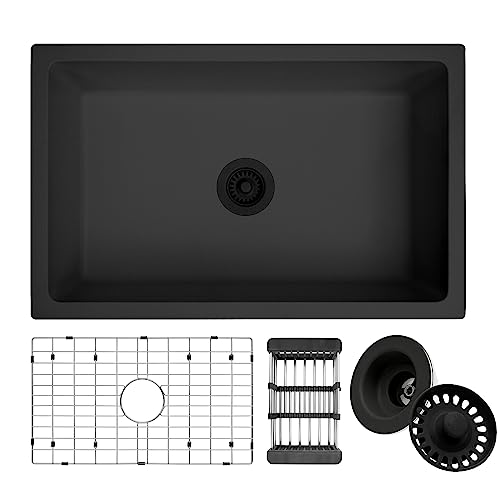
30 Inch Granite Composite Undermount Sink — Best Mid-Size Single Bowl Value
This unbranded thirty inch entry makes the composite case on dimensions and completeness. Thirty by nineteen inches with a nine inch depth is a genuinely useful single bowl, large enough for the Dutch oven and the dinner service, deep enough to keep spray contained, and honest about its cabinet class rather than pretending to fit everywhere. The matte black quartz-stone body delivers the category’s quiet and colour depth without a brand premium attached to the invoice.
Accessories in the box extend the value argument, since a first composite sink often arrives in a kitchen that owns none of the grids, racks or boards the format enjoys. Judge the bundle as a starting kit: serviceable pieces that establish the routines, replaceable individually in later years if a favourite earns an upgrade. The sink itself, moulded and through-coloured, is the durable part of the purchase, and it is specified like one.
Buyers should do the paperwork a brand would normally do for them: confirm the minimum cabinet, the drain position and the counter’s readiness for an undermount of composite weight before ordering. Households comfortable with that diligence gain the material’s full character, silence, heat tolerance, matte black calm, at the most accessible point in this guide.
Value in composite is not about the badge but about the moulding’s honesty, and this bowl’s dimensions and depth argue its case without a logo’s help.
- Material: granite composite quartz stone, matte black
- Dimensions: 30 by 19 inches, 9 inch depth
- Layout: single bowl, undermount fitting
- Bundle: accessories included in the box
- Cabinet class: sized for mid-width runs
Strengths
- Useful depth and width at an accessible point
- Matte black quartz delivers full composite calm
- Accessories establish workstation routines early
Trade-offs
- Unbranded file means owner verifies the details
- Matte surface shows flour and pale dust readily
- Undermount weight needs a supportive counter
Best for: value-focused buyers with a thirty-three inch cabinet who want composite character without brand pricing.
Not suited for: shoppers who prefer a deep manufacturer catalogue behind a major fixture.

Sarlai 33 Inch Granite Composite Undermount Sink — Largest Composite Workstation
Sarlai’s composite entry scales the workstation idea to its generous limit: thirty-three by nineteen inches of black quartz composite in a single sweeping bowl, with a ledge for boards and racks and accessories finished in gold tones that turn the sink into a deliberate design feature. Where the Kraus workstation is monochrome and architectural, this one is jewellery-aware, aimed at kitchens where the sink performs in front of guests gathered at the island.
The single bowl at this size is the entertainer’s configuration. A roasting pan, a dozen glasses and the evening’s prep all find room without the diplomacy a divider imposes, while the ledge keeps the board work above the bowl and the counter clear for plating. Composite quiet matters most exactly here, in a room where the washing up shares airspace with the conversation it is washing up after.
Gold accessories will divide taste, and the honest advice is to decide with the room rather than the photograph: in warm, brass-leaning kitchens the accents complete a sentence the hardware started, while in cool monochrome schemes they may read as a guest who dressed for a different party. The basin beneath them is a serious, full-size composite workstation either way, and accessories can be restyled long before a sink can.
Entertaining kitchens should judge this pick at midnight, mid-clear-up, when its size and silence do the work that photographs cannot demonstrate.
- Material: granite composite black quartz
- Dimensions: 33 by 19 inch single bowl
- Format: undermount workstation with ledge
- Accessories: gold-toned set included
- Layout: one large bowl for entertaining scale
Strengths
- Biggest single composite bowl in this guide
- Ledge supports island prep and plating flow
- Gold accents suit warm, brass-leaning schemes
Trade-offs
- Thirty-three inches demands a wide cabinet
- Gold detailing will not suit every scheme
- Composite heft makes installation a two-person job
Best for: entertaining households with wide cabinets and warm metal hardware already in the room.
Not suited for: cool monochrome kitchens or narrow cabinet runs.

27 Inch Granite Composite Undermount Sink — Best Compact Composite
Small kitchens are usually offered composite’s benefits only in theory, since most composite sinks are drawn at thirty inches and above. This twenty-seven inch model closes that gap with a real bowl: eighteen inches front to back, nine deep, in matte black granite composite with accessories included. An apartment or galley that cooks seriously gains the quiet, the heat tolerance and the through-body black of the material without surrendering the cabinet run to a sink it cannot house.
The single bowl is the right call at this size, since dividing twenty-seven inches would produce two puddles rather than two workspaces. Nine inches of depth keeps the bowl honest for stockpots and soaking trays, and the undermount fitting preserves the small counter’s most precious illusion, an unbroken work surface sweeping straight into the sink. In compact kitchens that illusion is square footage by other means.
Verify the cabinet minimum with the same care the larger picks demand, because compact cabinets vary more in their interior honesty than standard runs do. Where it fits, this is the composite sink for the cook who refuses to let a small kitchen dictate small ambitions, and who would like the washing up to sound like it belongs in a much larger house.
Compact composite is a small category with an outsized effect, because it lets the smallest kitchens in this guide’s audience stop compromising on the sink entirely.
- Material: matte black granite composite quartz
- Dimensions: 27 by 18 inches, 9 inch depth
- Layout: single bowl, undermount fitting
- Bundle: accessories included for the format
- Cabinet class: compact and galley runs
Strengths
- True composite character at apartment scale
- Depth keeps the small bowl genuinely useful
- Undermount preserves precious counter illusion
Trade-offs
- Capacity still yields to a full dinner party
- Compact cabinets need careful measurement
- Unbranded documentation asks owner diligence
Best for: apartments, galleys and small homes that cook far above their square footage.
Not suited for: large families whose pans queue for a thirty-three inch bowl.
How Do the Six Composite Sinks Compare?
| Pick | Size and layout | Mounting | Signature feature |
|---|---|---|---|
| Kraus KGUW2-33MBL workstation | 32 inch single bowl workstation | Undermount | Integrated ledge, board and roll-up rack included |
| Kraus KGD-52 double bowl | 33 inch double bowl, equal split | Drop-in or undermount | Thick deck and metallic-flecked black finish |
| Kraus KGD-433B black onyx | 33 inch double bowl, equal split | Undermount or topmount styling | Black onyx depth with 50/50 division |
| 30-inch matte black single bowl | 30 inch single bowl | Undermount | Matte black quartz with accessory set |
| Sarlai 33-inch workstation | 33 inch single bowl workstation | Undermount | Gold-accented accessories on a black basin |
| 27-inch compact single bowl | 27 inch single bowl | Undermount | Compact footprint for small cabinet runs |
Why Choose Composite Over Stainless Steel at All?
Begin with sound. A composite bowl receives a dropped pan the way a stone floor receives a step, with a short, low note, while steel answers the same event like an instrument. In open-plan living that difference is not a luxury detail but the acoustic terms on which cooking and conversation coexist, and it is the reason most composite owners cite first when asked whether they would buy the material again.
Add colour and calm. Composite holds a matte, through-body tone that neither reflects the room’s clutter nor reports every water spot, and it lands hot cookware without the scorch anxiety of lesser materials. Steel remains brighter, lighter and easier to install, and this guide’s general sink coverage honours it; the composite case rests on quiet, colour and composure, and for the right household those three outweigh the scale and the mirror.
How Heat-Safe Is Composite in Real Cooking?
The listings in this guide state heat tolerance in the hundreds of degrees, with the Kraus workstation naming five hundred, and the practical translation is about contact rather than storage. A pan moved from hob to sink, a roasting tray rested briefly while the oven is rearranged, a kettle’s worth of near-boiling water: composite takes these in stride, which is the heat life a sink actually leads.
What composite should not become is a permanent trivet for cast iron parked straight from a fierce oven while the cook answers the door. Ratings describe tolerance, not an invitation, and a board or rack under genuinely extreme cookware remains cheap wisdom. Treated as a heat-tolerant surface rather than a heat-proof one, composite will keep its face for decades.
Does Composite Stain, Scratch or Chip?
Staining is composite’s strongest suit: the non-porous surface gives coffee, wine and turmeric nowhere to live, and ordinary spills rinse away or lift with mild detergent. Scratching is subtler, since composite can collect fine marks from dragged pan bases, yet through-body colour means those marks read as texture rather than as wounds revealing another material, which is why composite ages gracefully where coated sinks age dramatically.
Chipping is the honest vulnerability, reserved for the heavy point impact, a cast-iron edge dropped from height onto the rim or divider. It is rarer than internet anxiety suggests and usually cosmetic when it happens, but it argues for the grid and for lifting rather than levering heavy pans. Every sink material keeps one such confession; composite’s is simply the most specific.
How Do You Install a Composite Sink Safely?
Respect the weight first. A thirty-three inch composite sink is a two-person lift with a plan, not an improvisation, and its undermount fixings must be set into a counter and cabinet structure that accept the load plus a bowl full of water and pans. Dry-fit everything, confirm the drain’s alignment with the disposal and trap, and support the bowl independently of the sealant while it sets.
Drop-in mounting, offered by the KGD-52 in this guide, lowers the stakes considerably and suits laminate counters that undermounts cannot serve. Whichever route is chosen, the fabricator conversation belongs before the counter is cut, with the sink’s own template in hand, because composite’s precision is moulded in and cannot be trimmed into compliance on the day.
Which Composite Colour Suits Your Kitchen?
Black dominates this guide because it dominates the market’s serious end, and its behaviour is well understood: it hides pigment and metal marks, displays pale dust and limescale, and anchors pale schemes with intent. Metallic flecks, present in both Kraus doubles here, soften black’s reporting by giving the surface a texture that breaks up minor evidence before the eye can file a complaint.
Pale composites reverse the ledger, forgiving dust and veiling while confessing coffee and curry. Choose by your household’s actual evidence production, the same advice this site gives for faucet finishes, and remember that composite colour is a decade-long commitment made in the material itself. There is no repainting a composite sink, which is precisely why its colour should be chosen slowly.
How Should You Clean Composite Day to Day?
Daily composite care is deliberately dull: a soft sponge, mild detergent, a rinse, and a wipe dry when the evening’s washing ends. That routine denies pigment its standing time, denies limescale its evaporation stage, and keeps the matte surface in its factory temperament without a single specialist product. A weekly pass with a composite-suitable cleaner, of the kind covered in this site’s Blanco and counter guides, handles the film that daily wiping eventually misses.
The prohibitions matter more than the products: no scouring powders, no steel wool, no acid descalers borrowed from the kettle. Composite’s resin binder is the price of its moulded quiet, and those chemistries tax exactly that binder. A household that observes the short blacklist will find composite the least demanding sink material it has ever owned.
What Size Composite Sink Fits Which Cabinet?
The arithmetic mirrors steel’s, with weight added to the conversation. Twenty-seven inch models serve thirty inch class cabinets, the thirty inch single suits a thirty-three, and the thirty-two and thirty-three inch designs expect a thirty-six inch cabinet with the structure to carry them. Interior width, not the door’s nominal size, is the measurement that decides, and composite’s clips and supports take their share of it.
Depth deserves the same tape: nine inch bowls appear across this guide because they balance soaking capacity against the reach of an average user at an undermount’s added counter thickness. Measure the cabinet, then measure the household’s tallest pan, and let those two honest numbers choose among the six rather than letting a photograph choose for you.
Are Workstation Ledges Useful in Composite?
A ledge in composite carries a particular pleasure, because boards and racks rest on stone-quiet rails instead of ringing steel, and the whole prep performance happens at a volume the rest of the room can talk over. The Kraus and Sarlai workstations in this guide build the ledge into the moulding, which keeps accessories seated with a stability that clip-on rails on steel rarely match.
The cost is a small narrowing of the bowl’s open mouth and one more surface line to wipe, which ledge owners consistently report as the best trade in their kitchen. Households that cook from raw ingredients most nights will use the ledge daily; households that reheat will not, and the plain bowls in this guide exist respectfully for them.
How Long Does a Composite Sink Last?
Composite’s service life is measured in the same decades as the stone it imitates, provided its short blacklist is observed and its impacts stay ordinary. There is no finish to peel, no coating to wear through at the handle’s equivalent, and no rust in its future, which removes three of the four ways sinks usually die and leaves only genuine accident as an ending.
That longevity reframes the purchase price honestly. A composite sink amortised across twenty years of daily use costs less per washed pan than almost any appliance in the room, and its quiet compounds daily in a way the spreadsheet cannot capture. Buy the size and layout your household will still want in a decade, because the material intends to stay for one.
What Should You Check on the Day a Composite Sink Arrives?
Inspect the moulding before anything is cut: rim flatness, drain opening finish, colour evenness in daylight, and the accessories’ fit on the ledge where one is moulded. Composite travels well but it is heavy, and a corner chip from freight is exactly the kind of flaw that must be caught before installation makes it yours permanently.
Photograph the sink, keep its template and paperwork with the house documents, and register anything registrable. A fixture expected to serve for decades deserves a file, and the household that keeps one will answer every future question, from drain parts to colour matching a second sink, in minutes rather than archaeology.
How Does Composite Handle a Garbage Disposal?
A disposal hangs real weight and real vibration from the sink’s drain, and composite’s density handles both with a calm that thin steel cannot imitate. The bowl does not buzz sympathetically at the disposal’s favourite frequencies, and the thick floor around the drain opening gives the flange a substantial seat. Confirm the flange hardware suits composite floor thickness before installation day, since that single measurement is where disposal fittings on composite occasionally improvise badly.
Daily disposal habits carry over unchanged: cold water during grinding, small batches, and nothing fibrous in heroic quantities. The sink’s contribution is composure, and in an open-plan evening, a disposal that clears the plates without announcing itself to the sofa is another verse of the same quiet song this material keeps singing.
What Accessories Suit a Composite Sink Best?
Start with the grid that matches your bowl, since it prevents most pan contact and lifts washing out of standing water, then add the ledge accessories your format supports: boards that seat properly, a roll-up rack, a colander that parks over the bowl. Composite’s ledges and rims reward fitted pieces over universal gadgets, because the moulded dimensions are exact and a wobbling board over a quiet sink is a small daily betrayal.
Resist accessorial excess beyond that short list. The composite sink’s appeal is architectural calm, and a rim colonised by caddies, brushes and novelty holders dissolves the very quality the material was bought for. Keep the deck clear, let the black or pale expanse read as designed, and store the tools under the sink where tools live.
Should You Match a Composite Sink to Composite Counters?
Composite sinks and quartz counters are cousins rather than twins, sharing a stone-and-resin logic while differing in moulding and finish, and they coexist beautifully when their colours are chosen as a family rather than as a match. A black composite bowl beneath a pale quartz counter is the combination this guide’s photographs would choose; the reverse, pale bowl under dark stone, works where the kitchen wants the sink to disappear entirely.
Avoid chasing an exact colour marriage between sink and counter, because the materials take light differently and a near-match reads as an error while a clear contrast reads as design. The same family-agreement rule from this site’s faucet finish guide applies: agree in temperature and intention, and let each material keep its own exact voice.
How Do You Live With a Dark Composite Sink in Hard Water Country?
Hard water writes its pale signature across dark composite exactly as it does across black faucets, and the management is identical in spirit: deny the water its evaporation stage. A wipe after the evening wash keeps the bowl’s depth true, a weekly composite-suitable clean lifts whatever the wipes missed, and the matte black stays the calm, dark field the design intended rather than a chalkboard of the week’s kettles.
Owners who adopt that rhythm report the dark bowl as the lowest-effort sink they have owned, because the alternative evidence, pigment, pan marks, fingerprints, is precisely what through-body black conceals best. The households that struggle are those who bought black for its showroom stillness and declined the thirty-second nightly part of the contract.
What Is the Difference Between Granite Composite and Fireclay?
Fireclay is ceramic, glazed and kiln-fired, brilliant white and ringing bright when struck, with a glaze that can craze or chip across a long life. Granite composite is moulded stone and resin, matte and quiet, coloured throughout and immune to glaze failures because it has no glaze. The two materials suit different kitchens’ aesthetics entirely: fireclay belongs to the farmhouse photograph, composite to the architectural one.
Care divides them just as clearly. Fireclay’s glaze fears abrasion and thermal shock in its own ways, while composite fears acids and point impacts in its. A household choosing between them is really choosing which short blacklist it would rather keep, and this guide’s six picks exist for households whose answer is the composite list.
How Should a Composite Sink Be Winterised in a Seasonal Home?
Seasonal homes ask fixtures to survive neglect gracefully, and composite answers well provided the plumbing is drained and the bowl is left clean and dry. Clean the sink as the last kitchen act of the season, dry it thoroughly, and leave the cupboard beneath it aired, since a sealed, damp under-sink space is where returning owners meet the smells they then blame on the sink.
On reopening, rinse the bowl generously before the first wipe, because months of settled dust contain grit that a dry cloth would drag. Composite’s non-porous face forgives the closed season more completely than most materials, and a seasonal household that follows this short ritual will find the sink the least changed object in the house each spring.
Can a Composite Sink Be Repaired if It Chips?
Small chips and edge marks on composite can often be improved with maker-appropriate repair kits that fill and colour-match the material, a possibility that exists precisely because the colour runs through the body. The repair will rarely be invisible under forensic light, yet at sink distance, in sink light, a well-matched fill restores the bowl’s composure and protects the spot from collecting soil.
Larger structural damage belongs to the manufacturer conversation, as with the Blanco guidance elsewhere on this site. The practical lesson is preventive: grids for the pan-heavy, care with the cast iron, and no levering of heavy cookware against the divider or rim, the three habits that keep repair kits in their drawer for a decade at a time.
What Questions Should You Ask a Counter Fabricator About Composite?
Ask how the bowl will be supported independently of the sealant, where the clips will land, and whether the cabinet’s structure needs reinforcement for the combined weight of sink, water and a bowl full of pans. Ask who owns the template’s accuracy and what happens if the cut and the moulding disagree by a few millimetres, because composite cannot be persuaded on site the way thin steel sometimes can.
A fabricator who answers those questions with drawings and specifics is the right partner for this material. The sink will outlast the counter in many installations, so the conversation is worth having at full length once, before anyone cuts anything, with the chosen model’s own paperwork open on the counter that is about to receive it.
How Does a Composite Sink Change a Kitchen’s Design Conversation?
A steel sink is equipment; a composite sink is architecture, and rooms respond accordingly. The matte expanse becomes a colour decision on the scale of the cabinetry, the quiet becomes part of the room’s acoustic design, and the faucet, suddenly the only metal voice at the sink, gets chosen with a care it rarely received when it had a steel bowl echoing beneath it.
That elevation is the deepest reason households choose this category and the reason this guide treats colour and layout as primary decisions rather than finishing touches. Buy the composite sink as a piece of the room’s permanent design, sized and coloured for the decade, and its daily performance will feel like a dividend on a decision that was already right.
How Do You Choose Between the Two Kraus Double Bowls?
The two Kraus doubles in this guide share a size, a split and a material family, so the decision between them is unusually pure: mounting story against colour story. The KGD-52’s thick deck and dual mounting serve the household whose counter will change during the sink’s life, while the black onyx model commits fully to the deepest colour and a single, deliberate installation. Neither is the upgraded version of the other; they are answers to different renovation timelines.
Run the timeline honestly. If a stone counter is funded and scheduled within a few years, mounting patience wins and the dual-mount earns its place. If the current counter is the long-term counter, colour wins, and the onyx’s depth will be the thing the room is complimented on. Composite’s longevity means this choice echoes for a decade, which is an argument for deciding slowly and installing once.
What Does a Composite Sink Do to Resale Photographs?
Estate photography loves a matte sink. Steel bowls blow out under flash and mirror the photographer’s tripod back at the viewer, while composite holds its tone and lets the counter and faucet carry the composition. In a dark scheme the black bowl reads as intentional architecture in listing photographs, which is a small but real commercial argument for the material in homes that will be marketed within the sink’s long life.
The same quality helps in daily life rather than only at sale: a sink that photographs calmly is a sink that looks calm at breakfast. Owners consistently underestimate how much of a kitchen’s perceived order comes from the sink’s visual noise level, and composite’s matte silence lowers that noise more completely than any organiser or accessory can.
How Should You Pair a Faucet With a Composite Sink?
The faucet becomes the sink’s only metallic voice, so its finish carries more design weight than it would over steel. Brushed steel over black composite is the classic, quiet pairing; brass and bronze warm the black toward the heritage end of the room; matte black on black composite is the boldest and the most demanding, since two mattes must agree in depth or the mismatch shows at conversational distance.
Functionally, composite’s weight and rim thickness can limit some faucet mounting fantasies on rear decks, so confirm the deck’s drilling and the faucet’s reach against the bowl’s centre before the counter is cut. A high-arc pull-down remains the natural partner for these deep bowls, and its hose will work over a surface that does not ring when the spray wand knocks it, a small mercy repeated daily.
What Mistakes Do Composite Sink Buyers Make?
Treating composite like quarried granite is the foundational error, because the resin binder that makes the material mouldable also gives it a blacklist granite does not keep. Acid descalers and scouring powders, tolerable on a stone slab, tax a composite bowl’s surface directly. The material is tougher than steel in some ways and more particular in others, and the particular ways are printed in every care leaflet owners skip.
A second mistake is choosing a double bowl by photograph and discovering at home that neither side accepts the household’s roasting pan. Composite doubles divide real width, and the pan test, largest pan, largest tray, biggest board, should be run against the listing’s interior dimensions before the order, not against the installed sink after it.
Third, buyers underestimate the installation’s physical side, scheduling a lone afternoon for a heavy undermount that wants two people, a fabricator’s template and a supported set. Composite forgives many things but not being dropped, and the money saved by skipping proper fitting is the most expensive saving in the category.
Finally, households clean composite with the steel routine they grew up with, steel wool included, and then blame the material for the freckles and scratches that follow. The daily care described in this guide is gentler and shorter than the steel routine; the only difficulty is unlearning, and the sink will wait patiently while you do.
Final Recommendation
For most composite buyers, the KRAUS 32 Inch Undermount Granite Composite Sink KGUW2-33MBL is the complete answer: workstation ledge, included accessories, through-body metallic black and heat tolerance, in the size the standard cabinet run was built around. It is the sink this guide would install first and explain least.
Divided households take the KRAUS 33 Inch Double Bowl Granite Sink KGD-52 for its mounting patience or the black onyx double for its drama, entertainers take the Sarlai’s broad single bowl, and small kitchens take the twenty-seven inch model without apology. The 30-inch matte black composite single holds the value ground between them honourably.
A composite sink will not shout for attention across the years; it will simply make every pan land more quietly than the last kitchen you lived in, and that hush becomes the sound of home.
Frequently Asked Questions
Is granite composite better than stainless steel for a sink?
Better is the wrong axis; quieter, calmer and more colour-fast is accurate, while steel is lighter, brighter and easier to install. Composite wins in open-plan rooms, dark design schemes and households tired of water spots and drumming. Steel wins where weight, budget or a laminate counter constrain the project. This guide’s six are the composite answer for households whose priorities already lean that way.
Can a hot pan go straight into a composite sink?
Ordinary hot cookware can touch down briefly, and several listings here state heat tolerance in the hundreds of degrees, the Kraus workstation naming five hundred. Treat that as tolerance for the sink’s real life, pans in transit and trays rested momentarily, rather than as permission to park oven-fierce cast iron indefinitely. A rack or board under extreme cookware remains wise.
Do composite sinks need sealing like granite counters?
A moulded composite sink is non-porous through its body and does not need the sealing a quarried granite counter does. Care kits with sealers exist to refresh surface behaviour on composite, as this site’s Blanco guide discusses, but that is restoration of water behaviour, not a structural requirement. Daily mild cleaning is the whole standing obligation.
Will a black composite sink show scratches?
Fine marks can appear where pans drag, yet because the colour runs through the material, they read as subtle texture rather than bright wounds, and most fade into the matte surface’s general character. Pale dust and dried droplets are what black composite actually displays, which is why this guide pairs every dark pick with a wipe habit rather than a warning.
Can composite sinks be undermounted with any counter?
They undermount happily under stone, quartz and solid surface counters with proper support for their weight, and they are not suited to laminate, whose cut edge cannot live with the rim’s moisture. The dual-mount KGD-52 in this guide exists for laminate households, wearing its deck on top instead. Always confirm the fabricator’s support plan before the cut.
How heavy is a composite sink to install?
Noticeably heavier than a steel sink of the same size, enough to make installation a planned two-person job with the bowl supported while fixings set. The weight is the material’s density making itself known, the same density that delivers the quiet. Budget the help, dry-fit everything, and the install is uneventful.
Is a composite sink a good choice for a busy family kitchen?
It is often the best choice in the house for exactly that household: pans land quietly, hot cookware touches down without ceremony, pigment rinses away, and the through-body colour hides the evidence of a decade of homework, baking projects and midnight snacks. The family’s obligations are the short blacklist, no scouring powders and no acid descalers, plus lifting the heaviest cast iron rather than dragging it, which are habits children can learn as easily as adults.
What is the first accessory to buy for a new composite sink?
The fitted bottom grid, before any board, rack or organiser. It prevents the majority of pan contact and metal transfer from the sink’s first week, lifts dishes out of standing water, and establishes the habit of treating the bowl as a surface worth protecting while it is still perfect. Workstation owners should add the ledge board second, since that is the piece that converts the sink from a basin into a prep station.
How do I know a composite sink listing is describing real quartz composite?
Look for the material language to do specific work: quartz or granite composite named as the body, heat tolerance stated, weight that implies density, and care guidance that bans abrasives and acids. A listing that calls a thin, feather-light basin composite while promising it behaves like steel is describing coloured plastic in borrowed vocabulary, and the price usually confesses what the text conceals.
Related Guides
Composite ownership continues into drainage and daily care, and these guides cover the neighbouring decisions a new sink brings with it. Best Drain Cleaner for Kitchen Sinks with Garbage Disposal Best Portable Microwaves (0.7 Cu Ft Class) Best Espresso Capsules for Nespresso Machines.


