What's inside
- Key Takeaways
- Quick Picks
- How Did We Choose These Drain Cleaners?
- What Should You Understand About Drain Chemistry Before Buying?
- How Do the Six Cleaners Compare Side by Side?
- How Should You Actually Treat a Disposal Drain, Step by Step?
- Which Warning Signs Mean You Should Stop Pouring and Call a Plumber?
- What Mistakes Do People Make With Disposal Cleaners?
- How Can You Tell Grease Build-Up Apart From Other Blockages?
- Final Recommendation
- Do You Need an Opener, a Maintainer, or One of Each?
- What About Ice Cubes, Citrus Peel and Other Folk Remedies?
- How Does Having a Disposal Change What Belongs in the Drain?
- What Does a Sensible Year of Drain Care Look Like?
- Which Label Details Should You Check Before Any Cleaner Goes Down?
- Frequently Asked Questions
- Related Guides
As an Amazon Associate I earn from qualifying purchases. This post may contain affiliate links at no extra cost to you.
cottageverdict.com is reader-supported. When you buy through links on our site, we may earn an affiliate commission.
Where to buy: every cleaner below is sold through Amazon, and each pick name in this guide links straight to its listing so you can read the current label, directions and safety notes before ordering. Start there rather than in a hardware aisle, because the label version matters more than the bottle colour when a disposal and a septic tank are both involved.
A slow kitchen sink rarely announces what is actually wrong with it. Water pools around a colander of pasta, a sour smell rises after the dishes are done, and the disposal growls through a film of grease that never quite leaves. Choosing the best drain cleaner for kitchen sinks with garbage disposal starts with admitting that three different problems share one drain: living odour in the grind chamber, soft grease building along the pipe wall, and the occasional partial blockage further down the line. No single bottle honestly solves all three, which is why this guide separates maintenance products from openers instead of pretending they are interchangeable.
It also shapes how you should shop. Resist the urge to buy by bottle size or by the boldest verb on the label, and instead write down, literally if it helps, which of those three problems your sink is showing this month. The product that matches the symptom in your notebook will outperform a stronger product aimed at a fault you do not have, every single time.
That honesty shapes the whole list. Enzyme and bacterial cleaners digest organic matter slowly and keep pipes clear over weeks, but they will not punch through a hard, complete clog tonight. Foaming disposal cleaners scrub the splash guard and grind chamber where sponges cannot reach. Tablets trade strength for a tidy monthly routine. Stronger caustic openers exist on the wider market, yet they demand strict label discipline around disposals and septic systems, and none of the six picks here should be treated as a licence to pour first and read later.
Key Takeaways
- Match the product to the fault: odour in the chamber, grease on the pipe wall, and a true blockage are three separate jobs.
- Enzyme and bacterial formulas work by digestion over hours, so judge them on a fortnight of use rather than one dramatic evening.
- Foam reaches the underside of the splash guard, the surface most responsible for disposal smell.
- Septic households should stay with products whose labels state septic safety and should dose after the last washing-up of the day.
- A completely stopped drain, or one that backs up into the other bowl, is a plumbing job, not a stronger-bottle job.
- Never run two different drain chemicals through the same evening, and never mix products in a standing pool of water.
Quick Picks
| Pick | Badge | Why it earns a place |
|---|---|---|
| Green Gobbler Enzyme Drain Cleaner 1 Gallon | Best for Grease Maintenance | A gallon of enzyme cleaner aimed squarely at oils and fats, suited to households that cook with plenty of both. |
| Drano Foamer Garbage Disposal Cleaner | Best Foaming Disposal Clean | Expanding foam pushes up into the grind chamber and under the splash guard where lingering food film hides. |
| Affresh Garbage Disposal Cleaner | Best Tablet Routine | Six pre-measured tablets turn disposal cleaning into a monthly habit that takes minutes and needs no measuring jug. |
| Roebic K-27 Garbage Disposal Cleaner | Best Bacteria-Enzyme Liquid | A disposal-specific liquid pairing bacteria with enzymes to break down residue clinging inside the unit. |
| Bioda Professional Strength Drain Cleaner | Best Septic-Conscious Gallon | A professional-strength gallon whose labelling leads with septic safety, built for regular odour control in the line. |
| Zep Drain Defense Enzymatic Drain Cleaner | Best Powder Format | An enzymatic powder that stores neatly, measures by the scoop and suits scheduled treatment of kitchen lines. |
How Did We Choose These Drain Cleaners?
We began by excluding anything whose labelling warns against use in garbage disposals, because a cleaner that endangers the appliance it is meant to serve fails the brief before chemistry enters the discussion. Products also had to state their position on septic systems clearly, since a large share of homes with disposals drain into a tank rather than a municipal sewer, and vague wording on that point helps nobody.
Next we sorted candidates by mechanism rather than by brand. Enzymatic liquids, bacterial blends, foaming cleaners, tablets and powders behave differently in a pipe, and a useful shortlist needs genuine variety across those mechanisms so a reader can match a product to a symptom. Anything marketed with instant-unclog promises for a kitchen line full of grease was read with suspicion, because grease does not dissolve on contact the way advertising implies; it softens, emulsifies or gets digested, each on its own timescale.
Finally we weighed the unglamorous details that decide whether a cleaner actually gets used: bottle size against treatment count, whether dosing needs a measuring cup at the sink, how the product stores under a crowded cabinet, and how plainly the directions explain contact time. A technically capable cleaner that households abandon after one fiddly application loses to a slightly gentler one that becomes a routine.
We also deliberately left hard caustic openers off the pick list rather than ranking one as a token strong option. Their labels vary enough on disposal and septic compatibility that a responsible recommendation has to be made bottle by bottle at the shelf, and a guide that cannot verify that wording for a specific product should not lend it authority. The six products above earned their places because their intended use around a disposal is stated by their own makers, in language a buyer can recheck on the listing before spending anything.
What Should You Understand About Drain Chemistry Before Buying?
Enzymes are proteins that accelerate specific reactions. Lipase attacks fats, protease works on protein-based residue, and amylase handles starches, which between them cover most of what a kitchen drain collects. Bacterial products go a step further: the organisms settle on pipe walls and keep producing enzymes between doses, forming a living layer that grazes on new deposits. Both approaches share one limitation that marketing tends to bury. Digestion takes time and contact, so these products shine on maintenance schedules and soft build-up, and disappoint anyone expecting a sealed drain to roar open within the hour.
Caustic openers sit at the opposite pole. They generate heat and aggressive alkalinity that can melt through grease and hair quickly, which is exactly why their labels carry the sternest warnings in the cleaning aisle. Around a disposal, that aggression raises real questions: seals, splash guards and older metal fittings all have tolerances, and a septic tank depends on a bacterial population that a caustic surge can knock back hard. The correct posture is neither fear nor bravado. Read the specific label, confirm disposal and septic compatibility in the manufacturer’s own words, keep the disposal switched off unless directed otherwise, and never follow one chemical with another.
Foamers and tablets occupy the practical middle. Their chemistry is usually milder, but their physical form does work that liquids skip: foam expands against chamber walls, and a fizzing tablet agitates debris off the impeller plate. Treating the disposal itself and treating the downstream pipe are related but distinct tasks, and several households will sensibly own one product from each camp.

Green Gobbler Enzyme Drain Cleaner 1 Gallon — Best for Grease Maintenance
Green Gobbler’s gallon is the most single-minded product on this list: its stated targets are oils and fats, in drains, grease traps and septic systems. That focus suits a particular kind of kitchen, the one where olive oil rinses off pans nightly, bacon fat gets wiped rather than jarred, and butter sauces finish in the sink. In those homes the pipe wall slowly varnishes itself with a greasy layer that narrows the passage and traps everything else passing through. An enzyme routine aimed at fats addresses the root deposit instead of perfuming its consequences.
The gallon format changes how the product gets used. Smaller bottles invite rationing, and rationed enzyme doses underperform because the organisms and enzymes need enough presence to colonise the line. A gallon removes that hesitation, and the listing’s claim of up to eight treatments gives a realistic rhythm of roughly one treatment every few weeks across a season. The anti-glug bottle design sounds like a trivial detail until you have poured a heavy gallon jug at arm’s length into a sink; controlled pouring is genuinely part of dosing accuracy.
Set expectations the way the chemistry demands. Pour the dose in the evening, let it sit while the kitchen sleeps, and judge the result across several treatments as drainage steadies and the greasy smell thins. Anyone whose sink is already fully blocked should not start here, because enzymes need flowing contact with deposits, and standing water above a hard clog mostly dilutes the dose before it reaches the problem.
- Format: liquid enzyme cleaner, one gallon
- Stated focus: breaks down oils and fats
- Stated settings: drains, grease traps, septic tanks
- Treatments: up to eight per gallon
- Positioning: alternative to caustic chemicals
Strengths
- Targets the fat deposits that dominate kitchen drain build-up
- Generous volume encourages proper, unrationed dosing
- Anti-glug pouring suits a heavy container at the sink
Trade-offs
- Works on a schedule of weeks, not on tonight’s emergency
- Gallon jug needs storage room under the sink
- Grease focus means less emphasis on chamber odour itself
Best for: households that cook rich food often and want a standing grease-maintenance routine. Not suited for: a sink that has already stopped draining completely.
There is a second, quieter benefit to the fat-first strategy that shows up around the third month. Grease on a pipe wall acts as glue for everything else the sink sends down: coffee grounds lodge in it, rice swells against it, and fine bone fragments from the disposal settle into the layer instead of washing through. Strip the grease away steadily and those passengers lose their grip, so the whole line behaves better than the modest chemistry might suggest. Households that entertain often notice it first after a big cooking weekend, when the drain that used to hesitate over a sink of rinse water simply takes it. That is the realistic promise of this gallon: not a dramatic rescue, but a kitchen line that stops being a recurring character in your weekends, provided the dosing calendar survives real life.

Drano Foamer Garbage Disposal Cleaner — Best Foaming Disposal Clean
Most disposal odour does not live in the pipe at all. It lives on the underside of the rubber splash guard and across the upper grind chamber, surfaces that a stream of liquid cleaner slides past in a second. Drano’s foamer attacks that geography problem directly: the foam expands upward and outward, clinging to the chamber walls and the guard’s hidden face long enough to loosen the film of ground food that ferments there. The listing also positions it against clogs from hair, grease and soap in kitchen drains and slow drains generally, with pipe and septic safety stated.
The experience differs from every liquid on this list. You see the foam rise, which gives a rare bit of feedback in a category where most products vanish down the hole and ask to be taken on faith. That visibility also enforces patience, because watching foam work discourages the premature flush that ruins contact time for other formulas. For a household whose complaint is specifically a smell that returns a day after cleaning the sink, this physical coverage is the argument.
Keep its limits in view. A 17-ounce foamer is a treatment product, not a bulk maintenance supply, and heavy grease loading further down the line still belongs to an enzyme schedule. Think of it as the chamber specialist in a two-product household: foam for the unit you can smell, enzymes for the pipe you cannot see.
- Format: foaming cleaner, 17 ounces
- Stated targets: hair, grease, soap and odour sources
- Coverage: grind chamber and splash guard area
- Stated safety: pipes and septic systems
- Use pattern: occasional deep clean of the disposal
Strengths
- Foam clings where liquids simply run through
- Directly addresses the splash guard odour reservoir
- Visible action makes correct contact time easier
Trade-offs
- Smaller volume suits treatment rather than routine dosing
- Chamber focus leaves deep pipe grease to other products
- Foam action needs the disposal area left undisturbed briefly
Best for: sinks whose main symptom is a stubborn disposal smell. Not suited for: buyers wanting one bulk product for whole-line maintenance.
Technique decides how much of that foam coverage you actually get. Clear the sink, dry the chamber briefly, and apply the product exactly as the label directs so the foam builds from a relatively clean surface rather than dissolving into a pool of rinse water. Then resist the urge to run the disposal just to see what happens; the foam needs its dwell time against the guard. When you do rinse, use cold water and a short run of the unit to sweep loosened film away. Owners of older disposals with torn or hardened splash guards should know that foam will reveal the problem rather than fix it: if the guard no longer seals, smell escapes regardless of cleaning, and replacing that inexpensive rubber part does more than any bottle could.

Affresh Garbage Disposal Cleaner — Best Tablet Routine
Affresh sells discipline in tablet form. The box holds six tablets, framed as a six-month supply, and each one is dropped in for a cleaning cycle that foams through the grind chamber, across the impeller and into the drain pipe, aimed at the bacteria, debris and grime responsible for odour. There is nothing to measure, dilute or pour, which sounds minor until you compare it with decanting liquid from a gallon jug over a sink full of washing-up.
The honest trade is potency against consistency. A tablet will not rehabilitate a neglected line, and Affresh does not pretend otherwise; its language is about powering away the causes of smell inside the unit. What the format buys is adherence. Disposal cleaning fails in most homes not because products are weak but because the task is forgettable, and a dated monthly tablet is the sort of small ritual that actually survives contact with a busy kitchen. Pair it with an enzyme treatment for the pipe a few times a year and the two routines cover the system sensibly.
Tablets also travel well between households, which matters for anyone stocking a rental property or a second home where the disposal sits idle and ripens between visits. A box in the cabinet and a note on the calendar outperform a shelf of half-used liquids that nobody remembers opening.
- Format: pre-measured tablets, six per box
- Supply framing: six months of monthly cleaning
- Coverage: grind chamber, impeller and drain pipe
- Stated target: odour-causing bacteria, debris and grime
- Dosing: none required, one tablet per cycle
Strengths
- Pre-measured format removes every excuse to skip cleaning
- Foaming cycle reaches the impeller area directly
- Compact box stores anywhere and suits second homes
Trade-offs
- Odour control focus rather than pipe degreasing strength
- Six tablets assume monthly use, not rescue treatment
- Cost per clean runs above bulk liquid dosing
Best for: organised households that will actually keep a monthly cleaning date. Not suited for: clearing established grease build-up in the line.
A tablet routine also creates a natural inspection moment that liquid dosing never does. Once a month, while the tablet fizzes, you are standing at the disposal with nothing else to do, which is precisely when a slow drip from the trap, a weeping dishwasher hose connection or a corroding mounting ring gets noticed. Several expensive kitchen repairs begin as exactly those unnoticed drips, so the habit pays twice. If your household runs on shared chores, the box is easy to divide as well: whoever cooks the first Sunday dinner of the month drops the tablet while the plates soak. Small, owned rituals like that are why this modest product earns a place beside far stronger chemistry in a serious guide.
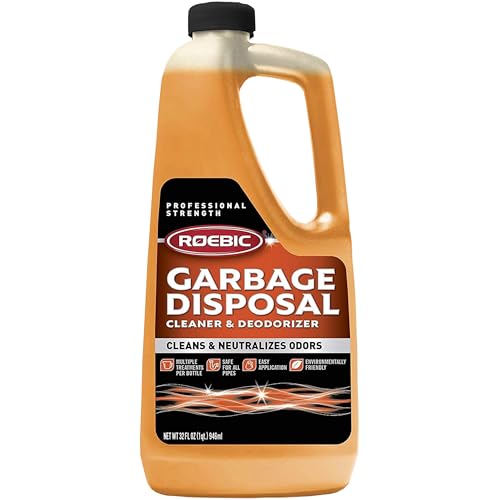
Roebic K-27 Garbage Disposal Cleaner — Best Bacteria-Enzyme Liquid
Roebic has built its name on bacterial treatments for septic and drainage systems, and the K-27 brings that heritage to a product labelled specifically for garbage disposals. The formula pairs bacteria with enzymes in a 32-ounce bottle, positioning the two as a working partnership: enzymes begin breaking residue down immediately, while the bacterial component keeps working on what remains inside the unit and the trap beyond it. For odour that seems to live inside the disposal body itself rather than on the splash guard, that inside-out approach makes sense.
The disposal-specific labelling matters more than it might appear. Plenty of general drain liquids are technically usable around a disposal yet say nothing about the chamber, the impeller or the particular residue a grinder leaves behind, which is ground food paste rather than the hair and soap scum of a bathroom line. K-27’s directions speak to the appliance directly, and that specificity tends to produce better real-world use, because owners follow instructions written for the machine in front of them.
As with every bacterial product, temperature and timing influence results. A dose poured right before a dishwasher discharges a flood of very hot water wastes the organisms you just paid for, so evening application after the final rinse, with the sink then left alone, gives the formula its fairest chance. Judge it after a few applications; bacterial cleaning compounds quietly.
- Format: liquid, 32 fluid ounces
- Formula: bacteria plus enzyme blend
- Labelling: made specifically for garbage disposals
- Stated aim: breaks down residue, reduces sink and drain odours
- Maker background: bacterial drainage and septic treatments
Strengths
- Disposal-specific directions rather than generic drain wording
- Bacterial action continues after the dose is poured
- Sensible bottle size for repeated chamber treatments
Trade-offs
- Results build gradually across several applications
- Hot dishwasher cycles soon after dosing waste the bacteria
- Less suited to heavy grease loads than a fat-focused gallon
Best for: owners whose odour problem sits inside the disposal unit itself. Not suited for: anyone expecting a single application to transform a neglected drain.
Consider who benefits most from a bacterial formula: the household whose sink is used in bursts. Weekend batch cooking, a holiday baking day, then quiet weekdays give bacteria the feast-and-rest cycle they handle well, because the colony persists in the trap and chamber between uses and wakes up with each new load of residue. By contrast, a sink rinsed constantly with near-scalding water all day, as in a small café, works against colonisation. Kitchens in the first pattern often report that the third application smells noticeably better than the first, a compounding curve that one-off chemical treatments cannot reproduce. Keep the bottle somewhere visible rather than buried behind the bleach, because bacterial cleaning rewards the owner who remembers it exists.

Bioda Professional Strength Drain Cleaner — Best Septic-Conscious Gallon
Bioda leads with two phrases that septic households scan for first: professional strength and septic safe, printed on a gallon built for repeated drain odour elimination rather than one dramatic intervention. That combination defines its audience precisely. Homes on septic systems cannot treat the drain as a chemistry experiment, because everything poured at the sink eventually meets the tank’s working bacteria; a maintenance cleaner that respects that system while still being sold at professional strength resolves the tension those owners feel with ordinary shelf products.
The gallon sizing suits a whole-house rhythm rather than a single sink. Kitchen line this month, the slow bathroom basin next, the laundry drain after that: a bulk septic-conscious cleaner turns drain care into a property routine, which is how landlords and owners of older homes with long pipe runs tend to think. Odour elimination is the stated headline, and in practice recurring drain smell in a septic home often signals biofilm in the lines rather than trouble in the tank, so a line treatment is the proportionate first response.
Professional strength should still be read through the maintenance lens. This is a product for keeping lines clear and sweet on a schedule, applied generously and left to work, not a substitute for rodding a collapsed or root-invaded pipe. Used that way, its restraint is the feature: strong enough to matter, compatible enough to use without a worry spiral about the tank.
- Format: liquid, one gallon
- Positioning: professional strength formula
- Stated safety: septic safe
- Stated aim: drain odour elimination
- Use pattern: scheduled treatment across household drains
Strengths
- Septic safety stated plainly on a bulk product
- Gallon supports a whole-house maintenance rotation
- Odour focus matches the commonest septic-home complaint
Trade-offs
- Maintenance framing, not an emergency opener
- Bulk format is more than a small flat needs
- General drain scope rather than disposal-specific directions
Best for: septic households wanting one bulk cleaner for every drain. Not suited for: a small kitchen needing only occasional chamber cleaning.
There is a budgeting angle to the gallon that single-sink products cannot match. A property with four drains treated monthly from one container spreads its cost thinly enough that nobody is tempted to skip a dose, and skipped doses are where maintenance programmes quietly die. Bioda’s professional framing also hints at the settings it was blended for: rental turnovers, guest houses and busy family homes where drains are serviced on a rota rather than in a panic. If you manage any property beyond your own kitchen, that rota logic will feel familiar, and this is the bottle built for it. Keep a simple log on the cabinet door, initial it at each treatment, and the line’s history stops being guesswork when a tenant reports a slow sink.

Zep Drain Defense Enzymatic Drain Cleaner — Best Powder Format
Zep’s Drain Defense takes the enzymatic idea and dries it. The 18-ounce container holds a powder, labelled safe for pipes and septic systems, that is measured by the scoop and activated in the drain. Powder changes the ownership experience in small but real ways: no drips down the bottle neck, no crystallised cap, no heavy jug, and a container that tolerates being knocked over in a crowded cabinet without consequence. For a product whose entire value depends on being used monthly for years, those ergonomic details are not decoration.
The enzymatic mechanism is the familiar maintenance story, digesting organic build-up gradually and defending the line against the slow narrowing that precedes a blockage; the product name itself, Drain Defense, is honest about that posture. Powders also dose precisely for partial treatments, so a household can treat the kitchen line heavily and give the bathroom basins a lighter pass from the same container without guesswork about liquid levels.
One handling note separates powder from the liquids here: it needs water to activate and disperse, so follow the label’s flushing directions rather than tipping dry powder into a dry, blocked trap and hoping. Given that modest care, Drain Defense is the pick for people who think in systems, a small recurring scoop standing guard over an expensive plumbing call-out.
- Format: enzymatic powder, 18 ounces
- Stated safety: pipes and septic systems
- Dosing: measured scoop, adjustable per drain
- Posture: preventative defence against build-up
- Storage: dry, spill-proof container
Strengths
- Powder stores cleanly with no drips or stuck caps
- Scoop dosing adapts easily between different drains
- Enzymatic prevention suits a fixed monthly schedule
Trade-offs
- Needs correct water activation to disperse properly
- Preventative strength only, no rescue capability
- Powder can clump if the cabinet is damp
Best for: methodical owners who prefer a dry, measured maintenance product. Not suited for: clearing a drain that has already closed up.
Powder has one more advantage worth naming for households watching what goes into a septic tank: dose control at the level of a single scoop. Liquid maintenance products are easy to over-pour in a spirit of enthusiasm, and while enzymatic formulas are comparatively gentle, a measured powder makes moderation the default rather than a discipline. The same precision helps when a home has one problem drain and several healthy ones; the kitchen gets a full treatment, the rest get a light defensive pass, and the container lasts accordingly. Zep’s long presence in professional janitorial supply shows in that practicality. Nothing about Drain Defense tries to dazzle, and for a product meant to be opened twelve times a year for years, that plain reliability is the point.
How Do the Six Cleaners Compare Side by Side?
| Pick | At a glance |
|---|---|
| Green Gobbler Enzyme Drain Cleaner 1 Gallon | Enzyme liquid gallon, fat and oil focus, up to eight treatments |
| Drano Foamer Garbage Disposal Cleaner | Expanding foam, chamber and splash guard coverage, 17 ounces |
| Affresh Garbage Disposal Cleaner | Six tablets, monthly foaming cycle for chamber and impeller |
| Roebic K-27 Garbage Disposal Cleaner | Bacteria-enzyme liquid, disposal-specific, 32 fluid ounces |
| Bioda Professional Strength Drain Cleaner | Septic-safe gallon, professional strength odour elimination |
| Zep Drain Defense Enzymatic Drain Cleaner | Enzymatic powder, scoop dosing, pipe and septic safe |
How Should You Actually Treat a Disposal Drain, Step by Step?
Begin with the free diagnosis. Run cold water and the disposal together and listen: a healthy unit clears quickly, while a gurgling, slow vortex points past the chamber into the line. Check under the sink for leaks before any chemical goes in, because cleaner poured into a system with a weeping trap ends up on the cabinet floor. Remove what you physically can, since a spoon, a bottle cap or a wad of fibrous peel explains more sudden blockages than chemistry ever will.
Then treat in the right order. Clean the chamber first with a foamer or tablet so the unit itself stops contributing odour, and only afterwards dose the line with an enzyme or bacterial product, ideally last thing at night so the formula gets uninterrupted hours against the pipe wall. Keep cold water as your working rinse; hot water melts grease temporarily, letting it travel further and reset deeper in the line, which is how a kitchen problem becomes a basement problem.
Finish by changing the habits that built the deposit. Scrape plates into the bin before rinsing, wipe greasy pans with paper towel destined for the trash, and never pour cooking oil toward the sink even under a running hot tap. A monthly cleaner then maintains a line that daily behaviour is no longer actively clogging, which is the only arrangement in which any of these products can keep their promises.
Which Warning Signs Mean You Should Stop Pouring and Call a Plumber?
Some symptoms sit beyond bottled chemistry, and recognising them early saves both money and pipework. If both bowls of a double sink back up together, the blockage sits past the junction and a surface treatment is unlikely to reach it with any strength. If draining one fixture makes another gurgle or bubble, air is being displaced by a restriction further down, possibly in a vent or a main line. Sewage smells, as opposed to food smells, deserve professional attention promptly, as does any drain that slows again within days of every treatment, a pattern suggesting scale, a sagging run or intruding roots rather than grease.
There is also a safety stop that overrides curiosity: if a previous chemical is already sitting in a blocked drain, do not add another product on top of it and do not plunge vigorously, because splashing unknown mixtures is how eye and skin injuries happen in kitchens. Tell the plumber exactly what was poured and when; that information shapes how they open the system, and honesty about a failed bottle is cheaper than a damaged pipe.
What Mistakes Do People Make With Disposal Cleaners?
The commonest mistake is category confusion: buying a maintenance enzyme product during a full blockage, watching nothing happen, and concluding that enzyme cleaners are useless. The second is impatience, flushing a dose away after ten minutes when the label asked for hours, then blaming the formula. Close behind comes mixing, where a frustrated owner follows one product with a different chemistry in the same evening, a gamble that ranges from neutralising both to generating genuinely hazardous reactions.
Habit mistakes matter just as much. Running the disposal without cold water, feeding it stringy or starchy loads it cannot clear, and treating the sink as an oil drain all rebuild deposits faster than any monthly product can digest them. Finally there is the storage mistake: keeping drain chemicals beside food or within a child’s reach under an unlocked sink. Every product in this guide deserves a latched cabinet and its original labelled container, without exception.
How Can You Tell Grease Build-Up Apart From Other Blockages?
Grease announces itself gradually and democratically. The drain slows a little more each month, it slows most after washing greasy pans, and it often improves briefly after a lot of hot water has gone down, because heat temporarily thins the layer before it resets. The water that does drain tends to swirl with a faint oily sheen, and the smell, when it comes, is the smell of old cooking fat rather than anything worse. A line behaving that way is describing its own treatment, and the enzymatic and bacterial picks in this guide were chosen for exactly that signature.
A sudden blockage tells a different story. Drainage that was fine at breakfast and hopeless by lunch usually means something specific entered the system: a utensil wedged in the chamber, a mass of fibrous peel, a child’s contribution nobody witnessed. Suddenness argues for looking, not pouring, and the first look is free: with the power off and hands kept clear of the chamber’s sharp parts, check for obstructions you can retrieve with tongs from above, and check the trap if you are comfortable opening it over a bucket. Many sudden blockages end at that bucket, with no chemical involved at all.
Scale and age produce a third pattern, common in hard-water homes with older metal pipe: drainage that worsens over years, rough deposits you can feel at any exposed fitting, and treatments that help for a week before the slowness returns unchanged. Cleaners cannot rebuild a corroded pipe interior, and repeated dosing against that pattern only postpones a repiping conversation. Naming which of the three stories your sink is telling, before choosing a bottle, is the single most valuable skill this guide can leave you with, because each story has a different honest ending and only one of them is sold in a container.
Final Recommendation
For most kitchens the sensible core purchase is the Green Gobbler Enzyme Drain Cleaner 1 Gallon, because grease is the deposit that actually narrows kitchen lines and a gallon encourages the generous, regular dosing that enzymes need. If the complaint is smell rather than slowness, start instead with the Drano Foamer Garbage Disposal Cleaner for the chamber and add the Affresh Garbage Disposal Cleaner tablets as the monthly habit that keeps it from returning. Septic households should lean toward the Bioda or Zep options, and everyone should treat a fully stopped drain as a mechanical problem from the outset.
Buy one product for the fault you actually have, give it the contact time its label asks for, and let a quiet month of ordinary washing-up deliver the verdict.
Do You Need an Opener, a Maintainer, or One of Each?
Picture three kitchens. In the first, the sink drains freely but smells faintly of old cooking oil by Thursday. In the second, water leaves slowly and a greasy ring marks the bowl at the waterline. In the third, nothing moves at all and the dishwasher has nowhere to empty. Only the first two kitchens belong in this guide at all, and they need maintainers: enzymatic, bacterial or foaming products used on a rhythm. The third kitchen needs a snake, a trap removal or a professional, in that order, and any money spent on bottles first is money spent delaying the real fix.
Between those poles sits the household that genuinely benefits from owning two categories at once. A foaming or tablet product keeps the disposal chamber pleasant, while an enzyme gallon quietly defends the pipe run; neither duplicates the other, because they work in different places by different means. That pairing costs less than one emergency call-out and covers the full path food waste travels. What no household needs is a shelf of five half-used openers bought in successive panics, each opened once and abandoned, quietly expiring behind the washing-up liquid.
If you are tempted by a strong caustic opener for a partial grease blockage, pause on two label questions before anything else. Does the manufacturer explicitly permit use with a garbage disposal fitted, and does it address septic systems if you have one? If either answer is absent or hedged, the product is the wrong tool for your sink regardless of its reputation. Keep the disposal off while any strong chemical sits in the chamber unless the label instructs otherwise, ventilate the room, and keep children and pets out of the kitchen until the system has been flushed exactly as directed.
What About Ice Cubes, Citrus Peel and Other Folk Remedies?
The ice-cube ritual deserves its decent reputation within narrow limits. Grinding a tray of ice with cold water running scours loose debris off the impeller plate and chamber walls by simple abrasion, and it costs nothing. Citrus peel adds a brief, pleasant scent and a whisper of citric acid. Neither touches grease lining the pipe beyond the trap, neither digests anything, and neither substitutes for a cleaner when odour keeps returning. Treat them as between-treatment fresheners, useful habits that support the products above rather than compete with them.
Baking soda followed by vinegar produces enthusiastic fizzing and very little drain chemistry, because the acid and alkali largely neutralise each other in the bowl before either can work on deposits. It will not harm a disposal, and the agitation can loosen surface grime, but a household relying on it for a greasy line is mistaking theatre for treatment. Boiling water carries a similar caveat: poured into a greasy trap it can soften fat, yet in quantity it can also stress older plastic fittings and simply move molten grease further down to reset in a cooler section of pipe.
The folk remedy that genuinely earns its keep is the humblest one: a sink strainer. Catching food solids before they reach the disposal or the trap prevents the raw material of most odours and many blockages from entering the system at all. Every cleaner in this guide works better in a kitchen where the strainer is emptied into the bin as a reflex.
How Does Having a Disposal Change What Belongs in the Drain?
A plain sink drain receives whatever rinses off plates, but a disposal changes the material arriving in the pipe. Food leaves the chamber as a fine slurry rather than as softened scraps, and that slurry coats pipe walls evenly, which is why disposal kitchens develop their characteristic uniform grease film instead of isolated blockages at a bend. The disposal also introduces its own geography of odour: a grinding chamber that stays damp, a rubber guard that flexes over every handful of waste, and seams where paste accumulates beyond the reach of a brush pushed down from above.
That geography explains the shape of this shortlist. Chamber products exist because the unit itself is a room that needs cleaning, not just a hole that needs clearing. Line products exist because the slurry travels. A guide that recommended only strong line openers would leave the chamber fermenting; one that recommended only disposal deodorisers would leave the pipe narrowing. Reading any future product claim, ask which of those two territories it addresses, and be wary of one that claims both without explaining how a single formula lingers in a chamber it is designed to flow through.
The disposal also imposes a mechanical etiquette that supports every cleaner here. Cold water during grinding keeps fats solid enough to be carried as particles instead of smearing as liquid. Running the unit a few seconds after the last food disappears clears the chamber rather than leaving a wet residue to sour. Feeding waste gradually, rather than in one packed load, keeps the slurry thin. None of this is chemistry, yet households that practise it routinely report that their cleaning products suddenly seem to work better, when in truth the products are finally being asked to do a fair amount of work.
What Does a Sensible Year of Drain Care Look Like?
January, after the richest cooking of the year, is when most kitchen lines carry their heaviest grease load, so begin the year with a full enzyme treatment and a chamber clean in the same week. Through spring, settle into the maintenance rhythm your chosen product asks for, monthly for tablets and powders, every few weeks for the gallons. Summer brings its own pattern: more cold food preparation, more fruit waste, and in warm weather a disposal that ripens faster between uses, which argues for not stretching intervals just because the season feels lighter.
Autumn is the moment to look under the sink properly. Check the trap joints for the faint crust that betrays a slow weep, confirm the dishwasher hose still loops high, and replace any splash guard that has gone stiff or torn. Before the holiday cooking season, give the line one deliberate enzyme course so it enters December with capacity in hand rather than already narrowed. That single piece of timing prevents the most traditional plumbing emergency of all, the sink that gives up on the day twenty people are coming to dinner.
Across the whole year, keep the records light but real. A note on the calendar each time you treat the drain takes seconds and turns the next slow drainage into a diagnosis instead of a mystery: if the line slows six weeks after every treatment, your interval is seven weeks too long, and if it never slows, you may be dosing more often than your cooking requires. Drain care is one of the few home routines where the feedback is this honest, and the products in this guide are at their best in households willing to listen to it.
Which Label Details Should You Check Before Any Cleaner Goes Down?
Read for four things, in this order. First, disposal compatibility stated in plain words, not implied by a picture of a kitchen sink. Second, the septic position, again in words, because a tank household is betting an expensive ecosystem on that sentence. Third, contact time, since a product needing overnight dwell suits a different household rhythm than one claiming a short treatment, and buying against your own habits guarantees disappointment. Fourth, the warnings about mixing and about use in standing water, which tell you how the manufacturer expects the product to behave when a drain is already in trouble.
Material compatibility deserves a line of its own. Older homes may have galvanised or cast-iron sections downstream, newer ones are mostly plastic, and some cleaners distinguish between them. If your plumbing is a patchwork from several decades of repairs, choose the product whose label is comfortable with the widest range of pipe materials, and when in doubt let the gentler enzymatic options do the work slowly rather than asking a reactive formula to negotiate with unknown metal.
Finally, note the treatment count and the dose size rather than the bottle size alone. A gallon that delivers eight treatments and a gallon that delivers thirty are different purchases wearing the same container, and cost per month of protection is the number that makes comparison honest. That arithmetic, done once at the listing, prevents the commonest buying error in this whole category: choosing by shelf presence instead of by the schedule the product can actually sustain.
Frequently Asked Questions
Can enzyme cleaners really clear a clogged kitchen drain?
They can clear soft, recent build-up and restore a slow drain over repeated treatments, because enzymes digest the grease and food film narrowing the pipe. A hard, complete blockage is different: the dose cannot circulate past it, so mechanical clearing or a plumber comes first and enzymes maintain the result afterwards.
Is it safe to use these products on a septic system?
The picks here that state septic safety on their labels are formulated with tank systems in mind, and that label statement is the thing to verify for your exact product. Caustic openers are the risky category for septic bacteria, which is why this guide favours enzymatic, bacterial and foaming maintenance products for septic homes.
Why does my disposal still smell after cleaning the sink?
Because the smell usually lives under the splash guard and on the chamber walls, not in the bowl you wiped. Foaming products and tablets are designed to expand into those hidden surfaces; if odour persists after chamber treatment, the trap and line beyond it are the next suspects.
How often should a disposal be cleaned?
A monthly chamber clean is a workable rhythm for an ordinary household, with enzyme line treatments every few weeks in kitchens that cook with a lot of fat. Homes that rarely use the disposal should still run and flush it weekly, since stagnation alone produces odour.
Should I treat the drain before guests arrive or after a big cooking day?
After, almost always. A treatment poured before a heavy cooking session gets buried under exactly the fresh grease it was meant to digest, while a dose applied once the last pan is washed can work on the whole accumulated load through a quiet night. The one exception is a chamber clean before guests arrive, purely so the sink smells neutral when the kitchen fills; do the line treatment once the party’s washing-up is done.
Why do enzyme products ask for warm, not hot, water?
Enzymes and bacteria are biological tools with temperature ranges they work within, and very hot water can damage the organisms or denature the enzymes before they reach the deposits. Warm water keeps the dose mobile and the biology alive, which is also why labels suggest applying treatments when the sink will rest afterwards rather than right before a dishwasher cycle floods the line with heated water.
Can I plunge a sink after using a drain cleaner?
Only with great care, and never while an unknown chemical sits in standing water, because plunging can splash it onto skin and eyes. If a cleaner has failed to move a blockage, the safer sequence is to leave the system alone, note what was used, and let a plumber open it with that knowledge.
Related Guides
If the sink itself is next on your list, our companion guides cover the tools and appliances around it: Best Material for Measuring Spoons for the drawer beside the sink, Best 0.9 Cubic Foot Microwaves for the counter above it, and Best Cheap Pressure Cookers for the cupboard below.



[…] and daily care, and these guides cover the neighbouring decisions a new sink brings with it. Best Drain Cleaner for Kitchen Sinks with Garbage Disposal Best Portable Microwaves (0.7 Cu Ft Class) Best Espresso Capsules for Nespresso […]