What's inside
- Key Takeaways
- Quick Picks
- How Did We Choose These Measuring Spoon Sets?
- Why Does Stainless Steel Beat Plastic, Silicone and Wood for Measuring?
- How Do the Six Sets Compare at a Glance?
- How Should You Measure With Steel Spoons to Get Bakery Accuracy?
- How Do You Keep Stainless Spoons Measuring True for Years?
- How Do You Test a Set in the First Week Before the Return Window Closes?
- What Mistakes Do People Make When Buying Measuring Spoons?
- What Happens to Each Material After Five Years of Daily Use?
- Final Recommendation
- What Do Steel Grades, Finishes and Marking Methods Actually Mean?
- Which Spoon Shapes Suit Which Kind of Cooking?
- How Does a Good Set Change the Way You Cook From Recipes?
- Should You Choose Ring Storage, Magnetic Stacking or Nesting?
- Frequently Asked Questions
- Related Guides
As an Amazon Associate I earn from qualifying purchases. This post may contain affiliate links at no extra cost to you.
cottageverdict.com is reader-supported. When you buy through links on our site, we may earn an affiliate commission.
Where to buy: all six sets below are available on Amazon, and each name in this guide links to its listing so you can confirm the sizes included and the steel described before ordering. Measuring spoons look too simple to shop for carefully, which is exactly how kitchens end up with a ring of flimsy scoops that bend in the dishwasher and lie about a teaspoon.
Ask a baker what ruins a recipe quietly and they rarely blame the oven. They blame the half-teaspoon of baking soda that was actually two-thirds, the tablespoon of cocoa heaped past level, the spice jar a spoon was too wide to enter. The best material for measuring spoons is the material that keeps a small scoop honest for years: rigid enough not to flex under a packed scoop of brown sugar, inert enough not to hold last week’s cumin, smooth enough to level cleanly, and marked in a way that survives a thousand washes. That material, for most kitchens and most budgets, is stainless steel, and every set shortlisted here is steel — but they are not the same steel, the same shape, or the same idea of what a set should contain.
There is also a question of what a set should contain, and it is inseparable from the material question. A material cheap enough to bundle twelve sizes invites sets padded with duplicates, while a material worth stamping its grade onto invites sets designed around the sizes cooks actually use, including the fractional spoons that separate a complete set from a decorative one. Read the six sets below with both questions in mind at once: what is it made of, and what does its maker think a kitchen needs? The answers, taken together, predict how the set will behave in your drawer five years from now far better than any finish photograph.
Plastic, silicone, aluminium and bamboo all get a fair hearing in the material sections below, because each has one genuine virtue. What they cannot match is the combination: a thin steel bowl that slips into a spice jar, a handle that will not snap, markings that can be stamped rather than printed, and a surface that comes out of the dishwasher tasting of nothing at all.
Key Takeaways
- Stainless steel wins on rigidity, neutrality and longevity, which is why all six shortlisted sets use it.
- Look for 18/8 or 18/10 grades named on the listing; unnamed steel is a gamble on rust resistance.
- Stamped or etched markings outlast printed ones, and measuring accuracy dies with faded labels.
- Bowl shape matters as much as material: narrow, elongated bowls enter spice jars that round bowls cannot.
- Dual-ended and magnetic designs solve storage and liquid-versus-dry problems in genuinely different ways.
- A leveler, or a straight bowl edge used as one, does more for accuracy than any premium finish.
Quick Picks
| Pick | Badge | Why it earns a place |
|---|---|---|
| Spring Chef Magnetic Measuring Spoons Set of 8 | Best Magnetic Storage | Dual-sided magnetic spoons that nest flat, stick to the fridge and carry a leveler for dry goods. |
| Spring Chef Nesting Measuring Spoons Set of 7 | Best for Spice Jars | Rectangular bowls on long handles, shaped deliberately to reach inside narrow spice containers. |
| U-Taste 18/8 Stainless Measuring Spoons Set of 9 | Best Size Range | Nine sizes including the fractional spoons serious baking recipes quietly assume you own. |
| Hudson Essentials Stainless Measuring Spoons | Best Slim Everyday Set | A seven-piece steel set built around fitting into spice jars and behaving in daily cooking. |
| Le Creuset Stainless Steel Measuring Spoons Set of 5 | Best Premium Finish | Five core sizes finished to the standard of a brand whose cookware people keep for decades. |
| Heavy Duty Stainless Measuring Spoons 6-Piece | Best Heavy Gauge | Thick steel with US and metric markings, made for cooks who pry at frozen-solid spice pastes. |
How Did We Choose These Measuring Spoon Sets?
Material came first, and it eliminated most of the market. We required stainless steel for the shortlist because the article’s question is which material deserves your money, and the honest answer had to be tested against the best examples of that material rather than padded with token plastic sets. Within steel, we favoured listings that name a grade, describe dishwasher behaviour plainly, and show markings that are stamped or engraved rather than surface-printed.
Shape came second. A measuring spoon spends half its life entering containers designed without it in mind, so bowl width and handle length were judged against a standard spice jar mouth, the narrowest common opening in a kitchen. Sets offering a leveler, dual ends or a genuinely useful extra size scored ahead of sets that simply repeated the standard five spoons in shinier packaging.
We also handled every candidate the way a tired cook would at six in the evening: pressed into a firm jar, dragged across a rim, dropped into a full sink. Tools reveal their material honestly under that treatment, and several attractive sets were cut at this stage for flexing, for markings that were already softening at the edges, or for bowls whose shape promised spice-jar access they could not deliver. What survived is a shortlist of sets that behave the same on a tired Tuesday as they do in their listing photographs.
Storage came third, because a set that tangles in a drawer gets separated, and a separated set is a missing size waiting for the worst recipe. Magnetic nesting, ring storage and flat stacking were all acceptable answers; a loose handful of spoons with no organising idea at all was not. Finally we checked that each set covers, between its sizes, the measures home recipes actually call for, from a quarter teaspoon of salt to a full tablespoon of oil.
Why Does Stainless Steel Beat Plastic, Silicone and Wood for Measuring?
Start with rigidity, the property measuring depends on most. A spoon is a small lever that gets pressed into packed sugar, dragged across a bowl rim to level, and occasionally used to dig at a firm paste. Plastic flexes under those loads, and a flexed bowl both scoops less and levels worse; worse, plastic weakens with heat cycling until one day a handle simply snaps mid-recipe. Steel of any reasonable gauge does none of this, and the heavier sets below can be used for years of daily baking without the bowl drifting from its stamped volume.
Flavour neutrality is the second argument. Silicone and plastic both retain odours and can carry a ghost of garlic or curry into a delicate custard, and both stain from turmeric and tomato in ways that make a set look tired long before it fails. Wood and bamboo are worse for measuring specifically: they absorb liquid, swell microscopically, stain deeply and cannot be soaked or dishwashed without splitting, so a wooden teaspoon is a volume that changes with its history. Steel rinses clean, tolerates any detergent, and returns to neutrality every wash.
Aluminium deserves its footnote as the respectable runner-up. It is light, rigid enough, and common in older sets that still measure accurately after decades. Its weaknesses are dishwasher discoloration, a tendency to react with acidic ingredients during longer contact, and a softer surface that dents. For a tool whose entire job is a fixed volume, denting is a slow form of lying, which is why the shortlist stays with steel.
The last argument is markings. A measurement you cannot read is a guess, and steel accepts deep stamping and etching that remain legible after years of abrasion, while printed markings on plastic fade in the dishwasher within a season or two. When you shop, treat the marking method as a material question too, because in practice it decides how long the set stays accurate.

Spring Chef Magnetic Measuring Spoons Set of 8 — Best Magnetic Storage
Spring Chef’s magnetic set treats storage as a design problem rather than an afterthought. Each of the eight spoons is dual-sided, with a rounder end suited to liquids and a narrower end shaped for dry ingredients and spice jars, and magnets in the handles let the set nest into one flat stack that can live on the side of a fridge or range hood. In a small kitchen, that stack ends the drawer archaeology that precedes most baking sessions, and it keeps sizes in order, which quietly speeds up measuring when a recipe wants three different spoons in ninety seconds.
The included leveler is the detail that lifts this set from clever to accurate. A straight sweep across a heaped spoon of flour or baking powder produces the level measure recipes assume, and having the tool stored with the set means it actually gets used instead of improvised with a knife held at a doubtful angle. The black finish gives the steel a distinct look among silver sets, though as with any coated finish, owners who prize bare metal above all may prefer an uncoated set from this same list.
Dishwasher-safe steel matters here because dual-ended spoons collect residue at both ends and hand-washing eight of them is exactly the friction that makes people reach for a random teaspoon instead. Put the stack in the rack, restack it dry, and the system sustains itself. For cooks whose constraint is space rather than budget, this is the most thought-through answer on the list.
- Pieces: eight dual-sided spoons plus leveler
- Material: stainless steel, black finish
- Storage: magnetic nesting, flat stack
- Ends: round for liquids, narrow for dry goods
- Care: dishwasher safe
Strengths
- Magnetic stack keeps the full set together and visible
- Two bowl shapes cover liquids and spice jars alike
- Included leveler turns heaped guesses into level measures
Trade-offs
- Coated finish will not suit bare-steel purists
- Magnets need a steel surface to earn their keep
- Dual ends mean more surface to dry after washing
Best for: small kitchens where drawer space is genuinely scarce. Not suited for: cooks who dislike any finish layer on their steel.
Watch how the dual ends change a real recipe session and the design earns further respect. A marinade wants a tablespoon of oil, then a teaspoon of dried thyme, then a half-teaspoon of salt: with ordinary spoons that is three tools washed or three tools dirtied, while a dual-ended spoon flips between its liquid and dry faces and keeps the count at one or two. The magnets also impose a gentle discipline after washing, because a stack that clicks together is visibly incomplete when one spoon is missing, so losses get noticed the same day rather than at the next bake. Small kitchens run on exactly these micro-efficiencies, and this set is full of them.
Spring Chef Nesting Measuring Spoons Set of 7 — Best for Spice Jars
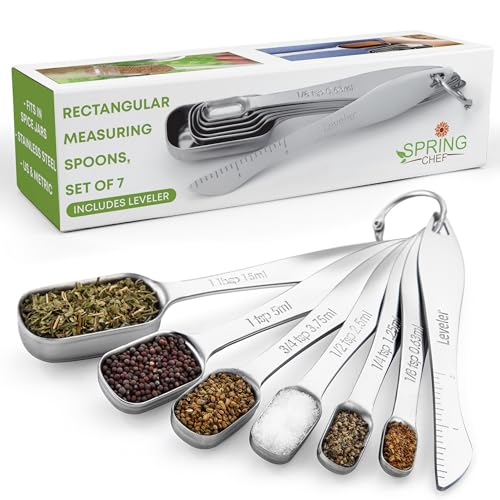
The rectangular bowl is this set’s whole argument, and it is a good one. Standard round spoons collide with the mouths of most spice jars, forcing cooks to tip spices into a palm or onto paper, losing some to the counter and contaminating the rest. Spring Chef’s seven nesting spoons use elongated rectangular bowls on long handles that slide into those jars directly, scoop level against the jar’s own rim, and come out clean. Anyone who bakes with a serious spice collection will recognise the problem this solves in the first week of ownership.
The nesting design stacks the set into a compact bundle rather than splaying it across a drawer, and a leveler is included for the same accuracy reason as its magnetic sibling. Long handles also keep fingers out of deep containers like tall cocoa tins and flour canisters, a small ergonomic point that matters when the ingredient is expensive saffron or a staining powder you would rather not wear.
Rectangular bowls do behave slightly differently with liquids, sitting less naturally than a round bowl under a pouring stream, so a cook who measures mostly oils and extracts may lean toward a dual-ended set. For dry-goods bakers, though, the trade runs entirely the other way, and this set is the specialist’s choice among the six.
- Pieces: seven spoons plus leveler
- Bowl shape: rectangular, elongated
- Handles: long, for deep containers
- Storage: nesting stack
- Material: stainless steel
Strengths
- Rectangular bowls enter spice jars that defeat round spoons
- Long handles reach deep tins without dipping fingers in the contents
- Leveler included for consistent dry measures
Trade-offs
- Rectangular bowls are less graceful for liquids
- Seven pieces skip some fractional sizes
- Nesting stack must be kept in order to stay compact
Best for: bakers working from a large, jarred spice collection. Not suited for: cooks who measure mainly liquids and oils.
The rectangular profile has a second talent nobody advertises: it levels itself. Draw the filled bowl back across the rim of the spice jar and the straight edge of the container shears the heap cleanly, giving a level measure without transferring anything to a knife or a leveler at all. That single motion, repeated across a six-spice curry blend, is the difference between measuring that feels like a chore and measuring that feels like a craft. It also keeps expensive spices inside their jars instead of dusted across a worktop, which anyone who has bought saffron or real vanilla powder by the gram will appreciate in cash terms as much as tidiness.
U-Taste 18/8 Stainless Measuring Spoons Set of 9 — Best Size Range
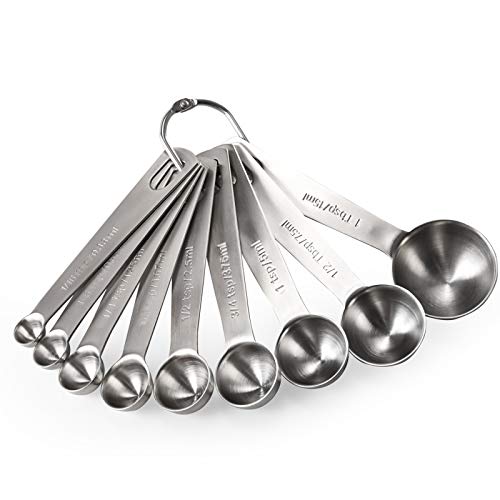
U-Taste names its steel, and that specificity sets the tone for the set: 18/8 stainless, the grade built around eighteen percent chromium and eight percent nickel, chosen for corrosion resistance in a tool that meets salt, acids and dishwasher detergent daily. Nine spoons cover 1/16, 1/8, 1/4, 1/3, 1/2 and 3/4 teaspoon plus 1/2 and 1 tablespoon measures, a range that quietly serves the recipes other sets fumble — the third of a teaspoon in a spice blend, the sixteenth in a concentrated extract dilution, the three-quarter measure in a scaled-down sauce.
Fractional sizes are where cheap sets cheat, repeating the standard five and calling it complete. Owning the in-between sizes changes behaviour at the counter: instead of estimating half of a half-teaspoon by eye, you reach for the correct spoon, and recipes that were written assuming a full set suddenly reproduce properly. For anyone who scales recipes up and down, those extra spoons pay for themselves in rescued batches.
Nine pieces do ask more of storage than five, and the set rewards being kept on its ring or in a dedicated slot rather than loose. The steel’s stated grade also makes this the easiest set here to recommend to a coastal or hard-water household, where lesser steels spot and pit; corrosion resistance is not glamour, but on a tool measured in decades it is the whole game.
- Pieces: nine spoons
- Steel grade: 18/8 stainless, named on listing
- Sizes: 1/16 tsp through 1 tbsp, including 1/3 and 3/4 tsp
- Suited measures: dry and liquid ingredients
- Audience: recipe scalers and precision bakers
Strengths
- Widest size range here, including rare fractional spoons
- Named 18/8 grade gives confidence on rust resistance
- Ends estimation for scaled and blended recipes
Trade-offs
- Nine pieces need deliberate storage to stay together
- Smallest sizes are easy to misplace in a busy drawer
- No leveler bundled for the dry-goods routine
Best for: precision bakers and anyone who scales recipes often. Not suited for: minimalists who only ever use three sizes.
Consider the smallest spoon in the box, the sixteenth of a teaspoon, which looks like a novelty until a recipe for a two-person spice rub or a small-batch pickle brine asks for a pinch rendered precisely. Pinches vary by hand; the little spoon does not. The third-of-a-teaspoon earns its place just as concretely in coffee and cocktail work, where ratios are the recipe, and in children’s baking, where halving a small recipe turns every standard size into an awkward estimate. A set that covers these corners changes measuring from approximation into compliance, and cooks who bake for restricted diets, where salt and leavening tolerances are tight, feel that difference more than anyone.

Hudson Essentials Stainless Measuring Spoons — Best Slim Everyday Set
Hudson Essentials built this seven-piece set around a single observation printed right in its title: measuring spoons should fit in spice jars. The slim bowls do exactly that, and the rest of the design stays deliberately unshowy — stainless steel, dry and liquid use, a set sized for daily cooking rather than for display. In a guide full of clever mechanisms, there is room for the set that simply gets the fundamentals right and then gets out of the way.
Everyday sets live or die on whether they survive everyday handling, and steel is doing the work here: no flex when a spoon is pressed into a firm jar of mustard powder, no lingering flavour when the same spoon moves from chilli flakes to sugar, no anxiety about the dishwasher. Seven pieces cover the working range of a normal kitchen without the fractional extras that occasional cooks would never touch.
Choose this set if your measuring is frequent but not fussy, and if the spice-jar problem is your main irritation with the spoons you own now. It lacks the magnetic storage theatre and the nine-size completeness of its neighbours, yet for a first proper steel set, or a replacement for a bent plastic ring, its balance of shape, material and count is hard to argue with.
- Pieces: seven spoons
- Material: stainless steel
- Bowl profile: slim, spice-jar friendly
- Use: dry and liquid ingredients
- Positioning: everyday cooking set
Strengths
- Slim bowls solve the commonest daily annoyance
- Straightforward steel construction with no gimmicks
- Seven sizes cover ordinary cooking completely
Trade-offs
- No leveler or magnetic storage included
- Fractional sizes beyond the basics are absent
- Plain finish offers little visual distinction
Best for: everyday cooks replacing a worn plastic set. Not suited for: precision bakers needing fractional spoons.
There is a rental-kitchen argument for this set that students and first-flat cooks should hear. A slim steel set survives being packed and unpacked yearly, lends itself to any cuisine a new cook explores, and asks for no accessories, batteries or companion pieces to remain useful. It is also the set on this list most likely to be bought twice by the same person, once for home and once for a workplace kitchen or a holiday let where the provided spoons are a bent plastic ring. Not every purchase needs to be a flagship; some tools earn their recommendation by being the obvious, durable default, and Hudson’s set occupies that ground comfortably.

Le Creuset Stainless Steel Measuring Spoons Set of 5 — Best Premium Finish
Le Creuset sells five spoons where others sell nine, and the confidence is the point. This is the core set — the sizes a kitchen reaches for daily — executed in stainless steel to the finish standard of a brand built on heirloom cookware. The bowls are smoothly formed, the handles balanced, and the whole set has the dense, finished feel that distinguishes tools made to be kept from tools made to be replaced. For a wedding registry or a deliberate kitchen upgrade, that feel is the product.
Five pieces is a real limitation and this guide will not pretend otherwise: no fractional spoons, no leveler, no storage innovation. What the buyer gets instead is material quality and finishing at the top of this list, in a category where the difference shows up in the hand every single day. A cook who already owns odd sizes, or who measures the exotic fractions rarely enough to estimate them, loses nothing and gains the set they will enjoy using most.
There is also a coherence argument. Kitchens accumulate visual noise, and a single well-made set on a ring, matching the standard of the cookware around it, is a small daily pleasure that purely functional buying ignores. If that sentence resonates with you, this is your pick; if it does not, the U-Taste set above offers more measurement per purchase, and both answers are respectable.
- Pieces: five core sizes
- Material: stainless steel, premium finish
- Brand position: heirloom cookware maker
- Storage: ring set
- Audience: quality-first and gift buyers
Strengths
- Finest finish and in-hand feel on this list
- Core five sizes cover the great majority of recipes
- Brand known for products kept for decades
Trade-offs
- Only five pieces, no fractional sizes
- No leveler or storage system bundled
- Premium positioning for a simple tool
Best for: gift buyers and cooks who prize finish over range. Not suited for: bakers who need the fractional sizes weekly.
Ownership of a premium small tool follows a pattern worth naming: it gets hand-washed more often, dried properly, and put back on its ring, not because the steel demands ceremony but because people look after objects that feel valuable. That care loop is a genuine performance advantage over a decade, since the best-kept set is the one whose markings stay crisp and whose bowls stay true. Le Creuset’s spoons also sit comfortably beside the brand’s enamelled cookware on a worktop, which matters in open-plan kitchens where utensils are part of the room. Buy them as the last set rather than the first, and they behave like one.

Heavy Duty Stainless Measuring Spoons 6-Piece — Best Heavy Gauge
Some cooks are gentle with tools and some cooks pry. This six-piece set is built for the second group: heavy-duty stainless steel with enough substance in the handle and bowl to survive being used as a scoop, a scraper of last resort and a lever against a solid jar of coconut oil. Thin spoons bend at exactly those moments, and a bent spoon is worse than a missing one because it keeps measuring, wrongly, with confidence.
The markings carry both US and metric measurements, a practical bilingualism for anyone cooking from international recipes, where a recipe’s five millilitres and a set’s teaspoon are close cousins rather than twins. Six pieces cover the standard range, and the set’s plain, thick construction shrugs off the dishwasher, the utensil crock and the bottom of a crowded drawer alike.
Weight is the honest cost: these are not the spoons you pack for a camping kitchen, and cooks with limited grip strength may find the heft tiring across a long baking session. For a home kitchen that has already destroyed one set of spoons by enthusiasm, though, heavy gauge steel is not over-engineering. It is simply the material thickness the job was always asking for.
- Pieces: six spoons
- Construction: heavy-duty stainless steel
- Markings: US and metric measurements
- Use: dry and liquid ingredients
- Positioning: durability-first set
Strengths
- Thick gauge resists bending under real kitchen force
- Dual US and metric markings suit international recipes
- Plain construction tolerates rough storage and washing
Trade-offs
- Heavier in the hand across long sessions
- Six pieces omit fractional extras
- Utilitarian finish rather than a premium look
Best for: heavy-handed cooks tired of bending thin spoons. Not suited for: ultralight or travel kitchen kits.
Preserving and canning seasons expose spoon quality brutally, because a day of jam and pickle production means hundreds of measures taken with wet, acidic ingredients, often with a spoon doubling as the tool that skims, stirs and scrapes the pan’s edge. Thin sets fatigue visibly by the second weekend of that work; heavy-gauge steel treats it as an ordinary fortnight. The dual markings help here too, since preserving recipes cross the Atlantic in both directions and a set that reads in millilitres as confidently as in teaspoons removes a conversion step at the exact moment the cook’s hands are busiest. Durability, in this set, is not machismo. It is throughput.
How Do the Six Sets Compare at a Glance?
| Pick | At a glance |
|---|---|
| Spring Chef Magnetic Measuring Spoons Set of 8 | Eight dual-sided magnetic spoons, leveler, fridge-friendly stack |
| Spring Chef Nesting Measuring Spoons Set of 7 | Seven rectangular-bowl spoons, long handles, spice-jar focus |
| U-Taste 18/8 Stainless Measuring Spoons Set of 9 | Nine spoons, named 18/8 steel, fractional sizes included |
| Hudson Essentials Stainless Measuring Spoons | Seven slim steel spoons for everyday dry and liquid use |
| Le Creuset Stainless Steel Measuring Spoons Set of 5 | Five core spoons, premium finish, heirloom brand |
| Heavy Duty Stainless Measuring Spoons 6-Piece | Six thick-gauge spoons, US and metric markings |
How Should You Measure With Steel Spoons to Get Bakery Accuracy?
Material only sets the ceiling; technique decides whether you reach it. For dry ingredients, spoon the ingredient into the bowl loosely rather than scooping directly from the bag, because a scooping motion packs the contents and inflates the measure. Then level with a straight edge — a leveler, a knife back, the rim of the spice jar — in one confident pass. For sticky ingredients like honey, a whisper of oil in the bowl first lets the full measure leave the spoon instead of half of it staying behind as a coating.
Liquids want the opposite patience: fill to the brim at eye level, because a spoon read from above hides a meniscus error that matters at teaspoon scale. Brown sugar is the sanctioned exception to loose filling, packed firmly when a recipe says packed and levelled loosely when it does not. Salt deserves special care, since the difference between a level and heaped teaspoon of fine salt can season a dish past saving, and steel’s clean release makes that level measure repeatable in a way sticky plastic never manages.
Finally, measure over a small plate or the mixing bowl, not over the flour bin, so overflow returns to the dish rather than contaminating a whole container with a second ingredient. Accuracy is a chain of small habits, and a rigid, neutral, clearly marked steel spoon is simply the link that stops breaking.
One more habit separates careful bakers from hopeful ones: dry the spoons before measuring anything that clumps. A wet bowl grabs flour and sugar unevenly, so the first spoonful of a session should follow a quick towel pass, and a spoon used for an extract should be dried before it returns for a dry spice. Steel tolerates this wet-dry alternation indefinitely, which is part of why it suits the rhythm of a real recipe, where a single spoon may measure oil, then vanilla, then salt inside two minutes. Plastic holds water in scratches, wood holds it in the grain, and both quietly tax every measure they touch.
Temperature deserves a sentence as well. A spoon left resting in a hot pan handle’s reach can carry enough heat to melt butter on contact and change how a fat measure behaves, so park measuring spoons on a cool plate between uses during long sessions. It is a small discipline, and like the others it asks nothing of the cook that the material does not repay.
How Do You Keep Stainless Spoons Measuring True for Years?
Steel asks little: wash it, dry it if your water is hard, and do not use the spoons as pry bars against jar lids unless you bought the heavy-gauge set with that abuse in mind. Hard water leaves mineral spots that look like damage but wipe away with a vinegar-dampened cloth; true rust on a named 18/8 or 18/10 set is rare enough to be a warranty conversation rather than a maintenance task. Avoid leaving spoons soaking for days in tomato-based sauces, not because a night harms them, but because indefinite acidic soaking is the one environment that tests any steel’s patience.
Check your set once a year with the simplest calibration there is: water. A tablespoon holds three teaspoons, so fill and transfer; if your tablespoon takes visibly more or less than three level teaspoons from the same set, one of them has bent or was born wrong, and it should be retired before it seasons a year of recipes incorrectly. That thirty-second test, done annually, is the entire quality-assurance programme a home set requires.
How Do You Test a Set in the First Week Before the Return Window Closes?
Begin with water and arithmetic. Three level teaspoons should fill your tablespoon exactly, and four tablespoons should match a quarter cup from a trusted measure; a set that fails its own internal arithmetic goes back regardless of how handsome it looks. Next, take the set to your actual spice jars, all of them, including the tall narrow ones at the back, because a set that fits nine jars and fails the tenth will fail it weekly for years.
Then bake something unforgiving: a plain sponge or a batch of biscuits where leavening and salt have nowhere to hide. If the result matches the recipe’s promise, your technique and tools are aligned; if it does not, the spoons are the first suspect to eliminate, and the water test will already have told you whether suspicion is fair. Finish the week by running the set through your real dishwasher cycle rather than a gentle rinse, since markings that cannot survive your own machine have no future in your kitchen.
That week of testing costs nothing and converts a guess into knowledge while returns are still simple. It is the same discipline this guide applied in miniature when shortlisting: believe the material claims that survive contact with water, jars, heat and detergent, and treat the rest as packaging.
What Mistakes Do People Make When Buying Measuring Spoons?
The classic error is buying by piece count alone, collecting twelve spoons that repeat the same five sizes in two finishes while omitting the fractional measures that make a set genuinely complete. The second is ignoring the spice jars in your own kitchen: a beautiful round-bowled set that cannot enter them will be cursed weekly. Third comes printed markings, chosen in the shop because they look crisp, illegible within a year of dishwashing.
Material mistakes round out the list: silicone bought for its colours that perfumes desserts with last week’s spices, bamboo bought for its looks that swells and splits, and bargain steel so thin it flexes under brown sugar. Every one of those sets costs less than a good steel set and gets replaced sooner, which is the most expensive way to buy anything. The spoons in this guide cost a little thought once and then disappear into reliable service, which is what a measuring tool is for.
What Happens to Each Material After Five Years of Daily Use?
Run the clock forward on a plastic set first. The bowls carry a permanent haze from dishwasher heat, the printed sizes have faded to ghosts that must be guessed by bowl size, one handle has a hairline crack at the neck, and the whole ring smells faintly of the spices it has measured. It still functions after a fashion, but every measure involves a small act of interpretation, and interpretation is the enemy the purchase was meant to kill. Most plastic sets are replaced at this point, which means their low purchase price was really a subscription.
Silicone ages more gracefully in appearance and worse in flavour. The bowls stay flexible and colourful, yet they hold odours tenaciously and their softness, charming in a spatula, undermines the levelling stroke that dry measuring depends on. A silicone bowl also deforms under its own contents when lifted by a long handle, so the volume arriving at the mixing bowl is not quite the volume that left the jar. Five years in, a silicone set is a set for rough work, not for the baking it was bought to serve.
Wood and bamboo sets, five years on, tell their history in stains and splits. They cannot be soaked, they resent the dishwasher, and their volumes have drifted with every season of absorbing and releasing moisture. As decorative objects they gain character; as measuring instruments they have retired without announcing it. Aluminium sits in the middle of the table: probably still accurate, visibly dulled by dishwasher detergent, possibly dented at one bowl, and carrying a faint reactivity that keeps it away from long contact with vinegar or citrus measures.
Now run the same five years on a decent stainless set. The bowls are bright or softly brushed, the stamped sizes read as clearly as the day the set arrived, the ring or stack is intact, and nothing about the set flavours anything else. The only maintenance it has asked for is washing. That contrast, projected over the decades a kitchen actually operates, is the entire material argument in one picture, and it is why this guide’s shortlist contains no other material despite each rival’s genuine charms. Cheap tools are bought repeatedly; honest tools are bought once and then forgotten, which for a measuring spoon is the highest praise available.
Final Recommendation
For most kitchens, the U-Taste 18/8 Stainless Measuring Spoons Set of 9 is the set to buy first, because named 18/8 steel and nine sizes answer both halves of the material question at once. If storage is your binding constraint, choose the Spring Chef Magnetic Measuring Spoons Set of 8 and let the fridge hold your set; if your spice jars defeat every spoon you own, the Spring Chef Nesting Measuring Spoons Set of 7 was designed around that exact frustration. Whichever you pick, you are buying the same underlying verdict: rigid, neutral, clearly marked stainless steel, in the shape your cooking actually needs.
A teaspoon is a tiny promise a recipe makes to you, and steel is the material that keeps it.
What Do Steel Grades, Finishes and Marking Methods Actually Mean?
The numbers in a steel grade describe its recipe. In 18/8 and 18/10 stainless, the first figure is the chromium share that forms the invisible oxide layer resisting rust, and the second is the nickel share that adds corrosion margin and a warmer lustre. Below those grades sits a crowd of unnamed steels that may perform adequately for years or may spot within a winter of dishwasher use, and the listing’s silence on grade is itself information: makers who pay for good steel say so. For a tool that costs little and serves for decades, insisting on a named grade is the cheapest insurance in the kitchen.
Finishes divide into bare polished steel, brushed steel and coated steel. Polished bare metal shows every fingerprint but also shows its condition honestly and can be restored with a soft cloth and patience. Brushed finishes hide daily wear gracefully, which is why they dominate workhorse sets. Coatings, including the black finish on the magnetic set above, add grip and identity at the cost of a surface that can eventually wear at edges; they suit owners who value the look and accept that trade knowingly.
Markings complete the material story. Deep stamping displaces metal and survives abrasion indefinitely, though very fine fractional marks can be hard to read in poor light. Laser etching is crisp and permanent on quality steel. Printed or painted marks sit on the surface and are the first casualty of dishwashing, which is why a printed set should be priced as a temporary tool. When a listing shows close photographs of its markings, zoom in: the depth you can see is the lifespan you are buying.
Which Spoon Shapes Suit Which Kind of Cooking?
Round bowls remain the default because they pour liquids cleanly and release sticky ingredients with a single flick, and for a cook whose measuring is mostly oils, extracts and syrups, round is correct. The shape’s weakness appears only at the spice jar, where the rim of the container is narrower than the bowl trying to enter it. Kitchens built around dried spices, rubs and baking blends feel that weakness daily, which is why two sets on this list abandon the circle in different ways, one going rectangular, the other adding a narrow second end to every spoon.
Long handles serve a different geography: deep canisters, tall storage jars and the bottom third of a flour bin, where short spoons force fingers into the ingredient. They also keep hands clear of steam when a measure is added to a simmering pot, a small safety dividend nobody lists on packaging. Short handles, conversely, store more easily and feel nimbler for work at a crowded hob. None of these shapes is a gimmick; each maps to a real pattern of cooking, and the honest way to choose is to picture your ten most common measuring acts and ask which geometry serves the majority.
Weight distribution is the quiet final factor. A spoon balanced near its middle flips less when rested on a jar rim mid-recipe, and a set that feels calm in the hand gets used with more care than one that clatters. You cannot judge balance from a listing photograph, but handle length, stated gauge and brand track record are the available proxies, and they are the ones this guide leaned on.
How Does a Good Set Change the Way You Cook From Recipes?
The first change is trust. A cook who believes the spoons stops adding insurance pinches and corrective shakes, and dishes begin to taste like their recipes rather than like their author’s anxiety. Seasoning becomes reproducible, which is the precondition for improving anything: you cannot adjust a blend you cannot repeat. Home bakers notice it in leavened goods first, where a true teaspoon of baking powder produces the rise the recipe photographed, and the failure mode of blaming the oven quietly disappears.
The second change is speed. A complete, organised set means the right size is in hand in seconds, mid-recipe, with wet hands, without a drawer excavation. Cooking from unfamiliar recipes stops feeling like an obstacle course, and cooks attempt more of them, which is how a kitchen’s repertoire actually grows. The third change is subtler: children and new cooks learn measuring as a precise, satisfying act when the tools are rigid and clearly marked, and that early accuracy becomes a lifelong habit rather than a correction they must make as adults.
None of this requires the most expensive set on the list. It requires a set whose material does not flex, stain, fade or swell, whose sizes cover your cooking, and whose storage keeps it whole. That is a modest specification, and it is remarkable how much of the market fails at least one clause of it.
Should You Choose Ring Storage, Magnetic Stacking or Nesting?
A traditional ring keeps a set together with zero technology and one flaw: the spoons splay, tangle and must be unthreaded to free a middle size. Kitchens that hang the ring on a hook forgive all of that, because the set is visible, complete at a glance, and off the worktop. If your spoons live in a drawer, a ring is the least elegant option here, though it remains the easiest to clean as a unit and the hardest to lose pieces from.
Magnetic stacking answers the drawer problem by collapsing the set into a single flat object that behaves like one utensil until you peel a size away. It also relocates storage entirely for households with a steel fridge or range hood within reach of the prep area. The cautions are minor but real: magnets and very hot surfaces are poor neighbours, and a stack dropped on tile makes a noise out of proportion to its size.
Nesting designs, ringless and magnet-free, stack the bowls inside one another and rely on shape to stay together, which suits cooks who want the set inside a canister or a narrow drawer divider. Whichever system you choose, choose one: the evidence of every kitchen drawer is that unorganised sets shed their smallest members within a year, and a set missing its quarter-teaspoon is a set that has quietly stopped being a set at all.
Frequently Asked Questions
Is 18/10 steel noticeably better than 18/8 for spoons?
The extra nickel in 18/10 adds lustre and a margin of corrosion resistance, but for a small tool that is washed and dried regularly, 18/8 performs essentially identically in service. Either named grade is a far better sign than unnamed steel, where the chromium content that prevents rust is anyone’s guess.
Can stainless measuring spoons go in the dishwasher?
Yes, and the sets here are built for it. The practical cautions are ordinary: avoid prolonged soaking in salty or acidic residues before a wash, and expect hard-water spots that wipe off rather than damage that does not. Dishwasher safety is one of steel’s decisive advantages over wood and printed plastic.
Why do my current spoons measure inconsistently?
Usually because a thin bowl has bent slightly, a printed size has been misread, or the scooping technique packs dry ingredients. Test the set with the water method described above; a bent spoon reveals itself immediately, and replacing it restores the whole set’s credibility.
Are magnetic spoons safe to store on the fridge?
For the spoons themselves, entirely; the magnets are in the handles and affect nothing about measuring. Keep the stack away from anywhere it could slide into a hot hob area, and remember that a magnetic set stored on a painted fridge door should be lifted off rather than dragged, to protect the paint.
Are heavier spoons always better than lighter ones?
Up to the point where the steel stops flexing, yes; beyond it, weight is preference rather than performance. A spoon must resist the force of packing and levelling without bending, and once a set clears that bar, extra heft helps cooks who pry and hinders cooks with tired hands. Judge by whether the set you are replacing bent in service: if it did, move up a gauge; if it did not, standard steel will serve you just as faithfully.
Can I use the same spoons for coffee and baking?
You can, and many households do, but coffee oils are persistent flavour carriers, so a spoon that lives in the coffee tin will eventually season a custard. A spare tablespoon dedicated to coffee is the tidy solution, and it is another quiet argument for sets with duplicate-friendly pricing rather than heirloom pricing at every position in the drawer.
Do I really need fractional sizes like a third of a teaspoon?
Only your recipes can answer that, but spice blends, scaled-down sauces and older cookbooks use them often enough that owning them ends a category of estimation. If your cooking never leaves the standard five measures, a five-piece set serves you honestly; if you scale recipes monthly, the fractional spoons earn their drawer space quickly.
Related Guides
From the drawer to the worktop, our related guides continue the same evidence-first approach: Best Industrial Electric Meat Grinders for the heaviest job in the kitchen, Best Alternatives to Microwaves for reheating without one, and Best Electric Pressure Cookers for weeknight speed.


