What's inside
- Key Takeaways
- Quick Picks
- How Did We Choose These Lightweight Bagged Uprights?
- How Do the Five Machines Compare in Hand and on Paper?
- Why Did Homes Drift to Bagless, and Why Are They Drifting Back?
- How Should You Stock, Change and Judge Bags?
- What Mistakes Do Buyers of Lightweight Bagged Uprights Make?
- Which Homes Gain Most from Going Light and Bagged?
- How Do These Machines Behave on Stairs, Landings and Upper Floors?
- What Does a Year of Owning a Commercial Upright Feel Like?
- How Should You Decide between the Two Orecks and the Two Sanitaires?
- What Attachments and Companions Complete a Bagged Upright?
- How Do Bagged Uprights Treat Hard Floors and Transitions?
- Can a Lightweight Bagged Upright Be a Home’s Only Vacuum?
- What Should You Check in the First Week with a New Machine?
- Final Recommendation
- Frequently Asked Questions
- Related Guides
As an Amazon Associate I earn from qualifying purchases. This post may contain affiliate links at no extra cost to you.
cottageverdict.com is reader-supported. When you buy through links on our site, we may earn an affiliate commission.
Where to buy: the five linked uprights below are sold on Amazon; follow any name to its listing to check price on Amazon and confirm the bag type it uses before you stock a cupboard with spares.
The best lightweight bagged upright vacuums solve two problems that are usually sold separately. The first is weight: a full-size machine you can carry up stairs one-handed, push for half an hour without shoulder fatigue, and lift into a car boot without choreography. The second is the bag itself — the unfashionable, quietly superior way to store debris, in which everything the machine collects is sealed inside a disposable liner that leaves the vacuum in one clean motion, taking its dust, its hair and its smell with it. Put the two together and you get the format that hotels, offices and cleaning services never actually abandoned, now sized for homes that value their arms.
It surprises people that the bagged upright is where lightweight design lives, because the bagless era taught shoppers to associate bags with their grandparents’ heavy canisters. The physics runs the other way, and a prose-only section later in this guide explains it fully: a bagged machine needs no cyclone assembly, no heavy separator stack, no rigid dust cup with its latches and seals. A motor, a fan, a brush and a paper-or-fabric bag make a short, light bill of materials. The five machines below are the proof, from two Oreck siblings and two Sanitaire Traditions to Bissell’s commercial PowerForce — every one of them a working tool that happens to be easy to carry.
Commercial heritage runs through this whole list, and that is a recommendation rather than a warning. Machines designed for people who clean for a living are designed for the realities domestic marketing avoids: daily use, quick servicing, bags and belts available everywhere, and no feature that cannot survive a corridor collision. A homeowner who buys from this shelf gets a vacuum with the decoration stripped away and the durability left in — and, not incidentally, gets it at the working tier of pricing rather than the flagship tier.
Set one expectation honestly before the picks. Bagged ownership has a running cost, paid in bags, and this guide discusses it in words rather than figures: modest, predictable, and the entire price of sealed, dust-free emptying. Owners who cannot abide any consumable should look at bagless formats instead. Owners who have emptied a bagless cup in a gust of wind, at face height, in their good clothes, already understand what the bag fee buys — and it is those owners this guide was written for.
Key Takeaways
- Bagged uprights are light by construction: no cyclone stack or rigid cup means the motor, brush and bag carry almost no dead weight.
- All five picks share commercial DNA, which brings serviceable parts, available bags and belts, and designs proven over daily professional use.
- Sealed bag emptying is the format’s signature comfort — debris leaves in one motion, without the dust cloud of a bagless cup.
- Oreck’s two entries are the weight specialists; Sanitaire’s pair are the fleet workhorses; Bissell’s BigGreen is the commercial value play.
- Bags are a real running cost, modest and predictable, and they are also a filter: a fresh bag restores airflow like a service visit.
- Light weight changes behaviour — a machine anyone can carry gets used on stairs, upper floors and quick jobs that heavy machines miss.
Quick Picks
| Pick | Badge | Why it made the list |
|---|---|---|
| Oreck Commercial XL Upright Vacuum | Lightest-feeling full-size | The benchmark for carrying a real upright one-handed, with a high-speed brush and automatic height adjustment. |
| Oreck Commercial Upright LEED | Efficiency-minded commercial pick | A LEED-compliant sibling with Microsweep behaviour for buildings counting energy and cleanliness together. |
| Sanitaire Tradition SC679K Upright | Simple fleet favourite | The Tradition formula in its most straightforward form — bagged, durable and endlessly serviceable. |
| Sanitaire Tradition SC684G Upright | Heavy-duty sibling | The Tradition line’s harder-working configuration for larger, demanding floor plans. |
| Bissell BigGreen Commercial PowerForce Bagged Upright | Commercial value tier | Bissell’s BigGreen line brings bagged commercial cleaning to a notably accessible tier. |
| The Bagged Weight Advantage, Explained | Prose-only explainer entry | Why removing the cyclone makes uprights lighter, and what bags really cost in words. |
How Did We Choose These Lightweight Bagged Uprights?
Weight was the first screen, judged the way owners experience it rather than the way scales report it. A vacuum’s burden lives in three moments — carrying it between floors, pushing it through a long session, and lifting it into storage — and a machine can be light in one and treacherous in another. The picks below are honest in all three: balanced enough to carry by their handles without swinging into doorframes, light enough at the head to push across a big room repeatedly, and compact enough to stow without a dedicated closet negotiation.
The second screen was the bag system itself. We favoured machines whose bags are widely available, generously sized and simple to change without tools or dust, because a bagged machine whose bags are obscure has failed at its own concept. Filtration through the bag matters too: modern vacuum bags are filter media in their own right, and the better systems use that fact, keeping fine dust inside the bag rather than passing it to a secondary filter that clogs in protest.
Third came serviceability, the commercial world’s gift to domestic owners. Belts that a user can change, brush rolls that can be freed and eventually replaced, cords long enough for working spaces, and designs that a local repair shop will greet with recognition rather than curiosity. A lightweight machine that cannot be serviced becomes landfill on its first snapped belt; every pick here is built to be kept.
Finally, we required the list to span the format’s personalities rather than repeat one. The two Orecks argue for ultimate lightness and efficiency, the two Sanitaires for fleet-proven endurance at two intensities, and the Bissell for commercial bagged value. The prose entry then explains the shared physics underneath all five, so that readers can judge any future bagged lightweight — from any maker — with the same instruments.

Oreck Commercial XL Upright Vacuum — Lightest-feeling full-size
The Oreck Commercial XL is the machine that taught the hotel industry a vacuum could be carried like a briefcase. Its listing describes a bagged upright, lightweight, for carpets and hard floors, with automatic height adjustment and a high-speed brush roll — a specification that reads plainly until you lift one, at which point the design’s intent becomes physical. This is a full-size cleaning head on a body that asks almost nothing of the arm, and the combination rewires what its owner attempts: stairs without dread, upper floors without planning, the quick pass before guests without a sigh.
The cleaning method matches the weight philosophy. Rather than leaning on a massive motor, the Oreck spins its brush roll fast and keeps its air path short, sweeping debris into the bag with an efficiency that has sustained its commercial career for decades. Automatic height adjustment means the head meets carpet and hard floor at their own levels without the user stooping to a dial between rooms — a small mercy repeated forty times a session. On the hard floors of lobbies and kitchens it behaves with a tidiness that heavier machines, for all their theatre, do not automatically match.
Its trade-offs are the format’s and the philosophy’s. The bag is a consumable, as this guide keeps confessing. Above-floor work is not its theatre — there is no lift-away theatre here, no hose ballet — and owners who clean upholstery weekly will pair it with a handheld. Deep plush pile asks more sustained agitation than its light head naturally presses into the fibres. But as the definitive answer to the question this guide asks — how light can a real bagged upright be while still cleaning like a professional tool — the XL remains the name the others are measured against.
- Format: bagged upright, commercial lightweight design
- Brush: high-speed brush roll per the listing
- Height: automatic adjustment across surfaces
- Surfaces: carpets and hard floors per the listing
- Positioning: the weight benchmark of this guide
Strengths
- One-handed carrying transforms stairs and upper floors.
- Fast brush and short air path clean beyond its weight class.
- Automatic height adjustment removes a per-room chore.
Trade-offs
- Bags are an ongoing, if modest, ownership cost.
- Above-floor cleaning needs a companion handheld.
- Very deep pile wants a heavier head’s pressure.
Best for: multi-floor homes and anyone whose shoulders choose the vacuum. Not suited for: owners wanting one machine for upholstery and drapery too.

Oreck Commercial Upright LEED — Efficiency-minded commercial pick
The second Oreck in this guide exists for buildings that count. Its listing describes a LEED-compliant bagged upright for carpets and hard floors, lightweight, with a Microsweep feature — a specification aimed at facilities pursuing green-building credentials, where cleaning equipment is audited for energy behaviour and indoor-air manners alongside its pickup. For a homeowner, that pedigree translates into a machine designed to clean thoroughly while drawing modestly and containing its debris in a sealed bag rather than exhausting it back into the room it just cleaned.
Microsweep, the listing’s named feature, describes the machine’s behaviour at the edges of its work — the pass along skirting and transitions where debris collects and where a vacuum’s manners show. In commercial corridors, that edge behaviour is the difference between a floor that looks cleaned and a floor that is cleaned, and it transfers directly to domestic hallways and kitchen perimeters. The rest of the Oreck formula carries over: light body, bagged containment, commercial serviceability, and a design that assumes daily professional handling rather than occasional domestic ceremony.
Choosing between the two Orecks is a matter of context rather than quality. The XL is the generalist benchmark; the LEED model speaks to owners who value its efficiency credentials — perhaps for a home office pursuing its own standards, a rental property with green commitments, or simply a household that likes its appliances audited. Its compromises mirror its sibling’s: bags to buy, above-floor work to delegate, deep pile to approach with patience. Within the bagged lightweight world, it is the conscientious choice, and for the buildings it was designed for, that is not a niche virtue but the entire brief.
- Format: bagged upright, LEED-compliant per the listing
- Feature: Microsweep edge behaviour
- Surfaces: carpets and hard floors per the listing
- Build: lightweight commercial construction
- Positioning: the efficiency-audited sibling
Strengths
- Efficiency credentials suit energy-conscious buildings and homes.
- Microsweep attention shows at edges and skirting lines.
- Bagged containment supports indoor-air quality goals.
Trade-offs
- Its specialisation is wasted on buyers who ignore credentials.
- Bags remain a running cost, as with every pick here.
- Upholstery and above-floor jobs need a second tool.
Best for: efficiency-minded homes, offices and green-committed properties. Not suited for: shoppers who want maximum features per machine instead.
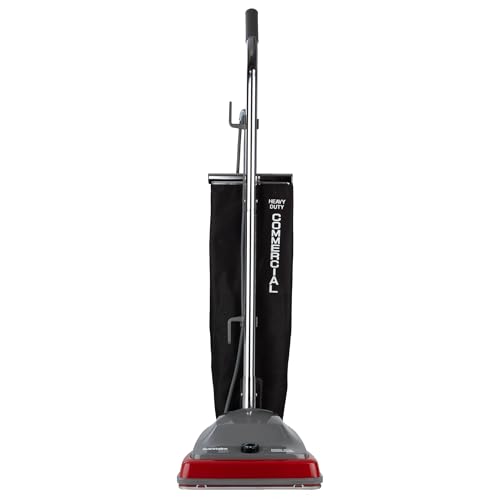
Sanitaire Tradition SC679K Upright — Simple fleet favourite
The Sanitaire Tradition SC679K is what a vacuum looks like after forty years of having its excuses removed. Its listing is almost austere — a Tradition upright, commercial, bagged, red — because the machine’s reputation does the talking in the world it serves. Cleaning companies buy these in fleets, issue them to staff who will not baby them, and expect them to work the next day and the next year. For a homeowner tired of appliances that feel like gadgets, that austerity is the most luxurious specification on this page.
The Tradition formula is a study in what cleaning actually requires: a durable motor, a brush roll that means it, a large bag that keeps airflow honest as it fills, and a body whose every wear part — belt, brush, bag, cord — can be serviced quickly by human hands. Nothing on the machine exists to be demonstrated. Everything on it exists to be used, cleaned out and used again, and its weight, while a touch more workmanlike than the Orecks’, remains entirely manageable for a full-size commercial upright, especially given how its balance carries.
Domestic adopters should know what they are joining. There are no headlights to admire, no swivel party tricks, no filtration claims beyond the bag system’s honest work. The machine will also out-clean its welcome in one respect: it is loud in the way of tools rather than appliances, and proud of it. But for a house with serious carpet, a garage it can live in, and an owner who values a decade of service over a season of features, the SC679K is the fleet’s wisdom made available one household at a time.
- Format: commercial bagged upright
- Design: Tradition line, built for fleet service
- Servicing: belts, bags and brush parts widely supported
- Debris: large-capacity bag system
- Positioning: durability first, decoration nowhere
Strengths
- Fleet-proven durability under daily professional handling.
- Every wear part is serviceable with ordinary skills.
- Large bags keep sessions long and airflow consistent.
Trade-offs
- Tool-like noise and styling make no domestic apologies.
- Slightly more heft than the Oreck pair in this guide.
- Feature list is deliberately, almost defiantly, short.
Best for: carpeted homes wanting a decade-scale workhorse. Not suited for: buyers who shop by features and finishes.
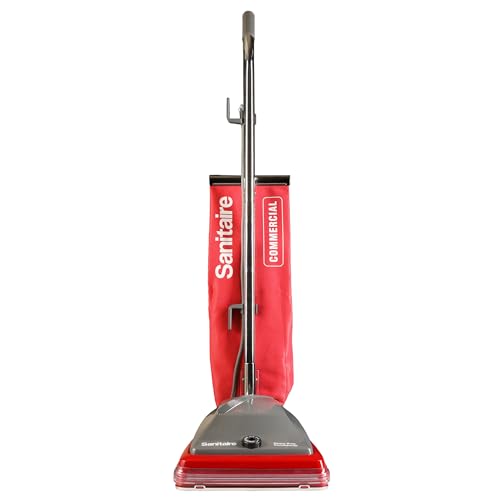
Sanitaire Tradition SC684G Upright — Heavy-duty sibling
Every durable family has a stronger sibling, and in the Tradition line the SC684G is it. Sharing the SC679K’s commercial bagged architecture — the same red livery, the same fleet logic, the same serviceable guts — this configuration is the one specified when the floors get larger, the traffic heavier and the cleaning less forgiving. Hotels with ballrooms, schools with corridors of carpet tile, churches with fellowship halls: the machine’s natural habitats describe a duty cycle beyond most houses, which is exactly why some houses should buy it.
The domestic case writes itself for the right floor plan. A large carpeted home, a home business with client-facing floors, a rental property turned over weekly, a household with several large dogs grinding grit into pile daily — these are domestic addresses with commercial problems, and they wear out domestic machines on a commercial schedule. The SC684G answers with the Tradition virtues at higher intensity: capacity, brush authority, and a build that treats daily full-house sessions as its ordinary Tuesday rather than its annual marathon.
It remains, for this guide’s purposes, a lightweight in spirit and manageability if not the lightest in hand — its weight is honest working weight, carried on a balanced frame, and owners stepping up from the SC679K will feel the difference as solidity rather than burden. The same confessions apply: bags to stock, noise to accept, above-floor work to delegate. Buy it when your floors genuinely file commercial complaints, and it will settle them for years without ever once asking to be admired.
- Format: commercial bagged upright, heavy-duty configuration
- Design: Tradition architecture, uprated duty
- Servicing: shared parts culture with the Tradition line
- Habitats: large carpeted spaces, heavy traffic
- Positioning: the strongest sibling, still manageable
Strengths
- Commercial duty cycle swallows large homes’ demands easily.
- Tradition serviceability keeps a decade of ownership simple.
- Capacity and brush authority suit grit-heavy, pet-heavy floors.
Trade-offs
- More machine than small flats can justify or store happily.
- Working noise is part of the commercial inheritance.
- Bags and belts are forever, by design and by budget line.
Best for: big carpeted homes and home businesses with heavy traffic. Not suited for: compact homes needing the lightest possible carry.

Bissell BigGreen Commercial PowerForce Bagged Upright — Commercial value tier
Bissell’s BigGreen line is the company’s commercial banner, and the PowerForce Bagged Upright carries it into this guide as the value argument: a lightweight, industrial-brief bagged machine from a maker whose domestic pet machines fill the other chapters of this batch. Its listing describes an upright built for commercial work in the BigGreen tradition — which means the design questions were asked by people who clean buildings: how fast does it cover a floor, how simply does it service, how honestly does it weigh?
For a homeowner, the attraction is the combination of that brief with Bissell’s ubiquity. Bags, belts and service knowledge for this machine live in the same ecosystem as the country’s most common household vacuums, so ownership never involves a pilgrimage for parts. The PowerForce name signals where its priorities sit — cleaning force applied through a straightforward bagged upright design — and its weight keeps it in this guide’s lightweight company, manageable on stairs and across long sessions in a way that purely industrial machines rarely attempt.
Its position in the five is the accessible door. Shoppers curious about the commercial bagged world but wary of the Sanitaires’ austerity or the Orecks’ specialisation will find the BigGreen the friendliest entry: familiar brand, working-tier positioning, no credentials required. The usual bagged confessions apply — consumable bags, tool-grade manners, above-floor work by other means — but as proof that the lightweight bagged format is a living, competitive category rather than a nostalgia act, the PowerForce makes the closing argument of this shortlist persuasively.
- Format: bagged upright, BigGreen commercial line
- Design: PowerForce cleaning brief, lightweight body
- Ecosystem: Bissell parts and service availability
- Duty: commercial and demanding domestic floors
- Positioning: the accessible commercial entry point
Strengths
- Commercial bagged design at a welcoming tier.
- Bissell’s network makes bags and service effortless to find.
- Lightweight handling suits homes as well as workplaces.
Trade-offs
- Less specialised than the Oreck and Sanitaire pairs.
- Bags are a permanent running cost, as throughout.
- Industrial styling prioritises work over appearance.
Best for: newcomers to commercial bagged machines who value easy parts. Not suited for: buyers wanting the ultimate lightweight or fleet pedigree.
The Bagged Weight Advantage, Explained — Prose-only explainer entry
Why are these machines light? Open a bagless upright in your mind and inventory its debris system: a rigid transparent cup, a cyclone separator with its cone stack, a shroud, seals at every joint, a latch engineered to hold against suction, and often a second chamber for fine dust. Every gram of that apparatus exists to spin dust out of air without a bag, and you carry all of it, forever, including when it is full of the debris it collected. Now open a bagged upright: a cavity, and in it, a bag. The separator is disposable, weighs almost nothing, and leaves the machine when full — taking its weight of dirt with it.
The bag is also the filter, which deletes another stack of components. As air passes through the bag’s walls, debris stays inside; a fresh bag therefore restores both capacity and airflow in one motion, which is why a bag change feels like a service. Modern bag materials hold fine dust far better than the paper of memory, and the sealed collar designs on better systems mean the change happens without the puff of dust that bagless cups emit at the bin. The honest cost, in words: bags are a modest, predictable, per-month consumable, varying with how much floor and fur your home feeds them — the price of never washing a filter or wearing your vacuum’s harvest.
We keep this entry prose-only because it is an explanation, not a product, and because it arms the reader for every future encounter with the format. When any maker claims a bagged machine is light, you now know the mechanism to verify: short parts list, disposable separator, filtration that leaves with the debris. And when a bagless machine claims lightness, you know which stack of plastic to ask about. Physics keeps no brand loyalties, which is what makes it such a reliable shopping companion.
- Mechanism: the disposable bag replaces the separator stack
- Filtration: the bag’s walls are the primary filter
- Emptying: sealed, single-motion, dust contained
- Cost: bags as a modest recurring consumable, in words
- Lesson: lightness here is architecture, not marketing
Strengths
- Explains every pick’s weight with one checkable mechanism.
- Fresh bags restore airflow and capacity simultaneously.
- Sealed emptying protects clothes, lungs and tempers.
Trade-offs
- The explanation cannot be bought; it must be understood.
- Bag costs recur for as long as the machine serves.
- Running out of bags mid-week is the format’s own failure mode.
Best for: readers who want to judge any bagged lightweight forever. Not suited for: shoppers who prefer their physics pre-chewed by brands.
How Do the Five Machines Compare in Hand and on Paper?
| Pick | Badge | Character | Bags | Natural habitat |
|---|---|---|---|---|
| Oreck Commercial XL Upright Vacuum | Lightest-feeling full-size | Featherweight all-rounder | Oreck system bags | Hotels, multi-floor homes |
| Oreck Commercial Upright LEED | Efficiency-minded commercial pick | Audited efficiency sibling | Oreck system bags | Green-credential buildings |
| Sanitaire Tradition SC679K Upright | Simple fleet favourite | Austere fleet standard | Sanitaire system bags | Cleaning-company fleets |
| Sanitaire Tradition SC684G Upright | Heavy-duty sibling | Uprated Tradition duty | Sanitaire system bags | Large, heavy-traffic floors |
| Bissell BigGreen Commercial PowerForce Bagged Upright | Commercial value tier | Accessible commercial entry | Bissell system bags | Homes crossing into commercial needs |
| The Bagged Weight Advantage, Explained | Prose-only explainer entry | The shared physics | All of them | Every future comparison |
Read the table as temperaments rather than rankings. The Orecks are the diplomats — light, efficient, welcome anywhere. The Sanitaires are the tradespeople — indifferent to admiration, devoted to Tuesday. The Bissell is the translator between those worlds and the ordinary home. All five share the bagged architecture the final row explains, and all five will still be serviceable when this season’s feature-led machines are being explained to a repair shop that no longer stocks their parts.
Why Did Homes Drift to Bagless, and Why Are They Drifting Back?
The bagless revolution sold a genuine grievance: bags cost money, ran out at the worst moments, and belonged — in the advertising’s telling — to a smellier century. Cyclonic machines arrived with transparent cups that displayed their harvest like trophies, and for a while the display was the delight. Experience then filed its slower report. Cups need emptying at face height. Filters need washing and a day of drying. Seals age, cyclones clog with felted dust, and the machine that was bought to escape consumables develops a maintenance liturgy of its own — one performed with wet hands over a sink.
The drift back is not nostalgia; it is accounting. A bag change takes seconds, seals its contents, and renews the machine’s breathing completely. For allergy-conscious owners, for pet homes whose cups fill with hair that mats into every seal, and for anyone who has worn a dust cloud in good clothes, the bag’s small recurring fee reads less like a tax and more like a subscription to cleanliness that includes the emptying. Commercial users, who ran the numbers earliest and at scale, mostly never left — which is why this guide’s shelf is a commercial shelf.
None of this convicts bagless design, which suits plenty of homes happily and fills most other chapters of this batch. It simply restores the bag to its correct status: not an obsolete embarrassment but a different, defensible answer to the question every vacuum must answer — where does the dirt live, and who has to meet it again at emptying time? The lightweight bagged upright is what happens when that answer is “inside a sealed bag, briefly, and then never again.”
How Should You Stock, Change and Judge Bags?
Bag discipline is the whole of bagged ownership, and it has three rules. First, stock ahead: keep a full pack in reserve, because the format’s one true failure mode is the Saturday the last bag fills and the cupboard is bare. Second, change on fullness rather than on the calendar — a bag’s capacity is consumed by volume, and a house with two shedding dogs lives on a different schedule from a quiet flat; the honest signal is suction softening and the bag’s own firmness when you check it during a session. Third, treat the change as the service it is: while the cavity is open, wipe its seal, glance at the belt’s world through whatever access the design offers, and note the brush’s hair harvest for its monthly freeing.
Judging bags themselves is simpler than the packaging suggests. Fit is non-negotiable — a bag that seals poorly at its collar leaks dust into the cavity and quietly converts your bagged machine into a bagless one with worse manners. Material matters next: modern multi-layer bags hold fine dust and maintain airflow longer than plain paper, and they are the ones that make the format’s filtration story true. Capacity finishes the list, since a larger bag is not merely fewer changes but steadier suction across each change’s life. Buy the maker’s specification or a reputable equivalent that names it, and the system will repay the fidelity.
What Mistakes Do Buyers of Lightweight Bagged Uprights Make?
The first mistake is importing bagless expectations: waiting for a visible fill line that bags do not provide, then running a suffocated machine for weeks and blaming its motor. Bags announce themselves through suction and firmness, and the owner who learns those signals in the first month will never suffocate a machine again. The second mistake is false economy in the bags themselves — ill-fitting substitutes that leak at the collar and dust the motor cavity, converting the format’s cleanest virtue into its dirtiest failure for the sake of a trivial saving.
Third comes neglecting the brush and belt because the bag system feels so maintenance-free. The debris path may renew itself, but the agitation path wears like any other: belts stretch, brushes load with hair, and a machine can breathe perfectly while barely sweeping. Fourth, some buyers choose the lightest model for a job that needed the strongest — an Oreck asked to live on deep plush pile, a fleet Sanitaire stored where its working size cannot turn. Match the sibling to the floors, as the picks above arrange them, and the format’s reputation for decade-long contentment will make sense in your own hallway.
Which Homes Gain Most from Going Light and Bagged?
Multi-floor houses gain first, because every stair is a toll that heavy machines collect in avoidance — the upper floor cleaned monthly instead of weekly, the quick pass postponed until it becomes a project. A machine that travels like luggage abolishes the toll. Homes cleaned by several different people gain next: teenagers, partners, grandparents and cleaners all handle a light, simple, bagged upright without training, fear or favouritism, and a machine everyone will use is worth two that only their purchaser can love.
Pet homes gain in a specific way this batch has not yet stated plainly: hair behaves better in bags. In a cup, hair mats against seals and filters and must be pulled out by hand; in a bag, it simply accumulates inside a container designed to be thrown away entire, hair, dust and all, without its owner ever handling the harvest. Add the commercial world’s long cords and durable switches, and the format suits the pet home’s rhythm — frequent, unceremonious, finished — as well as it suits the hotel corridor it was born in.
How Do These Machines Behave on Stairs, Landings and Upper Floors?
Stairs are where lightweight stops being a specification and becomes a biography of the house. A heavy upright turns the staircase into a scheduled event, with the machine parked at the bottom like a piano awaiting movers, and the upper floor’s cleaning quietly reorganised around the dread. The machines in this guide reclassify the staircase as a corridor that happens to tilt. Carried by one handle, set down on a landing without ceremony, they make the upstairs pass an extension of the downstairs one — same session, same momentum, no negotiation with gravity’s management.
Technique still matters, and the commercial world has settled it: work from the top down, keep the machine on the landing or the tread behind you rather than balanced ahead, and let the head take each tread’s edge where grit collects. The long cords these machines carry are a stair feature disguised as a corridor feature, letting one socket serve a flight and a landing without the mid-job replugging that breaks rhythm and occasionally tempers. Owners with three floors will feel the arithmetic most: the weight saved per flight compounds into a house whose top floor is as clean as its bottom, which visitors notice and heavy machines rarely achieve.
There is also a safety dividend that deserves plain statement. Most vacuum-carrying accidents are not dramatic; they are the twisted ankle, the barked shin, the doorframe collision of a person wrestling an awkward load on a narrow stair. A machine that carries like luggage reduces the load, the awkwardness and the incident rate together. For households where an older person cleans their own stairs — a population this format serves with particular dignity — that dividend may be the most important specification in this entire guide.
What Does a Year of Owning a Commercial Upright Feel Like?
Month one is adjustment: learning the bag’s signals, the belt’s location, the exact angle at which the machine leans happily against the hall wall. The domestic appliance habits — watching for warning lights, consulting an app — fall away, replaced by a tool relationship closer to owning a good ladder. By month three, the machine has a place, a rhythm and a reserve pack of bags in the cupboard, and it has begun to disappear from consciousness in the way of all successful infrastructure.
The year’s middle is where the format’s economics declare themselves. The bag changes accumulate into a modest, predictable line in the household budget — never zero, never a surprise. A belt may be changed, in minutes, with the satisfaction of a person who fixed something. The brush gets its monthly freeing. Nothing requires a service visit, a firmware negotiation or a customer-support correspondence, and the machine’s cleaning in month nine is measurably the cleaning of month one, because the bag system renews its breathing completely with every change.
By year’s end the comparison that matters is not with other vacuums but with the owner’s previous appliance biography: the bagless machine whose seals aged, the stick whose battery faded, the gadget whose parts vanished from catalogues. The commercial upright’s promise is boredom — the same performance, the same chores, the same availability, indefinitely. In a category addicted to novelty, boredom of this quality is a luxury good, and the hotels and fleets that buy these machines by the dozen have understood its price all along.
How Should You Decide between the Two Orecks and the Two Sanitaires?
Within the Oreck pair, the question is whether efficiency has an auditor in your life. The XL is the universal soldier: lightest, simplest to justify, at home in any corridor. The LEED model adds its compliance pedigree and Microsweep manners, which matter in buildings pursuing certification and in households that think in systems — energy counted, air contained, equipment audited. Neither cleans circles around the other on an ordinary carpet; choose by whether the word efficiency in your home is a preference or a policy.
Within the Sanitaire pair, the question is duty. The SC679K covers the honest majority: family homes, ordinary fleets, carpets that see daily life rather than daily crowds. The SC684G is for when the description of your floors starts sounding like a venue — square footage in the commercial dialect, traffic in the hundreds of passes, debris with industrial confidence. Overshooting to the stronger sibling costs a little weight and money; undershooting costs a machine worn before its time. Describe your floors as a facilities manager would, in traffic and area rather than in rooms, and the correct sibling names itself.
Across the brands, the divide is temperament. Oreck optimises the human side of the equation — the arm, the shoulder, the stair. Sanitaire optimises the machine’s side — the decade, the fleet, the repair bench. Bissell’s BigGreen stands between them as the interpreter. None of these is a wrong answer to the question this guide’s title asks; they are three dialects of one language, and fluency in any of them will keep a home clean for years.
What Attachments and Companions Complete a Bagged Upright?
An upright of this school is a floor specialist, and honesty about its borders makes its household stronger. The territory above the floor — upholstery, curtains, car interiors, the tops of wardrobes — belongs to companions, and the wisest companion at this end of the market is a simple handheld, cordless for preference, whose whole job is the ambush work the upright is too dignified to chase. The pairing costs less than most flagship uprights and covers more of the home, which is a recurring arithmetic in this batch: two specialists, honestly chosen, out-clean one generalist asked to be brilliant everywhere.
Within the upright’s own world, a few additions earn their keep. A spare belt, bought with the machine and stored with the bags, converts the format’s most common interruption into a five-minute anecdote. A brush suitable for hard floors, where the model offers one, extends its manners on boards and tile. And a simple hand brush for the machine itself — dusting its body and vents monthly — keeps a working tool looking like one, which sounds cosmetic until you remember that machines people respect get maintained, and machines that get maintained get old gracefully.
What not to add is equally instructive. Elaborate attachment kits for machines without the hose systems to drive them are cupboard archaeology in the making. Scent products inside bags fight the format’s own cleanliness with perfume. The commercial philosophy is a complete philosophy precisely because it refuses decoration; let the upright be the best floor machine it can be, and let its companions be equally honest in their own smaller territories.
How Do Bagged Uprights Treat Hard Floors and Transitions?
Carpet built these machines’ reputations, but most homes they serve are mixed, and the transition between surfaces is where an upright’s manners are audited several times per session. The Orecks’ automatic height adjustment exists for exactly this border country, raising and settling the head as the floor changes without a stoop or a dial. The Sanitaires meet hard floors with the working directness of machines that clean lobbies and tiled corridors professionally — suction forward, brush managed, scatter kept to a minimum by pace and by the operator’s growing familiarity.
Scatter is the hard-floor sin to watch for in any upright: grit flicked ahead of a spinning brush, collecting in the next room’s doorway like a rumour. The remedies are technique as much as technology — approach debris slowly, let the head’s seal form, overlap passes at edges — and they are the same remedies the amperage guide in this batch teaches for different reasons. A light machine helps here in an unexpected way: it is easier to place precisely, to angle along a skirting line, to pause and re-place without the wrestling that makes operators rush. Precision is a cleaning feature, and weight is its tax.
Rugs on hard floors deserve a sentence of their own, because they are where mixed homes actually live. The light head that crosses from board to rug without adjustment drama, gathering the rug’s traffic lane and then the board’s grit in one continuous intention, is doing the format’s best work. Judge any of the five on that border in your own home during its first week, and you will know more about your purchase than a month of carpet-only impressions could tell you.
Can a Lightweight Bagged Upright Be a Home’s Only Vacuum?
For a gratifying number of homes, yes — and the profile of those homes is worth describing, because it doubles as the format’s honest border. A house of mostly carpet and hard floors, with modest upholstery ambitions, a car that a service station vacuum or a small handheld can cover, and occupants who clean in defined sessions rather than constant ambushes: that house can be served, completely and for years, by any of the five machines above, with a hand brush and a crevice-minded technique covering the small remainder. Generations of homes ran exactly this system, and their floors were not dirty.
The borders appear where the home’s life rises above floor level or fragments into moments. Heavy upholstery shedding, drapery that needs seasonal attention, stairs carpeted in deep pile that wants a powered hand tool, a car that functions as a second pet — each nominates a companion, usually the handheld this guide keeps recommending. The wise sequence is to buy the upright first, live with it for a season, and let its genuine gaps, demonstrated by your own housekeeping rather than by advertising, choose the companion. Most owners find the gap list short. Some find it empty, and they are the format’s quietest and most convincing advertisement.
Either way, the upright remains the system’s foundation, because floors are the largest surface a home presents to dirt and the one every visitor reads first. A foundation this light, this sealed and this durable does not merely clean that surface; it changes the household’s relationship with it, from a weekly negotiation to a standing arrangement. That, more than any single specification, is what the commercial world has been buying all these years — and it is available, as this guide has shown, one household at a time.
What Should You Check in the First Week with a New Machine?
Give the new upright one honest week and inspect four things. First, the bag’s behaviour: how quickly it firms up on your floors, and whether the suction signal arrives gradually enough to plan around — this calibrates your personal change rhythm better than any schedule printed anywhere. Second, the belt and brush, not because they should already need attention but because locating them calmly, in daylight, with the manual open, converts a future interruption into a familiar room. Third, the stairs: carry it, set it, work a flight, and adjust your storage plan to wherever the machine naturally wanted to live.
Fourth, check the household, because a vacuum’s first week is a social event. Who else has used it, and did they need instruction or courage? Where did it fail to go that the old machine went, and where did it go that the old machine never reached? The answers write the companion list — or close it. A week is enough for a working tool to declare its character; by its end you should know whether you bought a decade of boredom, which in this category is the highest praise a machine can earn.
Final Recommendation
Choose by temperament and territory.
The Oreck Commercial XL is the default answer — the lightest full-size bagged cleaning in this guide, and the machine we would hand to most multi-floor homes without a second thought. Its LEED sibling serves efficiency-audited buildings and owners who share their values. The Sanitaire SC679K is the fleet-hearted workhorse for carpeted homes that value decades, and the SC684G is its answer when the floors turn semi-commercial in size or traffic. The Bissell BigGreen PowerForce is the welcoming door into the whole category, with the easiest parts story of the five.
Whichever arrives, buy its bags in the same order, keep a reserve pack, and learn the suction-and-firmness signal of a filling bag in the first month. Store the machine where the cleaning starts rather than where the architecture suggests, even if that means a hallway corner with a hook — a working tool’s address is a functional decision, and the fleets that designed these machines have always kept them where the work is, not where the brochure photographs well. Do that, and you will own the format’s full promise: a machine light enough to use everywhere, sealed enough to empty anywhere, and durable enough that this may be the last upright comparison you read for a very long time indeed — long enough, certainly, for the machine to stop being a purchase and become simply the way your house is kept.
Frequently Asked Questions
Are bagged vacuums really lighter than bagless ones?
In this class, yes, and the reason is architectural rather than magical. A bagless machine carries a permanent separator — cyclone stack, rigid cup, shrouds and seals — while a bagged machine’s separator is the disposable bag itself, which weighs little and leaves when full. The prose-only section in this guide explains the mechanism in full, and the five picks demonstrate it in the hand.
How often will I change the bag?
It depends entirely on what your floors feed it. A quiet hard-floored flat might stretch a bag across many weeks; a carpeted home with shedding dogs will fill them far faster. Judge by the bag’s firmness and by suction softening rather than by the calendar, and keep a reserve pack so a full bag never becomes a postponed clean.
Do bags filter as well as modern bagless systems?
Modern multi-layer bags are effective filter media, capturing fine dust inside the bag and keeping the exhaust path cleaner than the paper bags of memory did. They also hold their performance steadily as they fill, and changing one renews the filtration completely. Households with diagnosed sensitivities should still compare specific models’ filtration claims carefully and take their clinician’s advice on home cleaning.
Can these commercial machines really serve a home?
They have been doing so for decades, quietly, in homes whose owners value durability over decoration. Commercial design brings long cords, serviceable parts and switches built for daily use. What it does not bring is domestic theatre — headlights, screens and swivel tricks are scarce on this shelf — so buy it for the working virtues and enjoy them daily.
What happens if I run out of bags?
The machine should rest until bags arrive; running a bagged vacuum without its bag, or with an improvised substitute, invites dust into the motor cavity the bag exists to protect. This is the format’s one true failure mode and it is entirely preventable: order the reserve pack when you open the last one, the way you would with any household staple.
Which of the five is best for stairs?
The Oreck pair, by weight and balance, with the XL the guide’s default recommendation for multi-floor homes. All five are uprights, so stairs are cleaned with the machine carried and set on landings or worked from the hose-free head at each tread’s edge — light weight is what makes that routine pleasant rather than postponed, which is precisely the XL’s life work.
Related Guides
Compare the sealed-bag philosophy with its rivals in Best and Worst Robot Vacuums, see the format at work on pet floors in Best Automatic Vacuums for Pet Hair, or test these machines against deep carpet in Best Bagged Vacuums for High-Pile Carpet. Readers arriving from the bagless side can revisit our live comparison, Best Affordable Bagless Upright Vacuums, for the other half of the argument.



[…] in this batch with Best Lightweight Bagged Upright Vacuums for the sealed-bag alternative, look further ahead to Best Automatic Pool Vacuums for a very […]