What's inside
- Key Takeaways
- Quick Picks
- How Did We Choose These Bag and Filter Systems?
- How Do the Six Picks Compare Side by Side?
- How Do Vacuum Bag Letter Codes Actually Work?
- Genuine or Compatible: How Should a Household Decide?
- What Does Cost per Bag Really Mean over a Machine’s Life?
- When Should a Bag Be Changed, Whatever the Indicator Says?
- How Does a Bag’s Media Shape Filtration and Suction Together?
- What Should You Stock, and Where, to Never Run Out?
- How Did the Disposable Bag Become the Filtration Standard?
- What Happens Inside the Machine When a Bag Leaks?
- How Should Bags Be Stored for Years Without Degrading?
- A Short Guide to Reading a Bag Listing Like a Professional
- How Do Bags Behave Differently with Pet Hair and Building Dust?
- What Should You Do When Your Bag Type Is Discontinued?
- How Does Altitude, Humidity and Storage Climate Affect Bags in Service?
- Why Do Two Identical Machines in Different Homes Eat Bags at Different Rates?
- How Should You Dispose of Full Bags Responsibly?
- What Is the Motor Protection Filter, and Why Does It Deserve Attention?
- How Do You Teach a Household the Bag Routine?
- One Last Check Before You Order Any Bag Pack
- How Do Commercial and Domestic Bag Habits Differ?
- Why Does This Guide Discuss Prices Only in Words?
- A Final Word on the Bag as a Piece of Engineering
- How a Spare Bag in the Car Boot Saves Holidays
- One Sentence of Perspective on the Whole Category
- What Mistakes Do Bag Buyers Make Most Often?
- Final Recommendation
- Frequently Asked Questions
- Related Guides
As an Amazon Associate I earn from qualifying purchases. This post may contain affiliate links at no extra cost to you.
cottageverdict.com is reader-supported. When you buy through links on our site, we may earn an affiliate commission.
Where to buy: the four bag packs reviewed in detail below are sold on Amazon, and their linked names lead to the listings where you can check price on Amazon and confirm the bag type letter against your own machine before ordering.
A vacuum bag is the least glamorous purchase in cleaning and one of the most consequential. The best vacuum bags and bag filter systems decide how well a bagged machine filters, how long it holds its suction, how cleanly it empties, and — quietly, over years — how much the machine costs to run. This guide compares genuine manufacturer bags with compatible third-party packs, explains the letter codes that govern fit, and sets out the cost-per-bag arithmetic in words, because the right bag bought confidently is a different ownership experience from the wrong bag bought hopefully.
Fit is the first law of this category. Bags are coded by letter and type — Miele’s GN, Kenmore’s Q, Hoover’s various designations — and those codes describe the collar shape, capacity and connection your machine’s bag compartment was built around. A bag that almost fits leaks dust into the motor compartment, collapses early, or strains its seams under load. Every pick below is therefore presented with its intended machines named, and the guide’s recurring instruction is unglamorous and absolute: match the letter, then consider the brand.
The genuine-versus-compatible question is the second law, and it deserves a fair hearing rather than a slogan. Genuine bags carry the maker’s filtration claims, collar tolerances and capacity as designed. Good compatible bags replicate the dimensions and much of the filtration at a lower cost per bag, and millions of households run them without incident. Poor compatibles leak at the collar, use thinner media and fill unevenly. The two compatible packs in this guide are labelled as third-party in plain words, with the checks a buyer should make before trusting any compatible with their machine’s motor and their home’s air.
Two prose-only sections complete the picture: the filter discipline that bagless owners owe their machines, since this guide’s readers often run both systems, and the HEPA exhaust filters that form the final stage of a bagged machine’s defences. A bag is one component in a filtration chain, and it performs only as well as the chain around it.
Key Takeaways
- Match the bag letter to your machine first — GN, Q and their equivalents describe fit, and a near-fit bag leaks dust where it matters most.
- Genuine bags guarantee the maker’s filtration and collar tolerances; good compatibles save money per bag but must be checked at the collar and seams.
- Cost per bag, in words: genuine packs cost more per change and less in risk; compatibles reverse that ledger — the right choice depends on your machine’s value and your dust sensitivity.
- Change the bag at the indicator or when suction softens, not when it is bursting — an overfilled bag taxes the motor and leaks fines.
- Bagless machines in the same household still need their filters washed and replaced on schedule; the prose-only sections cover that discipline and HEPA exhaust stages.
Quick Picks
| Pick | Badge | Why it earns its place |
|---|---|---|
| Miele GN Vacuum Bags 4 Pack | Best genuine bag system | The manufacturer’s own GN bags for select Miele canisters, with the collar fit and filtration media the machines were designed around. |
| Kenmore Type Q HEPA Vacuum Bags | Best genuine HEPA bag for Kenmore canisters | Kenmore’s own Type Q HEPA bags in a six count, fitting the long list of Kenmore canisters that made the Q system a household standard. |
| Hoover MPWR Compatible Vacuum Bags 20 Pack | Compatible pack — labelled third-party, best bulk value for Hoover commercial backpacks | A twenty-pack of Type CB1 bags compatible with Hoover MPWR 40V commercial backpacks, clearly a compatible product rather than Hoover’s own. |
| Improvedhand Miele GN Compatible Bags | Compatible pack — labelled third-party Miele GN alternative | Ten third-party bags made to the Miele GN pattern for Classic C2, C3 and S-series canisters, bundled with motor protection and air-clean filters. |
| Bagless Filter Washing and Replacement Discipline | Prose-only: the other half of the household | Washable filters rinsed and fully dried on schedule, foam and felt stages replaced on theirs — the maintenance that keeps bagless machines honest. |
| HEPA Exhaust Filters as the Final Filtration Stage | Prose-only: the chain’s last link | The exhaust filter that polishes a bagged machine’s output — what HEPA at the exhaust does, and when replacing it matters. |
How Did We Choose These Bag and Filter Systems?
We chose coverage of the bag systems real households actually run. Miele’s GN is the reference system for premium canisters, Kenmore’s Type Q serves one of the largest installed bases of bagged canisters in North America, and Hoover’s commercial backpack ecosystem represents the high-volume professional pattern. Each genuine or compatible pick had to name its intended machines precisely enough for a reader to verify fit in one glance at their own bag compartment.
Compatible packs were admitted only under honest labelling and only where the listing states its compatibility and construction clearly enough to be checked. Both compatible picks below carry the words ‘compatible’ and ‘third-party’ in their own sections, not in a footnote, because the reader’s decision — savings against tolerance risk — can only be made with the fact in front of them. We also assessed what each pack includes beyond bags: motor protection filters and exhaust filters change the value calculation and the filtration result.
Finally, we judged the systems as systems. A bag’s filtration media, collar seal, capacity and change interval interact with the machine’s own filters and motor, and a cheap bag that leaks fines into a premium canister is the falsest economy in this guide. The ordering below weighs that whole chain, which is why the genuine packs lead and the compatibles follow with their conditions stated.

Miele GN Vacuum Bags 4 Pack — Best genuine bag system
The genuine GN pack is the reference against which every compatible in this guide is measured. Miele’s bag system is engineered as part of the canister: the collar seats exactly, the multi-layer media holds fine dust while preserving airflow as the bag fills, and the self-sealing closure keeps the captured load captured during the change. Owners of Miele canisters bought a filtration system as much as a vacuum, and the genuine bag is the component that keeps that system’s promises intact, change after change.
The cost discussion belongs in the open. Per bag, the genuine article sits at the premium end of this category, and a household changing bags monthly will feel the difference against compatibles across a year. The counterweight is risk and performance: no collar leakage into an expensive motor, filtration that matches the machine’s specification, and capacity used fully rather than abandoned early because a seam or seal felt untrustworthy. For a premium canister under warranty and a household that values its air, the genuine pack is the defensible default.
- Format: genuine Miele GN bags, pack of four
- Fit: select Miele canisters using the GN bag type — verify your model
- Media: multi-layer filtration designed for the GN system
- Closure: self-sealing collar for cleaner changes
- System role: primary filtration stage within Miele’s chain
- Tier: premium cost per bag, minimal fit and filtration risk
Strengths
- Exact collar fit eliminates the leakage that harms motors and air
- Filtration media matches the canister’s designed performance
- Self-sealing change keeps dust out of the room and the owner’s hands
Trade-offs
- Highest cost per bag in this guide
- Four-pack sizing means frequent reordering for heavy users
- No benefit to owners of non-GN machines — fit is exclusive
Best for: Miele canister owners who want the machine to perform exactly as designed.
Not suited for: Households determined to minimise cost per bag above all other factors.
Kenmore Type Q HEPA Vacuum Bags — Best genuine HEPA bag for Kenmore canisters
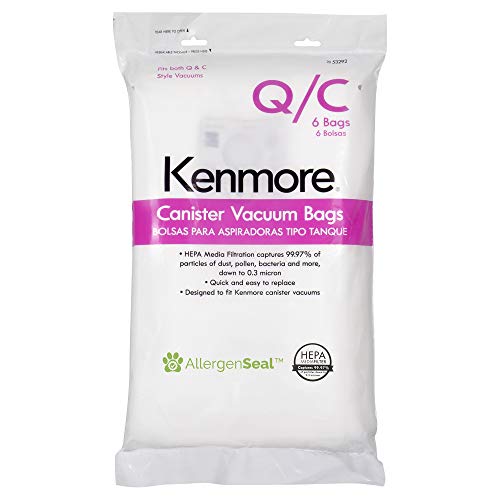
Kenmore’s Type Q is one of those quiet standards that millions of households run without ever discussing: the bag behind decades of Kenmore canisters, from the Progressive era to the current 600 and 200 series machines. This genuine six-pack uses HEPA media in the bag itself, which makes the disposable stage of the system do serious filtration work — capturing fine dust and dander within the bag’s large surface area while the machine’s exhaust filter polishes what remains.
The six-count pack suits the rhythm of real ownership: a bag a month or slower in most homes, a spare always in the cupboard, and no drama when the indicator shows full. Kenmore’s listing names its compatible canister models extensively, and buyers should use that list rather than memory, because Kenmore has sold uprights on entirely different bag types alongside these canisters for years. Matched correctly, the Type Q HEPA is the low-effort, high-filtration default for one of the largest bagged fleets in existence.
- Format: genuine Kenmore Type Q HEPA bags, six count
- Fit: Kenmore canisters listed on the pack, including 600 and 200 series families
- Media: HEPA-rated bag media for fine-particle capture
- Capacity: full-size canister bags, changed on indicator or suction loss
- System role: primary filtration stage ahead of the exhaust filter
- Tier: mid cost per bag for genuine HEPA media
Strengths
- HEPA media in the bag itself strengthens the whole filtration chain
- Six-pack matches real household change rhythms
- Extensive model list makes fit verification straightforward
Trade-offs
- Canister-only fit — Kenmore upright owners need a different type
- Genuine pricing sits above compatible Q bags
- Large bags tempt owners to overfill past the efficient point
Best for: Kenmore canister owners wanting genuine HEPA filtration without guesswork.
Not suited for: Any non-Kenmore machine, or Kenmore uprights on other bag types.

Hoover MPWR Compatible Vacuum Bags 20 Pack — Compatible pack — labelled third-party, best bulk value for Hoover commercial backpacks
Labelling first, as promised: this is a compatible, third-party pack — not Hoover’s own product — made to the Type CB1 pattern for Hoover’s MPWR 40V commercial backpack vacuums. Its case rests on volume economics. A commercial backpack in daily service changes bags at a rate no household matches, and a twenty-pack of sealed-collar bags converts that consumable from a recurring irritation into a stocked commodity. For a cleaning business running MPWR backpacks, the per-bag saving against genuine packs compounds across every machine, every week.
The compatible bargain carries its standard conditions, and commercial users are well placed to enforce them: inspect the first bag’s collar seal against a genuine one, watch the first week’s filtration behaviour around the machine’s exhaust, and standardise on the pack only once it has proved itself in your own machines. A sealed collar design is claimed on the listing, which is the critical feature — collar leakage is where compatibles fail — and a fleet buyer can verify it in a single shift. Verified, the pack is a rational professional purchase; unverified, it is a gamble with a motor as the stake.
- Format: third-party compatible bags, twenty pack — not Hoover-made
- Fit: Hoover MPWR 40V backpacks CH93619 and CH93600, Type CB1 pattern
- Collar: sealed collar design per the listing
- Replaces: AH10232 Type CB1 bags
- Use pattern: commercial fleets with frequent bag changes
- Tier: lowest cost per bag in this guide, with verification advised
Strengths
- Bulk pack transforms bag supply into a stocked commodity
- Per-bag cost suits high-change commercial rhythms
- Sealed collar targets the exact point where compatibles usually fail
Trade-offs
- Third-party tolerances vary; first-pack verification is essential
- Filtration media may not match genuine Hoover specification exactly
- Twenty bags is a commitment if the fit disappoints
Best for: Businesses running Hoover MPWR backpacks at commercial change rates.
Not suited for: A single household machine where genuine-pack costs are already trivial.

Improvedhand Miele GN Compatible Bags — Compatible pack — labelled third-party Miele GN alternative
Again, the label leads: Improvedhand’s pack is a third-party compatible for the Miele GN system, not a Miele product. Its proposition is arithmetic that many Miele households find persuasive — ten bags in the GN pattern, sized for the Classic C2 and C3 and the S2, S5, S8 and S400 families, bundled with motor protection filters and air-clean filters, at a cost per bag well below the genuine pack’s. For a household running its Miele hard — pets, children, a large floor plan — the annual difference is real money.
The honest conditions mirror the Hoover pack’s. The compatible’s media is described in the language of the genuine system’s design, but third-party media and collar tolerances are the buyer’s to verify: seat the first bag and check the collar’s fit, run the machine and check for dust odour or visible fines around the compartment after the first week, and keep one genuine bag as a comparison standard. Households with dust-sensitive members or a machine under warranty may rationally stay genuine; households whose Miele is a veteran workhorse often run packs like this happily for years. Both decisions are defensible — what matters is that the pack is chosen as a compatible, knowingly.
- Format: third-party compatible GN-pattern bags, ten pack — not Miele-made
- Fit: Miele Classic C2 and C3, S2, S5, S8 and S400 series per the listing
- Bundle: motor protection filters and air-clean filters included
- Media: multi-layer design described as 3D airclean style
- Use pattern: high-change Miele households seeking lower cost per bag
- Tier: low cost per bag, with first-bag verification advised
Strengths
- Ten bags plus filters makes a complete servicing kit in one purchase
- Cost per bag undercuts the genuine pack substantially
- Wide stated fit across Miele’s GN canister families
Trade-offs
- Third-party collar and media tolerances require verification
- Filtration may fall short of genuine GN specification in fine detail
- Warranty-sensitive owners may prefer to stay genuine
Best for: Cost-conscious Miele households with veteran machines and no dust sensitivity.
Not suited for: New Miele owners under warranty, or households managing allergies strictly.
Bagless Filter Washing and Replacement Discipline — Prose-only: the other half of the household
Many readers of this guide run a bagless machine beside their bagged one, and its filters deserve the same systematic respect as any bag. The washable stages — typically foam and felt or a rinsable cartridge — should be washed at the maker’s interval, and more often in pet homes, then dried completely before refitting: a full day on a windowsill is the usual honest figure, whatever optimism suggests. A damp filter restricts airflow, strains the motor and grows the smell owners then blame on the dog.
Replacement discipline matters as much as washing. Washable does not mean immortal; foam compresses, media thins, and a filter washed thirty times filters like a memory of itself. Keep a calendar note — bag changes for the bagged machine, filter washes and replacements for the bagless one — and the household’s whole fleet holds its performance instead of fading by degrees too gradual to notice and too real to ignore.
- Format: prose-only — maintenance discipline for bagless machines
- Washable stages: rinse on schedule, dry fully before refitting
- Replaceable stages: change on the maker’s calendar, not on failure
- Pet homes: shorten every interval the maker suggests
- Records: one calendar note covering the whole household fleet
- Cost framing: filters are the bagless machine’s equivalent of bags
Strengths
- Preserves suction that owners otherwise lose without noticing
- Prevents the damp-filter smell that discredits good machines
- Costs minutes on a schedule rather than performance forever
Trade-offs
- Requires drying space and patience between wash and use
- Replacement filters are a real, if modest, running cost
- Neglected once, a filter’s decline is hard to reverse fully
Best for: Every household running a bagless machine alongside a bagged one.
Not suited for: Nobody — but bagged-only households may skim it safely.
HEPA Exhaust Filters as the Final Filtration Stage — Prose-only: the chain’s last link
A bagged machine’s filtration is a relay: the bag captures the bulk and much of the fine load, a motor protection filter guards the motor, and the exhaust filter takes the final pass at whatever remains before the air returns to the room. When that last stage is a HEPA filter in good condition, the system’s output is genuinely clean; when it is clogged, grey and years past its change date, the machine’s other virtues are undermined at the exact point the household breathes.
Exhaust filters are the most neglected component in bagged ownership because the machine keeps running, apparently well, as they fade. The discipline is calendar-based: replace on the maker’s interval, sooner in pet homes, and treat a musty exhaust smell as the filter’s resignation letter. Readers choosing between the bag packs above should remember that the finest bag media cannot compensate for an exhausted final stage — the chain is judged, as all chains are, at its weakest link.
- Format: prose-only — exhaust filtration in bagged systems
- Position: final stage, after bag and motor protection filter
- Standard: HEPA grades capture the finest respirable fraction
- Change rhythm: maker’s interval, shortened in pet homes
- Symptom of failure: musty exhaust odour and visible dusting near the machine
- System role: decides the quality of air returned to the room
Strengths
- Completes the filtration story the bag begins
- Calendar replacement is cheap insurance for air quality
- Benefits every bag choice in this guide equally
Trade-offs
- Invisible decline tempts owners to skip changes
- Genuine HEPA exhaust filters carry their own cost
- Wrong-size replacements compromise the seal the stage depends on
Best for: Dust-sensitive and pet households running any bagged machine.
Not suited for: Owners content with bulk debris capture alone.
How Do the Six Picks Compare Side by Side?
| Pick | Type | Standout trait | Watch out for |
|---|---|---|---|
| Miele GN Vacuum Bags 4 Pack | Genuine manufacturer bags | Designed-fit collar and media for Miele’s GN canisters | Premium cost per bag — the genuine article prices itself accordingly |
| Kenmore Type Q HEPA Vacuum Bags | Genuine manufacturer HEPA bags | HEPA-media bags for a huge installed base of canisters | Type Q fits canisters; Kenmore uprights use different bag types — check yours |
| Hoover MPWR Compatible Vacuum Bags 20 Pack | Third-party compatible bags (labelled) | Bulk twenty-pack economics for high-change commercial use | Compatible, not genuine — check collar seal and media on first use |
| Improvedhand Miele GN Compatible Bags | Third-party compatible bags (labelled) | Ten bags plus bundled filters at a compatible price point | Third-party media and collar tolerances — the genuine GN remains the reference |
| Bagless Filter Washing and Replacement Discipline | Prose-only maintenance guide | Filter rhythm is what separates strong bagless suction from slow fade | A washed filter refitted damp will smell and underperform |
| HEPA Exhaust Filters as the Final Filtration Stage | Prose-only filtration guide | The stage that decides what the room breathes back | An exhausted HEPA filter quietly downgrades the whole system |
The comparison turns on three questions: is it genuine, what does it cost per change in qualitative terms, and what does it ask the buyer to verify? The genuine Miele and Kenmore packs minimise verification to a fit check. The compatibles trade a lower cost per bag for a first-pack inspection that any careful owner can perform in a week.
How Do Vacuum Bag Letter Codes Actually Work?
Letter codes are fit codes, not quality grades. A letter — GN, Q, and their many equivalents across brands — identifies the bag’s collar geometry, dimensions and intended compartment, so that any bag carrying the code will physically serve the machines designed for it. Manufacturers guard the popular codes jealously in their documentation and third parties build to them, which is why a compatible can share a genuine bag’s letter while differing in media and tolerances.
The practical method never changes: find the code in your machine’s manual or on the old bag’s collar, buy that code, and treat any listing that will not state its code plainly as a listing to avoid. Model names drift across years and regions; the letter endures. Owners who keep one empty bag’s collar card in the cupboard with the spares have solved fit permanently, at the cost of one moment’s foresight.
Genuine or Compatible: How Should a Household Decide?
Decide by machine value, warranty position and lungs. A premium canister under warranty, in a dust-sensitive home, argues for genuine bags with the decision barely needing discussion — the saving from compatibles is small against the machine’s value and the household’s air. A veteran machine out of warranty, in a robust household changing bags often, argues the other way, provided the buyer performs the first-pack verification this guide keeps prescribing.
The middle cases resolve by arithmetic done honestly: bags per year, multiplied by the per-bag difference, compared against the cost of one motor repair or one season of compromised filtration. Most households discover the genuine-versus-compatible difference is smaller annually than the argument about it suggests — which frees the decision to rest on trust and convenience, where it probably belonged all along.
What Does Cost per Bag Really Mean over a Machine’s Life?
Stated without prices, as this guide’s rules require: a bagged machine’s lifetime bag bill is its change rhythm multiplied by its years, and for most households that rhythm is a bag every month or two. Genuine bags sit at the higher tier per change, quality compatibles below them, and bulk commercial packs at the lowest per-bag cost of all. Across a decade the tiers separate into a sum worth noticing but rarely worth a worse machine — bags are the subscription, and the machine is the purchase the subscription serves.
The hidden term in the equation is capacity honestly used. A large bag changed at its efficient point may outlast two small ones; a compatible that fills unevenly or leaks may be discarded early and cost more per week than the genuine it undercut. Cost per bag is therefore really cost per month of clean filtration, and that figure rewards the systems — genuine or verified compatible — that use their full capacity cleanly.
When Should a Bag Be Changed, Whatever the Indicator Says?
Change on performance evidence: suction softening on familiar floors, the machine working audibly harder, dust odour at the exhaust, or a bag that feels densely packed when the compartment is opened. Indicators help but they measure pressure, not fullness, and a bag half-full of fine dust can restrict airflow more than a fuller bag of coarse debris. Pet homes should err early in shedding season, when the fine fraction loads media fastest.
Never run a bag to bursting. A split bag distributes its contents through the motor compartment and converts a consumable change into a service job, and the fines that reach the motor shorten its life invisibly. The cheapest bag habit in this entire guide is changing slightly early, forever — it costs a fraction of a bag per year and protects the most expensive component in the system.
How Does a Bag’s Media Shape Filtration and Suction Together?
Modern bag media is a graded structure: outer layers catch the coarse load, inner layers take the fines, and the whole presents enough surface area that airflow survives the accumulation. That is why a bagged machine holds its suction so gracefully as it fills — the filter is enormous compared with a bagless machine’s cartridge — and why HEPA-media bags like the Kenmore Type Q lift the whole system’s performance rather than merely containing dirt.
Media is also where compatibles quietly differ. Thinner or less graded media loads faster, passes more fines toward the motor filter, and can make a good machine feel ordinary by the bag’s third week. The buyer cannot see media quality in a photograph, which is why this guide’s verification ritual — first bag watched, compartment inspected, exhaust sniffed — is the compatible buyer’s substitute for the genuine maker’s laboratory.
What Should You Stock, and Where, to Never Run Out?
Running out of bags mid-clean is a small domestic failure with an outsized annoyance, and it is prevented by stocking like a professional: a working pack in the cupboard, a reserve pack behind it, and a reorder triggered when the reserve is opened. Store bags flat, dry and away from sunlight, in the room where the machine lives if possible, because a bag stored in a distant loft might as well be in a warehouse for all the good it does a Saturday clean.
Keep the machine’s other consumables in the same place — motor protection filters, the exhaust filter’s change date noted on a card — and the bag cupboard becomes a servicing station. Fleets and households alike run on this unglamorous logistics, and the households that adopt it stop experiencing consumables as emergencies altogether.
How Did the Disposable Bag Become the Filtration Standard?
The bag’s dominance is a filtration story before it is a convenience story. Early twentieth-century machines blew their dust through cloth that clogged, leaked and had to be shaken out — an ordeal that made vacuuming a dreaded day. The paper disposable bag converted the filter into a fresh, huge, graded surface at every change, and machines designed around it could promise consistent suction and genuinely cleaner exhaust for the first time.
Bagless cyclonic design later challenged the bag on consumable cost, and the contest continues in this guide’s own pages. But the bag’s core insight — that filtration wants surface area and freshness — still shapes even its rivals, whose cartridges and shrouds are attempts to reproduce a bag’s virtues without the bag. Understanding that history explains the present market better than any brand loyalty does.
What Happens Inside the Machine When a Bag Leaks?
A leaking collar or split seam admits a stream of dust-laden air into the motor compartment, bypassing the filtration the system exists to provide. The motor’s own filter catches what it can and loads quickly; the rest coats windings and bearings, raising temperatures and shortening life in ways that present, months later, as a machine that simply dies young. The room’s air receives its share too, through every vent the design never intended as an exhaust.
This cascade is why this guide treats collar fit as the first virtue and why compatible verification concentrates there. A leak is not a minor imperfection in a consumable; it is a systems failure with a slow fuse, and it is prevented by the cheapest diligence in cleaning — seating each new bag properly and checking the compartment’s cleanliness at every change.
How Should Bags Be Stored for Years Without Degrading?
Bag media and adhesives age quietly. Store packs flat in a dry cupboard away from sunlight and heat sources, keep them in their packaging until use, and rotate stock so the oldest pack is used first. A damp store room is the enemy: media that has absorbed moisture clogs faster in service and can carry a musty smell into the machine’s exhaust from the first use.
Households that buy compatibles in bulk for the savings should be especially careful, because the bulk discount tempts a stock level that outlasts sensible storage. Buy the quantity a year or two of your rhythm justifies, store it properly, and the last bag of the pack will perform like the first — which is the entire point of buying ahead.
A Short Guide to Reading a Bag Listing Like a Professional
Professionals read a bag listing in a fixed order: code and named models first, because fit is binary; collar design second, because leakage is the catastrophic failure; media description third, with HEPA claims noted and their exact wording weighed; count and included filters fourth, because bundles change value; and only then the pack’s price position within its tier. Any listing that obscures the first two items behind lifestyle language is telling you something about itself.
Apply the same order to this guide’s four picks and their structure becomes clear: each was admitted because its listing answers those questions plainly enough to be checked. That checkability, more than any single specification, is what separates a consumable you can standardise on from one you merely hope about.
How Do Bags Behave Differently with Pet Hair and Building Dust?
Pet hair fills a bag by volume long before it fills it by weight, lofting inside the compartment and triggering the change rhythm weeks ahead of a pet-free household’s schedule. Its fines — dander — load the media’s inner layers disproportionately, which is why pet homes notice suction softening earlier than the bag’s apparent fullness explains. Building and renovation dust is the opposite load: dense, abrasive and fine, it packs a bag hard and can blind media in a single project, which is why sensible owners sacrifice an old bag to a renovation rather than contaminating a fresh HEPA one.
Both loads argue for the same habit: judge the bag by the machine’s behaviour and a hand’s squeeze of the compartment, not by the calendar alone. A household that learns its own debris signature — hair-lofting in spring, grit-heavy in winter — schedules changes the way it schedules everything else that actually works: by evidence gathered at home.
What Should You Do When Your Bag Type Is Discontinued?
Discontinuation is a when, not an if, for long-lived machines, and the response is a small project rather than a panic. First, stock ahead modestly while genuine packs remain available, storing them properly as this guide describes. Second, identify the compatible makers who build to your code and verify one while genuine bags still exist as your comparison standard — the verification this guide prescribes is easiest exactly when it feels least urgent.
Third, keep the machine’s documentation and one sample collar card permanently; codes outlive listings, and a future compatible can be matched against a physical sample when every webpage has forgotten your model. Owners of durable machines — and bagged canisters are among the most durable appliances in the home — treat consumable continuity as part of ownership, and are rarely caught out by it.
How Does Altitude, Humidity and Storage Climate Affect Bags in Service?
A bag in a humid home loads differently from one in a dry climate: moisture in the airstream binds fines into the media faster and can lend the exhaust a heaviness that owners misread as a failing motor. Coastal and lakeside households should change on performance evidence sooner than their inland counterparts and store spare packs with particular dryness in mind. Very dry, dusty climates invert the load — volume arrives fast, media stays open longer — and the change rhythm stretches accordingly.
The lesson generalises beyond bags: consumables live in your climate, not in the manufacturer’s test laboratory, and every interval printed in a manual is a temperate average awaiting your household’s correction. Keep the small calendar this guide recommends, annotate it with what you actually observe, and within a year the household owns a servicing schedule more accurate than any maker’s generic advice.
Why Do Two Identical Machines in Different Homes Eat Bags at Different Rates?
Debris is local. One home’s bag fills with the grit of a gravel drive and a working dog; another’s with the fine dust of a city flat and a single cat; a third’s with the fibres of new carpet shedding its manufacture for a year. Floor area misleads too — a small home with an entrance that opens onto soil can out-consume a large home on a paved street. This is why bag advice traded between households so often sounds like contradiction: both reporters are telling the truth about different dirt.
The useful comparison is against your own machine’s history. Note the date on each bag as you fit it — a pencil line on the collar card — and within three changes you possess your household’s true interval, immune to every generalisation including this guide’s. Professionals do exactly this across fleets, and it is the cheapest fleet-management technique ever devised.
How Should You Dispose of Full Bags Responsibly?
A full bag goes into household waste, sealed by its collar closure where fitted, and placed rather than dropped into the bin to avoid puffing its fines back into the kitchen air. Households minimising waste should take their consolation from the system’s longevity: a bagged machine serviced for fifteen years, consuming a modest stack of paper-based bags, compares favourably with shorter-lived appliances replaced wholesale. Some bag media now incorporates recycled content, and makers’ take-back schemes appear intermittently — worth checking for your brand, not worth distorting the purchase around.
Never burn vacuum bags or empty them into compost: the contents are a concentrate of household dust, synthetics and whatever the floors held, and they belong in the controlled waste stream. The bag’s whole design purpose is containment from floor to disposal, and honouring that chain to its final step is the owner’s last small part in the system.
What Is the Motor Protection Filter, and Why Does It Deserve Attention?
Between the bag and the motor sits a small filter that most owners discover only when a manual insists. Its job is insurance: whatever escapes the bag — through a imperfect seal, a pinhole, an overfilled change left too long — meets this stage before it meets the motor. Bundled packs like the Improvedhand set include replacements because the stage is meant to be renewed, and a household that changes bags faithfully while ignoring this filter is maintaining the chain everywhere except its most protective link.
Inspect it at every second or third bag change. A clean motor filter is evidence your bags are sealing well; a grey, loaded one is a report — of a leaking collar, an overfilled bag, or a compatible whose media passes more than it should. Read that report and act on it, and the small square of foam becomes the cheapest diagnostic instrument in the entire cleaning cupboard.
How Do You Teach a Household the Bag Routine?
Bag changing fails in shared households at the information level: one person knows the code, another buys by brand, a third runs the machine on a bursting bag because nobody mentioned the indicator. The fixes are embarrassingly small — the code written inside the cupboard door where the spares live, a reserve pack whose opening triggers the reorder, and the change itself demonstrated once to everyone who vacuums.
Children old enough to vacuum are old enough to learn the squeeze test and the smell test, and households that distribute the knowledge find the machine cared for by whoever reaches it first rather than by a single exhausted expert. Consumables are a system, and systems survive in households exactly to the extent that more than one person understands them.
One Last Check Before You Order Any Bag Pack
Take the old bag out — or its collar card — and read the code with your own eyes. Compare it against the listing’s stated fit and named models, decide genuine or compatible with the warranty and lungs tests this guide sets out, and order a quantity matched to your household’s measured rhythm rather than to a bulk discount’s temptation. Five minutes with the old bag in hand is the difference between a consumable that disappears into the household’s routine and a parcel that begins a returns process.
How Do Commercial and Domestic Bag Habits Differ?
A cleaning business treats bags as inventory: counted, stocked by the case, changed on a route schedule, and standardised across the fleet so no operator ever meets an unfamiliar collar at midnight in a client’s building. The Hoover MPWR pack in this guide belongs to that world, and its twenty-count is sized by it. Waste is audited, because at fleet scale a bag changed too early is a measurable cost and a bag changed too late is a measurable risk.
A household treats bags as groceries — bought when noticed, occasionally run out of, stored wherever they land. Borrowing the commercial habits at domestic scale costs nothing and removes the category’s small frictions entirely: standardise on one verified pack, stock a reserve, note change dates. The households that envy professionals their calm about consumables are usually one cupboard reorganisation away from having it.
Why Does This Guide Discuss Prices Only in Words?
Because a bag’s price is the least stable fact about it — promotions, pack sizes and marketplace sellers move it constantly — while its tier and its cost rhythm are stable enough to plan a household around. A reader who knows that genuine bags sit at the premium tier, that compatibles undercut them, and that bulk commercial packs sit lowest per bag, possesses the durable knowledge; the exact figure belongs to the listing on the day of purchase, which is where this guide’s links take you.
The same discipline protects the reader from the opposite error: judging a pack cheap or dear by a headline number that divides across an unstated count. Cost per bag, then cost per month of clean filtration — those two quotients, computed at the listing with the day’s figures, are the only price judgements worth making in this category, and they can only be made there.
A Final Word on the Bag as a Piece of Engineering
It is easy to treat the bag as packaging for dirt and miss that it is the largest, freshest filter most cleaning systems ever deploy — a component whose surface area dwarfs every cartridge and whose renewal restores the machine to laboratory condition in seconds. Generations of engineers built serious machines around that simple fact, and the canisters still running after twenty years on their original motors are its standing evidence.
Choose the bag with the respect that record earns: right letter, sound collar, media matched to your household’s dust, changed before it begs. The machine will repay the respect in the only way machines can — by still being there, sucking hard and breathing clean, long after flashier appliances have been replaced twice over.
How a Spare Bag in the Car Boot Saves Holidays
Households with a second property, a caravan or a relative’s machine they maintain learn the trick early: one correct bag, kept with the travelling kit, prevents the holiday clean from dying at the cupboard. It sounds trivial until the alternative has happened to you — a full bag, a code nobody remembers, and a local shop stocking every letter except yours. Consumable literacy travels, and the pencil note of your codes in a phone or a wallet is the five-second version of the same insurance.
One Sentence of Perspective on the Whole Category
Nobody frames a vacuum bag or keeps it for its beauty, yet few objects in the home mediate so directly between effort and air — and the households that understand their bags, their codes and their rhythms are, without exception, the households whose machines are still worth using a decade after the receipt has faded to white.
What Mistakes Do Bag Buyers Make Most Often?
The first mistake is buying by machine brand alone and ignoring the letter. Brands sell many bag types simultaneously, and the confident purchase of the wrong letter is this category’s most common return. The code is on the old bag and in the manual; check it before the brand, every time.
The second mistake is running bags to bursting to extract full value, which extracts the opposite: a split bag, a contaminated motor compartment and fines through the system. Change early, on performance evidence, and the arithmetic of bag costs stays trivial beside the arithmetic of repairs.
The third mistake is judging compatibles by their first day. A compatible bag performs beautifully when empty; its collar seal, media loading and seam strength declare themselves across the third week. Verify across a full first bag before standardising — the patience costs nothing and prices the risk exactly.
Final Recommendation
For Miele owners, the genuine GN pack remains the recommendation that needs no conditions: it is the system the machine was built around. Kenmore canister owners hold the same position with the Type Q HEPA, a genuine bag whose media strengthens the whole chain. The two compatible packs earn their places as labelled, verifiable economies — the Hoover MPWR twenty-pack for commercial change rates, the Improvedhand GN pack for cost-conscious Miele households — provided each buyer performs the first-bag verification their sections describe.
Match the letter, respect the change rhythm, keep the exhaust stage fresh, and the humble bag will do what it has quietly done for generations of machines — keep the dirt sealed, the air clean and the motor young.
Frequently Asked Questions
Can I use a compatible bag in a machine under warranty?
Warranty positions vary by maker and region, and the cautious course under warranty is genuine bags, whose fit and media are beyond argument. Once a machine is out of warranty, verified compatibles are a rational economy for many households. When in doubt, the maker’s own documentation for your model is the authority, not a listing’s reassurance.
How do I find my bag’s letter code?
Three reliable places: the collar card of the bag currently in the machine, the machine’s manual, and the model information on the maker’s support pages. The code is a letter or letter-number combination, and it — not the machine’s marketing name — is what your replacement must match.
Are HEPA bags worth it over standard bags?
In dust-sensitive and pet households, generally yes: HEPA media in the bag strengthens the system’s largest filtration surface, and the exhaust stage then polishes an already cleaner stream. In robust households cleaning coarse debris, standard genuine bags perform perfectly adequately. Judge by your household’s lungs and its dust, not by the badge alone.
Why does my new bag smell musty after a few weeks?
Usually because the previous bag’s fines reached the exhaust filter, or because organic debris is ageing inside the current bag. Change the bag, inspect and if necessary replace the exhaust filter, and avoid vacuuming damp material, which accelerates the problem. Persistent odour after both changes points to debris in the hose or compartment, worth a thorough clean-out.
Can I empty and reuse a vacuum bag?
No — bags are designed as sealed, disposable filtration, and emptying one destroys its structure, spills its finest and most respirable contents, and refits a compromised filter to your machine. The reuse impulse is understandable and should be resisted every time; the bag’s disposability is its hygiene feature, not a marketing trick.
How many bags should a household use in a year?
Most households change every four to eight weeks, landing in the range of a handful to a dozen bags a year depending on pets, floor area and debris. Track your own rhythm for two changes and stock to it, keeping a reserve pack so the rhythm never becomes an emergency shop.
Related Guides
Bags make most sense in the context of the machines that use them and the wider choices around them, and these guides cover the bagged machines, the budget landscape and the adjustable models: Best Bagged Vacuums for High-Pile Carpet Best Affordable Vacuums Best and Worst Robot Vacuums Best Adjustable Vacuums


