What's inside
- Key Takeaways
- Quick Picks
- How Did We Judge Value Instead of Just Price?
- Which Affordable Vacuums Pass the Five-Year Ledger?
- How Do the Six Routes to Value Compare?
- What Does a Vacuum Really Cost Over Five Years?
- How Much Vacuum Does a Household Actually Need?
- When Is Spending More the Affordable Choice?
- What Do Filters, Belts and Warranties Really Tell You?
- How Should You Maintain a Vacuum So the Ledger Stays True?
- How Does the Value Method Travel Beyond Vacuums?
- What Should You Do in the First Month of Owning an Affordable Vacuum?
- Why Do Households Replace Vacuums That Still Work?
- What Mistakes Do Value Shoppers Keep Making?
- Final Recommendation
- Frequently Asked Questions
- Related Guides
As an Amazon Associate I earn from qualifying purchases. This post may contain affiliate links at no extra cost to you.
cottageverdict.com is reader-supported. When you buy through links on our site, we may earn an affiliate commission.
Where to buy: each linked vacuum below is sold on Amazon, where you can check price on Amazon on the day you shop. The listings also carry each model’s filter and belt situation in their contents and parts sections — reading them is part of the value method this guide teaches.
Every other guide in this affordable family starts from a floor, a pet or a brand. This one starts from a question: what makes a vacuum worth its money? The best affordable vacuums are not the cheapest machines on the shelf, nor the ones with the longest feature lists. They are the machines whose value survives arithmetic — the purchase tier divided by years of service, plus the filters, belts and brushrolls consumed along the way, minus the cleans that never happened because the machine was awkward, clogged or quietly broken in a cupboard.
That arithmetic rearranges the usual rankings in instructive ways. A budget upright with a washable filter, a belt stocked in every hardware shop and a body any owner can open with a kitchen screwdriver can out-value a cleverer machine twice its tier whose filter is proprietary, whose parts ship from one warehouse, and whose second year is a negotiation. The five linked picks below were chosen as the strongest current examples of value engineered in that order: honest cleaning first, cheap keeping second, findable parts always. They are uprights, because at the affordable end of the market the corded upright remains the value instrument against which everything else is measured.
A sixth entry, in prose, examines the refurbished route — yesterday’s premium machines renewed and resold — because no honest account of vacuum value can ignore the market where flagship cleaning changes hands at budget tiers. Read the five with a pencil and the value method in hand: filter, belt, warranty, parts. By the end, the method matters more than the list, because the list will age and the method will still be standing in the aisle with you in five years’ time.
One clarification of scope before the entries: this guide stays with corded uprights not from nostalgia but from arithmetic. At the affordable end, cordless machines carry a battery whose replacement cost and finite life belong in the ledger’s red ink, and robots carry a complexity premium the same colour. Both formats have their own guides in this family, judged by their own ledgers. Here, the question is the upright’s home ground: maximum cleaning per unit of lifetime cost, with the cord accepted as the small, honest tax it is.
A note on what this guide will not do: it will not name a single winner, because value is a ratio and ratios have households in their denominators. The settled carpeted house and the transient hard-floored flat can read the same five entries and correctly choose opposite ends of the list — and a guide that respects its readers will call both choices right, out loud, in the final section where such verdicts belong.
Key Takeaways
- Value is arithmetic, not a tier: purchase cost over years of service, plus consumables, minus the cleans a bad machine prevents.
- The Dirt Devil Endura Reach is the value floor — simple, fixable, sustained suction at the friendliest tier in this guide.
- Eureka’s PowerSpeed NEU181A pairs a 2.6-litre cup and pet tools with budget running costs.
- The Bissell CleanView and Amazon Basics uprights split the mid-value ground between reach-and-tank and washable-filter economy.
- The Hoover WindTunnel 2 costs a step more and repays it in longevity, filtration and a platform built to be kept.
- Refurbished premium vacuums, covered in prose, are the value route for buyers willing to inspect before they save.
Quick Picks
| Pick | Badge | Why it made the list |
|---|---|---|
| Dirt Devil Endura Reach Upright | The value floor | Endura sustained suction, extended reach and near-total simplicity at the friendliest tier here. |
| Eureka PowerSpeed Upright NEU181A | Capacity per coin | A 2.6-litre cup, pet turbo brush and full tool set in a light body at a budget tier. |
| Bissell CleanView Upright with Extension Wand | Reach-and-tank value | An XL 2-litre tank, OnePass brushing and an active wand — whole-house value in one box. |
| Amazon Basics Upright Bagless Vacuum | Washable-filter economy | A washable filter, 1.7-litre cup and 25-foot cord — running costs engineered toward zero. |
| Hoover WindTunnel 2 Whole House Rewind | Longevity investment | WindTunnel channels, HEPA media filtration and a keepable platform — the spend-more, keep-longer pick. |
| Refurbished Premium Vacuums | Prose-only value route | Renewed flagship machines at budget tiers — the inspection-buyer’s road to premium cleaning. |
How Did We Judge Value Instead of Just Price?
We built the five-year ledger every household builds eventually, usually after the first replacement filter costs more than expected. Column one is the purchase tier, read against each maker’s own range. Column two is consumables: filters that wash beat filters that must be bought, belts that cost coins beat assemblies that cost notes, and bagless cups beat a lifetime subscription to bags. Column three is repairability — whether the parts that wear are sold separately, stocked widely and replaceable by the owner — because a machine that can be fixed for the price of a pizza is cheaper, across five years, than a sealed machine replaced whole.
Column four is the one guides usually omit: cleans that actually happen. A vacuum’s value is its cleaning multiplied by its usage, and usage is decided by weight, cord manners, bin rituals and whether emptying it is a pleasure or a dust event. Light, simple, willing machines accumulate cleans the way compound interest accumulates money, quietly and then suddenly. Every pick below scores on all four columns; that, and not any single figure, is what ‘affordable’ means in this guide’s title.
Warranty was read as a value signal rather than a promise: its length matters less than what it reveals about the maker’s confidence and whether the service route behind it is a real network or a web form. Brand heritage counted only where it converts into parts on shelves — the one form of prestige a vacuum owner can spend. Novelty counted against, mildly, every time: a first-year platform has an unwritten parts story, and value is written in parts.
We also applied a humility rule to ourselves: no pick was admitted on reputation alone, including the famous ones, and no pick was excluded for lacking it, including the retailer’s own brand. Each had to show its ledger — consumables priced, parts findable, platform mature, usage likely — in evidence a reader can reproduce from the same listings. A value guide that asks to be trusted rather than checked has misunderstood its own subject.
Finally, we stress-tested each admitted pick against the replacement question: if this exact machine vanished from the market tomorrow, could its owner still keep it alive for five years on the parts already in circulation? Platforms with deep installed bases pass that test by the sheer physics of their numbers — warehouses and marketplaces hold their consumables the way libraries hold classic books. A first-year platform, however brilliant, cannot yet make that promise, and its absence from this list is the method working as designed.
Which Affordable Vacuums Pass the Five-Year Ledger?
Five linked uprights ordered by the shape of their value — simplest first, most enduring last — then the refurbished route in prose. The badges name each machine’s value mechanism, because in this guide the mechanism is the recommendation.
One reading instruction for what follows: in each entry, find the sentence where the machine’s costs are named, because that sentence — not the badge, not the opening compliment — is where the pick was actually decided, and learning to hunt for it in any listing is the skill this whole guide exists to transfer.

Dirt Devil Endura Reach Upright — The value floor
Start the value argument at its floor: the Endura Reach is what a vacuum costs when everything decorative is removed and everything functional is kept. The Endura filtration holds suction as the bin fills — the classic budget failure, engineered out — the reach covers stairs and upholstery, and the whole machine can be understood in one reading and maintained with the tools in a kitchen drawer. Its tier is the friendliest in this guide; check price on Amazon, then price its belt and filter, because the second number is where its value case is actually won.
Simplicity compounds. There are few mechanisms to fail, few seals to perish, few behaviours to learn, and that paucity is a five-year asset: the machine in year four is the machine from week one, needing a belt, a rinse and a roller clearing to stay that way. Households that have been burned by complexity — the vacuum with modes, moods and a manual like a novel — will recognise the Reach as the corrective purchase.
Its ceilings are stated as plainly as its virtues: low-to-medium pile is its home, the finish is honest plastic, and the tool set does its job without ceremony. A value guide that hid those would be a sales page. Within them, the Reach delivers the highest cleaning-per-commitment in this entire affordable family, which is why it opens a list that includes machines twice its tier.
Buy it as the household’s working instrument, the student flat’s inheritance, the second machine upstairs — any role where the ledger matters more than the logo. It will not be admired. It will be used, kept and, in the fullness of time, handed on, which in the value economy is the only admiration that counts.
The Reach also teaches the value method’s favourite lesson in physical form: everything on it can be pointed at and priced. There is no subsystem whose failure requires a technician’s prayer, no consumable whose listing requires detective work. A young person setting up a first home could maintain this machine for a decade with a phone, a screwdriver and a small drawer of parts — and that maintainability, more than the tier, is why it anchors a guide read by households counting every commitment.
Second-hand buyers will meet the Reach often, and that frequency is itself a value datum: machines that survive to be resold in volume are machines whose design tolerates real life. If your tier is at its strictest, a used Reach with a fresh belt and rinsed filters is among the most defensible purchases in the entire vacuum market — a fact this guide states about very few products, in very few categories, ever.
- Format: corded bagless upright with extended reach
- Filtration: Endura system for sustained suction
- Maintenance: belt, rinse, roller — all owner-level
- Parts: widely stocked, inexpensive
- Tier: friendliest in this guide
Strengths
- Lowest total cost of ownership here
- Simplicity that survives five years
- Reach included at a budget tier
Trade-offs
- Low-medium pile ceiling
- Plain finish throughout
- No convenience extras
Best for: strict budgets, second machines and simplicity refugees.
Not suited for: deep-pile homes needing maximum agitation.
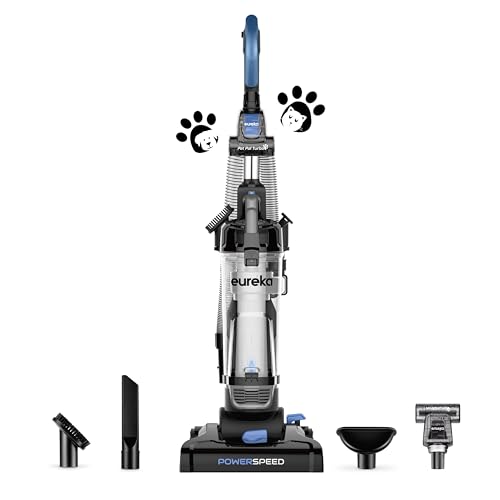
Eureka PowerSpeed Upright NEU181A — Capacity per coin
The NEU181A’s value mechanism is capacity: a 2.6-litre cup in a lightweight upright at a budget tier, which means fewer interruptions per clean, fewer cleans abandoned halfway, and a machine whose size flatters the debris volume of real family life. Value hides in such unglamorous ratios — litres per tier step, tools per box — and by those ratios this Eureka is one of the strongest purchases in the affordable market. Check price on Amazon and then look at what the cup and the tool roll would cost you elsewhere in the band.
The pet turbo brush deserves its line in a value ledger, because upholstery and stair tools are where budget machines usually economise invisibly: the box lists ‘tools included’ and delivers a nozzle that apologises. Here the turbo brush is a working instrument, and the crevice and upholstery pair complete a set that covers the whole house without an accessory purchase afterward — the hidden second transaction that ruins many a budget vacuum’s arithmetic.
Running costs follow the same generous pattern: standard consumables, sensibly priced, on a platform sold in volumes that keep them stocked. The machine’s lightness is a value feature too, in the usage column of the ledger — a vacuum carried willingly between floors cleans both floors, doubling the return on a single purchase in two-storey homes.
Its trade-offs are finish and refinement: the plastics are plain, the cord is manual, and nobody will write poems about its silhouette. Value buyers have always accepted that exchange, and the NEU181A is its current cleanest expression: everything the ledger rewards, nothing the ledger ignores.
There is a resale footnote to the Eureka’s value that owners discover at moving time: light, capacious, honestly specified machines sell onward easily, because the next household’s ledger reads them the same way yours did. A vacuum that retains a second life retains value in the literal sense — part of its purchase returns, or its service continues in a child’s first flat. Either way the NEU181A’s arithmetic keeps improving after households that bought ornament have written theirs off.
The NEU181A is also the pick we would specify for a community hall, a scout hut or a small office with carpet — the semi-public duties where a vacuum is used by everyone, respected by no one, and expected to work regardless. Capacity, simplicity and cheap consumables are exactly the virtues such postings audit, and a machine that survives communal ownership will find a single family’s care close to a holiday.
- Format: corded bagless upright, lightweight
- Cup: 2.6-litre capacity
- Tools: pet turbo brush, crevice and upholstery tools
- Consumables: standard, widely stocked
- Tier: budget end of the affordable band
Strengths
- Capacity and tools per tier step
- Light enough to serve two floors
- Cheap, findable consumables
Trade-offs
- Plain finish and fittings
- Manual cord handling
- No sealed-system headline
Best for: family homes wanting maximum equipment per tier step.
Not suited for: buyers who value finish as part of the purchase.

Bissell CleanView Upright with Extension Wand — Reach-and-tank value
The CleanView with Extension Wand makes its value case in the currency of sessions completed. The XL two-litre tank and the active wand together abolish the two interruptions that fragment a whole-house clean — the mid-round bin pilgrimage and the stair expedition — so one purchase covers a family home’s full geography in single, finished passes. A vacuum that finishes is worth more than a stronger vacuum that pauses, because unfinished cleans are where household standards quietly go to renegotiate themselves downward.
OnePass brushing is the same philosophy at floor level: a brush and suction path arranged to gather in one pass what lesser heads gather in two, halving the time cost of the carpeted rooms. Time is a real column in the value ledger — the household’s scarcest resource priced into every chore — and machines that respect it get used at full specification rather than at a rushed discount.
The tier is mid-band; check price on Amazon and weigh it against the two budget picks above with the ledger open. What the step buys is not luxury but completion: reach, capacity and pace, on a Bissell platform whose filters and parts sit in every marketplace search’s first page. For the single-vacuum household — the home buying one machine to do everything — that completeness is the value, because a second machine never has to be bought to cover the first one’s gaps.
Its honest limits are size and corded presence: it is a full upright, stored like one, and pet specialists may prefer its siblings’ brushes. As the one-machine answer for a carpeted, staircased family home on a mid-band commitment, however, it is the entry in this guide we would defend in any aisle argument.
Households with a cleaner or helpful relatives will appreciate the CleanView’s legibility dividend: a machine whose tank, wand and brush all behave conventionally can be operated well by any willing hands, which multiplies its effective usage across the household’s whole labour force. Idiosyncratic machines become one person’s job and therefore one person’s bottleneck. The Bissell’s conventional excellence is, in ledger terms, a staffing feature — and staffing, in busy homes, is where cleans are won and lost.
For the growing household — the one adding a storey, a dog or a generation every few years — the CleanView’s completeness is a hedge against the future: reach for stairs not yet carpeted, tank for rooms not yet furnished, pace for schedules not yet frantic. Buying slightly ahead of need is usually waste; buying completion ahead of need is insurance, and the distinction is whether the extra capability is structural, as here, or decorative.
- Format: corded bagless upright
- Tank: XL 2-litre capacity
- Brush: OnePass Technology system
- Reach: active extension wand
- Tier: mid within the affordable band
Strengths
- Whole-house sessions without interruption
- One-pass pace respects the owner’s time
- Deep parts and filter availability
Trade-offs
- Full-size storage footprint
- Corded, with manual cord care
- Generalist rather than pet specialist
Best for: one-vacuum households with stairs and carpet to finish weekly.
Not suited for: small flats where a compact pick would be used more.

Amazon Basics Upright Bagless Vacuum — Washable-filter economy
The Amazon Basics upright is the value method’s purest student: a machine whose specification reads as if the designer had the five-year ledger open on the desk. Washable filter, so the consumables column approaches zero. A 1.7-litre cup, so sessions complete. A 25-foot cord and detachable handle, so reach never forces a second purchase. Lightweight body, so the usage column stays high. Individually these are unremarkable; as a system, at its tier, they are a small masterclass in where vacuum value actually lives.
Scepticism about a retailer’s own-brand machine is healthy and, here, answerable in the ledger’s terms. The questions that matter are not about heritage but about the filter’s availability in year three and the belt’s price today — and a platform sold at this volume, through this storefront, answers both more reassuringly than many a storied badge managed by a distant licensee. Check price on Amazon, and check the parts listings on the same page; the pair of searches is the whole due diligence.
The compromises are the visible ones: utilitarian finish, a standard tool pair, carpet manners that are honest rather than authoritative. For the renter, the first home, the landlord equipping a property, and any household whose vacuum budget competes with worthier claims, those compromises are not merely acceptable — they are the point. The money not spent here is spent somewhere it matters more, and the floors are cleaned regardless.
It closes its case as the guide’s easiest recommendation to a first-time buyer: complete, cheap to keep, simple to understand, and — the value trait nobody lists — easy to replace like-for-like in five years if life intervenes, because its tier never becomes a financial event.
The Basics also quietly serves the emergency-purchase scenario, which is how many vacuums are actually bought: the old machine dies on a Saturday, guests arrive Sunday, and the replacement must be chosen in an hour. In that hour, the ledger’s questions are the only ones that matter — does it clean everything, can I keep it cheaply, can anyone run it — and this machine answers all three without a research project. Emergency-proofing is a value trait, and the Basics is the most emergency-proof pick in this guide.
There is a dignity argument for the Basics that value guides rarely make: it returns the vacuum to its proper place in a household’s attention — an appliance, not an acquisition. Money, worry and research are finite, and a machine that asks almost none of any of them, while cleaning the floors completely, frees all three for the parts of a home that actually reward them. Not every purchase should be a project, and this is the pick for people who agree.
- Format: corded bagless upright, lightweight
- Cup: 1.7-litre capacity
- Filter: washable
- Cord: 25-foot, detachable handle for reach
- Tier: budget end of the affordable band
Strengths
- Running costs engineered toward zero
- Complete, balanced specification
- Simple for any household member
Trade-offs
- Utilitarian finish
- Standard tools only
- Mid authority on deep pile
Best for: renters, first homes and ledger-first buyers.
Not suited for: deep-pile homes or finish connoisseurs.

Hoover WindTunnel 2 Whole House Rewind — Longevity investment
The Hoover closes the linked list by making the opposite value argument from the Dirt Devil, and making it honestly: spend a step more, keep it far longer, and let the division do the work. WindTunnel channels give it edge-to-edge authority the budget picks approximate; HEPA media filtration handles the fine fraction budget systems leak; the rewind cord removes a daily friction. None of that is cheap to build, and its tier — the upper end of this band; check price on Amazon — reflects it without apology.
The longevity column is where the argument lands. This is a mature, high-volume platform with kitchen-table serviceability: belts, brushrolls and filters stocked everywhere, failure modes documented by a decade of owners, remedies priced in coins. A machine that can be kept is a machine whose purchase tier amortises across a decade, and by year seven the Hoover’s ledger frequently beats the budget pick that was replaced in year four — the central paradox of vacuum value, and the reason this guide refuses to equate affordable with cheapest.
Choose it when the home is settled, the floors are extensive, and the intention is to stop shopping for vacuums. Its weight and presence are the honest costs; households in flux — rentals, first flats, temporary arrangements — will extract more value from the lighter, cheaper picks above, whose tiers forgive a change of plan.
In the guide’s terms, the Hoover is not the expensive pick. It is the pick whose expense is finished soonest, because it is paid once. Every household’s ledger has room for exactly one such purchase per appliance category, and the vacuum — used weekly, kept longest — is the category where that purchase earns its keep most visibly.
One more Hoover consideration belongs to households that measure value in decades because they measure everything that way — the ones with the twenty-year kettle and the inherited tools. The WindTunnel speaks their language: a defined machine, a known parts shelf, a service pattern documented by strangers on the internet for every symptom it will ever have. Such households do not buy appliances so much as adopt them, and the Hoover is the pick in this guide most worthy of adoption papers.
And the Hoover, finally, is the pick for the household that has already owned the other kind — the sealed novelty that died at its second filter, the bargain that was replaced twice — and has arrived, slightly singed, at the doctrine of buying once. Such households do not need persuading about longevity; they need a machine that honours the doctrine, with a parts shelf and a service pattern worthy of it. The WindTunnel has been honouring it for years, in public, at scale.
- Format: corded bagless upright
- Head: WindTunnel suction channels
- Filtration: HEPA media
- Cord: automatic rewind
- Tier: upper end of the affordable band
Strengths
- Decade-scale keepability and parts
- Edge authority and filtration
- Tier amortises across long service
Trade-offs
- Highest tier in this guide
- Heaviest presence and storage
- Over-specified for temporary homes
Best for: settled homes buying a vacuum for the long term.
Not suited for: rentals and households in transition.
Refurbished Premium Vacuums — Prose-only value route
Every value conversation eventually arrives at the refurbished shelf, where yesterday’s flagship uprights and premium sticks — manufacturer-renewed or seller-refurbished — change hands at tiers that overlap this guide’s budget end. The attraction is arithmetic and obvious: flagship cleaning, filtration and build, for the commitment of a mainstream machine. For the buyer willing to inspect, it is the single largest value lever in the vacuum market, and a guide about affordable machines that ignored it would be protecting its own list rather than its readers.
The inspection is the price, and it is non-negotiable. Buy manufacturer-renewed where possible, with a warranty in writing; interrogate the consumables — a refurbished machine with a tired battery or a perished belt is a project, not a bargain; run the brush, empty and reseat the bin, check the filters’ condition and the cord’s full length. Reputable refurbishers welcome the checklist because their good units pass it. Sellers who resist it have answered the only question that matters.
Where the route fails is hygiene ambiguity and missing accessories: insist on the full tool set in the box and a returns window measured in weeks, and budget a new filter set into the arithmetic from the start — with that line included, the honest total still usually wins. Households that follow the discipline acquire machines a class above their tier; households that skip it acquire other people’s problems at a discount. The route is neither praised nor condemned here — it is priced, which is this guide’s whole philosophy in miniature.
A final refurbished discipline: buy the machine you would have bought new. The route tempts buyers upward into classes they never needed — the commercial canister, the exotic stick system — because the tier makes them suddenly reachable. Reachable is not the same as suitable, and a refurbished flagship that mismatches your floors is a worse purchase than a new mainstream machine that matches them. The ledger does not care that a thing was once expensive; it cares what it costs you, per clean, in your house.
Timing flatters the refurbished route in one specific season: the weeks after new flagship launches, when the renewed shelves fill with the previous generation at once. A buyer whose need can wait for that tide buys the same machine for a kinder tier, with the same warranty discipline. Value, like vacuuming itself, rewards those who work to a rhythm rather than to a panic — the last sentence of method this guide will offer, and perhaps the most portable one.
- Format: renewed premium uprights and sticks
- Source: manufacturer-renewed preferred
- Warranty: insist on it in writing
- Budget line: add a new filter set upfront
- Tier: overlaps this guide’s budget end
Strengths
- Flagship cleaning at budget commitment
- Keeps premium machines in service longer
- Warranty-backed routes exist and are findable
Trade-offs
- Inspection effort is the real price
- Accessory and hygiene ambiguity
- Returns discipline required
Best for: confident inspectors wanting a class above their tier.
Not suited for: buyers who want a sealed box and no homework.
How Do the Six Routes to Value Compare?
Five machines buy value with simplicity, capacity, completion, economy or longevity; the sixth buys it with homework. The table names each mechanism; the ledger method below the picks is how you audit any of them — or any machine not listed here.
Read the table as a set of wagers: each pick bets its tier on a different theory of where money leaks out of vacuum ownership, and your own household’s history — the filters you forgot, the belt that ended a machine, the cleans that never happened — tells you which theory has been costing you the most.
| Pick | Format | Stands out for | Keep in mind |
|---|---|---|---|
| Dirt Devil Endura Reach Upright | Corded upright | Ownership cost near zero | Plain and pile-limited |
| Eureka PowerSpeed Upright NEU181A | Corded upright | Cup and tools for the tier | Budget trim |
| Bissell CleanView Upright with Extension Wand | Corded upright | Completion: tank, wand, pace | Full-size footprint |
| Amazon Basics Upright Bagless Vacuum | Corded upright | Washable filter economy | Plain, standard tools |
| Hoover WindTunnel 2 Whole House Rewind | Corded upright | Longevity per tier step | Buy it to keep it |
| Refurbished Premium Vacuums | Renewed machines (generic) | Premium class, budget tier | Inspect or abstain |
What Does a Vacuum Really Cost Over Five Years?
Run the arithmetic on any candidate, listed or not. Take the purchase tier as one unit. Add filters: a washable arrangement adds almost nothing, a bought-filter arrangement adds a fraction of a unit across five years, a bagged machine adds a steady subscription that can rival the budget picks’ entire purchase. Add one belt and one brushroll at shelf prices — if you cannot find those prices in two minutes, add a risk premium instead, because unfindable parts convert small failures into replacements. Then divide by realistic years of service, judged by platform maturity rather than hope.
The result rearranges showroom rankings with dependable cruelty. Machines that looked mid-priced become cheap; machines that looked cheap become mid-priced; and the occasional sealed, proprietary bargain reveals itself as the most expensive object in the aisle. This guide’s five linked picks were chosen because they survive that arithmetic in the open — their filters wash or cost little, their belts are coins, their platforms are old enough to trust — and the method is yours to keep for every appliance that follows them home.
How Much Vacuum Does a Household Actually Need?
Need is a function of area, pile, animals and standards, in that order, and it is usually smaller than the aisle suggests. A flat with boards and one rug needs the Basics or the Dirt Devil and nothing more, forever. A family house with carpet and stairs needs the Bissell’s completion or the Hoover’s authority. The premium features beyond need — extra modes, exotic filtration theatre, finishes — are not wicked, merely unamortised: they add tier without adding cleans, and the ledger notices even when the heart does not.
The honest way to size a purchase is to describe last month’s actual cleans: how many, how long, which rooms, what defeated the old machine. A vacuum matched to that diary will outperform, in lived value, a vacuum matched to an imagined household with more carpet, more pets and more time. Buy for the diary. It is the only specification sheet that never lies.
When Is Spending More the Affordable Choice?
Three situations justify the step up, and the Hoover’s entry embodies all of them. First, when the home is settled for a decade, because longevity only pays where it is allowed to accumulate. Second, when the cleaning load is heavy and weekly — deep pile, many rooms, animals — because authority and filtration are consumed per clean, and under-buying taxes every single one. Third, when the household’s scarcest resource is time, because completion features like tanks, wands and rewind cords are time purchases wearing vacuum clothes.
Outside those situations, the step up is usually a donation to the manufacturer’s margin, and the budget picks in this guide will serve with distinction. Knowing which situation you are in — settled or passing through, heavy load or light, time-poor or money-poor — is the entire art of affordable buying, and it cannot be outsourced to a badge, a sale or a guide. Including, with respect, this one.
What Do Filters, Belts and Warranties Really Tell You?
The filter tells you the maker’s business model. A washable or cheaply replaced filter says the maker profits from selling machines; a dear, proprietary, oddly shaped filter says the maker profits from owning your future, quarterly, forever. Read the filter’s price and availability before the machine’s suction figure and you will rarely be fooled by anything else in the listing. The belt tells you the maker’s philosophy of repair: a belt sold singly, cheaply, everywhere, is a promise that the machine was designed to be kept; a sealed brush assembly is a promise that it was designed to be replaced.
The warranty, finally, tells you the maker’s confidence, but only when read correctly — length is the headline, yet the operative text is what counts as wear, where the service happens, and whether the route to it is a network or a form. A short warranty from a maker with parts on every shelf routinely out-values a long warranty from a maker with neither. Value lives in the supply chain, not the certificate, and the supply chain can be inspected from your sofa before a single coin moves.
How Should You Maintain a Vacuum So the Ledger Stays True?
Maintenance is where value is either collected or forfeited, and the schedule is mercifully short. Monthly: empty discipline checked, filter rinsed or inspected, roller glanced at and cleared. Seasonally: belt tension judged against a spare, wheels and seals wiped, cord inspected along its length for the damage cords collect silently. Yearly: the honest audit — is the machine cleaning as it did, and if not, which consumable is confessing? Ten minutes a month and an hour a year is the entire premium on the insurance policy that a keepable machine represents.
Keep the spares drawer as part of the system: one belt, one filter set, bought when the machine was new and prices were a search away. A vacuum that fails on a Saturday with its belt already in the drawer is a twenty-minute story; the same failure without the belt is a week of dirty floors and, too often, a panic purchase that wrecks the ledger the first machine was keeping so well.
How Does the Value Method Travel Beyond Vacuums?
The ledger is not really about vacuums, which is why this guide teaches it so insistently. Washing machines, mattresses, boots and laptops all submit to the same five lines: tier, consumables, repairability, realistic years, and the usage the design invites. Households that internalise the method stop experiencing the marketplace as a series of ambushes and start experiencing it as a series of auditable claims. The vacuum aisle is simply where the lesson is cheapest to learn, because the parts shelf is public and the arithmetic fits on an envelope.
There is a household-level dividend, too: a family that buys its workhorse appliances by ledger frees its money and attention for the purchases where extravagance is actually joy — the good rug the vacuum will tend, the dog whose hair it will fight. Frugality aimed at the workhorses funds generosity everywhere else. That, in the end, is the domestic philosophy underneath every page of this affordable family of guides.
What Should You Do in the First Month of Owning an Affordable Vacuum?
The first month sets the ledger’s trajectory, so spend it deliberately. Register the warranty while the receipt is findable. Buy the spare belt and one filter set now, at the moment of maximum availability and minimum urgency, and store them with the manual in one labelled place. Perform the first filter rinse at week four whether it looks necessary or not, because the habit, not the dirt, is what is being installed. Note the date on a card kept with the spares, and let the card carry the rhythm forward.
Also in the first month, learn the machine’s one idiosyncrasy — every model has exactly one: a latch that wants a firm hand, a cup that seats with a click, a height dial with a favourite notch. Households that learn it early describe the machine as reliable for a decade; households that never learn it describe the same machine as temperamental. The difference is rarely the vacuum.
Why Do Households Replace Vacuums That Still Work?
Ask a room of owners why the last vacuum left and the answers cluster strangely: not death, but drift. A latch grew annoying, a smell developed that a filter would have cured, a newer shape caught an eye during a sale, a house move made the old machine feel like the old life’s property. Drift is the ledger’s silent enemy, because a replaced-but-working machine wastes its remaining service entirely — the worst line in any five-year account. The defence is the seasonal audit described earlier: most drift begins as a consumable’s confession, and a belt, a filter or a deep clean at the right moment recommissions machines that were ninety percent innocent.
There is also an honesty dividend in resisting drift: a household that keeps its workhorses develops a feel for real quality that no review can teach, because it has watched design decisions age. That feel compounds across every later purchase. The affordable vacuum, kept and understood, is thus not merely a saving but an education — the cheapest tuition in consumer literacy available anywhere in the home.
Keep, too, the old machine’s fate in view as a matter of household policy: a working vacuum passed to a neighbour, a student or a charity shop continues its service and its value story in another home, while a working vacuum landfilled is the ledger’s one unforgivable entry. Affordable buying and responsible retiring are the same virtue at opposite ends of the machine’s life, and households that practise both rarely feel poor in the appliance aisle again.
What Mistakes Do Value Shoppers Keep Making?
Equating affordable with cheapest is the founding error, and the five-year ledger is its cure: the sealed bargain replaced in year two costs more than the Hoover kept for eight. Second, ignoring consumables until the first filter bill arrives — the purchase is the down payment, not the price. Third, buying features for an imagined household instead of the diary of last month’s cleans. Fourth, treating warranty length as value while ignoring the parts shelf, when it is the shelf that will actually be visited. Fifth, discarding a fixable machine for want of a belt, then repeating the cycle with its replacement. Sixth, dismissing the refurbished route out of squeamishness — or embracing it without inspection, the equal and opposite error. Every pick and the prose route above were chosen against this list; the method that remains after the models change is the real deliverable of this guide.
Seventh, the subtlest error: valuing only money. Time, effort and temper are currencies too, and a machine that saves a tier while costing twenty minutes of wrestling per week is expensive in the coin busy households are shortest of. The ledger in this guide counts cleans and minutes alongside filters and belts for exactly that reason — a vacuum is bought with money but paid for, weekly, in everything.
If the list feels stern, remember its purpose: every error on it is one the guide’s own household has committed in some aisle or other, at some tier or other, and paid for in the only currency that teaches. The method exists so the tuition need only be paid once — ideally by us, in print, rather than by you, in person, at the till.
Final Recommendation
If the ledger must balance at the lowest possible line, take the Dirt Devil Reach or the Amazon Basics and keep their tiny rhythms. Family homes wanting equipment per coin should take the Eureka; one-vacuum households with stairs, the Bissell; settled homes buying for the decade, the Hoover. And the confident inspector should price the refurbished shelf before deciding anything, because value respects homework wherever it finds it.
A last note on the pencil we keep recommending: value decisions improve measurably when they are written down, even badly, on the back of an envelope — tier, filter, belt, warranty, parts, in five lines. The act of writing forces the questions the aisle is designed to skip. Take the envelope to the listing, fill it in from the page, and the machine that wins on paper will, with a reliability that surprises most first-time ledger-keepers, win in the house as well.
Whichever route you take, buy the machine whose costs you have actually read — filters, belts, warranty, parts — and whose cleans you will actually perform, and the purchase will still look intelligent in five years. Value in a vacuum is never found; it is calculated, then kept, one rinse and one belt at a time, until the arithmetic becomes a habit and the habit becomes a home that is simply well kept.
Frequently Asked Questions
What is the cheapest vacuum to own, not just to buy?
Usually a simple bagless upright with a washable filter and a belt stocked everywhere — the Dirt Devil and Amazon Basics patterns in this guide. Ownership cost is consumables plus repairs plus replacements, and machines designed to be opened, rinsed and re-belted by their owners win that sum against sealed or proprietary rivals at almost any purchase tier.
Are expensive vacuums ever worth it on a budget?
When the home is settled, the load is heavy and the platform is keepable, yes — the Hoover’s entry makes that case. The premium must buy longevity, authority or time, measurably, per clean. Premium that buys novelty or finish alone does not survive the five-year ledger, and this guide’s band deliberately ends where that kind of premium begins.
How can I check a vacuum’s running costs before buying?
Search the model name with the words filter, belt and brushroll, and read the first page of results as a financial document: Are the parts genuine and third-party both available? In stock? Priced in coins or in notes? That five-minute search predicts ownership cost more accurately than any review, including the ones in this guide.
Is refurbished a safe way to buy a premium vacuum?
Manufacturer-renewed with a written warranty and a real returns window, yes — with an inspection on arrival and a new filter set budgeted in. Anonymous refurbishment with neither warranty nor returns is a lottery ticket wearing a vacuum’s clothes. The route rewards discipline and punishes hope, in exact proportion.
How long should an affordable vacuum last?
Five years is the planning floor for the picks here; a decade is achievable on the mature platforms with belts, filters and rollers replaced as they wear. Longevity is mostly a property of the parts shelf and the owner’s monthly ten minutes, which is why this guide weighs both as heavily as the machines themselves. Treat any shorter expectation as a confession about the platform rather than a fact about vacuums.
Bagless or bagged for the lowest running cost?
Bagless, on arithmetic: the cup is free forever and the filter rhythm is the only tax. Bagged machines seal debris more hygienically and some households gladly pay the subscription for that — a legitimate preference, but a subscription nonetheless, and value shoppers should enter it with the five-year total written down rather than discovered.
Related Guides
When the value question turns to automation, the connected end of the market is surveyed in Best Alexa-Connected Robot Vacuums. The cordless specialists for animal households, judged by the same ledger, are in Best Cordless Vacuums for Animal Hair. Value thinking travels outdoors too, where the water has its own machinery, in Best Automatic Pool Vacuums for Private Pools. And for machines whose adjustability stretches their useful life across changing homes, see Best Adjustable Vacuums. Each applies the same arithmetic to a different corner of the house, which is exactly what a method is for. Apply it patiently, in pencil, and the aisle becomes a much quieter place than its designers intended.



[…] generalist affordable roundup that this floors guide specialises from is Best Affordable Vacuums. Automation tempts every mixed home eventually, and its honest highs and lows are in Best and Worst […]
[…] indoors, Best Bagged Vacuums for High-Pile Carpet for a very different kind of deep surface, and Best Affordable Vacuums for value thinking generally, while Best Robotic Vacuums for Above-Ground Pools goes deeper on the […]