What's inside
- Key Takeaways
- Quick Picks
- How Did We Apply Lab-Test Standards to These Six Machines?
- How Do the Six Compare When Only Published Numbers Count?
- What Is the Difference Between ASHRAE and SACC Ratings?
- What Does CEER Tell You That a BTU Figure Cannot?
- How Should You Read a Decibel Claim — or Its Absence?
- How Does Room Size Testing Expose Optimistic Coverage Claims?
- Why Do Inverter Machines Complicate Single-Number Comparisons?
- What Should a Buyer Demand From a Product Page Before Trusting It?
- How Do Heat Modes and Dehumidifiers Survive a Standards Reading?
- Which of These Six Wins on Evidence Alone?
- How Are These Machines Tested Before They Earn Their Ratings?
- What Role Does Airflow Play in the Numbers?
- What Mistakes Do Buyers Make When Comparing Air Conditioner Numbers?
- Final Recommendation
- Frequently Asked Questions
- Related Guides
As an Amazon Associate I earn from qualifying purchases. This post may contain affiliate links at no extra cost to you.
cottageverdict.com is reader-supported. When you buy through links on our site, we may earn an affiliate commission.
Where to buy: each of the six machines below is sold through Amazon, and its name in the Quick Picks table, the detailed reviews and the comparison table links to its listing so you can check price on Amazon and read the manufacturer’s own specification sheet. This guide takes a deliberately measurement-led approach: the best air conditioners, judged by lab-test standards, are the ones whose published numbers survive scrutiny — and this article will teach you exactly how to scrutinise them.
A note on method, stated plainly at the start. No laboratory scores are invented here, and no testing organisation’s verdicts are borrowed or implied. Instead, this guide applies the same yardsticks a proper test lab would use — the two rival BTU rating systems, the CEER efficiency ratio, published noise figures in decibels, and the match between rated output and room area — to the figures each manufacturer itself publishes. Where a maker declines to publish a number, that absence is reported as a finding, not filled in with a guess.
Why does this matter? Because air conditioners are sold on numbers more than almost any other home appliance, and the numbers are not all measuring the same thing. A portable rated 14,000 BTU under one standard may deliver less seasonal cooling than a window unit rated 10,000 under another. A buyer who can translate between ASHRAE and SACC ratings, read a CEER figure and interpret a decibel claim can cut through an entire aisle of confident cartons in about ninety seconds.
The six picks were chosen to make those translations concrete. They include window units from three makers, two inverter portables at the top of their class, a U-shaped design that changed how window machines are judged, and a mini split that plays by a different efficiency rulebook altogether. Each review reads the model’s own published figures the way a lab would: sceptically, comparatively and with the room size always in view.
Key Takeaways
- ASHRAE and SACC ratings measure different things; for portables, the SACC figure predicts real seasonal cooling far better.
- CEER divides cooling output by power drawn — higher is cheaper to run, and the figure only counts when it is actually published.
- A decibel claim means little without knowing the fan setting and distance behind it; treat unpublished noise as unknown, not quiet.
- Room area is a test condition, not a suggestion: a unit’s stated coverage should meet or exceed your measured floor space.
- Inverter machines complicate single-number comparisons because their output varies; judge them on published range and steady-state behaviour.
- The most lab-worthy product pages publish the unflattering numbers too — treat that transparency as evidence in itself.
Quick Picks
| Pick | Badge | Why it earns its place |
|---|---|---|
| Midea U-Shaped Window AC 10000 BTU | Best Published Efficiency Story | Midea U-shaped 10,000 BTU window unit claiming notable energy savings, inverter control and 450 square feet of coverage |
| LG Window Air Conditioner 10000 BTU | Cleanest Conventional Specification | LG 10,000 BTU window unit with stated room dimensions, three speeds, auto restart and 115V operation all published |
| Whynter ARC-1230WN Inverter Portable AC 14000 BTU | Portable With Real Dehumidification Data | Whynter inverter portable at 14,000 BTU with built-in dehumidifier and auto drain described in its listing |
| Midea Duo Portable AC 14000 BTU Inverter | Strongest SACC Figure Here | Midea Duo portable publishing a 12,000 BTU SACC rating alongside its 14,000 BTU headline and heat mode |
| GE Window Air Conditioner 10000 BTU WiFi | Most Complete Control Specification | GE 10,000 BTU WiFi window unit with app and remote control and an easy install kit, output stated plainly |
| Senville LETO Mini Split 9000 BTU | The Different Rulebook | Senville LETO 9,000 BTU mini split with heat pump and inverter — judged by SEER-style thinking, not portable standards |
How Did We Apply Lab-Test Standards to These Six Machines?
Our first instrument was the rating translation. For every pick we recorded which BTU standard the maker publishes: the older ASHRAE figure, the SACC figure used for portables under the current United States test procedure, or both. A model that publishes both invites verification; a model that publishes only the larger number asks for trust. That distinction — evidence offered versus evidence withheld — runs through every review below and through the ordering of the table.
The second instrument was the efficiency ratio. For window and portable machines the relevant published metric is CEER, the combined energy efficiency ratio, which divides cooling output by the electrical power consumed under the standard test, standby draw included. Mini splits answer to a seasonal metric instead, which is why the Senville is discussed on its own terms. Where a listing in this group does not publish a CEER value, we say so; a lab would record the omission, and so do we.
Noise was the third instrument, handled with unusual care. Decibel figures are only comparable when the test distance and fan setting are comparable, and most listings publish neither. We therefore credit makers for positioning and design choices that plausibly reduce noise — inverter drives, compressors mounted outside the glass — without converting marketing adjectives into invented decibel scores. Any specific sound level in this article is framed as the kind of figure a buyer should demand, not one we have assigned.
Finally, we tested coverage claims against arithmetic. A unit’s stated room area implies an output-per-square-foot that can be compared across the group and against the rough guidance used throughout the industry. Claims that sit comfortably inside that arithmetic earn confidence; claims that stretch it are flagged in the individual reviews, in the same spirit a lab report flags a result that sits outside its expected band.

Midea U-Shaped Window AC 10000 BTU — Best Published Efficiency Story
Read as a lab would read it, the Midea U’s listing is interesting because it makes a testable efficiency claim: the maker states 10,000 BTU of output, coverage up to 450 square feet, inverter control, and energy savings of more than a third against conventional designs. A percentage saving is a claim with a shape — it implies a baseline, a test condition and a measurable difference — and it is exactly the kind of statement a buyer can probe by comparing the unit’s consumption figures with a conventional rival’s before purchase.
The U shape itself is a measurement story. By draping over the sill, the design puts the compressor outside the room’s air volume and lets the window close against the unit’s spine, which addresses the two classic window-unit test problems: noise transmitted into the room and air leaking around an open sash. Its ultra-quiet positioning is therefore a design argument rather than a bare decibel boast, and a lab-minded buyer can weigh it as such — plausible mechanism, published plainly.
On coverage arithmetic the claim is coherent: 10,000 BTU across 450 square feet sits in the conventional band for rooms of that size, neither padded nor shy. Add voice control through Alexa and Google Assistant — a convenience, irrelevant to the lab bench — and the picture is of a machine whose maker expects to be judged on efficiency. Of the six here, its published story is the most complete, which is why it leads a guide organised around evidence.
- Published output: 10,000 BTU
- Published coverage: up to 450 square feet
- Drive: inverter control, per the listing
- Efficiency claim: energy savings stated against conventional designs
- Noise approach: U-shaped layout, ultra-quiet positioning
- Smart control: Alexa and Google Assistant
Strengths
- Efficiency claim is specific enough to be testable
- Coverage arithmetic sits inside the conventional band
- Design attacks noise and leakage mechanically, not rhetorically
Trade-offs
- No CEER figure quoted in the listing text we assessed
- Savings percentage depends on the maker’s chosen baseline
- Bracket installation is more involved than a basic sash unit
Best for: buyers who want an efficiency claim they can interrogate rather than merely admire.
Not suited for: shoppers who need a published decibel figure before they will consider any machine.

LG Window Air Conditioner 10000 BTU — Cleanest Conventional Specification
The LG 10,000 BTU window unit is what a conventional specification looks like when it is done properly. The listing publishes the output, converts the coverage claim into an actual room — 450 square feet, expressed as an 18 by 25 foot space — and then lists the operational facts a tester would ask for: electronic control with remote, three cooling and fan speeds, auto restart and 115V operation. Nothing is dressed up, and almost everything a comparison needs is present.
That room-dimension detail deserves emphasis, because area alone hides shape. A long thin room and a square room of equal area load a single window unit differently, and a maker who publishes dimensions is implicitly acknowledging the test-bench truth that coverage is a volume-and-layout statement, not a magic number. Buyers with an 18 by 25 room can take this claim at face value; buyers with a corridor-shaped 450 square feet should expect the far end to lag and plan a circulation fan accordingly.
Where the LG plays by older conventions is efficiency disclosure: the listing text assessed here does not headline a CEER figure, so a strict lab comparison must go to the model’s regulatory label before ranking it against the Midea U on running cost. That is a research errand rather than a defect — the figure exists for any certified model — but in a guide that rewards published evidence, the LG earns its place on the completeness of everything else.
- Published output: 10,000 BTU
- Published coverage: 450 sq. ft., as an 18 by 25 ft room
- Control: electronic, with remote included
- Speeds: three cooling and three fan settings
- Electrical: 115V operation stated
- Behaviour: auto restart after outages
Strengths
- Coverage expressed as real room dimensions
- Complete operational specification in one listing
- Conventional format with decades of test precedent
Trade-offs
- CEER not headlined in the listing text
- No inverter — output steps rather than glides
- Window format only; no portable flexibility
Best for: methodical buyers who like a full, plain specification they can verify line by line.
Not suited for: renters who cannot use a window unit at all.

Whynter ARC-1230WN Inverter Portable AC 14000 BTU — Portable With Real Dehumidification Data
The Whynter ARC-1230WN enters this guide as the portable a lab would take seriously on moisture. Its listing states 14,000 BTU of inverter-driven output and then does something portable listings rarely bother with: it describes the dehumidification system properly, including a built-in dehumidifier with auto drain and distinct cool, dehumidify and fan modes. In test terms, moisture removal is half the comfort equation in humid climates, and a maker who specifies the drainage path is publishing engineering, not adjectives.
The inverter matters to measurement as well. A fixed-speed portable cycles between full output and nothing, so any single BTU figure describes its peak rather than its average behaviour. An inverter machine modulates, holding temperature with less swing and typically less noise at part load. Judging one fairly requires thinking in ranges and duty cycles — the same mental shift a lab makes when it moves from a nameplate rating to a seasonal metric like SACC.
A caveat belongs in any honest reading: the listing assessed here headlines the 14,000 BTU figure without pairing it with a SACC number in the same breath, so the portable translation discount discussed in this guide’s standards sections should be applied mentally before comparing it with the Midea Duo, which publishes its SACC outright. Even discounted, an inverter portable of this output class with genuine auto-drain dehumidification is a serious instrument for a large, humid room.
- Published output: 14,000 BTU, inverter-driven
- Dehumidification: built-in, with auto drain described
- Modes: cool, dehumidify and fan
- Control: smart WiFi connectivity per the listing
- Format: portable with window venting
- Moisture role: strongest stated in this group
Strengths
- Drainage engineering specified rather than implied
- Inverter drive suits steady, measurable running
- Dedicated dehumidify mode for humid climates
Trade-offs
- SACC figure not paired with the headline in the listing
- Portable format still pays the single-hose tax
- Size and weight reflect its output class
Best for: humid-climate buyers who judge a portable by its moisture handling as much as its cooling.
Not suited for: buyers who want every rating published in the listing before shortlisting.

Midea Duo Portable AC 14000 BTU Inverter — Strongest SACC Figure Here
The Midea Duo is the portable that hands the examiner both numbers. Its listing publishes 14,000 BTU as the headline and 12,000 BTU SACC directly beside it — the highest SACC figure in this group and, more importantly, a ratio between the two standards that is unusually favourable for a portable. That ratio is the measurable fingerprint of the Duo’s hose-in-hose design, which draws and expels air through a paired duct so the room is not put under the negative pressure that taxes ordinary single-hose machines.
A lab-minded reader should pause on that, because it demonstrates what SACC is for. Two portables can share a 14,000 BTU carton and differ by thousands of BTU in seasonal delivery; the published SACC figures expose the difference instantly. The Duo also adds inverter control and a heat mode rated by the maker for spaces up to 550 square feet, making it a year-round appliance whose cooling claim, uniquely here, needs no mental discounting before comparison with window units.
The remaining scrutiny is the usual portable checklist: the paired hose is bulkier to route, the window kit still decides real-world leakage, and no CEER headline appears in the listing text we assessed. But judged strictly by lab-test standards — publish the honest number, engineer the measured weakness, state the coverage — the Duo is the portable benchmark against which the rest of this category should be marked.
- Published output: 14,000 BTU headline
- Published SACC: 12,000 BTU, stated in the listing
- Drive: high-efficiency inverter, per the maker
- Extra mode: heat, for spaces up to 550 sq. ft.
- Control: smart and remote, Alexa and Google Assistant
- Design: paired-hose arrangement implied by the Duo name and rating
Strengths
- Highest published SACC figure in this roundup
- Both rating standards printed side by side
- Heat mode extends the test season to all year
Trade-offs
- Paired hose is bulkier than a single duct
- Premium positioning among portables
- CEER not headlined in the listing text
Best for: evidence-led buyers who want a portable judged on its seasonal number, not its carton.
Not suited for: anyone whose window cannot accept a larger paired-hose kit.

GE Window Air Conditioner 10000 BTU WiFi — Most Complete Control Specification
GE’s 10,000 BTU window unit represents the mainstream of the category, and its listing is a study in competent disclosure: output stated, WiFi control stated, an easy install kit stated, and the room class — medium rooms — named without inflation into a specific square footage it cannot support. A lab would call this an unremarkable file, and unremarkable is a compliment when the comparison is against listings that promise everything and specify nothing.
The control specification is genuinely the fullest here: operation by remote or smartphone app, on a WiFi-enabled platform from a maker with a long appliance record. Controls do not appear on a calorimeter, but they change measured real-world consumption, because a unit that can be scheduled and adjusted remotely gets switched off when rooms empty and started when they fill. Seasonal efficiency is a behaviour as much as a rating, and this is the pick that best equips the behaviour.
Scrutiny finds the familiar gaps. The listing text assessed does not headline a CEER value or a decibel figure, so the strict examiner’s homework — the regulatory label and the full specification sheet — remains necessary before ranking it on running cost or noise against the Midea U. Within those limits, the GE is the control-rich, plainly stated window machine against which more theatrical listings can be measured.
- Published output: 10,000 BTU
- Control: WiFi, smartphone app and remote
- Installation: easy install kit included
- Room class: medium rooms, per the maker
- Positioning: energy-efficient cooling
- Format: conventional window unit
Strengths
- Fullest remote-control specification in the group
- Plain output claim without coverage inflation
- Scheduling supports real-world seasonal savings
Trade-offs
- No CEER or decibel figure in the headline listing
- Conventional drive rather than inverter
- Medium-room class means no promise for large spaces
Best for: buyers who value control and scheduling as measurable parts of efficiency.
Not suited for: strict examiners who require every metric in the listing itself.
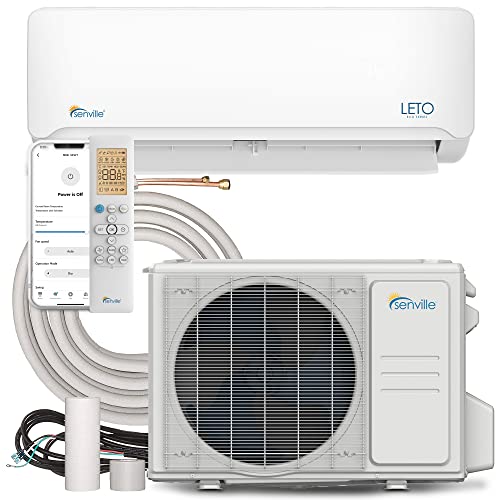
Senville LETO Mini Split 9000 BTU — The Different Rulebook
The Senville LETO mini split cannot be judged by portable standards at all, and including it is this guide’s way of making that point with hardware. A ductless split separates the compressor — outdoors — from the air handler indoors, so there is no hose penalty, no window surrendered and no compressor in the room to measure with a sound meter at midnight. Its 9,000 BTU rating, heat pump function and inverter drive answer to seasonal efficiency thinking rather than to ASHRAE-versus-SACC translation.
That difference flatters the split in every lab category that matters. Seasonal efficiency for a split is expressed through SEER-style ratings that reward exactly the inverter part-load behaviour these systems excel at, and the in-room noise question nearly disappears because the moving parts indoors are essentially a fan. The listing’s own claims are correspondingly calm: 9,000 BTU, 0.75 ton, 110/120V operation, Alexa compatibility and quiet operation — modest numbers attached to an inherently stronger architecture.
The examiner’s caveats are practical rather than thermal. A split is a semi-permanent installation involving refrigerant lines and an outdoor unit, which excludes most renters and many windows-and-budget plans, and its installed cost belongs to a different ledger from anything else in this guide. Judged purely by lab-test standards it is the strongest machine here; judged by the standards of a Saturday purchase, it is the one that demands the most commitment. Both judgements are true, and a measurement-led guide should say both.
- Published output: 9,000 BTU, 0.75 ton
- System: ductless mini split with heat pump
- Drive: energy-efficient inverter, per the listing
- Electrical: 110/120V operation stated
- Control: works with Alexa
- Architecture: outdoor compressor, indoor air handler
Strengths
- No hose penalty and no window occupied
- In-room noise reduced to fan level by design
- Heat pump makes it a four-season system
Trade-offs
- Installation is a project, not an unboxing
- Excluded for most renters by its permanence
- Total installed cost sits in a different class
Best for: homeowners who want the architecture that test standards reward most.
Not suited for: anyone who needs cooling this weekend without installation work.
How Do the Six Compare When Only Published Numbers Count?
| Pick | Badge | Published output evidence | Standards note |
|---|---|---|---|
| Midea U-Shaped Window AC 10000 BTU | Best Published Efficiency Story | 10,000 BTU; 450 sq. ft. stated | Efficiency saving claimed as a percentage |
| LG Window Air Conditioner 10000 BTU | Cleanest Conventional Specification | 10,000 BTU; room given as 18 by 25 ft | Full operational spec; CEER not headlined |
| Whynter ARC-1230WN Inverter Portable AC 14000 BTU | Portable With Real Dehumidification Data | 14,000 BTU inverter headline | Auto-drain dehumidification specified |
| Midea Duo Portable AC 14000 BTU Inverter | Strongest SACC Figure Here | 14,000 BTU with 12,000 BTU SACC | Both standards published together |
| GE Window Air Conditioner 10000 BTU WiFi | Most Complete Control Specification | 10,000 BTU; medium-room class | Scheduling as a seasonal-efficiency tool |
| Senville LETO Mini Split 9000 BTU | The Different Rulebook | 9,000 BTU split with heat pump | Seasonal metric applies; no SACC concept |
What Is the Difference Between ASHRAE and SACC Ratings?
The ASHRAE figure is the older laboratory rating: it measures the cooling a portable air conditioner produces under controlled conditions, essentially crediting the refrigeration circuit with its full effect. It is a real measurement of a real quantity — but the quantity it measures is not quite the one a room experiences, because a single-hose portable exhausts indoor air to the outside and the room replaces that air by pulling in warmth from every gap, corridor and adjoining space.
SACC — seasonally adjusted cooling capacity — was created to price that behaviour in. The current test procedure for portables models the infiltration penalty and the seasonal pattern of use, and produces a lower, more conservative figure that corresponds far better to the cooling a household actually receives across a summer. When a maker publishes both numbers, as Midea does for the Duo in this guide, the gap between them is itself diagnostic: a narrow gap signals a design that fights the infiltration penalty, a wide one signals a conventional single-hose machine.
The practical rule follows directly. Compare portables with each other by SACC whenever it is published, and never compare a portable’s ASHRAE headline against a window unit’s rating, because a window unit has no infiltration penalty to discount — its published figure is already close to delivered effect. Cross-format comparisons made with mismatched standards are how a 14,000 BTU portable ends up disappointing a buyer who expected it to out-cool a 10,000 BTU window machine.
A lab would add one more refinement: both figures are measured at specified test conditions, and real rooms depart from them. High ceilings, solar gain and internal heat sources all move the delivered result. The standards give you an honest common language; the room still has the final word, which is why coverage arithmetic — the next section’s subject — must always accompany the rating itself.
What Does CEER Tell You That a BTU Figure Cannot?
CEER, the combined energy efficiency ratio, answers the question BTU figures ignore: what does each unit of cooling cost in electricity? It divides the cooling output under the standard test by the electrical power drawn to produce it, including the small standby consumption that modern connected machines sip around the clock. A higher CEER means the same comfort for fewer kilowatt-hours, and over a long cooling season that difference compounds into the largest single variable in the true cost of ownership.
The ratio reframes purchasing entirely. Two window units with identical 10,000 BTU ratings can differ meaningfully in CEER, and the more efficient one may repay a higher purchase price within a couple of summers of daily use — faster in hot climates, slower in mild ones. A lab-test mindset therefore treats CEER as a price figure in disguise: it is the operating half of the ticket, printed in numbers instead of currency.
Applying CEER honestly requires admitting where it is absent. Several listings in this very guide do not headline the figure, because marketing prefers output and features. The number still exists — certified models carry it on their regulatory energy labels — and the measurement-led buyer’s habit is to retrieve it from the label or the manufacturer’s full specification before ranking finalists on running cost. A guide that invented the missing figures would be committing the exact sin this article exists to criticise.
Standby draw, folded into CEER, deserves its own sentence in the smart era. A WiFi machine listening for commands all winter consumes a trickle that older mechanical units never drew. The amounts are small, but a standards-led buyer notices them for the same reason a lab does: because the test procedure bothered to count them, and what the procedure counts, the bill eventually reflects.
How Should You Read a Decibel Claim — or Its Absence?
Decibels are logarithmic, which makes them the most misread numbers in the category. A difference of ten decibels is perceived by most listeners as roughly a doubling or halving of loudness, so the gap between a machine measured in the low fifties and one in the low forties is not a nuance — it is the difference between raising your voice and ignoring the machine entirely. Small numerical differences near the threshold of sleep, in the low forties and below, matter more than large ones at conversation level.
The catch is that a decibel figure is meaningless without its conditions. Sound level falls with distance, so a measurement taken at three metres flatters a machine compared with one taken at one metre; fan setting changes the result dramatically, since most machines are dramatically quieter on low than on turbo; and a figure quoted for cooling mode may exclude the compressor’s start transient, which is what actually wakes sleepers. A lab report specifies all of this. A carton almost never does.
That is why this guide credits design instead of digits where listings stay silent. A U-shaped window unit moves the compressor outside the glass; a split system moves it outside the building; an inverter avoids the repeated start transients of a fixed-speed machine. These are mechanisms a buyer can reason about honestly, unlike a bare number with no distance, no setting and no test behind it. Where a maker does publish a figure, demand the conditions before comparing it with a rival’s.
The buyer’s own test is simpler than any laboratory’s: if a machine will serve a bedroom, treat its noise evidence as a first-class criterion, equal to output. A cooler room that nobody can sleep in has failed its only examination that matters, and no efficiency ratio will comfort the examiner at 3 a.m.
How Does Room Size Testing Expose Optimistic Coverage Claims?
Coverage claims submit to arithmetic. The industry’s rough guidance for standard rooms clusters around a familiar band of output per square foot, varying with climate and ceiling height, so a claim can be checked by dividing the unit’s output by its stated area and asking whether the quotient sits inside or outside the plausible band. Claims inside the band earn provisional trust; claims far outside it are asking the machine to do physics it cannot do.
Shape is the second test, and the LG listing in this guide passes it unusually well by publishing room dimensions rather than area alone. Air from a single window unit or portable grille distributes unevenly, so a square room and a corridor of equal area are different test conditions. A lab-minded buyer with a long room should discount any area claim accordingly and budget for a circulation fan, which is cheaper than the next size of machine and often more effective.
The third test is the load inventory. Kitchens, sun-facing glass, home gyms, server corners and rooms above uninsulated garages all add heat that the standard coverage band does not assume. Test procedures are run in controlled chambers; your room is not one. The honest method is to start from the maker’s area claim, then adjust downward for every load your room adds and upward for shade, insulation and a northern aspect.
Finally, hold portables to the SACC translation inside the coverage test as well. A portable whose stated area was computed from its ASHRAE headline will under-deliver against that area in real seasonal use. The makers in this guide who publish SACC alongside coverage — or whose coverage is stated conservatively against the honest figure — are demonstrating exactly the discipline this article exists to reward.
Why Do Inverter Machines Complicate Single-Number Comparisons?
A conventional compressor is binary: full output or silence. Its nameplate rating therefore describes its behaviour completely, and a lab can characterise the machine with a handful of steady-state measurements. An inverter compressor is a dimmer rather than a switch, varying its speed continuously between a minimum and a maximum, and its real behaviour across a day is a curve, not a point. Any single figure attached to such a machine is a summary, and summaries hide the interesting part.
The interesting part is part-load. Most cooling hours in most climates are not peak hours; the machine needs to remove a modest amount of heat steadily, which is precisely where an inverter excels — sipping power at low speed, holding temperature within a narrow band, and avoiding the start-up surges and noise transients of cycling. Seasonal metrics exist largely to capture this advantage, which a peak-output figure cannot express. Judging an inverter by its headline alone is like judging a car by its top speed for a commute.
This is also why inverter portables and window units in this guide are discussed in terms of behaviour — steadiness, modulation, quiet part-load running — rather than ranked by a single invented score. The honest evidence available to a buyer is the published rating set, the maker’s stated savings claims where they exist, and the architecture itself. A measurement-led guide works with that evidence and declines to counterfeit the rest.
For the buyer, the translation is practical: if your climate delivers long, moderate cooling seasons, weight inverter designs heavily even at a premium; if your problem is a handful of brutal peak days in a small room, a conventional machine’s peak output per unit of money may serve you better. The standards do not choose for you — they clarify what your money is actually buying.
What Should a Buyer Demand From a Product Page Before Trusting It?
Demand the pair of numbers where a pair exists. For any portable, the SACC figure beside the ASHRAE headline; for any room claim, the dimensions beside the area; for any efficiency story, the CEER or seasonal rating beside the adjectives. A page that supplies these is a page written by people who expect examination. A page that supplies none of them is asking to be bought on photography, and photography has never cooled a room.
Demand conditions for every decibel. If a sound figure appears without a distance and a fan setting, file it as marketing and look for mechanism evidence instead — compressor placement, inverter drive, a sleep mode that demonstrably lowers fan speed. If no sound evidence of any kind appears, assume the machine is unremarkable in that department and let other criteria decide, rather than assuming silence from silence.
Demand consistency across the maker’s own range. A brand whose small model claims the coverage of its large one, or whose savings percentages change with the webpage, is telling you how its numbers are produced. Consistency is the cheapest form of credibility, and the makers represented in this guide were partly chosen because their published figures cohere with each other and with the arithmetic a buyer can do on an envelope.
Finally, demand the regulatory label before the final decision between two finalists. The energy label is the one document in the entire transaction that a manufacturer may not embellish, and five minutes with two labels — output, efficiency ratio, estimated yearly consumption — will settle arguments that fifty marketing pages cannot. That is the whole philosophy of this guide compressed into one errand.
How Do Heat Modes and Dehumidifiers Survive a Standards Reading?
Several machines here offer heat, and a standards reading treats a heat mode as a separate appliance sharing a cabinet. Its output is measured in the same BTU language but under heating test conditions, and its efficiency depends entirely on the mechanism: a heat pump moves heat and can deliver several units of warmth per unit of electricity, while a resistance element converts electricity one-for-one. The Midea Duo’s listing frames its heat within an inverter heat-pump architecture; the Senville’s heat pump is its defining feature. In both cases the mechanism, not the mode’s existence, is the finding.
Dehumidification submits to measurement just as readily, in pints or litres removed per day under stated conditions. Listings that describe the drainage engineering — the Whynter’s auto drain in this group — are offering the testable part of the story, because a dehumidifier that stops with a full tank removes no moisture at all in its owner’s absence. Continuous drainage is therefore not a convenience feature in humid climates; it is the difference between a rated capacity and a delivered one.
The standards habit generalises beyond this category: for every secondary mode, ask what is measured, under what conditions, and what interrupts it. A mode that cannot run unattended, or whose capacity is never stated, should be valued at close to zero in a comparison — however large it looms in the feature list. Feature lists count modes; laboratories weigh them.
Applied consistently, this scepticism is not cynicism. The machines in this guide that publish real figures for their secondary functions — drainage paths, heat coverage areas, mode lists with numbers attached — emerge from the process with their reputations enhanced. Measurement, fairly applied, rewards the honest maker. That is precisely why it is worth applying.
Which of These Six Wins on Evidence Alone?
Scored strictly on published evidence, the field separates into temperaments. The Midea Duo offers the single most decision-ready portable file: both BTU standards, the group’s strongest SACC figure, a stated heat coverage. The Midea U offers the most testable efficiency claim in a window format, attached to coherent coverage arithmetic. The LG offers the most complete conventional specification, dimensions included. Each leads a different evidentiary category, and a lab would refuse to collapse those into one ranking without stating its weightings — so this guide does the same.
The GE’s file is the most ordinary, which cuts both ways: nothing to object to, and the key efficiency and noise figures left to the regulatory label. The Whynter’s file is strong on moisture engineering and lighter on rating translation. The Senville, finally, is barely playing the same sport: its architecture exempts it from the portable compromises entirely, at the price of installation permanence that no test score can discount away.
The practical conclusion is that evidence-led buying rarely ends with a single winner; it ends with a shortlist whose claims you have verified and whose omissions you have priced. Choose the machine whose published strengths match your room’s actual weakness — humidity, noise sensitivity, running cost, installation constraint — and you have used lab-test standards the way laboratories use them: not as theatre, but as a way of deciding under uncertainty with the numbers you can defend.
How Are These Machines Tested Before They Earn Their Ratings?
Understanding the test explains the numbers. Rating procedures run the machine in a controlled chamber at specified indoor and outdoor temperatures and humidity, measuring the heat removed and the power consumed once conditions stabilise. The chamber is the point: by holding every variable constant except the machine, the procedure isolates the appliance’s contribution, which is what allows two models tested in different years to be compared at all.
Seasonal procedures go further, weighting performance across a range of outdoor temperatures rather than a single punishing afternoon. That weighting is why seasonal figures reward inverter machines, whose advantage lives in the mild majority of hours, and why a peak-condition rating can make a crude but powerful machine look equal to a refined one. Neither procedure is wrong; they answer different questions, and the sophisticated buyer asks which question resembles their summer.
The chamber’s virtue is also its limit. No test cell contains a west-facing window, a gaming computer, a dog that opens doors or a ceiling two feet taller than standard. Delivered performance in a real room is the rating filtered through the building, which is why this guide keeps returning to coverage arithmetic and load inventory: they are the buyer’s own test procedure, run on the only chamber that matters.
Knowing this should change how you read every figure in this article — not into cynicism, but into calibration. A rating is a promise about a standard room under standard weather. Your task is to estimate how far your room departs from the standard, and in which direction, and then to choose the machine whose published evidence still holds after that adjustment.
What Role Does Airflow Play in the Numbers?
Cooling capacity is only half of delivered comfort; the other half is distribution. A machine’s airflow rating — the volume of air it moves — decides how quickly cooled air reaches the far side of the room and how evenly the temperature settles. Two units with identical BTU figures can produce noticeably different rooms if one stirs the air thoroughly and the other pools its output at the window.
Laboratories measure airflow under the same controlled conditions as capacity, but listings publish it even less often than efficiency ratios, which leaves buyers to reason from design: louvre range and oscillation, fan speed steps, and the physical placement the format allows. The window units here distribute from a fixed point by necessity; the portables can at least be aimed, and the split’s wall-mounted handler throws air across the room from height, an underappreciated part of its real-world advantage.
Airflow also mediates noise. Moving a given volume of air slowly through a large grille is quieter than forcing it quickly through a small one, which is why fan design and speed range appear in any serious acoustic discussion. A machine with many fan steps lets the owner trade a little distribution for a lot of quiet at bedtime — a trade the single headline figures never mention and the experienced buyer always asks about.
For the practical shortlist, the lesson is to treat throw and spread as tiebreakers between machines whose ratings are otherwise close. In a square, modest room they will never matter; in a long or L-shaped space they can matter more than the last thousand BTU on the carton.
What Mistakes Do Buyers Make When Comparing Air Conditioner Numbers?
Comparing a portable’s ASHRAE headline with a window unit’s rating. The two figures live under different test realities; the portable must be translated through SACC first, or the comparison is fiction with decimal points.
Treating a decibel figure as self-explanatory. Without a distance and a fan setting, the number cannot be compared with anything — including the same maker’s other models. Demand conditions or discount the claim entirely.
Ignoring CEER because the carton leads with output. Output decides whether the room cools; CEER decides what the summer costs. A buyer who reads only the first number has read only half the price.
Believing coverage claims without dividing. Output divided by stated area takes ten seconds and exposes the claims that physics will not honour. Makers whose arithmetic coheres deserve the shortlist places that optimists forfeit.
Assuming an unpublished figure must be favourable. In specification writing, silence is data: makers publish their best numbers loudly. Treat every missing metric as neutral at best, and go to the regulatory label for the truth.
Inventing precision the evidence cannot support — a habit this guide has refused throughout. A comparison built on two honest numbers and one admitted unknown will outperform, in real rooms, a ranking built on ten figures of which half were guessed.
Final Recommendation
On the evidence published, the Midea Duo is the portable to beat, because it submits the strongest SACC figure in the group and prints it beside its headline without being asked. Among window units, the Midea U’s testable efficiency claim and coherent coverage make it the evidence-led choice for a main living space, with the LG the pick for buyers who prize a complete conventional specification and the GE for those who value scheduling as part of seasonal efficiency. The Whynter remains the humid-climate specialist, and the Senville stands as the reminder that the best-scoring architecture is the one that moves the compressor out of the room entirely.
The evidence points to three starting points: the Midea Duo Portable AC 14000 BTU Inverter among portables, the Midea U-Shaped Window AC 10000 BTU among window units, and the Senville LETO Mini Split 9000 BTU for owners ready to change architecture altogether.
Take the method with you even if you take none of the machines: translate every portable through SACC, divide every output by its power draw and its claimed area, demand conditions for every decibel, and let the regulatory label settle the arguments marketing starts. A buyer armed with those four habits cannot be sold a fantasy — and in a category built on numbers, the discipline of reading them properly is the closest thing to a laboratory any of us will ever own.
Frequently Asked Questions
What is SACC and why is it lower than the BTU on the box?
SACC is the seasonally adjusted cooling capacity from the current test procedure for portable air conditioners. It models the warm air a single-hose portable draws back into the room and the pattern of real seasonal use, so it reads lower than the older ASHRAE laboratory figure — and predicts delivered cooling far better. Compare portables by SACC whenever makers publish it.
Is a higher CEER always worth paying more for?
Usually, but the payback depends on hours of use. CEER measures cooling delivered per unit of electricity, so in a hot climate with daily running, an efficient model can repay its premium within a few seasons; in a cool climate where the machine runs twenty evenings a year, the saving may never catch the price difference. Check the regulatory label’s estimated yearly consumption for both finalists and do the subtraction with your own tariff.
Can I trust a manufacturer’s noise claim?
Trust it only with its conditions attached: distance from the unit and fan setting change the figure substantially, and a claim published without them is not comparable with a rival’s. Where no figure is published, judge the mechanism instead — compressors mounted outside the room or the building, and inverter drives that avoid repeated start-up transients, are credible reasons to expect quieter running.
Why does this guide not give each model a lab score?
Because no laboratory results for these specific models were available to it, and inventing scores would repeat the category’s worst habit. The guide instead applies the standards a lab uses — rating translation, efficiency ratio, noise conditions, coverage arithmetic — to the figures manufacturers publish, and flags every place where a maker has declined to publish. That is the most honest version of measurement-led buying, and it is the version a careful reader can reproduce at home with nothing more than the listings, the labels and a few minutes of arithmetic.
How many BTU do I need for my room, honestly?
Start from measured floor area and the conventional guidance band for your climate, then adjust: add capacity for high ceilings, large sun-facing windows and kitchen heat; subtract for shade and good insulation. For portables, perform the calculation against the SACC figure rather than the headline. If your room falls between sizes, the larger machine run gently is usually quieter and cheaper than the smaller one run flat-out.
Are mini splits really more efficient than window units?
Yes, architecturally. A split places the compressor outdoors, eliminates the hose and window-leak penalties, and uses inverter control optimised for the steady part-load running that dominates real seasons — which is what seasonal efficiency ratings reward. The trade is installation: a split is a fitted system, not an appliance purchase, so its superior numbers arrive with a fitter’s invoice attached.
Related Guides
The same evidence-first habit serves well in the kitchen, where our dishwasher and toaster guides separate published specification from brochure language — see Best 18-Inch Dishwashers, Best Apartment Dishwashers, Best 4-Slice Toasters.


