What's inside
- Key Takeaways
- Quick Picks
- What Did We Look for Before Calling a Dishwasher Good Value?
- How Do the Six Affordable Routes Compare?
- What Does Affordable Really Cost Once Installation Is Counted?
- How Many Place Settings Do You Actually Need?
- Which Budget Features Are Worth Paying For, and Which Are Not?
- How Can You Keep a Budget Dishwasher Cheap to Run?
- When Is a Portable the Smarter Buy Even With an Empty Cabinet?
- What Should You Check on Delivery Day?
- How Does a Budget Dishwasher Change a Household’s Evenings?
- Which Money Mistakes Do Budget Dishwasher Buyers Make?
- Final Recommendation
- Frequently Asked Questions
- Related Guides
As an Amazon Associate I earn from qualifying purchases. This post may contain affiliate links at no extra cost to you.
cottageverdict.com is reader-supported. When you buy through links on our site, we may earn an affiliate commission.
Where to buy: the six machines in this guide are all listed on Amazon, and each name links to its listing so you can check the current specification, the included hoses or racks, and what owners are offered before you commit to the budget option that fits your kitchen.
The best affordable dishwashers are not the cheapest machines on the page; they are the ones whose compromises land where a particular household will never notice them. A renter, a student house and a family buying their first built-in all say the word affordable and mean three different machines. This guide sorts six budget routes by situation instead of by sticker, because the wrong cheap dishwasher, replaced in three years, costs more than the right one would have on day one.
Two families dominate the value end of the market. Countertop and portable machines ask for no cabinet, no plumber and no landlord permission, and they repay that freedom with small capacity and a slice of your worktop. Entry-level twenty-four-inch built-ins ask for a standard opening and a proper installation, and repay it with family-size loads and a kitchen that looks finished. Everything below is one of those two trades, dressed in different finishes and cycle lists.
A word on what affordable should never mean. It should not mean a plastic interior that stains in a year, a wash that leaves grit in glasses, or a machine so loud the household schedules life around it. The picks here were chosen because their listings show the fundamentals done properly: sensible place-setting counts, recognised efficiency credentials where claimed, and cycle ranges that cover a real week of cooking. The savings come from size, finish and frills, not from the wash itself.
Key Takeaways
- Decide first between no-install countertop freedom and built-in capacity; that choice halves the list.
- Countertop models suit one or two people washing daily rather than stockpiling.
- A basic twenty-four-inch built-in is the cheapest route to family-size loads per wash.
- Stainless tubs and Energy Star notes on a listing are the budget features most worth having.
- Count place settings honestly against your largest regular load, not your average one.
- Installation costs belong in the budget for built-ins; a cheap machine plus fitting can match a dearer portable.
Quick Picks
| Pick | Badge | Why it earns a place |
|---|---|---|
| COMFEE’ Countertop Dishwasher Energy Star Portable | Best All-Round Countertop Value | Eight programs and Energy Star standing make this the countertop pick that feels least like a compromise. |
| EdgeStar DWP63 Countertop Dishwasher | Best Plain Countertop Workhorse | A straightforward six-setting countertop unit for buyers who want the wash, not the program menu. |
| BLACK+DECKER 24 Inch Built-In Dishwasher BDW100MB Black | Best Budget Full-Size Built-In | Twelve settings, a stainless tub and five programs in black, for kitchens with a standard opening. |
| Seasons 24 Inch Front Control Dishwasher Black | Best No-Frills Front-Control Built-In | A plainly specified front-control machine for buyers who distrust hidden controls and long menus. |
| Midea Countertop Dishwasher Portable 6 Place | Best Compact Portable for Quiet Corners | A silver countertop unit whose listing quotes 52 dB and eight cycle options for small-space living. |
| NOVETE Portable Countertop Dishwasher | Best Portable That Needs No Tap Connection | A built-in water tank means it can run where no suitable faucet exists, from rentals to camper setups. |
What Did We Look for Before Calling a Dishwasher Good Value?
Value was judged as cost per year of uncomplaining service, which pushed the reading toward build fundamentals. Tub material came first, because a stainless interior resists the odours and discoloration that make budget machines feel old before their time. Place settings came second, read sceptically: the figure is a manufacturer’s best case, so we mentally docked every claim and asked whether the remaining realistic capacity matched the household each pick is aimed at.
Cycle lists were read for coverage rather than length. A budget machine needs a genuine quick wash for lightly soiled loads, a thorough everyday program, and something hotter for pans and baby items; beyond that, extra programs are decoration. Listings mentioning baby-care or high-temperature options scored well for young families, while delay timers and smart features were treated as pleasant extras that should never be the reason a tight budget stretches.
Finally, we considered the total purchase, not the headline. Countertop machines arrive nearly complete, needing a tap connection and counter space. Built-ins may need a fitting kit, a power connection and professional installation, all of which belong in the comparison. A guide that pretends otherwise would steer readers toward a machine that is only cheap until the installer invoices.
One more filter was applied quietly throughout: every machine here had to make sense as the only dishwasher in its home. Budget guides sometimes excuse a weak wash because a model is cheap, but a household with one machine has nowhere else for a failed load to go. Each pick below was therefore read as a sole provider, and any listing whose fundamentals suggested the sink would remain a co-worker was left out, whatever its price advantage.
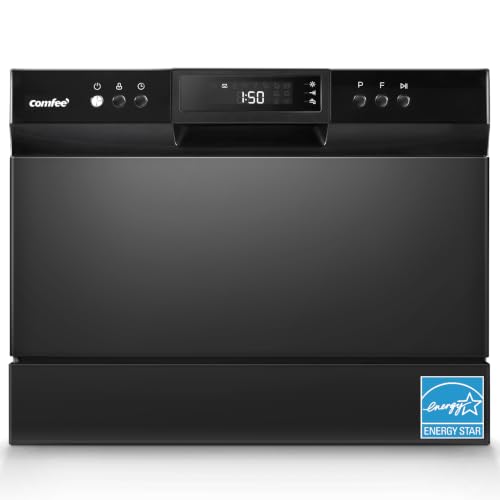
COMFEE’ Countertop Dishwasher Energy Star Portable — Best All-Round Countertop Value
COMFEE’ has built its name on small kitchens, and this countertop model shows why. The listing promises six place settings and eight washing programs, a spread that would not embarrass a built-in: alongside the everyday cycles there are speed and glass options and a baby-care program that young parents will use far more than they expect. Energy Star standing in the title matters at this end of the market, because a portable machine that runs daily in a small flat should not quietly tax the electricity bill it was bought to protect.
The daily experience is the real argument. Dishes from a day of cooking for two load in a few minutes, the machine connects at the sink, and the counter gives back its space the moment the unit is stored or simply left in its corner. Households upgrading from a washing-up bowl notice the change most at night: the last pans go in, the door closes, and the kitchen is finished. That feeling, repeated daily, is what the money buys, and this model delivers it with the least fuss in its class.
Its limits are the class limits. Six settings will not swallow a roast dinner for six, the counter footprint is permanent while the machine lives with you, and anyone whose sink tap is an unusual shape should confirm the connection arrangement on the listing before ordering. Within those honest boundaries, this is the portable to beat: the program list is generous, the efficiency credential is real, and the format asks nothing of your landlord or your cabinetry.
Ownership details reward a mention. Eight programs invite experimentation, but most households settle on two within a fortnight, and the machine is at its best treated that way: an everyday cycle for the standard load and the speed option for the morning-after-a-dinner-party scramble. The glass program, though, deserves its place in the rotation for anyone whose glassware has begun to cloud, because gentler water and temperature are kinder to the glasses a household actually drinks from daily than any amount of careful hand-washing in cooling water.
Verdict on value: for a small household this is the benchmark portable, the one rival listings must beat on programs or efficiency before they deserve a look.
One last practical note: countertop machines reward a fixed home. Sliding a filled, plumbed unit around the worktop invites leaks and resentment, so choose its corner as carefully as you would a built-in’s bay, with the tap, the drain and the cupboard for clean dishes all within one turning step.
For households choosing between this and a built-in they cannot yet afford, the portable has one more virtue: it teaches the household its true load size. A month of counting how often the six settings fill tells you, with evidence, whether the future built-in needs twelve settings or whether a slim machine would do, and that knowledge is worth money at the next purchase.
- Format: countertop portable
- Capacity: 6 place settings
- Programs: 8 washing programs including Speed, Baby-Care, ECO and Glass
- Credential on listing: Energy Star
- Colour noted on listing: black
Strengths
- Eight programs is unusually generous at this level
- Energy Star standing keeps daily running costs sensible
- Baby-care cycle is genuinely useful for young families
Trade-offs
- Six settings cap the size of a single load
- Occupies a permanent block of counter while owned
- Sink connection depends on a compatible tap arrangement
Best for: couples and small families in flats without a dishwasher cabinet
Not suited for: households regularly cooking for five or more

EdgeStar DWP63 Countertop Dishwasher — Best Plain Countertop Workhorse
The EdgeStar DWP63 takes the opposite route from the COMFEE’ above: fewer flourishes, same job. Its listing describes a countertop machine a little under twenty-two inches wide with six place settings, which is the standard portable footprint, and that standardisation is itself a virtue. It will sit where owners of earlier portables expect it to sit, connect the way they expect it to connect, and wash the same daily load without asking anyone to learn a new routine.
Where the COMFEE’ sells breadth of programs, the EdgeStar sells plainness, and plainness has a loyal audience. In a shared house, a holiday let or a small office kitchen, a machine that housemates and guests can operate without instructions is worth more than two extra cycles. The front-loading layout is familiar to anyone who has used a built-in, the interior is arranged for the plates-and-mugs reality of small households, and the whole unit can be installed by its owner in an afternoon with no trades booked.
Choose between this and the COMFEE’ by household, not by headline. A family with a baby will use the baby-care program weekly and should pay for it. A couple or a shared flat that simply wants the washing-up gone will never open the extra programs, and for them the EdgeStar’s simpler pitch is the smarter spend. Either way, measure the counter height beneath any wall cabinets first; portables are tall enough to fall foul of low cupboards, and that measurement is the one that decides whether any countertop model can come home at all.
A word about where this machine thrives geographically. Holiday lets, granny annexes and staff kitchens share a pattern: many users, simple loads, and a premium on appliances nobody needs to be taught. The DWP63 fits that pattern so well that it often becomes the default replacement when an earlier portable fails, because the counter gap, the connection and the household routine are all already shaped around exactly this footprint. Continuity is a genuine saving when the alternative is re-plumbing a cupboard for a different format.
Verdict on value: the honest workhorse of the pair, best bought by households that value simplicity over cycle-count bragging rights.
One last practical note: because this class of machine is often bought for a second property, check the listing’s voltage and plug details if it will travel between homes, and keep its connection adaptor taped to the unit so the second kitchen is never missing the one small part that makes it work.
Second-hand buyers should note this model class specifically. Portables change hands constantly as people move and refit, and a plain, current, standard-footprint machine is the easiest to buy used with confidence, because its connection, capacity and behaviour are all known quantities with no discontinued app or panel to worry about.
- Format: countertop, 21-5/8 inch wide per the listing
- Capacity: 6 place settings
- Loading: front door, built-in style
- Colour noted on listing: white
- Installation: owner-installed at the sink
Strengths
- Familiar layout that guests and housemates understand instantly
- Standard portable footprint fits established counter spots
- Owner installation avoids any fitting costs
Trade-offs
- Fewer specialist programs than the COMFEE’ rival
- White finish will not match every kitchen scheme
- Same six-setting ceiling as every countertop here
Best for: shared houses, lets and couples who want simple daily washing
Not suited for: parents wanting a dedicated baby-care program

BLACK+DECKER 24 Inch Built-In Dishwasher BDW100MB Black — Best Budget Full-Size Built-In
The BLACK+DECKER BDW100MB is where this guide crosses from portables into proper built-ins, and the jump in capability is the story. Twelve place settings double the countertop capacity, the listing specifies a stainless steel tub at this budget level, which is the single most welcome surprise in the guide, and five wash programs include a smart wash cycle that adjusts to the load. For a household with a standard empty dishwasher bay, this is the least money that buys a genuinely family-capable machine.
The stainless tub deserves emphasis because budget built-ins so often hide plastic interiors. Plastic tubs stain, hold smells and flex; stainless ones shrug off years of tomato sauces and dishwasher-tablet chemistry, and they help drying by holding heat. Finding one under a mainstream budget badge changes the long-term maths: this is a machine that can plausibly serve a decade, which is what makes an affordable purchase actually affordable rather than merely cheap this quarter.
The black finish will divide opinion and should be chosen deliberately. In a kitchen with black appliances it completes a set for very little money; in a pale kitchen it becomes the visual anchor of the room, which some owners love and others regret. Installation costs apply here as with any built-in, so budget for fitting and a connection kit alongside the machine, and confirm the opening is a true twenty-four inches with services in reach. Do that, and this is the value pick of the entire list for families.
Think about the household five years from now before dismissing the built-in as the extravagant option. Children grow into full-size plates, a couple becomes a family, a keen cook accumulates pans, and a twelve-setting machine absorbs all of it without a second purchase. The portables in this guide are honest tools for a stage of life; this built-in is a tool for the stage after, bought early at a budget badge’s price. Households confident they will stay in the same kitchen should weigh that horizon heavily.
Verdict on value: the strongest cost-per-year proposition here for any kitchen that already has the opening waiting.
One last practical note: measure the opening’s depth as well as its width. A full-size machine that protrudes past the cabinet line because a pipe run steals depth will annoy daily, and the time to discover a shallow bay is before delivery day, not during it.
Hosts should think about the second load. A twelve-setting machine’s real party trick is not the dinner itself but the turnaround: glasses and starter plates washing while the main course is eaten, ready for dessert. That rhythm turns a small kitchen into a workable entertaining space, and it is unavailable at any portable capacity.
- Format: 24-inch built-in, black
- Capacity: 12 place settings
- Tub: stainless steel per the listing
- Programs: 5 wash programs including Smart Wash
- Credential on listing: Energy Star
Strengths
- Stainless tub at a budget badge is rare and valuable
- Twelve settings handle genuine family loads
- Smart Wash takes the guesswork out of program choice
Trade-offs
- Installation and connection costs add to the headline
- Black finish is a strong visual commitment
- Five programs is a modest menu beside premium machines
Best for: families with an empty standard dishwasher bay
Not suited for: renters or anyone without permission to install

Seasons 24 Inch Front Control Dishwasher Black — Best No-Frills Front-Control Built-In
The Seasons front-control dishwasher is the most plainly presented machine in this guide: a twenty-four-inch built-in in black with its controls on the front face, described in a listing title of admirable brevity. That brevity tells you the pitch. This is a dishwasher for buyers who have been burned by touch panels, app connections and program wheels, and who simply want to press a button, see what they pressed, and hear the machine start.
Front controls carry practical advantages that have nothing to do with nostalgia. The selected program is visible at a glance from across the kitchen, a cycle can be changed without opening the door, and in a household where several people share the machine, everyone can see the state of play. For older users and for anyone fitting out a rental property, that legibility is a feature worth paying a small premium in attention to find, and here it arrives in one of the most affordable packages in the guide.
The honest caveats are about information. The listing title gives format, control position and colour, and buyers should read the full listing carefully for capacity, tub material and cycle details before ordering, because those are the numbers that decide whether this plain machine suits a family or a flat. Treat it as the shortlist candidate for straightforward needs: a rental upgrade, a first built-in, a replacement for a failed machine where the opening is standard and the requirement is simply clean dishes without ceremony.
Rental landlords should read this pick with particular interest. A front-control machine in a tenanted property reduces the two frictions landlords actually meet: tenants who cannot work a touch panel and leave the machine unused and resentful, and callouts that turn out to be a control lock rather than a fault. A legible machine generates fewer of both. For an owner-occupier the same legibility serves visiting family and older relatives, the people who load a dishwasher twice a year and should not need a tutorial to do it.
Verdict on value: bought with its full listing checked, it is the low-drama choice for rentals and first-time built-in buyers.
One last practical note: front controls collect fingerprints and the occasional splash, so in a hard-water kitchen a quick weekly wipe keeps the legends legible. It is the smallest maintenance task in this guide and the one that keeps the machine’s main virtue, clarity, intact.
There is a dignity argument for machines like this in later-life kitchens. Controls that can be read without bending to a hidden panel, and a door whose state is obvious, help an older cook keep running their own kitchen confidently. Families equipping a parent’s flat should weigh that clarity as heavily as any efficiency figure.
- Format: 24-inch built-in, black
- Controls: front control per the listing
- Size class: full-size standard opening
- Listing style: concise; verify capacity and cycles on the full listing
- Best role: rental and first built-in installations
Strengths
- Front controls are legible to every user in the house
- Full-size format suits a standard existing opening
- Plain specification keeps the purchase simple
Trade-offs
- Listing title is brief; homework needed on details
- Black finish will not suit every kitchen
- Fewer headline features than badge rivals
Best for: landlords, first-time built-in buyers and fans of visible controls
Not suited for: buyers who want long program menus and smart features

Midea Countertop Dishwasher Portable 6 Place — Best Compact Portable for Quiet Corners
Midea’s countertop entry competes directly with the COMFEE’ portable and differentiates itself in the listing with two details: a quoted 52 dB operating level and a six-plus-two cycle arrangement. The noise figure matters in the homes these machines serve. A countertop dishwasher in a studio flat runs within earshot of the sofa, the desk and the bed, and a machine that can wash through a film or a work call without dominating the room earns its place differently from one banished to overnight runs.
The cycle wording, six plus two, suggests a core menu with additional options, and the listing frames the machine squarely at apartments, dorms and RVs. That framing is accurate about scale: six place settings is a day of dishes for one or two people, and the silver finish suits the pale, small kitchens where these units usually land. Energy Star standing appears in the title as well, keeping the daily running-cost story consistent with the best portables in this guide.
Pick between this and the COMFEE’ on the details of your room. If the machine will live within a few feet of where you relax, the quoted quietness deserves real weight. If a baby-care program will be used weekly, the COMFEE’ answers better. If the unit is headed for an RV or a dorm, check the listing’s dimensions against the exact shelf or counter it must occupy, because in those spaces a centimetre is a decision. All three are good machines; the room chooses among them.
The six-plus-two cycle phrasing deserves a buyer’s translation. Core cycles do the week’s real work, while the additional options typically cover a hotter or more specialised treatment used occasionally. That structure suits small households well, because the daily decision stays simple while the occasional need, a preserving day, a curry night, a set of feeding bottles from a visiting grandchild, still has a program waiting. Read the full listing to name those extra cycles before ordering, so the machine’s occasional talents match your household’s actual occasions.
Verdict on value: the small-space specialist, strongest where the dishwasher shares a room with daily life.
One last practical note: in an RV or dorm, secure the unit for travel or for the bumps of shared living. A machine that walks across a counter under vibration will eventually find the edge, and a simple non-slip mat plus a strap for transit removes the risk entirely.
Students and first-flatters should hear the counter-space warning in its kindest form: in a truly tiny kitchen this machine will share its counter with chopping, and the household will develop a choreography around it. Most find the trade gladly worth it by the second week, when the sink stays empty for the first time since moving in.
- Format: countertop portable, silver
- Capacity: 6 place settings
- Cycles: 6+2 per the listing
- Noise: 52 dB quoted on the listing
- Credential on listing: Energy Star; aimed at apartments, dorms and RVs
Strengths
- Quoted 52 dB suits studio and open-plan living
- Energy Star standing matches the best portables here
- Silver finish blends into pale small kitchens
Trade-offs
- Six settings remain a one-or-two-person capacity
- Cycle structure needs a careful read on the listing
- Counter footprint is significant in the smallest kitchens
Best for: studio flats, dorms and RV owners washing for one or two
Not suited for: families needing a full-size load in one run

NOVETE Portable Countertop Dishwasher — Best Portable That Needs No Tap Connection
The NOVETE solves the one problem that stops some households buying any countertop dishwasher: the tap. Its listing describes a built-in five-litre water tank alongside the usual inlet hose, so the machine can be filled by jug and run in a kitchen whose faucet will not accept a connector, in a rented room, in a workshop, or in a camper where plumbing is a jug and a drain. That single design decision opens the portable category to people it previously excluded.
Around the tank, the listing promises five washing programs including a baby-care option, an air-dry function and an LED light inside. The air-dry detail pairs naturally with tank use: a machine filled by hand often sits in a room without extraction, and a drying function that moves air through the tub keeps the interior fresher between runs. The LED light sounds trivial until you load a small machine in a dim corner and discover how much easier it is to place glasses correctly when you can actually see the rack.
The trade is effort. Filling a five-litre tank is a small chore that tap-connected owners never think about, and in a busy family kitchen it would pall within a week. This machine is therefore best understood as the answer for specific addresses: the tap that will not fit, the room that was never plumbed, the van or annex where dishes still deserve better than a bowl. For those addresses it is not a compromise at all; it is the only machine in the guide that works there.
The tank also changes where dishes can be washed at all. A utility room with a sink too small for a washing-up bowl, a garden office, a boat, a market stall’s back room: anywhere with power and a drain or a bucket becomes a dishwashing station. That flexibility explains this model’s following among people whose lives do not happen in conventional kitchens. If your household is conventional, the tap-fed rivals are less work; if it is not, this machine may be the difference between a dishwasher and none.
Verdict on value: priced against the alternative of no dishwasher at all, the tank makes it the standout for unplumbed spaces.
One last practical note: tank users should empty and dry the tank if the machine will sit unused for a week, particularly in warm rooms. Fresh water in, fresh water out is the whole hygiene story of a tank-fed machine, and it takes less than a minute to keep it that way.
Gift buyers take note: this is the rare appliance that can be given to someone in rented or temporary housing without creating an installation problem for them. It arrives, it fills, it washes. Few presents survive contact with a landlord’s rules as gracefully as a tank-fed portable does.
- Format: countertop portable with tank or hose feed
- Tank: 5L built-in water tank per the listing
- Programs: 5 washing programs including Baby Care
- Extras on listing: air-dry function and LED light
- Best role: spaces without a compatible faucet
Strengths
- Runs without any faucet connection via its tank
- Baby-care program broadens its family appeal
- Air-dry keeps a small interior fresher between loads
Trade-offs
- Tank filling adds a manual step to every wash
- Capacity suits small households only
- Less set-and-forget than a plumbed or tap-fed rival
Best for: renters with incompatible taps, campers, annexes and workshops
Not suited for: busy family kitchens wanting fully automatic operation
How Do the Six Affordable Routes Compare?
The comparison that matters is not program counts; it is the shape of the commitment each machine asks for, in space, installation and daily effort.
| Pick | Format | Capacity note | Standout trait |
|---|---|---|---|
| COMFEE’ Countertop Dishwasher Energy Star Portable | Countertop portable | 6 place settings | Eight programs, Energy Star |
| EdgeStar DWP63 Countertop Dishwasher | Countertop | 6 place settings | Simple, familiar operation |
| BLACK+DECKER 24 Inch Built-In Dishwasher BDW100MB Black | 24-inch built-in, black | 12 place settings | Stainless tub, 5 programs |
| Seasons 24 Inch Front Control Dishwasher Black | 24-inch built-in, black | Full-size capacity class | Front controls |
| Midea Countertop Dishwasher Portable 6 Place | Countertop portable, silver | 6 place settings | 52 dB listing figure |
| NOVETE Portable Countertop Dishwasher | Countertop with water tank | Small-household capacity | No-tap operation |
Read the table as two leagues. The built-ins win every capacity argument and lose every flexibility argument, while the portables reverse that exactly. Households routinely overbuy capacity and underbuy convenience, ending with a family machine washing three plates; or overbuy portability and spend years running two loads a day. Your largest regular load, honestly counted, is the number that should settle the league before any model is compared.
Within each league the margins are finer. Among portables, programs, noise and the tank decide; among built-ins, tub material and control style decide. Notice that none of those deciding factors is the badge on the door, which is the healthiest sign that the budget end of this market has matured: the differences are real, practical and legible from the listings themselves.
What Does Affordable Really Cost Once Installation Is Counted?
A built-in’s price is a down payment. Add a fitting kit, possibly an electrician if the kitchen lacks a suitable connection, and professional installation where local rules or personal confidence require it, and the total can climb well past a portable’s all-in cost. That does not make built-ins bad value; their cost per load over a decade is usually the lowest in this guide. It makes them a different purchase: a small home improvement rather than an appliance delivery, and it should be budgeted with the same honesty.
Portables invert the arithmetic. The machine costs what it costs, plus a counter it may share with a kettle and a board. The hidden charge is space and, in the NOVETE’s case, the small labour of filling a tank. Households that cook elaborately may find the counter space dearer than money, while households in studios often have a corner that earns nothing and can host a machine rent-free. Affordable, in other words, is partly a question about which currency your household has spare: cash, space or effort.
There is also a resale and removal angle. A portable leaves with you when you move, which makes it the only dishwasher purchase a renter fully owns. A built-in stays with the kitchen and may add a little to a property’s appeal. Neither fact should dominate, but for households expecting to move within two years, the portable’s portability is a financial feature as real as any cycle program.
How Many Place Settings Do You Actually Need?
Place settings are counted in a standardised way that flatters every manufacturer, so translate the number into your own crockery. Six settings realistically means a full day for one person who cooks, or dinner for two plus the pans if the loading is thoughtful. Twelve settings means a family dinner with serving dishes, or two days of a couple’s dishes, which is exactly the rhythm most built-in owners settle into.
The trap is buying for the biggest day of the year. A machine sized for Christmas will run half-empty all January, wasting water, energy and the cupboard space a smaller unit would have freed. The households in this guide’s audience are better served by sizing for the biggest ordinary week: the Sunday roast for the family who roasts, the batch-cooking day for the couple who preps. Extra guests’ dishes can queue at the sink twice a year without justifying a bigger machine.
Load shape matters as much as count. Wide pans, tall glasses and mixing bowls defeat nominal capacity in any machine, and small kitchens often own exactly those awkward items. If your cooking leans on sheet pans and stockpots, read listings for rack flexibility and interior height rather than the setting count, and expect to hand-wash the single largest item whichever machine you buy.
Which Budget Features Are Worth Paying For, and Which Are Not?
Pay for the tub. A stainless interior is the budget upgrade with a decade-long payoff in hygiene, drying and durability, and it is the first place we would spend beyond the minimum. Pay also, if your life needs it, for the one specialist program you will use weekly: baby-care in a house with bottles, a genuinely hot cycle in a house that preserves and pickles, a quick wash in a house that entertains informally and turns plates around mid-evening.
Do not pay for program count as a number. Beyond the core handful, additional cycles mostly rename combinations of temperature and time you could approximate anyway. Do not pay for connectivity in this price band either; an app that tells a phone the wash has finished solves a problem few households have, and the money buys a better rack or a quieter pump elsewhere in the same machine.
Delay start sits between the camps. It is worth having where electricity tariffs reward overnight running or where a household wants the machine to finish as they wake. It is worthless where the machine must be loaded and run around a baby’s sleep or a shift pattern anyway. Features are only features when they meet a routine; the rest is catalogue furniture, and a disciplined budget ignores it politely.
How Can You Keep a Budget Dishwasher Cheap to Run?
Running costs are where affordable is won or lost after the purchase. The habits are unglamorous: run full loads rather than frequent half loads, scrape rather than pre-rinse under a running tap, and let the eco program do its slower, cooler work overnight when time costs nothing. Each habit is worth more than the efficiency gap between two rival listings, which is why this guide refuses to rank budget machines by tiny specification differences while ignoring the household’s own routine.
Maintenance protects the investment at this level more than at any other. A budget machine’s filter, spray arms and door seal need the same monthly attention as a premium model’s, and households that give it will find the cheap machine still washing well when its neglected twin has faded. Descale where the water is hard, clear the spray-arm jets with a pin when glasses emerge gritty, and leave the door ajar between runs in a small flat so the interior dries instead of ripening.
Detergent choice matters too, and not in the direction advertising suggests. A modest tablet in a well-loaded machine outperforms a premium tablet in a chaotic one every time. Spend the savings from the machine’s purchase on nothing at all; the discipline of loading well is free, and at the budget end of the market it is the single largest performance upgrade available.
When Is a Portable the Smarter Buy Even With an Empty Cabinet?
An empty dishwasher bay tempts every buyer toward a built-in, but there are households the portable serves better even then. Anyone expecting to move within a couple of years takes the portable with them and leaves the cabinet debate behind. Anyone whose kitchen is scheduled for a refit should not buy a built-in sized for the old layout months before the new one is drawn. And anyone renting a furnished property may find the cabinet is not theirs to fill in the first place.
There is also the trial argument. A household unsure whether a dishwasher suits its rhythm, and they exist, can learn the answer from a portable in a month. If the machine runs daily and the counter sacrifice feels painless, a built-in can follow at the next refit with confidence. If it gathers dust, the portable sells on locally for much of its cost, and the lesson was cheap. Few other appliances offer so reversible a first step.
Finally, consider who does the dishes now. In a house where one person washes up reluctantly and another enjoys it, a portable placed at the reluctant one’s sink-side may change the household’s evenings more than a built-in across the room. Placement is a behavioural feature. Put the machine where the habit needs to form, and let the empty cabinet store the pans it was probably holding anyway.
What Should You Check on Delivery Day?
Check the machine before the packaging leaves. Photograph the box, open it with the courier’s timeframe in mind, and inspect the door edges, racks and tub for transit damage that is far easier to claim on day one than day nine. Run an empty cycle before the first real load: it flushes manufacturing residue, proves the connection watertight, and reveals any rattle or leak while returning the machine is still simple.
Keep the paperwork with the same care as the machine. The listing’s stated specifications, the order confirmation and the manual form the bundle that any future warranty conversation will ask for, and at the budget end of the market the household that can produce them is the household whose claim moves quickly. Ten minutes of filing on delivery day is the last, smallest investment this guide asks for.
How Does a Budget Dishwasher Change a Household’s Evenings?
Ask owners of a first dishwasher what changed and few mention the dishes. They mention the counter that stays clear, the argument that stopped happening, and the half hour after dinner that came back. A budget machine delivers nearly all of that transformation, because the transformation was never about heated drying or a third rack; it was about a door that closes on the mess. That is the deepest reason this end of the market matters, and why choosing the right cheap machine deserves the same care as choosing an expensive one.
There is a cooking effect too. Households with a machine cook more ambitiously, because the marginal cost of one more pan or one more mixing bowl is a rack slot rather than a sink session. Budget machines unlock that effect exactly as well as premium ones, which makes them, quietly, cooking equipment as much as cleaning equipment. The household that starts baking again because cleanup stopped being a deterrent has bought something no specification sheet lists.
So the final test before ordering is not a feature at all. Picture your kitchen at nine in the evening on an ordinary Tuesday, the machine loaded and running, the counters clear. Every pick in this guide can produce that picture for the household it suits. Choose the one whose compromises never enter the picture, and the purchase is right.
Which Money Mistakes Do Budget Dishwasher Buyers Make?
The classic error is comparing a built-in’s shelf price with a portable’s total price and concluding the built-in is cheaper. Fitting, connection parts and possibly an electrician belong in the built-in column, and once they are added the comparison often flips. Write both totals down before deciding, including the value of the counter space a portable will occupy, and the decision usually makes itself.
A second error is buying capacity for guests rather than for the household. It produces a large machine running half-empty, using more water and energy per plate than the smaller unit it beat in the showroom. Size for the biggest ordinary week of your cooking life and let the two exceptional dinners a year overflow into the sink, as they have always done.
Third, buyers at this level often skip the listing’s fine print on what is included. Hoses, connectors and racks vary, and a bargain machine that needs an extra connection kit bought separately is less of a bargain by the weekend. The same applies to countertop height: failing to measure beneath wall cabinets has stranded more portables than any mechanical fault.
Finally, do not mistake the absence of frills for the absence of quality, or its presence for quality either. The machines in this guide were separated by tub material, capacity honesty and cycle coverage, none of which photograph well. Judge a budget dishwasher the way you would judge a budget knife: by the fundamentals it will repeat ten thousand times, not by the features it demonstrates once.
A fifth mistake is forgetting the household’s water. In a hard-water district, any dishwasher needs salt where the design allows it and regular descaling, and a budget machine denied both will cloud glasses and fur its heating element until its washing fades. The fix costs very little per year, but it must be known about, which is why the full listing and manual deserve a read for water-hardness guidance before the first load, not after the first disappointing one.
And a sixth: letting a portable inherit a chaotic counter. A countertop machine placed where post, shopping and homework already pile up will be buried, resented and finally blamed. Clear its territory before it arrives, defend that territory for the first month while the habit forms, and the machine will repay the discipline by keeping the rest of the kitchen clearer than it has ever been.
Final Recommendation
If a standard opening waits in your kitchen, the BLACK+DECKER BDW100MB is the recommendation to beat, because its stainless tub and twelve settings give it the longest useful life per unit of money in this guide. Households without an opening should start with the COMFEE Countertop Dishwasher and its eight programs, unless the room is a studio, where the Midea Countertop Dishwasher and its quoted quietness fit daily life better.
Renters with an uncooperative tap have exactly one name on the shortlist, the tank-fed NOVETE, and should embrace its small filling ritual as the price of a real dishwasher in an unplumbed room. Everyone else should let the largest ordinary load in their week choose the league, then let tub material choose within it.
Affordable done well is invisible after a month: the machine simply washes, dries and asks for nothing, and the money saved is forgotten because it was never missed. Buy for the household you actually run, in the kitchen you actually have, and the budget end of this market will treat you far better than its reputation suggests.
Frequently Asked Questions
Is a countertop dishwasher worth it for one person?
Usually, yes. One person who cooks generates a surprising pile of pans, boards and containers, and a six-setting portable absorbs a day or two of it per run. The machine earns its counter space quickly for anyone who dislikes ending the evening at a sink, provided the counter can spare the footprint.
How long should a budget dishwasher last?
A built-in with a stainless tub should be bought with a decade in mind, while a portable’s simpler life is often measured in years of daily service in one or two homes. Longevity at this level comes less from the badge than from filter cleaning, sensible loading and not overloading the racks.
Do I need a plumber for a built-in dishwasher?
Many confident owners install into an existing, prepared opening themselves, but a new installation, altered plumbing or electrical work should go to a professional. Budget for that possibility when comparing a built-in against a portable, whose installation is a sink connection and a level counter.
What is the difference between the two BLACK+DECKER sizes in this guide’s wider family?
Within this guide the BLACK+DECKER pick is the twenty-four-inch built-in with twelve settings. The brand sells several sizes and control styles, so check the listing’s stated width and capacity against your opening rather than relying on the badge or the colour.
Can a portable dishwasher wash pans and baking trays?
Small pans and trays, yes; the largest roasting tins usually stay a sink job in any six-setting machine. Load shape matters more than the setting count, so households built around sheet-pan cooking should expect to hand-wash one hero item per session whichever portable they choose.
Related Guides
If running costs and noise are next on the value checklist, or the countertop project is part of a wider small-kitchen refit, continue with Best Quiet Dishwashers Best Compact Toaster Ovens Best 5,000 BTU Compact Window Air Conditioners.


