What's inside
- Key Takeaways
- Quick Picks
- How We Chose These Picks
- Why Does the Exact Figure Matter So Much at This Size?
- Inverter or Conventional: How Should a Big-Microwave Buyer Decide?
- How Does a Family Actually Use a Cavity This Size, Week to Week?
- What Separates a Good Big-Microwave Control Panel From a Frustrating One?
- The Six Big Cavities, Compared
- How Do You Keep a Family-Size Microwave Cooking Evenly for Years?
- How Much Counter Does a 2.2 Microwave Really Claim?
- What Are Buyers of Very Large Microwaves Most Often Wrong About?
- Final Recommendation
- Frequently Asked Questions
- Related Guides
As an Amazon Associate I earn from qualifying purchases. This post may contain affiliate links at no extra cost to you.
**cottageverdict.com is reader-supported. When you buy through links on our site, we may earn an affiliate commission.**
Where to buy: each of the six machines below is sold through its own Amazon listing, linked from the Quick Picks table and from every review heading, so the current configuration and delivery details can be checked on the page before a large appliance joins your counter.
Two point two cubic feet is the full-size end of the countertop microwave world — the class built for households that cook in quantity: the whole casserole straight from the fridge, the family-size bag of vegetables, the dinner plate that would look lost in a compact and the serving bowl that would not fit at all. Readers searching for the best 2.2 cu ft microwaves are usually replacing a big machine that died, or graduating from a mid-size unit that kept refusing their dishes. Either way, the number in the title is the promise, and this guide keeps it literally: every pick below carries a title that states exactly 2.2 cubic feet. Not 2.1, not “about two” — 2.2.
That literalism costs a famous name its place. A 2.1 cubic foot Frigidaire circulates widely in this category’s search results, and it is not here, because 2.1 is not 2.2 and a guide that blurs the difference teaches readers to blur it too. The Frigidaire that does appear below is the brand’s genuine 2.2 model, title-verified. The same discipline governs wattage: figures are used only where titles print them, which they mostly do in this class — 1200 watts is the common thread, with one Panasonic printing 1250. Two listings carry no brand in their search titles at all; their names in this guide follow their verified listing titles, and they are reviewed on the facts those titles state, neither dressed up nor dismissed.
Within the shared size, the real contest is about how power is delivered. Two picks are inverter machines, which hold a steady lower power instead of pulsing full power on and off — a difference that shows up in defrosted mince without cooked edges and in sauces reheated without a scorched ring. The others deliver their 1200 watts conventionally, which most households know well and many prefer for sheer simplicity. Around that axis sit the secondary differences: sensor cooking, turntable diameter, preset depth and control layout. This guide walks all six in that order of importance.
Key Takeaways
- Every pick’s title states exactly 2.2 cu ft; the widely sold 2.1 cu ft Frigidaire is deliberately excluded as a different size.
- Stated wattage clusters at 1200W, with the Panasonic NN-SD975S printing 1250W — the strongest figure in this guide.
- The TOSHIBA and Panasonic are inverter models; steady low power is their shared advantage for defrosting and gentle reheating.
- The TOSHIBA prints a 16.5-inch removable turntable, the dimension that decides which of your largest dishes actually fit.
- Two picks are unbranded in their search titles; they are named here from their verified listing titles and judged only on stated facts.
- Sensor cooking appears on four of the six titles, making even, hands-off reheating the class’s common expectation rather than a premium extra.
Quick Picks
| Pick | Badge | Why it is here |
|---|---|---|
| TOSHIBA 2.2 Cu Ft Inverter Countertop Microwave | The family inverter | Inverter delivery, sensor cook and a stated 16.5-inch turntable in the full-size family format. |
| Panasonic NN-SD975S 2.2 Cu Ft Microwave | The power leader | Cyclonic Wave Inverter technology at a stated 1250W with Genius Sensor one-touch cooking. |
| Frigidaire 2.2 Cu Ft Countertop Microwave | The badge at full size | Frigidaire’s genuine 2.2 model at 1,200 watts — multi-function and programmable, per its title. |
| Farberware FMO22ABTBKC 2.2 Cu Ft Microwave | The sensor value | 1200 watts with sensor cooking and a green LED display from a kitchen-counter staple brand. |
| 2.2 Cu Ft Countertop Microwave (1200W) | The staged cooker | An unbranded listing whose title states multi-stage cooking, six presets and smart sensor cooking. |
| 2.2 Cu Ft Countertop Microwave With Gray Cavity | The measured width | A listing that states its 24.4-inch width and gray cavity — plan the counter from real numbers. |
How We Chose These Picks
Verification came first, and in this category verification is mostly arithmetic. Search results for very large countertop microwaves are salted with near sizes — 2.0 and 2.1 cubic foot models wearing the search term like a costume — so every candidate’s title was read for the exact figure, and only exact 2.2 titles survived. That single filter explains both the absences a brand-loyal reader might notice and the presence of two unbranded listings whose titles, whatever their marketing lacks, state the size honestly alongside their wattage and features.
The second pass divided the survivors by how they deliver power and how they sense food, because at a shared size and near-shared wattage those are the differences a household feels. Inverter models took two slots, sensor cooking was noted wherever a title claimed it, and control depth — presets, multi-stage cooking, programmability — filled out each model’s character. Readers whose kitchens ask a microwave to do more than heat will find the natural extension of this shortlist in our guide to Best Multifunctional Microwaves, where this size class’s cooking ambitions grow air-fry and convection wings. This guide stays with the pure microwave question: big, honest capacity, delivered well.
A word on the two unbranded picks, because their presence needs defending in a way the branded four do not. A listing without a famous badge asks the buyer to judge stated facts alone: size, wattage, power levels, presets, sensor claims. Those facts are printed in both titles here, and the models are reviewed strictly inside them, with the gaps — no turntable diameter is stated for either, for instance — flagged rather than papered over. That is the same standard applied to the famous names; the famous names simply arrive with more of their facts pre-printed.
Why Does the Exact Figure Matter So Much at This Size?
Because at the top of the countertop range, capacity differences stop being abstract. The step from 2.1 to 2.2 cubic feet is small in litres and large in consequence: it is roughly the margin in which a household’s biggest casserole, turned on its turntable, either clears the cavity walls or knocks against them twice per revolution. Families shop this class precisely because a specific dish — the lasagne pan, the big mixing bowl, the holiday serving platter — has been failing to fit for years. A guide that rounds a 2.1 up to the title’s promise sends that family home with the same problem wearing a new badge.
There is a second, quieter reason. Cavity volume is measured by makers in ways that flatter: the figure counts the whole interior box, including corners no dish occupies and the space the turntable motor housing steals. Two honest 2.2 models can still differ in usable room, which is why this guide treats stated turntable diameter — printed for the TOSHIBA at 16.5 inches — as the companion number that turns a volume claim into a dinner test. Where a title omits the turntable, measure your largest dish and interrogate the product page with that number in hand.
There is also the question of what this size replaces in a household’s habits. Families graduating to 2.2 often retire a decade of workarounds in the same week: the casserole split across two vessels, the frozen joint defrosted overnight because the old cavity could not take it, the serving dish warmed in the oven for want of anywhere else. Naming those workarounds is a useful pre-purchase exercise, because a household that cannot name three of them probably does not need this class, and a household that names six has been under-equipped for years.
Finally, exactness is a habit that protects the rest of the purchase. A seller precise about capacity tends to be precise about wattage and dimensions; a listing loose with the headline number invites suspicion about every figure beneath it. The six titles in this guide passed that character test, each in its own dialect — some expansive, some terse — and the reviews below keep each model inside what its own title committed to.
Inverter or Conventional: How Should a Big-Microwave Buyer Decide?
A conventional microwave delivers lower power levels by cycling its full output on and off — ten seconds of blast, ten seconds of rest — which averages out to gentler heat but treats food unevenly at the edges of each cycle. An inverter delivers a true, continuous lower output, so half power is actually half power, all the time. The practical differences concentrate in three jobs: defrosting, where inverter steadiness thaws mince and chicken without cooking their thin edges; melting and softening, where chocolate, butter and cheese punish pulsing; and reheating delicate leftovers, where a sauce can split under repeated blasts. For a household whose microwave mostly boils water and reheats sturdy plates, the difference is subtle. For a household that defrosts daily and cooks gently often, it is the main event.
Two of the six picks are inverter machines — the TOSHIBA, whose title says so plainly, and the Panasonic, whose Cyclonic Wave Inverter branding names its own version of the technology. The other four deliver their stated wattage conventionally, and none of them is disgraced by it: conventional delivery is the known quantity, the repair-friendly technology, the behaviour a generation of cooks has internalised. The choice is genuinely about cooking style, which is why this guide refuses to crown a universal winner and instead maps each model to the household it serves.
One more consideration belongs in this section because it is so often confused with it: wattage is not delivery. The Panasonic’s stated 1250 watts is the highest figure here, and it shortens cooking times for big loads; the TOSHIBA’s 1200 inverter watts will treat a delicate load more kindly. Speed and gentleness are different virtues, and a 2.2 cavity — bought for family-scale food — will be asked for both, sometimes in the same meal.
How Does a Family Actually Use a Cavity This Size, Week to Week?
Picture the loads honestly, because they are the specification that matters. Monday is a casserole reheated whole, still in its dish, because decanting family portions into smaller vessels is exactly the labour a big cavity abolishes. Wednesday is a bag of frozen vegetables the size of a pillow, defrosted without the edges surrendering. Friday is four plates in sequence at a pace set by the machine’s wattage, and Sunday is the batch cook: grains in a wide bowl, a sauce in a jug, vegetables steaming in the dish they will be served from. A 2.2 cubic foot microwave is bought for that rhythm — whole dishes, family volumes, no decanting — and every judgement in the reviews below is anchored to how a model handles those unglamorous, repeated loads.
The rhythm also explains which features in this guide are load-bearing. Sensor cooking matters because family loads vary in size daily, and a timer cannot know what a steam sensor can. Inverter delivery matters because family defrosting is measured in kilos, not in single portions, and kilos punish pulsing power. Turntable diameter matters because the casserole dish is a fixed object in the household’s life, older than the microwave and likely to outlive it. Preset counts matter least, which is why this guide mentions them politely and moves on: nobody’s family rhythm was ever saved by a beverage button.
There is a social dimension, too. A microwave this size in a family kitchen becomes shared infrastructure — teenagers reheating after training, a grandparent warming lunch, the cook defrosting tonight’s protein while something else occupies the hob. Controls that a twelve-year-old and a seventy-year-old can both operate without a manual are a genuine specification, and the models below were read with that household parliament in mind: the best control panel here is the one the whole family stops noticing by the second week.

TOSHIBA 2.2 Cu Ft Inverter Countertop Microwave — The family inverter
TOSHIBA’s big countertop model assembles the full-size brief in one title: a 2.2 cubic foot cavity with inverter delivery, 1200 watts, sensor cook, six auto menus, a 16.5-inch removable turntable and a child lock, aimed in the listing’s own words at the large family. Start with the turntable, because it is the number that converts the headline capacity into a usable promise. Sixteen and a half inches of rotating plate is genuinely wide — wide enough for the family casserole, the big dinner plates this class exists to serve, and the rectangular dishes that smaller turntables force into stop-start manual turning. Removable matters too: a plate that size, lifted out, can be washed in the sink rather than wiped in place.
The inverter is the second headline. In a cavity this large, conventional pulsing shows its weaknesses at scale — a family-size portion of mince defrosting will cook at its thin edges long before its centre thaws under blasts of full power, while the inverter’s steady low output walks the whole mass up together. Sensor cook completes the trio: the machine reads the food’s steam and judges doneness itself, which in a family kitchen translates to one less variable on the busiest half-hour of the day. Six auto menus is a modest preset count beside some rivals, but the menus chosen for a family machine tend to be the ones families actually press.
One more family reality shapes this model’s case: reheating in a big cavity is a queue, not an event. Plates go in sequence, the casserole follows, someone’s mug is forgotten and reheated at the end. A machine whose sensor mode can be trusted with the casserole frees the cook to plate the first servings instead of standing guard, and a turntable that takes the biggest dish removes the mid-cycle door-opening ritual of turning a dish by hand. Small mercies, multiplied by three hundred dinners a year, are what separate a specification that reads well from one that lives well.
The child lock earns its mention in a guide for large households because the machine’s audience and its users overlap: a 2.2 cavity at counter height in a family kitchen will be operated by children reheating their own snacks, and a lock for the moments it should not be is a considered inclusion rather than a bullet point. Altogether this is the most completely family-shaped specification in the guide — the pick that read the title’s promise and answered it point by point.
- Cavity as listed: 2.2 cu ft
- Power delivery as listed: inverter, 1200W
- Turntable as listed: 16.5 inch, removable
- Controls as listed: sensor cook, 6 auto menus
- Safety as listed: child lock
- Where to buy: the TOSHIBA 2.2 inverter listing on Amazon — check price on Amazon
Strengths
- Inverter steadiness transforms the big-cavity weak point: defrosting family-size loads evenly.
- The stated 16.5-inch turntable turns the capacity claim into a dish-tested fact.
- Sensor cook and a child lock shape the machine around real family use.
Trade-offs
- Six auto menus is a leaner preset library than some households expect at this size.
- Its footprint is the full-size commitment the whole category demands of a counter.
- Inverter benefits are wasted on households that only ever reheat on full power.
Made for: large families who defrost and reheat in quantity and want both done gently. Not made for: solo cooks whose loads never troubled a mid-size cavity.
Panasonic NN-SD975S 2.2 Cu Ft Microwave — The power leader
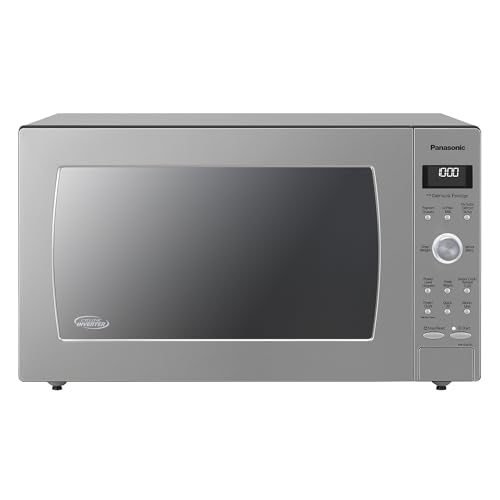
Panasonic’s entry carries the strongest stated wattage in this guide — 1250 watts — delivered through the maker’s Cyclonic Wave Inverter technology, with Genius Sensor one-touch cooking in a 2.2 cubic foot countertop body, model NN-SD975S. The extra fifty watts over the class’s 1200 standard is not a rounding error to the household cooking full family loads: at this scale, wattage is time, and time across three reheated plates and a casserole, night after night, accumulates into a real quality-of-life difference. The inverter delivery means that power can also be turned down truthfully, so the same machine that hurries a family dinner can thaw gently.
The Genius Sensor name describes Panasonic’s one-touch philosophy: press the sensor function and the machine weighs the food’s steam output and sets its own time, sparing the cook the arithmetic of guessing minutes for a load whose size varies daily. In practice, sensor reheating is the feature owners of big microwaves end up using most, because big cavities are bought for variable loads — and variable loads are exactly what fixed timers handle worst. A model that pairs the guide’s highest wattage with its most established sensor system is making a coherent argument: power, judged intelligently.
There is a pace argument specific to big cavities that this model presses hardest. A large microwave is often bought alongside a large household’s other volume habits — the weekly bulk shop, the freezer full of portions — and its daily work is measured in loads per hour at the dinner rush. Fifty stated watts over the standard is a few percent on paper and a visible shaving of seconds on every plate; multiplied across a family’s evening, it is the difference between a queue that clears and a queue that frays tempers. Buyers who recognise their kitchen in that description should weight this model’s headline figure accordingly, and buyers who do not can safely let it go.
Panasonic’s long history in inverter microwaves is the context a buyer is really purchasing — this is the maker that popularised the technology, and the NN-SD975S sits in that lineage at the family’s size and the guide’s top power figure. Households that prioritise raw pace and proven inverter behaviour, and that can live without a printed turntable dimension in the title, will find this the most authoritative specification here. Confirm the turntable size on the product page against your largest dish, as with every model whose title leaves it unstated.
- Cavity as listed: 2.2 cu ft
- Cooking power as listed: 1250W — the highest stated here
- Power delivery as listed: Cyclonic Wave Inverter technology
- Controls as listed: Genius Sensor one-touch cooking
- Model as listed: NN-SD975S, stainless
- Ordering route: the Panasonic NN-SD975S listing on Amazon is where to check price on Amazon
Strengths
- The strongest stated wattage in the guide, for family loads cooked faster.
- Inverter delivery from the technology’s longest-established maker.
- Genius Sensor one-touch cooking suits the variable loads big cavities exist for.
Trade-offs
- Turntable diameter is not stated in the title; verify it against your largest dish.
- Its authority is concentrated in power and sensing rather than preset variety.
- Fifty extra watts will not be felt by households cooking small, simple loads.
First choice for: pace-driven family kitchens that also defrost and reheat delicately. Second thought for: buyers who want every dimension printed in the headline before shortlisting.

Frigidaire 2.2 Cu Ft Countertop Microwave — The badge at full size
This is the Frigidaire that belongs in a 2.2 guide: a stainless steel countertop model whose title states 2.2 cubic feet and 1,200 watts, described as multi-function and programmable. Its presence here doubles as this guide’s honesty exhibit, because the same brand’s 2.1 cubic foot model is the one many shoppers will have seen first — and 2.1, however close, is a different size that would leave the biggest-dish problem unsolved for exactly the households this class serves. If you arrived expecting a Frigidaire, this is the correct one to be looking at; check the capacity figure on any listing you compare it against.
The title’s language is terser than the TOSHIBA’s or Panasonic’s: no inverter claim, no sensor claim, no turntable dimension. What it offers instead is a familiar badge’s full-size machine with programmable, multi-function operation — the conventional proposition, from a maker whose kitchen appliances fill a large share of the country’s homes. For many buyers that familiarity is the feature: controls that behave the way the old machine’s did, a service and parts ecosystem that needs no introduction, and a stainless finish that matches the rest of a Frigidaire kitchen without negotiation.
Programmability, the one operational word its title does offer, is worth translating for buyers who have not shopped this category lately. A programmable full-size microwave remembers the household’s repeated jobs — the specific minutes for the morning porridge bowl, the exact defrost routine for the weekly mince — and returns to them without re-derivation. In a kitchen where the same five tasks make up ninety percent of the machine’s life, that memory quietly outperforms a longer preset list written by a marketing department for a household that does not exist. The Frigidaire’s proposition is that your routines, saved, beat their presets, offered — and a great many family kitchens will find that proposition honest.
Judge this model as the straightforward full-size choice. Its 1,200 watts match the class standard, its capacity is the genuine article, and its unanswered questions — turntable size, sensor behaviour, preset depth — are product-page checks rather than mysteries. Households replacing a Frigidaire with a Frigidaire, at the size the title promises, are its natural audience, and they will find the transition the least surprising in this guide.
- Cavity as listed: 2.2 cu ft
- Cooking power as listed: 1,200 watts
- Operation as listed: multi-function, programmable
- Finish as listed: stainless steel
- Note: the brand’s 2.1 cu ft model is a different size and is not this pick
- Where to buy: the Frigidaire 2.2 listing on Amazon — check price on Amazon
Strengths
- The genuine 2.2 from a badge many kitchens already run.
- Class-standard 1,200 watts with programmable multi-function operation.
- Stainless finish that sits comfortably in a matched appliance suite.
Trade-offs
- No inverter claim in the title, so gentle-power work uses conventional cycling.
- Sensor cooking is not claimed in the title; confirm features on the product page.
- Its title is terse — turntable size and presets need page-level verification.
Suits best: brand-loyal households replacing a full-size machine like for like. Suits least: cooks who defrost daily and would feel the absence of inverter delivery.

Farberware FMO22ABTBKC 2.2 Cu Ft Microwave — The sensor value
Farberware’s Professional model, the FMO22ABTBKC, states the class essentials with a small flourish: a 1200-watt, 2.2 cubic foot microwave in brushed stainless steel, with sensor cooking and a green LED display. The sensor claim is the substantive one — it puts this model in the group that judges reheating by the food’s own steam rather than by a guessed timer, which at family scale is the difference between a casserole reheated through and a casserole with a cold centre wearing a hot rim. Buyers comparing titles will notice it achieves that without an inverter claim, delivering its power conventionally while sensing intelligently; for many households that is the pragmatic middle of this guide’s technology map.
The green LED is a period detail that divides opinion, and this guide declines to pretend otherwise: it reads clearly, it distinguishes the machine’s face from the blue-and-white displays around it, and it will either charm you as a retro note or send you to another pick. Either reaction is legitimate, and both are cheaper to have now, from a title, than after delivery. The brushed stainless finish is the safer pleasure — fingerprint-forgiving in the way family kitchens need, and neutral beside most range and fridge finishes.
Sensor cooking has a learning curve worth one honest paragraph, because first impressions mislead. A sensor judges by steam, so it judges covered, vented food best and dry loads — a slice of pizza, a bread roll — worst, and new owners who test it on exactly the wrong foods conclude it is a gimmick. Give it the covered casserole and the bowl of vegetables it was designed around, and the judgement reverses within a week. That learning curve applies to every sensor model in this guide, and the Farberware, as the sensor pick without inverter pricing logic around it, is where the lesson is cheapest to learn.
Farberware’s counter heritage is in everyday cookware and small appliances rather than built-in suites, and this model reads accordingly: a working family’s full-size microwave, sensor-equipped, plainly specified, without suite-matching pretensions. Households that want the sensor behaviour and the honest size without paying attention to inverter technology will find their calculation simplest here.
- Cavity as listed: 2.2 cu ft
- Cooking power as listed: 1200 watts
- Controls as listed: sensor cooking
- Display as listed: green LED
- Finish as listed: brushed stainless steel
- Model as listed: FMO22ABTBKC, Farberware Professional line
- Purchase path: find the Farberware FMO22ABTBKC on its Amazon listing to check price on Amazon
Strengths
- Sensor cooking at the class’s standard wattage and full honest size.
- Brushed finish shrugs off the fingerprints a family machine collects.
- A plainly written title that states its key facts without inflation.
Trade-offs
- The green LED display is a taste decision, not a neutral one.
- No inverter delivery is claimed, so defrosting uses conventional cycling.
- Turntable diameter goes unstated in the title and needs a page check.
Appeals to: households wanting sensor judgement and full size in a no-fuss package. Appeals less to: buyers building a visually matched suite of one brand’s appliances.

2.2 Cu Ft Countertop Microwave (1200W) — The staged cooker
The first of this guide’s two unbranded listings states a surprisingly complete hand: a countertop microwave oven of 2.2 cubic feet and 1200 watts in stainless steel, with ten power levels, multi-stage cooking, six preset options, smart sensor cooking and an LED display. Read that again and notice what it means — on stated facts alone, this no-name machine claims the joint-deepest control set in the guide, pairing sensor judgement with the staged power sequences that let a cook program defrost-then-cook as a single instruction. The absence of a badge cuts both ways, and this review will not pretend otherwise: there is no brand story to lean on, so the title’s facts carry the whole case, and fortunately they are the right facts.
Multi-stage cooking deserves the same explanation it received wherever it appears, because it is the feature that separates cooking with a microwave from merely heating in one. A stage sequence — low power to thaw, a pause in effect, full power to finish — turns the machine into something a recipe can be written for. Combined with ten power levels and sensor oversight, it makes this the dark-horse pick for the technically minded cook who reads specifications instead of logos. The six presets match the TOSHIBA’s menu count, and the LED display keeps the interface conventional.
Consider who actually writes recipes in stages, because the answer decides this pick’s fate in your kitchen. Meal-prep households do: grains that rest between power phases, frozen portions that must thaw before they can cook, sauces that need a gentle phase after a vigorous one. If your Sunday involves a notebook or a spreadsheet of the week’s food, a microwave that executes a two-stage instruction unattended is a small sous-chef. If your microwave use begins at “reheat” and ends at “popcorn”, the staging will sit unexplored in the menu for a decade, and the simpler sensor models above will serve you with less to ignore.
The honest caveats belong in the open. No turntable diameter is stated, no child lock is claimed, and an unbranded listing’s long-term parts and support story is a question the product page and its seller information must answer. A buyer comfortable weighing stated specifications over badge reassurance gets a lot of claimed capability here; a buyer who wants a maker’s name behind a decade-long appliance has four branded alternatives above. Both instincts are respectable, and this guide’s job is to make the trade visible rather than to make it for you.
- Cavity as listed: 2.2 cu ft
- Cooking power as listed: 1200 watts
- Power levels as listed: 10, with multi-stage cooking
- Controls as listed: 6 preset options, smart sensor cooking, LED display
- Finish as listed: stainless steel
- Where to buy: the unbranded 2.2 listing on Amazon — check price on Amazon
Strengths
- Multi-stage cooking plus sensor oversight is the deepest stated control set here.
- Full class-standard wattage and the exact 2.2 capacity, plainly printed.
- Ten power levels give the granular low end staged recipes need.
Trade-offs
- No brand stands behind the listing; support questions go to the product page.
- Turntable size is unstated, so your largest dish needs a page-level check.
- No child lock is claimed in the title, unlike the TOSHIBA.
For the spec-reader: who judges a machine by its printed capabilities. For the badge-anchored: the four branded models above carry the reassurance this one cannot.
2.2 Cu Ft Countertop Microwave With Gray Cavity — The measured width
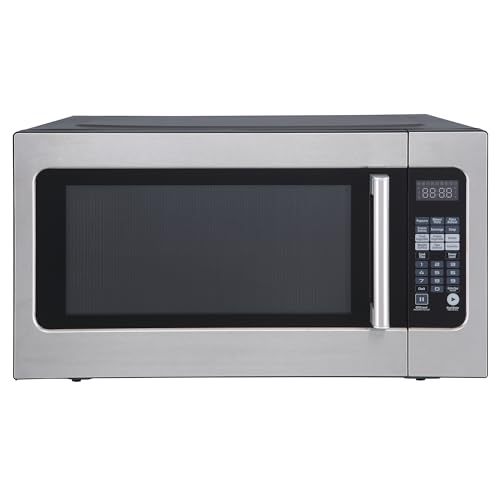
The second unbranded listing is the tersest title in the guide: a countertop microwave oven, 24.4 inches wide, 2.2 cubic feet, in stainless steel, with a gray cavity. No wattage is printed, no sensor is claimed, no preset is counted — and this review invents none of them. What the title does give is arguably the most practically useful single fact in the whole roundup: the machine’s exact width. A 2.2 cubic foot microwave is a serious countertop commitment, and the first question in most kitchens is not philosophical but spatial — will it fit the run of counter, under the cabinets, beside the hob? This listing answers that question in its headline, and buyers should take the hint and measure their own counter with the same directness.
Width deserves one more moment, because buyers consistently measure the wrong axis first. Height gets checked against the cabinets; depth gets checked against the counter’s edge; and width — the dimension that decides whether the machine crowds the hob or swallows the fruit bowl’s home — gets estimated by eye. A stated 24.4 inches lets a buyer rehearse the countertop precisely: mark it in tape, live with the tape for a day, and learn whether the class fits your kitchen’s habits before it fits your kitchen. Every model in this guide deserves that tape test; this one is simply the only title polite enough to hand you the number up front.
The gray cavity is the other stated detail, and it is more than a colour note. Cavity interiors in this class are usually white or stainless-toned; a gray interior hides the splatter shadows and turmeric ghosts that a family machine accumulates, and it changes the look of the open door from clinical to calm. Whether that matters to you is a taste question, but it is a real differentiator — the only interior finish called out in any title here — and for buyers who leave the microwave door visible in an open-plan kitchen, it is a legitimate reason to shortlist this model and then do the homework its title leaves undone.
That homework is the honest price of this pick: wattage, turntable size, power levels and controls all live on the product page, and a careful buyer confirms every one before ordering, especially the wattage, since a full-size cavity driven by a weak output would be a slow disappointment. Shortlist it for its measured width and its interior; verify everything else. That division of labour is stated plainly here so that nobody mistakes this listing’s brevity for this guide’s endorsement of its unstated details.
- Width as listed: 24.4 in
- Cavity as listed: 2.2 cu ft
- Interior as listed: gray cavity
- Finish as listed: stainless steel
- Not stated in the title: wattage and turntable size — confirm on the product page
- Ordering route: this gray-cavity model’s Amazon listing is where to check price on Amazon
Strengths
- Exact width printed in the title — the counter-planning number buyers need first.
- The only gray cavity in the guide, forgiving of family splatter and stains.
- The exact 2.2 capacity, honestly stated like every pick here.
Trade-offs
- Wattage is unstated in the title; a page check is essential before buying.
- No sensor or preset claims appear in the title at all.
- Like its unbranded sibling, it offers specifications instead of a badge.
Worth a shortlist place if: counter width is your binding constraint and gray suits your kitchen. Worth skipping if: you want wattage and features confirmed in the headline itself.
What Separates a Good Big-Microwave Control Panel From a Frustrating One?
At family scale, the control panel is used in motion — one hand holding a dish, eyes on a hob, a child asking a question — so its virtues are ergonomic before they are electronic. The essentials are a legible display readable across the kitchen, an express-start that adds time in sensible increments without menu-diving, and a stop control that can be found by touch. Sensor models add their own discipline: the sensor function must be reachable in one press, or households will revert to guessing times and the feature might as well not exist. The titles in this guide describe these systems in their makers’ dialects — Genius Sensor, sensor cook, smart sensor cooking — and the buyer’s translation task is simply to ask how many presses stand between a cold casserole and a reheating one.
Preset libraries deserve a sceptical paragraph. Six auto menus, as two picks here state, can cover a family’s real repertoire — popcorn, potato, vegetables, a beverage, a dinner plate, a defrost — or can be padded with novelties nobody presses twice. Depth of presets matters less than whether the everyday five are present and honestly calibrated. Multi-stage programming, claimed by the unbranded 1200W model, sits at the opposite pole: not a shortcut but a composition tool, valuable exactly in proportion to how much actual cooking, rather than reheating, the household does in the machine.
Finally, the panel’s relationship with the door matters more at this size. A wide door on a big cavity is a sail; controls placed so a cook can steady a dish with one hand and set the time with the other, without crossing arms or setting anything down on a hot hob, are the difference between a machine that integrates into the cooking flow and one that interrupts it six times a day. None of that appears in a title. All of it can be pictured, vividly, before ordering — and should be.
The Six Big Cavities, Compared
| Model | Stated power | Delivery | Signature detail |
|---|---|---|---|
| TOSHIBA 2.2 Inverter | 1200W | Inverter | 16.5-inch turntable, sensor cook, child lock |
| Panasonic NN-SD975S | 1250W | Cyclonic Wave Inverter | Genius Sensor one-touch cooking |
| Frigidaire 2.2 | 1,200 watts | Conventional | Multi-function, programmable; the genuine 2.2 Frigidaire |
| Farberware FMO22ABTBKC | 1200 watts | Conventional | Sensor cooking, green LED, brushed steel |
| Unbranded 1200W model | 1200 watts | Conventional | Multi-stage cooking, smart sensor, 6 presets |
| Unbranded gray-cavity model | Not stated in title | Conventional class | 24.4-inch width and gray cavity stated |
The table compresses this guide’s argument into one view: size is held constant so that power, delivery and detail can be compared honestly. Two inverters, one wattage leader, sensor cooking on four titles, staged cooking on one, and a width measurement on another — the class is more varied than its shared capacity suggests, and the right choice falls out of which row’s signature detail matches your kitchen’s daily reality.
How Do You Keep a Family-Size Microwave Cooking Evenly for Years?
Big cavities forgive many things but not neglect. The turntable and its roller ring want regular washing, because a ring gummed with sauce splatter stops rotating smoothly, and a dish that stops rotating in a microwave is a dish cooking in stripes. The cavity walls want wiping while spills are fresh — at family volumes, one baked-on casserole overflow becomes a permanent odour tenant — and the door seal wants the same attention, since the seal is both a safety component and the first place steam-borne grease settles. None of this is weekly labour; it is the two-minute habit after the worst spills, and it is what separates a machine that cooks evenly in year eight from one that smells of year three.
Use habits matter as much as cleaning. A cover on reheated food — a plate, a lid, a vented cap — keeps the cavity cleaner and the food moister, and it costs nothing. Letting a finished load stand for a minute before serving lets temperatures equalise through a big portion in a way no power setting can. And the sensor modes several picks here offer work best when the food is arranged as they expect: spread, not mounded, with the thickest part outward. A household that learns its machine’s expectations in the first month will be repaid at every meal afterwards, whichever of the six badges sits on the door.
How Much Counter Does a 2.2 Microwave Really Claim?
More than the width figure alone suggests. A full-size countertop microwave needs its width plus breathing room at the vents, its depth plus the door’s swing and the space to stand in front of it with a hot dish, and vertical clearance under wall cabinets that the machine’s height and your tallest container together must respect. The one explicit width in this guide — 24.4 inches from the gray-cavity listing — is the scale to plan around for the whole class: roughly two feet of prime counter, permanently committed. Kitchens with that run to spare gain a genuinely capacious appliance; kitchens without it should admit the fact early, because a 2.2 machine exiled to a distant utility counter gets used like a distant appliance, which is to say rarely and resentfully.
Placement has a second-order effect households discover late: the microwave’s position relative to the hob and the fridge shapes the kitchen’s working triangle at reheating time, which for a family machine is several times a day. Beside the fridge, leftovers travel inches; across the room, they travel dripping. Readers planning a fuller appliance layout — where a big microwave joins other statement pieces — will find the same measure-first discipline applied to built-in cooking in our colleagues’ survey of Best 30-Inch Gas Wall Ovens, a category where the planning stakes are higher still because the appliance cannot be moved once the cabinetry closes around it.
Weight completes the picture. Machines of this size are two-handed lifts with awkward balance, so the counter they land on should be the counter they stay on; plan the spot as a permanent address, run the tape measure twice, and let the delivery route — doorways, corners, the turn into the kitchen — be part of the decision rather than a surprise on the day.
What Are Buyers of Very Large Microwaves Most Often Wrong About?
The commonest error is shopping the volume figure and never the turntable, then discovering that the family’s widest dish — the reason for the purchase — rides the cavity walls. Measure the dish; check the plate diameter; the TOSHIBA’s stated 16.5 inches is the kind of number to demand from any listing. The second error is assuming wattage parity means performance parity, when delivery method divides the class: an inverter’s steady low power and a conventional machine’s pulsing are different tools, and defrost-heavy households feel the difference weekly. The third error is the near-size trap this guide opened with — accepting a 2.1 or a 2.0 because the search page grouped them together, and re-inheriting the exact problem the purchase was meant to solve.
Two more mistakes are quieter. Buyers forget that a big cavity heats small loads no faster in proportion — a single mug in 2.2 cubic feet is a mug in a ballroom, and households that mostly reheat single cups may find a large machine’s evenness and pace underwhelming for that job. And buyers overlook the support cast the appliance needs: a surge-protected outlet within cord reach, counter space in front for the door’s swing and the cook’s elbows, and a spot where the door’s opening arc does not collide with a walkway. The wider kitchen-equipment version of that lesson — capacity appliances earning their keep only inside a designed routine — runs through our guide to Best GE Dishwashers as well, where the same households often shop both categories in the same renovation season.
Final Recommendation
Start with the TOSHIBA if your household is the one this size class was invented for: its inverter delivery, stated 16.5-inch turntable, sensor cooking and child lock form the most complete family specification here. Choose the Panasonic when pace leads — its stated 1250 watts and Genius Sensor make it the fastest, most established inverter hand in the guide. The Frigidaire is the badge-loyal full-size answer, the Farberware the sensor-equipped straightforward one, and the two unbranded listings reward the specification-reader: staged cooking and sensor claims on one, an honest width and a forgiving gray cavity on the other. Whichever row of the table you land on, hold the line this guide opened with — exactly 2.2, measured against your own largest dish — because a big microwave bought by the numbers will still be proving its size right at the Sunday casserole ten years from now.
Frequently Asked Questions
Is 2.2 cu ft too big for a household of two?
Usually, unless the two of you cook in batches. A 2.2 cavity earns its counter space through wide dishes and family-size loads; a couple reheating two plates will find a mid-size machine faster to live with and cheaper to house. The honest exception is the batch-cooking household — two people who cook eight portions on Sunday live exactly like the large family this class targets, and for them the size is the point.
Why was the 2.1 cu ft Frigidaire left out?
Because this guide’s title promises 2.2, and 2.1 is a different size. The difference sounds trivial and is not: it is roughly the margin in which the largest dishes — the reason buyers choose this class — fit or foul the cavity walls. The Frigidaire included here is the brand’s genuine 2.2 model, so brand-loyal readers lose nothing by the exclusion except a near-miss.
What does an inverter actually change at this size?
It changes how lower power levels are delivered: continuously instead of in pulses. At 2.2 cubic feet the effect concentrates in defrosting large, uneven loads without cooked edges, in melting and softening without scorching, and in reheating delicate sauces without splitting them. Households that mostly blast sturdy leftovers on full power will notice little; households that defrost daily will notice every day.
How do I judge the two unbranded picks fairly?
By their stated facts, which is how this guide judges every pick. One claims multi-stage cooking, smart sensor cooking, six presets and 1200 watts; the other states an exact width and a gray cavity and leaves its wattage to the product page. Weigh the claims, verify the gaps on the page, and decide whether a badge is worth more to you than the specifications in front of you.
Does a bigger microwave use noticeably more electricity?
Per minute, a 1200 or 1250 watt machine draws more than a compact; per meal, the arithmetic softens, because the bigger machine finishes family loads in fewer, fuller runs instead of several half-empty ones. The honest answer is that a household reheating family quantities will not find the 2.2 class extravagant, while a household reheating one mug at a time is paying ballroom rent for a closet’s worth of work — one more reason the size decision should follow the loads, not the aspiration.
Will a 2.2 microwave fit under standard wall cabinets?
Height is the dimension to check, and it varies by model, so take it from each product page and set it against your counter-to-cabinet clearance with your tallest container in mind. Width is the other commitment — the one stated figure in this guide is 24.4 inches, a fair planning scale for the class. Measure both axes before ordering; returns of machines this size are nobody’s idea of a light errand.
Related Guides
Readers furnishing a countertop cooking corner rather than a single appliance may enjoy our guide to Best Countertop Rotisserie Ovens, where another generous cavity is put to a very different kind of work. Read together, the two guides cover the counter’s two heavy lifters: one for the week’s reheating and defrosting, one for the weekend’s centrepiece.


