What's inside
- Key Takeaways
- Quick Picks
- What Qualified an Oven as a Combo for This Guide?
- Two Formats, One Table: The Field Without the Blur
- Which Format Belongs in Your Kitchen?
- How Does a Combo Change Installation Planning?
- What Do Owners Actually Cook in the Top Cavity?
- Where Do Combo Shoppers Go Wrong?
- What Size Is the Microwave Hiding Inside a Column?
- Do Smart Features Earn Their Place in a Wall Column?
- Where Does a Second Cooking Station Make Sense?
- How Do You Clean a Microwave That Lives in a Wall?
- How Do You Read a Combo Listing Like an Installer?
- What Does the Countertop Microwave’s Farewell Look Like?
- How Does a Column Age?
- Why Does Microwave Wattage Deserve More Respect Than It Gets?
- Flush, Proud, or Framed — How Should a Column Meet the Cabinets?
- Final Recommendation
- Frequently Asked Questions
- Related Guides
As an Amazon Associate I earn from qualifying purchases. This post may contain affiliate links at no extra cost to you.
cottageverdict.com is reader-supported. When you buy through links on our site, we may earn an affiliate commission.
Every pick below is sold on Amazon and links to its own listing there, so once you know which of the two combo formats your kitchen wants, you can check price on Amazon for the exact unit. Read the format section first — in this class, format is destiny.
The best combo wall ovens answer a question every serious kitchen eventually asks: where does the microwave live? The combination wall oven’s answer is elegant — in the column, above the oven, behind a matching door, at eye level, sharing one cutout and one design language instead of squatting on the counter or squatting over the range. But the verified field for this guide contains two different appliances wearing the same name, and honesty requires separating them before a single pick is praised. Four of the six picks are full-size combination units: a true 30-inch wall oven below with a microwave built into the top of the same column. Two are compact 24-inch built-in units that merge a microwave and a convection oven in a single smaller cavity. Both formats are legitimately called combos by their makers. They are not interchangeable, they do not fit the same cutouts, and they do not serve the same households — so this guide names each pick’s format every time it names the pick.
The full-size four — Samsung, Professional, Frigidaire Gallery, and Bosch’s 800 Series — are renovation appliances: they replace a wall oven and a microwave in one stroke, at the cost of one large, carefully planned installation. The compact pair — ThermoMate and KoolMore Reserve, both 24-inch and both stating 1.6 cubic feet — are something subtler: single-cavity machines that microwave, convect, and in the KoolMore’s case air fry, sized for apartments, small kitchens, and secondary cooking stations where a full column is not in the cards. A double wall oven with no microwave section is not a combo at all, and none appears here; the word means the microwave is in the column, or the pick is not in this guide.
Feature discipline, as always, follows the listings. Air fry is claimed only where a title states it — the Frigidaire Gallery among the full-size four, the KoolMore among the compacts. Convection and self-cleaning are claimed for the Bosch because its title states them, and wattage is quoted only for the ThermoMate, whose title states 1000 watts. Where a title is terse — the Professional’s, notably — the pick is described by its format and finish, and the rest is left for the listing to say.
Key Takeaways
- This field holds two formats: full-size 30-inch oven-plus-microwave columns (Samsung, Professional, Frigidaire Gallery, Bosch) and compact 24-inch microwave-convection units (ThermoMate, KoolMore Reserve) — every pick is labeled by its true format.
- The Samsung’s title states the largest figure in the field, 7.0 cubic feet total, while both compacts state 1.6 cubic feet for their single dual-duty cavities.
- Air fry appears in exactly two titles: the Frigidaire Gallery full-size combo and the KoolMore Reserve compact, which also calls itself a 3-in-1.
- The Bosch 800 Series title is the most explicit of the full-size four, stating smart features, convection, self-cleaning, and the microwave in one breath.
- The ThermoMate is the only pick whose title states microwave wattage — 1000 watts — and the KoolMore is the only one whose title mentions its plug, a NEMA 5-20P.
- A combination unit concentrates risk as well as function: one column, one installation, and two appliances whose fates are joined — plan service accordingly.
Quick Picks
| Pick | Badge | Why it earned its place |
|---|---|---|
| Samsung NQ70M7770DS Combination Wall Oven | The stated-capacity leader | A full-size combination electric wall oven whose title states 7.0 cubic feet — the big family’s column, from a maker that builds its kitchen around matching columns. |
| Professional 30-Inch Combination Microwave Wall Oven | The plain-spoken 30-inch | A full-size combination microwave wall oven in stainless whose title promises the format and the finish, and leaves the embroidery to the listing. |
| Frigidaire Gallery Microwave Combination Wall Oven | Air fry in the column | A 30-inch microwave combination whose title states air fry — the full-size pick for households that crisp as often as they roast. |
| Bosch 800 Series Combination Wall Oven | The fully stated flagship | Smart, convection, self-cleaning, and microwave, all stated in the title of a 30-inch built-in — the most completely described full-size pick. |
| ThermoMate 24-Inch Microwave Convection Wall Oven Combo | The compact with numbers | A 24-inch built-in microwave-convection combo stating 1.6 cubic feet and 1000 watts, with sensor cook and a touch LCD. |
| KoolMore Reserve 24-Inch Built-In Microwave Convection Oven | The 3-in-1 compact | Microwave, convection, and air fry in a 24-inch built-in stating 1.6 cubic feet, sensor cook, and a soft-close door. |
What Qualified an Oven as a Combo for This Guide?
One test, applied without mercy: the microwave had to be part of the built-in unit itself. That sounds tautological until you see what it excludes — double wall ovens with two conventional cavities and no microwave anywhere, speed ovens marketed beside combos until the categories blur, and countertop microwaves photographed in kitchen columns they were never installed in. Samsung’s double ovens without a microwave section, to name the most tempting near-miss, are excellent appliances and are not in this guide, because the word combo must mean the combination or it means nothing. Each surviving pick then had to declare its format in its own title — 30-inch combination or 24-inch built-in — so the two families could be kept visibly separate rather than averaged into mush.
The reward for that discipline is a guide that can be shopped in either direction. The renovator with a 30-inch column reads the first four picks as a complete market. The apartment dweller, the small-kitchen owner, the household adding a second cooking station reads the last two the same way. And the reader still deciding between a wall column and the countertop’s flexibility will find the neighboring territory honestly mapped in Best Wall Steam Ovens, where another built-in specialty — steam — makes its own case for the column.
Samsung NQ70M7770DS Combination Wall Oven — The stated-capacity leader
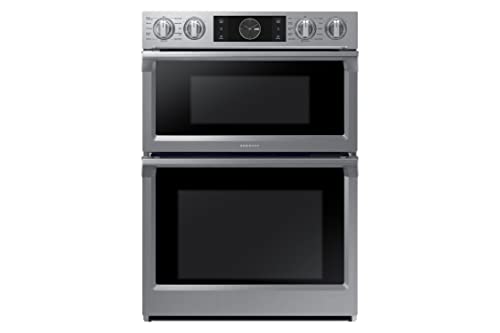
Format first, as promised: the Samsung NQ70M7770DS is a full-size combination electric wall oven, a 30-inch-class column with a microwave above a conventional oven, and its title states the figure that leads this field — 7.0 cubic feet. Read that number the way combination units must be read: it is the column’s total story, microwave cavity and oven cavity together, and it describes a machine built for households that cook in volume. A column like this replaces two appliances and a stretch of counter in a single installation, and Samsung — whose kitchen business is built around matched suites — designs it as the visual anchor of a wall: stainless, handle-matched, unmistakably one object rather than two appliances stacked by circumstance.
The buying logic is consolidation logic. A family that microwaves daily and roasts weekly gets both duties at eye level, in one cutout, on one electrical plan, with the counter freed for the work counters are for. What the title does not state, this guide does not claim: no air fry, no steam, no wattage figure is printed here, because none is printed there. The Samsung’s verified proposition is size and format from a major maker — the safe, suite-matching choice — and for many renovators that proposition, backed by a national service network, is exactly the point. In a category where two of the six picks come from compact specialists, the Samsung is the establishment candidate, and it campaigns on capacity.
- Format: full-size combination electric wall oven (microwave over oven, one column)
- Stated total capacity: 7.0 Cu. Ft. as stated in the listing
- Finish: stainless as stated in the listing
- Fuel: electric
- Microwave wattage: not stated in the listing title
- Where to buy: the Samsung NQ70M7770DS listing on Amazon — check price on Amazon
Strengths
- The largest stated total capacity in the field.
- A major maker’s suite styling and service footprint behind a big installation.
- True two-appliance consolidation in a single column.
Trade-offs
- Its title is terse about features; the listing must answer the detailed questions.
- A full-size column is a renovation commitment, not a weekend swap.
- Microwave and oven share one fate if the unit needs major service.
Best for: renovating families who want the biggest stated column from a mainstream maker.
Think twice if: your kitchen is compact — the 24-inch pair at the end of this guide speaks your language.

Professional 30-Inch Combination Microwave Wall Oven — The plain-spoken 30-inch
Format first again: this is a full-size 30-inch combination microwave wall oven in stainless steel — and that is very nearly all its title says. In a guide that honors title discipline, the Professional is the test case. No capacity is stated, so none is claimed. No feature is named, so none is praised. What the listing’s title verifies is the proposition itself — the format, the size class, the finish — and the pick earns its place because that proposition is the rarest thing in this category: a 30-inch combo column from outside the big-brand suite system, for buyers whose kitchens are not built around a single maker’s badge.
That plainness cuts in two directions, and both deserve stating. The risk is homework: every question a Samsung or Bosch title answers preemptively — capacity, cleaning, convection — must be carried to this listing and answered there, and a buyer unwilling to do that reading should not buy this oven. The reward is focus: the Professional’s proposition is the format itself, stainless and thirty inches, without a feature bundle the buyer may neither want nor wish to fund. Kitchens being renovated around professional-style ranges often want exactly this — a column that looks the part, does the two jobs, and lets the range be the room’s protagonist. For that brief, a plain-spoken title is not a lack. It is the pitch.
- Format: full-size 30-inch combination microwave wall oven
- Finish: stainless steel as stated in the listing
- Capacity: the title gives no figure — the listing holds it
- Features: not enumerated in the listing title — confirm on the listing
- Where to buy: find the Professional 30-Inch listing on Amazon to check price on Amazon
Strengths
- The full-size combo format without a suite-brand commitment.
- Stainless professional styling that defers to a statement range.
- A format-first proposition for buyers who read listings closely.
Trade-offs
- The tersest title in the field; nearly all specifics live on the listing.
- No stated capacity means the tape-measure conversation starts from zero.
- Support expectations should be set from the listing and maker, not assumed.
Made for: renovators building around a professional-style range who want the column to match, not compete.
A poor match for: buyers who want every feature verified before the listing page — the Bosch below campaigns to you.

Frigidaire Gallery Microwave Combination Wall Oven — Air fry in the column
Format: full-size, a Frigidaire Gallery 30-inch microwave combination wall oven — and the feature its title chooses to state is air fry. That choice tells you who the oven is for. Air frying migrated from countertop appliances into wall ovens because households that crisp weekly wanted the function without the countertop footprint, and in a combination column the logic doubles: the microwave handles the week’s reheating and defrosting, the oven roasts and air fries, and the counter stays clear of both the microwave and the air fryer that used to flank the stove. Gallery is Frigidaire’s feature-forward line, and this unit’s stated headline is the line’s whole personality — the combo as the kitchen’s modernizer.
The discipline note: the title states air fry and the 30-inch combination format, and this guide claims exactly that much. Capacity, wattage, and cleaning cycles live on the listing. What can be reasoned from the verified facts is the household fit. A family that air fries twice a week and microwaves daily is the precise center of this pick’s target; the column absorbs both habits into the wall. Buyers whose crisping is occasional should weigh whether the headline feature earns its prominence in their kitchen, or whether the Samsung’s stated capacity or the Bosch’s stated cleaning and convection ledger serves their actual week better. Features are only features when they match a habit; the Gallery’s stated habit is crisping, and it states it proudly.
- Format: full-size 30-inch microwave combination wall oven
- Stated feature: air fry as the listing states
- Line: Frigidaire Gallery per the listing
- Capacity: no figure in the title — the listing supplies it
- Where to buy: the Frigidaire Gallery combination listing on Amazon — check price on Amazon
Strengths
- Air fry stated in the column — the countertop air fryer can retire.
- A mainstream maker’s feature line behind a full-size installation.
- The combo format aimed squarely at daily microwave households.
Trade-offs
- Beyond air fry and format, the title leaves the ledger to the listing.
- Occasional crispers may be paying prominence for a weekly habit they do not have.
- As with every full-size combo, oven and microwave share one service fate.
Choose it if: your household crisps constantly and reheats daily, and wants both in the wall.
Less happy in: a kitchen where the oven is a holiday appliance — capacity or compacts will serve better.

Bosch 800 Series Combination Wall Oven — The fully stated flagship
Format: full-size, a 30-inch built-in combination electric convection wall oven with microwave, from Bosch’s 800 Series — and the title that does the most work in this guide. Smart, convection, self-clean, microwave: four load-bearing claims in one listing line, each of which another pick’s title omits. Convection in the oven cavity is the cooking claim, the fan that evens a full oven’s browning. Self-clean is the ownership claim, the high-heat cycle that returns the cavity to ash-and-wipe condition without a weekend of scrubbing. Smart is the control claim, the connected layer that Bosch’s 800 Series wears across its kitchen line. And the microwave, stated plainly, is the format claim that admits it to this guide at all.
The cumulative effect is a pick that asks the least listing-page faith of any full-size entry here: a buyer can know from the title alone that the Bosch covers the four questions renovators ask first. That completeness, from the maker whose built-in kitchen reputation is the field’s benchmark, makes the 800 Series the natural flagship of the full-size four — the one against which the others’ terseness is measured. Its unstated items are the familiar ones — capacity and wattage live on the listing — and its trade-offs are the format’s own. But for the renovator who wants the column decision to be the last oven decision of the decade, the Bosch’s stated ledger is the strongest opening argument in this guide.
- Format: full-size 30-inch built-in combination electric wall oven with microwave
- Stated features: smart, convection, self-clean as listed
- Series: Bosch 800 Series as its title states
- Finish: stainless steel per the title
- Capacity: no figure in the title — the listing supplies it
- Where to buy: shop the Bosch 800 Series combination listing on Amazon to check price on Amazon
Strengths
- The most completely stated feature ledger among the full-size picks.
- Self-cleaning stated — the ownership convenience renovators ask about first.
- Convection stated in the oven cavity, where it matters most.
Trade-offs
- Smart features ask for a household that will actually use the connected layer.
- Capacity must be confirmed on the listing before the cutout is cut.
- Flagship positioning within its line means flagship expectations to fund.
Suits best: renovators who want the column settled completely, from a maker’s top line.
Not the one for: minimalists who regard connected features as future maintenance wearing a bow.
ThermoMate 24-Inch Microwave Convection Wall Oven Combo — The compact with numbers
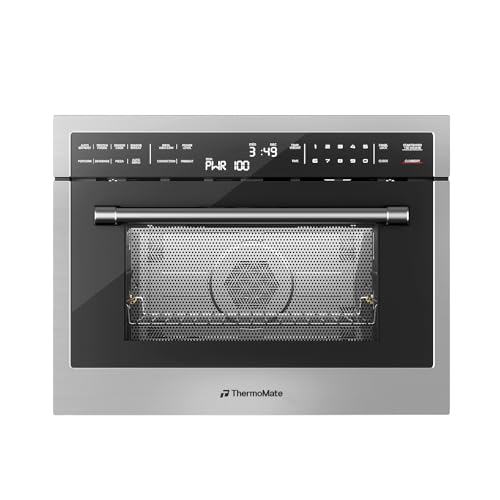
Now the other format, labeled as itself: the ThermoMate is a 24-inch built-in unit that combines a microwave and a convection oven in one 1.6 cubic foot cavity — not a column of two appliances, but a single chamber with two heating personalities. Its title is the compact field’s most numerical: 1.6 cubic feet, 1000 watts of microwave power, sensor cook, touch control with an LCD display, stainless finish. The wattage figure deserves its moment — it is the only microwave power figure stated by any pick in this guide, and 1000 watts is honest full-strength microwave power, not the weakened output small units sometimes hide. A compact that states its watts is a compact that expects to be compared.
The household for this format is specific and numerous: the apartment whose kitchen cannot spare a column, the small home where the wall oven slot is 24 inches because it always has been, the in-law suite or studio that needs one appliance to reheat, bake, and roast in a single cutout. In that brief, the ThermoMate’s single dual-duty cavity is not a compromise against the big columns; it is the correct machine, doing two jobs in the space of one. Sensor cook — the microwave judging doneness by humidity rather than by the clock alone — is the feature such households use most, since their microwaving is meals rather than beverages. Read the format label once more before buying: one cavity, two talents, twenty-four inches.
- Format: compact 24-inch built-in microwave and convection oven combination, single cavity
- Stated capacity: 1.6 Cu. Ft. as titled
- Stated microwave power: 1000 Watt from the listing
- Stated features: sensor cook, touch control LCD display as printed in its title
- Finish: stainless steel the listing states it
- Where to buy: the ThermoMate 24-Inch listing on Amazon — check price on Amazon before you cut the cabinet
Strengths
- The only stated wattage in the guide — 1000 watts of honest microwave power.
- One cutout, two cooking methods, for kitchens that cannot host a column.
- Sensor cook serves the meal-reheating life these units actually live.
Trade-offs
- One cavity means microwaving and baking are sequential, never simultaneous.
- 1.6 cubic feet will not take a holiday bird; know your largest dish.
- It is not a wall oven replacement for a household that cooks big — format honesty cuts both ways.
The right fit for: apartments, suites, and small kitchens needing two talents in one 24-inch cutout.
Skip it if: two dishes must cook at once in different modes — that simultaneity is the full-size column’s whole argument.

KoolMore Reserve 24-Inch Built-In Microwave Convection Oven — The 3-in-1 compact
The KoolMore Reserve shares the ThermoMate’s format — a 24-inch built-in, single 1.6 cubic foot cavity — and adds a third talent to the title: air fry, making it a stated 3-in-1 of microwave, convection, and air fry, with sensor cook and a soft-close door, in stainless. That third talent is the compact field’s modern signature. The households these units serve are exactly the households that made countertop air fryers ubiquitous, and the Reserve absorbs that third appliance into the wall as well, leaving a small kitchen’s counter genuinely empty — a outcome no full-size column can offer a small kitchen, because the column does not fit there in the first place.
Two title details reward attention. The soft-close door is a small luxury with daily compound interest in a unit opened a dozen times a day, and a marker of the Reserve line’s positioning within KoolMore’s range. And the title states the plug — a NEMA 5-20P — which is installation information of the most practical kind: this compact’s electrical appetite is declared up front, and the buyer can confirm the kitchen’s circuit before the unit arrives rather than during its installation. Between the two compacts, the choice is a feature ledger: the ThermoMate states its watts, the KoolMore states its third function and its plug. Both state the same capacity and the same honest format, and small kitchens are richer for having the argument at all.
- Format: compact 24-inch built-in microwave convection oven, single cavity, 3-in-1 combo
- Stated capacity: 1.6 cu. ft. as the title has it
- Stated features: air fry, sensor cook, soft-close door per its listing title
- Stated electrical: NEMA 5-20P plug as given in the listing
- Finish: stainless steel as the listing states
- Where to buy: find the KoolMore Reserve listing on Amazon and check price on Amazon
Strengths
- Three stated functions — microwave, convection, air fry — in one 24-inch cutout.
- Soft-close door: a daily-use refinement the compact class rarely states.
- The plug is declared in the title, so the circuit question is answered early.
Trade-offs
- No wattage is stated in the title; microwave power must be confirmed on the listing.
- Single cavity sequencing applies, as with the ThermoMate.
- The stated plug type means your circuit must match it — verify before ordering.
Pick it when: a small kitchen wants microwave, oven, and air fryer to disappear into one wall slot.
A weaker fit for: cooks who need a true second oven for feast days — one cavity cannot be two rooms.
Two Formats, One Table: The Field Without the Blur
| Pick | True format | Stated size facts | Headline stated feature |
|---|---|---|---|
| Samsung NQ70M7770DS | Full-size combo column | 7.0 Cu. Ft. total | Capacity, suite scale |
| Professional 30-Inch | Full-size combo column | 30-inch, stainless | Format and finish, plainly |
| Frigidaire Gallery Combo | Full-size combo column | 30-inch | Air fry |
| Bosch 800 Series Combo | Full-size combo column | 30-inch built-in | Smart, convection, self-clean |
| ThermoMate 24-Inch | Compact single-cavity combo | 1.6 Cu. Ft., 1000 watts | Stated wattage, sensor cook |
| KoolMore Reserve 24-Inch | Compact single-cavity combo | 1.6 cu. ft., NEMA 5-20P | Air fry 3-in-1, soft-close |
Which Format Belongs in Your Kitchen?
Answer with your cutout and your calendar. If a renovation is opening the wall anyway, the full-size column is the format that retires two appliances and a counter’s worth of clutter in one decision — provided the household actually microwaves daily, because a combo’s top cavity that sits idle is an expensive cabinet. If no renovation is coming and the kitchen’s oven slot is 24 inches, the compact format is not the consolation prize; it is the only format that fits the house as built, and its single cavity will handle the reheating, baking, and crisping of a small household’s real week. The error to avoid is the middle purchase: a compact bought by a family of six that cooks two dishes at once every Sunday, or a column bought by a couple who reheat coffee and call it microwaving. Format honesty, like the labeling discipline in Best Front-Control Dishwashers where the control’s location is the whole taxonomy, begins with naming your own habits correctly.
Simultaneity is the sharpest dividing line. Two dishes, two modes, one moment — a roast below while vegetables microwave above — is something only the full-size column’s separate cavities can do. The compacts answer with sequence: microwave the sauce while the casserole rests, air fry after the bake. Households cook in one of those two rhythms by temperament, and the rhythm you actually keep should choose the format before any feature list gets a hearing.
How Does a Combo Change Installation Planning?
It doubles the appliance inside a single installation’s paperwork. The full-size column needs its cutout, its clearances, and an electrical supply sized for an oven and a microwave that may run together — a figure the listing and a licensed electrician settle between them. The compacts shrink the carpentry but keep an electrical question of their own, which the KoolMore’s title answers preemptively by stating its plug. Ventilation thinking changes too: a microwave in the column is not a microwave over the range, so the cooktop’s hood must be planned as its own appliance rather than borrowed from an over-the-range unit the kitchen no longer has. None of this is exotic, but all of it belongs on paper before the column is ordered, because a combination unit is the least returnable object in the kitchen — it is, by design, furniture with a power cord.
Service planning deserves the same foresight. When a standalone microwave dies, a household buys another by Friday. When a combo’s microwave section fails, the oven below it is entangled in the repair — parts, access, and downtime all involve the whole column. That joined fate is the format’s true price, and it argues for the makers and warranties a buyer trusts most, weighed at purchase rather than discovered at breakdown. The households that thrive with combos are the ones that chose them as ten-year infrastructure, with the same seriousness they would give a furnace.
What Do Owners Actually Cook in the Top Cavity?
In the full-size columns, the microwave’s real curriculum is humbler and more frequent than the oven’s: the morning’s oatmeal, the evening’s reheated plates, vegetables steamed while the roast rests, butter and chocolate melted for the baking below. Its eye-level position — the format’s quiet ergonomic triumph — makes those small tasks safer and pleasanter than the stoop to a low drawer unit or the reach over a hot range to an over-the-range box. In the compacts, the single cavity’s curriculum is the whole menu in miniature: sensor-cooked reheats, convection-baked small roasts, air-fried everything, in portions honest to the 1.6 cubic feet both titles state. Owners of either format report the same surprise a year in: the counter space they reclaimed changed how the kitchen feels more than any single feature did. Travelers who cook in RVs, incidentally, live the compact version of this lesson already — the built-ins in Best RV Microwaves solve the same space equation at road scale.
Where Do Combo Shoppers Go Wrong?
The classic error is the blurred format — ordering a 24-inch compact for a 30-inch column’s hole, or expecting a compact’s single cavity to behave like a column’s two. The second is counting a double oven as a combo and discovering the microwave is nowhere. The third is feature drift: paying for a stated headline — air fry, smart control — that the household’s habits will never cash. The fourth is ignoring the joined-fate arithmetic until the first repair. And the fifth is measuring the cutout for the oven the kitchen has rather than the column the kitchen is getting. Every one of these errors is prevented by the same act: reading the format label first and the feature list second, in that order, every time.
What Size Is the Microwave Hiding Inside a Column?
The question sounds pedantic until a casserole dish answers it. In a full-size combination unit, the microwave cavity is a real microwave’s cavity — but its exact dimensions are listing facts, and none of the four full-size titles in this guide states them, which is why this guide prints no figures for them. The practical test is your own largest microwave regular: the covered dish that reheats Sunday’s stew, the popcorn bowl, the dinner plates your household actually uses, whose diameter decides whether the turntable’s circle is a home or a negotiation. Measure those objects before the renovation, and carry their numbers to each listing. A column is a decade-long commitment, and the decade is lived one reheated plate at a time.
The compacts invert the question. Their single cavities state their size — 1.6 cubic feet in both titles — and that figure must serve as microwave, oven, and air fryer by turns. The same casserole-dish test applies, with the oven’s demands added: the small roasting pan, the six-muffin tin, the frozen pizza whose diameter is the compact cavity’s most honest examiner. Buyers who run those measurements against the stated capacity before purchase join the large, quiet majority of compact owners who are pleased with their machines; buyers who skip the arithmetic join the vocal minority who discovered geometry by delivery. The format’s virtues are real, and so are its inches.
Do Smart Features Earn Their Place in a Wall Column?
The Bosch’s title states smart, and the honest evaluation of that word is a household audit rather than a technology verdict. Connected features earn their keep when they meet a real habit: preheating the oven from the grocery store’s parking lot, receiving the timer’s testimony on a phone in the garden, updating the appliance’s own software the way every other device in the house already does. They gather dust — metaphorically, since the dust is real on all ovens equally — in households that cook by instinct and regard a phone in the kitchen as an intruder. Neither household is wrong, and the feature’s presence in a title should be read as an invitation to self-knowledge rather than as a score in a contest.
There is a longevity angle unique to built-ins. A countertop appliance with abandoned software is replaced in an afternoon; a column is a decade of carpentry, and its connected layer will age on the maker’s schedule, not yours. The mature position is to buy the oven for its cavities, its cleaning, and its cooking — the virtues that cannot be deprecated — and to treat the smart layer as a pleasant tenant rather than a load-bearing wall. Judged that way, the Bosch’s stated ledger remains the field’s strongest, with the smart claim as its most perishable line and its convection and self-clean claims as its permanent ones.
Where Does a Second Cooking Station Make Sense?
The compact combo’s second career deserves its own paragraph, because it explains half the format’s sales. Butler’s pantries, basement bars, in-law suites, pool houses, and the far end of very large kitchens all share a brief: real cooking ability, small footprint, no renovation drama. A 24-inch built-in that microwaves, bakes, and — in the KoolMore’s case — air fries serves that brief completely, turning a beverage fridge and a counter into a genuine second kitchen. Holiday overflow alone justifies the installation in entertaining households: the rolls warm, the sides reheat, the second dessert bakes, all outside the main kitchen’s traffic jam. The full-size columns cannot play this role — they are main kitchens, singular — which is one more reason the two formats in this guide are complements wearing one name, rather than rivals for one crown.
Planning a second station repeats the main kitchen’s homework in miniature: the cutout, the circuit — the KoolMore’s declared plug again proving its worth — and the honest capacity conversation with the household’s actual entertaining habits. A station bought for the feast it hosts twice a year should be sized for those feasts; a station bought for a resident grandparent’s daily cooking should be sized for her dishes, her reach, and her habits. The format rewards that specificity, because at 24 inches and 1.6 cubic feet there is no surplus to hide a vague brief inside.
How Do You Clean a Microwave That Lives in a Wall?
With the same chemistry as any microwave and a little more respect for the address. Steam is the working tool: a bowl of water, heated until the cavity is fogged, loosens the week’s splatter for a cloth — and the habit matters more in a column than on a counter, because the column’s microwave is opened at eye level a dozen times a day and its interior is, in effect, part of the kitchen’s face. The oven cavity below follows its own stated terms — self-cleaning where the Bosch’s title promises it, manual care where a title is silent — and the stainless faces of all six picks ask for the grain-following wipe that keeps brushed metal honest. None of this is burdensome; it is the ordinary housekeeping of appliances that were bought as furniture, and furniture-grade appliances repay furniture-grade care by looking, a decade in, like the renovation still matters.
One combo-specific habit is worth adopting: keep the two cavities’ cleaning calendars together. The day the oven gets its deep clean is the day the microwave gets its steam bath and the column’s exterior its full polish, because a built-in that is maintained as one object ages as one object — evenly, gracefully, and without the shabby-half effect that betrays piecemeal care. The column was one purchase and one installation; let it be one ritual as well.
How Do You Read a Combo Listing Like an Installer?
An installer reads a combination unit’s listing backwards, starting from the wall rather than the brochure. Cutout dimensions first — height, width, depth, and the tolerances around them — because the column either fits the hole or begins its life as a carpentry negotiation. Electrical specification second: the circuit the unit wants, whether oven and microwave may run together on it, and in the KoolMore’s case the plug its title declares, which settles the question before it is asked. Clearances and ventilation third, since a microwave that sheds heat into a sealed cabinet ages differently from one with the maker’s specified air. Only then does the installer’s eye rise to the features the rest of us read first. Buyers who borrow that reading order — even without holding a license — ask their questions in the sequence that prevents returns, and returns of installed columns are the most expensive paragraphs in the appliance world.
The habit scales down as well as up. The compact buyer who confirms the 24-inch cutout’s true dimensions, the circuit behind the wall, and the stated 1.6 cubic feet against their largest dish has done, in miniature, exactly what the column buyer does at full size. Format differs; discipline does not. And when the listing is terse — the Professional’s title being this field’s monument to restraint — the installer’s reading simply moves one click deeper, to the specification documents the maker publishes, where the numbers a title omits are required to live.
What Does the Countertop Microwave’s Farewell Look Like?
Every combo purchase is also a retirement party, and it is worth attending consciously. The countertop microwave leaves behind a clear stretch of counter — the first honest workspace some kitchens have had in years — and a set of habits that must move house: the popcorn ritual, the butter-melting, the defrosting that used to happen at counter height now happens at eye level, which most households discover they prefer within a week. The over-the-range household’s farewell is more complicated, since the departing appliance took its vent hood with it, and the cooktop’s new hood must be chosen as its own appliance rather than as an accessory. Plan the farewell in the same project plan as the arrival and the kitchen never spends a week in the awkward interim — microwave in the garage, column in the driveway — that turns a renovation into a story told at parties.
There is also the question of the spare. Many combo households keep the old countertop unit in a pantry or basement as insurance and overflow, and the instinct is sound: it costs nothing to store, it covers the joined-fate scenario with a reheating lifeboat, and at feast scale it becomes the third hand every big meal wants. The column does not need the help often. But the households that kept the spare describe a particular peace of mind that the households who donated theirs sometimes rent back, one holiday at a time.
How Does a Column Age?
Gracefully, when it was chosen as infrastructure — and the aging pattern has a shape worth knowing. The oven cavity, doing the household’s heavy thermal work, shows its years first in seals and in the slow drift of calibration that any oven earns. The microwave section, cycling briefly and often, ages by its door and its controls — the parts touched ten thousand times. The column’s shared face ages by fashion, which is the one clock no manufacturer can slow; stainless, the finish every pick in this guide states, remains the safest bet against that clock precisely because it was never the height of any single year’s fashion. Owners who chose the format for their habits rather than for a trend find that a decade-old column reads as settled rather than dated — the kitchen equivalent of a well-kept tool, its presence explained by its use.
There is a small etiquette of ownership that columns reward: teach the household the new geography in the first week. The microwave’s migration changes where people stand, where the step stool lives, and which cabinet the microwave-safe dishes should move to — the one nearest the column, at the height of the hands that will carry them. Kitchens absorb appliances socially as well as physically, and a column whose dishes live across the room will be cursed at exactly the moments it was bought to bless. Move the bowls when you move the microwave, and the renovation is finished in the only sense that matters.
The practical corollary is to keep the column’s paperwork the way its first owner kept the decision: model numbers recorded, the installer’s name kept, the warranty’s terms read once a year rather than once ever. A combination unit is two appliances sharing one biography, and the biography is worth filing. When service is eventually needed, that file converts a research project into an appointment — the same alchemy that made the purchase itself go well, performed a second time, years later, by an owner who planned like an installer from the start.
Why Does Microwave Wattage Deserve More Respect Than It Gets?
Because it is the microwave’s whole character stated in one number, and this field states it exactly once. A microwave’s wattage decides how it treats the foods microwaves actually meet: the frozen entrée whose instructions assume a full-power machine, the mug that should be hot in ninety seconds rather than three minutes, the defrost that should thaw rather than cook the edges into rubber. The ThermoMate’s stated 1000 watts places its compact cavity in the full-strength class — a fact a small-kitchen buyer might not expect and should not have to guess. The other five picks leave the figure to their listings, which is not an accusation but an errand: if you reheat daily, run that errand before purchase, because a decade of mornings will be timed by the answer.
Wattage also disciplines the compact-versus-column conversation. A compact with full stated power is not a toy version of the column’s microwave; it is a peer in the task both perform most, differing in cavity and simultaneity rather than in strength. That is the sort of distinction a title-verified guide exists to surface: the small format’s real compromises are space and sequence, and buyers who understand that stop apologizing for a format that fits their house, their habits, and — as the ThermoMate’s number attests — their breakfast.
Flush, Proud, or Framed — How Should a Column Meet the Cabinets?
The last aesthetic decision is the installation’s depth. A combination column can sit proud of the cabinet faces in the traditional manner, its frame overlapping the cutout’s edges and forgiving the carpentry a sixteenth of an inch in every direction; or it can be planned toward the flush, built-in look that high-end kitchens favor, where the appliance’s face aligns with the cabinetry and the tolerances forgive nothing. The choice is partly taste and partly honesty about the project: flush installations reward new cabinetry and punish retrofits, while the framed, proud fit is the retrofit’s friend and the traditional kitchen’s native look. Makers publish their requirements either way, and the time to choose is at the drawing, not at the delivery — a column halfway into a hole it was not planned for is the most expensive sculpture a kitchen can commission.
Handles and sightlines complete the picture. A column is the tallest appliance in most kitchens and the one at eye level; its handle’s profile, its display’s brightness at night, and its agreement with the refrigerator across the room are the details owners actually live with, long after the feature ledger has been forgotten. Every pick in this guide wears stainless, which settles the color question into the safest available answer. The rest — how the column meets the wood, how it greets the cook at midnight — is the renovation’s own signature, and it is worth signing deliberately.
Final Recommendation
Choose the format before the brand and the features will sort themselves. Renovating households that microwave daily should take a full-size column — the Bosch 800 Series for the most completely stated ledger, the Samsung for stated capacity and suite manners, the Frigidaire Gallery when air fry is a weekly habit, the Professional when the column should match a statement range and otherwise keep quiet. Small kitchens and second stations should take a compact without a whisper of apology — the ThermoMate for its stated watts, the KoolMore Reserve for its third function and declared plug. Buy the format your cutout and your calendar agree on, and the microwave’s move into the wall will feel, within a month, less like an upgrade than like the kitchen finally admitting where the microwave always belonged.
Frequently Asked Questions
Is a 24-inch microwave-convection unit really a combo wall oven?
It is a combination appliance — microwave and convection oven in one built-in unit — and its makers call it a combo, as the ThermoMate’s title does outright. What it is not is a full-size column with separate oven and microwave cavities. This guide keeps the two formats labeled separately precisely so that distinction is never blurred at purchase time.
Can I cook in the oven and microwave at the same time?
In the full-size columns, yes — separate cavities, separate jobs, one moment. In the compact ThermoMate and KoolMore, no: a single cavity works in one mode at a time. Households whose cooking rhythm depends on simultaneity should buy the column format; households that cook sequentially lose nothing to the compacts.
What happens when one half of a combo breaks?
The whole column is involved in the repair, because the two appliances share one installed unit. That joined fate is the format’s standing trade-off, and it is why maker support and warranty terms deserve real weight in the purchase — and why this guide notes each maker’s positioning rather than treating the column as a commodity.
Does a combo wall oven replace an over-the-range microwave’s venting?
No. A combination column puts the microwave in the wall, not over the cooktop, so it provides no ventilation for the range below. Kitchens moving from an over-the-range microwave to a combo column must plan a separate hood for the cooktop as part of the same project.
Which pick states its microwave wattage?
Only the ThermoMate among the six: 1000 watts, printed in its title. The KoolMore instead states its capacity and its plug type; the full-size picks leave wattage to their listings. If microwave power is a deciding figure for you, the ThermoMate is the pick that answers before the listing page — and the others owe you a listing visit.
Is a combo a good choice for a small household that rarely roasts?
Usually the compact format is the better answer to that household’s actual week. A full-size column bought by two people who reheat and occasionally bake spends most of its oven cavity empty and most of its budget untested, while a 24-inch compact covers the reheating completely, bakes honestly at its stated 1.6 cubic feet, and leaves the renovation money for the parts of the kitchen that household uses daily. The exception is the small household that entertains largely and often — feasts forgive a column everything. Let the calendar, not the catalog, arbitrate.
Related Guides
The compact end of the built-in world has its own full map in Best 24-Inch Wall Ovens — the conventional single ovens at the width the ThermoMate and KoolMore call home, for kitchens whose microwave already has a place to live.


