What's inside
- Key Takeaways
- Quick Picks
- How This Line-Up Earned Its Places
- Production Numbers, Side by Side
- Lockstitch or Walking Foot: The Fork Every Volume Buyer Reaches
- What Does a Servo Motor Change About a Working Day?
- Setting Up a Station: The Half-Day That Decides the First Year
- Errors That Cost Production Shops Real Money
- Throughput Arithmetic: Turning SPM Into Pieces Per Day
- One Operator, Several Stations: How Production Rooms Actually Organise
- The Room Around the Machine: Power, Floor, and Air
- New Stations Versus the Used Industrial Market
- Training an Operator Is Part of the Machine’s Price
- Needles, Bobbins, and Thread at Production Scale
- A Maintenance Calendar a Small Shop Can Actually Keep
- Safety Is a Production Feature, Not a Poster
- Seasonal Volume: Owning Capacity You Only Sometimes Need
- What Sustained Speed Does to Materials and Method
- Reading a Production Listing Like a Factory Manager
- Final Recommendation
- Frequently Asked Questions
- Related Guides
As an Amazon Associate I earn from qualifying purchases. This post may contain affiliate links at no extra cost to you.
cottageverdict.com is reader-supported. When you buy through links on our site, we may earn an affiliate commission.
High-volume sewing is a different sport from good sewing. The best sewing machines for high-volume sewing are not domestic machines pushed harder; they are industrial stations — a head, a table, a servo motor underneath — built to close the same seam ten thousand times without drift, drama, or a service call every season. Five of the six picks below are exactly that. The sixth, Juki’s TL-2010Q, is the semi-industrial bridge for studios whose volume is rising but whose work still changes shape daily. Everything in this guide is judged by production logic: stitches per minute as stated in the titles, feed systems matched to material, lubrication that looks after itself, and assembly honesty — because several of these machines arrive as kits of heavy parts, and pretending otherwise helps nobody.
Volume also reorders what quality means. In domestic sewing, quality is the beauty of a single seam. In production, quality is the identity of ten thousand seams — the fiftieth shirt indistinguishable from the first — plus the absence of surprises: no skipped stitches at hour six, no tension drift as the bobbin empties, no feed change when the fabric batch changes. Every pick below was chosen for that second definition. A machine that sews one perfect seam is a demonstrator; a machine that sews the same good seam all week is a business asset, and the distance between those two things is exactly what industrial construction, servo control, and honest lubrication buy.
Where to buy is straightforward but worth reading carefully. These are Amazon marketplace equipment listings, and the title of each one is the packing list: it tells you whether a table, stand, servo motor, and lamp are in the shipment, and in one case it warns outright that assembly is required. Buy the configuration the title describes, not the configuration the photograph suggests. A head-only price and a complete-station price are different products wearing the same picture, and the difference is a week of sourcing parts while your orders wait.
Key Takeaways
- Four picks are single-needle industrial lockstitch or walking-foot stations with servo motors and tables; they do one stitch supremely well.
- The JACK F6 states the highest speed here at 5,000 SPM, with direct drive and automatic lubrication in its title.
- Walking-foot picks — two Juki models and the Consew — exist for leather, upholstery, and layered work that a drop-feed machine cannot move evenly.
- The Juki DDL-8100e is the budget industrial route, stating 4,500 SPM and warning plainly that assembly is required.
- The TL-2010Q is the only tabletop machine in the list, kept for studios whose volume is high but varied.
Quick Picks
| Station | Feed and drive | The production case |
|---|---|---|
| JACK F6 Industrial Lockstitch | Direct-drive lockstitch, servo | The fastest stated speed here, with automatic lubrication for garment work. |
| Juki TL-2010Q | Semi-industrial tabletop | High-speed straight stitching for quilting and garment studios not ready for a full station. |
| Juki DNU-1541S Walking Foot | Walking foot, needle feed, servo | The heavy-material specialist, with a safety mechanism and full table setup. |
| Juki DU-1181 Walking Foot | Walking foot, servo, K.D. stand | A simpler walking-foot station for shops entering heavy work. |
| Juki DDL-8100e | Lockstitch, up to 4,500 SPM | Juki’s economic industrial head for garment volume on a budget. |
| Consew Walking Foot Industrial | Drop feed, needle feed, walking foot | The upholstery-focused walking-foot package with table and servo motor. |
How This Line-Up Earned Its Places
Selection followed the factory floor’s own categories. A high-volume guide needs a top-speed garment lockstitch, and the JACK F6 claims that role with the fullest title in the list. It needs an economic lockstitch for shops buying their first industrial head, which is the DDL-8100e’s stated purpose. It needs walking-foot capacity in depth, because high volume in upholstery, leather goods, bags, and marine work is a different physical problem from high volume in shirting — so three walking-foot stations appear, differentiated by completeness and focus. And it needs one honest bridge machine for the studio that produces a lot but produces variety, which is where the TL-2010Q earns its keep.
Titles were read as contracts. Speeds are quoted only where a title states them — 5,000 SPM for the JACK, 4,500 for the DDL-8100e — and where a title is silent, as the TL-2010Q’s is, the review says so and declines to borrow a figure from folklore. Inclusions were treated the same way: table, stand, servo motor, and lamp count as included only when the title names them. One Consew note for transparency: this model appeared in an earlier pool on this site for a different buying intent, and it returns here because the walking-foot class for volume upholstery work is thin; the review is written fresh for this guide’s question.
Volume thinking also changes what counts as a minor feature. Automatic lubrication, a footnote on a domestic machine, is a production feature here because it removes a daily human task whose neglect destroys heads. Servo motors matter beyond noise: they sip power at idle, deliver torque at a crawl for positioning, and let an operator sew one stitch at a time into a corner — control that clutch motors never offered. Readers whose volume is decorative rather than industrial should detour to Best Sewing Machines for Applique before spending here, because a lockstitch station will not zigzag, satin-stitch, or appliqué at all, and discovering that after delivery is an expensive education.

JACK F6 Industrial Lockstitch — The Speed-and-Service Package
The F6’s title is the most complete production brief in this guide: single-needle direct-drive lockstitch, 5,000 SPM servo motor, built-in LED, automatic lubrication, and a set with table and stand, aimed at garment manufacturing and tailoring. Start with direct drive, because it defines the machine’s character. The motor sits on the handwheel axis rather than driving through a belt, which means response is immediate, low-speed control is fine, and a whole category of belt maintenance and slip simply does not exist. For a tailoring or garment operation sewing mixed weights at production pace, that responsiveness is felt in every start and stop of every seam.
The 5,000 SPM figure is the highest stated in this guide, and it should be read as the machine’s ceiling on suitable material with a skilled operator — long straight runs in garment fabrics — rather than as an all-day average. Automatic lubrication is the feature that will matter in year three: the head oils itself from its reservoir, so the daily oiling ritual that older industrial heads demand, and that busy shops eventually skip, is engineered away. The built-in LED at the needle is a small line with daily consequences, since seam quality at volume is partly a lighting problem. Sold as a set with table and stand, the F6 is the closest thing here to a station that arrives whole.
- Stitch type: single-needle lockstitch, stated in the listing title
- Drive: direct drive with servo motor, stated in the title
- Top speed: 5,000 SPM, stated in the title
- Lubrication: automatic, stated in the title
- Lighting: built-in LED, stated in the title
- Included: table and stand, as a set, per the title
- Buying route: check price on Amazon for the JACK F6 complete set, table and stand included as titled.
Strengths
- The fullest production specification in the guide, stated in one title.
- Direct drive gives fine low-speed control alongside the top-end pace.
- Automatic lubrication removes the maintenance step busy shops neglect.
Trade-offs
- Lockstitch only — no zigzag, no decorative work, ever.
- Its talents are wasted below genuine production volume.
- Direct-drive electronics make service a specialist matter compared with belt-drive heads.
Best for: garment and tailoring operations sewing long runs daily. Not suited for: mixed-craft studios that need stitch variety from one machine.
A note on who should not buy the F6 even though it tops this guide: the home studio sewing twenty pieces a week. At that volume the machine’s virtues are dormant and its demands — floor space, assembly, single-purpose focus — are fully awake. The TL-2010Q exists for that studio, and choosing it is not settling; it is matching. The F6 will still be there when the order book turns into a queue.
Juki TL-2010Q — The Semi-Industrial Bridge
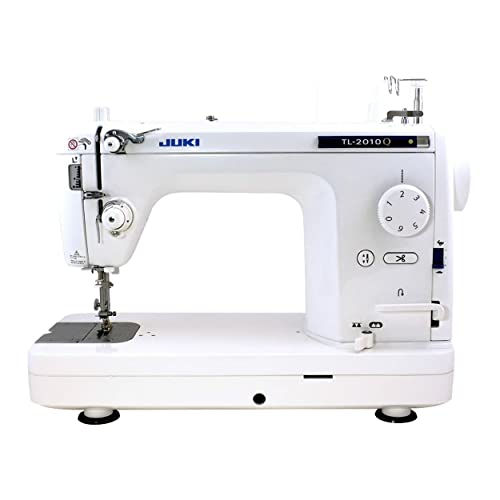
The TL-2010Q’s title calls it a high-speed semi-industrial sewing and quilting machine, and that semi is the most important word in this guide for a large class of studios. It is a tabletop machine — no industrial table, no under-mounted motor station — built with industrial intent: a straight-stitch focus, a body made for sustained speed, and a following among quilters and garment makers who sew for hours daily but still work in rooms that must serve other purposes. It is the machine for the studio whose order book has outgrown domestic equipment but whose work changes too often for a dedicated lockstitch station to be the only tool.
Honesty about the title: it states no speed figure, no stitch count, and no inclusions, so this review claims none of them. What can be said is structural. The TL-series proposition is a metal-bodied, straight-stitch specialist that trades the domestic machine’s library for speed, space under the arm, and stitch quality at pace — the quilting world’s favourite bargain. In a high-volume guide it plays the role of the on-ramp: the machine a growing studio buys first, learns production habits on, and later keeps for piecing, samples, and overflow even after a full industrial station arrives. Buying it is not a compromise on the way to volume; for many quilt and garment businesses, it is where volume legitimately lives.
- Class: semi-industrial, stated in the listing title
- Stated purposes: sewing and quilting, per the title
- Speed figure: the title gives none — confirm the rated figure in the manufacturer documentation
- Format: tabletop machine rather than a table-and-stand station
- Stitch focus: the TL line is a straight-stitch specialist; verify the exact specification before ordering
- Buying route: the Juki TL-2010Q listing on Amazon is the place to check price and current configuration.
Strengths
- Industrial intent in a tabletop footprint that suits multi-purpose rooms.
- A beloved platform among production quilters and garment makers.
- Keeps its role even after a full station joins the studio.
Trade-offs
- The title withholds its figures, so verification homework falls on the buyer.
- Straight-stitch focus means no zigzag or decorative capacity.
- True factories will outgrow it; it is a bridge and a specialist, not a line machine.
Best for: high-output quilting and garment studios in shared or home workspaces. Not suited for: buyers who need a complete industrial station with table and servo setup.
Quilters deserve a specific word, because this machine’s reputation was built in their studios. Production quilting — longarm alternatives aside — means piecing at pace and quilting through sandwiches that punish weak feed systems, and a straight-stitch specialist with real under-arm space answers both. A quilting business sewing client tops weekly will find the TL-2010Q’s working day closer to an industrial station’s than to a domestic machine’s, which is precisely the bridge this guide keeps describing.

Juki DNU-1541S Walking Foot — The Heavy-Material Anchor
When the material is leather, vinyl, canvas, or a sandwich of all three, volume sewing stops being about speed and becomes about movement: getting thick, sticky, layered stock through the needle evenly, without the top layer creeping or the bottom layer lagging. The DNU-1541S is built for exactly that physics. Its title states a walking foot with needle feed — the foot, the feed dogs, and the needle itself move the material together — plus a safety mechanism, a servo motor, a table, and a lamp. The safety mechanism matters in production: it protects the machine’s timing when the needle strikes something it cannot pass, turning a potential repair into a reset.
The listing’s DIY wording signals assembly involvement, so budget the setup afternoon and a helper; these stations are heavy in the way furniture is heavy. In return you get the machine class that upholstery shops, bag makers, and leather goods producers build their businesses on. Needle feed is the detail to underline: on long seams in leather, it is the difference between layers that arrive at the seam’s end together and layers that arrive a quarter-inch apart, which on a finished bag is the difference between product and seconds. If your volume is heavy material, this is the guide’s anchor pick, and the other walking-foot machines are best read as variations around it.
- Feed system: walking foot with needle feed, stated in the listing title
- Safety: safety mechanism included, stated in the title
- Drive: servo motor, stated in the title
- Included: table and lamp, per the title
- Assembly: the listing’s DIY wording indicates buyer assembly — plan time and help
- Buying route: look to the Juki DNU-1541S listing on Amazon and check price for the complete table setup.
Strengths
- Needle-feed walking foot keeps thick layers registered over long seams.
- Safety mechanism protects timing against the strikes heavy work invites.
- A complete station as titled: servo, table, and lamp included.
Trade-offs
- Assembly is part of the purchase, with real weight to move.
- Overkill and overspend for garment-weight fabrics.
- Walking-foot machines run slower than garment lockstitch heads by nature.
Best for: upholstery, leather, and bag production at genuine volume. Not suited for: shirting, dressmaking, or any light-fabric workload.
Buyers in this class should also think in terms of feet and guides as production tooling. Edge guides, binding attachments, and compensating feet matched to your product’s seams convert operator skill into machine consistency, which is the entire economics of volume: the tenth piece made by a tired operator at four in the afternoon should match the first piece made fresh. Walking-foot stations accept a rich world of such tooling, and budgeting for the two or three attachments your product actually uses is money better spent than any cosmetic upgrade.

Juki DU-1181 Walking Foot — The Straightforward Walking-Foot Station
The DU-1181’s title is the shortest of the industrial picks — single-needle walking foot, complete with K.D. stand and servo motor — and the machine matches its copy: a direct route into walking-foot production without the extra systems of its bigger sibling. K.D. means the stand ships knocked down, so assembly is part of the deal here too, traded for freight sanity and a lower delivered cost. For a shop adding its first heavy station — a furniture repair business, a canvas and awning maker, a leather workshop graduating from a domestic heavy-duty machine — that trade is often the right one.
Read against the DNU-1541S, the DU-1181 is the simpler instrument: walking foot stated, needle feed not claimed in the title, no safety mechanism mentioned. That does not make it a lesser machine for every shop; it makes it a machine whose title asks you to verify the feed details if needle feed is on your requirements list. Its production role is steady heavy work at moderate pace — the shop whose volume is measured in finished pieces per day rather than stitches per minute. Buyers should also note the stand configuration in the title when comparing prices, because a complete-with-stand listing and a head-only listing for this model family are different purchases.
- Configuration: single-needle walking foot, stated in the listing title
- Stand: K.D. (knocked-down) stand included, per the title — assembly required by design
- Drive: servo motor, stated in the title
- Needle feed: not claimed in this title; verify if your work depends on it
- Safety mechanism: not mentioned in the title
- Buying route: check price on Amazon under the Juki DU-1181 complete listing, stand and servo included.
Strengths
- A complete walking-foot station with stand and servo in one listing.
- Simpler specification suits shops entering heavy production.
- Knocked-down stand keeps freight practical for a heavy machine.
Trade-offs
- Feed and safety details are unstated in the title and need confirming.
- Assembly of stand and head is a genuine half-day of work.
- Less suited than the 1541S to the heaviest layered work.
Best for: first walking-foot stations in upholstery, canvas, and leather shops. Not suited for: buyers who need needle feed confirmed in the listing itself.
One more practical note for first-station buyers: a knocked-down stand is also a future advantage. Shops move, rooms reconfigure, and a stand that was assembled by your own hands can be disassembled, moved, and rebuilt without a specialist visit. The assembly you invest at purchase is partly a down payment on every rearrangement the business will ever make.

Juki DDL-8100e — The Economic Gateway Head
Juki calls this machine ECONOMIC in its own title, capitals and all, and the honesty is refreshing: the DDL-8100e is the brand’s value route into industrial lockstitch, stating a single needle and up to 4,500 stitches per minute, in white, with assembly required. For a start-up garment operation, a tailoring shop adding a second station, or a workroom replacing a dying head, that proposition is exactly calibrated. You are buying Juki’s lockstitch lineage — the feed, the stitch formation, the parts ecosystem — without paying for the flagship DDL line’s refinements.
The assembly warning deserves respect rather than anxiety. Industrial stations ship as a head, a table, a motor, and hardware, and the assembly is mechanical work: bolting, levelling, belt and timing checks, oil fill. Shops that treat it as a careful half-day with the manual open end up with a station they understand deeply, which pays off at the first adjustment. The 4,500 SPM ceiling sits a step below the JACK F6’s stated figure, and in garment practice the difference shows only on the longest straight runs; for mixed tailoring work, the operator, not the motor, sets the pace. Note that the title does not enumerate table and motor inclusions the way some rivals do, so confirm the exact configuration of the listing before comparing its price against complete-set rivals.
- Stitch type: single-needle lockstitch, stated in the listing title
- Top speed: up to 4,500 SPM, stated in the title
- Positioning: the economic model in Juki’s industrial lockstitch range, per the title
- Assembly: required, stated plainly in the title
- Table and motor inclusions: not enumerated in the title — confirm the shipped configuration on the listing
- Buying route: find the Juki DDL-8100e on Amazon and check price against the configuration you confirm.
Strengths
- Juki lockstitch lineage at the range’s most accessible position.
- A stated speed figure only a step below the guide’s fastest.
- Plain assembly language sets honest expectations.
Trade-offs
- Configuration details need confirming before price comparisons mean anything.
- No automatic lubrication is claimed in the title.
- Value positioning means fewer refinements than flagship Juki heads.
Best for: start-up garment operations and shops adding an affordable second station. Not suited for: shoppers expecting a fully enumerated, arrive-complete package.
There is a strategic way to use an economic head that experienced shops know: buy it as the second station first. Set it to the seam your main work repeats most — a specific hem, a lining seam, a standard join — and leave it set. Changeover time is invisible cost in every small shop, and a permanently set-up second head at the DDL-8100e’s position in the range can return more hours than a flagship that must be reconfigured five times a day.
Consew Walking Foot Industrial — The Upholstery Workhorse
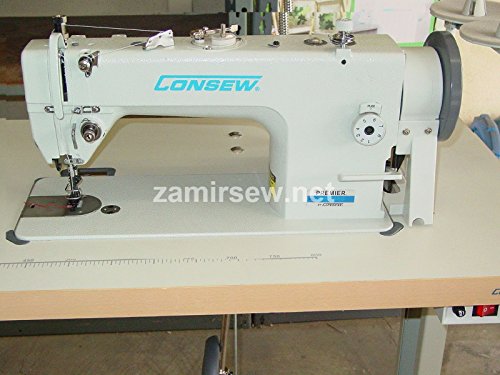
Consew’s title reads like a feed-system inventory: upholstery walking foot industrial machine with table and servo motor, drop feed, needle feed, walking foot, lockstitch. That triple-feed description — drop feed below, needle feed at the needle, walking foot above — is the full compound-feed arrangement, and upholstery is named as its home territory. Compound feed is what lets a machine walk a sofa panel’s worth of vinyl, foam, and backing through a long seam without layer shift, and it is the specification serious upholstery and automotive-trim shops shop for first.
Against the Juki walking-foot pair, the Consew’s case is completeness of the feed claim in writing: where the DU-1181’s title leaves needle feed unstated, this title prints all three feeds. The table and servo motor are likewise included as titled. For a production upholstery room, the machine’s value is measured in rework avoided — seams that do not need unpicking because the layers travelled together — and in the range of stock it accepts without complaint, from marine vinyl to layered canvas. This model has appeared in an earlier pool on this site under a different buying question; it is included here on the strength of its feed specification for volume upholstery work specifically.
- Feed system: drop feed, needle feed, and walking foot — all three stated in the listing title
- Stitch type: lockstitch, stated in the title
- Home territory: upholstery, named first in the title
- Included: table and servo motor, per the title
- Speed figure: not stated in the title, so treat pace claims from other sources cautiously
- Buying route: the Consew walking foot listing on Amazon carries the complete package — check price there.
Strengths
- Full compound feed stated in writing, the upholstery specification that matters most.
- Table and servo motor included as a working station.
- Built for the layered, slippery stock that defeats lesser feeds.
Trade-offs
- No speed figure in the title for comparison against the lockstitch heads.
- A heavy station that demands floor space and assembly effort.
- Garment-weight work gains nothing from its feed power.
Best for: upholstery and trim shops sewing layered stock all day. Not suited for: apparel production, where its feed system is expensive insurance.
Upholstery volume has a seasonal pulse — marine work in spring, furniture in autumn — and a compound-feed station earns its floor space by accepting the whole pulse without complaint: thin lining in the morning, foam-backed vinyl after lunch. Shops evaluating the Consew against the Juki pair should sew their single worst material on any machine they can access before deciding, because compound feed differences reveal themselves on the worst stock, not the average stock, and the worst stock is where rework is born.
Production Numbers, Side by Side
| Machine | Class | Stated top speed | Feed system | Station inclusions per title |
|---|---|---|---|---|
| JACK F6 | Industrial lockstitch | 5,000 SPM | Lockstitch, direct drive | Table and stand set |
| Juki TL-2010Q | Semi-industrial tabletop | Not stated in title | Straight-stitch specialist | Tabletop machine |
| Juki DNU-1541S | Industrial walking foot | Not stated in title | Walking foot, needle feed | Servo, table, lamp |
| Juki DU-1181 | Industrial walking foot | Not stated in title | Walking foot | K.D. stand, servo |
| Juki DDL-8100e | Industrial lockstitch | 4,500 SPM | Lockstitch | Confirm on listing |
| Consew Walking Foot | Industrial walking foot | Not stated in title | Drop, needle, walking foot | Table, servo motor |
Lockstitch or Walking Foot: The Fork Every Volume Buyer Reaches
The decision is physical, not preferential. If your material is garment-weight — shirting, dress fabrics, tailoring cloth, quilting cotton in sane layers — a lockstitch head moves it fast and cleanly, and its speed figures are real. If your material is heavy, layered, coated, or slippery, a lockstitch head’s drop feed alone will let layers travel at different rates, and no operator skill fully compensates across a production day; that is the walking foot’s entire reason to exist. Shops sewing both worlds need both stations, and the order of purchase should follow revenue: buy first for the work that pays this quarter. The power and control conversation in Best Professional Coffee Machines follows a similar logic — professional equipment rewards buyers who match the machine’s physics to the product’s physics, whether the product is espresso or upholstery.
What Does a Servo Motor Change About a Working Day?
Everything below the headline speed. A servo draws power mainly while sewing, runs quietly enough for conversation, and — decisively — gives the operator stitch-by-stitch control at the seam’s end, in corners, and across thickness changes. The older clutch-motor alternative is either on at full intent or off, which is why vintage industrial sewing has a reputation for eating beginners’ first projects. Every station in this guide that names its motor names a servo, and that uniformity is the market telling you the question is settled. When comparing any listing outside this guide, treat a clutch motor as a discount to negotiate, not a feature to accept silently.
Setting Up a Station: The Half-Day That Decides the First Year
Assembly is not a preliminary to owning these machines; it is the first act of ownership, and shops that rush it pay in vibration, noise, and timing drift. Level the table before the head goes on. Seat the head, fit the motor, and route belts or drive connections exactly as the manual orders. Fill oil to the mark — no more, no less — and run the machine unthreaded at moderate speed to circulate it. Thread, test on scrap of your real material, and adjust tension at working speed rather than at a crawl, because production tension is set where production happens. Finally, sew a full representative piece and keep it. That sample is your baseline when, months later, something sounds different and you need to know what right looked like.
Errors That Cost Production Shops Real Money
The expensive mistake is buying speed for material that needs feed: a 5,000 SPM lockstitch cannot help an upholstery shop, and its seams in layered vinyl will wander no matter who operates it. The second mistake is the mirror image — buying a walking-foot station for garment work and accepting its slower pace and heavier hand as the cost of quality that a lockstitch would have delivered faster. Third, shops under-budget the station’s surroundings: industrial needles in the right systems, bobbins wound consistently, a chair and lighting fit for eight-hour days, and floor space to handle material before and after the needle. Fourth, buyers skip the configuration check and discover a head-only shipment where a station was expected. Each of these errors is a reading error before it is a sewing error, which is why this guide keeps returning to titles as contracts.
The fifth mistake is maintenance amnesia. Industrial heads are durable, not immortal: oil levels, hook condition, belt or drive checks, and needle replacement on schedule are the difference between a ten-year station and a three-year one. Even the ovens in Best GE Profile Double Wall Ovens reward the same philosophy — professional-grade equipment repays owners who maintain it like professionals. Write the service intervals on the wall above the machine, in marker, where forgetting them requires effort.
Throughput Arithmetic: Turning SPM Into Pieces Per Day
New production buyers fixate on stitches per minute because it is the number printed largest, but pieces per day is the number that pays wages, and the two are connected by handling. Watch a skilled operator for ten minutes and count how much of that time the needle is actually moving: in most garment work it is well under half, because positioning, aligning, turning, trimming, and stacking consume the rest. This is why a 5,000 SPM head does not produce two-thirds more than a 3,000 SPM head in a real shop, and why the F6’s real advantages over the DDL-8100e are as much its drive response and self-lubrication as its ceiling. Speed matters most on long uninterrupted runs — curtains, duvet covers, production quilting, drapery panels — where the needle genuinely spends its life moving.
Handling is also where the walking-foot stations quietly justify themselves in arithmetic. A lockstitch operator sewing layered stock spends hidden minutes per piece easing, pinning, and correcting layer drift — minutes that never appear in a speed comparison but dominate the day. The walking foot removes those minutes wholesale. This is why comparing a walking foot’s unstated pace against a lockstitch’s 5,000 SPM ceiling is a category error: on the material each is built for, each is the faster machine, measured in finished pieces rather than needle cycles.
The practical method is to time a complete piece, not a seam. Sew ten of your actual product, start to finish, and divide. That figure, multiplied honestly across a working day with breaks and faults included, is your capacity, and it tells you whether your bottleneck is the machine, the operator, or the work’s own handling. Shops that do this arithmetic before buying a second station sometimes discover they needed a second pair of hands, a better cutting setup, or a pressing station — purchases that cost less than a head and unlock more. Volume problems are system problems; the machine is only the loudest component.
One Operator, Several Stations: How Production Rooms Actually Organise
Walk into a functioning small production room and you will rarely find one operator welded to one machine. Work flows: cutting feeds bundles to the lockstitch station, seams move to pressing, heavy pieces detour to the walking foot, and the TL-class machine absorbs samples, repairs, and the odd jobs that would otherwise interrupt a set-up station. This is why the bridge machine in this guide matters beyond its price — flexibility is a production resource, and a station that must be re-threaded, re-needled, and re-tensioned for every variation is a bottleneck wearing a fast motor. Plan a room as a system of stations with a flow, even if the room is a garage and the system is you walking between two tables.
Cutting deserves its place in the system too, because no station sews faster than the table that feeds it. Production rooms cut in layers with the right tools, bundle pieces in sewing order, and keep the next bundle within the operator’s reach before the current one ends. A station that waits for work is capital asleep, and in most small shops the cutting table, not the motor, is where the queue actually lives.
Thread discipline belongs to the same system thinking. Production rooms standardise: one thread family for the main work, cones racked by colour within reach of the stations that use them, bobbins wound in batches at a set tension, and needles logged by machine and date. These habits sound bureaucratic until the first fault appears mid-run, when the room that standardised can eliminate variables in minutes and the room that improvised starts guessing. Volume sewing is manufacturing, and manufacturing is mostly the elimination of surprises.
The Room Around the Machine: Power, Floor, and Air
Industrial stations ask things of a room that domestic machines never do. The floor must carry a loaded table without flex, because a station that rocks is a station whose timing and stitch quality wander. Power must be a clean, adequate circuit — servo motors are efficient, but a room running several stations, pressing equipment, and lighting on one tired circuit will teach you about voltage the hard way. Air matters too: production sewing generates lint and fibre dust at a rate home sewing never approaches, and heads breathe it. A room that gets a weekly blow-out and a filter habit keeps its machines; a room that does not is slowly sanding them from inside.
Noise belongs in the room plan as well. Servo stations are civilised compared with their clutch-motor ancestors, but several heads running together still build a working soundscape, and rooms that share walls with customers, family, or neighbours should plan for it: solid doors, soft surfaces where practical, and working hours chosen with the building in mind. A production room that gets shut down by complaints produces nothing at any speed, which makes acoustics a throughput specification too.
Layout is the last room question, and it is a throughput question in disguise. Material should enter near cutting, flow to the stations in process order, and leave near pressing and packing, without the operator carrying bundles across the room’s diagonal forty times a day. Even in a small space, arranging the lockstitch, the walking foot, and the pressing point in a triangle you can pivot inside will return more pieces per day than a faster motor bought instead. Measure your room with the same honesty this guide applies to listing titles, and spend on the constraint that actually binds.
New Stations Versus the Used Industrial Market
Every machine in this guide competes with a shadow: the used industrial market, where retired factory heads sell for fractions of their original price. Used Juki and Consew heads are the backbone of half the small production rooms in existence, and a good one — inspected, stitch-tested, with a known history — can be the smartest purchase a young shop makes. The conditions matter. Inspect in person if geography allows. Sew your own material on the machine before money moves. Price in a professional service visit and a motor upgrade if the head carries an old clutch unit, because the servo conversion is where used bargains quietly return their savings. And confirm parts availability for the specific model, since a cheap head with an unobtainable hook assembly is not cheap for long.
The new listings in this guide answer the used market with certainty: known configuration, warranty, current servo equipment included as titled, and no previous owner’s habits ground into the mechanics. For a shop whose orders begin the week the machine arrives, that certainty has a cash value. For a shop with time, skills, and a local mechanic, the used route remains honourable. What is not honourable is the middle path of buying used sight-unseen from photographs — the one route where every risk in this section applies and none of the savings are guaranteed.
Training an Operator Is Part of the Machine’s Price
An industrial station in untrained hands is a fast way to make bad seams and one genuine safety hazard. Shops buying their first station should budget training as deliberately as freight: a day of supervised practice on scrap, a written setup checklist at the machine, and a rule that new operators sew production only after their test pieces pass inspection. The skills are specific — feeding material without pushing or dragging, stopping exactly at a mark using servo control, recognising the sound of a dull needle, knowing when a tension change is the answer and when it is the problem wearing a disguise. None of this is talent; all of it is trainable, and the shops with the fewest faults are the ones that treat training as a station cost rather than a personality trait they hope to hire.
Cross-training multiplies the investment. An operator who can run both the lockstitch and the walking foot covers absences, balances queues, and understands the product whole. In a two-person shop, that flexibility is worth more than a third machine. Write the room’s procedures down as they stabilise — threading paths, needle systems per station, tension starting points per material — because the document you write in month two is the training course you will deliver in year two.
Needles, Bobbins, and Thread at Production Scale
Production consumables are a system, and the system fails at its cheapest point. Industrial needles come in machine-specific systems with point styles matched to material — ball points for knits, sharp points for wovens, cutting points for leather — and a station fed the wrong system will skip, shred, or damage goods while appearing to be a tension problem. Buy the correct system in bulk, label the drawer by station, and replace needles on a schedule counted in sewing hours, because a needle’s cost is trivial against a run of damaged product. Bobbins deserve the same standardisation: one correct type per station, wound at consistent tension in batches, because a badly wound bobbin manufactures tension faults that no dial adjustment can cure.
Thread at volume is bought by the cone and judged by consistency. A thread that breaks twice an hour costs more in stopped production than a premium cone costs at purchase, and its lint loads the machine’s internals with the dust discussed above. Standardise the main colours, keep cones racked and covered, and treat thread changes as setups to be minimised by batching work — the same logic as the stations themselves. The rooms that hit their pieces-per-day numbers are rarely the rooms with the fastest heads; they are the rooms where nothing trivial ever stops a needle.
A Maintenance Calendar a Small Shop Can Actually Keep
Daily: brush lint from the hook and feed area, glance at the oil level or sight glass, and listen — a station’s sound is its first diagnostic, and a new rattle noticed today is a repair avoided next month. Weekly: check belt or drive condition where fitted, wipe down the table and machine bed, verify the lamp and safety features work, and sew a test seam on standard scrap to compare against your baseline sample. Monthly: inspect needles’ stock and rotate, check bobbin cases for burrs, examine the motor vents for dust loading, and review tension behaviour across your material range. Annually, or at the hours the manual specifies: a professional service — timing, hook condition, clearances — by hands that do it daily.
The calendar works because it is written, posted, and initialled. Production rooms that rely on memory discover that memory is the first casualty of a busy season, which is exactly when maintenance matters most. The F6’s automatic lubrication removes one daily task from this list; it does not remove the list. Owners who keep the calendar own machines that feel new for years, and when resale day comes, the maintenance record is the document that separates their station from the identical model with an unknown past.
Safety Is a Production Feature, Not a Poster
Industrial needles at production speed deserve a sober paragraph. Needle guards stay on. Eye protection is worn for heavy work where needle strikes are possible — and the DNU-1541S’s stated safety mechanism exists because strikes happen even to experts. Hair, sleeves, and jewellery are managed before the motor starts, not after. New operators learn the servo’s stop behaviour at low speed before they are given pace. None of this slows a well-run room; it keeps the room running, because an injury stops production longer than any breakdown in this guide and costs things no machine money measures. Treat the safety setup of each station — guards, lamp, mechanism — as part of its specification, reviewed at assembly with the same care as its feed system.
Seasonal Volume: Owning Capacity You Only Sometimes Need
Many sewing businesses are tidal: uniforms before the school year, marine canvas in spring, costumes in autumn, alterations after holidays. Tidal volume changes the buying logic. A station bought for the peak must justify itself across the trough, which argues for versatile sequencing — the lockstitch that sews the peak product and the everyday work between peaks — and against hyper-specialised purchases that idle for ten months. It also argues for the economic end of this guide more often than pride prefers: a DDL-8100e that earns across the whole year beats a flagship that earns brilliantly for six weeks and decorates the room for the rest. Where peaks are extreme and brief, the honest alternatives are overtime, temporary help on a bridge machine like the TL-2010Q, or subcontracting the overflow — all cheaper than owning peak capacity outright.
What Sustained Speed Does to Materials and Method
Sewing at production pace changes the materials themselves. Fabric heats at the needle on long fast runs, synthetics can glaze, and adhesives in interfaced work soften — which is why experienced rooms slow down for specific materials even on fast machines, and why the stated ceiling is a property of the machine rather than an instruction to the operator. Method changes too: pieces are cut with production seam allowances, marked with production tools, and bundled in sewing order, because at volume the cheapest stitch is the one sewn once, in sequence, without the piece leaving the operator’s hands for a search. A shop adopting its first station should expect a month of method adjustment, during which the machine seems faster than the room; the room catches up, and then the numbers in this guide start to mean something.
Reading a Production Listing Like a Factory Manager
Close this guide where it began: with the title as a contract. A factory manager reading these six titles extracts, in order, the stitch type, the feed system, the drive, the stated ceiling, the inclusions, and the assembly burden — and treats everything absent as a question to be answered in writing before purchase. Photographs are atmosphere; titles are commitments. Two listings here state their speeds and four do not, and the four silences are not defects to be excused but facts to be priced: a machine whose pace is unstated must win on feed, completeness, or cost, as the walking-foot picks here do. Buyers who internalise that reading order will shop every future equipment category — in this guide’s world and beyond it — with the same protection.
Final Recommendation
Match the station to the material and the volume to the truth. Garment operations should start with the JACK F6’s complete, self-lubricating speed or the DDL-8100e’s economy, depending on budget and how much configuration homework they accept. Heavy-material shops should anchor on the DNU-1541S, step in through the DU-1181, or take the Consew where compound feed in writing matters most. Growing studios not yet ready for a station should buy the TL-2010Q and learn production habits on it. Whichever you choose, assemble it like you mean it, oil it like the manual says, and the machine will repay you in the only currency volume sewing recognises: seams that come off the table finished, identical, and on time, day after day, until the work itself — not the machine — decides when the day is done.
Frequently Asked Questions
Can an industrial lockstitch machine sew leather?
Thin garment leather, sometimes, with the right needle and patience. Production leather work, no — that is walking-foot territory, because the feed system, not the needle, is what fails first on thick and layered stock. Match the feed to the material and the question answers itself.
How fast is 5,000 SPM in practice?
It is a ceiling reached on long straight runs in suitable fabric by a practiced operator. Real production averages far below the ceiling once starts, stops, turns, and handling are counted. Buy the ceiling as evidence of the machine’s class, and plan your throughput from timed test pieces.
Do these machines zigzag or sew stretch fabrics?
Lockstitch stations sew a straight lockstitch only. Stretch garments in production are sewn on overlock and coverstitch machines, which are different stations entirely. A high-volume shop usually ends up owning several single-purpose stations rather than one machine that imitates all of them badly.
How long do industrial heads last in daily service?
Measured in years rather than seasons: a maintained industrial head in a small shop commonly serves a decade or more, with wear parts — hooks, feed components, belts where fitted — replaced along the way. Longevity is the economic foundation of the whole category, and it is why the maintenance calendar in this guide is written as a business practice rather than a hobby suggestion.
Is assembly really a half-day job?
For a first station, yes — uncrating, stand assembly, head fitting, motor mounting, oiling, and testing, done carefully, fills a half-day with a helper. Shops that have done it before work faster. Rushing it is false economy, because levelling and setup errors persist for the machine’s whole life.
What needles and thread do industrial heads use?
Industrial needle systems differ from domestic ones and vary by machine class, so the manual’s specification governs. Buy needles and bobbins to that specification, in production quantities, from the start; a station stopped for want of a two-dollar part is the most expensive machine in the building.
How many stations does a small production shop actually need?
Most start with one and discover the answer from their order book: a second station becomes necessary when one product’s setup keeps evicting another’s, or when a queue forms at a single needle while hands stand idle. Buy stations in the order your bottlenecks appear, and let each purchase be argued by the queue, not by ambition.
Can one machine cover both garment and upholstery volume?
Not honestly. The feed systems are optimised for opposite material classes, and a shop sewing both needs a lockstitch and a walking foot, sequenced by revenue. Attempting to cover both with one station produces mediocre results in both and accelerated wear in the bargain.
Related Guides
Heavy sewing overlaps with this guide at several edges, and readers speccing a workroom should also read Best Sewing Machines for Upholstery, which approaches the walking-foot decision from the furniture side rather than the production side.


