What's inside
- The Short Version for Roasters
- Roasting Contenders at a Glance
- How Roasting Ability Was Judged From Listing Titles
- Six Ovens, One Technique: The Roasting Ledger
- The Physics of a Perfect Tray: Moisture, Spacing, and Moving Air
- Which Vegetables Test Which Part of the Oven?
- Converting Your Old Recipes to a Convection Cavity
- Cleaning a Roaster’s Oven: Sugar, Smoke, and the Self-Clean Question
- A Roaster’s Year: What Each Season Asks of the Cavity
- Where Wall Ovens Go Wrong for Roasters
- Fitting Day and the Electrical Conversation to Have First
- Trays, Racks, and the Small Equipment That Decides Results
- Final Recommendation
- Height, Reach, and Who the Wall Format Serves Best
- Energy, Heat in the Room, and Running a Big Cavity Honestly
- Roasting Questions From the Oven Door
- Related Guides
As an Amazon Associate I earn from qualifying purchases. This post may contain affiliate links at no extra cost to you.
cottageverdict.com is reader-supported. When you buy through links on our site, we may earn an affiliate commission.
Buying route for this list: each oven below is sold through its Amazon listing, where you can check price on Amazon and confirm the cutout dimensions against your cabinetry before committing — wall ovens are the least returnable appliances in the kitchen, so the listing’s dimension diagram deserves the same attention as its photographs.
Begin with the confession this search requires: no wall oven on the market is sold “for vegetables,” and not one listing title in this guide claims to be. The best wall ovens for roasting vegetables are simply the ovens whose titles confirm the machinery that roasting actually uses — true convection to move hot air around crowded trays, a roast or air-fry mode that runs the cavity hot and dry, enough capacity for two sheet pans without steaming, and controls precise enough to hold a fierce temperature without scorching the honey on your carrots. Every pick below was chosen because its title states convection, roast, or air-fry capability outright. Where a title is silent — on rack positions, probe thermometers, exact temperature ranges — this guide records the silence and points to the manufacturer’s documentation, rather than dressing a guess as a specification.
Why does the distinction matter? Because vegetables are the most honest test of an oven. A chicken forgives; a tray of Brussels sprouts does not. Roasting is the art of driving moisture off surfaces faster than it can pool, so that sugars brown instead of stewing — and that is a contest between the oven’s airflow and the vegetables’ own water. A still oven with a weak fan produces the grey, soft result that gives roasted vegetables their undeserved reputation in school canteens. A true-convection cavity, loaded correctly, produces edges, char, and sweetness. The six ovens here span that capability from a compact 24-inch convection model to a double oven with air fry in both spirit and name, and the guide treats them as roasting instruments first and appliances second.
One more premise: size is a roasting feature. The 30-inch models dominate this list because a half-sheet pan — the roasting workhorse — wants a wide cavity with air space around it, but the 24-inch GASLAND earns its place for small kitchens by stating convection and a dozen cooking functions in a compact frame. Households graduating to a wall oven from a range will find the format questions answered in the sections after the reviews, and readers speccing a full wall should cross-read Best GE Profile Double Wall Ovens, where the double-oven question is examined through one brand’s range in depth.
The Short Version for Roasters
- No title here claims a vegetable mode — the picks rest on stated convection, roast, and air-fry capability, and this guide says so openly.
- True convection is named by three picks: the Frigidaire Professional and both ZLINE Autograph models.
- Air fry appears in three titles, and it is a roasting asset, not a gimmick — it is convection run hot and fast, which is what tray vegetables want.
- Only one title states a roast mode by name: the ExploreHorizon, with Broil/Bake/Roast printed in its listing.
- Capacities stated range from the GASLAND’s 2.6 cubic feet to the ExploreHorizon’s 4.8 — tray count, not litres, is the number to plan around.
Roasting Contenders at a Glance
| Oven | Our label | Roasting case in one line |
|---|---|---|
| Frigidaire Professional Single Wall Oven | Roaster’s default | True convection plus air fry in a mainstream 30-inch single cavity. |
| GASLAND 24-Inch Convection Wall Oven | Small-kitchen roaster | Convection and twelve functions in a 24-inch frame for compact kitchens. |
| ZLINE Autograph Double Wall Oven | Two-cavity feast oven | True convection and air fry across a double cavity for roasting at scale. |
| ZLINE Autograph Single Wall Oven | Design-led single | The double’s convection and air fry in one cavity, with the Autograph finish. |
| Forno Vomero Double Wall Oven | White double | A convection double oven in white — the finish almost no other double offers. |
| ExploreHorizon 30-Inch Wall Oven | Named-roast-mode pick | The only title here that prints the word Roast among its modes. |
How Roasting Ability Was Judged From Listing Titles
The method deserves spelling out, because this is a guide built on a premise it had to construct honestly. Roasting vegetables needs four physical things: moving air, high sustained heat, dry cavity conditions, and room for trays to sit in a single layer with space between pieces. A listing title can confirm the first directly — convection, and especially true convection, where a heating element works with the fan so the moving air is itself heated — and can confirm the second and third indirectly through named roast and air-fry modes, which are engineered around exactly those conditions. Capacity figures, where stated, address the fourth. Those confirmations formed the screen: no oven entered this guide on brand reputation or on a retailer’s category tag, only on roasting machinery its own title was willing to name.
What the screen could not confirm, the guide does not assert. Maximum temperatures, rack counts, glide systems, meat probes, and self-cleaning cycles beyond the ZLINE titles’ stated self clean are all absent from these listings’ titles, and each spec box below marks its model’s silences plainly. This matters more for wall ovens than for almost any other appliance, because the purchase is semi-permanent: the oven is wired, fitted, and trimmed into cabinetry, and discovering a missing feature afterward is a renovation conversation, not a returns label. Read the documentation for your finalist as if you were signing for the cabinetry — because you are.
A word, too, on what was excluded and why it matters. The marketplace is full of wall ovens whose titles speak only of size and finish, and some of them no doubt roast perfectly well; they are absent here because this guide’s promise is that every claim traces to a title a reader can verify. That discipline narrows the field and occasionally excludes a worthy machine, and it is still the right discipline for an appliance that will be wired into a wall for fifteen years on the strength of a decision made in an afternoon. Where a beloved model of yours is missing, the method is portable: read its title for convection, for roast or air-fry modes, for capacity, and let the documentation answer the rest.
Within the six, the ranking follows roasting logic rather than price or prestige. The Frigidaire leads because true convection plus air fry in a single mainstream cavity is the combination most households will use weekly. The doubles follow for households whose roasting is done in volume or alongside other dishes. The GASLAND’s place is protected by the small kitchens no 30-inch oven can enter, and the ExploreHorizon closes the list as the one model whose title literally names the mode this guide is about.

Frigidaire Professional Single Wall Oven — Roaster’s default
The Frigidaire Professional’s title makes the two claims a roaster needs and stops there: true convection and air fry, in a 30-inch single electric wall oven, model PCWS3080AF, in stainless steel. True convection is the load-bearing phrase. In a conventional oven the fan, if one exists at all, merely stirs air heated by elements at the cavity’s edges, and the corners run cool; in a true-convection design the fan works with its own heating element, so the air arriving at your tray of cauliflower is at temperature on contact. For vegetables — thin pieces, high moisture, crowded trays — that difference is the difference between browning and steaming, and it is why this mainstream oven, without luxury branding, leads a guide that includes ZLINE’s statement pieces.
Air fry is the second claim, and roasters should claim it for their own. An air-fry mode is convection turned assertive: high heat, fast air, intended for surfaces that crisp. Run a tray of chickpeas or potato wedges under it and the mode earns its keep; run delicate vegetables — asparagus, green beans — and you will learn to shorten times and watch the final minutes, because the same assertiveness that crisps a potato will char a thin bean past kindness. The title states neither capacity nor a temperature range, so both belong on the documentation checklist, along with rack positions: two-tray roasting wants racks spaced so both pans sit in moving air, and the manual, not this guide, is where that geometry is confirmed.
- Format: 30-inch single electric wall oven, stainless steel
- Model: PCWS3080AF, per the listing title
- Heating named: True Convection and Air Fry
- Capacity and temperature range: the listing title states neither — pull both from the manufacturer’s documentation
- Sourcing the Frigidaire Professional Single Wall Oven: its Amazon listing carries the offer — check price on Amazon there and download the dimension diagram in the same visit
Strengths
- True convection is the single most valuable roasting feature, and it is confirmed in the title.
- Air fry gives tray vegetables a high-heat, fast-air mode without a countertop appliance.
- A mainstream maker’s network stands behind parts and service for a fitted appliance.
Trade-offs
- One cavity means roasting competes with everything else the meal requires.
- Unstated capacity in the title forces a documentation check before tray planning.
- Air fry’s aggression needs supervision with thin or sugary vegetables.
Best for: the household that roasts twice a week and wants the right machinery without a luxury badge. Not suited for: feast-scale cooks who routinely need two cavities at two temperatures.

GASLAND 24-Inch Convection Wall Oven — Small-kitchen roaster
Small kitchens are where wall ovens earn their existence — freeing the worktop, lifting the cavity to eye level — and the GASLAND is this guide’s compact instrument. Its title is the most numerate here: 24 inches, ETL certified, 2.6 cubic feet, 3100W, twelve cooking functions, 3D heating, convection with a rotisserie, touch control, and a safety lock, in black. Translate for roasting: a small cavity heats fast and its fan has less air to move, so a single tray of vegetables in a 24-inch convection oven can brown beautifully — arguably more evenly than in a large cavity, where corners hide. The constraint is arithmetic, not quality: one tray at a time, and pieces in a single layer or not at all.
The rotisserie is a bonus this guide notes without leaning on — it belongs to the chicken cookery the oven also serves — while the twelve functions suggest the mode menu includes the bake and grill variations a small household needs from its only oven. What the title does not state is a maximum temperature or an air-fry mode, so fierce-heat roasters should confirm the ceiling in GASLAND’s documentation; most vegetable roasting lives comfortably in the standard range, but char-seekers after blistered peppers will want the number in writing. For a flat, a small house, or a garden kitchen, this is the pick that respects the room it must fit.
- Format: 24-inch electric wall oven, black
- Capacity and power: 2.6 Cu.ft and 3100W, per the listing title
- Functions: 12 cooking functions, with convection and rotisserie named
- Heating description: 3D heating, per the title
- Controls and safety: touch control and safety lock, per the title
- Certification: ETL certified, per the title
- Maximum temperature: the listing title does not give one — the manufacturer’s documentation is the source for it
- Sourcing the GASLAND 24-Inch Convection Wall Oven: sold through Amazon — check price on Amazon on the listing and verify your cutout against its diagram
Strengths
- Real convection in a 24-inch frame serves kitchens the 30-inch models cannot enter.
- A small cavity heats quickly and moves its air thoroughly around a single tray.
- The title’s completeness — capacity, power, functions — is a model of honest listing.
Trade-offs
- One tray at a time is a hard ceiling for batch roasting and entertaining.
- No air-fry mode is named, so the hottest, fastest roasting style needs verification.
- A rotisserie will be dead weight for households that never cook whole birds.
Best for: flats and small houses whose only oven must roast well in a compact cavity. Not suited for: households that roast for crowds or run two trays as a matter of routine.

ZLINE Autograph Double Wall Oven — Two-cavity feast oven
The feast problem is a scheduling problem: the roast vegetables want fierce heat at the last moment, the gratin wants gentleness, the bread wants its own regime, and a single cavity forces them into a queue that ends with something served lukewarm. ZLINE’s Autograph double answers with architecture — two cavities, true convection, air fry, and self clean, in satin stainless steel with polished gold handles, model WADSZ-30-G. For roasting specifically, the double format transforms the vegetable course: roots can hold at a lower temperature in one cavity while the second runs a tray of sprouts at full aggression minutes before serving, so everything arrives hot, browned, and simultaneous, which is the entire difficulty of a feast removed.
The Autograph line is ZLINE’s design-led tier, and the gold handles announce that this oven is also furniture — a consideration this guide respects, because a wall oven is the most visible appliance in a kitchen and the one least often replaced. What the title does not state is the capacity split between cavities or whether convection serves both, and feast planners should confirm both in the documentation: a double whose lower cavity is a part-time citizen changes the scheduling maths. Self clean, stated outright, matters more for roasters than for bakers — roasted vegetables at high heat spatter sugars that carbonise on cavity walls, and a genuine self-clean cycle is the difference between an oven that stays sweet and one that smokes faintly forever.
- Format: 30-inch double wall oven, satin stainless steel with polished gold handles
- Model: WADSZ-30-G, per the listing title
- Heating named: Professional True Convection and Air Fry
- Cleaning: self clean, per the title
- Capacity split between cavities: the listing title does not state it — confirm the per-cavity volumes in the manufacturer’s documentation
- Sourcing the ZLINE Autograph Double Wall Oven: available via Amazon — check price on Amazon at the listing, and treat the cutout diagram as part of the purchase
Strengths
- Two cavities dissolve the feast-scheduling problem that defeats single ovens.
- True convection plus air fry gives both gentle and aggressive roasting registers.
- Stated self clean answers the carbonised-sugar reality of high-heat roasting.
Trade-offs
- A double’s price and cabinet commitment are the largest in this guide.
- The per-cavity capacity split is unstated in the title and shapes real tray planning.
- Statement hardware dates a kitchen if the household’s taste moves on.
Best for: households that host seriously and roast in volume across two temperatures. Not suited for: small households, whose second cavity would spend its life as expensive storage.
ZLINE Autograph Single Wall Oven — Design-led single
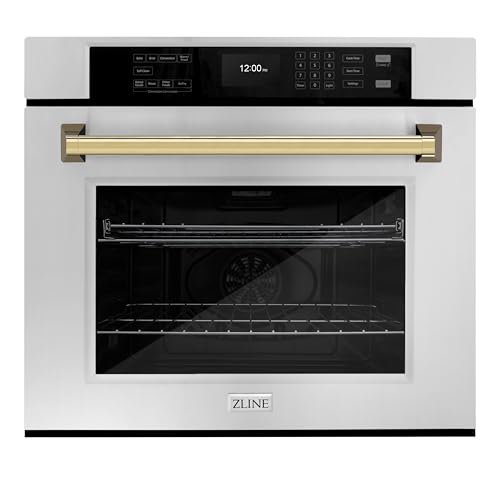
Everything the double promises in one cavity, minus the scheduling magic: the Autograph single, model WASZ-30-G, states professional true convection, air fry, and self clean in stainless steel with a polished gold handle. For the household whose roasting is a nightly tray rather than a feast production, this is arguably the more honest purchase — one excellent cavity, fully featured, in a kitchen where the second oven would have been a warming drawer with delusions. The roasting machinery is identical in kind to the double’s: heated moving air for even browning, a fast hot mode for crisping, and a cleaning cycle that forgives the sugars.
The design conversation is unavoidable with Autograph and should be had plainly. Satin stainless with gold hardware is a commitment to a palette; it will organise a kitchen around itself, delight its owners daily if the palette is theirs, and nag quietly if it was chosen for a photograph rather than a life. The title does not state capacity, so tray planners must visit the documentation — a 30-inch single usually hosts a half-sheet pan comfortably, but “usually” is not a specification, and this guide’s rule is that pan fit gets verified, not assumed. Kitchens that run a café-grade drinks programme alongside dinner might enjoy Best Commercial Coffee and Tea Machines as an unlikely companion read — the same buy-once, buy-documented philosophy governs both.
- Format: 30-inch single wall oven, stainless steel with polished gold handle
- Model: WASZ-30-G, per the listing title
- Heating named: Professional True Convection and Air Fry
- Cleaning: self clean, per the title
- Capacity: the listing title leaves it open — the manufacturer’s documentation states the cavity volume
- Sourcing the ZLINE Autograph Single Wall Oven: listed on Amazon — check price on Amazon there before ordering cabinetry work
Strengths
- The double’s roasting machinery in the format most households actually need.
- Self clean is stated, sparing roasters the carbonised-sugar scrape.
- Autograph hardware turns a fitted appliance into the kitchen’s deliberate centrepiece.
Trade-offs
- A single cavity reinstates the feast queue the double abolishes.
- Gold hardware is a palette commitment the whole room must honour.
- Capacity must be verified in documentation before tray maths is done.
Best for: design-led kitchens that roast nightly in one cavity and want it beautiful. Not suited for: entertainers who need two temperatures at once, or minimalists the hardware would oppress.
Forno Vomero Double Wall Oven — White double
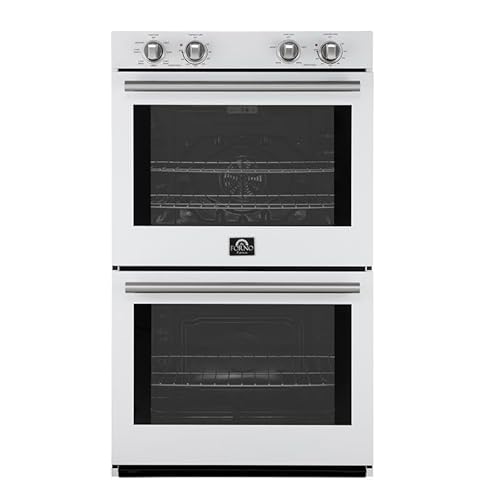
Forno’s Vomero does something no other double in this guide attempts: it comes in white. The title is brief — 30-inch double wall oven, electric convection, white — and the brevity cuts both ways. Convection is confirmed, which is the roasting essential; the double format is confirmed, which is the feast essential; and the finish is the rarest thing in the wall-oven market, where doubles are stainless almost by law. For the pale, traditional, or farmhouse kitchen that needs two cavities, this may be the only candidate that does not force a finish divorce, and that scarcity is itself a specification.
Everything else must be researched. The title does not say whether the convection is true convection with its own element, whether both cavities convect, what the capacities are, or whether a self-clean cycle exists — and for a roaster, the first two questions decide the purchase. Forno is an Italian-heritage brand with a value-led position in the market, and its documentation is where this oven will either confirm itself as the white double of a roaster’s dreams or reveal itself as a gentler instrument for a baking household. This guide’s verdict is deliberately suspended in exactly those terms: the premise is unique, the homework is mandatory.
- Format: 30-inch double wall oven, white
- Heating named: electric convection, per the listing title
- Convection type, per-cavity detail, capacity, cleaning: none of these is specified in the listing title — each belongs on the manufacturer’s documentation checklist
- Sourcing the Forno Vomero Double Wall Oven: sold via Amazon — check price on Amazon at the listing after the documentation has answered the convection questions
Strengths
- The only white double here — a finish monopoly for pale kitchens needing two cavities.
- Convection is confirmed in the title, covering the roasting essential.
- Forno’s value positioning makes the double format reachable for more households.
Trade-offs
- The sparsest full-size title in the guide; nearly everything needs verifying.
- Whether both cavities convect is unknown from the title, and feast maths depends on it.
- No self-clean claim is stated, which high-heat roasters will feel.
Best for: white kitchens that need a double and refuse to break the finish for it. Not suited for: buyers who want their specification stated in the title — the ZLINEs oblige, this one does not.
ExploreHorizon 30-Inch Wall Oven — Named-roast-mode pick
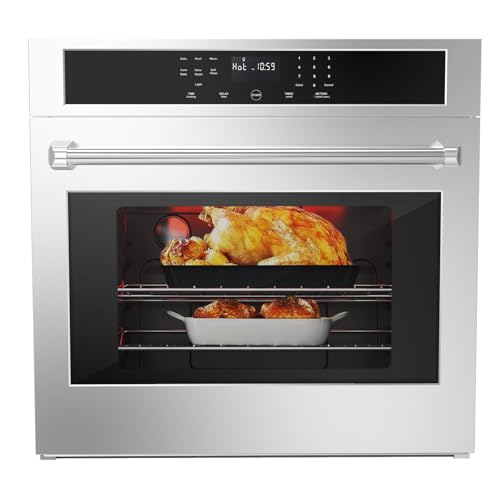
One title in this guide uses the word at the heart of the search: the ExploreHorizon’s mode list reads Broil/Bake/Roast, printed in its listing alongside a 4.8 cubic foot convection cavity, 3800W, touch control with an LED display, a timer, and a safety lock. A named roast mode is not proof of roasting greatness — modes are recipes of heat and fan behaviour, and the documentation would describe this one’s — but it is evidence that the maker engineered a setting around the technique rather than leaving roasters to improvise one from bake. Combined with the largest stated capacity in the guide, that makes this lesser-known badge a genuinely interesting instrument for tray work: 4.8 cubic feet is two-tray territory in a single cavity, provided the racks and airflow cooperate, which the manual must confirm.
The brand is the trade. ExploreHorizon lacks the service history of Frigidaire or the design profile of ZLINE, and a wall oven is the appliance where support matters most, because it cannot be boxed and returned on a whim. Buyers drawn by the specification should weigh the documentation’s completeness as a proxy for the company’s seriousness — a maker that publishes full cutout diagrams, electrical requirements, and mode descriptions is telling you something reassuring. On stated roasting credentials alone, though, this oven closes the guide with its head up: convection, capacity, power, and the word Roast itself.
- Format: 30-inch electric built-in single wall oven
- Capacity and power: 4.8 Cu. Ft. and 3800W, per the listing title
- Modes named: Broil, Bake, and Roast, with convection
- Controls and safety: touch control, LED display, timer, safety lock
- Convection type and rack detail: the listing title does not describe them — the manufacturer’s documentation holds both
- Sourcing the ExploreHorizon 30-Inch Wall Oven: available through Amazon — check price on Amazon on its listing and read the full mode descriptions before deciding
Strengths
- The only named roast mode in the guide, engineered for the technique itself.
- The largest stated single-cavity capacity here, promising two-tray roasts.
- A complete control and safety list is stated in the title, unusually for its tier.
Trade-offs
- The least-established badge in the guide, on the least-returnable appliance type.
- Convection type is unstated, so browning evenness needs documentation evidence.
- Two-tray performance depends on rack geometry the title does not describe.
Best for: specification-led buyers who will read the manual first and value the named roast mode. Not suited for: buyers who rank service network above all else in a fitted appliance.
Six Ovens, One Technique: The Roasting Ledger
| Oven | Convection as titled | Air fry titled | Capacity titled |
|---|---|---|---|
| Frigidaire Professional Single | True convection | Yes | Not stated |
| GASLAND 24-Inch | Convection, 3D heating | No | 2.6 Cu.ft |
| ZLINE Autograph Double | True convection | Yes | Not stated |
| ZLINE Autograph Single | True convection | Yes | Not stated |
| Forno Vomero Double | Convection | No | Not stated |
| ExploreHorizon 30-Inch | Convection, roast mode | No | 4.8 Cu. Ft. |
The ledger’s pattern is worth seeing whole: the famous names confirm the heating but not the size, while the lesser-known names confirm the size but not the heating’s type. Every buyer in this guide has exactly one documentation question that matters most — ask yours before the cabinetry is cut.
The Physics of a Perfect Tray: Moisture, Spacing, and Moving Air
Roasting fails in one way only: water wins. A cut vegetable is mostly water, and heat drives that water to the surface, where it must evaporate before browning can begin. Crowd the tray and the evaporating moisture of forty sprout halves raises the humidity around each one until the tray is effectively steaming — the vegetables cook, soften, and stay pale, and the cook concludes that roasting “doesn’t work” in their oven. The oven is usually innocent. Space pieces so they do not touch, use a pan with low sides that does not shelter them from the fan’s path, and roast in batches rather than in piles. Convection then does what it is for: the moving air strips the humid layer from each surface continuously, evaporation keeps pace, and the sugars that remain begin the browning reactions that are the entire point.
Heat is the second variable, and it should be braver than most cooks are. Roots and brassicas reward fierce roasting — the highest temperatures your oven and your oil’s smoke point agree on — while delicate vegetables want the same airflow at gentler settings and shorter times. Preheat fully, and preheat the tray with the oven when char matters: vegetables landing on hot metal begin browning at the contact face immediately instead of stewing in their first juices. Oil belongs on the vegetables, tossed in a bowl beforehand so every piece carries a film, never pooled in the pan where it fries the undersides unevenly. Salt before roasting for seasoning; salt after, in flakes, for finish — and know that wet marinades are the enemy of everything above, because they import the very water the technique exists to expel.
Rack position is the third variable and the one wall ovens change most. A wall oven’s cavity at waist-to-eye height invites a middle rack as default, which suits most trays; move up a level when the tops need the element’s attention in the final minutes, and down when thick roots need time without scorching. In a double, the two cavities’ personalities will diverge — one will run hotter at the edges, one gentler — and the first month of roasting is partly an exercise in learning which cavity your sprouts prefer. Keep a notebook if you cook seriously; ovens, like gardens, reward those who record what actually happened.
Which Vegetables Test Which Part of the Oven?
Brussels sprouts are the convection examination: halved, oiled, cut-side down, they must emerge with charred leaves and tender hearts in the same minute, which only even moving air achieves. Sweet potatoes test sustained heat and capacity — dense, sugary, cut thick, they need time at temperature without the edges carbonising, and a double oven earns its price the first time they share an evening with a faster tray. Cauliflower tests the fan’s honesty at the tray’s corners, where still air leaves pale, soft florets among browned ones. Peppers and chillies test the ceiling: blistering skins want the hottest, closest heat the oven owns, and they are the vegetables that will tell you whether your model’s unstated maximum temperature matters to your cooking.
Roots in mixture — carrots, parsnips, beetroot, celeriac — test the cook more than the oven: cut them by density, not by habit, so the beetroot’s wedges are thinner than the carrot’s batons and everything finishes together. Green vegetables test restraint: beans, asparagus, and tenderstem broccoli want a brief, hot pass, ideally in the air-fry register the Frigidaire and ZLINEs offer, and they punish distraction by the minute. A household that roasts the full repertoire will use every capability these titles name across a month, which is the practical argument for buying the machinery rather than the marketing: modes are only gimmicks on the days you do not need them.
Converting Your Old Recipes to a Convection Cavity
Every roaster moving from a conventional oven to one of these convection machines inherits a library of timings that are now wrong, and the correction is simpler than the anxiety it causes. The working rule is to reduce the temperature by a modest step — the figure your new oven’s manual will state for its own fan — or to keep the temperature and shorten the time, checking early the first few occasions. Vegetables forgive observation better than meat does: they announce their state visibly, through colour and the sound of the tray, so the conversion period is really a fortnight of paying attention. Roots cut thick are the safest training load; thin, sugary, or leafy items should wait until the oven’s personality is known, because convection’s efficiency shortens their margin between browned and burnt from minutes to moments.
Two habits make the conversion painless. Keep the old recipe’s temperature for the first attempt of any dish you know intimately, and simply check ten minutes early — the comparison teaches you your specific oven’s offset in the only units that matter, which are your dishes. And record the result on the recipe itself, in pencil, the way cooks have annotated margins for a century. Within a month the notebook effect compounds: the oven stops being new, the timings become the household’s own, and the fan’s behaviour at the tray’s corners is knowledge rather than theory. An oven is learned the way a garden is learned, by seasons of the same plants.
Cleaning a Roaster’s Oven: Sugar, Smoke, and the Self-Clean Question
Roasting is the dirtiest cooking an oven does. Sugars from carrots, beetroot, and onions aerosolise at high heat and settle as a varnish on the cavity’s upper surfaces; oil mist from a thousand trays polymerises into the familiar amber film. Left alone, the deposits season every subsequent dish with a faint ghost of old smoke and eventually make the oven smell tired before it is switched on. The ZLINEs state self clean outright, and for a weekly roaster that feature is not a luxury but a maintenance plan: a pyrolytic cycle reduces the varnish to ash that wipes away, at the cost of an afternoon’s heat and a ventilated kitchen. For the models whose titles are silent on cleaning, the documentation question is correspondingly important — a roaster buying an oven without a stated cleaning system should know whether the cavity is enamelled for manual cleaning and what the maker permits on its surfaces.
Between deep cleans, rhythm beats intensity. Wipe spills after the oven cools on roasting days, while sugars are hours old rather than weeks; run the fan’s filter or grease areas, where fitted, through the cleaning the manual prescribes; and never let a sugary spill carbonise through a second and third roasting, after which it becomes geology. Racks deserve their own soak occasionally, because tray vegetables drip through them and the drips bake on in layers. None of this is onerous, and all of it protects the flavour neutrality that is the whole point of a good cavity: the next tray of pears should taste of pears, not of last month’s sprouts.
A Roaster’s Year: What Each Season Asks of the Cavity
Autumn is the oven’s examination season — roots, squash, sprouts, and onions arriving together, dense and sugary, wanting long fierce heat and plenty of tray room. This is when capacity and convection earn their keep, and when doubles justify themselves at harvest suppers. Winter extends the same repertoire and adds the long, slow roasts where a wall oven’s steady temperature and eye-level access change the cook’s relationship to the dish: checking a tray at waist height, in good light, without kneeling on a cold floor, is a small ergonomic revolution that range owners never believe until they have lived it.
Spring turns the technique delicate — asparagus, young carrots, new potatoes — and tests the oven’s gentler registers and the cook’s timing rather than its power. Summer, honestly, is when the wall oven rests or works at dawn: roasting concentrates a vegetable’s flavour in a way that suits salads eaten cold, and a tray of peppers or tomatoes roasted in the cool of the morning flavours a week of lunches. The household that roasts seasonally will use every mode these titles name across the year — convection daily, air fry for the crisp register, the roast mode where it exists — and will find, by the second autumn, that the oven has become the kitchen’s calendar made metal.
Where Wall Ovens Go Wrong for Roasters
The commonest error is buying the cavity by the photograph and discovering the tray by the tape measure. A half-sheet pan is a standard object; hold its dimensions against the documented interior width and rack geometry of your finalist, with clearance for air around it, before any money moves. The second error is treating a double oven as twice a single: cavities differ in size and sometimes in function, and the title that does not state the split is asking you to read the manual, as the ZLINE and Forno entries above insist. The third error is electrical optimism — wall ovens are hardwired appliances with serious requirements, and the GASLAND’s stated 3100W and the ExploreHorizon’s 3800W are reminders that the circuit, not the cabinet, may be the binding constraint in an older kitchen.
Fourth, roasters sabotage new ovens by roasting the old way: piling trays, skipping the preheat, and blaming convection for results that loading caused. The technique section above is not decoration — in a convection cavity, spacing is the specification the cook supplies. Fifth, do not let a beautiful finish outrank a missing mode: the Autograph’s gold handles will be seen daily, but the air fry will be tasted daily, and a household choosing between them should know which sense it feeds more often. Our curtain-sewing colleagues make the parallel point about specialist machines in Best Sewing Machine for Curtains — the right tool is the one whose working parts match the work.
Fitting Day and the Electrical Conversation to Have First
A wall oven is installed, not placed, and the quality of the installation decides half the ownership experience. The cabinet cutout must match the documented dimensions with the maker’s clearances honoured — convection cavities move serious air and heat, and a squeezed fit shows up later as hot cabinetry and shortened electronics life. The electrical supply must be a dedicated circuit of the documented rating, installed or certified by an electrician; the stated wattages in this guide, 3100W and 3800W among them, are the numbers that conversation starts from. Do not let a delivery schedule pressure either check: an oven that waits a week in its packaging for a proper circuit is a nuisance, while an oven fitted into the wrong cutout on the wrong circuit is a decade of consequences.
Level and flush are the visible virtues. The oven should sit square in its opening with the door’s gaps even and the trim — where the design uses it — lying flat against the cabinet faces; a door that hangs a degree out will catch the eye every day in a way no feature can repay. Run the first heat empty, at a solid roasting temperature, and stay in the room: new cavities burn off manufacturing residues with a smell that should fade within the hour, and the first run is also the moment to verify that the fan runs true and the controls respond as the manual promises. Then roast something forgiving — potatoes, in quantity — and begin the notebook.
Trays, Racks, and the Small Equipment That Decides Results
The oven supplies heat and air; the tray decides what the vegetables do with them. Heavy, rimmed sheet pans are the roaster’s standard for a reason: they resist warping at fierce temperatures — a warped pan pools oil and juice in its low corner and steams whatever sits there — and their low rims let the fan’s air reach the food. Dark pans brown faster at the contact face and suit roots; pale pans are gentler for delicate items. A rack set inside a pan has its uses for items that drip heavily, but for most vegetables direct contact with hot metal is the browning they came for. Parchment is a cleaning convenience that costs a little contact char; foil costs more and can tear under a metal spatula. None of these objects is expensive, and together they matter more to the result than the difference between two good ovens — which is precisely why this guide ranks ovens by their air and their honesty, and leaves the trays to you.
Final Recommendation
For the household that roasts as a way of life, the Frigidaire Professional is the recommendation: true convection and air fry, stated plainly, in a mainstream single cavity backed by a mainstream network — the roasting machinery without the monument. Take the ZLINE double when feasts are your calendar’s fixed points, its single when the same machinery must also be the room’s jewellery, and the GASLAND when the kitchen is small and the roasting is serious despite it. The Forno is the white double for those who will do its homework, and the ExploreHorizon is the specification-led wildcard whose named roast mode deserves its audience. Whichever you choose, load it with space around every piece and heat without timidity — because an oven bought for vegetables should spend its life proving, tray after tray, that brown is a flavour.
Height, Reach, and Who the Wall Format Serves Best
The wall oven’s quiet revolution is ergonomic. A cavity centred at waist-to-chest height lets the cook baste, turn, and inspect a tray standing upright, in the kitchen’s best light, with the pan sliding toward them on its rack rather than being lifted from a floor-level box while a door hangs open at shin height. For older cooks, for anyone whose back or knees ration their bending, and for the simple pleasure of seeing the food properly, that geometry is worth as much as any mode in this guide — and it is the reason wall ovens retain devoted owners who would never return to a range’s oven, whatever the specifications said. Roasting, which asks for mid-cook turning and end-of-cook judgement by colour, benefits from the sightline more than any other technique.
The format’s costs are equally physical. The oven needs its cabinet, which needs its wall run; a kitchen without a spare column of cabinetry cannot host one without a redesign, and the range it supplements or replaces must be rethought as a cooktop decision. Children reach a wall oven’s controls more easily than a range’s rear panel, which is why the safety locks stated in the GASLAND and ExploreHorizon titles are not boilerplate but a household feature worth weighing where small hands live. And a double wall oven places its upper cavity high — the top rack of the top oven is a lift, with a hot tray, at shoulder height, which shorter cooks should rehearse in a showroom before committing. Format is a bodily decision before it is a financial one, and this guide’s six ovens all ask it in the same way.
Energy, Heat in the Room, and Running a Big Cavity Honestly
A wall oven’s running cost is a function of cavity size, insulation, and the cook’s habits, in ascending order of importance. Heating a 4.8 cubic foot cavity to roast one small tray is wasteful in the way heating a hall to warm one chair is wasteful, and households that mostly roast small should let that arithmetic speak for the GASLAND or for batching — two trays in one heating, with the second held for tomorrow’s lunch, is the oldest energy strategy in the kitchen. Convection helps the ledger as well as the browning: moving air transfers heat to food more efficiently, so dishes finish sooner or at gentler settings than in still air, and the season’s total is measurably kinder than the conventional oven it replaced, provided the cook actually adopts the converted timings rather than running the old ones out of habit.
Room heat is the summer corollary. A wall oven at roasting temperature is a radiator with a fan, and in a small kitchen its waste heat is a presence; the compact GASLAND heats its room least, the doubles most when both cavities run. None of this argues against roasting — it argues for the seasonal scheduling the earlier section described, and for treating the oven’s heat in winter as the contribution it genuinely is. Appliances live in houses, not laboratories, and an honest guide counts the room as part of the specification.
Roasting Questions From the Oven Door
Is true convection really different from ordinary convection?
Yes, in the way that matters to vegetables. Ordinary convection circulates air heated by the cavity’s main elements; true convection adds a heating element at the fan itself, so the moving air arrives at temperature and the whole cavity holds an even heat. On a crowded tray, that evenness is the difference between uniform browning and a map of pale corners.
Can I roast on two trays at once in a single cavity?
In a convection cavity, usually yes — moving air is precisely what makes multi-tray cooking viable — provided both trays are spaced, pieces are in single layers, and you swap and rotate the trays halfway for insurance. The ExploreHorizon’s stated 4.8 cubic feet is the single-cavity size where this becomes comfortable; in the GASLAND’s 2.6, roast in successive batches instead.
What does an air-fry mode actually do for vegetables?
It runs the convection system hot and fast, maximising surface drying and crisping. It is excellent for potato wedges, chickpeas, kale, and anything that should emerge with edges, and it is too aggressive, unmonitored, for thin or sugary pieces. Treat it as roasting’s top gear: wonderful, and to be selected deliberately.
Do I need a double oven for roasting?
Only if your meals regularly need two temperatures at the same moment — a feast pattern — or two large trays on different schedules. Nightly roasting for a family is single-cavity work, and the Frigidaire or ZLINE single will do it superbly. Buy the double for the calendar you actually keep, not the one you host twice a year.
Should vegetables go in before the oven reaches temperature?
No. A cold or climbing oven steams vegetables in their own escaping moisture during the long warm-up, and they begin cooking before browning becomes possible. Preheat fully — with the tray inside when contact char matters — and only then load, quickly, so the cavity’s stored heat meets dry pieces in moving air from the first minute. The discipline costs a few minutes and returns them in colour.
Is a rotisserie useful for a vegetable-focused household?
Mostly as a bonus rather than a reason. The GASLAND’s stated rotisserie serves whole birds and joints; a vegetable household will use it rarely, perhaps for a whole cauliflower given the patience that dish requires. Count it as a pleasant extra on a compact oven whose real roasting credentials are its convection and its twelve functions, and never let a rotisserie headline substitute for the airflow questions that decide tray results.
Why do my vegetables steam instead of browning?
Almost always because of water and crowding, not the oven. Pieces touching each other trap evaporating moisture; a deep or crowded pan shelters them from the fan; a wet marinade imports more water than the heat can expel. Dry the pieces, space them in a single layer on a low-rimmed tray, preheat fully — ideally with the tray inside — and give convection room to work. If they still steam, the load is simply too large for the cavity: roast in two batches and combine them at serving.
How do I verify a wall oven fits before ordering?
From the manufacturer’s documentation, not the listing summary: cutout width, height, and depth; interior cavity dimensions against your largest pan; and the electrical specification against your kitchen’s circuit. Measure the existing cutout in three places, because cabinetry settles. A wall oven is the least forgiving appliance purchase in the home — the tape measure is part of the product.
Related Guides
Compact kitchens should also read Best 24-Inch Wall Ovens, which ranks the narrow format across brands and use cases — the natural companion if the GASLAND’s size class is your kitchen’s reality.


