What's inside
- Where a Venue Buys Its Brewers and Urns, and Why One Pick Here Brews Nothing at All
- Key Takeaways
- Quick Picks
- How Was This Station Assembled, Pick by Pick?
- The Six Units, Role by Role
- The Station at a Glance
- How Should a Venue Size This Station for Its Real Guest Count?
- What Does a Service Day Look Like Across These Six Units?
- What Mistakes Do Beverage Programmes Make With Urns, Brewers and Dispensers?
- How Does Water Quality Quietly Govern Everything This Station Pours?
- What Happens Inside an Urn While It Percolates, and Why Does It Matter?
- What Does a Defensible Cleaning Schedule Look Like for This Station?
- Three Venues, Three Ways This Station Gets Assembled
- What Should a Buyer Confirm About Servers, Taps and Fittings?
- How Does Iced Tea, Specifically, Want to Be Brewed at Gallon Scale?
- A Word on Guests, Signage and the Self-Serve Contract
- How Do Tea and Coffee Share One Station Without Stealing Each Other’s Flavour?
- What Records Should a Beverage Programme Keep?
- Final Recommendation
- Frequently Asked Questions
- Related Guides
As an Amazon Associate I earn from qualifying purchases. This post may contain affiliate links at no extra cost to you.
cottageverdict.com is reader-supported. When you buy through links on our site, we may earn an affiliate commission.
Where a Venue Buys Its Brewers and Urns, and Why One Pick Here Brews Nothing at All
A self-serve beverage programme stands on two different kinds of equipment, and the best commercial coffee and tea machines are best understood as a partnership between them. The best commercial coffee and tea machines divide, in this guide, into the makers — two BUNN iced tea brewers, a GKFF tea maker with a removable infuser, and two coffee urns that percolate and hold at scale — and one holder: the VEVOR two-tank unit, which is a dispenser, full stop. It brews nothing, heats nothing for brewing, and earns its place because brewed tea and juice must be held cold and served cleanly, at a title-stated 45 to 54 degrees Fahrenheit, long after the brewer has done its work. Calling a dispenser a brewer is the kind of small dishonesty that ruins a purchasing plan, so this guide names each machine for what its title says it does.
The programme these six build together is the unattended one: the hotel breakfast corner, the office floor, the church hall, the catered event where guests serve themselves and the host’s attention belongs elsewhere. Volumes are the language here — three gallons and six gallons of iced tea, fourteen litres of brewed tea, sixty cups and a hundred cups of coffee — and the reviews quote those volumes exactly as the titles state them, because a venue planning a two-hundred-guest reception does arithmetic with those numbers. Where a title is silent — a hold time, a brew duration beyond the TB6Q’s quick brew claim — the silence is flagged and the seller becomes the source.
Follow the linked names to their Amazon listings to check price on Amazon and confirm current configuration; this page prints no prices, because a venue’s beverage budget is a season’s arithmetic, not a single transaction. One absence deserves its sentence at the start: a certain BUNN tea dispenser model circulates in buyers’ conversations for this category, but it is not in the verified pool for this guide, so it is not reviewed, not ranked and not linked — what you see here is what was verified, six machines and no ghosts.
Key Takeaways
- Five picks make beverages — two BUNN iced tea brewers (3-gallon TB3Q, 6-gallon TB6Q), the GKFF 14L tea maker, and two coffee urns (60-cup Hamilton Beach Commercial, 100-cup Zulay) — and one pick, the VEVOR, is a cold dispenser that brews nothing.
- Iced tea is the guide’s centre of gravity: the BUNNs brew it by the gallon, the GKFF brews and keeps it warm or serves it iced, and the VEVOR holds it cold at a stated 45–54°F.
- The Zulay’s title claims both coffee urn and tea percolator roles for events; the Hamilton Beach urn is a coffee urn and hot beverage dispenser at 60 cups.
- Every volume in this guide — gallons, litres, cups — is quoted from the listing titles, and hold times are not invented where titles omit them.
- The six assemble into one self-serve station: brew with the makers, hold hot in the urns, hold cold in the dispenser.
Quick Picks
| Unit | Role at the station | The case in one line |
|---|---|---|
| BUNN TB3Q Iced Tea Brewer | The 3-gallon tea brewer | BUNN’s dedicated iced tea brewing at a three-gallon batch. |
| BUNN TB6Q Tea Brewer | The 6-gallon tea brewer | Double the batch with a quick brew claim in the title, for high-volume tea service. |
| GKFF 14L Commercial Tea Maker | The infuser tea station | 14 litres and 90 cups with a removable infuser, brew and keep-warm, for hotels and events. |
| Hamilton Beach Commercial Urn D50065 | The 60-cup coffee urn | A commercial coffee urn and hot beverage dispenser in polished stainless steel. |
| Zulay 100-Cup Coffee Urn | The 100-cup event urn | Double-wall stainless, titled as both coffee urn and quick brew tea percolator for events. |
| VEVOR Two-Tank Beverage Dispenser | The cold dispenser — not a brewer | Two 10-litre tanks holding drinks at a stated 45–54°F for restaurants, bars and parties. |
How Was This Station Assembled, Pick by Pick?
The assembly began with the beverage rather than the appliance. A commercial coffee-and-tea programme must answer four questions: who brews the tea, who brews the coffee, what holds each at serving temperature, and what serves the cold drinks that half the guests actually want. The pool was therefore read as a station, not as six rivals, and the six survivors each own one of those answers. The BUNN pair own tea brewing at two scales. The GKFF owns the infused, keep-warm middle — loose and flowering teas that a gallon brewer’s basket handles less gracefully. The urns own coffee volume and hot holding. The VEVOR owns the cold case.
Title evidence governed every claim, as it does throughout this series. The TB6Q’s title says quick brew; the TB3Q’s does not, so the reviews report the difference instead of smoothing it. The Zulay’s title calls the unit a tea percolator as well as a coffee urn; the Hamilton Beach title calls its unit a coffee urn and hot beverage dispenser without claiming tea brewing, and the reviews keep that distinction visible, because a venue that buys an urn expecting a tea brewer has been failed by somebody’s wording. The VEVOR’s title says dispenser and juice dispenser and gives a cooling range — the review takes all three at face value and adds nothing.
Scale was the final filter, and it is why no domestic machine appears here wearing a commercial costume. A programme serving a lobby or a banquet needs batches counted in gallons and urns counted in dozens of cups, with the duty expectations that follow. Readers furnishing a smaller, attended setting — a counter where a person makes each cup — are served by a different guide in this series, and the distinction matters as much as the one drawn in Best Coffee Machines for College, where the whole frame is a single student, a single desk and a single mug.
The Six Units, Role by Role
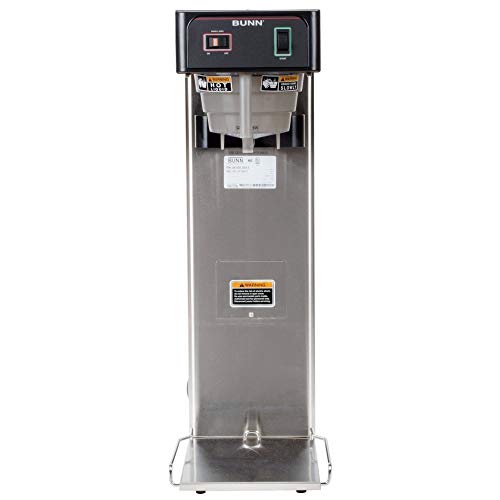
BUNN TB3Q Iced Tea Brewer — Three Gallons, Brewed Properly
The TB3Q’s title is four facts long — BUNN, TB3Q, three gallons, iced tea brewer — and a commercial buyer learns to love titles like that, because every word is load-bearing. This is a dedicated brewer: it exists to produce iced tea in three-gallon batches, repeatedly, in the environments where iced tea is not a menu garnish but a river — the cafeteria line, the fast-casual drinks station, the office that goes through a dispenser a day. Dedicated machines earn their footprint by doing one thing without negotiation, and a brewer that never has to be a coffee machine, a hot water tap or a compromise is a brewer whose tea tastes like tea every time.
Three gallons is the scale to plan around: enough for a lunch rush at a modest venue, small enough that a quieter operation is not brewing a day’s tea at dawn and serving its tired remainder at dusk. Venues should match batch to demand honestly, because iced tea’s freshness window is its quality, and the right-sized brewer is the one whose batch turns over. The title does not print a brew time or a dispenser pairing, so both belong on the pre-purchase checklist — confirm what vessel the brewer discharges into and what your service vessel will be, since brewer and server are separate purchases in this class more often than newcomers expect.
- Function: iced tea brewer — a maker, in this guide’s terminology
- Batch: 3 gallons, per the title
- Model: TB3Q, named in the title
- Brew time and server pairing: not printed in the listing title — confirm both for the BUNN TB3Q Iced Tea Brewer on its listing and check price on Amazon
- Tea format and plumbing needs: likewise listing questions; ask before the station is plumbed around assumptions
Strengths
- A single-purpose brewer from the category’s defining commercial name.
- Three-gallon batches suit daily-turnover venues that value freshness.
- A title of pure fact: model, volume and function with no decoration.
Trade-offs
- It brews iced tea and nothing else; the rest of the programme needs other units.
- Server and dispenser pairing must be planned and purchased separately.
- High-volume venues will outgrow three gallons and should read the TB6Q review next.
Best for: cafes, offices and cafeterias whose iced tea turns over daily in moderate volume. Not suited for: banquet-scale tea service, or any programme wanting one machine to brew everything.

BUNN TB6Q Tea Brewer — Six Gallons at Quick Brew Pace
The TB6Q doubles the batch and adds an adverb: its title describes a 6-gallon tea brewer with quick brew, model code included. Six gallons is banquet arithmetic — the batch a venue brews when a wedding, a conference break or a summer lunch rush will empty a server as fast as staff can carry it — and the quick brew claim addresses the second half of that problem, the refill. A high-volume programme fails in the gap between the first batch and the second, and a brewer titled for speed is promising to narrow that gap; the exact minutes are a listing detail to confirm, but the design intent is printed where buyers can hold the seller to it.
Choosing between the two BUNNs is therefore a pure volume judgement, and this guide will not dress it as anything else. Estimate your peak-hour tea demand in gallons, honestly, including the event days that define your reputation; if the number lives under three, the TB3Q’s freshness advantage wins; if it lives above, the TB6Q’s batch and pace are the programme. Both machines ask the same supporting questions — server pairing, water supply, counter run — at different scales, and the six-gallon answer should be plumbed and positioned with the seriousness its volume deserves.
- Function: tea brewer — a maker
- Batch: 6 gallons, per the title
- Pace: quick brew, claimed in the title; exact timing is a listing detail
- Model code in title: 36700-0301, as printed
- Server pairing and water requirements: not printed in the listing title — verify them for the BUNN TB6Q Tea Brewer before installation planning, and check price on Amazon
Strengths
- Six-gallon batches built for event and rush volume.
- Quick brew positioning targets the refill gap that breaks tea programmes.
- The same single-purpose BUNN discipline as its smaller sibling.
Trade-offs
- Oversized for daily-turnover venues; big batches age when demand is thin.
- A six-gallon programme implies servers, plumbing and counter planning to match.
- Still a tea-only machine; coffee remains another unit’s job.
Best for: hotels, caterers and large venues whose tea demand peaks hard and refills matter. Not suited for: modest daily service, where the TB3Q’s smaller batch stays fresher.

GKFF 14L Commercial Tea Maker — The Infuser Station for Hotels and Events
The GKFF occupies the guide’s most versatile seat. Its title describes a 14-litre, 90-cup tea maker and dispenser pot that is also a hot water dispenser, with a removable infuser and multi-function brew and keep-warm, aimed at flower blooming teas, iced tea, commercial catering, hotels and events. Unpack the infuser first: a removable infuser is the hardware of loose-leaf and flowering teas, the service style where the tea itself is part of the presentation — a blooming flower opening in hot water is a small ceremony a hotel breakfast or a catered tea service can build around, and neither BUNN’s basket architecture nor an urn’s percolation tells that story.
Brew and keep-warm in one vessel is the second distinction. Where the BUNN programme separates brewing from serving, the GKFF’s title describes a unit that brews and then holds its tea warm in the same pot it dispenses from — a simpler station for a venue whose tea service is a feature rather than a river. Fourteen litres is a serious but not banquet-scale batch, and the hot water dispenser role gives the unit a second shift: the same station that brews the morning’s tea can supply hot water for guests’ own infusions. Venues should confirm the keep-warm duration and the infuser’s capacity on the listing, since the title claims the functions without timing them.
- Capacity: 14 L / 90 cups, per the title
- Infuser: removable, named in the title
- Functions named in the title: brew, keep-warm, hot water dispensing
- Named territory: flower blooming tea, iced tea, catering, hotels and events
- Keep-warm duration: the span is not printed in the listing title — ask the seller for the GKFF 14L Commercial Tea Maker’s hold performance and check price on Amazon
Strengths
- The only infuser-led pick: loose and flowering teas are its home territory.
- Brew, keep-warm and hot water in one vessel simplifies the station.
- A presentation-friendly format for hotels and catered tea service.
Trade-offs
- Fourteen litres sits below the TB6Q’s batch for true banquet volume.
- Keep-warm duration is unstated in the title and needs confirmation.
- Infuser service is a ritual; high-speed self-serve lines may prefer the BUNN route.
Best for: hotels, event venues and tea-led programmes where infusion is part of the show. Not suited for: maximum-volume iced tea production, where the gallon brewers rule.

Hamilton Beach Commercial Urn D50065 — Sixty Cups of Coffee, Held Hot
The urn is the oldest technology in this guide and still the backbone of unattended coffee: brew a large batch by percolation, hold it hot, let guests draw it cup by cup. Hamilton Beach’s commercial entry states its terms plainly — a coffee urn and hot beverage dispenser of 60-cup capacity in polished stainless steel, model D50065. Sixty cups is the meeting-and-gathering scale: the office all-hands, the church coffee hour, the training day, the funeral reception — the occasions where coffee is hospitality and running out is the only unforgivable outcome.
Note what the title does not claim: it does not call this unit a tea brewer. It is a coffee urn and a hot beverage dispenser, and a venue that wants hot water for tea bags will find the dispensing role useful while understanding that the brewing of tea, as a programme, belongs to the guide’s three tea makers. That precision is worth more than a longer claim list, because urns live for years and are bought on the strength of exactly these words. The polished stainless finish suits front-of-house placement, and the commercial designation in the model name signals the duty this unit is sold for, as opposed to a domestic urn borrowed into service it was not specced to survive.
- Function: coffee urn and hot beverage dispenser — a maker and holder for coffee
- Capacity: 60 cups, per the title
- Model: D50065, named in the title
- Finish: polished stainless steel
- Brew and hold timings: not printed in the listing title — confirm the cycle expectations for the Hamilton Beach Commercial Urn D50065 on its listing and check price on Amazon
Strengths
- The classic urn proposition at the gathering scale, from a commercial line.
- Polished stainless suits front-of-house, guest-facing placement.
- An honest title: coffee and hot beverage dispensing, no borrowed tea claims.
Trade-offs
- Sixty cups is a ceiling that banquet programmes will breach; see the Zulay.
- It is not a tea brewer, whatever a hopeful buyer might wish.
- Percolated urn coffee is a crowd style, not a craft style — attended brewing lives elsewhere.
Best for: offices, churches, meetings and gatherings where sixty cups of coffee, held hot, is the whole brief. Not suited for: banquet volume, tea brewing, or craft coffee service.
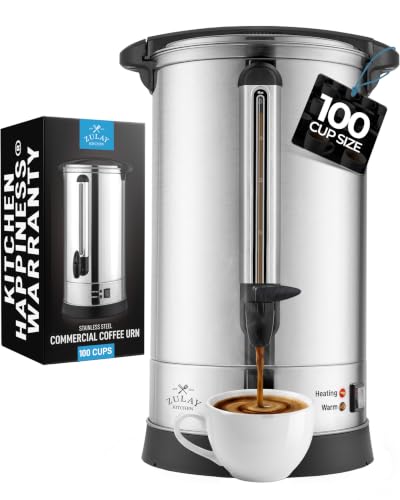
Zulay 100-Cup Coffee Urn — The Hundred-Cup Event Urn That Also Percolates Tea
The Zulay is the guide’s volume answer on the hot side: a commercial 100-cup coffee urn in double-wall stainless steel, titled also as a quick brew tea percolator for events. Take the claims in the title’s own order. One hundred cups is the largest hot capacity in this guide — the wedding, the conference, the festival stall — and double-wall construction is the title’s promise about holding that volume’s temperature and keeping the exterior safer to be around in a crowded serving line. The tea percolator claim distinguishes it from the Hamilton Beach urn: this title says the unit percolates tea as well as coffee, which makes it the hot station’s generalist.
Generalism at an urn deserves one caution, offered in the spirit of the guide’s distinctions. Percolation — cycling hot water through the beverage — is a robust crowd method for both drinks, but a venue whose identity is fine tea should still route its signature service through the infuser or the brewers, using the Zulay’s tea role for what it is: high-volume, event-grade tea that keeps a crowd served. Within that honest frame, the Zulay is a formidable single purchase for an events business: one unit, two beverages, a hundred cups, and a double wall standing between the coffee and the guests’ elbows.
- Capacity: 100 cups — the largest hot batch in this guide
- Construction: double-wall stainless steel, per the title
- Roles named in the title: coffee urn and quick brew tea percolator for events
- Cycle timing: quick brew is claimed without minutes in the title — confirm the brew duration for the Zulay 100-Cup Coffee Urn on its listing
- Buying route: check price on Amazon via the Zulay listing and confirm the current configuration there
Strengths
- A hundred cups in one unit anchors event-scale hot service.
- Tea percolation is claimed in the title — the hot station’s only dual-beverage urn.
- Double-wall stainless suits crowded, guest-facing serving lines.
Trade-offs
- Percolated tea is event-grade, not connoisseur-grade; fine tea belongs with the infuser.
- A hundred-cup batch is wasteful at small gatherings; match the urn to the event.
- Quick brew is unquantified in the title and should be confirmed in minutes.
Best for: caterers, venues and event programmes needing maximum hot volume for coffee and tea from one urn. Not suited for: intimate gatherings, or tea service where infusion quality is the headline.

VEVOR Two-Tank Beverage Dispenser — The Cold Holder: a Dispenser, Not a Brewer
This entry begins with the correction the whole guide has been promising: the VEVOR unit does not brew anything. Its title describes a commercial beverage dispenser with two tanks of 10 litres each, a stainless steel juice dispenser and iced tea drink machine holding a cooling temperature of 45 to 54 degrees Fahrenheit, for cold drink service in restaurants, bars and parties. It is the cold case of the station — the vessel that receives what the brewers made, or what the juice supplier delivered, and presents it cold, clear and self-serve for hours.
Two tanks is the operative luxury: iced tea in one, a juice or a second tea in the other, each at the stated cooling band, in a stainless presentation that suits a counter guests approach. Programmes that brew with the TB3Q in the morning and serve all afternoon will recognise the workflow instantly — brew, chill, dispense — with the VEVOR owning the final, longest stage. Buyers must plan that workflow honestly: the dispenser has no way to make a drink, so a programme that buys it alone has bought a beautiful refrigerator with taps. Paired with a maker, it completes the station; the title’s own language — dispenser, drink machine for cold drinks — says exactly this, and this review simply refuses to upgrade its job title.
- Function: beverage dispenser — a holder, explicitly not a brewer
- Tanks: 2, at 10 L / 10.6 qt per tank, per the title
- Cooling range: 45°F to 54°F, stated in the title
- Named drinks: juice and iced tea, held cold
- Brewing capability: none — pair it with a maker from this guide; the VEVOR Two-Tank Beverage Dispenser’s listing confirms configuration, and you can check price on Amazon there
Strengths
- Two chilled tanks let a station serve tea and juice side by side.
- A stated cooling band gives planners a real number to work with.
- Stainless, guest-facing presentation for restaurants, bars and parties.
Trade-offs
- It brews nothing and heats nothing; a maker is a mandatory companion purchase.
- Cold only: hot service belongs entirely to the urns and the GKFF.
- Two tanks are two cleaning commitments at close of service.
Best for: restaurants, bars and party venues whose cold drinks need a chilled, self-serve home beside the hot station. Not suited for: any buyer shopping for a machine that makes tea or coffee — this unit, by design and by title, does not.
The Station at a Glance
| Unit | Makes or holds | Batch in title | Station role |
|---|---|---|---|
| BUNN TB3Q Iced Tea Brewer | Makes iced tea | 3 gallons | Daily tea brewing |
| BUNN TB6Q Tea Brewer | Makes tea, quick brew | 6 gallons | Event tea brewing |
| GKFF 14L Commercial Tea Maker | Makes and keeps warm | 14 L / 90 cups | Infused tea service |
| Hamilton Beach Commercial Urn D50065 | Makes and holds coffee | 60 cups | Gathering coffee |
| Zulay 100-Cup Coffee Urn | Makes and holds coffee and tea | 100 cups | Event hot service |
| VEVOR Two-Tank Beverage Dispenser | Holds cold only — dispenser | 2 × 10 L | Chilled self-serve |
How Should a Venue Size This Station for Its Real Guest Count?
Work backwards from the busiest hour, not the average day. Count the guests who will want a hot drink in the peak sixty minutes and the guests who will want a cold one, and let those two numbers choose your makers. A programme whose peak is a hundred hot cups belongs to the Zulay or to the Hamilton Beach urn with a refill plan; a programme whose peak is thirty belongs to the Hamilton Beach alone, with the Zulay’s hundred cups standing as a warning against buying volume that will sit and stew. Tea arithmetic runs in gallons: the TB3Q’s three against the TB6Q’s six, with the freshness principle cutting against size — a batch that turns over tastes like a programme that cares, and a batch that lingers tastes like a venue that bought too much machine.
The cold side has its own version of the same discipline. The VEVOR’s two ten-litre tanks hold a party’s worth of iced tea and juice, but they hold it at their best when the contents were brewed or bought fresh that day and the tanks are cleaned that night. Venues that treat the dispenser as a storage tank across days discover that cold and fresh are different virtues. Sizing, in short, is a freshness decision wearing an arithmetic costume, and the titles in this guide give you the real numbers — gallons, litres, cups, degrees — to make it with. Programmes equipping an attended counter alongside the self-serve station can borrow the per-cup thinking from Best Coffee Machines for Cafes, where volume is measured in drinks per hour rather than gallons per batch.
What Does a Service Day Look Like Across These Six Units?
Dawn belongs to the makers. The BUNN brews its batch — three gallons on a weekday rhythm, six when the calendar says event — and the urns begin their percolation so the first guests meet coffee that is ready rather than promised. The GKFF’s infuser goes in where the venue’s tea service has a face: a hotel whose breakfast includes a flowering tea, a caterer whose afternoon includes a brewed-and-kept-warm urn alternative. By mid-morning the station’s centre of gravity shifts to the holders: urns dispensing, the GKFF keeping warm, the VEVOR — loaded with the morning’s chilled tea and the juice — doing the long, quiet work of cold service through the hours when nobody is brewing anything.
Close of service is where programmes are made or unmade, and it is unglamorous by definition: urns emptied, rinsed and dried rather than left to season overnight; the infuser lifted out and washed before its leaves become archaeology; dispenser tanks drained and cleaned, because a chilled tank forgives a day’s residue exactly once. Venues that write this closing routine into the same checklist as the locking-up routine own equipment that tastes clean in year three. The machines in this guide are commercial in designation; the closing routine is what makes a venue commercial in fact.
What Mistakes Do Beverage Programmes Make With Urns, Brewers and Dispensers?
The first is the category error this guide opened with: buying a holder and expecting a maker, or buying a maker and forgetting the holder, so the programme discovers at its first event that brewed tea has nowhere cold to live. The second is stewing — holding coffee or tea for hours beyond its grace because the batch was sized for pride rather than for the guest count. The third is cross-contamination of roles: tea run through a coffee urn for a season emerges tasting of the urn’s memory, which is why the guide keeps the Zulay’s dual claim distinct from the Hamilton Beach’s coffee-only honesty, and why dedicated tea hardware exists at all. The fourth is neglecting water: brewers and urns scale in hard-water venues, and a descaling rhythm belongs in the programme’s calendar from the first week, not from the first failure.
A fifth mistake is quieter: staffing the station as if it were furniture. Self-serve means guests serve themselves; it does not mean nobody owns the station. Somebody checks levels at the half hour, somebody wipes the drip zone, somebody starts the refill before the urn sighs empty. The venues whose beverage programmes draw compliments have usually made that ownership explicit — a name on a checklist — while the venues whose programmes draw complaints have assumed the machines would handle it. Machines handle brewing and holding. Programmes are handled by people, a distinction the cleaning schedules of neighbouring equipment make just as plainly in Best Mid-Range Dishwashers, where the wash programme likewise rewards the venue that plans it.
How Does Water Quality Quietly Govern Everything This Station Pours?
Tea and coffee are both, by weight, almost entirely water, and a commercial station is therefore a water programme wearing beverage clothing. Hard water scales the heating surfaces of brewers and urns, and scale is a slow saboteur: it insulates elements so cycles lengthen, it flakes into batches, and it eventually converts a reliable machine into a service call. Venues in hard-water districts should treat a descaling rhythm — and, where the volume justifies it, filtration — as part of the equipment purchase rather than as an afterthought, because the machines in this guide will brew exactly the water they are given, faithfully, including its flaws.
Taste is the other half of the water story. Municipal chlorine that a home drinker barely notices becomes the headline flavour of a delicately brewed tea at gallon scale, and the GKFF’s flowering teas — bought for their subtlety — are the first casualties of an untreated supply. The ordering of investments follows from this: a venue choosing between a larger urn and a water treatment step for its existing urn should usually choose the water. Guests cannot name water quality when it is right, but they can always taste when it is wrong, and they attribute the taste to the venue rather than to the mains.
What Happens Inside an Urn While It Percolates, and Why Does It Matter?
Percolation is a cycle of persuasion: heated water rises and rains repeatedly over the coffee bed, extracting a little more on every pass, while the brewed coffee below returns toward the heat. The method’s virtue is robustness — it produces a consistent, crowd-pleasing cup from simple hardware with no pressure system to fail — and its known vice is that the same recirculation that builds body can, if a batch is held and reheated for hours, keep extracting bitterness from a beverage that was finished long ago. This is the physics underneath the guide’s repeated freshness advice: an urn’s batch has a prime, and the prime is measured in the first hours, which is why the right-sized urn outperforms the oversized one on the only metric the guest can taste.
The Zulay’s tea percolation works by the same circulation, which explains both its usefulness and its limit. Event tea — strong, sweetened, served over ice or in quantity — tolerates percolation happily. Delicate tea does not, because its leaves surrender their best compounds early and their harsh ones later, and a circulating system cannot be told to stop at the best. The station logic of this guide is precisely the map of these physics: percolate what percolation flatters, infuse what infusion protects, brew by the gallon what a crowd drinks by the gallon, and chill the rest in a dispenser that asks nothing of the leaves at all.
What Does a Defensible Cleaning Schedule Look Like for This Station?
Daily, the schedule is rinse-and-dry work: urns emptied of their dregs, washed, and left open to dry; the GKFF’s infuser removed, emptied and washed while its residue is still cooperative; dispenser taps and drip zones wiped; the VEVOR’s tanks drained of anything that will not be served tomorrow, because chilled storage is a pause, not a preservation. Weekly, the schedule turns to the mineral story — a descale or a vinegar cycle where the manufacturer allows it, gaskets and taps inspected, the brewers’ spray and basket areas cleaned of the tea film that builds invisibly and flavours everything it touches.
Monthly, a programme with ambitions audits itself: a batch brewed and tasted critically rather than served on faith, temperatures checked against the titles’ claims where a thermometer can reach, and the closing checklist itself reviewed — because checklists age, staff rotate, and the routine that protected the station in its first season can quietly lose a step by its third. None of this requires a facilities department. It requires the same insight as the sizing chapter: the machines are the easy part, and the programme — written, owned, repeated — is the product the guest actually drinks.
Three Venues, Three Ways This Station Gets Assembled
The hotel breakfast room is the GKFF’s natural home, flanked by one urn. Guests arrive in a long, uneven stream rather than a rush; the infuser’s ceremony suits a room selling calm; the Hamilton Beach urn’s sixty cups cover the coffee stream with one mid-morning refill; and the VEVOR, if the property serves a chilled juice and iced tea through the day, takes the cold shift after breakfast without asking the kitchen for anything. The BUNNs stay in the catalogue for this venue — a property whose iced tea demand grows into a lobby programme can add the TB3Q later, and the station’s logic makes the addition obvious rather than improvised.
The catered event inverts the emphasis. Volume arrives all at once and the programme’s reputation is decided in ninety minutes, so the TB6Q’s six gallons and the Zulay’s hundred cups become the spine, the VEVOR’s twin tanks carry the cold side, and the GKFF — if it travels at all — travels as the premium touch for a head-table tea service rather than as a workhorse. The church hall and the office sit between those poles: a TB3Q or the GKFF for tea according to the congregation’s habits, the Hamilton Beach urn as the default coffee answer, and the dispenser only where a genuine all-day cold programme exists. The point of the three sketches is that the six units are a kit, not a bundle: the venue’s day, drawn honestly, selects its subset.
What Should a Buyer Confirm About Servers, Taps and Fittings?
Brewer-class purchases fail at their interfaces more often than at their cores. A gallon brewer discharges into a server; whether that server is included, proprietary or a standard the venue already owns is a listing question with budget consequences, and it should be answered before the brewer is ordered rather than discovered on delivery day. Urns dispense through taps that guests operate; tap style, drip behaviour and the availability of replacement seals belong on the same checklist. The dispenser adds its own interfaces — tank lids, tap assemblies, the drip tray’s capacity — each a small thing that a season of service will test daily.
Electrical and water interfaces complete the audit. Commercial beverage equipment shares circuits with refrigeration and warming equipment in most real venues, and a station planned as six independent purchases can arrive as one collective overload. List the station’s total draw, walk the panel with whoever maintains the building, and let that conversation happen before the first box ships. The titles in this guide state volumes and functions generously but leave installation specifics to the listings, which is the correct division of labour — provided the buyer actually reads them, as this guide has advised at every pick.
How Does Iced Tea, Specifically, Want to Be Brewed at Gallon Scale?
Iced tea is brewed hot and served cold, and the gallon scale changes both halves of that sentence. The brew must be made at a strength that anticipates dilution — ice in the server and ice in the glass both take their share — which is why dedicated brewers exist: their baskets and cycles are proportioned for tea that will be chilled and diluted, not for tea that will be sipped at brewing strength. A venue improvising iced tea from a coffee urn’s hot water and hope is fighting that arithmetic with the wrong tools, and the BUNN pair’s entire existence is the rebuttal. Sweetened programmes add their own discipline: sweeten while the batch is hot and the sugar can dissolve completely, and treat an unsweetened batch beside it as a separate citizen, labelled, because guests’ preferences in this matter are absolute.
The chilling half deserves equal respect. Tea brewed at dawn and left to drift down to room temperature before it meets a server spends its middle hours in the temperature band where freshness goes to retire; the professional rhythm is brew, chill promptly, hold cold — which is, once again, the workflow the VEVOR’s tanks exist to complete. A station that brews with the TB6Q and chills into the dispenser has closed the loop properly, and the guest who draws a glass at four in the afternoon tastes a beverage whose whole biography was managed. That biography, not any single machine, is what a beverage programme actually is.
A Word on Guests, Signage and the Self-Serve Contract
A self-serve station makes a promise to its guests: that everything is labelled, full and clean, and that nobody will need to ask a question to get a drink. The equipment in this guide supports that promise mechanically — capacities that outlast the rush, a dispenser whose contents are visible, urns whose taps a first-time guest can operate — but the promise is kept by presentation. Labels that name the beverage and its character, cups stationed where the pourer’s hand expects them, a drip zone wiped before it photographs itself onto the counter: these are the station’s soft furnishings, and venues neglect them at the cost of the hardware’s good work.
There is an accessibility dimension worth the sentence it takes: taps at a height and with a resistance that children, older guests and guests with limited grip can manage, and a station layout that never requires reaching across a hot urn to reach a cold tank. Commercial programmes are hospitality at scale, and scale is no excuse for a station that only the able and the initiated can use comfortably. The six units here, arranged with that contract in mind, will serve a banquet’s worth of strangers as graciously as they serve the regulars — which is, in the end, the entire point of buying commercial equipment rather than borrowing domestic machines into a public job.
One closing thought for the buyer assembling this station on a budget, because most are: sequence beats simultaneity. Buy the maker your programme cannot open without — for most venues that is the urn or the tea brewer — run it for a season inside a written closing routine, and let the season teach you whether the second purchase should be capacity, infusion or cold holding. The dispenser bought in month four, in answer to a summer’s evidence, will be the right dispenser; the full station bought in week one, in answer to a catalogue, usually contains one unit the venue never needed and lacks the one it did. This guide has laid the six roles side by side precisely so that a phased purchase can still be a coherent one.
How Do Tea and Coffee Share One Station Without Stealing Each Other’s Flavour?
Shared stations fail by flavour migration. Coffee oils are persistent, tea is absorbent, and equipment that alternates between the two without a cleaning boundary will eventually serve a single blended beverage that pleases nobody. The architecture of this guide is partly a defence against that migration: the BUNNs brew tea and only tea, the Hamilton Beach urn holds coffee and only coffee, and the one sanctioned crossover — the Zulay’s titled tea percolation — is a deliberate, disclosed choice for event programmes rather than an accident of scheduling. A venue that buys with this map in mind can still improvise on a desperate day, but improvisation will be an exception with a cleaning consequence attached, not the programme’s daily method.
The dispenser’s tanks deserve the same discipline in miniature. A tank that held sweet tea yesterday and holds citrus juice today will testify about yesterday unless it is washed with intent, and the two-tank design tempts a venue into permanent assignments — tea always left, juice always right — which is a temptation worth surrendering to, because consistency of assignment is what lets staff clean, fill and label on autopilot without error. Self-serve programmes run on such small systems: the guest never sees them, and the guest’s unbroken confidence that the labelled drink is the drink in the tank is built entirely from them.
What Records Should a Beverage Programme Keep?
Three small records repay their keeping. A batch log — what was brewed, when, by whom — converts freshness from an aspiration into a checkable fact and settles the eternal question of how old the urn’s contents are without anyone having to guess or taste defensively. A cleaning log, initialled, does for hygiene what the batch log does for freshness, and it is the document a health inspector’s question is really asking for. A consumption note — how much of each beverage the event actually drank — is the programme’s purchasing memory, turning next season’s sizing decisions from folklore into arithmetic.
None of these records needs software or ceremony; a notebook at the station outperforms an application nobody opens. Their collective value is that they make the programme transferable: a new staff member inherits the station’s knowledge instead of reinventing it, and the venue’s beverage quality stops depending on one person’s memory of how the regulars take their tea. Commercial equipment, as this guide has argued from its first page, is the programme’s skeleton. Records like these are its memory, and a station with both will out-serve a station with newer machines and neither.
And a final practical word on the morning the equipment arrives: commission it like a programme, not like a parcel. Brew a full batch through every maker before the first guest is invited to judge one, taste each beverage at the start of its hold and at the end of the hold you intend to serve, and write down what you learn while the lesson is fresh. A station commissioned that way begins its life with known quantities — real brew times against the titles’ quick claims, real hold behaviour against your venue’s clock — and the gap between the brochure’s programme and yours closes in a day instead of across a season of complaints.
It is also worth saying, before the recommendation, what this station will not do, because a commercial buyer deserves the boundary in print. None of these units will produce an attended, per-cup craft beverage; that is a different programme with different machinery, and a venue whose identity is the crafted cup should build that programme deliberately rather than expecting an urn to impersonate it. What this station produces — reliably, at volume, without a specialist in attendance — is the honest crowd beverage: fresh tea in gallons, coffee by the dozens of cups, cold drinks held at a stated chill. For the great majority of venues, that is not the compromise option. It is the assignment itself.
Final Recommendation
Build the station in the order this guide reviewed it: a BUNN sized to your tea truth — TB3Q for daily turnover, TB6Q for event volume — the GKFF where infused tea is part of your hospitality’s face, and one urn matched to your hot peak, Hamilton Beach at sixty cups or the dual-beverage Zulay at a hundred. Then, and only then, add the VEVOR for the cold service those makers deserve, remembering it dispenses and never brews. A station assembled in that order, sized by the busiest hour and closed down properly each night, will pour like a programme twice its budget — because its money was spent on makers first and holders second, exactly as the drinking day demands.
Frequently Asked Questions
Is the VEVOR unit a tea brewer?
No. It is a two-tank beverage dispenser that holds cold drinks — juice and iced tea among them — at a title-stated 45 to 54 degrees Fahrenheit. It brews nothing, and this guide lists it as the station’s cold holder, to be paired with a brewer such as the BUNN TB3Q or TB6Q.
Which BUNN should a venue choose, the TB3Q or the TB6Q?
By peak demand. The TB3Q brews three gallons and suits daily turnover where freshness matters most; the TB6Q brews six gallons with a quick brew claim and suits events and rushes. Buying the six for a three-gallon programme trades freshness for capacity you will not use.
Can an urn make good tea?
One urn here claims tea in its title: the Zulay, as a quick brew tea percolator for events, which is honest event-grade service. The Hamilton Beach urn claims coffee and hot beverage dispensing only. Fine or infused tea belongs with the GKFF’s removable infuser or the BUNN brewers.
How much coffee does a hundred-cup urn really serve?
One hundred cups is the title’s capacity for the Zulay, and sixty for the Hamilton Beach. Plan against your peak hour rather than the full event, and remember that a batch held too long loses the quality the capacity was bought to deliver; the refill plan matters as much as the number.
What should be confirmed before ordering any of these units?
Server and dispenser pairings for the brewers, brew and hold timings where titles claim speed without minutes, water and plumbing requirements, and the cleaning routine each unit expects. Those confirmations, made through the listings, prevent the classic first-event discoveries this guide catalogued.
Related Guides
Cold coffee has its own devoted equipment, surveyed in Best Coffee Machines for Iced Coffee, a live companion for venues whose chilled programme extends beyond the dispenser’s tanks.


