What's inside
- Where to Buy a First Pizza Oven, and Why the Fuel Decision Comes Before the Brand Decision
- Key Takeaways
- Quick Picks
- How Did We Narrow a Crowded Field Down to Six Ovens?
- Six Ovens, One Bench: A Side-by-Side Reading
- Gas, Wood or Electric: Which Fuel Matches the Pizza You Actually Make?
- How Hot Does a Pizza Oven Really Need to Get?
- Your First Bake, Step by Step: From Cold Stone to Finished Crust
- Mistakes That Ruin More First Pizzas Than Bad Dough Ever Does
- Where Will the Oven Live? Footprint, Carts and the Storage Question Nobody Asks at Checkout
- What Does a Season of Pizza Actually Cost to Run?
- Matching Dough to Oven: Which Pizza Styles Each Class Cooks Best
- The Kit Around the Oven: Peels, Stones and the Small Tools That Decide Your Second Month
- Heat Safety in a Family Garden: Clearances, Cylinders and Common Sense
- Running a Queue: How Pizza Night Actually Flows When Six People Are Hungry
- Final Recommendation
- Frequently Asked Questions
- Related Guides
As an Amazon Associate I earn from qualifying purchases. This post may contain affiliate links at no extra cost to you.
cottageverdict.com is reader-supported. When you buy through links on our site, we may earn an affiliate commission.
Where to Buy a First Pizza Oven, and Why the Fuel Decision Comes Before the Brand Decision
The best pizza ovens for a home cook are not the ones with the longest feature lists; they are the ones whose fuel matches the way a household actually cooks on a Friday night. Every oven in this roundup is sold through its Amazon listing, where the name of each pick below links straight to the product page so you can check price on Amazon and read the current listing title for yourself. That habit matters more with pizza ovens than with most outdoor gear, because a single model name can hide several fuel configurations, and the listing title is where the manufacturer states plainly whether a given unit burns propane, wood, pellets or household electricity. We read those titles closely and report only what they claim: a temperature range appears in a spec box here only when the title itself prints one, and where a title stays silent we say so rather than filling the gap with a guess.
Six ovens survived our screening, and they split along fuel lines. Three are propane machines built for speed and repeatability. One burns wood or gas depending on which burner you fit. One is a dual-fuel steel oven that ships with both a gas burner and a wood tray. And one — the honest exception in an outdoor roundup — is an electric countertop-style unit that happens to be marketed for outdoor use, the Ninja Artisan, which we flag as electric every time it appears because a reader planning around a propane tank deserves to know that this one plugs in instead. None of these six is a wood-only specialist; that discipline gets its own guide, and readers who already know they want flame and smoke should read Best Wood-Fired Pizza Ovens alongside this one before deciding.
A word about what this roundup refuses to do. It refuses to rank these ovens by a single temperature number, because a ceiling figure tells you nothing about how evenly the stone heats or how quickly the oven recovers between pizzas. It refuses to treat a sixteen-inch stone as automatically better than a fourteen, because the larger stone is wasted on a cook who only ever stretches twelve-inch dough. And it refuses to pretend that the cheapest oven here is a lesser product for a beginner; for a first oven, forgiving heat and a short learning curve are worth more than bragging rights. Keep those refusals in mind and the six picks below sort themselves quickly.
Key Takeaways
- Propane is the beginner’s fuel: three of the six picks burn it, light in seconds, and hold a steady stone temperature without any fire-tending at all.
- The Ninja Artisan MO201 is electric, not gas — it is the one pick here that needs an outlet rather than a tank, and its stated ceiling is 700°F.
- Two ovens in this lineup, the Ooni Karu 2 Pro and the PIZZELLO 16, can burn wood as well as gas, which makes them the bridge picks for cooks who want flame flavour on weekends and push-button heat on weeknights.
- Stone size runs from the Solo Pi Prime’s 13-inch opening up to sixteen-inch stones on the Karu 2 Pro and the PIZZELLO, so match the stone to the largest pizza you genuinely make.
- Only three listings state a temperature figure in their titles; where a title is silent, our spec boxes say so instead of borrowing a number from a different model.
- Every pick here is a countertop or cart-top unit with no permanent installation, so renters and small patios are not excluded from any of the six.
Quick Picks
| Oven | Fuel it burns | Why it earns its place |
|---|---|---|
| Ooni Koda 2 | Propane | The straightforward gas pick — a 14-inch stone and a stated range running up to 950°F. |
| Ooni Karu 2 Pro | Wood or gas | The two-fuel flagship with a 16-inch cooking surface and a thermometer built in. |
| Solo Stove Pi Prime | Propane | A demi-dome design that claims a 90-second bake once the stone is at 950°F. |
| Ninja Artisan MO201 | Electric | The plug-in exception — a 5-in-1 outdoor unit that also air fries, with a 700°F ceiling. |
| BIG HORN Gas Pizza Oven 15 | Propane | A 15-inch stone in stainless steel at the value end of the gas field. |
| PIZZELLO 16 Dual Fuel | Propane and wood | Ships with a gas burner, a wood tray, a peel and a carry bag in one box. |
How Did We Narrow a Crowded Field Down to Six Ovens?
We started from the listings themselves rather than from brand reputation. Each candidate had to be a self-contained pizza oven — not a grill insert, not a stone sold for a kitchen range, not an accessory kit pretending to be an appliance. It had to state its fuel in its title, because an oven whose fuel is ambiguous in its own listing will be ambiguous on your patio too. It had to include its cooking stone, since a pizza oven sold without the surface it cooks on is a bill with a second line item hiding behind it. And it had to be sized for a household: everything here cooks one pizza at a time for a family or a small gathering, which is the honest shape of home pizza making.
Beyond those gates, we weighted the things that decide whether an oven gets used weekly or gathers dust by August. Recovery time between pizzas matters more than peak heat, because pizza night is a queue, not a single pie. Portability matters because most of these ovens live on a cart or a folding table and get stored in a garage corner. Fuel flexibility mattered enough to earn two dual-fuel ovens their places. And we deliberately kept one electric oven in the six, clearly labelled, because some readers have balconies, condo rules or simple preferences that rule out open flame — a roundup that ignores them would be a roundup for somebody else’s household. Readers feeding a crowd from a fixed kitchen line, by contrast, are shopping a different category entirely, closer to the machines in Best Commercial Ovens for Baking than to anything on this page.
Finally, we checked each listing title for the word that disqualifies a pick outright in our guides — a renewed or refurbished unit sold as the headline offer. None of the six titles carries it. What the titles do carry, we report; what they omit, we mark as unstated in the spec boxes and leave for the manufacturer’s own documentation to confirm.

Ooni Koda 2 — Easiest First Oven
The Koda 2 is what the propane pizza oven looks like when a manufacturer strips away everything that intimidates a first-time buyer. The listing describes a 14-inch gas-powered outdoor oven in Foundry Black, shipping with a 28 mBar regulator and gas hose, and it states a temperature range of 375°F to 950°F — a range worth reading twice, because the lower bound matters almost as much as the upper one. An oven that can hold a moderate temperature without sulking is an oven that can bake a thicker crust, warm through a topped pie without scorching the base, and generally behave like a cooking appliance rather than a one-trick flamethrower.
In practice, gas ovens like this one win their owners over with rhythm. You light it, you wait for the stone, you launch, you turn once, you retrieve. There is no fire to feed and no ash to manage, so the cook’s attention stays on the dough, where it belongs during the first dozen pizza nights. Fourteen inches of stone is the sweet spot for most households: big enough for a proper sharing pizza, small enough that the oven itself still lifts onto a cart and stores without a negotiation. If your pizza ambitions run to a weekly family ritual rather than a hobbyist’s flame study, this is the pick that asks the least of you.
- Fuel: propane, with regulator and gas hose included per the listing title
- Stone: 14-inch class cooking surface
- Stated temperature range: 375°F–950°F, as printed in the listing title
- Finish: Foundry Black
- To confirm the Koda 2’s current bundle, check price on Amazon under its own listing name
Strengths
- A stated temperature range with a genuinely usable low end, not just a headline maximum.
- Regulator and hose in the box, so the first bake needs no extra hardware run.
- Fourteen-inch format balances pizza size against storage and lifting weight.
Trade-offs
- Gas only — there is no wood tray or second fuel hiding in this design.
- No thermometer is mentioned in the listing title, so stone temperature checks are on you.
- The black finish shows flour dust and ash-coloured smudges more than a lighter shell would.
Best for: first-time buyers who want restaurant-style pizza with the shortest possible learning curve. Not suited for: cooks who specifically want wood smoke in the crust — that desire points at the Karu below or at the wood-fired guide.

Ooni Karu 2 Pro — Two-Fuel Flagship
The Karu 2 Pro is the roundup’s argument that you do not have to choose your fuel on the day you buy the oven. Its listing calls it a multi-fuel pizza oven for wood and gas, in a 16-inch format, with a pizza stone and an integrated thermometer in the box. That thermometer is a small detail with an outsized effect: wood cooking is guesswork without a temperature reference, and a built-in readout turns fire management from folklore into something a beginner can actually learn, bake by bake. Sixteen inches, meanwhile, is the size class where an oven stops being a personal gadget and starts feeding a table — a full-size pie for sharing, or room to keep a pizza off the hottest part of the stone while it finishes.
The honest way to think about this oven is as two appliances sharing one shell. On gas, it behaves like the Koda’s bigger sibling: steady, quick to recover, indifferent to your fire skills. On wood, it becomes a different evening entirely — slower to start, demanding while it runs, and capable of the blistered, faintly smoky crust that gas cannot quite imitate. Buying both personalities in one unit costs more counter space and more money than a single-fuel oven, and it only pays off if you genuinely expect to use both modes across a season. The household that lights a wood fire twice a year is renting the second personality, not owning it.
- Fuel: wood and gas, per the listing title’s multi-fuel description
- Format: 16-inch dual-fuel pizza maker
- Included per title: pizza stone and integrated thermometer
- Peak temperature: the listing title does not print one — confirm the figure in the manufacturer documentation
- For the Karu 2 Pro’s current configuration, check price on Amazon on the listing itself
Strengths
- Real fuel choice in a single oven, so weeknight gas and weekend wood share one footprint.
- Integrated thermometer removes the worst guesswork from wood-fired bakes.
- Sixteen-inch capacity suits entertaining and larger doughs.
Trade-offs
- The largest footprint in this roundup — measure your cart or table before ordering.
- Wood mode still means sourcing, storing and lighting solid fuel; the oven does not do that part for you.
- The listing title states no peak temperature, so spec-sheet shoppers must dig into the documentation.
Best for: households torn between convenience and flame flavour who will honestly use both. Not suited for: small balconies or anyone who knows the wood mode would be a twice-a-year novelty.

Solo Stove Pi Prime — The 90-Second Claim
Solo Stove built its name on smokeless fire pits, and the Pi Prime applies the same design confidence to propane pizza. The listing describes a portable outdoor gas oven with a cordierite pizza stone, a demi-dome heating shape, a 13-inch wide opening, and a 304 stainless steel body. It states that the oven heats to 950°F and cooks a pizza in 90 seconds — a claim we repeat exactly as the title makes it, with the obvious rider that ninety seconds is the bake time once the stone is fully hot, not the time from a cold start to dinner. The demi-dome idea is the engineering heart of the pick: a low, curved ceiling that rolls heat over the top of the pizza while the stone handles the base, aiming at the leopard-spotted top and crisp underside that usually require a mid-bake turn.
The 13-inch opening deserves a moment of honesty. It is the narrowest in this roundup, and it defines the oven’s audience: personal pizzas, couple-sized pies, and households happy to bake in sequence rather than serve one giant round. In exchange, the Pi Prime is the pick that most plausibly travels — to a campsite, a tailgate, a friend’s garden — because its whole design reads as portable equipment rather than patio furniture. Stainless construction suits that life; it shrugs off weather and wipes clean without ceremony. Choose it for the way you will actually move it and feed people in small batches, not for a headline bake time.
- Fuel: propane
- Stone: cordierite, behind a 13-inch wide opening
- Stated performance: heats to 950°F; 90-second pizza claim as printed in the title
- Body: 304 stainless steel, demi-dome heating design
- To see the Pi Prime’s current listing details, check price on Amazon via its name above
Strengths
- Demi-dome heat circulation aims at even tops with less turning.
- Stainless body and portable format suit travel and outdoor storage.
- A stated 950°F ceiling puts it level with the hottest gas picks here.
Trade-offs
- The 13-inch opening rules out large sharing pizzas.
- The 90-second figure assumes a fully heated stone; cold-start patience is still required.
- No second fuel option — propane is the whole story.
Best for: couples and campers who bake smaller pizzas and value portability. Not suited for: hosts planning sixteen-inch pies for a crowd.

Ninja Artisan MO201 — The Electric Exception
Let us be direct, because this pick demands it: the Ninja Artisan MO201 is an electric pizza oven. It does not burn propane, it does not burn wood, and no tank or firebox is involved — it plugs in. We include it in an outdoor roundup because Ninja markets it as an outdoor appliance and because a real slice of readers cannot or will not run a gas appliance where they live: apartment balconies with flame rules, households without a safe place to store a propane cylinder, cooks who simply prefer a dial to a burner. For those readers, an honest electric option beats a gas oven they will never be allowed to light. The listing describes a 5-in-1 unit that bakes a 12-inch pizza in three minutes at up to 700°F, handles five pizza styles, and air fries as a second trade.
The 700°F ceiling is the number to think with. It sits well below the 950°F figures claimed by the gas picks, and it changes the pizza you should plan around: excellent New York-style and pan pizzas, thoroughly cooked toppings, a crust with colour and chew — rather than the sixty-second Neapolitan blister that only the hottest stones produce. In exchange you get the electric virtues: no fuel to run out of mid-evening, no regulator, no hose, heat that behaves the same in a January garden as in July, and a second life as an air fryer for the other six days of the week. Judge it as the most versatile appliance in this roundup and the least specialised pizza oven in it, and you have judged it fairly.
- Fuel: electricity — this is the one plug-in pick in an outdoor lineup
- Stated performance: 12-inch pizza in 3 minutes, up to 700°F, as printed in the title
- Functions: 5-in-1, with five pizza styles and air frying named in the listing
- Colour: grey, model MO201
- For the Artisan’s current listing and bundle, check price on Amazon before deciding
Strengths
- No flame, no tank and no hose — workable where gas appliances are restricted.
- Five pizza styles plus air frying give it a weekday life beyond pizza night.
- Electric heat is indifferent to wind and cold in a way burners are not.
Trade-offs
- A 700°F ceiling will not produce a true high-heat Neapolitan crust.
- Twelve-inch pizzas are the limit; there is no larger format to grow into.
- It needs an outdoor-rated outlet within cord reach of where you cook.
Best for: balcony cooks, flame-restricted homes and anyone wanting one appliance that covers pizza and weeknight air frying. Not suited for: purists chasing the hottest possible stone.
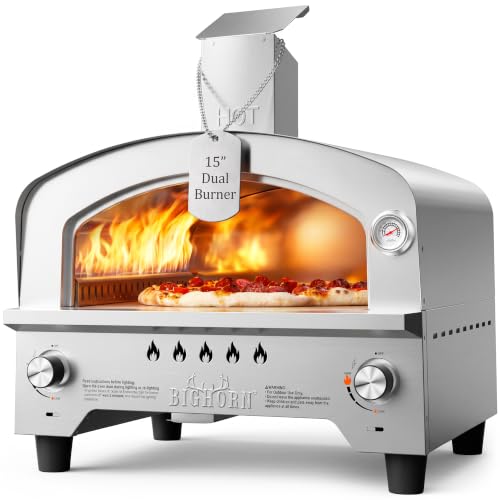
BIG HORN Gas Pizza Oven 15 — Roomiest Value Stone
BIG HORN’s gas oven makes a simpler pitch than the brand-name picks: a portable propane pizza oven in stainless steel with a 15-inch pizza stone, aimed at outdoor cooking without a flagship price tag. Fifteen inches is a genuinely useful middle size — larger than the 12- and 13-inch formats that dominate this category, shy of the full sixteen — and for many families it is the difference between one pizza for everyone and a relay of personal pies. The listing title is otherwise restrained: it states no peak temperature, and we will not invent one. What the title does promise is the configuration itself — portable, propane, stainless — which is the configuration that matters for a buyer comparing shapes rather than spec-sheet trophies.
Value ovens earn their keep or lose it on the unglamorous details: how the stone sits, how the shell weathers, how the whole thing feels after a season of garage storage and garden use. Stainless steel construction is the right starting answer to the weather question, and a portable format means the oven can live indoors between sessions, which does more for longevity than any coating. Where this pick asks for your faith is heat behaviour — with no stated ceiling in the title, the sensible buyer reads the listing’s full documentation and treats the first few bakes as calibration, learning where this particular stone likes its dough. Many owners of value ovens report exactly that learning curve and then years of unremarkable, reliable service.
- Fuel: propane
- Stone: 15-inch, per the listing title
- Body: stainless steel, portable format
- Peak temperature: not printed in the listing title — the manufacturer’s documentation is the place to verify it
- To weigh the BIG HORN 15 against its rivals today, check price on Amazon on its listing
Strengths
- A 15-inch stone at the value end of the gas field is a rare combination.
- Stainless, portable construction suits store-indoors ownership.
- Propane operation keeps the running ritual identical to the premium gas picks.
Trade-offs
- No peak temperature is stated in the title, so heat claims rest on documentation, not the listing.
- Fewer headline features — no built-in thermometer or second fuel is mentioned.
- Brand support networks are thinner than those of the biggest names here.
Best for: families who want a bigger stone without flagship money. Not suited for: spec-driven buyers who want every figure printed in the listing itself.

PIZZELLO 16 Dual Fuel — The Fuel-Swapper’s Kit
The PIZZELLO takes the dual-fuel idea and sells it as a complete kit rather than a bare oven. The listing describes a 16-inch outdoor pizza oven in steel, propane and wood fired, shipping with a gas burner, a wood tray, the pizza stone, a pizza peel and a carry bag. Read that accessory list again, because it changes the arithmetic of the purchase: a peel is not optional equipment in pizza making, it is the tool the entire process hangs on, and a carry bag signals that the manufacturer expects this oven to move — between garden and garage, house and campsite — rather than sit as a fixed installation. Sixteen inches of stone puts it in the largest class in this roundup, alongside the Karu 2 Pro.
Where the Karu is the polished flagship interpretation of two fuels, the PIZZELLO is the pragmatic one: steel construction, a tray-and-burner swap system, and a box that tries to contain the whole hobby on day one. The trade-offs follow from that pragmatism. A kit this complete at a value position in the market will not match a flagship’s fit and finish, and the listing title states no peak temperature for either fuel, so heat expectations should be set by the documentation and by your first calibration bakes. But for a buyer whose real question is “can I try wood this summer and gas on a Tuesday without buying two ovens or a pile of accessories,” this is the most direct answer in the six.
- Fuel: propane and wood, via gas burner and wood tray
- Format: 16-inch steel outdoor oven
- Included per title: stone, pizza peel and carry bag alongside the two fuel fittings
- Peak temperature: the title gives no figure — verify it in the manufacturer documentation
- For the PIZZELLO kit’s current contents, check price on Amazon under its listing name
Strengths
- The most complete box in the roundup — peel and carry bag included.
- Sixteen-inch capacity shared with the flagship class.
- Fuel swapping needs no second oven and no accessory hunt.
Trade-offs
- No temperature figure appears in the listing title for either fuel.
- Value positioning shows in finish and hardware next to premium rivals.
- A carry bag encourages travel, but a 16-inch oven is still a two-handed move.
Best for: experimenters who want both fuels and the tools to start tonight. Not suited for: buyers who rank fit and finish above completeness of kit.
Six Ovens, One Bench: A Side-by-Side Reading
| Oven | Stone or opening | Heat source | The trait that separates it |
|---|---|---|---|
| Ooni Koda 2 | 14-inch | Propane | Stated 375°F–950°F range with hose and regulator included |
| Ooni Karu 2 Pro | 16-inch | Wood or gas | Integrated thermometer for fire management |
| Solo Stove Pi Prime | 13-inch opening | Propane | Demi-dome ceiling and a 90-second bake claim at 950°F |
| Ninja Artisan MO201 | 12-inch | Electric | 5-in-1 design that also air fries; 700°F ceiling |
| BIG HORN Gas 15 | 15-inch | Propane | Largest value-class stone in stainless steel |
| PIZZELLO 16 Dual Fuel | 16-inch | Propane and wood | Peel and carry bag included in the box |
Gas, Wood or Electric: Which Fuel Matches the Pizza You Actually Make?
Fuel is the decision that quietly determines whether your oven gets used. Propane’s case is rhythm: it lights instantly, holds a stone temperature through a queue of pizzas, and asks nothing of the cook between launches. Its cost is character — a gas crust is clean-tasting, and no burner arrangement fully imitates the faint smoke that wood deposits. Wood’s case is the opposite: flavour and ritual in exchange for tending, a fire that must be built, fed and read. Electric’s case is permission and predictability — it works where flame cannot, behaves identically in all weather, and doubles as other appliances in the Ninja’s case, in exchange for a lower heat ceiling and a smaller pizza.
Dual-fuel ovens exist because many households honestly live in two of those worlds. The Karu 2 Pro and the PIZZELLO both let a Tuesday be gas and a Saturday be wood. If you are choosing between single and dual fuel, ask how your household cooks when nobody is showing off: the weeknight pattern is the one your oven must serve without friction, and the weekend personality is a bonus, not the brief. Readers in compact homes sometimes pair an outdoor oven with a small indoor cooker for winter, which is the logic behind guides like Best 24-Inch Gas Ranges — a different appliance class, but the same discipline of matching heat source to household reality.
How Hot Does a Pizza Oven Really Need to Get?
Hotter is better only up to the pizza style you are making. Neapolitan-style pies, with their wet dough and sparse toppings, genuinely need the 900°F-plus class that the Koda 2’s stated range and the Pi Prime’s stated ceiling reach; the crust blisters before the toppings drown it. New York-style and topped family pizzas are happier lower, where the base crisps through without the rim carbonising — the Koda’s stated 375°F floor is a quiet admission that good ovens work across the dial, not just at its end. Pan and deep-dish styles live lower still, in territory where the electric pick’s 700°F ceiling is no handicap at all.
The figure that matters after peak heat is recovery: how fast the stone returns to temperature after a cold, wet pizza lands on it. Recovery is a function of stone thickness, burner or element power and how long you let the oven rest between launches — and no listing title in this roundup states it, which is why our spec boxes leave it out rather than guessing. The practical defence is pacing: give the oven a couple of closed minutes between pizzas, and a queue of four pies will come out evenly instead of declining in quality from first to fourth.
Your First Bake, Step by Step: From Cold Stone to Finished Crust
Start earlier than hunger suggests. Every oven here needs its stone fully saturated with heat, and that takes longer than the air temperature reaching its mark — a stone that reads hot on the surface but is cool in the core will give you a charred top over a pale, soft base. While the oven heats, bring your dough to room temperature, portion your toppings with a dry hand, and remember that wet toppings are the enemy of a crisp base: drain mozzarella, pat mushrooms, and treat sauce as a thin film rather than a ladleful.
Stretch on a floured surface, build the pizza on the peel with a dusting of flour or semolina beneath it, and give the peel a shake before you commit — the pizza should glide, not grip. Launch with one confident motion onto the centre of the stone, then leave it alone for the first stretch of the bake; opening and peeking costs heat and the crust needs undisturbed contact to set. Turn once, a half or a third of a rotation, when the near edge colours faster than the far one. Retrieve onto a rack rather than a plate for the first minute, so steam escapes instead of softening the base you worked for, and let the oven recover with its opening closed while you build the next pie.
Mistakes That Ruin More First Pizzas Than Bad Dough Ever Does
The commonest failure is impatience at the start: launching onto a stone that has not finished heating, then blaming the dough. The second is overloading — a pizza buried under wet toppings steams itself, and no oven at any temperature can crisp a swamp. Third comes the neglected turn: most countertop ovens heat unevenly front to back, and an unturned pizza is two half-pizzas, one scorched and one pale. Fourth, owners of dual-fuel ovens often judge the category by their first wood fire, which is like judging driving by your first hill start; wood is a skill, and the gas mode exists precisely so dinner never depends on your fire-lighting form.
A quieter mistake is storage neglect. Stones crack when they are washed with detergent and soaked, shells rust when they are put away wet, and propane fittings suffer when hoses live kinked in a hot shed. Wipe the stone, dry the shell, coil the hose loosely, and your oven’s fifth season will look like its first. Finally, do not buy the oven for the pizza you aspire to make twice a year. Buy it for the pizza your household will make on an ordinary Friday, and let the aspirational bakes be the bonus they were meant to be.
Where Will the Oven Live? Footprint, Carts and the Storage Question Nobody Asks at Checkout
A pizza oven’s dimensions on a product page are the dimensions of the box it arrives in, not the space it consumes in your life. In use, every oven here needs working room around it: space behind for a gas hose to curve without kinking, space in front for a peel to travel in a straight line, and space above that no shelf, awning or low branch intrudes into, because the heat leaving the top of a pizza oven is not a metaphor. Measure the full working envelope, not the shell, and then measure the doorway or gate the oven must pass through to reach its winter home. A sixteen-inch oven like the Karu 2 Pro or the PIZZELLO is a two-handed carry through a narrow side gate, and the household that stores its oven in a basement should rehearse that carry before the first frost, not during it.
The surface underneath matters as much as the space around. These ovens sit on carts, steel tables and heat-tolerant outdoor worktops; they do not sit on plastic folding tables, glass-topped patio furniture or wooden surfaces you care about unless the manufacturer’s documentation explicitly blesses the arrangement with a stand or insulation layer. Radiant heat travels downward as surely as it travels up. A purpose-built cart with a lower shelf also solves the second storage problem, which is everything else: the peel, the stone brush, the turning peel, the cover, the spare cylinder. Pizza night falls apart not when the oven fails but when the tools scatter across three rooms and a garage. Give the oven a station — one cart, one shelf, one hook for the peel — and the whole ritual compresses into a ten-minute setup that a tired Friday can still manage.
Weight is the quiet spec that decides portability in practice. A compact propane oven like the Pi Prime, built around a 13-inch opening, is the sort of unit one person loads into a car boot without choreography. The big dual-fuel ovens are patio residents that occasionally travel, not travellers that occasionally sit on a patio. Be honest about which life yours will lead. The carry bag in the PIZZELLO’s box is an invitation, but invitations can be declined; a 16-inch steel oven that never leaves the garden is still a fine oven, as long as you did not pay for portability you never use while resenting the size every time you squeeze past it.
What Does a Season of Pizza Actually Cost to Run?
The purchase price is the loud number; the running costs are the ones that repeat. Propane is the most predictable: a standard cylinder carries a household through many pizza nights, because an oven at full blast for an hour still sips compared with a grill, and most pizza nights involve an hour of heat for fifteen minutes of actual baking. The real propane cost is not fuel but friction — the evening the cylinder runs dry mid-queue, which is why experienced owners keep a gauge or a spare. Wood and pellets invert the maths. The fuel itself can be cheap or even free to those with a supply, but it arrives as labour: sourcing dry hardwood, storing it under cover, splitting it to the small sizes these ovens burn, and clearing ash the morning after. Pellet ovens split the difference, trading some of wood’s romance for a hopper’s consistency.
Electricity is the simplest ledger of all — the Ninja Artisan draws household power at a predictable rate and asks for no storage, no gauge and no ash pan, which is part of why it suits households that cook pizza as a weeknight convenience rather than a weekend ceremony. Against that, weigh consumables that every fuel shares: stones crack if they are thermally shocked or dropped, and a replacement stone is a real cost that careful handling mostly avoids; covers perish in ultraviolet light over a few seasons; peels bend, brushes shed, and the small tools of the trade want replacing on a cycle of years. None of this is an argument against any pick in this roundup. It is an argument for buying the oven whose running ledger — money, storage, labour — fits the household that will actually pay it, because an oven whose costs annoy you is an oven that quietly stops being used.
Matching Dough to Oven: Which Pizza Styles Each Class Cooks Best
It helps to name the pizza you are chasing, because the six ovens divide cleanly once styles are on the table. The Neapolitan ambition — a soft, leopard-spotted crust, a soupy centre, a bake measured in a minute or two — belongs to the hottest stones in the roundup, the gas picks with stated 950°F figures, and even there it belongs to them on their best behaviour, with a fully saturated stone and a disciplined turn. The New York ambition — a foldable slice with a crisp underside and fully rendered toppings — is more forgiving and arguably better served by the middle of the dial: the Koda 2’s stated range reaching down to 375°F is built for exactly this patience, and the electric Ninja, with five named pizza styles in its listing, is aimed squarely at this mainstream of home baking rather than at the Neapolitan fringe.
Pan styles, stuffed crusts and heavily topped family pies form a third family, and they punish excessive top heat: the cheese browns before the base sets, and the centre stays gummy under a beautiful lid. For these, an oven’s low-end control and stone recovery matter more than its ceiling, and a cook who mostly makes this style should weight the dual-fuel ovens’ gas mode and the mid-size stones accordingly. Dessert pizzas, flatbreads and the reheating of last night’s slices form a humble fourth family that every oven here handles, and handles better than a kitchen range does, because a hot stone revives a crust instead of steaming it. None of this ranking is a verdict on taste. It is a reminder that “best” in this category is a matching exercise — oven to style, style to household — and the six picks were chosen so that every common style has a natural home among them.
The Kit Around the Oven: Peels, Stones and the Small Tools That Decide Your Second Month
New owners fixate on the oven and improvise the tools, then discover in month two that the tools were the hobby all along. The peel is the first truth: you need one whose blade matches your stone — a 16-inch oven fed with a short, narrow peel feels like serving soup with a teaspoon — and many cooks end up with two, a wooden or bamboo peel for launching, because dough releases from it kindly, and a thin metal turning peel for rotating and retrieving without disturbing the crust. The PIZZELLO’s inclusion of a peel in the box is therefore not a garnish; it removes the single most common first-week frustration. For the other five picks, order the peel the same day as the oven, not after the first pizza has welded itself to a baking sheet in protest.
Heat measurement is the second truth. Only the Karu 2 Pro names an integrated thermometer in its listing among the six, and even an integrated readout usually reports air or dome temperature rather than the stone surface your crust actually touches. An inexpensive infrared thermometer, pointed at the stone’s centre, converts guesswork into a number you can repeat — launch at the same reading each time and your bakes become consistent enough to improve deliberately. The third truth is cleaning restraint: a stiff brush for the warm stone, a damp cloth for the shell once cool, and nothing more exotic. Stones are never soaked, never soaped, and never scraped with anything that gouges; a stone’s stains are a diary, not a defect, and a darkened stone cooks exactly as well as a pale one.
Finally, the unglamorous trio: a cover that actually fits your oven’s shape, a cylinder gauge or a spare cylinder for gas owners, and a heatproof mat or stand layer if your cart’s surface needs protection. Wood and pellet owners add a dry fuel store to that list — a lidded box near the oven, not a pile under a tarp — because damp fuel is the difference between a fire that roars and an evening of smoke and apologies. Budget the kit as part of the oven, whichever of the six you choose, and the hobby’s second month will feel like a continuation of its first week instead of a series of small defeats.
Heat Safety in a Family Garden: Clearances, Cylinders and Common Sense
Every oven in this roundup is, by design, a box of extreme heat sitting at waist height in a leisure space, and it deserves the respect that description implies. Keep the working envelope clear: no cushions, paper plates, solvent bottles or children’s toys within the zone where a peel travels and sparks or embers might land, and treat the oven’s exterior as hot for longer than intuition suggests — steel shells hold heat well past the end of baking, which is precisely what they are built to do. Wood-fired sessions add ember discipline: a metal ash container with a lid, never a plastic bin, and never ash indoors the same night, because embers can smoulder invisibly for a day.
Gas brings its own checklist. Cylinders stand upright, outdoors, away from the oven’s heat, connected with the hose routed so nobody trips over it and nothing hot rests against it. A soapy-water check on connections at the start of the season takes two minutes and finds the leak your nose might miss. Electric ownership swaps those rituals for simpler ones: an outdoor-rated socket, a cord that crosses no walkway, and a strict rule that the Ninja never runs in rain or with wet hands at the controls. Children, finally, are managed by geography rather than by warnings — a marked boundary around the cooking station, one adult whose only job during launches is the oven, and pizzas carried to the table by that adult rather than retrieved by small volunteers. None of this is fearfulness; it is the ordinary discipline that lets a 950°F appliance live comfortably in a family garden for years.
Running a Queue: How Pizza Night Actually Flows When Six People Are Hungry
A single pizza oven feeding a group is a production line, and the cooks who enjoy it are the ones who organise it like one. Dough balls rest portioned and covered, each on its own patch of flour, so that stretching the next pie never waits on dividing the last of a dough batch. Toppings sit in small bowls in assembly order — sauce, cheese, the rest — within one reach of the stretching surface, because a cook who walks to the fridge mid-build returns to a pizza that has glued itself to the peel. The first pizza out is deliberately the simplest: a plain cheese pie that tests the stone, feeds the most impatient child, and tells the cook everything about tonight’s heat before the expensive toppings are committed.
Pacing is the skill underneath the logistics. Each launch cools the stone; each closed minute restores it. Build the next pizza while the current one bakes, but launch only when the stone has recovered, even if the queue is vocal — a pale fourth pizza pleases nobody, and a two-minute pause between pies is invisible at a table with conversation and a first course of slices circulating. Assign the turning and retrieving to one person; oven work suffers from committee. And plan the ending while you still have heat: a final flatbread, a dessert pizza, or tomorrow’s lunch slices baked deliberately rather than accidentally. The ovens in this roundup all reward this rhythm, because none of them is a batch appliance — they are sequence appliances, and the household that embraces the sequence gets restaurant pacing out of a garden cart.
Final Recommendation
Most first-time buyers should start with the Ooni Koda 2: it is the roundup’s most honest expression of what propane does well, with a stated temperature range that covers delicate and fierce bakes alike. Households that know they will burn wood regularly should step up to the Karu 2 Pro and enjoy one oven living two lives, while experimenters on a tighter budget get the same two-fuel idea, plus the tools, from the PIZZELLO. The Pi Prime suits small-batch cooks and travellers, the BIG HORN 15 serves families who want a bigger stone for less, and the Ninja Artisan — electric, unapologetically — is the right answer wherever flame is not allowed. Whichever of the six ends up on your cart, the first pizza will teach you more than this page can, so let it be a cheap dough and a forgiving audience.
Frequently Asked Questions
Can these ovens stay outside all year?
The stainless and steel shells tolerate outdoor life, but tolerance is not an invitation. A cover, a dry storage corner for winter, and a stone kept out of standing damp will add seasons to any of the six. The electric Ninja additionally needs its cord and controls kept dry, as any plug-in appliance does.
Do I need a special peel, or will a baking sheet do?
A peel is close to essential: its flat, thin edge slides under a topped pizza in a way a rimmed baking sheet cannot. The PIZZELLO includes one in the box per its listing; for the other five, budget for a peel as part of the purchase rather than an accessory for later.
Why is one oven in this roundup electric?
Because the Ninja Artisan is marketed for outdoor use and serves readers whose homes rule out flame. We label it electric at every mention so nobody mistakes it for a gas model, and its 700°F stated ceiling is weighed openly against the 950°F figures elsewhere in the six.
How long do these ovens take to heat up?
Plan on a real preheat rather than a token one: the stone, not the air, is what must saturate, and across this class of countertop ovens that means giving the unit a generous run at full power before the first launch — longer on a cold, windy evening, shorter in high summer. Cooks who rush this step produce the classic two-tone pizza, dark on top and pale beneath, and then wrongly blame their dough recipe for what was really a scheduling error. Build the preheat into the ritual — light the oven before you stretch anything, pour the first drink while the stone climbs, and the wait stops feeling like a delay at all.
What size oven should a family of four choose?
Fourteen to sixteen inches covers a family comfortably — one sharing pizza at a time, baked in sequence. The 12- and 13-inch picks suit couples or personal-pizza households. Size for the largest pizza you will make monthly, not the largest you can imagine making once.
Is a higher maximum temperature always better?
No. Peak heat serves Neapolitan-style baking; other styles prefer the middle of the dial. Recovery between pizzas and even stone heating shape your results more than the last fifty degrees of ceiling, which is why this guide reports stated figures without crowning the biggest number.
Related Guides
Pizza at production scale is a different discipline from pizza on a patio, and readers whose baking outgrows one pie at a time may enjoy Best Conveyor Pizza Ovens, where throughput replaces fire-tending as the central problem. Between that world and this one sits the six ovens above — start where your Fridays actually are.


