What's inside
- Where to Buy a Countertop Deck Oven, and Why the Electrical Spec Decides Everything
- Key Takeaways
- Quick Picks
- What Made the Cut for This Deck Oven Shortlist?
- The Lineup at a Glance: Decks, Sizes and Stated Power
- One Deck or Two: How Should a Small Kitchen Decide?
- What Does the Wattage Actually Buy You in a Deck Oven?
- How Do You Run a Deck Oven Through a Service Without Losing the Stone’s Heat?
- Which Buying Mistakes Catch Deck Oven Shoppers Most Often?
- What Should You Measure on Your Counter Before a Deck Oven Arrives?
- How Does Stone Material Change the Bake in a Deck Oven?
- What Does It Cost to Run a Deck Oven All Day?
- Which Pizza Styles Suit a Deck Oven Best?
- How Should You Commission a New Deck Oven in Its First Week?
- What Separates a Commercial Deck Oven from a Home Pizza Oven?
- Final Recommendation
- Frequently Asked Questions
- Related Guides
As an Amazon Associate I earn from qualifying purchases. This post may contain affiliate links at no extra cost to you.
cottageverdict.com is reader-supported. When you buy through links on our site, we may earn an affiliate commission.
Where to Buy a Countertop Deck Oven, and Why the Electrical Spec Decides Everything
The best pizza deck ovens are countertop commercial machines: squat steel boxes with a stone floor, a heating element above and below, and none of the theatre of a flame-fired oven. They are bought by small cafés, bars adding a pizza line, food trucks and serious home bakers, and they live or die on unglamorous numbers — deck count, pizza diameter, wattage and the plug on the end of the cord. Every machine in this roundup is sold through its Amazon listing, with each pick’s name linking to that listing so you can check price on Amazon and read the title’s own statement of its specifications. We report only what those titles claim, and this category contains the roundup’s most instructive silence: one respected manufacturer’s title tells you almost nothing at all, and we have left its spec box mostly empty rather than fill it from memory.
The six machines split into two honest camps. Four are double-deckers or sized for sixteen-inch pizzas, aimed at small commercial counters: a PYY double decker built around 12-inch pies, a VEVOR double deck with two 16-inch stones and the highest stated wattage relative to its footprint, a BOSBAK double deck that is ETL listed, and a CROSSON single-deck 16-inch machine, also ETL listed. The remaining two are the old guard: Waring’s WPO500, a heavy-duty single deck that takes an 18-inch pizza on a standard 120-volt circuit, and the WISCO 421, a compact countertop oven whose listing title says little beyond its name and an LED display. Between them they cover the realistic buying range for a small operation that wants deck-oven results without a floor-standing installation.
Keep one distinction clear as you read: these are not the ovens in our guide to Best Pizza Ovens Propane, which burn gas outdoors and answer to the weather, and they are not conveyor machines either. A deck oven holds a small number of pizzas still, on stone, under a cook’s eye — which is why deck count and recovery between bakes matter more here than raw top temperature. If your counter, your circuit and your pizza size are known quantities, the right machine below will identify itself quickly.
Key Takeaways
- Deck count is the first decision: double-deckers from PYY, VEVOR and BOSBAK bake two pizzas at once; the Waring, WISCO and CROSSON are single-deck machines.
- Every pick here runs on 120 volts where the title states a voltage, but wattage ranges from the PYY’s stated 1100W to the BOSBAK’s stated 3.6kW — check your circuit before you fall for a machine.
- The Waring WPO500 takes the largest stated pizza, up to 18 inches in diameter, on a single deck with a ceramic stone included.
- The WISCO 421’s listing title states almost no specifications; its spec box below honestly reflects that, and buyers must verify dimensions and power on the product page.
- Two picks, the BOSBAK and the CROSSON, carry an ETL listing claim in their titles — relevant for commercial premises where inspectors ask.
- Only the PYY and VEVOR titles state a temperature range or ceiling; where a title is silent, we do not assign the oven a temperature.
Quick Picks
| Deck oven | Tag | The case for it |
|---|---|---|
| Waring WPO500 Single Deck Pizza Oven | The Commercial Benchmark | A heavy-duty single deck that swallows an 18-inch pizza and runs on an ordinary 120V outlet. |
| WISCO 421 Pizza Oven | The Minimalist Classic | A compact countertop name with an LED display — and a listing title that leaves its specs to be verified. |
| PYY 12-Inch Double Decker Pizza Oven | Compact Double Deck | Two 12-inch decks, a stated 122°F to 572°F range and a 60-minute alarm timer in a small footprint. |
| VEVOR 2×16-Inch Double Deck Pizza Oven | Most Independent Control | Two 16-inch decks with independent temperature and time control and two stones included. |
| BOSBAK Double Deck 16-Inch Pizza Oven | ETL-Listed Double Deck | Stainless double deck, ETL listed, with a stated 120V / 3.6kW draw and a timer. |
| CROSSON 16-Inch Countertop Pizza Oven | Single-Deck Simplicity | An ETL-listed 16-inch single deck at a stated 1800W for counters that bake one pie at a time. |
What Made the Cut for This Deck Oven Shortlist?
We required each machine’s title to function as a spec sheet in miniature: deck configuration, pizza size, power or temperature had to be stated somewhere in it, or — in the WISCO’s case — the machine had to be a recognised countertop name whose very silence was worth documenting for buyers. We then balanced the list across the real shape of demand: single decks for counters that bake in a steady trickle, double decks for counters that face a lunch rush, and sizes from 12 inches up to the Waring’s 18. A list of six near-identical double-deckers would have been easier to write and useless to read.
We also deliberately kept one machine whose documentation burden falls on the buyer. A shortlist that only includes perfectly specified products teaches readers that the market is tidier than it is; the WISCO’s presence, clearly flagged, teaches the more valuable lesson that a listing title is a starting point for verification rather than the end of it. Every other pick earned its place by stating its essential facts where a buyer can check them in seconds, and the contrast between the fullest title here and the emptiest is itself a piece of buying advice no specification table could give.
Electrical honesty ran through every decision. Countertop deck ovens are routinely bought by people who assume a commercial oven needs commercial wiring, or — worse — by people who assume it does not. The titles here mostly say 120V, which is household-and-café voltage, but the wattage spread is wide, and a 3.6kW machine and an 1100W machine make very different demands even at the same voltage once other equipment shares the circuit. We have printed the stated figures exactly as the titles give them and flagged every gap, because the gap is where returns and tripped breakers come from.

Waring WPO500 Single Deck Pizza Oven — The Commercial Benchmark
Waring’s WPO500 is the machine the rest of this list is implicitly measured against, and its title reads like a specification because Waring writes for buyers who spec equipment for a living. Heavy-duty single deck. Pizzas up to 18 inches in diameter — the largest stated capacity in this roundup, a size that matters because an 18-inch pie is the standard large of American pizza service, and most countertop decks top out at 16. One ceramic pizza stone is included. The electrical line is complete: 120V, 1800W, and a 5-15 plug, which is the ordinary North American household plug — meaning this commercial deck runs anywhere a kettle runs, provided the circuit is not already loaded.
That combination explains the WPO500’s endurance in small pizzerias, bars and concession counters. It asks for no electrician, takes the full-size pie, and comes from a commercial equipment maker whose service network exists outside the internet. The single deck is the honest limitation: one pizza at a time, baked under your eye, with throughput set by bake time rather than by deck space. For a bar adding pizza to a drinks menu, that rhythm is exactly right. For a slice shop at lunch, it is a bottleneck with a famous name.
Note what the title does not state: a temperature range. Waring’s silence there is common among established commercial brands, whose buyers consult full spec sheets rather than marketplace titles. We record the gap rather than filling it, and the practical consequence is simple — if a guaranteed ceiling temperature is a condition of your purchase, verify it in the manufacturer’s documentation for this model before ordering, because the listing title will not give it to you.
Ownership of a WPO500 also means owning Waring’s assumptions about how a kitchen works. The machine is built to be left on through a service, holding temperature for hours, rather than switched per pizza — its economics and its element life both favour the always-ready pattern of a working counter. A home baker who fires it for a single Friday pie will still get an excellent bake, but the honest framing is that this is professional equipment tolerating domestic use gracefully, not a home appliance with professional styling. Buyers comfortable with that framing rarely regret this machine; buyers who wanted a gadget sometimes find its seriousness sobering.
- Decks: single deck, heavy-duty commercial build
- Stated capacity: pizzas up to 18 inches in diameter
- Stone: one ceramic pizza stone included
- Electrical: 120V, 1800W, 5-15 plug — all stated in the listing title
- Temperature range: not stated in the listing title — check the manufacturer’s full documentation if a ceiling figure matters to you
- Where to buy it: the Waring WPO500 Single Deck Pizza Oven listing on Amazon is the place to check price on Amazon
Strengths
- The largest stated pizza capacity here — a full 18 inches.
- Complete electrical disclosure, including the plug type.
- A commercial maker’s build and support behind a countertop format.
Trade-offs
- One deck means one pizza at a time; rush-hour throughput is limited.
- No temperature range is stated in the title.
- Heavy-duty commercial construction makes it the least portable pick here.
Best for: bars, cafés and concession counters baking full-size pizzas one at a time. Not suited for: any counter whose lunch rush arrives all at once.

WISCO 421 Pizza Oven — The Minimalist Classic
This is the most unusual review in the roundup, because the listing title — “WISCO Industries, INC. 421 Pizza Oven, LED Display” — is nearly empty. No pizza diameter. No wattage. No voltage, no deck description, no temperature. In a guide that claims specifications only when a title states them, the WISCO 421’s spec box is therefore a row of honest blanks, and we would rather print those blanks than dress the machine in numbers recalled from other models or other years. WISCO’s 421 is a long-standing compact countertop name in concession and snack-bar circles, and the LED display is the one feature its own title vouches for.
Why include a machine we can say so little about? Because buyers will meet it in search results beside the fully-specified machines above and below, and the contrast is the lesson: a famous compact oven can be listed with almost no verifiable specification at all. The correct response is not to avoid the WISCO — its installed base in American snack bars is real — but to buy it with open eyes, pulling its dimensions, power draw and pizza capacity from the product page’s documentation and the manufacturer’s own materials before money moves. If those documents confirm the compact countertop format the 421 is known for, it suits low-volume counters that bake the occasional pizza rather than a service built around it.
There is a discipline point here that applies to the whole category. Marketplace titles are marketing surfaces, and brands with institutional buyers often barely bother with them. The absence of a stated spec is not evidence of a bad machine; it is evidence that the burden of verification has been handed to you. Accept that burden knowingly with the WISCO, or choose one of the five machines in this list whose titles do the work for you.
It helps to understand who has historically bought machines in the 421’s class, because the use explains the listing. Compact countertop ovens of this kind live in concession stands, school canteens, bowling alleys and small bars — places where pizza is an addition to the main business, sold by the whole small pie or the slice, and where the oven is bought through catalogues and distributors whose spec sheets do the talking. A marketplace title written for that world can afford to be terse. The retail buyer meeting the machine online for the first time is simply not its historical audience, and the homework this review keeps recommending is the price of admission to a genuinely proven format.
- Decks: not stated in the listing title — verify the configuration in the manufacturer’s documentation
- Pizza capacity: not stated in the listing title — confirm the maximum pie size on the product page
- Confirmed feature: LED display, the one specification the title itself offers
- Electrical: wattage and voltage are not given in the listing title — look them up before planning a circuit around this oven
- Temperature range: likewise absent from the title; do not assume a ceiling
- Where to buy it: find the WISCO 421 Pizza Oven on Amazon to check price on Amazon and read its full product documentation
Strengths
- A long-standing compact countertop name in concession service.
- LED display confirmed by its own title.
- Small-format intent suits occasional, low-volume baking.
Trade-offs
- Almost every specification must be verified outside the listing title.
- Buyers cannot compare its capacity or power against rivals from the title alone.
- Not the pick for a buyer who needs certainty at the point of clicking.
Best for: snack-bar and concession buyers who know the 421 format and will verify its documents. Not suited for: first-time buyers who need specifications stated up front.

PYY 12-Inch Double Decker Pizza Oven — Compact Double Deck
The PYY makes the opposite choice from the Waring: instead of one large deck, two small ones. Its title describes a commercial countertop oven with a 12-inch double-decker layout — dual-layer capacity for two 12-inch pizzas at once — driven by a stated 1100W of baking power, the lowest wattage figure in this roundup. A modest draw like that is a deliberate trade. It will not recover heat like a 2700W machine when cold dough lands on both stones, but it can live on circuits and in food-truck power budgets where the hungrier ovens in this list simply cannot go.
Uniquely in this six, the PYY states its full temperature range in the title: 122°F to 572°F, adjustable. The low end is not for pizza at all — it is for holding and gentle warming — while the top end is a genuine pizza temperature for the 12-inch format, where pies are thin and bake quickly. A built-in 60-minute alarm timer completes a title that reads like it was written by someone who has actually run a small counter: two decks, a known range, a timer that calls you back. For a café adding personal pizzas to a coffee menu, this is a coherent little machine.
The limits are the mirror of its virtues. Twelve inches caps the menu at personal and small pizzas; a business whose customers expect a 16-inch pie to share cannot serve it from this oven. And dual-layer capacity on 1100W means the two decks share a modest power budget, so back-to-back full loads will test its recovery. Buy it for the workload it describes — steady, small-format, two-at-a-time — and it is honestly matched to its title.
Consider the PYY’s natural habitat more concretely, because it clarifies the whole small-format class. A coffee shop whose food offer is a chalkboard of personal pizzas, flatbreads and warmed pastries needs an oven that a barista can run between drinks: two small decks, a timer with an alarm so a bake announces itself over the espresso machine, and a power draw the shop’s existing circuits absorb without an electrician’s visit. That is this machine, almost clause for clause from its title. Judged as a pizzeria’s main oven it is undersized; judged as a café’s second appliance it is the most thoughtfully specified pick in this roundup.
- Decks: double decker, dual-layer, 12-inch format
- Stated power: 1100W
- Stated temperature range: 122°F to 572°F, adjustable
- Timer: built-in 60-minute alarm timer
- Intended setting: indoor countertop commercial use
- Where to buy it: look for the PYY 12-Inch Double Decker Pizza Oven listing on Amazon to check price on Amazon
Strengths
- Two decks in a compact countertop footprint.
- The gentlest power draw here — friendly to small circuits and mobile setups.
- A full stated temperature range and an alarm timer, rare candour in this category.
Trade-offs
- Twelve-inch pies only; no large format.
- 1100W shared across two decks limits recovery under continuous load.
- Less headroom for thick, heavily topped pizzas.
Best for: cafés, coffee counters and food trucks baking personal pizzas two at a time. Not suited for: any menu built around large sharing pies.

VEVOR 2×16-Inch Double Deck Pizza Oven — Most Independent Control
VEVOR’s entry is the control freak of the six. The title specifies a double-deck countertop maker in a 2×16-inch format — two decks, each taking a 16-inch pizza — built in heavy-duty iron, with a stated ceiling of 662℉, a stated 2700W of power, two stones included, and the feature that separates it from every other double-decker here: independent temperature and time control. Independent control means the top deck can run a finishing bake while the bottom runs a gentler one, or one deck can hold while the other works — the kind of flexibility a small kitchen uses constantly once it has it and misses badly when it does not.
The 2700W figure deserves its context. Spread across two 16-inch decks, it is a working commercial power budget: enough for genuine recovery between bakes, and enough to demand respect for the circuit it shares. The iron body is the honest commercial choice too — less pretty than stainless, entirely unbothered by a working kitchen. VEVOR positions the machine for home kitchen and restaurant use alike, and the specification supports both readings: a serious home baker with a dedicated counter could run it, and a small restaurant could build a two-pie rhythm around it.
What the title leaves unstated is the voltage and plug, so the circuit conversation must happen on the product page before purchase — at 2700W that conversation is not a formality. Verify the supply requirement, confirm the counter depth against the machine’s footprint, and the VEVOR becomes the most capable double-deck proposition in this roundup for a kitchen that bakes two sizes or two styles of pizza in the same service.
The independent controls also change how a small kitchen handles the shoulder hours. Between lunch and dinner, a single deck can be held warm for the occasional order while the other rests cool, halving the idle draw and the heat dumped into the kitchen; at the rush, both come up to temperature and the separation game begins. Machines without independent control force an all-or-nothing choice on exactly the hours when trade is thinnest. It is a small operational elegance, invisible in a showroom, that working cooks notice within the first week — and it is stated plainly in this oven’s title rather than buried in a manual.
- Decks: double deck, 2×16-inch format
- Stated power: 2700W
- Stated ceiling: 662℉ in the listing title
- Controls: independent temperature and time control per the title
- Body and stones: heavy-duty iron body; two stones included
- Where to buy it: the VEVOR 2×16-Inch Double Deck Pizza Oven is sold on Amazon — check price on Amazon there and confirm its voltage on the same page
Strengths
- Independent deck control, unmatched elsewhere in this list.
- Two 16-inch decks with stones included.
- A stated power and ceiling figure — no guessing.
Trade-offs
- Voltage and plug are not stated in the title; verification is required.
- Iron body is heavier and less wipe-clean handsome than stainless.
- 2700W will not share a light circuit happily.
Best for: small restaurants and serious home bakers running two pizza styles at once. Not suited for: counters with fragile or already-loaded electrical circuits.

BOSBAK Double Deck 16-Inch Pizza Oven — ETL-Listed Double Deck
BOSBAK leads its title with the two words a commercial buyer scans for: ETL Listed. That certification mark signals the oven has been tested to recognised safety standards by an accredited laboratory, and in real premises — pizzerias, restaurants, bars, the very settings BOSBAK names in its title — it can be the difference between an oven an inspector accepts and one that starts an argument. Beneath that headline sits a substantial machine: a double-deck, 16-inch electric oven in stainless steel, with a pizza stone, a timer, and a stated electrical draw of 120V / 3.6kW.
Pause on that draw, because it is the highest power figure in this roundup and it arrives on a 120V claim. A 3.6kW load is serious countertop territory; the practical meaning is that this oven wants a circuit conversation with an electrician or at least with the breaker panel before it wants a pizza. Buyers who plan for it get the reward: two 16-inch decks with the power to recover between bakes, wrapped in the stainless body a working kitchen prefers for cleaning. Buyers who do not plan for it get nuisance trips at the worst moment of service.
The title states no temperature ceiling, so — as with the Waring — that figure lives in the manufacturer’s documentation rather than in our spec box. What the title does give is a clear picture of intent: this is a premises oven, specified for pizzerias, restaurants and bars, and its certification, material and power all point the same way. Home bakers can run it, but they should know they are buying commercial intent, with commercial appetites to match.
A word about the timer, which reads as a minor line in the title and is not. In a bar or restaurant where the person running the oven is also pouring drinks or plating other dishes, an oven that announces a finished bake is worth real money across a service; pizzas die quietly in unwatched ovens, and they die expensively. BOSBAK including a timer alongside its certification and its stainless body suggests a maker thinking about the whole shift rather than the spec sheet’s headline numbers. Combined with the 3.6kW appetite, the picture is consistent: this is equipment for a staffed premises, specified by someone who has worked one.
- Decks: double deck, 16-inch format
- Certification: ETL listed, per the listing title
- Body: stainless steel, with pizza stone and timer
- Stated electrical: 120V / 3.6kW — plan the circuit accordingly
- Temperature ceiling: the listing title does not publish one; consult BOSBAK’s documentation for the figure
- Where to buy it: sold via the BOSBAK Double Deck 16-Inch Pizza Oven listing on Amazon, where you can check price on Amazon
Strengths
- ETL listing speaks directly to commercial premises requirements.
- The strongest stated power draw here, feeding two 16-inch decks.
- Stainless construction suits daily commercial cleaning.
Trade-offs
- 3.6kW demands deliberate circuit planning.
- No temperature ceiling stated in the title.
- Commercial intent makes it more oven than most home counters need.
Best for: pizzerias, restaurants and bars that need a certified double deck. Not suited for: casual home use on an unexamined kitchen circuit.
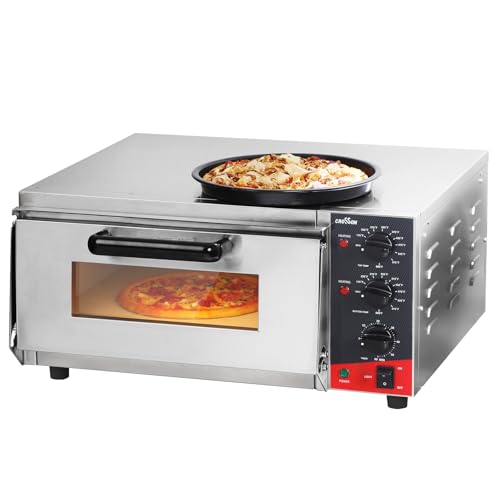
CROSSON 16-Inch Countertop Pizza Oven — Single-Deck Simplicity
CROSSON closes the list by making the simplest respectable offer in it: an ETL-listed commercial 16-inch countertop electric oven, with a pizza stone, at a stated 120V/1800W, described in its own title as multipurpose and intended for restaurant use indoors. Single deck, full-size 16-inch capacity, certified, and drawing exactly the wattage of the Waring — but taking a 16-inch pie rather than an 18. For a counter that bakes one pizza at a time and wants the certification conversation settled, this is a tidy specification with no wasted words.
The multipurpose word in the title is worth a sentence, because deck ovens with a stone and an open chamber earn it honestly: flatbreads, reheated slices brought back to crispness, par-baked items finished to order, even tray items that benefit from a stone’s stored heat. A small restaurant rarely bakes only pizza in a deck oven once the staff learns its habits, and a single deck that is free between pizza orders becomes the kitchen’s finishing station. CROSSON’s modest claim covers that reality without overselling it.
Like the BOSBAK, the CROSSON title states no temperature ceiling, and we leave that box unfilled rather than borrow a figure. What is stated is enough to place it precisely: it is the certified, full-size, single-deck option for premises that value simplicity over throughput — the deck oven for the bistro, the taproom and the small restaurant whose pizza trade is steady rather than frantic.
There is also a staffing argument for the single deck that double-deck marketing never mentions. One deck means one bake to watch, one rhythm to learn, and a new hire can be trusted with the oven inside a single shift. In the small premises this machine targets — where the oven’s operator is also the bartender, the server or the owner — simplicity is not a compromise but a management strategy. The CROSSON’s specification reads the way it does because its buyers’ scarcest resource is not deck space; it is attention. An oven that respects that scarcity earns its counter room every service.
- Decks: single deck, 16-inch format
- Certification: ETL listed, as the listing title states
- Included: pizza stone
- Stated electrical: 120V/1800W
- Temperature ceiling: not published in the listing title — see the manufacturer’s documentation
- Where to buy it: find the CROSSON 16-Inch Countertop Pizza Oven on Amazon to check price on Amazon
Strengths
- ETL listing at a single-deck size and price class.
- Full 16-inch capacity on an ordinary stated wattage.
- Multipurpose chamber earns its keep between pizza orders.
Trade-offs
- Single deck caps throughput at one pie at a time.
- No temperature ceiling stated in the title.
- Fewer headline features than the double-deck rivals.
Best for: bistros and taprooms baking steadily, one full-size pie at a time. Not suited for: high-volume counters that need two decks working.
The Lineup at a Glance: Decks, Sizes and Stated Power
| Model | Decks | Stated pizza size | Stated power |
|---|---|---|---|
| Waring WPO500 Single Deck Pizza Oven | Single | Up to 18 inches | 1800W, 120V, 5-15 plug |
| WISCO 421 Pizza Oven | Not stated in title | Not stated in title | Not stated in title |
| PYY 12-Inch Double Decker Pizza Oven | Double | 12 inches, two layers | 1100W |
| VEVOR 2×16-Inch Double Deck Pizza Oven | Double | 16 inches per deck | 2700W |
| BOSBAK Double Deck 16-Inch Pizza Oven | Double | 16 inches | 3.6kW, 120V |
| CROSSON 16-Inch Countertop Pizza Oven | Single | 16 inches | 1800W, 120V |
One Deck or Two: How Should a Small Kitchen Decide?
The deck question is really a question about your busiest fifteen minutes. A single deck bakes one pizza at a time, and its output across an hour is set by bake time and the cook’s rhythm; a double deck doubles the simultaneous capacity but not the cook — someone still launches, watches and turns every pie. Counters whose orders arrive in a steady trickle, a pizza every few minutes across an evening, are served perfectly well by the Waring or the CROSSON, and they keep the counter simpler and the power draw lower. Counters whose orders arrive in a clump — the lunch rush, the halftime surge — need the second deck not for average output but for simultaneity: two pies baking while a third is built.
There is a subtler use of the second deck that experienced kitchens exploit: separation. One deck runs hot for fresh pizzas while the other runs cooler for reheats, garlic bread or finishing, which is where the VEVOR’s independent controls stop being a specification and start being a service pattern. If your menu mixes fresh pies with by-the-slice reheats, a double deck with independent control is not a luxury; it is the machine your menu is quietly asking for. If your menu is one pizza, made one way, a single honest deck will out-serve a double deck you never light.
What Does the Wattage Actually Buy You in a Deck Oven?
Wattage buys recovery. A deck oven’s stone and elements hold a working temperature, and every cold, wet pizza you launch is a withdrawal from that bank. A high-wattage machine repays the withdrawal quickly, so the sixth pizza of a rush bakes like the first; a low-wattage machine repays slowly, and bake times stretch as the stone’s stored heat drains. This is why the PYY’s 1100W and the BOSBAK’s 3.6kW are not good and bad versions of the same number — they are different service promises. The PYY promises gentle, economical baking for a light, small-format workload. The BOSBAK promises to keep up.
The other side of the wattage coin is the building’s wiring, and it deserves the same plainness. A stated figure like 3.6kW on a 120V claim should start a conversation about dedicated circuits before it starts a purchase; a stated 1800W with a named 5-15 plug, as on the Waring, is the manufacturer telling you the machine was designed for ordinary outlets. Kitchens scaling up their equipment generally — the same readers who weigh machines in our guide to Best Freestanding Commercial Mixers — learn this lesson once across every category: the appliance’s appetite and the premises’ supply are a single decision, never two.
How Do You Run a Deck Oven Through a Service Without Losing the Stone’s Heat?
Preheat longer than feels reasonable. A deck oven’s air temperature arrives quickly; its stone temperature does not, and the stone is where the bake lives. Give the machine a full, patient heat-soak with the doors closed before the first pizza, and treat the first pie of the day as the calibration bake it honestly is. During service, work in a rhythm that keeps the doors shut: build the next pizza while the current one bakes, launch decisively, and resist the urge to peek, because every open door is heat leaving the chamber and a longer recovery the elements must fund.
Rotate each pizza once, halfway through its bake, because deck ovens have hot geography — the rear of the stone near the back element runs ahead of the front near the door. Flour and cornmeal residue should be brushed off the stone between bakes with a dry oven brush; residue carbonises, smokes, and eventually flavours a crust with yesterday’s service. At close, let the oven cool with its doors ajar, brush the stones cold the next morning, and never introduce water to a hot stone. A deck oven treated this way holds its calibration for years; treated casually, it develops a reputation for inconsistency that belongs entirely to its operator.
Which Buying Mistakes Catch Deck Oven Shoppers Most Often?
The classic mistake is buying diameter you cannot use: the 18-inch deck bought for a menu whose largest pie is 14 inches, wasting counter, power and money on capacity that never earns. The mirror mistake is buying a 12-inch double decker for a sharing-pie menu and discovering the cap during the first Friday service. The third mistake is electrical — ordering the hungriest machine on the list for a premises whose circuits were wired for a coffee machine, and meeting the problem as a tripped breaker mid-rush. All three mistakes are visible in the titles before purchase, which is precisely why this guide prints stated specifications so literally.
A fourth mistake is quieter: assuming a famous name’s empty title means the machine needs no research. The WISCO in this list is a legitimate oven with a nearly blank marketplace title, and the correct response is homework, not either blind trust or dismissal. And a fifth, for outdoor-minded readers wandering in from the grilling world: a countertop deck oven is an indoor appliance with a cord, a different tool from the flat-top stations in our guide to Best Outdoor Flat Top Grills — counters that confuse the two categories end up with the wrong machine in the wrong weather.
What Should You Measure on Your Counter Before a Deck Oven Arrives?
Countertop is a hopeful word. These machines are countertop the way a microwave oven is countertop only in its largest dreams — they are deep, tall and heavy, they need clearance for heat on every side, and their doors open into the workspace where the cook stands. Measure the counter’s depth against the machine’s footprint, then measure again with the door open and a peel inserted, because that working envelope, not the box, is what your kitchen must surrender. Check the height under wall cabinets and shelves; a double deck’s top surface is not a shelf, however tempting it looks, since the cabinet above it will cook slowly in the escaping heat.
Then walk the route the oven will travel. Commercial countertop machines arrive on pallets and meet their kitchens through doorways, corridors and occasionally a flight of stairs, and the Waring-class heavyweights in this list do not forgive optimistic route planning. Finally, stand where the cook will stand and look at the sight lines: a deck oven’s pizzas are judged by eye through a door window or an open door, so the oven should sit at a height where the stone is visible without stooping or stretching. Ergonomics decided in advance is the difference between an oven the staff loves and one they route around.
How Does Stone Material Change the Bake in a Deck Oven?
The stone is the deck oven’s memory. Elements cycle on and off, air temperature swings with every door opening, but a heat-soaked stone holds its temperature through the noise and delivers it steadily into the base of the pizza — which is why every pick in this roundup that names its stone treats it as a headline feature. The Waring includes a ceramic stone, the CROSSON and BOSBAK include stones with their chambers, and the VEVOR includes two, one per deck. Where a title does not name a stone at all — the WISCO again — the buyer should confirm what the baking surface actually is before assuming a stone bake.
Ceramic and cordierite-style stones differ mainly in how they forgive. A stone shocked by a cold, wet dough landing on a fierce surface, or by a careless splash, can crack; materials formulated for thermal shock tolerate those insults longer. In a deck oven the shock is milder than on a grill — the chamber is enclosed, the temperature steadier — so a plain ceramic stone like the Waring’s lives a long, calm life provided it is heated and cooled gradually and never washed. Care, in other words, substitutes for exotic materials indoors. What no stone forgives is being treated as a worktop: resting trays, knives and cold pans on a hot deck stone is how good ovens acquire cracked hearts.
What Does It Cost to Run a Deck Oven All Day?
Running cost follows the wattage conversation to its natural end. A deck oven held at temperature through a ten-hour service draws its rated power in cycles — heavily during heat-up and recovery, lightly while idling at temperature — and the honest way to estimate its appetite is to treat the stated wattage as the ceiling of each hour rather than the constant. Even so, the spread in this list is instructive: a 1100W machine like the PYY and a 3.6kW machine like the BOSBAK live in different cost worlds across a month of services, and the difference buys exactly what the earlier section described — recovery speed and simultaneity. There is no free throughput; there is only throughput you have decided to pay for.
Heat is the second cost, paid by the kitchen rather than the meter. Every watt a deck oven draws eventually becomes heat in the room, and a small kitchen running a big double deck through a summer lunch will feel its oven in the air conditioning load and in the staff’s temper. Ventilation and placement — the oven under extraction, away from the cold station — are part of the purchase decision for premises buyers, and one more reason the modest machines in this list keep their devoted following among cafés whose kitchens were never designed around a pizza programme.
Which Pizza Styles Suit a Deck Oven Best?
Deck ovens are the native habitat of the New York style pie: a large, thin, foldable pizza baked directly on stone at a strong but not ferocious heat, with time for the crust to set into something crisp-chewy rather than blistered-soft. The stated capacities in this list map neatly onto that tradition — 16 and 18-inch decks exist because that style is sold at those sizes — and a cook whose ambition is the classic slice-shop pie is shopping in exactly the right category. The same ovens handle bar pies, grandma-style trays rested on the deck, and reheated slices beautifully, because all of them reward a steady, stone-led bake.
Styles at the extremes ask more questions. A very wet, delicate dough in the Neapolitan manner wants a fiercer, faster bake than most countertop decks are specified for — only the titles here that state a ceiling, the VEVOR at 662℉ and the PYY’s range topping at 572°F, let you even begin that conversation with numbers, and for the others the honest answer is that the title does not promise it. Thick, heavily loaded deep-dish styles bake low and slow in pans, which any deck oven can do but none is optimised for. The practical rule: buy the deck for the style you will serve weekly, and let the exotic styles be occasional guests rather than the specification.
How Should You Commission a New Deck Oven in Its First Week?
Unbox it like equipment, not like a parcel. Photograph the delivery condition, read the manufacturer’s manual before the first power-up — the manual, not the marketplace title, is where the full specification and the safety clearances live — and run the oven empty through its first heat cycle to burn off the manufacturing residues every new heating appliance carries. That first cycle will smell industrial; ventilate, let it finish, and do not let it anywhere near dough. Then bake something expendable: a plain dough skin, no toppings, watched closely. You are learning the oven’s geography — where the stone runs hot, how the door side lags — and cheap dough is the tuition.
Across the first week, keep a small notebook by the oven, a habit borrowed from professional kitchens that looks eccentric and pays immediately. Record deck settings, bake times and results for each style you serve, because a deck oven’s dial and its stone are cousins, not twins, and your notes are the translation between them. By the second week the notebook becomes the kitchen’s calibration chart, new staff can reproduce the bake, and the oven stops being a machine with moods. Every pick in this roundup rewards that discipline equally; it is the cheapest performance upgrade in the entire category.
What Separates a Commercial Deck Oven from a Home Pizza Oven?
Duty cycle. A home pizza oven is built for an evening: a few pizzas, a cool-down, a cupboard. A commercial deck oven is built for a shift — powered at open, held at temperature for ten or twelve hours, loaded and unloaded hundreds of times, cleaned down and repeated tomorrow. That difference explains everything about the machines in this list that can puzzle a home buyer: the heavy doors, the plain finishes, the absence of novelty features, the seriousness about plugs and certification. It also explains the prices’ logic without quoting a single one: you are paying for repetition, not for a better single pizza.
It also explains why a deck oven can be a superb home purchase for the right household and a poor one for the wrong household. A family that bakes pizza twice a week, hosts pizza parties, and has the counter and circuit to spare gets professional steadiness that no novelty appliance matches. A household that bakes monthly gets a large, hungry box occupying prime counter for a hobby it rarely practises. The machines do not care which household they land in; the buyer’s honesty has to do that work before the order, which is the same honesty this guide has applied to the titles throughout.
Final Recommendation
Decide by deck, then by diameter, then by circuit, and the six sort themselves. A premises needing certification and two decks should take the BOSBAK and plan its power properly. A kitchen running two pizza styles at once should take the VEVOR for its independent controls. A café baking personal pies on a gentle power budget should take the PYY. A bar or bistro baking full-size pies one at a time should choose between the Waring’s 18-inch benchmark deck and the CROSSON’s certified 16-inch simplicity — and the buyer who knows the WISCO 421’s format from the concession world can take it, documents verified, with our blessing. The right deck oven is the one whose stated specifications match your busiest quarter-hour, and in this roundup, unusually, the titles tell you almost everything — where they do not, we have shown you the blank rather than papering over it.
Frequently Asked Questions
Can a countertop deck oven really run on a household outlet?
Some can, and their titles say so. The Waring WPO500 states 120V, 1800W and a 5-15 plug — the ordinary outlet plug. Others, like the BOSBAK at a stated 3.6kW, demand circuit planning even at 120V. Always match the stated draw to your premises before ordering.
Why does the WISCO 421’s spec box have so many gaps?
Because its listing title — “421 Pizza Oven, LED Display” — states almost nothing else. We claim specifications only when a title or documentation supports them, so the WISCO’s capacity, wattage and voltage must be verified on its product page and in the manufacturer’s materials.
Is a double deck always better than a single?
No. A double deck doubles simultaneous capacity, which matters when orders arrive in clumps. A counter with a steady trickle of orders is served as well by a single deck, with lower power draw and a smaller footprint. Match the deck count to your busiest fifteen minutes.
What does ETL listed mean, and should I care?
It means an accredited laboratory has tested the product against recognised safety standards. Home buyers may treat it as a reassurance; commercial premises should treat it as close to a requirement, since inspectors and insurers ask about certification. The BOSBAK and CROSSON titles both carry the claim.
How large a pizza should my deck oven take?
The largest your menu actually serves. Twelve-inch decks suit personal-pie menus, 16-inch decks suit standard sharing pies, and the Waring’s stated 18-inch capacity suits menus built on a true large. Buying beyond your menu wastes counter space and power on every bake.
Do deck ovens need special ventilation?
They need thought, if not always a dedicated system. An electric deck oven produces no combustion gases, which is why it can live indoors where a gas deck cannot, but it pours heat and cooking vapour into the room all service long. Small premises usually place the oven under existing extraction; a home baker should expect the kitchen to warm up and plan a window or hood accordingly. Your local code and your insurer, not this guide, have the final word for commercial premises.
Related Guides
Deck ovens are one branch of the commercial pizza family; for the branch that moves pizzas through the oven on a belt instead of resting them on stone, see our roundup of Best Conveyor Pizza Ovens, which covers the high-throughput alternative to everything in this guide.


