What's inside
- Where to Buy a Propane Pizza Oven, and Why the Tank Changes Everything
- Key Takeaways
- Quick Picks
- How Did This Propane-Only Shortlist Get Built?
- Six Propane Ovens, Compared on Stone, Heat Claims and Carrying
- Why Does Propane Suit Pizza Better Than Any Other Portable Fuel?
- Rotating Stone or Hand-Turned: Which Bake Should You Choose?
- How Do You Run a Propane Pizza Oven Session, Start to Finish?
- What Mistakes Do First-Time Propane Oven Owners Make?
- Twelve Inches or Sixteen: What Size Propane Oven Should You Actually Buy?
- How Should You Set Up a Propane Oven Safely Outdoors?
- What Does a Season of Ownership Look Like for a Propane Pizza Oven?
- Which Accessories Does a Propane Oven Owner Actually Need?
- How Do Propane Ovens Behave in Cold or Windy Weather?
- Final Recommendation
- Frequently Asked Questions
- Related Guides
As an Amazon Associate I earn from qualifying purchases. This post may contain affiliate links at no extra cost to you.
cottageverdict.com is reader-supported. When you buy through links on our site, we may earn an affiliate commission.
Where to Buy a Propane Pizza Oven, and Why the Tank Changes Everything
The best pizza ovens propane shoppers can buy share one defining trait: they carry their fire with them. A standard propane tank, a regulator, a hose — and the oven bakes anywhere a flat surface exists, from a patio to a campsite to the tailgate end of a car park. That freedom is why this category exists separately from the deck ovens and grill-top chambers elsewhere on this site, and it shapes the buying decision: you are choosing not just an oven but a way of cooking outdoors that answers to a gas bottle. Every pick below is sold through its Amazon listing, each name linking to that listing so you can check price on Amazon and read the manufacturer’s own title claims before you spend. As throughout this batch, we claim only what those titles state — heat figures, stone sizes and bake times appear here only where a title prints them.
Six ovens made this list, and none of them is borrowed from the general pizza oven roundup elsewhere on the site; this is a propane-only field, assembled for readers who have already chosen their fuel. Three are Gozney machines, and they are three genuinely different ovens — a 16-inch stationary flagship, a 12-inch portable that also accepts a wood burner, and a 12-inch adventure model built to be carried — so they are reviewed as three separate products, not as one brand with three badges. Around them sit a HALO with a rotating stone and a dual burner system, a Mimiuo that ships as a complete 12-inch travel kit, and a VEVOR that pairs a 16-inch stone with electric rotation and a carry bag.
One honesty note belongs at the top. The Gozney Roccbox is a dual-fuel oven — its title says gas and wood fired — and it appears in a propane guide on the strength of its integrated gas burner, which is a complete, primary way to run the oven, not an accessory afterthought. We discuss its gas performance and treat the wood burner as the secondary option it is. Readers who want the full wood-fired discipline should start with the dedicated guide linked at the end of this page. Readers still equipping the rest of the outdoor corner — the audience of our guide to Best Karcher Electric Pressure Washers as much as of this one — should settle the fuel question before the brand question; readers who have settled on propane are in the right place.
Key Takeaways
- Every oven here runs on propane as a primary fuel; the Roccbox additionally accepts a wood burner, but its gas burner is the reason it belongs in this guide.
- Three Gozney models appear because they are three different ovens: the Arc XL (16-inch, stationary), the Roccbox (12-inch, portable, dual-fuel) and the Tread (12-inch, built for carrying).
- Two ovens rotate the stone for you — the HALO Versa 16 and the VEVOR — removing the mid-bake turn that the other four require by hand.
- Three titles state a 950F ceiling (all three Gozneys); the HALO, Mimiuo and VEVOR titles state no maximum temperature, and we assign them none.
- The Mimiuo is the only pick whose title confirms a full kit — stone, peel and cover — and a stated weight of 33 lbs.
- Bake-time claims in titles (60 seconds, 5-minute pizzas) describe the oven at full heat with a thin pie; treat them as ceiling claims, not promises for a loaded family pizza.
Quick Picks
| Propane oven | Distinction | Why it is here |
|---|---|---|
| HALO Versa 16 | The Rotating-Stone Original | A 16-inch rotating stone and a patented dual burner system aim at an even bake with no turning. |
| Gozney Arc XL | The Stationary Flagship | Gozney’s 16-inch patio oven with a lateral flame, digital display and a removable thick stone floor. |
| Gozney Roccbox | The Portable Dual-Fuel | The compact 12-inch original, run here on its gas burner, with wood as the optional second act. |
| Gozney Tread | The Trail-Ready One | A lightweight, rugged 12-inch propane oven with a lateral gas burner and a stated 15-minute heat-up. |
| Mimiuo 12-Inch Gas Pizza Oven | The Complete Travel Kit | A 33 lb oven sold with stone, peel and cover — the whole pizza station in one box. |
| VEVOR 16-Inch Propane Pizza Oven | Big Stone, Rotating, Bagged | A 16-inch propane oven with electric stone rotation, a thickened stone and a carry bag included. |
How Did This Propane-Only Shortlist Get Built?
We began by excluding everything that was not propane-first. Electric countertop machines, wood-only ovens and the dual-fuel generalists already covered in the site’s broader pizza coverage were set aside, because a reader searching for propane ovens has made a fuel decision and deserves a list that honours it. What remained had to state its propane credentials in its own title, and the survivors were then spread across the category’s real axes: stationary versus portable, rotating stone versus hand-turned, 12-inch versus 16-inch, kit versus bare oven.
The three-Gozney question was debated and settled on the evidence of the titles. Arc XL, Roccbox and Tread differ in size, in burner arrangement, in heat-up claim and in intended habitat — patio, portable all-rounder, and carried adventure oven respectively. Collapsing them into one review would have hidden exactly the differences a buyer is paying to distinguish. They are therefore reviewed separately below, in separate language, because they are separate machines. Finally, stated figures were fenced: 950F appears only beside the three titles that print it, and the rotating-stone ovens’ bake claims are reported as the titles phrase them, not upgraded into guarantees.

HALO Versa 16 — The Rotating-Stone Original
The Versa 16 attacks the oldest annoyance in small pizza ovens: the side of the pie nearest the flame cooks faster than the side nearest the door, so the cook becomes a turntable, rotating the pizza by hand through its bake. HALO’s answer, stated in the title, is a 16-inch rotating stone — the pizza turns itself, continuously, while a patented dual burner system heats from the arrangement HALO designed around that motion. The result the design promises is an even bake with the cook’s hands free, and the title’s own summary of the experience is “5-Minute Pizzas” with easy cleaning, under the model code HZ-1004-ANA.
Judge that five-minute claim correctly: it is the oven’s own framing for its bake at working temperature, and a rotating stone genuinely does forgive the thick spots and thin spots of a hand-stretched base, because no single patch of crust camps beside the burner. What rotation cannot do is rescue an overloaded pizza or a stone that was never heat-soaked, and the Versa’s title states no maximum temperature — so we record no ceiling for it, and buyers for whom a printed heat figure is essential should note the gap. The 16-inch stone, though, is stated plainly, and it puts the HALO in the large-pie class alongside the Arc XL and the VEVOR.
The ownership picture is a patio oven with a party trick that turns out to be a real convenience. Rotation means a beginner’s pizzas come out evenly baked while their turning technique is still developing, and it means a host can talk to guests instead of crouching by the oven door. Against that, a rotating mechanism is a moving part in a hot box — one more thing to keep clean and one more thing that can, in principle, stop. The title’s “Easy Clean” claim speaks to the first concern; the second is simply the price of the feature, paid knowingly.
One more consideration separates the Versa from the fixed-stone ovens in daily use: dough behaviour. On a fixed stone, a slightly sticky dough is a problem you manage with flour and nerve at the launch; on a rotating stone, the launch still matters, but once the pizza is aboard, the oven takes over the part beginners find hardest — judging when and how far to turn. Families who hand the oven to teenagers and guests will feel this difference immediately. The Versa effectively lowers the skill floor of the whole session while keeping the 16-inch ceiling high, and that combination, more than any single specification, is its identity in this list.
- Stone: 16-inch rotating stone
- Burner: patented dual burner system, propane powered
- Model code: HZ-1004-ANA
- Bake claim in title: 5-minute pizzas; easy clean
- Maximum temperature: not stated in the listing title — we do not assign the Versa a ceiling figure
- To buy: search Amazon for HALO Versa 16 to check price on Amazon on its listing
Strengths
- Continuous stone rotation removes the mid-bake turn entirely.
- Full 16-inch capacity for family-size pies.
- Dual burner design is built around the rotating bake.
Trade-offs
- No maximum temperature is stated in the title.
- A rotating mechanism adds a moving part to maintain.
- Its evenness advantage matters least to cooks who enjoy hand-turning.
Best for: hosts and beginners who want an even bake without learning the turning craft first. Skip this one if a stated maximum temperature is a condition of your purchase — the HALO’s title simply offers no such figure.

Gozney Arc XL — The Stationary Flagship
The Arc XL is the oven Gozney built for a permanent place on the patio, and its title is a study in stated specifics. It heats up to 950F. It makes a 16-inch pizza in 60 seconds — the title’s claim, at full heat, for the thin style this class of oven exists to bake. Its flame is a lateral flame, rolling across the stone from the side rather than blasting from the rear, with precision control. A digital display reports the temperature, ending the guesswork that defines cheaper ovens. And its stone floor is removable and 0.8 inches thick — a detail worth dwelling on, because stone thickness is heat storage, and a thick, removable floor both holds the bake steady across consecutive pizzas and comes out for cleaning and eventual replacement. The finish named in the title is Off Black.
Everything about that specification says stationary. This is not the Gozney you carry to a viewpoint; it is the one that anchors an outdoor kitchen, lives on a stand, and is bought by a cook who has decided that pizza night is a permanent institution. The digital display and the lateral flame’s precision control serve that cook’s real need, which is repeatability: the same bake, Friday after Friday, dialled rather than improvised. In a six-oven list with two other Gozneys, the Arc XL is the one whose review is about staying put and doing one thing at the highest stated level.
Its trade-offs are the flagship’s usual ones. A 16-inch stationary oven demands its space permanently, not per session, and its talents are wasted on a household that bakes twice a summer. The 60-second figure, repeated from the title, describes the oven’s ceiling performance on a thin pie at full heat — your first pizzas will take longer while you learn its temperament, and thick, loaded pies will take longer forever. Buy it as the patio’s anchor and it has no rival in this list; buy it as a portable and you have misread it completely.
It is worth being precise about what the digital display changes, because sceptics dismiss it as decoration. In a dial-only oven, the cook learns the stone’s temperature by ritual and memory — this mark on the knob, this many minutes, this flame colour. A display replaces ritual with reading: the number is the number, a second cook can reproduce the first cook’s session, and a recipe note that says a temperature means something transferable. For a household where two or three people share the baking, that transferability quietly raises every pizza they make. The Arc XL’s specification is full of these unglamorous competences, which is what flagship ought to mean.
- Stone: 16-inch capacity; removable stone floor, 0.8 inch thick
- Stated ceiling: heats up to 950F
- Burner: lateral flame with precision control
- Display: digital temperature display
- Finish stated in title: Off Black
- To buy: the Gozney Arc XL listing on Amazon is where to check price on Amazon
Strengths
- The fullest stated specification of any pick here.
- Thick, removable stone floor for heat storage and serviceability.
- Digital display makes its heat repeatable rather than guessed.
Trade-offs
- A stationary oven — it claims permanent patio space.
- The 60-second claim describes thin pies at full heat, not every bake.
- Over-specified for households that bake pizza rarely.
Best for: committed home pizza cooks building a permanent outdoor setup. Not suited for: anyone who needs the oven to travel or store away.

Gozney Roccbox — The Portable Dual-Fuel
The Roccbox is the oven that made portable pizza ovens a category, and in this propane guide it is reviewed strictly as a gas oven — because that is how most of its owners run it, and because its integrated gas burner is a complete primary system, not a compromise. The title states the shared Gozney heat claim, up to 950F, and the same 60-second framing for a 12-inch pizza, in a body the title describes as compact and low-profile, restaurant-grade, and portable. The finish here is Black. Where the Arc XL spreads out across a patio, the Roccbox crouches: a small, dense, insulated box that goes on a table, bakes like something much larger, and then goes away again.
Now the honest paragraph about its second fuel. The title says gas and wood fired: the Roccbox can accept a wood burner in place of the gas unit. In this guide that fact is recorded and then set aside, deliberately. On gas, the oven lights instantly, holds its temperature without tending, and asks for no cleanup beyond the stone — which is the entire propane proposition, and the basis on which it competes with the other five ovens here. The wood option is a bonus for a different mood and a different guide’s territory; no part of this oven’s propane case depends on it, and buyers who never fit the wood burner own a complete oven, not a diminished one.
Against its own siblings, the Roccbox’s identity is balance. It gives up the Arc XL’s 16 inches and digital display, and the Tread’s carried-anywhere lightness, and in exchange offers the original portable formula at the full stated heat: 12 inches, 950F claimed, restaurant-grade intent, home by dinner. For the buyer who wants one oven that lives in a cupboard, travels to friends’ gardens, and still bakes at flagship temperature, that balance is the argument — and it is an argument about the gas burner first, with everything else as supporting evidence.
Storage is where the Roccbox’s low profile earns its keep in ordinary homes. A stationary oven colonises its corner forever; the Roccbox, cooled and closed, goes onto a shelf or into a cupboard, and the patio returns to its other lives between pizza nights. Apartment balconies, rented gardens and small yards — the habitats where a permanent outdoor kitchen is impossible — are exactly where this oven built its following. Judge it by that standard and its specification stops looking like a smaller Arc XL and starts looking like a different answer to a different housing situation, which is the truth of it.
- Stone: 12-inch pizza capacity
- Stated ceiling: heats up to 950F
- Fuel as reviewed here: integrated gas burner (propane); a wood burner is an optional alternative noted in the title, not part of this propane assessment
- Form: portable, compact and low-profile, restaurant-grade
- Finish stated in title: Black
- To buy: look up the Gozney Roccbox on Amazon to check price on Amazon
Strengths
- Flagship stated heat in a genuinely portable body.
- Gas burner is a full primary system — light, bake, done.
- Compact, low-profile shape stores where the Arc XL cannot.
Trade-offs
- Twelve-inch pies only.
- No digital display is claimed in its title, unlike the Arc XL.
- The wood option, if explored, is a separate burner purchase decision.
Best for: cooks who want top stated heat from an oven that stores and travels. Not suited for: households baking 16-inch family pizzas.

Gozney Tread — The Trail-Ready One
The Tread is what happens when the portable idea is pushed past the garden gate. Gozney’s title for it reads like a field specification: makes 12-inch pizzas fast, heats up to 950F, takes 15 minutes to reach heat — a stated heat-up figure no other pick in this list offers — and does it with a revolutionary lateral gas burner in a body described as lightweight and rugged, a portable propane outdoor oven finished in Black. Where the Roccbox is portable in the sense that it can be moved, the Tread is portable in the sense that it is meant to be: carried to the campsite, the rooftop, the beach shelter, the places where pizza is an expedition rather than a routine.
The 15-minute heat-up claim is the specification to linger on, because away from home, time-to-pizza is the whole game. A stationary oven can soak its stone for forty minutes while the cook preps at leisure; a carried oven at a windy viewpoint earns its keep by being ready when the dough is. The lateral burner matters here too — the same flame architecture as the Arc XL, rolled across the stone from the side, in a body built to be knocked about gently by travel. The design story is coherent: flagship flame, expedition body, honest clock.
Its compromises are the expedition’s usual tax. Twelve inches is the ceiling, as with the Roccbox, and a lightweight rugged body will never have the thermal mass or the permanent-station presence of the Arc XL. The buyer choosing between the two 12-inch Gozneys should ask a single question — where will this oven actually bake? If the honest answer is mostly at home with occasional trips, the Roccbox’s balance wins. If the answer is genuinely out in the world, the Tread was designed for you and the Roccbox was not.
There is a social dimension to the Tread that its specification only hints at. Pizza at a campsite or a rooftop is a small event — it gathers people around a process they can watch, in places where the usual catering is a cool box. An oven that arrives in a carry, sets up on a table and is baking within its stated quarter-hour turns its owner into the person who brings that event with them. That is a genuinely different product from a patio oven, and it explains why the Tread can share a brand, a burner idea and a heat claim with the Arc XL while competing with it not at all.
- Stone: 12-inch pizzas
- Stated ceiling: heats up to 950F
- Stated heat-up: 15 minutes to heat
- Burner: lateral gas burner, propane
- Form: lightweight and rugged portable design
- To buy: find the Gozney Tread listing on Amazon to check price on Amazon
Strengths
- The only stated heat-up time in the roundup — 15 minutes.
- Built and described for carrying, not just moving.
- Lateral burner brings the flagship’s flame pattern to the trail.
Trade-offs
- Twelve-inch capacity, like the Roccbox.
- Lightweight build trades away stationary thermal mass.
- At home, its travel talents go largely unused.
Best for: campers, travellers and rooftop cooks who bake away from home. Not suited for: a permanent patio station, where the Arc XL is the better spend.

Mimiuo 12-Inch Gas Pizza Oven — The Complete Travel Kit
The Mimiuo’s title is a packing list, and that is its charm. A 12-inch gas pizza oven, 33 lbs in weight — stated, which almost no rival bothers to do — with a 60-second bake claim, sold complete with stone, peel and cover, described as heavy duty and portable, intended for backyard parties and camping. Where the Gozneys sell you an oven and assume your tools, the Mimiuo sells you the evening: open the box and every object the bake requires is in your hands, including the cover that protects the oven between outings. For a first-time buyer, that completeness is not a minor convenience; it is the difference between baking this weekend and baking after two more deliveries.
The stated weight deserves its moment. Thirty-three pounds is a one-person carry to a car boot or a short walk to a pitch, and it positions the oven honestly in the portable class the Tread also inhabits — though the Mimiuo’s pitch is value and completeness rather than expedition engineering. Its title states no maximum temperature, and we assign it none; the 60S bake claim is the title’s own shorthand for a hot, fast oven at working temperature, and buyers should read it as the maker does, as a description of the oven’s intent rather than a laboratory figure.
Think of the Mimiuo as the kit-form answer to the same question the Roccbox answers in premium form: how does a household start baking real pizzas outdoors, anywhere, this month? Its answer is to remove every excuse — no separate peel order, no cover to source, no stone to match. Experienced cooks with a drawer of tools will pay for duplicates they do not need; everyone else should recognise the bundle for what it is, the most administratively simple purchase in this roundup.
The cover in the box deserves the same respect as the peel, because outdoor ovens die of storage more often than of use. A portable oven that travels gets knocked; one that lives in a garage between monthly outings gets dusty, damp and nested-in. Mimiuo including the cover signals that the maker expects the oven to be kept, not consumed — and it saves the buyer the small, annoying second purchase that most rival ovens impose within a month. Bundles are often a way to hide a weak core product; here the core claims — weight, size, bake — are stated plainly enough that the bundle reads as thoughtfulness instead.
- Stone: 12-inch format, stone included
- Stated weight: 33 lbs
- Included kit: stone, peel and cover
- Bake claim in title: 60-second bake at working heat
- Maximum temperature: not stated in the listing title — the spec is left blank here rather than estimated
- To buy: search the Mimiuo 12-Inch Gas Pizza Oven on Amazon to check price on Amazon
Strengths
- Stone, peel and cover all included — nothing else to buy.
- A stated, carry-able weight of 33 lbs.
- Heavy-duty portable framing suits parties and camping alike.
Trade-offs
- No maximum temperature stated in the title.
- Tool owners pay for a peel they may already have.
- Twelve-inch pies only.
Best for: first-time buyers who want one box to contain the whole hobby. Not suited for: cooks who already own peels and covers and want 16-inch capacity.
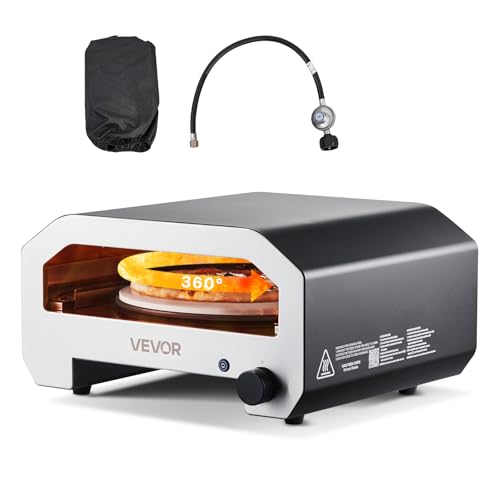
VEVOR 16-Inch Propane Pizza Oven — Big Stone, Rotating, Bagged
VEVOR’s propane entry combines the two features that headline two different rivals: the HALO’s rotating stone — here described as electric rotation — and a 16-inch format, in a portable body with a thickened pizza stone and a carry bag included. Read the title closely and the proposition assembles itself: a big oven that turns its own stone, packs into a bag, and goes outside — the title names the backyard, the patio and camping as its habitats. The thickened stone is the quiet specification in the list; thickness is stored heat, and stored heat is what keeps the third and fourth pizzas of a session baking like the first.
The electric rotation deserves a clarifying sentence, because it defines the oven’s one logistical quirk: the stone’s motor needs electricity, so this propane oven also wants access to power for its rotation feature — a battery, a campsite hookup, a patio socket. At home that is a triviality; at a truly remote pitch it is a planning item, and it is the honest difference between this oven’s portability and the Tread’s self-contained kind. Buyers who bake mostly on patios will never feel it. Buyers who bake at the end of a dirt track should weigh it before, not after.
As with the HALO and the Mimiuo, the VEVOR’s title states no maximum temperature, and our spec box leaves that line to the product page rather than inventing a figure. What is stated is enough to place it: the largest rotating-stone format in this list, a bag to carry it in, and a stone thickened for session-long work. For a household that wants rotation and 16 inches without giving up portability entirely, it is the only pick that offers all three at once.
Compare the VEVOR’s carrying proposition with the Mimiuo’s, because the two bags-and-kits philosophies diverge. The Mimiuo packs small and light — 12 inches, 33 lbs, everything nested. The VEVOR packs big: a 16-inch oven is a substantial object even bagged, and its journeys will be car journeys, tailgate journeys, the short carry from boot to pitch. That is not a criticism; it is a sizing of the promise. A family whose pizza travels happen at campsites they drive to gets the large rotating stone without the stationary commitment, and the bag keeps the oven clean and contained in the garage between trips. Portability has degrees, and this oven occupies the vehicular one honestly.
- Stone: 16-inch, thickened pizza stone
- Rotation: electric stone rotation — plan a power source for the motor alongside the propane
- Fuel: propane gas
- Included carry gear: carry bag
- Maximum temperature: not stated in the listing title — verify on the product page if a figure is essential
- To buy: the VEVOR 16-Inch Propane Pizza Oven listing on Amazon is the place to check price on Amazon
Strengths
- Rotation and 16-inch capacity in one portable oven.
- Thickened stone holds heat across a long session.
- A carry bag is included for storage and transport.
Trade-offs
- Electric rotation needs a power source as well as propane.
- No maximum temperature stated in the title.
- A 16-inch portable is still a two-handed carry.
Best for: patio hosts who want a big, self-turning stone that can still travel. Not suited for: off-grid campers, who should take the Tread instead.
Six Propane Ovens, Compared on Stone, Heat Claims and Carrying
| Oven | Stone | Stated heat claim | Portability cue |
|---|---|---|---|
| HALO Versa 16 | 16-inch, rotating | None stated in title | Patio oven with dual burner system |
| Gozney Arc XL | 16-inch, removable 0.8-inch floor | Up to 950F | Stationary flagship |
| Gozney Roccbox | 12-inch | Up to 950F | Portable, compact, low-profile |
| Gozney Tread | 12-inch | Up to 950F; 15-minute heat-up | Lightweight and rugged, built to carry |
| Mimiuo 12-Inch Gas Pizza Oven | 12-inch, included with peel and cover | None stated in title | 33 lbs, complete travel kit |
| VEVOR 16-Inch Propane Pizza Oven | 16-inch, thickened, electric rotation | None stated in title | Carry bag included |
Read the heat column of that table as the roundup’s honesty in miniature. Three ovens state a ceiling and three do not, and the three that do not are not thereby cooler, weaker or worse — the HALO’s rotating evenness and the VEVOR’s thickened stone are real virtues that happen not to be temperature figures. What the blank cells mean is narrower: if a printed ceiling is the evidence your purchase requires, the titles of the HALO, the Mimiuo and the VEVOR will not supply it, and the product page or the manufacturer must. A buyer who understands that distinction can shop this category without being either gullible or cynical, which is the exact reader this guide was written for.
Why Does Propane Suit Pizza Better Than Any Other Portable Fuel?
Propane’s virtue is obedience. It lights the moment you ask, holds the setting you choose, and shuts off the second the session ends — no fire to build, no coals to judge, no burn-down to wait through before the oven can be packed. For pizza specifically, that obedience matters because the bake is a heat-management exercise: the stone must soak, hold, and recover between pies, and a fuel that answers the dial precisely makes the stone’s behaviour predictable. A cook learning a propane oven is learning one variable, the oven itself. A cook learning a wood oven is learning two, and the second one is alive.
The logistics are equally plain. A propane tank is sealed, shelf-stable, refillable almost anywhere, and shared with the household’s other outdoor equipment — the same fuel that feeds the grills beneath the chambers in our guide to Best Pizza Ovens for Grills, and half the patios in the country. There is no ash to dispose of, no sparks to manage near a campsite’s dry grass beyond ordinary burner sense, and no flavour argument to settle: propane bakes cleanly, and the pizza tastes of its dough and toppings. Cooks who want smoke in the crust are shopping for a different fuel on purpose, and this guide respects that choice by not pretending propane provides it.
Rotating Stone or Hand-Turned: Which Bake Should You Choose?
The case for rotation is consistency without skill. A turning stone — the HALO’s, the VEVOR’s — presents every edge of the pizza to the hot side of the oven in turn, evening out the bake automatically. Beginners get round, evenly coloured pizzas from their first session; hosts get to stand upright and talk. The case against is mechanical: a motor and a rotating assembly live inside or beneath a very hot box, they need cleaning and power (explicitly, in the VEVOR’s electric design), and they are one more system between you and a working oven five years from now.
The case for hand-turning is the opposite virtue: nothing to break, and a skill that transfers to every oven you will ever use. A quarter-turn with a small peel, twice during the bake, is the whole technique, and within a few sessions it is muscle memory. The stationary-stone ovens here — all three Gozneys and the Mimiuo — assume that small ritual and reward it. Choose rotation if your pizza nights are social events where the oven is one attraction among several; choose a fixed stone if the bake itself is the event and your hands are happily occupied. Neither choice is the amateur one; they are different allocations of attention.
How Do You Run a Propane Pizza Oven Session, Start to Finish?
Begin with the tank, not the dough. Check the connection, open the valve, and leak-test with soapy water if the setup has been disturbed — bubbles are information you want before ignition, not after. Set the oven on a stable, level, non-combustible surface with clearance behind it for the heat’s exit path, light the burner as the manufacturer directs, and give the stone its full heat-soak: the Tread’s title promises readiness in 15 minutes, and the heavier stationary ovens deserve longer, whatever the air near the burner feels like. A stone is ready when it has soaked, not when the flame looks impressive.
During the session, work like the deck-oven cooks: next pizza built while the current one bakes, one confident launch, one turn if your stone is fixed, and a closed door or averted face between peeks. Between pizzas, let the stone recover for a minute or two with the burner up — consecutive cold doughs drain a stone faster than any burner refills it, and pacing is the difference between a session that improves and one that fades. At the end, burner off, valve closed at the tank, and the oven left to cool where it stands; stones are brushed dry when warm, never washed hot, and covers go on only once the metal is cold enough to hold a hand against. Readers who run the rest of the outdoor fleet with the same patience — the low-and-slow discipline behind our guide to Best Vertical Charcole Smokers — will recognise the mindset: fire equipment rewards owners who follow a sequence and punishes those who improvise one.
Two quiet habits protect both the bake and the equipment between sessions. The first is hose discipline: route the gas hose so it never drapes across the oven’s hot rear panel or rests against the body, coil it loosely rather than kinking it when the oven is packed away, and store it out of direct sun, because ultraviolet light ages a rubber hose faster than ordinary use does. The second is thermal patience at the end of the session — let the burner run for a minute after the last pizza leaves, burning off the drips and splashes while the stone is still hot enough to carbonise them, then shut down and let the stone’s stored heat finish the cleaning for you. An oven closed up clean and cool is an oven that lights next time without surprises, and a hose stored kink-free and shaded is one that will not crack at the fitting on the coldest morning of the year.
What Mistakes Do First-Time Propane Oven Owners Make?
The first is believing the bake-time headline. Sixty-second claims describe a thin pizza in a fully soaked oven at maximum heat; a first session’s pizzas, launched onto a half-soaked stone with generous toppings, will take several minutes, and there is nothing wrong with the oven. The second mistake is the opposite of patience at the other end — packing the oven away warm, cover on, stone still holding heat, which cooks the cover and traps moisture against the metal. The third is tank management: the household bottle borrowed from the grill, discovered empty mid-session, with the dough already stretched. Propane’s convenience is real only for owners who keep a spare or a gauge.
Two category-specific mistakes complete the list. One is buying portable and baking stationary — paying the Tread’s travel premium for an oven that never leaves the patio, where the Arc XL would have served better. The other is buying stationary and dreaming of travel, then attempting one heroic carry of a flagship oven that ends the experiment and possibly the oven. The six picks here are honest about which life each is built for; the buyer’s job is the matching honesty about their own.
Twelve Inches or Sixteen: What Size Propane Oven Should You Actually Buy?
The size question in this category is really two questions wearing one coat. The first is about the pizza: a 12-inch oven bakes the personal and medium pies that most households actually eat, while a 16-inch oven bakes the big sharing pie that anchors a party. The second is about the oven’s life: 12-inch models here are the portable ones — Roccbox, Tread, Mimiuo — and 16-inch models are the patio ones, with the VEVOR straddling the line by bagging its big stone for car travel. Choosing a size is therefore also choosing a habitat, and buyers who answer the habitat question honestly usually find the size has chosen itself.
There is a dough-handling truth that cuts against the bigger-is-better instinct. A 16-inch pizza is a genuinely harder object to stretch, top and launch than a 12-inch one; its centre sags, its rim tears, and its launch demands a wide peel and a steady nerve. Many households buy sixteen inches, bake twelve-inch pizzas in the middle of the stone for a year, and would have been equally served — and better travelled — by the smaller oven. Buy the sixteen for the parties you truly host, not the one you describe. The stone you use fully beats the stone you admire.
How Should You Set Up a Propane Oven Safely Outdoors?
Site the oven like a small fireplace, because that is what it is. A level, stable, non-combustible surface; clearance on every side and especially behind, where the heat exits; nothing overhead that a season of heat would damage; and the tank positioned as the hose naturally allows, valve accessible, never tucked beneath the oven’s hot underside. On a patio that means a proper stand or a stone-topped table rather than the wooden bench that happens to be nearby. At a campsite it means the flattest ground you can find, upwind thinking, and a surface that will not scorch the site you are borrowing.
Wind is the variable new owners underestimate. A crosswind leans a burner flame, cools one side of the oven, and can make a normally even bake lopsided; it also carries heat toward whatever stands downwind. Turning the oven’s back to the wind, or sheltering it with a windbreak that keeps its distance, restores the behaviour the specifications promise. Finally, build the shutdown into the setup: know where the tank valve is without looking, keep a clear path to it, and let the habit form on the first session rather than the tenth. Propane’s safety record in this category is excellent precisely because its rituals are simple — the failures belong to improvisation.
What Does a Season of Ownership Look Like for a Propane Pizza Oven?
The first month is calibration. Every oven in this list has a temperament — a hot side, a favourite setting, a stone that wants a longer soak than the manual admits — and the owner’s job is to learn it with cheap dough and close attention. Pizzas improve weekly, not because the oven changes but because the cook’s map of it sharpens. By the second month, most owners have a house style: a dough weight, a sauce thickness, a launch-and-turn rhythm, and a short list of toppings that behave. This is the phase the ovens were designed for, and it is quietly delightful.
The rest of the season is maintenance and rhythm. Stones get brushed, burners get checked for the spider nests and debris that outdoor gas appliances collect, connections get their soapy-water test after every tank change, and covers — the Mimiuo’s included one, or an equivalent for the others — go on cold ovens without exception. Owners who keep those small rituals find their oven identical in October to the one they unboxed in May. Owners who skip them meet the failures in the mistakes section above, one at a time, in an order that feels like bad luck and is not.
Which Accessories Does a Propane Oven Owner Actually Need?
Fewer than the internet suggests, and the list starts with the peel. A launching peel sized to your stone — metal for sliding under a baking pizza, wood or composite for building and launching if you prefer its release — is the one tool no propane oven session survives without, which is why the Mimiuo’s inclusion of one matters and why the other five picks assume you will source your own. A small turning peel is the second tool, and for fixed-stone ovens it is nearly as essential: it rotates the pizza without removing it, keeping the door closed and the heat banked.
Beyond the peels, the honest list is short. An infrared thermometer, pointed at the stone, replaces guesswork about readiness with a number and pays for itself in saved first-pizzas. A long-handled brush keeps the stone clean between bakes. A cover — included with the Mimiuo, an accessory for the rest — protects the oven’s storage life. Heat-proof gloves that reach the forearm make handling a hot oven door and a hotter peel a calm activity instead of a daring one. Everything beyond that list is enthusiasm, which is a fine thing to spend on, provided it is recognised as enthusiasm rather than necessity.
How Do Propane Ovens Behave in Cold or Windy Weather?
Cold weather lengthens everything except the bake’s quality. The stone takes longer to soak, the oven burns more gas holding its temperature against the chill, and the cook learns to add minutes to the preheat rather than degrees to the dial. None of the six ovens here is disqualified by winter — propane burners are indifferent to the cold in a way that charcoal, with its reluctant lighting, is not — but the session’s economics change, and a household that bakes year-round in a cold climate should weight the stationary, well-insulated end of this list, the Arc XL’s territory, more heavily than the expedition end.
Wind, as the setup section warned, is the subtler enemy, because it attacks the bake’s evenness rather than its temperature. A rotating stone quietly compensates for a wind-leaned flame, which is one more argument for the HALO and the VEVOR in exposed gardens; a fixed-stone oven asks the cook to turn the pizza more often and forgive a little asymmetry. Either way, the answer is positioning first and equipment second: an oven sited out of the wind’s main path behaves like the oven in the specifications, and no burner design fully substitutes for a sheltered corner.
Final Recommendation
Let habitat decide. A permanent patio with a committed cook belongs to the Arc XL, the fullest-specified oven here. A household that bakes at home and away, in one oven, belongs to the Roccbox on its gas burner. A genuinely travelling cook belongs to the Tread, the only oven designed around the journey. A beginner who wants the whole station in one box belongs to the Mimiuo, and a host who wants the stone to do the turning should choose between the HALO’s dual-burner patio design and the VEVOR’s bigger, bagged, thick-stoned take on the same idea. Propane’s promise is pizza anywhere with the fire under your control — pick the oven whose idea of “anywhere” matches yours, and the tank will do the rest.
Frequently Asked Questions
How long does a propane tank last in a pizza oven?
It depends on the burner’s appetite and your session length, and none of these titles states a consumption figure, so we do not invent one. In practice a standard household tank serves many pizza sessions; the discipline that matters is checking the level before a session and keeping a spare for party nights. What you can control is the burner’s duty cycle: an oven held at full blast through a long party draws far more gas than one turned down between pizzas, so easing the flame back during gaps in the session is the easiest way to stretch a tank. Weighing the bottle before a big session, or fitting a simple gauge, removes the guesswork entirely.
Is the Roccbox really a propane oven if it also burns wood?
Yes. Its integrated gas burner is a complete primary fuel system, and that is the configuration reviewed here. The wood burner is an optional alternative the title mentions; owners who never fit it still own a full propane oven, which is why the Roccbox belongs in this guide.
What is the difference between the three Gozney models?
Habitat and size. The Arc XL is a stationary 16-inch oven with a digital display and a thick removable stone floor. The Roccbox is a portable 12-inch oven, dual-fuel, built to store and travel. The Tread is a lightweight, rugged 12-inch oven with a stated 15-minute heat-up, built to be carried to where the baking happens.
Do rotating-stone ovens really bake more evenly?
Rotation removes the main cause of unevenness — one side of the pizza sitting beside the burner for the whole bake — so yes, the bake evens out without the cook’s intervention. The trade is a mechanism to maintain and, on the VEVOR, a motor that needs electric power alongside the propane.
Can I use a propane pizza oven on a wooden deck or table?
Follow the manufacturer’s clearances for your specific model, and treat them as minimums. These ovens radiate serious heat downward and backward; a stable, level, heat-resistant surface with space behind the oven is the safe default, and no pizza is worth improvising around that.
Do I need a special propane tank or regulator for these ovens?
These ovens are built around the standard household propane bottle and the regulator supplied or specified by each maker; use the fitting the manufacturer provides rather than adapting one from another appliance. If a listing or manual specifies a regulator type, treat that specification as part of the oven, and replace a damaged hose or regulator with the correct part before the next session, not after it.
Related Guides
If reading about propane’s clean, obedient heat has instead sharpened your appetite for flame and smoke, the natural next read is our guide to Best Wood-Fired Pizza Ovens, where the fire is the ingredient rather than the utility.


