What's inside
- Key Takeaways
- Quick Picks
- How We Chose These Picks
- Comparison Table
- Why Does Fine Hair Collapse by Midday, and Can a Dryer Prevent It?
- How Do You Dry Fine Hair for Volume Without Frizz?
- Which Settings Should Fine and Thin Hair Start With?
- How Does Hair Length Change the Fine-Hair Drying Brief?
- What Is the Best Way to Dry a Fine Fringe and Hairline?
- What Mistakes Flatten or Fry Fine Hair Most Often?
- How Should Fine Hair Be Dried in Humid or Dry Climates?
- Why Do Fine-Haired Users Replace Dryers for the Wrong Reasons?
- How Do You Maintain a Dryer So Its Low Settings Stay Honest?
- What Does a Week of Volume-First Drying Teach a New Owner?
- How Can Thin Hair Be Dried to Look Its Fullest at the Parting?
- Why Is Air-Drying Alone Rarely the Answer for Fine Hair?
- Final Recommendation
- Frequently Asked Questions
- Related Guides
As an Amazon Associate I earn from qualifying purchases. This post may contain affiliate links at no extra cost to you.
cottageverdict.com is reader-supported. When you buy through links on our site, we may earn an affiliate commission.
Where to buy: the six dryers below are sold through Amazon, and each linked name opens that model’s listing, where you can check price on Amazon and confirm its weight, settings and attachments before ordering. Hunting for the best blow dryers for fine, thin hair means unlearning most dryer advice, because fine hair breaks the usual rules in both directions at once. It dries fast — a blessing — yet it is flattened by the very airflow that dries it, scorched by heat settings that thicker hair shrugs off, and weighed down by tools built like gym equipment. The winning dryer for this hair type is therefore a study in moderation: light in the hand, moderate in its heat, precise in its airflow, and clever enough to build volume instead of ironing it away.
Fine and thin are related but not identical, and this guide serves both. Fine describes each strand’s narrow diameter — hair that heats through quickly and wilts under heavy product or heavy air. Thin describes density — fewer strands per head, so the scalp shows through when styling collapses and every broken hair is a visible percentage of the whole. Many readers have both, and all of them share the same shopping conclusion: control at the low end of every dial matters more than power at the top of any of them.
Volume is the other half of the brief, and it is a drying problem before it is a product problem. Fine hair dried downward, hot and fast, will lie flat no matter what mousse promised; the same hair dried with lifted roots, moderate warmth and a cool finish can hold body for hours. The six dryers here were chosen because their weight, heat character and attachments make that volume routine physically easy — several weigh remarkably little, and none requires a bodybuilder’s shoulder to hold at crown height while the roots set.
Key Takeaways
- Lightness is a styling feature on fine hair: a dryer held high at the roots without fatigue is a dryer that builds volume.
- Moderate, even heat beats maximum heat — fine strands heat through in seconds and scorch just as quickly.
- The two Shark systems were tuned for fine-to-medium hair explicitly, a rare admission in a power-obsessed category.
- The BaBylissPRO Nano Light weighs under a pound, making it the easiest tool here to keep aloft during root work.
- Strong airflow is a double-edged tool: used at the roots it lifts; blasted down the lengths it flattens and tangles.
- A cool finish matters disproportionately on fine hair, because its styles set — and collapse — faster than any other type.
Quick Picks
| Pick | Badge | Why it made the cut |
|---|---|---|
| Shark SpeedStyle Hair Dryer HD331 | Best fine-hair styling system | Three tools tuned for fine-to-medium hair, including a gloss finisher that smooths without flattening. |
| Shark SpeedStyle Pro Ionic Hair Dryer HD731 | Fastest volume routine | High-velocity air and a QuickSmooth brush build sleek volume quickly on fine-to-medium hair. |
| BaBylissPRO Nano Light High-Speed Dryer | Lightest tool in the guide | Under one pound with a 1400W brushless motor and three attachments — root work without arm fatigue. |
| slopehill Professional Ionic Hair Dryer 1800W | Gentle professional control | Moderate 1800W ionic power, two concentrators for root direction and a quiet, calm delivery. |
| Conair Double Ceramic Hair Dryer 1875W | Even heat at a friendly level | Double ceramic spreads warmth so fine hair dries without hot spots, with diffuser and concentrator included. |
| High-Speed Ionic Blow Dryer 180000 RPM | Display-guided precision | A 180,000 RPM brushless motor with an LED display, so the gentle setting you chose is the one you get. |
How We Chose These Picks
Weight was measured first, in spirit if not on a scale, because fine-hair styling is done with the dryer raised — at the crown, at the roots, upside down — and a heavy tool quietly trains its owner to skip exactly the positions that create volume. Listings that published a light weight or a compact format scored immediately, and the under-a-pound BaBylissPRO entry set the standard the others were judged against.
Heat character came next. Fine strands reach styling temperature almost instantly, so the guide favoured even delivery — ceramic, carefully managed high-speed air, moderate professional platforms — over raw maximum heat, and looked for low settings that remain useful rather than token. Airflow was assessed as a volume instrument: enough precision, via good concentrators or directed tools, to lift roots and set direction, without so much undirected blast that lengths tangle into a fine, knotted halo.
Finally, every pick had to respect fine hair’s economics of breakage. With fewer, narrower strands, each snapped hair is a larger loss, so ionic finishing that reduces rough handling, tools that combine drying with smoothing in one pass, and displays or simple controls that prevent accidental full-heat blasts all counted as protective features. All six models were verified through the retailer’s catalogue data for their stated tuning, attachments and motor types.

Shark SpeedStyle Hair Dryer HD331 — Best fine-hair styling system
Most dryers tolerate fine hair; the HD331 was designed around it. Shark tunes this SpeedStyle for fine-to-medium hair explicitly, and its three tools map onto the fine-hair routine with unusual precision: the Turbo Concentrator for directed root work, the QuickSmooth Brush for drying lengths smooth without a separate brush-and-dryer juggling act, and the RapidGloss Finisher for a final pass that adds shine while the hair stays lifted rather than pressed flat. That last distinction — gloss without flattening — is the one fine-haired users have wanted from finishing tools for years.
The system’s speed serves volume in a counterintuitive way. Because fine hair dries quickly, the danger is rarely under-drying; it is over-drying the lengths while chasing the roots. A fast, focused tool lets the user work section by section, setting each one cool before moving on, so the roots get their full lift while the ends receive only the brief warmth they need. Wet-to-dry speed, in this hair type, is really about sequencing, and the HD331’s tool-swapping makes the sequence effortless.
Its costs are the system’s costs: proprietary attachments, a price at the top of this guide’s band, and a learning curve of a few sessions while the three tools sort themselves into a personal routine. Fine hair that is also very short may find the full kit more than the job requires. But for the classic fine-hair ambition — smooth lengths, lifted roots, shine that survives past noon — nothing else here assembles the whole answer in one box.
The compact body also deserves credit in this category specifically. Held upside down for root drying — the position fine hair loves and arms hate — the HD331 stays manageable long enough to finish the crown properly, and that endurance, multiplied across every wash day, is where its volume advantage actually comes from.
- Tuning: designed for fine-to-medium hair
- Tools: QuickSmooth Brush, Turbo Concentrator, RapidGloss Finisher
- Promise: ultra-fast wet-to-dry with less frizz
- Finish: gloss pass that preserves lift
- Format: compact high-velocity body
Strengths
- Purpose-tuned for this exact hair type
- Finisher adds shine without flattening volume
- Fast sequencing protects ends from over-drying
Trade-offs
- Proprietary tools and top-of-guide pricing
- Three tools mean a short learning curve
- Very short hair needs only part of the kit
Best for: fine hair wanting smooth lengths and lasting lift. Not suited for: minimalists who only rough-dry.
Partners and family sharing the bathroom should note how the HD331 reframes the morning queue: because fine hair dries so quickly under it, the fine-haired user’s total occupation of the mirror shrinks to minutes, which is a domestic virtue no specification sheet records. The Shark SpeedStyle Hair Dryer HD331 thus earns its counter space twice — once in the mirror, where the lift lasts, and once in the household, where the queue does not form.

Shark SpeedStyle Pro Ionic Hair Dryer HD731 — Fastest volume routine
The Pro version takes the same fine-to-medium brief and adds velocity. With airflow in the up-to-100 MPH class, the HD731 dries fine hair almost as fast as the user can section it, and its QuickSmooth Brush turns that speed into sleek volume: lengths dry smooth under the brush’s guidance while the roots, worked first with the Turbo Concentrator, keep the lift that fine hair usually surrenders by mid-morning. The listing’s promise of sleek, high-shine volume is, for once, a description of the mechanism rather than a hope.
A scalp-shield design note in the listing matters for thin hair in particular. Where density is low, powerful air reaches skin with little hair in the way, and a system that acknowledges the scalp’s comfort encourages the close root work that volume requires. Ionic output handles the static that fine hair generates so enthusiastically in dry weather — the flyaway halo that makes thin hair look thinner by scattering its outline.
Velocity is a commitment, though. Fine hair tangles enthusiastically under strong air pointed the wrong way, so this dryer rewards users who dry downward along the shaft and keep sections tidy; chaotic blasting will produce a bird’s nest at record speed. It also shares the family’s proprietary-tool economics. For disciplined users with fine-to-medium hair who want the morning done quickly and the volume to outlast the commute, it is the sharpest tool in this guide.
There is a confidence effect worth noting: fine hair that reliably holds its style gets handled less across the day — less re-brushing, less emergency product, fewer hot-tool rescues — and that gentler total routine is its own form of protection for strands that cannot spare casualties.
- Tuning: fine-to-medium hair, ionic system
- Airflow: high-velocity, up to 100 MPH class
- Tools: Turbo Concentrator and QuickSmooth Brush
- Design note: scalp-shield brief for low-density hair
- Promise: sleek, high-shine volume
Strengths
- Fastest route to smooth, lifted fine hair
- Brush tool merges drying and smoothing
- Ionic finish tames thin hair’s static halo
Trade-offs
- Strong air tangles undisciplined technique
- Proprietary attachments only
- More system than very short styles need
Best for: fine-to-medium hair wanting quick, lasting volume. Not suited for: carefree blasting in every direction.
Fine hair that is also long will appreciate one specific mercy of the Pro’s speed: the ends, which are the oldest and most fragile part of the head, spend the least time under heat precisely because the whole session compresses. Long fine hair usually suffers the opposite arithmetic — length multiplies minutes — so a tool that breaks that multiplication changes the hair’s prospects across a year of mornings, not just its appearance before breakfast.
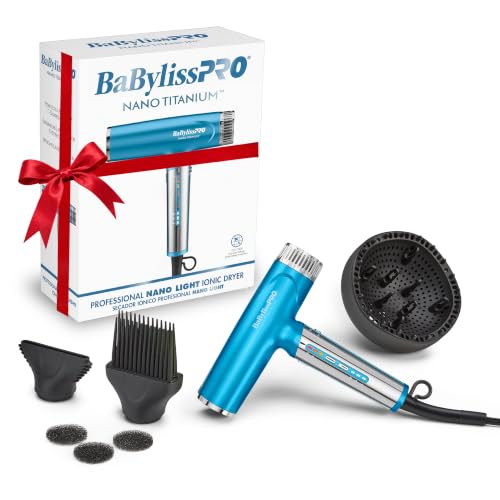
BaBylissPRO Nano Light High-Speed Dryer — Lightest tool in the guide
Under one pound is not a statistic on fine hair; it is the whole styling strategy. Root lift is built with the dryer held above and against the head’s curves, often inverted, for minutes at a time — and the Nano Light is the tool least likely to make an arm quit before the crown is finished. Its 1400W brushless high-speed motor dries by air velocity rather than by heavy heat, a character that suits fine strands twice over: less thermal stress per section, and a body that can stay in the volume-building positions as long as the style needs.
BaBylissPRO describes it as the lightest, smallest and most powerful dryer it has made in this class, and includes three attachments, so the travel-sized body does not mean a travel-sized repertoire. Ionic output keeps the finish smooth, and the professional badge behind it reassures buyers who have been burned by featherweight dryers that were merely weak. This one is light the way a racing bicycle is light — by engineering, not by omission.
Its limits mirror its virtues. Absolute heat for a heavy smoothing session is not its brief, and the thickest hair in a household will claim other dryers first. Compact controls take a session to learn. But judged on the fine-thin brief alone — moderate heat, minimal weight, professional finish — it is arguably the purest answer in the guide, and the one most likely to still be used with pleasure in five years, because tools that do not tire their owners do not get replaced.
Travellers with fine hair will recognise a second gift: hotel dryers are at their worst on this hair type, all blast and scorch, and a dryer this small finally makes bringing your own the obvious choice rather than a packing indulgence.
- Weight: under 1 lb, lightest here
- Motor: 1400W high-speed brushless
- Attachments: three included
- Technology: ionic output for smooth finish
- Colour: blue, travel-ready format
Strengths
- Featherweight body enables real root work
- Airflow-led drying limits heat stress
- Professional build in a travel size
Trade-offs
- Not a heavy-heat smoothing specialist
- Thick household hair will outgrow it
- Compact controls need familiarisation
Best for: fine hair, long routines, travel and tired arms. Not suited for: households centred on thick, coarse hair.
There is a posture benefit hiding inside the featherweight design. Root work with a heavy dryer tends to pull the shoulders up and the head down, a hunch that worsens as arms tire; with the BaBylissPRO Nano Light High-Speed Dryer the head can stay level and the dryer does the travelling, which sounds like ergonomics and feels like a noticeably better morning. Owners with any neck or shoulder sensitivity should treat that difference as a headline feature, not a footnote.

slopehill Professional Ionic Hair Dryer 1800W — Gentle professional control
Where the Sharks pursue systems and the BaByliss pursues lightness, the slopehill pursues aim. Its two concentrator nozzles — the kit detail that earned it a place here — let fine hair be dried with unusual precision: the wider nozzle for a gentle general pass, the narrower one for setting root direction section by section, which is where volume is actually manufactured. At 1800W its power sits in the moderate band fine hair prefers, strong enough for a timely session, disinclined to bully.
Ionic conditioning addresses fine hair’s other daily enemy, the static halo that scatters its silhouette and makes density look lower than it is. The included diffuser, meanwhile, serves the wavy end of the fine-hair spectrum, lifting soft waves without blowing them into fluff. Low-noise running rounds out a profile that feels considered rather than extreme in any direction — a professional temperament at a home scale.
The reservations are the familiar ones for this capable brand: a shorter track record than the heritage names and a support network to match. Its settings will not dazzle users who want displays and six-way spreads. But for the fine-hair owner whose main needs are direction, calm and moderation — and whose hair is straight or nearly so — the slopehill’s nozzle discipline may serve better than any system, because volume on straight fine hair is built at the root, one aimed section at a time.
It is also the easiest dryer here to share with a partner whose hair is medium rather than fine: nothing about its tuning excludes them, and the diffuser keeps wavy guests happy too. Versatility with a gentle centre of gravity is a rare combination, and this dryer holds it quietly.
- Power: 1800W ionic, moderate professional band
- Attachments: two concentrators and a diffuser
- Noise: low-noise design
- Focus: root direction and calm finishing
- Colour: black finish
Strengths
- Twin concentrators build volume at the root
- Moderate power suits fine strands
- Diffuser covers fine wavy hair too
Trade-offs
- Shorter brand history than legacy rivals
- No display or wide setting spread
- Support channels thinner than biggest brands
Best for: straight fine hair needing root direction and calm air. Not suited for: users wanting a full styling system.
Short fine hair — bobs, crops, the growing-out phase — may be this dryer’s sweetest spot of all. Sessions last minutes, the narrow concentrator sets a parting or a fringe with surgical calm, and the moderate heat band means the whole job can be done without ever approaching the settings that fine short hair fears. It is the rare professional-style tool whose virtues scale down as gracefully as they scale up.

Conair Double Ceramic Hair Dryer 1875W — Even heat at a friendly level
Fine hair’s intolerance for hot spots is the Conair’s founding argument. Double ceramic construction spreads heat across the airstream, so the section nearest the nozzle does not receive a scorching core while the edges stay damp — an unevenness that fine strands, heating through in moments, experience as damage at the centre and dampness at the fringe simultaneously. With the heat composed, 1875W becomes usable rather than frightening: the user can select a moderate setting and trust it.
The kit supports both of fine hair’s styling moods. The concentrator directs air for root lift and smooth lengths; the diffuser, described in the listing as enhancing curl definition, serves fine wavy hair that wants encouragement rather than discipline. Ionic conditioning calms the frizz and static that make fine hair look frazzled, and Conair’s familiar control layout means the settings a nervous user needs — the low ones — are found by touch within the first session.
Nothing about it chases the modern extremes: the motor is conventional, the body is a classic full size, and there is no brushless velocity story to tell. Its weight, while ordinary, is the most noticeable here during long inverted root sessions. What it offers instead is the most affordable route in this guide to genuinely even heat from a brand with deep support — a combination that has quietly served fine hair in millions of bathrooms, and continues to earn its place on evidence rather than novelty.
For households where the fine-haired user shares with thicker-haired family, it is also the least specialised compromise: turned up, it is a perfectly capable family dryer; turned down, its ceramic evenness keeps faith with the finest head in the house.
- Heating: double ceramic for even spread
- Power: 1875W with ionic conditioning
- Attachments: diffuser and concentrator included
- Focus: frizz smoothing and curl definition
- Brand: long-established, widely supported
Strengths
- Even heat protects quick-heating fine strands
- Familiar controls suit cautious users
- Affordable entry with full attachment kit
Trade-offs
- Heaviest feel here on long root sessions
- Conventional motor, no high-speed option
- Classic styling rather than compact format
Best for: budget-conscious fine hair needing even, trustworthy heat. Not suited for: weight-sensitive users and travellers.
Budget realism deserves its paragraph. Fine hair does not need exotic machinery; it needs even heat, honest low settings and attachments that exist. The Conair Double Ceramic Hair Dryer 1875W delivers exactly those three things at the most accessible level in this guide, which makes it the rational first purchase for anyone still discovering whether a careful routine suits them — with the Sharks and the Nano Light waiting as upgrades whose benefits the user will by then understand precisely.

High-Speed Ionic Blow Dryer 180000 RPM — Display-guided precision
Fine hair lives and dies by small differences — one heat step too many, one blast too close — and this dryer’s signature feature is knowing exactly where you stand. Its LED display reports the working settings at a glance, which turns the careful low-heat routine from a memory test into a visible fact: the gentle configuration you chose is confirmed before the air reaches a fragile fringe, every single time. Behind the display sits a brushless motor rated at 180,000 RPM, moving air fast enough that fine hair dries in brief, moderate encounters rather than long bakes.
Magnetic attachments suit this hair type more than marketing suggests. Swapping between the diffuser and concentrator with a click means the user actually performs the swap — root work with one, gentle diffusion for the wavy sections with the other — instead of skipping the second tool because the fitting fight was not worth it on a workday morning. Low-noise running, meanwhile, keeps early sessions household-friendly.
The standing reservation for unbranded high-speed dryers applies: support runs through the retailer, and the listing’s largest ionic figures are the manufacturer’s own claims. The hardware logic, however, is precisely aligned with fine hair’s needs — velocity over heat, visibility over guesswork, attachments that invite use. Buyers comfortable with the provenance trade gain the most information-rich dryer in this guide, and for hair that punishes guesswork, information is protection.
It also packs like a modern appliance should — compact body, flat-packing magnetic pieces — which makes it the natural second entry on any fine-haired traveller’s list after the Nano Light, and the first for those who want their settings in writing.
- Motor: brushless, rated 180,000 RPM
- Display: LED readout of settings
- Attachments: magnetic fitting, diffuser included
- Ionic system: high-output negative ion design
- Noise: low-noise running, travel-friendly
Strengths
- Display removes heat guesswork entirely
- Fast airflow shortens exposure for fine strands
- Magnetic swaps encourage using both tools
Trade-offs
- Unbranded support depends on retailer
- Headline ion figures are manufacturer claims
- Durability evidence still accumulating
Best for: precise users who want visible, repeatable gentle settings. Not suited for: brand-first buyers wanting heritage support.
Repeatability is the quiet gift of the display. Fine hair responds to small variables, so a routine that works on Monday should be reproducible on Friday; a dryer that shows its settings turns a good morning into a documented recipe rather than a lucky accident. Users who have ever stood in a hotel bathroom wondering why the same hair behaved differently will recognise the value instantly — consistency is a feature, and this dryer wears it on its face.
Comparison Table
| Model | Weight / format | Heat character | Volume asset |
|---|---|---|---|
| Shark SpeedStyle Hair Dryer HD331 | Compact system | Tuned fine-to-medium | Gloss finisher keeps lift |
| Shark SpeedStyle Pro Ionic Hair Dryer HD731 | Compact system | High-velocity ionic | Brush-built sleek volume |
| BaBylissPRO Nano Light High-Speed Dryer | Under 1 lb | Airflow-led brushless | Endless root-work stamina |
| slopehill Professional Ionic Hair Dryer 1800W | Standard professional | Moderate ionic | Twin concentrators aim roots |
| Conair Double Ceramic Hair Dryer 1875W | Full-size classic | Double ceramic evenness | Trusted low settings |
| High-Speed Ionic Blow Dryer 180000 RPM | Compact brushless | Display-confirmed settings | Repeatable gentle routine |
Why Does Fine Hair Collapse by Midday, and Can a Dryer Prevent It?
Collapse is usually baked in at the roots. Fine hair dried lying against the scalp takes that flatness as its set, and gravity — against which fine strands have almost no spring — does the rest by noon. Product applied to flat-set roots merely varnishes the problem. The preventative is positional: roots must dry lifted, pointing away from their natural fall, and then cool in that lifted position so the set is structural rather than cosmetic.
That is why this guide weighted lightness and root tools so heavily. A dryer that can be held inverted or angled at the crown for the full root phase — the Nano Light by weight, the slopehill by nozzle aim, the Sharks by system design — manufactures volume at the only place it can be manufactured. The cool finish then locks it. Owners who master only this sequence will extract more lasting body from any pick here than owners who buy all six and dry downward.
How Do You Dry Fine Hair for Volume Without Frizz?
Start with less product than instinct suggests; fine hair is weighed down by generosity. Work a small amount through the mid-lengths, keep heavy products away from the roots entirely, and blot the hair so the dryer begins on damp rather than dripping lengths. Dry the roots first, with the head tilted or inverted and the airflow directed upward into the root area on moderate heat, until the scalp zone feels fully dry — this phase decides the day.
Then bring the head upright and dry the lengths downward in the direction they will lie, using the concentrator or brush tool and keeping tension feather-light. Fine hair that is pulled hard while hot sets flat and breaks sooner; the goal is guidance, not stretching. Finish with the cool setting across the whole head while the hair rests in its final shape, and resist touching it for several minutes afterwards. The style fine hair wears at noon is the style it cooled into at eight.
Which Settings Should Fine and Thin Hair Start With?
Begin one notch below your instinct on both dials. Heat: the middle setting is the working ceiling for most fine hair, with the lowest reserved for fringes, hairlines and any section that already feels dry. Air: enough to move the hair, not enough to whip it — if lengths are tangling in the airstream, the air is doing styling of its own, and it has bad taste. Distance completes the trio: a hand’s breadth at the roots, more at the ends.
Adjust by evidence across a week rather than by feel in a steamy bathroom. If the hair dries in good time and holds its lift, the settings are right even if they feel modest. If it wilts within the hour, add root time, not heat. If it feels rough or looks flyaway, subtract heat and add distance before blaming the dryer. Fine hair’s feedback is quick and honest; the skill is changing one variable at a time so its messages stay legible.
How Does Hair Length Change the Fine-Hair Drying Brief?
Short fine hair wants speed and precision: the whole head dries in minutes, the fringe and parting are the entire style, and a narrow concentrator at moderate heat is practically a complete salon. Medium lengths add the volume question in full — roots must lift, lengths must stay smooth, and the two tasks want different tools in sequence. Long fine hair introduces the arithmetic of fragility: more length means more age at the ends, more minutes under heat, and more weight pulling the roots flat while everything dries.
The picks divide along that scale naturally. Short hair is served by almost everything here, with the slopehill’s aim and the Nano Light’s agility at the front. Medium hair is the Sharks’ home ground, where systems manage the root-then-length sequence elegantly. Long fine hair should weight the light bodies and the fast, moderate machines — Nano Light, display-guided brushless, Shark Pro — because every saved minute is heat the oldest hair on the head did not have to survive.
What Is the Best Way to Dry a Fine Fringe and Hairline?
The fringe is where fine hair is thinnest, most visible and most often ruined, so it gets its own protocol. Dry it first, before the rest of the head, while it is fully wet and still persuadable — a fringe that begins drying in the wrong direction during the root phase will argue for the rest of the morning. Use the lowest effective heat, a narrow stream or a small brush, and move the air side to side across the hairline rather than blasting straight down, which separates fine fringes into strings.
Then leave it alone. Fine fringes are re-wetted by steam, touched into separation by anxious fingers, and flattened by hats applied too early; the owner’s restraint in the ten minutes after drying decides more than the dryer did. If the fringe misbehaves later, a mist of water and thirty seconds of the same gentle protocol resets it — a full re-dry is almost never necessary, and the hair is spared accordingly.
What Mistakes Flatten or Fry Fine Hair Most Often?
Drying downward from the crown, because it is comfortable, is the champion error — it irons the roots into their flattest possible set before the day begins. Second is heat inheritance: using the setting a thicker-haired partner left on the dryer, which is why the display-guided pick in this guide exists. Third is the parked nozzle over the fringe, fine hair’s thinnest and most visible territory, which scorches in seconds and then refuses to lie with its neighbours for weeks.
Shopping mistakes rhyme with usage ones. Buying maximum wattage as insurance, choosing a heavy salon dryer whose weight forbids root work, and skipping attachments to save a little money all optimise for the wrong variable. So does neglecting the intake filter, whose clogging turns any dryer’s output hotter and weaker simultaneously — a transformation fine hair detects long before its owner does. Clean it monthly; fine hair will thank you in the only currency it has, which is body that survives until evening.
How Should Fine Hair Be Dried in Humid or Dry Climates?
Humidity is fine hair’s saboteur: the style leaves the bathroom correct and arrives at the street expanded and separated, because fine strands absorb atmospheric moisture quickly and unevenly. The countermeasures are completeness and cooling — hair dried thoroughly at the roots, then cooled fully in its shape, presents less thirst to the air — plus a finish that keeps hands off during the first half hour outdoors, while the set is still negotiating with the weather.
Dry climates reverse the threat toward static and brittleness. Ionic output earns its keep here, sessions should end a breath earlier than instinct suggests, and the temptation to re-dry flyaways repeatedly must be resisted — each rescue pass costs more than the flyaway did. Owners who travel between climates will find the moderate, controllable dryers in this guide adapt with a setting or two, while one-note power tools behave like the weather they were bought in and sulk in the other.
Why Do Fine-Haired Users Replace Dryers for the Wrong Reasons?
The commonest misdiagnosis is blaming the dryer for flatness that technique created: a new, more powerful dryer is bought, the same downward drying continues, and the roots set flat with greater efficiency than before. The second is chasing shine with heat — increasing temperature to force a gloss that a cool finishing pass, or the HD331’s finisher tool, would have supplied without the damage. The third is abandoning a suitable dryer during its learning curve, since fine hair reveals a tool’s character across a fortnight of settings experiments, not a single morning.
Before replacing anything, run the audit this guide implies: clean the filter, drop one heat setting, dry the roots lifted for a full week, and finish cool without touching. If the hair transforms — it frequently does — the dryer was innocent and the savings are yours. If the same flatness and frizz persist under honest technique, then shop, and shop for the variables this guide ranked: weight, evenness, low-end control, and attachments that exist for your hair’s actual ambitions.
How Do You Maintain a Dryer So Its Low Settings Stay Honest?
Fine hair depends on the truth of the low settings, and maintenance is what keeps them truthful. A clogged intake starves airflow and concentrates heat, so the gentle setting gradually becomes a harsh one while the dial insists nothing changed; monthly filter cleaning is therefore not housekeeping but calibration. Wipe attachments after product-heavy sessions, since baked-on residue near the nozzle disturbs the airstream’s shape and with it the root direction the user so carefully set.
Storage completes the calibration. A dryer that cools before it is drawer-bound, whose cord hangs or coils loosely instead of strangling the body, keeps its switches positive and its power steady — the two qualities fine hair, with its narrow margins, notices first when they fade. Treat the appliance as an instrument and it will behave as one; the hair in the mirror is the readout.
What Does a Week of Volume-First Drying Teach a New Owner?
Day one usually disappoints slightly, because hands are learning positions while eyes expect a transformation. By day three the root phase has become a habit rather than a project, and the midday mirror shows the first honest evidence — lift that was scheduled rather than accidental. By the end of the week most owners discover the pleasant arithmetic of fine hair: because it responds quickly, it also rewards quickly, and small correct repetitions compound faster than on any other hair type.
Keep the experiment clean while it runs. Same products, same order of sections, one variable adjusted at a time, and judgement reserved for the cooled result in daylight rather than the steamy bathroom’s flattering chaos. Owners who run that week properly rarely return their dryer, not because of sunk cost but because the routine has quietly become theirs — and a routine that belongs to its owner is the only kind that survives February.
How Can Thin Hair Be Dried to Look Its Fullest at the Parting?
The parting is where thinness announces itself, so it deserves tactics of its own. Dry the hair at the parting in the opposite direction to the one it will wear — roots pushed across the line while they set — then flip the section over into place once cool; the roots stand fractionally taller for having been set against their fall, and the scalp shows less. Alternating the parting’s side across weeks also helps, since hair trained to one line for years lies flattest exactly there.
Colour and cut do the rest of the work outside this guide’s scope, but the dryer’s contribution is real: complete root dryness, a cool set, and no downward blasting across the parting at the end. Owners who adopt just those three habits often find the parting question shrinking from a daily concern to an occasional one, which for thin hair is a meaningful promotion.
Why Is Air-Drying Alone Rarely the Answer for Fine Hair?
Air-drying sounds like the gentle ideal, and for the lengths it often is — but roots that dry lying flat against a warm scalp take hours to release their moisture, and fine hair emerges with its volume already surrendered and its shape decided by gravity and the pillow of the sofa. The hybrid that serves this hair type best is mostly air with a brief, deliberate dryer phase at the roots: lift and set the architecture mechanically, then let the lengths finish in peace. Several picks here, with their quick moderate air, execute that hybrid in under five minutes.
There is also the matter of the scalp’s comfort in cold weather and the simple human wish to leave the house finished. A dryer used briefly and moderately is not fine hair’s enemy; an hour of downward blasting was always the enemy, and confusing the two has denied many owners a tool that, properly ranked and properly used, gives them the one thing air never could — a say in the outcome.
Final Recommendation
Choose by the volume problem you actually have. If you style deliberately and want the complete fine-hair system, the HD331’s three tuned tools are the most thoughtful answer here, with the HD731 adding velocity for those whose mornings are truly rushed. If arm fatigue or travel rules your life, the Nano Light’s under-a-pound brushless body is the pick that will still delight you in year three. The slopehill serves straight fine hair that lives or dies at the roots, the Conair delivers even ceramic heat at the friendliest level, and the display-guided high-speed model suits anyone who wants their gentleness confirmed in writing. Whichever you choose, dry upward at the roots, moderately in the heat, and cool at the finish — and fine hair, so often described by what it lacks, will start being described by the lift it keeps.
One last encouragement belongs to owners who have made peace with flat hair for years and suspect the game is rigged against them. Fine hair’s responsiveness cuts both ways: it collapses quickly, yes, but it also learns quickly, and a fortnight of lifted roots and cool finishes can change its default behaviour more visibly than a season of effort changes thicker hair. The dryers in this guide were chosen to make that fortnight easy to complete — light enough to hold correctly, moderate enough to trust, and honest enough in their low settings to let the hair, rather than the heat, do the talking.
Measure the result the way this hair type measures everything: not in the bathroom mirror at eight, but in the lift still present at lunch, the parting that stayed quiet, the ends that did not need rescuing. When those small evidences accumulate, the dryer has done its work, and the category’s long-standing insult — that fine hair is difficult hair — can be retired in favour of the truth, which is that it was only ever waiting for tools ranked in the right order.
Budget, finally, should be allocated in this guide’s own order: first to weight and even heat, then to the attachment your routine actually uses, and only lastly to maximum performance figures you will rarely visit. Fine hair is the category where the mid-priced, well-chosen tool most often beats the flagship in daily satisfaction, because the flagship’s advantages live at settings this hair type cannot use. Spend where your hair lives — in the moderate middle of the dial — and the purchase will feel less like a gamble and more like a fitting.
Give the fitting a fair fortnight before judging it. Fine hair keeps its opinions briefly but expresses them clearly, and by the second week the mirror will have delivered a verdict more reliable than any review — including, the authors of this guide are content to admit, this one. Trust the lift that is still there at lunch; it is the only statistic that was ever really yours.
And if the fortnight surprises you — as it surprises most owners who dry upward for the first time in years — consider passing the habit along. Fine hair runs in families, and somewhere in yours is a teenager flattening their roots with a borrowed dryer right now, concluding that their hair is simply lifeless. A borrowed Nano Light, a borrowed Shark, or simply borrowed knowledge of the root-first sequence can correct that conclusion in a week, which is a better inheritance than most bathroom appliances ever provide.
Keep your own routine written somewhere unglamorous — the settings, the order, the finish — because fine hair’s successes are repeatable only when they are recorded. Memory edits; a note does not. On the mornings when everything works, that note is the difference between a style and a system, and systems are what carry hair through busy seasons when attention is scarce and the mirror is unforgiving.
One more distinction is worth carrying into the purchase: fine hair forgives a modest dryer used beautifully far more readily than it forgives a magnificent dryer used carelessly. If the budget forces a choice between the Conair’s even heat today and months of saving for a system, take the Conair and the technique — the hair will not know what it missed, and by the time an upgrade arrives you will know exactly which of its features your own routine has been asking for.
That patience — tool now, knowledge immediately, upgrade eventually — is the temperament this entire category rewards, and it is available at every price represented above. The hair does not read receipts; it reads heat, weight, direction and time. Give it the right four, in the right order, and it will repay you in the only review that matters, repeated daily at the mirror.
Start tomorrow morning, whatever dryer is currently in the drawer: roots lifted, heat moderated, finish cooled, hands off. If the day already improves, you have learned what this guide knows — and the six tools above are simply the most reliable ways to make that improvement permanent, portable and considerably more comfortable to hold.
The rest — the compliments, the photographs, the suspicion that your hair has somehow become thicker — is commentary. Enjoy it when it arrives, and credit the roots.
Credit them, too, with the discipline of the cool finish — the ten unglamorous seconds in which fine hair’s whole day is decided, and in which every dryer in this guide, used patiently, becomes an ally rather than an appliance.
Ten seconds, every morning, faithfully.
Keep the retail packaging until the routine has settled and every attachment has been tried at least twice; a tool exchanged in week one costs nothing but a trip, while a tool tolerated for a year costs a year of mornings. Fine hair, of all hair types, should never be asked to tolerate — its margins are too narrow and its rewards for the right match too immediate to accept a merely adequate fit.
Frequently Asked Questions
Is high heat ever appropriate for fine hair?
Rarely, and briefly. A short, moving pass at a higher setting can help set a stubborn root direction on otherwise healthy fine hair, but it should be the exception negotiated consciously, not the default. If a style only works at maximum heat, the style — not the hair — usually needs redesigning around moderate temperatures.
Why does my fine hair tangle while drying?
Airflow pointed upward along the lengths, or air strong enough to whip the ends, tangles fine strands almost instantly. Dry downward along the shaft, keep sections separated with clips, and lower the air before lowering your standards — a gentler stream plus a concentrator’s direction solves most tangling without any product at all.
Can a diffuser work on fine wavy hair?
Yes, with a light touch: lowest air, brief cupping, and an early stop while a whisper of dampness remains. Fine waves are easily blown straight or into fluff, so hover more than you cup, and let the wave finish setting as it air-dries. The Conair and slopehill in this guide both include diffusers suitable for the experiment.
How light should a dryer be for comfortable root work?
There is no universal number, but the practical test is positional: can you hold it inverted at your crown for two minutes without your arm negotiating an early finish? The Nano Light, at under a pound, passes for almost everyone; heavier dryers pass for shorter root phases, which is why technique — roots first, quickly — matters alongside weight.
Does ionic drying help thin hair look fuller?
Indirectly. Ionic output calms the static halo that scatters thin hair’s outline and makes density look lower than it is; hair that lies in its intended direction reads as more substantial. It will not create volume — that is built at the roots — but it stops the finish from advertising thinness that the styling had already solved.
Should fine hair be dried upside down every time?
For volume, the inverted position is the most reliable root-lifting method available, but it need not be the whole session: roots inverted, lengths upright is the pattern most owners settle into. If inversion is uncomfortable, tilting the head sideways section by section achieves much of the same lift with less drama.
Related Guides
Keep reading with Best Blow Dryers for Men for short-hair and quick-routine picks, Best Affordable Upright Freezers for budget-friendly frozen storage, and Best Affordable Under-Cabinet Range Hoods for compact kitchen ventilation.


