What's inside
- Key Takeaways
- Quick Picks
- How Did We Choose Dryers That Are Safe for Dogs, Not Just Strong?
- How Do the Six Dog Dryers Compare Side by Side?
- Why Is a Human Hair Dryer the Wrong Tool for a Dog?
- How Hot Is Too Hot When You Are Drying a Dog?
- How Do You Introduce a Nervous Dog to a Force Dryer?
- What Does a Good Drying Routine Look Like, Step by Step?
- Which Coats Need Which Kind of Airflow?
- How Do Nozzles, Hoses and Filters Change the Result?
- What Should You Make of Horsepower and Wattage Claims?
- How Do Puppies, Seniors and Anxious Dogs Change the Plan?
- Where Should You Dry a Dog, and How Should the Space Be Set Up?
- How Does Drying Fit Into the Wider Coat-Care Routine?
- What Ownership Looks Like After the First Month?
- How Do You Match One of These Six to Your Household?
- What Mistakes Do Owners Make With Dog Dryers?
- Final Recommendation
- Frequently Asked Questions
- Related Guides
As an Amazon Associate I earn from qualifying purchases. This post may contain affiliate links at no extra cost to you.
cottageverdict.com is reader-supported. When you buy through links on our site, we may earn an affiliate commission.
Where to buy: every dryer below is sold through Amazon, and the pick names in the Quick Picks table, the detailed sections and the comparison table link straight to their listings so you can check price on Amazon and read the current specification before ordering. The best blow dryers for dogs solve a problem a towel never will: a soaked double coat holds water against the skin for hours, and that damp underlayer is where hot spots, matting and that unmistakable wet-dog smell all begin.
A dedicated dog dryer is not a hair dryer with a longer hose, whatever the product photos suggest. It is a force dryer first and a heater second: a motor drives a high-velocity stream of air through a flexible hose, and that moving air physically blasts water out of the coat rather than evaporating it slowly with heat. The distinction matters for safety as much as speed, because a dog cannot tell you the air has become too hot, and a coat traps warmth against skin far more efficiently than human hair does.
The six machines in this roundup span the realistic home range, from established grooming brands that salons have used for years to newer high-output models quoting serious horsepower figures. They differ in how their heat is controlled, how many nozzles they ship with, how loud they run in a small bathroom, and how honestly their listings describe what the motor can do. Those differences decide whether bath day becomes a calm twenty-minute routine or a wrestling match your dog dreads for a week.
One warning before the picks themselves: power is the easiest number to sell and the least important one to maximise. A nervous rescue, a senior dog with thin skin, or a puppy at its first bath needs restraint, distance and patience far more than it needs maximum airflow. Read the safety sections of this guide as carefully as the product sections, because the best dryer in the world still fails if the dog will not stand near it.
Key Takeaways
- Force dryers dry by air velocity, not heat: moving air strips water from the coat, so drying stays faster and skin stays safer than with a human dryer.
- Heat on a dog dryer must be limited, adjustable or switchable off entirely; skin under a wet coat overheats quietly and quickly.
- Noise shapes the whole experience, and a gradual introduction over several short sessions beats one forced marathon every time.
- Nozzle choice is a grooming tool, not an accessory: wide nozzles move water off the body, narrow ones work legs, paws and dense undercoat.
- The PETNF listing publishes the most specific control figures here, with air speed of 25-65 m/s and heat spanning 85-140°F that can be switched off.
- Match motor strength to coat and temperament: thick double coats justify high velocity, while short coats and anxious dogs rarely need it.
Quick Picks
| Pick | Badge | Why it earns its place |
|---|---|---|
| SHELANDY Pet Hair Force Dryer with Heater | Best Established Home Grooming Pick | A long-running home grooming blower with a heater, built for owners moving up from towels and patience. |
| CHAOLUN High Velocity Dog Grooming Dryer | Best Straightforward Blower with Heat | High-velocity air plus a heater in a simple blue unit that keeps the control layout uncomplicated. |
| EGFKI Dog Dryer 5.2HP 3800W | Most Powerful Pick | The strongest figures in this group, with adjustable speed and temperature plus four nozzles for serious coats. |
| PETNF High Velocity Dog Dryer 3.2HP | Best Published Temperature Control | Published heat and speed ranges, a heat on-off switch and an undercoat comb among its four nozzles. |
| Flying Pig High Velocity Dog Grooming Dryer | Best Long-Running Brand Pick | The Flying One model from a grooming-focused brand, in purple, with a heater for finishing work. |
| High-Velocity Dog Dryer 4 Nozzles with Heater | Best for Large Dogs and Deshedding | Adjustable speed, four nozzles and a deshedding focus aimed squarely at large dogs with thick coats. |
How Did We Choose Dryers That Are Safe for Dogs, Not Just Strong?
We started from the dog outward rather than from the motor inward. A dryer earns a place here only if its listing describes a machine designed for pets: a hose-fed blower rather than a handheld human unit, heat that the design treats as an adjustable extra rather than the main event, and nozzles shaped for coats instead of concentrators shaped for styling human hair. Raw output figures were read last, not first.
Temperature control carried unusual weight in this category. Dogs overheat without obvious warning signs, their skin is thinner than ours in many areas, and ears, bellies and the insides of legs are vulnerable long before a thick back coat feels warm to your hand. Models whose listings publish an actual temperature range, or at least a heat on-off arrangement, scored ahead of models that simply promise warmth.
Noise and handling mattered almost as much, because a dryer a dog fears is a dryer that gathers dust. We looked for speed adjustment that lets an owner start low and far away, hoses long enough to keep the motor unit and its noise at a distance, and nozzle sets that let you soften the airflow for faces and ears. Finally, we favoured listings that describe grooming outcomes — undercoat removal, deshedding, thick-coat work — over listings that only shout wattage.

SHELANDY Pet Hair Force Dryer with Heater — Best Established Home Grooming Pick
The SHELANDY has been a fixture of home grooming setups long enough that many owners buy it on the recommendation of a breeder, a groomer or a forum thread rather than an advertisement. Its formula is the classic one for this category: a force blower with a heater, pushing air through a hose so the noisy motor sits on the floor while only the nozzle travels over the dog. For a household graduating from bathroom towels and a borrowed human dryer, that layout alone changes bath day completely.
In practice the SHELANDY suits the broad middle of dog ownership. It has the airflow to strip bath water out of a retriever or spaniel coat in a sensible time, yet it remains a home machine rather than a salon cannon, which keeps it manageable around dogs that are merely tolerant rather than enthusiastic. The heater helps most at the finishing stage, when the coat is nearly dry and a little warmth stops the session ending with a damp chill on a cold floor.
Use that heater with the respect this guide keeps repeating. Warm air aimed at one spot, held close, will heat skin under a thinning coat faster than your hand on the surface suggests. Keep the nozzle moving, check the belly and ear leather with your palm every minute or so, and drop to unheated air for the last pass on any dog that pants, shifts or tries to sit down mid-session.
One underappreciated strength of an established design is predictability of supply: hoses split, nozzles wander off, filters wear, and a model that has sold for years tends to have replacements findable when you need them. That matters more than a novelty feature, because a dryer usually fails at the exact moment a wet dog is standing in the bath. Buying into a mature product line is, in this category, a form of insurance.
- Type: hose-fed force dryer with heater
- Colour in listing: blue
- Positioning: groomer-partner home blower
- Best matched coat: medium to thick single and double coats
Strengths
- Proven home-grooming layout with the motor kept away from the dog.
- Heater adds finishing comfort once most water has been blasted out.
- A familiar, widely owned design that groomers readily advise on.
Trade-offs
- Listing gives less published detail on exact heat range than the PETNF.
- Force dryers of this style are never quiet, whatever the room size.
- Very dense northern-breed coats will still test its patience and yours.
Best for: owners of medium and large coated dogs who want the established, no-drama route into force drying.
Not suited for: highly noise-sensitive dogs in tiny flats, where any blower needs a slower introduction plan.

CHAOLUN High Velocity Dog Grooming Dryer — Best Straightforward Blower with Heat
The CHAOLUN keeps its pitch refreshingly plain: high-velocity air, a heater, a blue housing, and a job to do. There is no app, no styling language borrowed from human salons, and no attempt to pretend drying a muddy collie resembles blow-drying a bob. That plainness is a genuine virtue for first-time buyers, because the controls you actually need on a dog dryer are few — airflow up or down, heat on or off — and everything else is nozzle technique.
Where the CHAOLUN earns its keep is the middle of the grooming routine. After the first dramatic minute, when sheets of water leave the coat and the bathroom walls learn about it, drying becomes methodical: work in sections, against the lie of the coat on the body, with the grain on legs, and keep the stream moving so loose undercoat lifts out instead of tangling. A straightforward blower that simply sustains its airflow supports that rhythm better than a fussy machine with modes you will never select.
Treat the heater as a finishing tool here as well. Start unheated or low while the coat is saturated, because wet fur conducts warmth to the skin efficiently, and save warmer air for the last drying of the chest, feathering and tail. Dogs with skin folds, ear issues or a history of hot spots should be dried mostly with moving air alone, and any redness you find while drying is information worth mentioning to your vet, not something to blast dry and forget.
- Type: high-velocity pet blow dryer with heater
- Colour in listing: blue
- Control style: simple, function-first layout
- Best matched coat: everyday family dogs, short to medium-long
Strengths
- Uncomplicated controls suit owners new to force drying entirely.
- High-velocity airflow handles the heavy water-removal phase well.
- Heater available for finishing without dominating the design.
Trade-offs
- Fewer published control figures than the most detailed listings here.
- Nozzle variety is a question to confirm on the listing before ordering.
- Blue housing shows pale dog hair less, but white scuffs more, over time.
Best for: first-time force-dryer buyers with a cooperative dog and a normal family coat to dry.
Not suited for: owners who want published temperature ranges and the finest low-end speed control.

EGFKI Dog Dryer 5.2HP 3800W — Most Powerful Pick
At 5.2HP and 3800W, the EGFKI posts the biggest output figures in this roundup, and it backs them with the two adjustments that make big output usable: speed and temperature are both adjustable, and four nozzles let you shape that airflow from a broad body sweep to a focused undercoat jet. On a husky, a malamute or a heavily coated shepherd after a full bath, that headroom translates into a session measured in minutes rather than in episodes of a podcast.
Power this strong demands technique, and the EGFKI rewards owners who learn it. Begin at a distance with the wide nozzle and let the dog register the sound before the stream touches fur. Work the torso first, where dogs tolerate airflow best, and leave the head, ears and rear for last and gentlest. The adjustable temperature should live at its lower end for most of the session; reserve warmer settings for brief finishing on the thickest areas, with your free hand in the airstream as a constant thermometer.
There is also an honesty point about horsepower numbers in this category generally: ratings across brands are not measured to one shared standard, so treat 5.2HP as a statement of intent — this is the maker’s maximum-output model — rather than a laboratory comparison against the 3.2HP PETNF below. What you can rely on is the combination of high maximum airflow, genuine adjustability and nozzle choice, which together cover both the deluge phase and the detail phase of a heavy-coat groom.
- Output in listing: 5.2HP / 3800W
- Adjustability: speed and temperature both adjustable
- Nozzles: four included
- Best matched coat: very thick double coats and large breeds
Strengths
- Highest output in this group for the heaviest water-removal jobs.
- Adjustable speed and temperature keep the power controllable.
- Four nozzles cover body, legs and dense undercoat work.
Trade-offs
- Maximum settings are far too much for small or nervous dogs.
- Strong airflow blows loose hair everywhere; groom outdoors if possible.
- Horsepower figures are not standardised across brands, so compare cautiously.
Best for: owners of large double-coated breeds who dry full baths regularly and want the session shortened.
Not suited for: puppies, toy breeds or any dog still being introduced to grooming sounds.

PETNF High Velocity Dog Dryer 3.2HP — Best Published Temperature Control
The PETNF listing does something rare in this category: it publishes numbers an owner can actually groom by. Air speed runs from 25 to 65 m/s, heat spans 85-140°F with an on-off switch so cool air is a deliberate choice rather than an absence of settings, and the maker names the coats it had in mind — husky, German shepherd, golden retriever, thick coats generally. For safety-conscious buyers, that specificity is worth more than another half-horsepower of claimed muscle.
The 85-140°F range deserves a moment of interpretation. The low end is barely warm — close to a summer breeze — and that is exactly where sensitive dogs, thin-skinned areas and warm days should be dried. The top end exists for brief work on the densest parts of a winter coat in a cold garage, nozzle moving, hand checking, never parked on one patch. Having the whole span on one dial, plus a true off position for heat, makes the PETNF the easiest dryer here to run conservatively on purpose.
Its four nozzles include an undercoat comb, which changes the deshedding conversation. Air alone lifts loose undercoat; a comb nozzle works through it as you dry, so a spring moult can be dried and thinned in the same session instead of brushed out dry over the following week. The listing also leans on low noise for the class — no blower is a library, but a 3.2HP unit run at half speed for most of a session is a materially calmer proposition than a bigger motor idling down.
- Output in listing: 3.2HP high velocity
- Air speed in listing: 25-65 m/s, adjustable
- Heat in listing: 85-140°F, with on-off control
- Nozzles: four, including an undercoat comb
Strengths
- Published speed and temperature ranges make conservative drying plannable.
- Heat switches fully off for cool-air drying on warm days.
- Undercoat comb nozzle doubles the dryer as a deshedding tool.
Trade-offs
- Less maximum output than the EGFKI for the very largest coats.
- Owners must still judge distance and dwell time themselves.
- Comb nozzle needs cleaning mid-session during heavy moults.
Best for: safety-first owners of huskies, shepherds and retrievers who want documented control over heat.
Not suited for: anyone wanting the absolute fastest dry on a giant coat regardless of finesse.
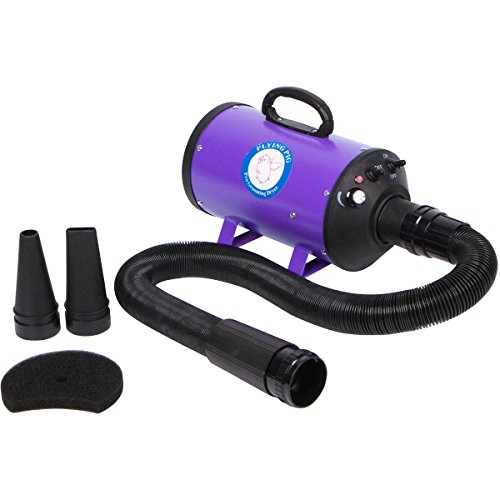
Flying Pig High Velocity Dog Grooming Dryer — Best Long-Running Brand Pick
Flying Pig built its name inside grooming rather than beside it, and the Flying One — this purple high-velocity dryer with heater — has been a salon and home staple through years of newer rivals arriving with bigger numbers. Longevity like that signals something specifications cannot: parts, hoses and filters that survive real use, and a design groomers reach for when the dog on the table is not their own and behaviour matters.
For home buyers, the appeal is predictability. The Flying One does the core job — strong airflow through a hose, heat available for finishing — with the settled manners of a mature product. Dogs read our confidence as much as the machine’s noise, and owners tend to be calmer with equipment that feels established, which quietly improves every session. If your household grooms several dogs, or one dog very frequently, that workhorse character compounds.
Run it with the same thermal discipline as every pick here. The heater is for the end of the job: ears, belly and groin get cool or barely warm air, the nozzle never rests against the coat, and a dog that begins to pant or fidget is telling you the session, or at least the heat, is finished. Finished coats should feel dry at the skin, not merely dry on the guard hairs — part the fur in two or three places and check with your fingertips before you declare victory.
- Model in listing: Flying One, purple
- Type: high-velocity grooming dryer with heater
- Positioning: grooming-brand staple for salon and home
- Best matched coat: regular multi-dog or frequent grooming routines
Strengths
- Grooming-specialist brand with a long-running, proven model.
- Settled, predictable behaviour for frequent grooming schedules.
- Heater included for finishing work on colder days.
Trade-offs
- Listing publishes fewer numeric ranges than the PETNF’s detailed figures.
- Purple finish will not match every utility room’s quiet ambitions.
- Newer rivals offer more nozzles in the box for deshedding work.
Best for: frequent groomers and multi-dog homes wanting the established grooming-brand option.
Not suited for: buyers who shop primarily by published temperature and speed ranges.

High-Velocity Dog Dryer 4 Nozzles with Heater — Best for Large Dogs and Deshedding
This unbranded high-velocity dryer describes its mission in its listing title: quiet-leaning operation for the class, a heater, four nozzles, adjustable speed, and a professional blower aimed at large dogs, thick coats and deshedding. That is a coherent brief. Large double-coated dogs are exactly the animals for whom drying takes longest, loose coat flies furthest, and a well-chosen nozzle set earns its drawer space.
Adjustable speed is the feature to lean on with a dog of this size. A big dog presents several different drying problems in one body: a waterproof topcoat on the back, a woolly undercoat at the neck and thighs, short hair on the legs, and sensitive ears and face. One fixed airflow handles at most two of those well. Dial down for the head end, up for the saddle and britches, and swap nozzles as you travel, and the session becomes systematic instead of theatrical.
The deshedding angle deserves honest framing. A force dryer does not stop a coat from blowing; it concentrates the event. Drying a moulting dog outdoors with a dryer like this removes in twenty minutes what would otherwise decorate your home for a fortnight, and the coat left behind dries fully to the skin, which reduces the itchy, damp window in which scratching and hot spots start. Wear old clothes, warn the neighbours’ laundry, and let the garden have the fluff.
Because the listing leans on quietness for the class, a word of calibration: judge that claim against other force dryers, not against household appliances. You will still raise your voice slightly over it, and the dog will still hear it clearly across the garden. What a quieter-leaning blower genuinely buys is a softer edge to the sound — less whistle, less harshness — and for sound-sensitive dogs that edge, combined with distance and low starting speeds, can be the margin that makes training succeed.
- Type: high-velocity dryer with heater, adjustable speed
- Nozzles: four included
- Listing focus: large dogs, thick coats, deshedding
- Noise positioning: quiet-leaning for the force-dryer class
Strengths
- Adjustable speed suits the varied zones of a large dog’s coat.
- Four nozzles support a deliberate deshedding routine.
- Purpose-written for thick coats rather than adapted from human tools.
Trade-offs
- Unbranded listing means fewer published control ranges to compare.
- Quiet is relative; expect blower noise, not hair-dryer noise.
- Oversized for small breeds that a towel and patience handle fine.
Best for: owners of large, thick-coated dogs facing seasonal coat blows and long drying times.
Not suited for: small-breed owners, for whom this class of machine is mostly unnecessary.
How Do the Six Dog Dryers Compare Side by Side?
| Pick | Badge | Control evidence | Distinguishing detail |
|---|---|---|---|
| SHELANDY Pet Hair Force Dryer with Heater | Best Established Home Grooming Pick | Force blower with heater | Long-running home grooming staple |
| CHAOLUN High Velocity Dog Grooming Dryer | Best Straightforward Blower with Heat | High velocity with heater | Simple, function-first blue unit |
| EGFKI Dog Dryer 5.2HP 3800W | Most Powerful Pick | Adjustable speed and temperature | 5.2HP / 3800W, four nozzles |
| PETNF High Velocity Dog Dryer 3.2HP | Best Published Temperature Control | 25-65 m/s; heat 85-140°F on-off | Undercoat comb nozzle included |
| Flying Pig High Velocity Dog Grooming Dryer | Best Long-Running Brand Pick | High velocity with heater | Flying One model, grooming brand |
| High-Velocity Dog Dryer 4 Nozzles with Heater | Best for Large Dogs and Deshedding | Adjustable speed, heater | Four nozzles, deshedding focus |
Why Is a Human Hair Dryer the Wrong Tool for a Dog?
The difference is thermal philosophy. A human dryer is built to evaporate water with heat, on a scalp whose owner can say “too hot” and pull away. Its airflow is modest and its temperature high, which is a poor bargain for an animal covered in insulating fur: the coat surface can feel merely warm while skin underneath, especially where fur is thin or the nozzle lingers, climbs toward discomfort or worse. Human dryers also lack the velocity to move water out of a double coat, so owners compensate by holding them closer and longer — precisely the wrong direction.
Dog force dryers invert the recipe: very high airflow, modest optional warmth. Moving air shears water droplets off hair shafts and lifts them out of the undercoat bodily, so most drying happens at temperatures a dog’s skin tolerates easily. That is also why these machines shorten drying so dramatically on thick coats. They are not drying harder; they are drying by a different mechanism entirely, one matched to how a wet coat actually holds water.
There is a behavioural difference too. A hose-fed blower lets the motor — the frightening part — sit metres away while a light nozzle does the travelling. A human dryer puts its motor, its noise and its heat source in your hand, inches from the dog’s face. For puppies and rescues especially, that distance is often the difference between a dog that learns to accept grooming and one that learns to flee the bathroom.
How Hot Is Too Hot When You Are Drying a Dog?
Work from a simple rule: if the airstream feels hot on the inside of your wrist after five seconds at working distance, it is too hot for sustained use on the dog. Skin under a coat cannot shed heat the way exposed human skin can, and the places owners most want to dry thoroughly — armpits, groin, belly, behind the ears — are thin-skinned and poorly ventilated. Keep heat low or off there regardless of what the dial allows elsewhere.
Published ranges help you stay honest. The PETNF’s 85-140°F span shows the shape of the whole category: the bottom of that range is a warm breeze, the top is a tool for seconds-long passes over the densest coat in a cold room, nozzle sweeping, never resting. On any dryer, build the habit of parking your free hand in the airflow or on the skin being dried. Your palm is the only temperature sensor that is actually at the scene.
Watch the dog as your second instrument. Panting that escalates, repeated attempts to sit or turn away, skin that pinks up, or sudden restlessness after calm all say the same thing: reduce heat, increase distance, or stop for the day. A coat left slightly damp and finished later is a minor inconvenience. A scalded or heat-stressed dog is a vet visit and a grooming setback that can last for years.
How Do You Introduce a Nervous Dog to a Force Dryer?
Treat introduction as training, not as a preamble to the real event. Session one can be absurdly small: the dryer sits in the room, switched off, while the dog investigates it and gets rewarded for calm curiosity. Next, the motor runs briefly in another room or at maximum distance, paired with food, and stops before the dog’s concern grows. Only when the sound has become boring does air enter the picture, at the lowest speed, aimed at the dog’s shoulder for a few seconds at a time.
Build duration before intensity, and always end while things are still going well. A dog that has had six two-minute sessions of low air and good outcomes will usually accept a full dry within a fortnight; a dog pinned through one thirty-minute ordeal may need months to forgive the bathroom. Puppies deserve the gentlest version of this ladder, because early grooming experiences write themselves into adult behaviour with unusual permanence.
Practical details help more than bravery. Dry on a non-slip surface so scrambling does not amplify panic. Keep the hose from tangling around legs. Let a second person feed a lick mat during early sessions if your dog finds that settling. And never aim airflow at the face, into the ears or at the eyes: work the head last, at the lowest setting, with the nozzle angled away and your hand shielding the ear openings.
What Does a Good Drying Routine Look Like, Step by Step?
Start before the dryer switches on. Squeeze and towel the coat thoroughly, work out any mats you can find with your fingers — force dryers tighten wet tangles — and, for long coats, consider brushing the worst feathering while it is still bath-damp. Set the dryer on a stable surface, confirm the filter is clean, and choose the wide nozzle for the opening phase.
Open with volume, not heat. On medium or low speed, sweep the torso in slow passes, blowing with the lay of the coat to shed water, then against it briefly to lift the undercoat and expose the damp layer beneath. You will see the coat change character as the deep moisture leaves: guard hairs separate, the undercoat fluffs, and the dog stops looking lacquered. Legs, chest and tail follow, with speed dropped and distance increased as the areas get more delicate.
Finish by checking, not by clock. Part the coat at the neck, behind the ears, at the armpits and along the belly, and feel for cool dampness at the skin. Those pockets are where irritation starts if they stay wet. A final cool-air pass over the whole dog settles the coat, removes the last loose hair, and ends the session on the safest setting the machine offers.
Which Coats Need Which Kind of Airflow?
Double coats — shepherds, retrievers, spitz breeds, collies — are the force dryer’s home ground. Their undercoat traps water like a sponge, air-drying takes most of a day, and the skin beneath stays humid enough to invite trouble. Strong, adjustable airflow, worked methodically in sections, is transformative here, and it doubles as undercoat management during a moult.
Single and short coats need far less ceremony. A smooth-coated dog may dry fully on the lowest setting in minutes, and many genuinely need only the briefest cool pass after towelling. Curly and wool coats sit between the extremes: they hold water deeply but tangle readily, so moderate airflow, more brushing during drying, and lower heat protect the texture you are trying to keep. Senior dogs and those with skin conditions default to the gentlest programme of all — cool air, short sessions, and drying in stages if that is what the dog prefers.
How Do Nozzles, Hoses and Filters Change the Result?
Nozzles are where airflow becomes grooming. A wide, flat nozzle moves a sheet of air across the torso and shifts the greatest volume of water per pass, which is why it opens almost every session. A round nozzle concentrates the stream for legs, paws and the dense britches at the rear. The narrowest tips reach into undercoat and along the spine, and comb attachments, like the one in the PETNF set, add mechanical separation so loosened hair leaves instead of re-settling. Swapping nozzles mid-session feels fussy the first time and obvious by the third bath.
The hose deserves more respect than listings give it. Its length decides how far the motor can sit from the dog, and every extra metre of distance softens both noise and the dog’s sense of being crowded by machinery. Its flexibility decides whether the nozzle tracks smoothly over a moving animal or fights you at every turn of the wrist. A hose that kinks chokes airflow exactly as a dirty filter does, so route it in a lazy curve, keep it off the floor where paws and feet can pin it, and store it looped rather than folded.
Filters are the quiet determinant of whether a dryer ages well. The intake screen catches the hair and dust that a grooming room generates in industrial quantities, and as it loads, airflow falls, noise rises and the motor works hotter to achieve less. Owners then compensate by raising speed and heat, degrading the experience for the dog while blaming the machine. Brush or rinse the filter on a rhythm — after heavy moults, before it looks necessary — and the dryer you bought is the dryer you still have in year three.
What Should You Make of Horsepower and Wattage Claims?
Shop this category with a translator’s scepticism. Horsepower figures for pet dryers are not certified to a single standard across brands, and wattage describes electrical appetite rather than drying effect. A 3800W claim like the EGFKI’s tells you the machine draws serious power and intends maximum output; it does not promise exactly twice the drying of a unit claiming half the figure. What reaches the coat depends on motor efficiency, fan design, hose losses and nozzle shape as much as on the headline number.
Air speed, where a listing publishes it, is the more honest currency. The PETNF’s 25-65 m/s range describes what actually touches the dog, and its span matters as much as its ceiling: the bottom of that range is where faces, ears, puppies and seniors get dried, and a machine whose lowest setting is still a gale forces owners into distance tricks to soften it. When comparing two dryers, prefer the one whose published figures describe a range you can imagine using at both ends.
There is also a household-electrics footnote. The most powerful dryers draw heavily, and older bathroom circuits shared with heaters or hair tools may object. Run a big blower on its own circuit where you can, avoid extension leads unless they are properly rated for the load, and let a high-output machine rest between dogs on multi-dog days. None of this is glamorous, but grooming equipment earns trust in exactly these unglamorous details.
How Do Puppies, Seniors and Anxious Dogs Change the Plan?
Puppies are not small adults; they are students. Their first dryer experiences should be measured in seconds of distant, low-speed air woven into play and feeding, well before any bath makes drying necessary. A puppy that has learned the sound is harmless by twelve weeks will usually accept real drying as a normal sequel to bath time, while a puppy first meeting the machine wet, cold and restrained has learned a very different lesson.
Senior dogs bring thinner skin, stiffer joints and often a lifetime’s accumulation of grooming opinions. Lower heat is non-negotiable, sessions may need splitting with rest breaks, and a raised or non-slip surface that spares their balance matters as much as the dryer itself. Watch breathing and posture rather than the clock, and accept a two-stage dry — body today, finishing pass after a nap — when that is what the dog in front of you is asking for.
Anxious adults, especially rescues with unknown histories, sit at the far end of the patience scale. For them the introduction ladder in this guide may stretch over weeks, and some will always dry best at low speed with the motor in another room and a trusted person assigned purely to reassurance. That is not failure. A slightly slower dry with a calm dog protects skin, coat and the relationship, and it keeps grooming possible for the decade of baths still to come.
Where Should You Dry a Dog, and How Should the Space Be Set Up?
Outdoors wins whenever weather allows, especially during a coat blow: loose hair leaves on the breeze instead of redecorating soft furnishings, the dog associates the garden rather than the bathroom with the noisy part, and water flung from the coat lands on ground that does not care. A shaded spot out of the wind is ideal, because a crosswind fights your airstream and chills a wet dog between passes.
Indoors, the bathroom is the usual compromise, and setup decides whether it works. Put a non-slip mat in the tub or on the floor, set the dryer unit outside the splash zone with the hose fed in, and close the door — not to imprison the dog, but to keep a damp escapee from touring the house. Keep towels, treats and the spare nozzles within arm’s reach before you start; a session interrupted while you hunt for equipment teaches the dog that fussing pauses the process.
Owners who groom weekly often graduate to a table, and the gain is ergonomic as much as canine. Working at waist height saves your back across a long double-coat session and puts the belly, legs and feet — the areas owners under-dry when bending — at eye level where they belong. Whatever the surface, the rule is identical: the dog must feel foot-sure. More dryer fear is born from slipping paws than from sound, and it is the easiest cause to eliminate entirely.
How Does Drying Fit Into the Wider Coat-Care Routine?
A dryer is one instrument in a sequence, and the sequence matters. Bathing loosens dirt and dead coat; drying, done with air and a brush working together, is when most of that loosened undercoat actually leaves the dog. Owners who brush only when the coat is dry are doing the hardest version of the job: dry undercoat clings, static builds, and mats that formed during the bath set like concrete. Ten minutes of brush-and-blow during drying replaces an hour of dry wrestling later.
Drying is also your best inspection opportunity. The airstream parts the coat to the skin in a way eyes alone never achieve, revealing ticks, hot spots, lumps, dry patches and the early redness of irritation while they are still small problems. Groomers find things owners miss precisely because they dry methodically, section by section. Adopt the same habit, and mention anything new or changing to your vet with the advantage of having spotted it early.
Finally, frequency is a coat decision, not a calendar one. Dogs dried properly after every bath, and given a short air-only session during heavy moults, need fewer emergency grooms and arrive at each bath with a coat in better order. Between baths, a brief cool-air pass after a muddy walk lifts grit out of the coat before it grinds into the skin. Used this way, the dryer stops being bath-day machinery and becomes the household’s general coat-maintenance tool.
What Ownership Looks Like After the First Month?
The first month with a force dryer is mostly education — yours. You learn your dog’s map: which flank tolerates full airflow, which ear needs shielding, where the coat hides its last damp pocket. You learn the room’s map too, because blown water and hair settle in places you will find for weeks. Owners who keep a small ritual — same place, same order of work, same reward at the end — find the dog starts cooperating with the routine itself, and sessions quietly shorten without any change of machine.
Maintenance settles into a short list. Filters need regular attention, as covered earlier. Hoses should be inspected for splits at the cuffs, where flexing concentrates, and nozzles checked for the cracks that turn a smooth airstream into a whistle a dog can hear better than you can. Store the unit dry, hose looped loosely, and run it briefly after a damp-room session so its own internals do not sit wet. None of this takes five minutes a month, and all of it protects the two things you actually bought: airflow and reliability.
Expect your standards to rise as the months pass. Owners who once accepted a mostly dry dog begin checking armpits and ear bases automatically. Bath frequency often increases slightly, paradoxically, because the dreaded drying marathon that used to follow has shrunk into a manageable task. That, more than any specification, is the return on a good dryer: grooming stops being an event the household negotiates and becomes maintenance it simply does.
How Do You Match One of These Six to Your Household?
Start with the dog’s coat and temperament, in that order, and let the machine follow. A household with one medium-coated dog that bathes monthly needs reliability and simplicity more than maximum output; that is SHELANDY and CHAOLUN territory, and the money and storage space saved are real. A household with two large double coats and a spring moult that fills bin bags should be shopping at the other end of this page, where airflow headroom and nozzle sets repay their bulk every single week.
Then weigh how much you value documented control. Some owners are natural dial-judges who happily manage heat by hand and distance; others want the listing itself to draw the safety map. The PETNF exists for the second group, and there is no shame in belonging to it — published ranges make cautious grooming repeatable, and repeatable caution is what keeps a decade of baths incident-free. If your dog is elderly, thin-skinned or heat-sensitive, that documented low end should probably decide the purchase on its own.
Finally, consider the humans and the house. A dryer used in a small flat at seven in the morning before work argues for the quietest-leaning, most adjustable option and a strict introduction programme for the dog. A dryer living in a garage grooming corner, used on farm dogs that arrive genuinely filthy, argues for raw capacity and easy filter access. The right answer differs by household, which is exactly why this roundup keeps six distinct machines rather than crowning one and dismissing the rest.
What Mistakes Do Owners Make With Dog Dryers?
The classic error is treating heat as the drying agent and parking a warm nozzle over one spot while chatting. The second is skipping the introduction entirely, because the dog “was fine with the vacuum once” — a force dryer is louder, closer and accompanied by the indignity of a bath. Third comes aiming at the face to get it over with, which teaches the dog that the machine attacks the part of them they care about most.
Equipment mistakes matter too. A clogged intake filter strangles airflow and makes motors run hotter, so rinse or brush it out on the maker’s schedule. Drying a matted coat without working the mats first welds them tighter. And declaring a dog dry because the topcoat feels dry, while the undercoat at the skin is still cool and damp, undoes much of the point of owning the machine.
Final Recommendation
Most households should start where control is documented: the PETNF High Velocity Dog Dryer 3.2HP, whose published speed and heat ranges let you dry conservatively on purpose. Owners of the very heaviest coats who dry weekly will feel the EGFKI Dog Dryer 5.2HP 3800W earn its headroom, while anyone who simply wants the proven grooming-brand route can take the Flying Pig Flying One and stop deliberating. Whichever machine comes home, remember that the dryer only does half the work — the other half is a dog who trusts the process, and that trust is built in the first three quiet minutes, not bought with the motor.
Frequently Asked Questions
Can I just use my own hair dryer on my dog occasionally?
Occasionally and carefully beats never drying at all, but keep it on its coolest setting, keep it moving and far away, and accept that a thick coat will still be damp at the skin long after the surface feels done. The heat-first design of human dryers is the risk; if your dog needs regular drying, a purpose-built blower is the safer tool by design.
How long does force drying usually take?
It depends on coat mass more than dog size. A short single coat can be fully dry in a few minutes, a medium double coat commonly takes a quarter of an hour of methodical work, and a heavy northern coat after a full bath can take considerably longer even with a strong machine. Drying to the skin, not to the clock, is the standard that matters.
Will a force dryer help with shedding?
Yes, in the sense that it concentrates it. Loose undercoat that would drift around your home for weeks gets lifted and blown out in one outdoor session, and comb nozzles like the PETNF’s work through the coat as you dry. The dog still sheds on its own schedule; you simply choose where and when most of it lands.
How do I keep the noise from frightening my dog?
Distance, low speed and gradual exposure do most of the work: motor far away, first sessions short, rewards frequent, and no face work early on. Some owners add cotton balls loosely at the ear openings during drying, removed immediately afterwards. If your dog panics despite a patient ladder of sessions, talk to a groomer or behaviourist rather than escalating force.
Is warm air ever necessary, or is cool air enough?
Cool air is enough for the great majority of drying, and on warm days it is all you should use. Gentle warmth earns its place in cold rooms, on very dense coats during finishing, and for dogs that chill easily after baths. Think of heat as a seasoning in this category — a little, late, and never the main ingredient.
Should I dry my dog after rain walks as well as baths?
A short, cool-air pass after a soaking rain walk is one of the kindest uses of these machines. It lifts grit and road splash out of the coat before they dry into the skin, dries the paws and belly that stay wettest, and prevents the slow, damp air-dry that leaves double coats smelling stale by evening. Keep it brief and gentle; this is maintenance, not a full groom.
How often should I clean the dryer’s filter?
Check it after every few sessions and clean it whenever visible hair and dust build up; a moulting double coat can load a filter in a single groom. A clean filter preserves airflow, keeps the motor cooler and quieter, and is the cheapest maintenance the machine will ever ask for.
Related Guides
Grooming sits alongside the rest of a well-run home in our coverage, from cold storage for bulk pet food to the laundry machines that handle the towels bath day produces — explore Best 10 Cu Ft Upright Freezers, Best 30-Inch Ducted Range Hoods, Best 24-Inch Stackable Washer and Dryer Sets.


