What's inside
- Key Takeaways
- Quick Picks
- How We Chose These Picks
- How Do the Six Compare at a Glance?
- How Should You Prepare Before the Sale Starts?
- What Should You Verify in the Listing While the Clock Runs?
- What Costs Hide Outside the Headline Figure?
- When Is Walking Away the Right Deal?
- How Does Delivery Week Actually Go?
- Should You Shop Early, or Wait for the Day Itself?
- What About Extended Warranties and Protection Plans?
- How Do You Compare the Two Towers Head to Head?
- What If You Are Buying for a Rental, a Flip, or a Second Home?
- How Should the First Month With the New Laundry Go?
- How Do You Keep the Receipt Trail Straight in Sale Season?
- What Does a Good Deal Look Like, Finally?
- How Do You Handle the Old Machines?
- What Should Second-Time Stackable Owners Do Differently?
- How Do You Brief the Household Before the Purchase?
- Which Mistakes Define a Bad Black Friday Laundry Purchase?
- Final Recommendation
- Frequently Asked Questions
- Related Guides
As an Amazon Associate I earn from qualifying purchases. This post may contain affiliate links at no extra cost to you.
cottageverdict.com is reader-supported. When you buy through links on our site, we may earn an affiliate commission.
Where to buy: the six laundry centres and sets below are sold through Amazon, and the linked names throughout this guide lead to each product’s listing, where you can check price on Amazon on the day and confirm the configuration, fuel type, and included hardware before ordering. The best Black Friday deals on stackable washer dryers cannot be written as a list of prices, and this guide will not insult you by trying: sale prices move by the hour, vary by configuration and postcode, and expire while articles are still being read. What does not expire is judgement. A stackable laundry purchase is a decade-long commitment of floor space, plumbing, and money, and the discount event is precisely when judgement is scarcest — countdown timers do not care whether the tower fits your closet.
So this guide does the durable part of the work. It presents six genuine contenders for a stacked laundry purchase — two full-size laundry centres with gas dryers, one full-size two-piece package, and three compact 24-inch-class sets — and surrounds them with the deal-season discipline that separates a bargain from a beautifully discounted mistake: what to measure before the sale, what to verify in the listing while the clock runs, which costs hide outside the headline price, and when walking away from a deal is the deal.
Read the pick sections for the machines. Read the strategy sections before you spend. The order matters, in November more than in any other month.
Key Takeaways
- No prices appear in this guide, deliberately: check the live listing on the day, and judge the machine, not the countdown.
- Two of the six — the LG WashTower and the Samsung Laundry Hub — are single-unit laundry centres with gas dryers; confirm your fuel before falling for either.
- The Samsung package and the three compact sets are separate machines, serviceable independently.
- The real Black Friday risks are configuration traps: wrong fuel, wrong voltage, missing stacking kit, freight delivery nobody scheduled.
- Total cost includes delivery, installation, kits, and hoses — a cheaper machine with none of these can cost more than a pricier one with all of them.
- Measure the space, the doorway, and the vent or drain plan before the sale starts, not during it.
Quick Picks
| Pick | Badge | Why it earns its place |
|---|---|---|
| LG WashTower Laundry Center | Full-Size Tower, Gas Dryer | A single stacked centre with a 4.5 cu ft washer and a 7.4 cu ft gas dryer in black steel — the remodel-grade option. |
| Samsung Bespoke AI Laundry Hub | Single-Unit Smart Hub | Samsung’s one-cabinet answer: a 4.6 cu ft steam washer under a 7.6 cu ft gas dryer, controlled from one panel. |
| Samsung Front Load Laundry Package | Two-Piece Samsung Pair | A front-load washer and dryer package for buyers who want full size with separately serviceable machines. |
| Equator Ultra Compact Stackable Set | Compact Column, 110V | The 24-inch-class two-piece set for closets and small flats, running on ordinary household power. |
| Splendide Stacked Bundle | Kits Included, RV-Bred | Washer, dryer, vent kit, and stacking kit in one bundle, engineered in the marine and RV world. |
| SEKIDO Compact Stackable Set | Black Compact Column | A 110V compact pair in black, for laundry corners that live in visible space. |
How We Chose These Picks
The selection brief for a deal-season guide differs from an ordinary one: every pick had to be a machine we would recommend at its ordinary price, because a discount on the wrong appliance is not a saving. From the stackable field we chose for genuine spread — full-size centres against compact columns, single-unit towers against separable pairs, gas drying against standard-voltage compact sets — so that the reader’s floor plan, not the sale’s marketing, determines which section of the guide is theirs.
We also favoured listings whose configurations are legible under pressure. Black Friday punishes ambiguity: a listing that states its fuel, its capacities, and its inclusions in plain terms protects a hurried buyer, while one that buries the gas-versus-electric distinction in a dropdown is a trap with a timer attached. Each pick below is annotated with the specific verification its listing demands, because during a sale the most valuable sentence in a review is the one that tells you what to check before the button, not after the delivery.
Finally, the set was balanced across the two honest reasons people shop this event: replacing a dead laundry pair under time pressure, and upgrading a working one by choice. The first reader needs reliability and availability; the second needs permission to wait for the right configuration. Both are served here, and both are warned, in the strategy sections, against the other’s characteristic mistake.

LG WashTower Stacked Laundry Center — Full-Size Tower, Gas Dryer
The WashTower is the machine that made the stacked centre respectable in the full-size market: the listing describes a single stacked unit with a 4.5 cu ft front-load washer beneath a 7.4 cu ft gas dryer, finished in black steel, with steam in the dryer and the controls gathered at the centre of the tower where both machines can be run without reaching or crouching. That centre-control idea is the design’s intelligence — a stacked pair’s traditional ergonomic fault is a dryer panel at the ceiling and a washer panel at the floor, and LG simply moved the conversation to the middle.
The fuel word governs everything: this tower’s dryer is gas. For a home with a gas line at the laundry, that is a virtue — fast heat, capacious drying, the running-cost profile gas usually brings. For a home without one, the tower is the wrong product at any discount, and no sale percentage repairs a missing gas supply. Verify, too, the tower’s total height against your ceiling and its single-unit nature against your service philosophy: a laundry centre is replaced and repaired as one appliance, which simplifies design and complicates the year-nine conversation about a single failed component.
As a Black Friday target, the WashTower suits the planned remodel buyer — the household that measured in October, confirmed gas and clearances, and is now simply waiting for the season to improve the arithmetic on a decision already made. That is the correct way to buy it, and the guide’s strategy sections exist to make more buyers into that buyer. Bought on impulse by a household guessing at its clearances, the same tower is a very elegant problem.
- Configuration: single-unit stacked centre — not two separate machines
- Washer: 4.5 cu ft front load
- Dryer: 7.4 cu ft, gas fuel — a gas line is required
- Controls: centre panel serving both machines
- Finish: black steel, steam in the dryer
Strengths
- Centre controls fix the stacked format’s ergonomic fault.
- Full-size capacities serve family laundry outright.
- One designed object instead of two machines and a kit.
Trade-offs
- Gas-only dryer excludes homes without a laundry gas line.
- Single unit means single point of failure for both functions.
- Tower height and weight demand measured, planned delivery.
Best for: remodelled laundry rooms with gas service and family volume. Not suited for: electric-only homes or buyers who value separately serviceable machines.
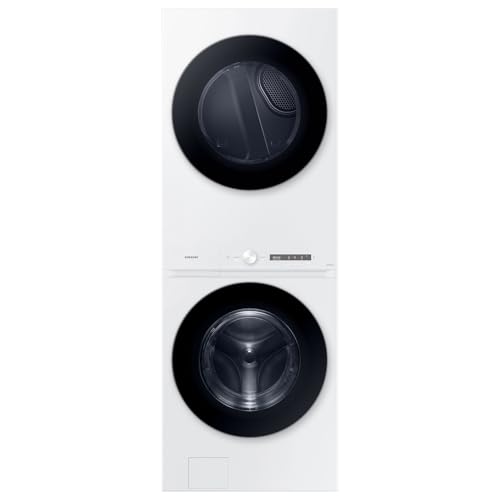
Samsung Bespoke AI Laundry Hub — Single-Unit Smart Hub
Samsung’s Laundry Hub is the other full-size tower philosophy: the listing describes a single-unit Bespoke washer dryer with a 4.6 cu ft washer offering steam wash beneath a 7.6 cu ft gas dryer, in white, under the maker’s AI-branded control umbrella. The capacities edge past the LG’s on both floors, and the single-panel control concept is shared — one interface, at a civilised height, conducting both machines. The Bespoke design language aims the tower at laundry rooms that are seen, and the white finish keeps it bright where the LG goes dramatic.
The gas qualification applies identically, and it is worth repeating in a deal guide because fuel is the specification most often misread under time pressure: this hub’s dryer burns gas. Households with the line gain a large, brisk dryer; households without it should let this listing pass at any headline figure. The AI layer — cycle suggestions and connected management — is the second verification: it rewards households that live in the maker’s ecosystem and adds nothing for those that do not, and Black Friday is no time to change ecosystems by accident.
Choose between the two towers on the honest margins: capacity by a whisker to the Samsung, finish by taste, ecosystem by the phone already in your pocket and the washer brand your household already trusts for service. Both are planned purchases. The hub bought deliberately, with gas confirmed and the space measured, is a decade of laundry handled by one handsome column; bought as a doorbuster by a household that has not checked its fuel, it is an expensive education in reading listings to the end.
- Configuration: single-unit laundry hub — one cabinet, two functions
- Washer: 4.6 cu ft with steam wash
- Dryer: 7.6 cu ft, gas fuel — gas line required
- Controls: single panel with connected features
- Finish: white, Bespoke design line
Strengths
- Largest combined capacities of the full-size towers here.
- Steam washing joins the dryer’s capacity in one column.
- Single-panel control is genuinely convenient daily.
Trade-offs
- Gas dryer only — no electric variant in this listing.
- Connected features presume life inside the maker’s app.
- One cabinet retires both functions together someday.
Best for: gas-equipped family homes wanting the largest single-column capacities. Not suited for: electric-only laundry rooms or app-averse households.

Samsung Front Load Laundry Package — Two-Piece Samsung Pair
The package is the traditionalist’s route to a Samsung laundry: a front-load washer — the listing names the WF45T6000WPR — sold with its matching dryer as a pair, rather than fused into a tower. The distinction is not nostalgia. Two machines can be delivered through a difficult doorway one at a time, installed side by side or stacked with the appropriate kit where the room prefers a column, serviced independently across their lives, and replaced independently at their ends. For households whose laundry philosophy is modular, the package is the full-size answer in this guide.
Deal-season diligence applies to packages with special force, because a bundle listing must be read as two listings wearing one coat. Confirm which dryer the package contains — its fuel above all, since Samsung pairs are sold in both gas and electric configurations across the market — and whether the stacking kit, hoses, and cords are included or merely compatible. A package whose price assumes hardware it does not contain is the classic November surprise, and the listing’s includes-list, read slowly, is the entire defence.
Judged cleanly, the package suits the buyer whose space or service philosophy says two machines, and whose brand decision says Samsung. It lacks the towers’ single-panel elegance and gains the pair’s flexibility in exchange — the oldest bargain in laundry, offered here without apology to either side. During the sale, it is also the configuration most worth comparing against buying the same washer and dryer separately, since package arithmetic and separate arithmetic cross in interesting ways when individual models are promoted unevenly.
- Configuration: two separate machines, washer plus dryer
- Washer reference: WF45T6000WPR front load
- Arrangement: side by side, or stacked with the correct kit
- Verification priority: dryer fuel and the includes-list
- Service: each machine independent across its life
Strengths
- Independent service and replacement for washer and dryer.
- Flexible arrangement — pair or column, as the room dictates.
- Full-size Samsung laundry without the tower’s single-unit risk.
Trade-offs
- Stacking kit and hookups may be separate purchases — verify.
- No single centre control panel as on the towers.
- Bundle listings demand slower reading under sale pressure.
Best for: households wanting full-size Samsung laundry in separable machines. Not suited for: buyers who want one delivery, one cabinet, one panel.

Equator Ultra Compact Stackable Washer Dryer Set — Compact Column, 110V
Down at the 24-inch end of the guide, the Equator set is the compact column in its purest form — and this section judges it by November’s criteria rather than repeating its general virtues. As a deal target, its attractions are structural: a matched two-piece set, a 1.6 cu ft washer under a 2.6 cu ft dryer, running entirely on 110 volts, which means the installation it demands of a home is an outlet and a water supply rather than a tradesman’s itinerary. Compact sets rarely headline the sale adverts, which is precisely their opportunity — the season’s noise concentrates on full-size towers while the small columns are promoted quietly to the people actually measuring closets.
The verification list for this set is short and physical. Measure the column’s stacked height against the closet, the doorway route against the boxes, and confirm the stacking arrangement and any kit’s inclusion in the listing before the order. Then confirm the household arithmetic one final time: this set serves one or two people’s laundry in a spread-out weekly rhythm, and a Black Friday figure does not enlarge a drum. The family of five that buys it in November has not saved money; it has scheduled a return.
For the right household, though, the compact column is the sale’s most life-changing category — in-unit laundry where none was possible, at a footprint a hallway closet can spare. Landlords fitting small units and renters with permission both shop here, and both should value the set’s separability: two machines, each replaceable, from a maker whose whole business is this size of laundry. In a guide about judgement, the Equator is the pick whose judgement is mostly about the tape measure.
- Configuration: two-piece compact stack
- Washer / dryer: 1.6 cu ft / 2.6 cu ft
- Power: 110V throughout
- Fit: 24-inch-class column for closets and alcoves
- Verification priority: stacked height and the doorway route
Strengths
- Standard-voltage install suits rentals and conversions.
- Balanced drums — dryer properly larger than washer.
- Compact-specialist maker behind both machines.
Trade-offs
- Capacity is a hard ceiling no discount can raise.
- Compact sets rarely carry the season’s deepest promotions.
- White finish only in this listing.
Best for: small households and landlords creating laundry in a closet. Not suited for: family-volume laundry at any price point.

Splendide Stacked Washer Dryer Bundle — Kits Included, RV-Bred
The Splendide bundle’s deal-season virtue is completeness, and completeness is a financial property in November. The listing bundles the stacked washer and dryer with the vent kit and the SK04 stacking kit included — the hardware other listings leave as follow-up purchases, each with its own delivery and its own opportunity for the wrong part to arrive during the busiest logistics week of the year. A bundle that arrives whole, from a maker whose pairs have served RVs and boats for decades, converts the installation from a scavenger hunt into an appointment.
Two verifications govern this pick. The first is the vent: the bundle’s dryer exhausts, by design and by heritage, so the home must offer the exterior path — trivially true for the RVs, cabins, and garage laundries it suits, disqualifying for the sealed interior closet. The second is freight: the bundle ships as freight, which in sale season means scheduling a delivery window and having hands and access ready, rather than finding a large shipment learning about your porch from a tracking page. Both are manageable; both are the kind of detail a countdown timer hopes you will skip.
For its natural habitats — the cabin being finished before winter, the RV being refitted, the tiny house, the boat-adjacent condo with a real vent — the Splendide is the guide’s most purpose-built instrument, and the season’s pricing on a niche, complete bundle can be quietly excellent precisely because the crowd is elsewhere. Judge it by whether its completeness matches your project’s list; where it does, few listings in the category waste less of your November.
- Configuration: stacked pair, bundled as one purchase
- Included: vent kit and SK04 stacking kit
- Drying: vented — an exhaust path is required
- Delivery: freight — schedule it deliberately
- Heritage: RV and marine installations
Strengths
- Hardware completeness removes November’s accessory scramble.
- Engineering proven under motion and vibration.
- One purchase closes the whole project list.
Trade-offs
- Vented drying excludes ventless floor plans.
- Freight delivery needs planning and access.
- Niche sizing suits its habitats, not family laundry rooms.
Best for: cabins, RVs, tiny houses, and vented compact installs. Not suited for: sealed closets or doorsteps unprepared for freight.

SEKIDO Compact Stackable Laundry Set 110V — Black Compact Column
The SEKIDO closes the list with the visible-corner brief: a compact stackable pair — 1.57 cu ft washer, 3.1 cu ft dryer, 110 volts throughout — finished in black. Its general case was made elsewhere; its deal-season case is about who shops in November. The buyers furnishing a rental flat, a studio, or an open-plan kitchen ahead of the new year are precisely the buyers for whom a laundry column’s appearance is a functional specification, and a black column that reads as furniture rather than equipment earns rent and photographs in ways a white one does not. A sale is when such furnishing projects are funded, and this set is the category’s only dark column.
The verifications are the compact set’s usual liturgy — stacked height, doorway, kit inclusion — plus one for the newer name: read the listing’s support and parts story with the care due a brand still building its network, and weigh the finish’s value to your space against the depth of an older maker’s catalogue. That is a fair trade to offer a buyer plainly, and different households will settle it differently, which is what a shortlist is for.
Within its brief, the SEKIDO’s proportions are sound — the dryer properly outsizes the washer — and its standard-voltage operation keeps the installation to the outlet-and-water level that makes compact columns the renters’ and landlords’ friends. If the season’s arithmetic brings it within reach of a project that needs a dark, narrow, complete laundry, it is the only pick in this guide that was ever going to furnish that corner.
- Configuration: two-piece compact stack
- Washer / dryer: 1.57 cu ft / 3.1 cu ft
- Power: 110V across the pair
- Finish: black — the guide’s only dark compact column
- Verification priority: kit inclusion and support story
Strengths
- Black finish serves visible, design-led laundry corners.
- Well-proportioned drums for the compact class.
- Standard-voltage simplicity for rentals and studios.
Trade-offs
- Newer brand; parts network still maturing.
- Compact capacity ceiling applies in full.
- Dark surfaces show lint in daily use.
Best for: styled rentals, studios, and open-plan laundry corners. Not suited for: buyers prioritising the deepest service network available.
How Do the Six Compare at a Glance?
| Model | Form | Scale | Check before buying |
|---|---|---|---|
| LG WashTower Laundry Center | Single tower | 4.5 / 7.4 cu ft | Gas line; total height |
| Samsung Bespoke AI Laundry Hub | Single hub | 4.6 / 7.6 cu ft | Gas line; app ecosystem |
| Samsung Front Load Laundry Package | Two-piece pair | Full size | Dryer fuel; includes-list |
| Equator Ultra Compact Stackable Set | Two-piece stack | 1.6 / 2.6 cu ft | Stacked height; doorway |
| Splendide Stacked Bundle | Two-piece bundle | RV class | Vent path; freight plan |
| SEKIDO Compact Stackable Set | Two-piece stack | 1.57 / 3.1 cu ft | Kit inclusion; support |
The check column is the table’s gift to your November: every row names the one fact that can veto the purchase. Run your row’s check before the sale, and the event becomes a simple matter of timing on a decision already made well.
How Should You Prepare Before the Sale Starts?
Do the measuring in a calm week. Record the laundry space’s width, depth, and ceiling; the stacked height of any column you are considering, from the listing’s own dimensions; the doorway route from street to laundry, at its narrowest; and the services actually present — gas line or not, outlet positions, vent path or drain. Photograph the space and its connections. A buyer carrying those five facts into a sale is immune to the event’s main weapon, which is hurry dressed as opportunity.
Decide the configuration questions in advance as well. Tower or pair? Gas or electric or compact-voltage? Which ecosystem, if any? Write the shortlist down to one primary target and one acceptable alternative, with the walk-away conditions stated — wrong fuel in the listing, kit not included, delivery unavailable to your address. When the timer starts, you are no longer deciding; you are verifying. Verification is fast. Decision-making under a countdown is how the wrong dryer gets bought beautifully.
What Should You Verify in the Listing While the Clock Runs?
Fuel first, because it vetoes: the two towers here dry with gas, and a listing variant or dropdown can change a configuration between visits. Then the includes-list — stacking kit, hoses, cords, vent hardware — against the assumption in your head, because the difference between included and compatible is a second purchase in December. Then delivery: who brings it, up how many stairs, on what schedule, and whether haul-away of the old pair is offered, since a dead washer’s removal is a logistics problem with a price either way.
Finally, read the returns and restocking terms for appliances specifically, because large laundry is not a parcel. A tower that cannot fit the turn at the stairwell is a freight problem, not a returns-label problem, and knowing the policy before the order converts a potential disaster into a known quantity. None of this reading takes ten minutes. All of it is cheaper than the alternative, which is learning the same facts from a delivery crew standing in your hallway.
What Costs Hide Outside the Headline Figure?
Installation is the largest: a gas connection’s licensed work where a line must be run or adapted, a vent’s materials where the path is new, the stacking kit where it is not in the box. Delivery tiers follow — threshold, room-of-choice, and full installation are different products at different prices, and the sale’s headline rarely specifies which one is bundled. Haul-away, hoses, cords, a drip pan, and the electrician’s half-hour for an outlet that turns out to be in the wrong wall compose the long tail.
None of these costs is an argument against buying; they are an argument for totalling. Compare complete projects, not appliance tags: the tower with installation included against the pair plus kit plus fitting, each summed honestly. The season’s genuine bargains survive the totalling. The illusions do not, and discovering which is which at the spreadsheet stage rather than the checkout stage is the entire financial skill this event tests.
When Is Walking Away the Right Deal?
When the configuration is wrong, at any figure. A gas tower for an electric home, a compact column for a family of six, a vented bundle for a sealed closet — these are not bargains awaiting negotiation; they are mismatches awaiting return freight. The discipline of November is remembering that the sale returns, in some form, on a calendar — while the wrong appliance, once plumbed, stays. A missed deal is a story; a wrong dryer is a decade.
Walk away also when the listing will not answer its own questions: fuel unstated, includes-list vague, delivery terms opaque. Opacity under time pressure is information, and it is never favourable. The six picks in this guide were chosen partly for the legibility of their listings; where a variant or a seller makes one of them illegible, the correct response is to wait for clarity rather than to purchase the ambiguity at a discount.
How Does Delivery Week Actually Go?
For the towers and the pair, like a small building project: a scheduled window, a route cleared and measured a second time, the old machines leaving as the new arrive, connections made and tested, a first empty cycle watched for leaks and vent behaviour. For the Splendide, freight rules apply — a scheduled dock-to-door arrival, hands present, packaging inspected before signature. For the compact sets, the week is gentler, but the stacking and levelling still reward an unhurried afternoon rather than a midnight assembly before guests arrive.
Keep every document the week generates: delivery receipt, installer paperwork, serial numbers photographed, warranty registered while the numbers are in front of you. Sale-season purchases generate a blizzard of email; the household file that survives it is the one assembled deliberately, in a folder, during the week itself. Future you, booking a service visit in year four, will be grateful with a specificity that present you cannot imagine.
Should You Shop Early, or Wait for the Day Itself?
The season has stretched into a month of rolling promotions, which quietly changes the strategy: the right configuration at a fair figure in the calm early weeks is usually worth more than a gamble on the day itself, when stock thins and listings mutate under traffic. Laundry is not a doorbuster category in the old sense — nobody camps outside a store for a dryer — so availability of the exact fuel and finish you need is the scarce resource, not the headline promotion. When your verified target appears at a figure your spreadsheet accepts, the disciplined move is to take it and stop shopping.
Waiting has one legitimate use: when two configurations both serve you and the season may separate them. The tower-versus-pair household, genuinely indifferent between the WashTower and the Samsung package, can let November arbitrate. But indifference must be real, established in the calm week, between options both measured and both suitable. Waiting as a substitute for deciding is how the event decides for you — usually in favour of whatever remains in stock at midnight, which is the market’s preference, not yours.
Set a calendar discipline to match: research closes when the sale opens, verification happens at the listing, and the purchase happens when the verified target meets the accepted figure. After the purchase, close the tabs. The season will continue without you, advertising figures on machines you did not need, and the household that stops watching owns its decision in peace.
What About Extended Warranties and Protection Plans?
Sale season attaches a protection plan to every checkout, and the honest answer is conditional rather than reflexive. For the single-unit towers, a plan has a clearer logic than usual: one cabinet concentrates both functions, a single board or pump failure idles the whole laundry, and the plan’s value is the value of that concentration. For the separable pairs and compact sets, the arithmetic softens — each machine’s risk is independent and mainstream parts channels are deep — and many households rationally self-insure, banking the plan’s cost against a future repair that may never arrive.
Read any plan for the three clauses that decide its worth: who performs the service and how local they are, whether food-loss-style consequential claims are irrelevant (they are, here — the question is repair speed), and what the plan does when a machine is deemed unrepairable. A plan that answers those plainly can be bought with a clear head during the same calm deliberation as the machine. A plan bought in the checkout’s final ten seconds, unread, is neither protection nor savings — it is a tip to the retailer, and November already has enough of your money earmarked for people who measured things.
How Do You Compare the Two Towers Head to Head?
Start where they agree: single cabinet, centre-minded controls, family capacities, gas dryers, designed-object presence in the room. Then walk the margins in the order your household will feel them. Capacity: the Samsung edges both drums, which matters to the household whose loads genuinely fill 4.5 cubic feet and is trivia to everyone else. Washer features: the Hub’s steam wash speaks to households with allergy or workwear briefs; the LG’s steam sits in its dryer, speaking to crease management. Finish: black steel against white is a room decision, not a specification.
Then the ecosystem question, which outlasts every other margin: the app your household will actually open, the service network with the stronger local bench, the brand of the washer being replaced and the satisfaction it left behind. Towers are marriages between a household and a maker’s whole system, and prior experience is the best predictor available. On a spreadsheet the two are close enough that these soft factors are not a tiebreaker of last resort — they are the decision, and making it in the calm week is what frees your November for mere verification.
What If You Are Buying for a Rental, a Flip, or a Second Home?
The investment buyer reads this guide differently, and should. For a rental, the separable compact sets and the Samsung pair carry the brief: independent service, mainstream parts, configurations a tenant cannot easily confuse, and — in the compacts — standard-voltage installs that avoid gas work in a property you do not live in. The towers’ integration is a liability where the operator changes yearly and the service call is yours. Buy the landlord’s machines, not the homeowner’s, and let the listing photos benefit from the SEKIDO’s finish where the market rewards it.
For a second home, the Splendide’s heritage and the calendar rule: a machine that sits idle for months wants simplicity, a winter-friendly story, and an installation completed in one visit — which is the bundle’s whole design. For a flip, the calculus is photographic and actuarial at once: a handsome tower sells a laundry room in a listing, while its gas requirement narrows the buyer pool to homes where the line already runs. Each of these briefs is legitimate; each selects a different row of the comparison table; and the season rewards all of them equally, provided the measuring happened before the marketing.
How Should the First Month With the New Laundry Go?
Week one is verification: every cycle type you actually use, run once with attention — the vent’s damper observed, the connections felt for warmth or moisture, the tower’s or column’s level re-checked after the floors and feet settle. Loads that the old machine handled should be re-learned rather than assumed, because a new drum’s judgement of dryness differs from its predecessor’s and the household’s habits should be recalibrated against the sensor, not against nostalgia.
Weeks two to four are rhythm: the laundry finds its schedule in the new machine’s capacities, the folding station migrates to wherever the household actually folds, and the accessories that were guessed at in November are corrected by experience — a different hose route, a mat under the column, a shelf where the detergent truly lives. Keep the packaging until this month ends if the space allows; exchanges for fit are a sale-season reality, and the household that trials honestly in month one owns confidently for the decade after.
How Do You Keep the Receipt Trail Straight in Sale Season?
November generates paperwork at a rate no other month attempts: order confirmations, delivery rescheduling, installer invoices, rebate forms with deadlines, warranty registrations, and the old machines’ haul-away receipts. The household that treats this as one project file — a single folder, physical or digital, named for the laundry — will find in March exactly the document a service visit demands. The household that treats it as weather will find a memory of an email, in an inbox, somewhere in the storm.
Three habits do most of the work. Screenshot the listing’s configuration and includes-list at the moment of ordering, because listings mutate and your screenshot is the only edition guaranteed to describe your purchase. Photograph serial plates on delivery day, before the machines take their positions against the wall. And calendar every deadline the season imposes — registration windows, rebate submissions, return periods — on the day the purchase is made, while the dates are in front of you. None of this is shopping, exactly; it is the ownership of the shopping, and it is where the season’s savings are either banked or quietly returned.
What Does a Good Deal Look Like, Finally?
It looks unremarkable, which is the point. The right machine, in the right fuel, at a figure the spreadsheet accepted in October, delivered on a scheduled day to a room that was measured for it, installed with its kit present and its paperwork filed. No story attaches to it — no midnight, no frenzy, no hallway negotiation with a crew holding a tower that will not turn the stair. The drama of the event happened entirely in other households, and your laundry simply works, at a better figure than it would have in September.
That is the standard this guide has aimed at through every section: not the largest number off, but the smallest number of regrets, which in a decade-long category is the only arithmetic that compounds in your favour. Shop the season by all means — it exists to be used — but use it the way the prepared household does, as a discount on a decision rather than a substitute for one.
How Do You Handle the Old Machines?
The outgoing pair is part of the project, and November is when its options narrow. Haul-away bundled with delivery is the cleanest exit and should be confirmed as part of the order, not requested of the crew as a favour. Where haul-away is unavailable, the alternatives rank by effort: a retailer or charity pickup for working machines, a scrap collection for dead ones, or a private sale that prices your time honestly — a working compact set, in particular, has a ready second-hand audience of the same renters and landlords this guide addresses, provided the listing describes it with the same fuel-and-dimension honesty demanded of retailers.
Disconnect in the right order and keep the evidence: water off and drained, gas capped by the professional where gas is involved, the vent path inspected while it stands open — delivery week is the one moment the duct’s interior is conveniently visible, and a photograph of it settles arguments about its condition for years. The new laundry inherits a cleaner room, literally and administratively, when the old one’s departure is treated as a task rather than an afterthought.
What Should Second-Time Stackable Owners Do Differently?
Buy from your own service history. The household replacing a stacked pair after a decade knows things no review can teach it: which machine failed first and how the repair went, whether the column’s height ever truly suited the shortest adult, whether the vent’s route was a triumph or a grievance. Let that record vote. The commonest second-purchase change is architectural — pair owners seduced by a tower’s looks, tower owners converted to separability by a single memorable repair bill — and both conversions are wisdom, because they are purchased rather than theorised.
The second commonest change is ergonomic honesty: the panel that was merely high in year one is unreachable in year ten, and the centre-control towers exist because a generation of owners reported exactly that. If the first stack taught your household a physical lesson, believe it over every specification in this guide. Reviews generalise; your hallway does not.
One constituency deserves a direct word: the household replacing a dead machine this week, shopping the sale because the laundry failed into it. Your position is stronger than it feels. A dead washer does not obligate a tower, a fuel change, or a configuration gamble; it obligates a working laundry, and the fastest safe route is the like-for-like replacement your room was already built around — the pair that fits the existing connections, in the fuel already present, from a maker whose service you can book this month. Let the sale discount that decision rather than redesign it, and the emergency ends as a story about a good week rather than the beginning of a decade with the wrong column.
And the household shopping with no deadline at all should protect that luxury fiercely, because it is the rarest asset in the entire event. You can wait for the exact configuration, decline three almost-right listings, and let other people’s urgency clear the stock of machines you never wanted. November punishes the hurried and rewards the merely prepared; be the second thing, at leisure, and the season works for you instead of the other way around.
How Do You Brief the Household Before the Purchase?
Laundry is shared infrastructure, and a unilateral purchase imports a decade of other people’s opinions. The five-minute version of this guide, delivered at the kitchen table, prevents most of them: here is the space measured, here is the fuel we have, here are the two configurations that fit, here is what each asks of the people who will load it — the tower’s centre panel, the column’s high dryer door, the compact set’s smaller rhythm. Households that hold that conversation buy machines nobody resents, and resentment, in an appliance used daily by everyone, is a cost no discount offsets.
Include the operators in the ergonomic rehearsal, as with any stack: the reach to the dryer, the bend to the washer, the folding surface’s location. A configuration that suits the tallest member and strands the shortest is not a household decision; it is a solo one wearing a receipt. November’s pace discourages these conversations, which is precisely why the calm week exists — the measuring, the talking, and the deciding all belong to it, leaving the event itself with nothing to do but arithmetic.
Keep one more number from the calm week, alongside the measurements: the household’s honest weekly load count, taken from a real week rather than an impression. Every configuration in this guide has a throughput it serves gracefully, and the load count is how you know yours before the sale tells you otherwise. A tower idling under a single person’s laundry and a compact column drowning under a family’s are the same error in opposite directions, and both are purchased in November more often than in any other month — not from foolishness, but from shopping the event before measuring the life. Measure the life first. It is the only specification the listings cannot give you.
And when the purchase is made and the tabs are closed, resist the season’s last temptation, which is comparison. Somewhere a marginally better figure will appear on a marginally different configuration, advertised to a household that is not yours, for a room that is not yours. Your machine was chosen against your measurements and your fuel and your family’s rhythm, and those facts have not changed because a banner did. The discipline that bought it well is the same discipline that owns it well: verify what matters, ignore what glitters, and go and do the laundry.
Which Mistakes Define a Bad Black Friday Laundry Purchase?
- Buying the fuel you do not have: a gas tower ordered into an electric-only laundry room.
- Skipping the stacked-height measurement and meeting the ceiling on delivery day.
- Assuming the stacking kit, hoses, and cords live inside a box that never promised them.
- Comparing headline figures instead of total project costs.
- Letting a countdown make the configuration decision that a calm week should have made.
- Ignoring the freight or delivery terms until a tower is learning about your staircase.
Notice that price appears nowhere on the list. In this category, the bad purchases are never the ones that cost too much; they are the ones that fit too little — the home, the fuel, the family, or the facts.
Final Recommendation
If your laundry is measured, gassed, and family-sized, the LG WashTower Stacked Laundry Center is the tower to watch through the sale, with the Samsung Bespoke AI Laundry Hub as its capacity-edging rival. If your philosophy is separable machines, the Samsung Front Load Laundry Package carries the full-size brief, while the compact columns — Equator for the closet, Splendide for the vented project, SEKIDO for the visible corner — serve the smaller floor plans with equal legitimacy.
Buy the machine your measurements chose, at the moment the season rewards you for choosing it — and let every countdown that describes a different machine expire unmissed, because the best deal in this category is a laundry that fits your home for a decade, and no timer sells that.
Frequently Asked Questions
Why does this guide list no sale prices?
Because any figure printed here would be stale or wrong by the time it was read, and a wrong price is worse than none. The listings carry the live numbers; this guide carries the judgement — which machine, which configuration, which checks — that makes a live number mean something when you see it.
Are the two towers really gas-only in these listings?
The WashTower and Laundry Hub listings featured here describe gas dryers, yes. Both product families exist in other configurations elsewhere in the market, which is exactly why the fuel line of the specific listing in front of you must be read before ordering, every time.
Is a single-unit tower riskier than a pair?
It concentrates risk: one cabinet houses both functions, so a major failure idles the whole laundry and replacement means a whole tower. In exchange you gain designed integration, centre controls, and one delivery. Households that value service flexibility choose pairs; households that value the designed object choose towers. Both are defensible; only the uninformed version of either is a mistake.
What if my preferred model sells out during the event?
Then the correct purchase is usually no purchase. The alternative configuration bought in panic is the category’s classic regret. Laundry is a decade-long fixture and sales recur; a working current setup, or a few weeks of laundromat patience, costs less than ten years of the wrong machine.
Should I buy the stacking kit during the sale too?
If your chosen pair needs one and the listing does not include it, yes — buy the exact kit for the exact pair while the order is open, rather than discovering its absence on delivery day. Verify compatibility by model, not by brand alone, and keep it with the machines until installation.
Do compact sets get meaningful Black Friday attention?
Less noise, sometimes steadier value. The event’s marketing concentrates on full-size towers, which leaves the compact columns to be promoted quietly. A shopper whose home genuinely fits a compact set should not wait for a headline that is not coming; a fair figure on the right column beats a spectacular one on the wrong tower.
Related Guides
Round out the season’s planning with our companion guides: stylist-grade hair tools in Best Affordable Hair Dryers with Stylist-Level Features, pet-safe drying in Best Blow Dryers for Dogs, and kitchen ventilation in Best 30-Inch Range Hoods.



[…] The capacity ladder continues in both directions from this class, toward the uprights that organise by shelf and the laundry pairs that serve a busy household — explore Best Affordable Upright Freezers, Best Affordable Under-Cabinet Range Hoods, Best Black Friday Deals on Stackable Washer Dryers. […]