What's inside
- Key Takeaways
- Quick Picks
- How Did We Compare Six Freezers With Identical Capacity?
- How Do the Six Compare on Controls, Noise and Placement?
- How Much Food Does 5.0 Cu Ft Hold in Real Shopping?
- Where Can a Small Chest Freezer Sensibly Live?
- How Do You Organise a Freezer With One Basket?
- What Do the Energy and Noise Claims Really Mean?
- How Does Defrosting Work at This Scale?
- How Does a Small Chest Change a Small Household’s Cooking?
- What Should You Check in the First Fortnight of Ownership?
- How Long Should a Small Chest Last, and What Decides It?
- Why a Chest, and Not a Small Upright, at This Size?
- How Do You Freeze Food Well in a Small Cabinet?
- What Happens to a Small Freezer in a Power Cut?
- How Do the Seasons Show Up in a Five-Cubic-Foot Cabinet?
- What Should You Verify on the Listing Before a Small Chest Ships?
- How Do You Decide Between These Six in Ten Minutes?
- How Does a Compact Chest Serve a Household Through a Busy Year?
- What Mistakes Do Small Freezer Buyers Make?
- Final Recommendation
- Frequently Asked Questions
- Related Guides
As an Amazon Associate I earn from qualifying purchases. This post may contain affiliate links at no extra cost to you.
cottageverdict.com is reader-supported. When you buy through links on our site, we may earn an affiliate commission.
Where to buy: the six freezers below are sold through Amazon, and their names in the Quick Picks table, the detailed sections and the comparison table link to their listings so you can check price on Amazon and verify dimensions for your room. The best 5.0 cu ft small chest freezers are the entry point to real frozen storage: every pick in this roundup lists exactly 5.0 cu ft, in a top-opening cabinet compact enough for an apartment corner, a dorm room, an office kitchenette or the end of a garage workbench, yet large enough to hold a month of meat, meals and ice cream for a small household.
Five cubic feet is a considered size, not a shrunken apology. It holds roughly a hundredweight of frozen food in practical terms — portioned meat in flat bags, several loaves, bags of vegetables and fruit, tubs, ready meals and a basket’s worth of daily items on top — while occupying about the floor space of a large suitcase stood on end. For renters, couples, students and anyone adding a first freezer beside a fridge whose icebox has become a source of domestic fiction, it is the size that fits both the room and the life.
Because all six cabinets share the same listed capacity, this roundup is decided by everything else: how their thermostats are arranged, what their listings say about noise and energy, whether a basket is included and how it is coated, whether the design claims garage readiness, and how honestly each maker describes a small, simple machine. Small chests are mechanically straightforward — a compressor, a thermostat, an insulated box — so the differences that matter are the human ones: where it can live, how quietly, and how easily it organises a modest but precious stock of food.
The sections after the picks cover the questions small-freezer buyers actually ask: how much food 5.0 cu ft holds in shopping terms, where a compact chest can sensibly live, how to organise a cabinet with one basket, what the energy figures mean, and how defrosting works at a scale where the whole chore fits inside a morning. Read the capacity section first if you are torn between this size and the 7 cu ft class above it.
Key Takeaways
- All six picks list exactly 5.0 cu ft, so the choice turns on controls, noise, energy claims and placement rather than size.
- Every model here includes a removable basket in its listing — the daily-access layer that makes a small chest workable.
- The Frigidaire EFRF5003 is the group’s garage-ready pick, built for unheated spaces as well as kitchens.
- The Ultra Quiet model publishes the most specific efficiency figure here: 0.36 kW.h per day in its listing.
- Seven-setting and seven-level thermostats appear across the group, giving repeatable temperatures once you map them with a thermometer.
- At this size a chest can live in apartments and dorms, provided ventilation clearance and a level floor are respected.
Quick Picks
| Pick | Badge | Why it earns its place |
|---|---|---|
| Mini Compact Black Chest | Best Classic Mini Chest | The archetypal compact chest in black: seven-step thermostat, low-noise design and a removable basket. |
| FRIGIDAIRE EFRF5003 | Best Garage-Ready 5.0 | A freezer-specialist name, garage-ready in black, with a vinyl-coated wire basket and an easy defrost drain. |
| Ultra Quiet Deep Freezer | Best Published Efficiency Figure | Ultra-quiet positioning, fast freeze, mechanical control and a listed consumption of 0.36 kW.h per day. |
| Seven-Setting Compact Chest | Best for Dorms and Apartments | Seven temperature settings and low-noise operation, pitched squarely at dorms, apartments and home kitchens. |
| muhub Compact Chest | Best Energy-Saving Positioning | A seven-level thermostat and energy-saving design in black, for kitchen or dorm use. |
| TABU Compact Chest | Best Low-Noise Black Cabinet | Seven-level thermostat, removable basket and low-noise freestanding design in black. |
How Did We Compare Six Freezers With Identical Capacity?
Identical capacity figures turned out to be a gift to honest reviewing, because they removed the easiest comparison and forced attention onto ownership. We read each listing for its control arrangement first: how many thermostat steps it offers and whether those steps are described in a way an owner can map to real temperatures. Seven settings recur across this group, and that recurrence is meaningful — at this size, repeatable cold matters more than exotic features.
Noise and energy came next, because a 5.0 cu ft chest is uniquely likely to live within earshot of a bed, a desk or a sofa. Two listings lean explicitly on quietness, one publishes a daily consumption figure, and one leads with energy saving; we weighted those claims as placement information, not decoration. A freezer that can live in a studio flat without comment is a different appliance from one exiled to a garage, even at identical capacity.
Finally we checked the practical furniture: baskets and their coatings, defrost drains, finish and placement claims such as garage readiness. In a cabinet this small, a basket is not an accessory but the entire filing system, and a defrost drain is the difference between a chore and a nuisance. The picks below are ordered to surface those distinctions rather than to pretend the six are interchangeable boxes.

Chest Freezer 5.0 cu ft Mini Compact Black — Best Classic Mini Chest
This black mini chest is the form in its purest expression: 5.0 cu ft, top door, an adjustable thermostat with seven steps, low-noise design and a removable basket. Nothing in its listing reaches for novelty, and that is its qualification. A first freezer should be a machine you understand in a week — set the dial, map it with a thermometer, learn the basket’s geography — and this model asks exactly that and no more.
The seven-step thermostat deserves its paragraph. Stepped controls suit small freezers because the loads are modest and the right answer rarely changes: find the step that holds 0°F in your room, note it, and leave it there through the seasons. Owners who treat the control as a diary — one setting, verified — get steadier food and fewer surprises than owners who treat it as a toy. The basket rides above the well for the daily items, and the black finish suits kitchens and utility corners where white appliances glare.
Low-noise design at this size is a placement promise. A compact chest commonly lives closer to life than its big garage cousins — a flat’s hallway alcove, a home office, a bedroom-adjacent utility cupboard in a small house — and compressor character decides whether that arrangement survives the first month. If your freezer will share air with your evenings, weight this model’s quiet positioning heavily; if it will live in a garage regardless, the Frigidaire below argues its own case.
- Listed capacity: 5.0 cu ft
- Thermostat: adjustable, 7 steps
- Organisation: removable basket included
- Design notes: low noise, top door, black finish
Strengths
- The classic compact formula with nothing unnecessary added.
- Seven thermostat steps give a repeatable, mappable setting.
- Low-noise design widens where the cabinet can live.
Trade-offs
- No garage-ready claim appears in the listing.
- No defrost drain is described, so expect towels at thaw time.
- Unbranded listing offers fewer ownership details to research.
Best for: first-time freezer owners wanting the standard compact chest, simply done.
Not suited for: unheated-garage placement or buyers who want a defrost drain.
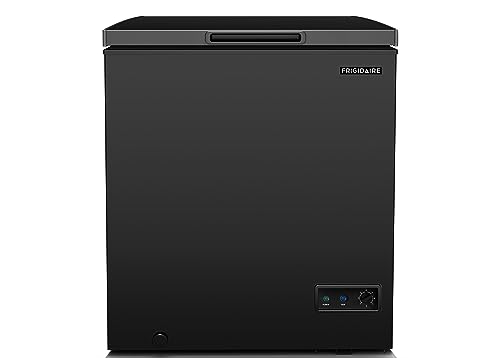
FRIGIDAIRE EFRF5003 Chest Freezer 5.0 Garage Ready — Best Garage-Ready 5.0
The EFRF5003 brings a freezer specialist’s checklist to the 5.0 class: garage-ready design in black, an adjustable thermostat, a removable vinyl-coated wire basket and an easy defrost drain. Read together, those four lines describe the most completely equipped small chest in this group for life outside the kitchen — the garage corner, the basement, the workshop — where a compact freezer so often ends up serving as the household’s overflow.
Garage readiness is the headline because it is the claim small freezers most often lack. Unheated spaces swing from summer heat that burdens a compressor to winter cold that can confuse a basic thermostat into letting the cabinet drift warm. A model designed and sold for that environment removes a whole category of doubt, and at 5.0 cu ft it means the little chest can take the garage slot that a bigger cabinet cannot fit, without thermal apology.
The vinyl-coated basket and the defrost drain are the maintenance pair. The coating protects both the basket and the packages it carries, resists the rust that bare wire grows in a frosty cabinet, and slides more kindly against bags. The drain converts the annual defrost into a directed flow rather than a bailing exercise — a feature owners consistently undervalue at purchase and overvalue, gratefully, every year thereafter. If your small chest will work hard in a cold garage, this is the pick built for that biography.
- Listed capacity: 5.0 cu ft, garage-ready
- Organisation: removable vinyl-coated wire basket
- Defrost help: easy defrost drain
- Control: adjustable thermostat; finish black
Strengths
- Garage-ready design suits unheated placement at this size.
- Defrost drain makes the annual thaw markedly easier.
- Coated basket resists rust and treats packages gently.
Trade-offs
- Garage virtues are wasted in a climate-controlled kitchen.
- Listing does not headline quietness for studio-flat placement.
- Black finish shows dust in bright garages and kitchens.
Best for: households placing a compact chest in a garage, basement or workshop.
Not suited for: buyers whose top priority is the quietest possible in-flat machine.
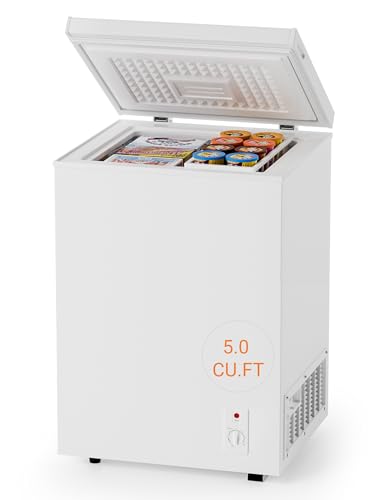
Ultra Quiet Deep Freezer 5.0 cu ft — Best Published Efficiency Figure
Most small-freezer listings speak in adjectives; this one publishes a number. Alongside its ultra-quiet positioning and fast-freeze claim, the listing states consumption of 0.36 kW.h per day — a figure an owner can actually reason with. Multiplied across a year it describes a modest, predictable appetite for an appliance that never sleeps, and it lets a renter or a budget-watcher place the freezer in the household accounts with unusual precision.
The ultra-quiet claim is the other half of its identity, and at this size it is aimed at the placements this size class exists for: homes, apartments and dorms, as its own listing says. A freezer beside a studio bed or under a study desk must earn its place acoustically as well as spatially. Mechanical temperature control keeps the machine’s philosophy simple — a dial, a compressor, manual defrost — and fast freeze addresses the small cabinet’s one physical anxiety, which is how quickly it pulls a fresh load down to temperature.
Manual defrost at this scale deserves a reassuring word. Emptying 5.0 cu ft into a cool box, letting a modest frost layer release, and wiping down is a small morning’s work, not the weekend campaign of a big chest. Owners who eat the cabinet down monthly will sometimes find the frost barely worth the name. For the noise-sensitive, efficiency-counting buyer, this model makes the most numerate case in the group.
- Listed capacity: 5.0 cu ft compact chest
- Energy in listing: 0.36 kW.h per day
- Control: mechanical temperature control; manual defrost
- Features: fast freeze, removable basket, freestanding
Strengths
- Published daily consumption allows real running-cost reasoning.
- Ultra-quiet positioning suits flats, dorms and home offices.
- Fast freeze helps fresh loads reach temperature promptly.
Trade-offs
- Manual defrost still requires the occasional planned thaw.
- No garage-ready claim for unheated placement.
- Efficiency figure is the maker’s; your room and habits will vary it.
Best for: noise- and energy-conscious buyers in flats, dorms and small homes.
Not suited for: garage placement in climates with hard winters or hot summers.
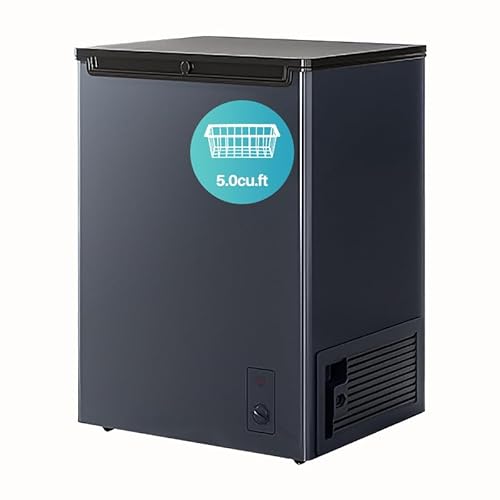
5.0 cu ft Chest Freezer 7 Temperature Settings — Best for Dorms and Apartments
Some listings are written for a room, and this one names three: dorms, apartments and home kitchens. Its proposition is a compact deep freezer with seven temperature settings, low-noise operation and a removable basket — the complete small-space brief. For a student household or a young renter, the significance is permission: frozen storage stops being limited to the sliver of icebox in a shared fridge and becomes a real, personal store.
Seven settings at this size is about matching loads, not chasing precision. Deep settings for the term-time stockpile of meat and batch cooking; a notch gentler when the cabinet holds mostly ice cream and bread for a few weeks. Because the steps are numbered, roommates and partners can share the setting knowledge — the cabinet’s correct number becomes household information rather than one person’s folklore, which in shared housing is worth more than it sounds.
Low-noise operation completes the dorm logic, because a dorm freezer lives in the room where its owner sleeps, studies and takes calls. Pair that with the basket — the difference between a cabinet you can use one-handed at midnight and one that requires excavation — and this model reads as the most socially adapted of the six. It does not promise garage heroics or commercial manners; it promises to fit a small life well, and that is the correct promise for its rooms.
- Listed capacity: 5.0 cu ft compact deep freezer
- Settings: 7 temperature settings
- Operation: low noise positioning
- Organisation: removable basket; dorm and apartment focus
Strengths
- Purpose-written for dorms, apartments and small kitchens.
- Numbered settings make shared-household use straightforward.
- Low-noise design respects sleeping and studying space.
Trade-offs
- No garage-ready or defrost-drain claims in the listing.
- Households will outgrow 5.0 cu ft as families and houses grow.
- Fewer specialist features than the Frigidaire’s equipped design.
Best for: students, renters and small households needing quiet, simple frozen storage.
Not suited for: garage overflow duty or bulk-buying families.

muhub 5.0 cu ft Chest Freezer — Best Energy-Saving Positioning
The muhub leads its listing with two words this category should use more: energy saving. Its design pairs that positioning with a seven-level adjustable thermostat, a top-opening door and a removable basket, in black, for kitchen or dorm use. Where the Ultra Quiet model publishes a consumption figure, the muhub makes efficiency its identity — a reasonable stance for an appliance whose entire life is spent drawing power in rooms where the bill is watched.
The seven-level thermostat supports the efficiency story in practice. Most waste in small freezers comes not from the compressor’s design but from owners running cabinets colder than their food requires, because an unmapped dial invites superstition. Numbered levels, once mapped with a thermometer, let you hold exactly the cold you need and no more — the setting becomes a decision rather than a habit, and the cabinet’s appetite follows.
As a kitchen-or-dorm machine in black, the muhub also understands its visual brief: it will be seen, daily, in rooms that are not utility spaces. A compact black chest in a kitchen corner reads as an appliance; the same cabinet in a dorm reads as furniture-adjacent infrastructure. Neither role requires apology when the machine is quiet, frugal and organised by its basket — which is the whole of this model’s argument, plainly made.
- Listed capacity: 5.0 cu ft
- Thermostat: 7-level adjustable
- Design notes: energy-saving positioning, top-opening door
- Organisation: removable basket; kitchen or dorm use
Strengths
- Energy-saving design leads the listing’s priorities.
- Seven levels support precise, repeatable temperature holding.
- Black compact format suits kitchens and dorm rooms visually.
Trade-offs
- No published consumption figure to verify the efficiency pitch.
- No garage-ready claim for unheated rooms.
- Brand is less established than the freezer-specialist names here.
Best for: bill-conscious buyers in kitchens and dorms who think in settings, not dials.
Not suited for: buyers who want a published kWh figure or garage placement.
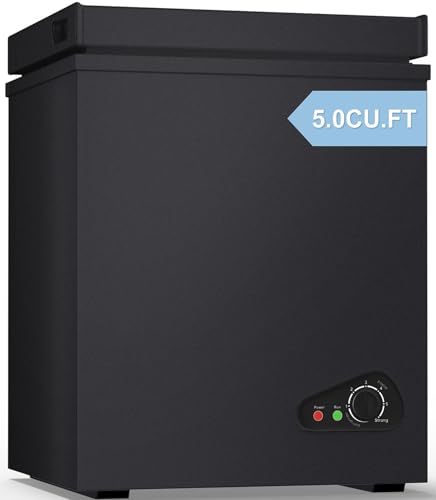
TABU 5.0 cu ft Chest Freezer — Best Low-Noise Black Cabinet
TABU’s 5.0 entry closes the group with the combination several buyers will recognise as their exact list: a compact black chest, seven-level adjustable thermostat, removable basket, low-noise operation and freestanding placement. It is the same formula the maker applies at 12 cu ft in our larger roundups, scaled down faithfully — stepped control, a basket for the daily layer, and quietness treated as a feature worth printing.
The seven-level thermostat at this size gives the cabinet a seasonal range: deeper cold when the little chest is entrusted with a month of meat, a step back when it is mostly holding ice cream, bread and leftovers. Because levels are repeatable, the household can keep a note — winter number, summer number — and the machine becomes predictable in a way free-spinning dials rarely achieve in shared or busy homes.
Low noise plus freestanding black design makes the TABU the flexible citizen of the group: kitchen corner, utility room, large pantry, a flat’s storage wall. It makes no garage claim and no efficiency boast, and its honesty about being a well-mannered indoor compact is itself a recommendation. Buyers whose freezer will live indoors, within earshot, and work as the household’s everyday store will find this the most balanced of the six plain propositions.
- Listed capacity: 5.0 cu ft, black
- Thermostat: 7-level adjustable
- Operation: low noise, freestanding
- Organisation: removable basket, top opening
Strengths
- Balanced indoor brief: quiet, stepped control, basket included.
- Seven levels make seasonal settings repeatable.
- Black finish integrates with kitchen and utility interiors.
Trade-offs
- No garage-ready or energy figure claims in the listing.
- No defrost drain is described for thaw days.
- Shares its formula with several rivals; the choice is one of emphasis.
Best for: indoor placement where quiet manners and stepped control matter most.
Not suited for: unheated garages or buyers wanting published efficiency data.
How Do the Six Compare on Controls, Noise and Placement?
| Pick | Badge | Control | Distinguishing claim |
|---|---|---|---|
| Mini Compact Black Chest | Best Classic Mini Chest | 7-step thermostat | Low-noise design, removable basket |
| FRIGIDAIRE EFRF5003 | Best Garage-Ready 5.0 | Adjustable thermostat | Garage-ready; defrost drain; coated basket |
| Ultra Quiet Deep Freezer | Best Published Efficiency Figure | Mechanical control | 0.36 kW.h/day listed; fast freeze; ultra quiet |
| Seven-Setting Compact Chest | Best for Dorms and Apartments | 7 temperature settings | Low noise; dorm and apartment focus |
| muhub Compact Chest | Best Energy-Saving Positioning | 7-level thermostat | Energy-saving design; kitchen or dorm |
| TABU Compact Chest | Best Low-Noise Black Cabinet | 7-level thermostat | Low noise; freestanding black cabinet |
How Much Food Does 5.0 Cu Ft Hold in Real Shopping?
Picture a deliberate weekly shop, frozen. Five cubic feet accommodates, in practical mixed loads, several kilograms of portioned meat in flat bags, a stack of loaves and pizza bases, bags of peas, fruit and oven chips, a few tubs of batch-cooked meals, butter, ice cream and the basket above carrying the week’s working items. For one or two people who shop weekly and cook from frozen three or four nights, that is not a compromise cabinet; it is the correct size of store.
The size shows its edges at predictable moments: the whole large turkey, the warehouse-club month, the garden’s August. Households that regularly freeze at that scale should step up to the 7 cu ft class or beyond rather than wage a weekly packing war. The honest test is your peak, not your average — but also not your fantasy. Most small households discover their true peak is a holiday bird that can, with planning, be bought fresh, while their everyday peak fits 5.0 cu ft with room to spare.
Think of the capacity as a shelf system: basket for this week, upper layer for this month, bottom for the archive of two or three treasured items. Run that way, a small chest delivers the essential freezer benefits — buying ahead, cooking ahead, wasting less — at a footprint and appetite a small home can absorb without negotiation.
Where Can a Small Chest Freezer Sensibly Live?
Almost anywhere with three provisions: a level floor, a power socket, and breathing room around the cabinet for the air its cooling system moves. Kitchens take it in a corner or under a worktop run’s end; utility rooms and large pantries are natural homes; a hallway alcove in a flat works if the lid can open fully and the compressor’s hum will not colonise the night. The listings’ own placements — dorms, apartments, offices, kitchens — reflect how domesticated this size has become.
Garages and basements are the exception that requires a claim. Only the Frigidaire in this group declares garage readiness, and that declaration is the difference between a machine designed for temperature swings and one merely surviving them. A mild-climate garage that never freezes or roasts is a gentler case, but the honest rule stands: unheated space, garage-ready model, or accept a shorter and less predictable life.
Two placement errors recur. The first is sealing the cabinet into a tight cupboard with no airflow, which cooks the compressor slowly. The second is standing it on deep carpet or an uneven floor, where it rocks, seals imperfectly and hums against the boards. A small chest is light enough to reposition in minutes; spend those minutes, because placement decided once is performance decided for years.
How Do You Organise a Freezer With One Basket?
Treat the basket as the present tense. It holds what this week will eat: the open bags, the ice cream, the bread in rotation, the leftovers awaiting their second act. Everything in it should be visible at a glance and reachable one-handed, because the basket’s whole purpose is to spare you the dig. When the basket becomes a storage layer for forgotten items, the system has already failed politely.
Below it, freeze flat and file upright. Bags of mince, soup, sauces and produce, frozen flat on a tray first, stand in rows like envelopes and can be thumbed through like a card index. Boxes and tubs stack in the corners; the irregular items — a chicken, a joint — take the centre floor. Label every package with contents and date at the moment of freezing, in marker, without exception for items you are sure you will remember. You will not remember; nobody does.
Keep the inventory tiny and visible: a note on the lid or the wall, updated in pencil, listing what sleeps below the basket. At 5.0 cu ft the list fits on an index card, and that card is what turns a small freezer from a lucky dip into a store. Eat down the oldest line on the card first, and the cabinet will never develop the archaeological stratum that shames owners of larger machines.
What Do the Energy and Noise Claims Really Mean?
A freezer runs continuously, so small numbers compound. The Ultra Quiet model’s listed 0.36 kW.h per day is the group’s only hard figure, and it sketches the class’s scale: a daily consumption comparable to leaving a modest appliance running, spread across every hour. The muhub’s energy-saving positioning makes the same point without a figure. Your real consumption will move with room temperature, how full the cabinet runs, how often the lid lifts and how cold you set it — which is why mapping the thermostat to 0°F, rather than to maximum, is an energy decision as much as a food one.
Noise claims need the same translation. No listing here publishes a decibel figure, so “low noise” and “ultra quiet” are comparative promises within the class, best honoured by placement: a solid floor, a level cabinet, a little distance from the bed or desk. A small chest’s compressor cycles rather than drones, and most owners habituate within a week; the minority who are highly sound-sensitive should weight the two quiet-positioned models — the Ultra Quiet and the TABU — and test the placement with the room’s door closed at night.
Together, these claims define the modern small freezer’s bargain: cold storage cheap enough and quiet enough to live inside the home’s ordinary rooms. That is a genuine change from the garage-only era, and it is why this size class keeps growing even as houses, in many places, do not.
How Does Defrosting Work at This Scale?
Pleasantly, compared with its bigger cousins. Eat the cabinet down over a week, move what remains into a cool box or a neighbour’s shelf, switch off, lid open, towels down. The frost in a 5.0 cu ft chest is a modest layer, and bowls of hot water set inside will loosen it within the hour. The Frigidaire’s easy defrost drain lets meltwater leave by design; the other models ask for a jug and a sponge, which at this volume is a ten-minute task rather than a grievance.
Never chip ice with metal near the walls, where refrigerant lines run unseen; plastic tools and patience are the approved instruments. Wipe the interior dry before restarting — a dry cabinet re-frosts more slowly — and let it return to temperature before the food comes back. Use the empty moment to check the lid seal with a sheet of paper and to retire any package whose label has become archaeology.
Frequency is modest: once or twice a year for most homes, sooner in humid rooms or with heavy lid traffic. Because the chore is small at this size, owners actually do it — which quietly means the small chest often runs closer to its intended efficiency than a neglected giant twice its price.
How Does a Small Chest Change a Small Household’s Cooking?
The first change is that batch cooking becomes rational at small scale. A pot of soup for two becomes a pot for eight, eaten twice and frozen four times, because the surplus has a home that is not the fridge’s back corner. Sauce, stock, cooked grains and marinated meat all become make-ahead ingredients, and the weeknight question shifts from what can be cooked to what should be thawed — a shorter question with better answers.
The second change is shopping shape. With a real freezer, the household can accept the larger, cheaper pack sizes that small kitchens usually refuse: the family bag of chicken for a couple, the seasonal fruit glut, the bakery’s end-of-day loaves. Food waste falls in both directions at once — less bought desperately at high prices, less thrown away because the fridge could not hold the surplus. For renters and students especially, the little chest quietly functions as a raise.
The third change is hospitality. A small household with a stocked freezer can feed unexpected guests from its store, keep ice and a dessert in permanent readiness, and say yes to the neighbour’s garden surplus or the family visit with a dish to spare. None of this requires the cabinet to be large; it requires it to be organised, which is why this guide spends as many words on baskets and lists as on compressors.
What Should You Check in the First Fortnight of Ownership?
Begin with temperature truth. Put a freezer thermometer inside on day one, let the cabinet settle, and map the thermostat: which step or level holds 0°F in your room. Write the answer on a card taped beside the machine, with the date. Rooms change with seasons, and a setting verified in spring may drift in a hot August kitchen; the card turns that drift into a ten-second check rather than a spoiled shelf.
Load gradually and label fanatically from the first package. Habits formed while a freezer is half-empty set like concrete; the household that labels in week one is still labelling, effortlessly, in year three. Assign the basket its weekly role, freeze the first bags flat on a tray to establish the filing system, and photograph the interior once it is stocked — the photograph becomes the shopping list’s memory and prevents the duplicate purchases that small cabinets cannot afford.
Listen to the machine across the fortnight. Learn its normal cycle — when the compressor runs, how it sounds at night, how the lid seal feels when it closes well. That baseline is your diagnostic instrument for the appliance’s whole life: the owner who knows the normal sound hears the abnormal one in its first week, when the fix is still small. A freezer bought attentively in its first fortnight mostly vanishes into the household thereafter, humming at the edge of attention, which is exactly where it belongs.
How Long Should a Small Chest Last, and What Decides It?
Small chests share the format’s longevity: a simple sealed system with few moving parts, commonly good for well over a decade of service. The deciding factors are unglamorous — a seal kept clean and supple, frost never allowed to become geology, ventilation unblocked, and a floor level enough that the lid closes true ten thousand times. None of these costs money; all of them cost attention in small, regular instalments.
Environment is the multiplier. A cabinet in a cool, dry utility room ages slowly; the same cabinet in a steamy kitchen corner or a damp garage corner works against its surroundings every hour. This is why the placement sections of this guide carry as much weight as the product sections: the best small freezer, badly placed, will be outlived by a modest one placed with care. Choose the room as carefully as the model.
When a small chest finally ages, it usually announces itself honestly — longer cycles, uneven cold, frost blooming despite defrosting. At this size the replacement decision is refreshingly simple, because the new cabinet will fit the old one’s footprint exactly. Owners who kept the inventory card and the label habit transfer their whole system in an afternoon, which is the last dividend of having run the little machine properly.
Why a Chest, and Not a Small Upright, at This Size?
Shoppers at 5.0 cu ft often meet the format question for the first time, and it deserves a straight answer. A chest holds cold better when opened, because its cold air pools inside rather than spilling from a front door; it accepts awkward shapes without shelf geometry arguing back; and it usually gives more volume for the money. Its tax is access — you reach down into it — which at this shallow size is a small tax indeed, since nothing in a 5.0 chest is ever truly buried.
An upright at this size answers with visibility: shelves at standing height, everything surveyed in one glance. Households with mobility limits, or a deep dislike of leaning into a cabinet, may rightly prefer it. But for the broad middle of small households — flats, couples, dorms, garage corners — the chest’s efficiency, simplicity and price logic win the argument, and its one-basket shallowness neutralises the format’s classic weakness.
The deciding question is behavioural. If your household will keep a list and file bags upright, the chest will reward you for a decade. If your household freezes by tossing and hopes by memory, no format will save it, but the upright will at least show it the evidence. Choose the machine that matches the people, not the brochure.
How Do You Freeze Food Well in a Small Cabinet?
Small freezers reward good freezing technique disproportionately, because there is no spare volume to hide mistakes in. Cool food fully before it enters, portion it into the sizes you will actually cook, and wrap it against air with a devotion that borders on ceremony: air left in a bag is freezer burn scheduled for March. Bags pressed flat freeze fast, store like files and thaw in a bowl of water in the time a tub needs to think about it.
Freeze new items in a single layer on top of the existing stock or on a tray, then file them once solid. A warm mound placed in the centre raises its neighbours’ temperature and freezes slowly at its own heart, damaging texture in everything it touches. At 5.0 cu ft the landing area is small, which teaches the right habit automatically: little and often beats the monthly avalanche, in freezing as in shopping.
Respect the boundary between safety and quality. Held at 0°F, food stays safe far longer than it stays delicious; fats stale, textures slacken, herbs fade to a memory of themselves. The inventory card exists to enforce rotation before quality leaves. A small cabinet run on short cycles — most things eaten within a few months — quietly delivers better food than a large one run as an archive, which is the small format’s secret culinary advantage.
What Happens to a Small Freezer in a Power Cut?
The same physics as its big cousins, on a shorter clock. A full, unopened 5.0 chest holds safe cold for roughly a day, give or take the room’s temperature and how full it truly is; a half-empty one for considerably less. The household rules are identical and worth repeating in small: keep the lid shut, keep the cabinet full in ordinary times with water bottles as ballast, and let a thermometer, not optimism, judge the food afterwards.
Small cabinets have one underappreciated advantage in an outage: they are movable and their contents are few. The whole store can be transferred to a neighbour’s freezer or packed into cool boxes with ice in minutes, and a small generator or a car’s inverter — where safely usable outdoors — can keep a 5.0 chest alive far more easily than a big one. Resilience at this size is partly a matter of being easy to rescue.
Afterwards, triage without sentimentality. Items still icy or refrigerator-cold can be cooked or refrozen promptly; anything warm, leaking or doubtful leaves. Then note the lesson the outage taught — usually that the cabinet should run fuller, or that the ice packs should live in it permanently — and let the little machine return to its unnoticed work.
How Do the Seasons Show Up in a Five-Cubic-Foot Cabinet?
Summer fills it with ice, berries, barbecue stock and the ice creams that justify it to every child who opens the lid. It is also the season of warm rooms and hard-working compressors, when the thermometer check earns its card and the ventilation gap behind the cabinet proves it was not a superstition. A small chest in a hot flat works honestly in August; give it air and it will give you August back, frozen.
Autumn brings the preserving household’s small harvest — beans, fruit, the last herbs — and the first batch-cooking of the soup season. Winter makes the cabinet the home’s quiet insurance during storms and illnesses, and the season when its stock should be eaten down deliberately, oldest first, so that spring’s defrost meets a nearly empty box. Each season asks a slightly different setting, load and discipline, and the seven-step thermostats across this group exist to make those adjustments repeatable.
Households that learn this rhythm stop thinking of the freezer as an appliance and start treating it as a pantry with a temperature. That shift — from box to system — is the real product being bought at 5.0 cu ft, and it is available at every price point in this roundup, which is precisely why the roundup is decided by placement, noise and control rather than by capacity.
What Should You Verify on the Listing Before a Small Chest Ships?
Start with dimensions, because small rooms forgive nothing: width, depth and, most forgotten, the height the lid needs to stand open against a wall or under a shelf. Check the stated basket provision — every model in this group includes one, but coatings and sizes differ — and the control style you are actually getting, whether stepped levels or a plain dial, so the machine that arrives matches the household that will run it.
Verify placement claims against your room rather than your hopes. Garage duty requires the garage-ready claim, which only the Frigidaire carries here; in-flat quiet duty argues for the quiet-positioned models. Confirm the defrost arrangement too, since a drain is a feature you will bless annually and its absence is a chore you will meet annually. Small appliances are bought quickly and lived with slowly, and the listing’s fine print is where the living gets decided.
Finally, plan the delivery like furniture, not like a parcel: door widths, stairs, and where the packaging will go. A compact chest is light enough for most adults to position once it is inside, which is one of the format’s genuine pleasures — no installers, no plumbing, no ceremony. Socket, level floor, breathing room, thermometer: the whole commissioning kit fits in one sentence and one small shopping trip.
How Do You Decide Between These Six in Ten Minutes?
Ask three questions in order. Where will it live? A garage or basement answer selects the Frigidaire almost by itself; a bedroom-adjacent or studio answer elevates the Ultra Quiet and the TABU; a dorm answer points to the seven-setting dorm-focused model. What will you count? Buyers who track bills will value the Ultra Quiet’s published consumption or the muhub’s energy-saving design; buyers who count settings will take a seven-level machine and map it once. What will you tolerate? A defrost with towels, or only with a drain — the Frigidaire again — and a dial you set by feel, or levels you set by number.
Notice what the ten-minute method never asks: which is biggest, because they are all the same size, and which is best in the abstract, because at identical capacity the abstract does not exist. The right 5.0 chest is the one whose claims match your room, your ears and your habits. Decide those three honestly and the model chooses itself, which is the surest sign the decision was framed correctly.
How Does a Compact Chest Serve a Household Through a Busy Year?
January eats down the festive surplus and resets the inventory card. Spring brings the first defrost, an empty-cabinet audit and the garden’s early greens. Summer tests the machine hardest — hot rooms, ice demand, barbecue stock — and rewards the owner who mapped the thermostat before the heat arrived. Autumn refills it with preserving and batch cooking, and winter leans on it as insurance when weather and illness make shopping a negotiation. A small freezer’s year is a household’s year, told in frozen form.
Through all of it, the machine’s demands stay modest: a clean seal, a defrost kept, a list kept honest. That modesty is the deepest argument for the size. Large appliances command routines; this one joins them. For the small household deciding whether frozen storage is worth the floor, the answer this roundup keeps returning to is that five cubic feet, well run, is not a compromise at all — it is a pantry that happens to be cold, and pantries have never needed to be large to be life-changing.
What Mistakes Do Small Freezer Buyers Make?
The sizing mistakes come first: buying 5.0 cu ft for a bulk-buying family of five, or dismissing it for a single-person flat whose owner then fills a 7 with three bags and a pizza. Next comes placement — an unventilated cupboard, a rocking floor, an unheated garage with a model never claimed for it. Third is control superstition: running the dial at maximum forever, paying to keep ice cream at temperatures meant for long meat storage.
Daily mistakes are smaller and sadder. Unlabelled packages that become mystery meat within a month. A basket treated as deep storage. Warm food loaded in a mound so its centre freezes slowly. A lid left propped open during a long unpacking. None requires money to fix — only the modest systems this guide describes: labels, a list, a mapped thermostat and a basket with a job description.
Final Recommendation
Choose by room, then by temperament. If the little chest will live in a garage or basement, the FRIGIDAIRE EFRF5003 is the only pick here designed for that life, drain included. If it will share your living space, the Ultra Quiet Deep Freezer makes the most numerate, neighbourly case, with its published daily consumption and fast freeze. And if you simply want the classic compact chest with a seven-step thermostat and a basket, the black mini chest that opens this guide remains the form in its purest state — five cubic feet, honestly organised, will change a small household’s kitchen more than appliances three times its size.
Frequently Asked Questions
Is 5.0 cu ft big enough for a couple?
For most couples, yes, comfortably: it holds several weeks of portioned meat, batch cooking, bread, vegetables and treats when food is frozen flat and organised with the basket as the weekly layer. Couples who buy meat in whole-animal quantities or host large holidays from frozen stock should consider the 7 cu ft class instead.
Can a small chest freezer go in a bedroom or studio flat?
It can, and the quiet-positioned models here — the Ultra Quiet and the low-noise TABU and dorm-focused model — are designed with such rooms in mind. Give it ventilation clearance, a level solid floor and a little distance from the bed, and expect a gentle compressor cycle rather than silence; no freezer is truly silent.
What temperature should I set on a seven-step thermostat?
Whichever step holds the cabinet at 0°F or below, verified with an inexpensive freezer thermometer left inside overnight. The correct step varies with room temperature and load, which is why the mapping exercise matters more than any number printed in a guide — find yours once, note it, and revisit it when the seasons change.
How much does a 5.0 cu ft freezer cost to run?
The only published figure in this group is the Ultra Quiet model’s listed 0.36 kW.h per day; multiply a figure like that by your electricity price per kW.h for a daily estimate. Real consumption rises in hot rooms, with frequent lid opening and with settings colder than food safety requires, and falls in cool rooms with a full, well-sealed cabinet.
How long does a small chest take to freeze food after I switch it on?
Let it run empty until it reaches temperature first — typically within the first day — and only then begin loading, in stages. Food added gradually to a cold cabinet freezes promptly; a full load of room-temperature shopping added at once will take much longer and warm everything around it, which is why the staged habit is worth forming on day one.
Do I need to defrost a small chest freezer?
Yes, periodically — these are manual-defrost machines — but at 5.0 cu ft the task is small: an hour or so once or twice a year, less if your room is dry and the lid discipline is good. The Frigidaire’s defrost drain makes its version the easiest in this group.
Can I put a 5.0 cu ft freezer in my garage?
Choose the model that claims it: the Frigidaire EFRF5003 is listed as garage-ready. Other models in this group make no such claim and belong indoors, where temperatures stay moderate. A garage that never freezes or overheats is a gentler case, but the claim, not the hope, is what the machine was designed around.
Related Guides
Small chests are one step on a capacity ladder that runs from these compact cabinets to the big family uprights — explore Best 7 Cu Ft Freezers, Best 500 CFM Range Hoods, Best Apartment-Size Dryers.


