What's inside
- Key Takeaways
- Quick Picks
- How We Chose These Picks
- How Do the Six Compare at a Glance?
- How Much CFM Does Your Range Actually Need?
- Why Does the Same Hood Perform Differently in Two Kitchens?
- What Does a Speed Setting Actually Divide?
- How Does Duct Size Rewrite a Hood’s Rating?
- When Is Less Than 500 CFM the Correct Answer?
- How Should You Test Whether Your Hood Is Enough?
- How Do Burner Totals Translate Into Airflow?
- What Role Does Kitchen Volume Play?
- How Should You Read a Hood’s Specification Like an Engineer?
- How Does Recirculation Change the CFM Question?
- What Will the Next Decade Ask of This Purchase?
- How Do You Compare Two Hoods With the Same Rating?
- What Does Installation Day Reveal About a CFM Figure?
- How Should a Growing Household Future-Proof Its Choice?
- Why Does This Guide Trust Delivered Air Over Printed Air?
- What Is the Sensible Order of Upgrades Around This Class?
- How Do You Keep a Mid-Class Hood Delivering Its Figure?
- Which CFM Mistakes Do Buyers Make Most Often?
- Final Recommendation
- Frequently Asked Questions
- Related Guides
As an Amazon Associate I earn from qualifying purchases. This post may contain affiliate links at no extra cost to you.
cottageverdict.com is reader-supported. When you buy through links on our site, we may earn an affiliate commission.
Where to buy: the six hoods below link to their own Amazon listings, where each model’s exact rated airflow, duct size, and speeds can be confirmed — a habit this particular guide recommends more warmly than most. The best 500 CFM range hoods need an honest word before any ranking begins: 500 CFM is a class, not a uniform. The six machines gathered here span 280 to 580 CFM, gathered around the 500 mark the way a neighbourhood gathers around a village green, and pretending each one delivers exactly five hundred would be a disservice this guide declines to perform.
That spread is a feature, because the real question in this class is not which hood owns the roundest number but how much airflow a given kitchen actually needs. A 30-inch electric hob used for family suppers asks for a fraction of what a 36-inch gas range at full stretch produces, and both can be served from this page — the first by the 280 and 300 CFM models, the second by the 580 CFM pair, with the 380 and 450 CFM machines holding the broad, useful middle.
So this guide is organised around a calculation rather than a coronation. The reviews give each model its honest figure and its honest job; the sections that follow explain how to work out your own number from your burners, your duct, and your cooking, so the figure you buy is the figure your kitchen needed — not the figure a headline found easiest to print.
Key Takeaways
- The 500 CFM class spans 280 to 580 CFM in this guide — treat 500 as a neighbourhood, not a specification.
- Work out your need from the range: gas burners and wide hobs ask more, gentle electric cooking asks far less.
- A common planning rule matches roughly 100 CFM per linear foot of range for wall hoods, adjusted for cooking style.
- Duct size can quietly demote any of these ratings; a 580 on a skinny run may deliver like a 380 on a good one.
- The two VIKIO HOME models at 580 CFM top this class; the SNDOAS at 450 and Cosmo at 380 hold its centre.
- The 280 and 300 CFM models are complete answers for small electric hobs and short ducts — not failed 500s.
Quick Picks
| Model | Badge | Why it earns a place |
|---|---|---|
| SNDOAS 36in 450CFM | Centre of the Class | 450 CFM in a 36-inch chimney-style wall mount with three speeds, push buttons, LED light, and convertible venting. |
| VIKIO HOME 36in 580CFM | Top of the Class, 36-Inch | 580 CFM with low-noise billing, touch control, three speeds, and LED lights in a 36-inch wall-mount body. |
| VIKIO HOME 30in 580CFM | Top of the Class, 30-Inch | The same 580 CFM and low-noise brief in a 30-inch wall-mount body for smaller ranges that cook above their size. |
| Cosmo Vista 380CFM | Baffle-Equipped Middle | 380 CFM with permanent dishwasher-safe baffle filters, push buttons, three speeds, and a backdraft damper. |
| FIREGAS 300CFM Stainless | Small-Duct Realist | 300 CFM with two speeds, rocker switches, LED light, and top or rear venting in a ducted or ductless convertible body. |
| Under Cabinet 280CFM | The Honest Minimum | 280 CFM in a slim under-cabinet body with rocker button control, two speeds, LED light, and convertible ducting. |
How We Chose These Picks
Selection for this class began with a refusal: no model would be described as a 500 CFM hood unless its listing said so, and none of these six says exactly that. Instead we assembled the honest neighbourhood around the figure — 280, 300, 380, 450, and a pair at 580 — because that is the shelf a shopper searching this class actually faces, and because each step on that ladder serves a recognisable kitchen. Every model had to offer real ducted service or a genuine conversion path, since the class’s purpose is extraction rather than recirculating decoration.
Within the ladder we weighted delivered performance over printed performance: filter designs that hold their airflow, canopies deep enough to gather a plume, and controls a cook will actually use at the moment of need. The result is a guide that can be read two ways — as six reviews, or as a worked example of how to size extraction — and we recommend the second reading to anyone whose kitchen does not obviously match one of the six.
The ladder in one breath: the SNDOAS 36in 450CFM is the class’s centre for a full-size range; the VIKIO HOME 36in 580CFM tops it where headroom and quiet matter; and the Cosmo Vista 380CFM trades headline figure for baffles that keep its delivered airflow honest.
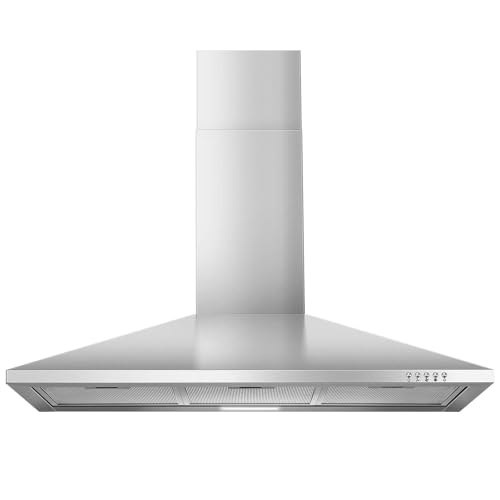
SNDOAS 36 Inch Range Hood 450CFM — Centre of the Class
If the 500 class has a centre of gravity, the SNDOAS sits on it: 450 CFM across a 36-inch chimney canopy, three speeds, push buttons, and an LED light, in stainless that suits most kitchens without consulting them. The figure deserves respect rather than apology — over a 36-inch range used the way families use one, 450 CFM delivered through a decent duct clears the plume completely, and the chimney’s gather does work that a slim panel at the same rating cannot.
Three speeds divide 450 CFM into useful portions. The lowest ventilates a sauce in near-silence; the middle is the household’s daily gear; the top exists for the frying pan’s ambitious minutes. Push buttons keep the summoning of each speed unambiguous through steam, and the convertible venting lets the machine start life recirculating in a pinch — though at this width and output, ducting is where its character completes itself.
As the class’s reference point, it also exposes the arithmetic honestly: a household that finds 450 sufficient has no reason to chase 580, and a household whose gas range defeats 450 will not be rescued by hoping. The SNDOAS is the measuring stick against which the rest of this guide’s claims can be checked.
Ownership of the SNDOAS settles into a comfortable pattern within a month. The middle speed becomes the household’s default gear for everything from a Sunday roast to a tray of roasted vegetables, the buttons acquire the faint polish of daily use, and the chimney overhead stops being a new object and becomes simply where the kitchen’s air goes. That disappearance into routine is the middle rung’s whole virtue — enough extraction that the subject never comes up, in a format handsome enough that nobody minds it hanging there. Households replacing a same-width slim panel notice the canopy difference most: the plume has somewhere to gather now, and the room can tell.
There is also a resale-flavoured argument for the SNDOAS’s rung that deserves airing. A 36-inch chimney at 450 CFM photographs and inspects as a serious, complete installation — the thing buyers and surveyors both nod at — without the makeup-air questions a four-figure flagship invites in a tight modern house. It is the largest figure in this guide that can be recommended to an unknown kitchen with a clear conscience, and that universality is a kind of specification in itself.
- Airflow: 450 CFM listing figure
- Format: 36-inch chimney-style wall mount
- Speeds: three-speed exhaust fan
- Controls: push-button panel
- Lighting: LED over the hob
- Vent path: ducted or ductless convertible
Strengths
- Balanced output for a full-size range
- Chimney canopy deepens capture
- Simple, durable control layout
Trade-offs
- Not the ceiling for pro-style gas output
- Buttons only, no remote options
- Recirculating mode undersells it
Best for: 36-inch ranges and ordinary ambitious family cooking.
Not suited for: six-burner ranges run at constant full stretch.

VIKIO HOME 36 Inch Wall Mount Hood 580CFM — Top of the Class, 36-Inch
The VIKIO HOME’s 580 CFM is this class’s ceiling at the 36-inch width, and the machine wraps that figure in a low-noise brief that open-plan households will read twice. Touch control, three speeds, and LED lighting complete a specification aimed at the kitchen that cooks seriously and converses simultaneously — a combination more common, and more demanding, than either trait alone.
What 580 buys over 450 is headroom with manners. The same dinner that asks the SNDOAS for its top speed asks the VIKIO for its middle, and a fan loafing at its middle is a quieter, calmer appliance than a smaller fan at full voice. That is the honest case for buying above your calculated need by one step: not more capture on paper, but the same capture at a lower, livable volume.
Ductless conversion is available and, as ever, is the bridge rather than the destination. Ducted on a sound run, the low-noise engineering makes structural sense — the fan is never fighting its own exhaust — and the 36-inch wall-mount format gives a wide range a finished, deliberate look without a chimney’s full ceremony.
The VIKIO at 36 inches finds its people among hosts. Its party trick is arithmetic made social — a full range working, a room full of guests, and a fan clearing the air from its middle setting while nobody raises their voice. Owners who cook in the open learn to trust the headroom the way drivers trust a larger engine on a hill: rarely used, constantly reassuring. The touch panel, wiped as part of the post-dinner ritual, stays responsive, and the machine’s calm becomes part of the kitchen’s hospitality. It is the rung this guide recommends when the brief includes the words open-plan and often.
Running costs follow the same calm logic as the VIKIO’s purchase logic. A motor loafing at its middle draws modest power while moving family-sized air, and its filters and lamps ask for nothing exotic across a decade. The household that buys one rung of headroom discovers the dividend is paid in three currencies at once — quieter evenings, lower effort, and a system that never feels like it is working at its limit, because it almost never is.
- Airflow: 580 CFM listing figure
- Width: 36-inch wall mount
- Character: low-noise design emphasis
- Controls: touch panel
- Speeds: three-speed fan with LED lights
- Vent path: ducted or ductless convertible
Strengths
- Class-leading power at this width
- Headroom buys quieter daily running
- Clean touch interface and lighting
Trade-offs
- Premium output wasted on tiny ducts
- Touch face needs degreasing wipes
- More than gentle cooking requires
Best for: open-plan kitchens with a 36-inch range.
Not suited for: small galley kitchens with minimal cooking.

VIKIO HOME 30 Inch Wall Mount Hood 580CFM — Top of the Class, 30-Inch
A 30-inch range under a 580 CFM hood is a deliberate mismatch in the cook’s favour, and this VIKIO HOME exists for households that want exactly that. The narrower canopy concentrates the same class-topping airflow over a smaller hob, so a keen cook working a modest range — the wok enthusiast in a small flat, the searing devotee in a cottage kitchen — gets extraction that bigger kitchens usually monopolise.
The low-noise emphasis travels with the figure, and at 30 inches it matters more, not less: small kitchens are usually close to the rest of the home, and a fan that can clear a stir-fry at conversational volume changes whether extraction gets used at all. Touch control and three speeds keep the interface as compact as the canopy, and the LED lighting covers a 30-inch hob completely.
Proportionality deserves its sentence. A household boiling pasta under this machine has bought a sports car for the school run — harmless, even enjoyable, but unnecessary. A household whose small range works hard will find the VIKIO the most precisely overqualified hood in this guide, and overqualification, in extraction, is a luxury that pays out nightly.
At 30 inches the big VIKIO creates a small kitchen with an unfair advantage. Wok cooking, which in most small flats is a negotiation with the smoke alarm, becomes an ordinary weeknight event; the plume is claimed so completely that the rest of the flat never learns what happened. The cook develops a loyalty to the arrangement that puzzles owners of larger, weaker systems — proof, if the category needed it, that delivered capture is a product of concentration as much as of volume. Small kitchens are where this guide’s ladder logic bites hardest, and this rung is its sharpest example.
The 30-inch VIKIO also makes an unexpected case as a rental-grade upgrade for landlords with keen-cook tenants — the sort of small flat whose kitchen is its selling point. Its extraction protects the paintwork, the cabinets, and the deposit conversation at the end of the tenancy, because a kitchen that exports its cooking leaves far less evidence behind. Landlords who have paid for one deep clean too many tend to understand this arithmetic immediately.
- Airflow: 580 CFM listing figure
- Width: 30-inch wall mount
- Character: low-noise design emphasis
- Controls: touch panel operation
- Speeds: three-speed fan, LED lights
- Vent path: ducted or ductless convertible
Strengths
- Maximum capture over a small hob
- Quiet running suits compact homes
- Concentrated canopy suits wok work
Trade-offs
- Overqualified for gentle cooking
- Needs a duct that can feed it
- Wall-mount only, no cabinet fit
Best for: small ranges worked hard by keen cooks.
Not suited for: households whose hob mostly boils and simmers.

Cosmo Vista 36in Wall Mount Hood 380CFM — Baffle-Equipped Middle
The Cosmo Vista’s 380 CFM reads modestly in this company until its filters enter the discussion. Permanent baffles, washed in a dishwasher, keep the system’s resistance constant under greasy cooking in a way mesh cannot — which means the Vista’s delivered airflow in month six resembles its delivered airflow in week one more closely than rivals whose filters fade between washes. In a class obsessed with a number, that consistency is a quiet form of honesty.
Push buttons and three speeds keep the daily operation plain, and the included backdraft damper protects the kitchen from the chimney effect of its own duct on cold nights. The Vista chimney styling gives a 36-inch range a finished wall presence, and its ducted design exports steam completely — the benefit family kitchens feel in their paintwork over years.
Place it where the cooking is regular, greasy in the ordinary family sense, and unhurried: roasts, breakfasts, curry nights. It will not chase a pro-range’s plume, and this guide contains machines for that household further up the page. Within its brief it is arguably the class’s best-engineered value, because it spends its money on the parts that determine delivered performance rather than on the figure printed largest.
Vista households develop a relationship with their dishwasher that other hood owners never quite understand, because the baffles’ monthly cycle through it is the moment the kitchen’s air is renewed. The ritual is brief — baffles out, hot cycle, baffles back — and the effect is a system whose month-six performance is a photocopy of its first week. In a class where rivals quietly fade between filter washes, that constancy is the Vista’s argument, and families who fry often make it with the confidence of people who have kept the receipts.
Cosmo’s damper, unglamorous as it sounds, is the Vista detail its owners mention in winter. A duct is a hole in the house’s thermal envelope, and on a still, freezing night an undamped chimney breathes cold air down onto the cook’s shoulders. The Vista’s included damper closes that account, and the household feels the difference as an absence — no draught, no whistle — which is the form most good building engineering takes.
- Airflow: 380 CFM ducted rating
- Filters: permanent baffles, dishwasher-safe
- Controls: push-button panel
- Damper: backdraft damper included
- Speeds: three fan settings
- Design: Vista wall-mount chimney, 36-inch
Strengths
- Delivered airflow stays consistent
- Baffles suit regular family frying
- Damper guards against cold draughts
Trade-offs
- Lowest ceiling among the wide models
- No touch or remote conveniences
- Needs ducting to show its quality
Best for: family kitchens cooking greasy food regularly.
Not suited for: high-output gas ranges at full stretch.

FIREGAS Range Hood 30 inch Stainless 300CFM — Small-Duct Realist
Three hundred CFM is where this guide’s honesty is tested, and the FIREGAS passes by being exactly what its number says: a compact extractor for a 30-inch hob, a short duct, and cooking that values steadiness over spectacle. On a brief run through an outside wall, its 300 CFM genuinely exhausts — steam leaves, smells leave — which no amount of recirculating theatre at higher figures can claim.
Top and rear venting gives it two chances to meet an existing opening, rocker switches give every household member an interface they already understand, and the convertible design forgives the kitchen whose duct turns out to be imaginary. Two speeds are a fair match for its brief: one for the ordinary, one for the smoky.
The FIREGAS is also the class’s reminder that airflow interacts with house size. In a small flat, 300 CFM of real exhaust changes the air briskly without the pressure dramas a giant motor brings to a sealed box. Bought for the right building, it is not the budget compromise of this guide; it is the proportionate answer, wearing a stainless finish and asking only for a washed filter in return.
The FIREGAS collects a particular kind of review: the surprised one, from a household that expected a budget appliance and got a transformation. The cause is almost always the short duct behind it, quietly delivering the full modest figure to the canopy while grander installations elsewhere are being throttled by their plumbing. It teaches the category’s central lesson in its cheapest form — that the system, not the sticker, decides — and it teaches it to exactly the households most likely to be shopping by sticker alone.
Simplicity is the FIREGAS’s maintenance department, staffing department, and warranty philosophy combined. Rocker switches do not need firmware, two speeds do not need a manual, and a filter that washes in the sink does not need a subscription. Households that have been burned by clever appliances recognise the pattern with relief: this is equipment from the era when a hood was a fan, a light, and a box, improved only where improvement was free of consequences.
- Airflow: 300 CFM listing figure
- Venting: top or rear, ducted or ductless
- Fan: two-speed exhaust
- Controls: rocker switch operation
- Lighting: LED over the cooking surface
- Finish: stainless steel, 30-inch width
Strengths
- Real exhaust for short duct runs
- Simple controls for the whole household
- Convertible forgiveness for odd kitchens
Trade-offs
- Limited headroom for smoky dishes
- Two speeds only
- Not a wide-range solution
Best for: small kitchens with a short route outside.
Not suited for: wok cooking or wide, hot ranges.

Range Hood 30 inch Under Cabinet 280CFM — The Honest Minimum
The smallest figure in this guide, 280 CFM, belongs to a slim under-cabinet hood that makes no attempt to disguise its station — and this guide includes it deliberately, as the class’s floor and its conscience. For a 30-inch electric hob in a small kitchen, cooking the week’s ordinary suppers, 280 CFM of capture through a washed filter is a complete and sufficient service. The gap between this and no hood at all is enormous; the gap between this and 450, for that household, is mostly theoretical.
Rocker button control, two fan speeds, and a bright LED light are the whole interface, and there is a real argument that for this duty they are the correct whole interface. The convertible ducting lets the unit exhaust through a short run where one exists or recirculate where none does, and its slim body fits the standard cabinet opening without negotiation.
Buy it knowingly. It will not clear a smoke incident with authority, and a household whose cooking grows ambitions will outgrow it — at which point this guide’s ladder is waiting. As a first hood, a rental upgrade, or the extractor for a genuinely gentle kitchen, its honesty is its recommendation: a small number, plainly stated, doing a small job completely.
The 280 CFM under-cabinet model has a dignity that larger machines should envy: it has never once been blamed for a kitchen it was honestly matched to. Its owners are landlords improving a let, first-time buyers rescuing a kitchen from no extraction at all, and gentle cooks who read this guide’s ladder and climbed onto the correct rung without embarrassment. Every category needs its honest minimum, plainly labelled and completely sufficient within its brief, and this slim steel box discharges that office without a wasted feature or a wasted word on its carton.
Finally, the little 280 deserves its place in the guide’s closing argument. Every ladder needs a first rung that a household can reach without a renovation, a loan, or a landlord’s committee, and this hood is that rung made of steel. Kitchens climb from it when their cooking does, and the ones that never climb were never wrong to stand on it. A class that cannot honour its smallest honest member has no business lecturing anyone about numbers.
- Airflow: 280 CFM listing figure
- Mounting: 30-inch under-cabinet
- Controls: rocker button operation
- Fan: two speeds
- Lighting: bright LED lamp
- Vent path: ducted or ductless convertible
Strengths
- Sufficient for gentle electric cooking
- Slim fit for standard cabinets
- Simplest ownership in the guide
Trade-offs
- Least capture headroom here
- Outgrown by ambitious cooking
- Basic feature set throughout
Best for: first hoods, rentals, and gentle small kitchens.
Not suited for: gas ranges or regular high-heat frying.
How Do the Six Compare at a Glance?
Read this table as a ladder, not a league. Each rung exists because a real kitchen stands on it, and the snapshot names that kitchen beside each figure.
| Model | Snapshot |
|---|---|
| SNDOAS 36in 450CFM | 450 CFM chimney, three speeds, push buttons. |
| VIKIO HOME 36in 580CFM | 580 CFM, low-noise billing, touch control, 36-inch. |
| VIKIO HOME 30in 580CFM | 580 CFM at 30 inches, low-noise, touch control. |
| Cosmo Vista 380CFM | 380 CFM, permanent baffles, damper, push buttons. |
| FIREGAS 300CFM Stainless | 300 CFM, top/rear venting, rocker switches. |
| Under Cabinet 280CFM | 280 CFM, slim under-cabinet, rocker buttons, LED. |
How Much CFM Does Your Range Actually Need?
Start with the range itself. A widely used planning rule for wall-mounted hoods asks for roughly 100 CFM per linear foot of cooking surface — about 300 for a 30-inch hob, 360 for a 36-inch — as a baseline for ordinary cooking. Gas ranges add a second calculation, since their burners’ combined output produces its own plume; high-output gas argues for stepping a rung or two up the ladder from the baseline, while a gentle electric hob often sits comfortably a rung below it.
Then adjust for the cook, who matters as much as the appliance. A household that stir-fries twice a week lives further up the ladder than one that roasts on Sundays, whatever ranges they own. The honest method is to take the baseline, move one step for a serious gas hob or a smoky repertoire, move one step down for a small sealed flat or a simmering household, and buy the rung you land on.
Why Does the Same Hood Perform Differently in Two Kitchens?
Because CFM is measured at the hood and experienced at the end of a duct. Resistance from length, elbows, narrow sections, and loaded filters all tax the figure between the listing and the living. A 580 CFM model on a long, kinked, undersized run can deliver less air at the canopy than a 380 on a short, wide, smooth one — the single most misunderstood fact in this entire category, and the reason this guide keeps returning to pipework.
Canopy geometry plays the same trick at the other end. A deep chimney canopy at a sensible height gathers a plume so effectively that a modest motor clears the room, while a shallow panel at a heroic height lets the plume escape before any motor can vote. When a kitchen underperforms its hood’s number, the investigation order is always: filters, duct, height, canopy — and the motor last.
What Does a Speed Setting Actually Divide?
A three-speed hood does not offer three versions of its headline figure so much as three appliances in one housing. The top speed is the rated number, reserved for incidents and ambition; the middle is the household’s working gear, typically delivering a comfortable majority of the airflow at a fraction of the noise; the low speed is a simmering whisper for keeping air moving while a sauce finishes. Most owners live on the middle setting, which is why this guide judges hoods by their middle as much as by their maximum.
That is also the practical case for one rung of headroom. A hood bought exactly at need spends its life at full voice; a hood bought a step larger spends it loafing at the same delivered airflow, more quietly. The premium for the larger machine is partly a noise purchase, and in open-plan homes it is often the wisest money in the whole installation.
How Does Duct Size Rewrite a Hood’s Rating?
Air resists being hurried through narrow passages, and the resistance rises brutally as diameter shrinks. A hood designed for a generous duct, throttled into a smaller legacy run, loses airflow and gains noise in the same motion — the motor works harder to deliver less. Adapters exist, and a short, gradual transition is a tolerable compromise, but a whole run at the wrong size is a decision to buy a smaller hood than the one on the wall.
The practical ritual is unglamorous: measure the existing duct before ordering, photograph it, and match the hood to the measurement or budget to change the duct. Households that perform this ritual are the ones whose delivered performance resembles the listing. Households that skip it join the reviewers blaming motors for plumbing, a literary genre this guide hopes to shrink.
When Is Less Than 500 CFM the Correct Answer?
More often than the marketing of this class admits. A small electric hob, a short duct, a gentle repertoire, and a small sealed flat can make 280 or 300 CFM of genuine exhaust the most proportionate purchase on this page — brisk air change without pressure drama, capture matched to the plume the cooking actually produces, and a fan quiet enough at its working speed to be used without negotiation.
There is also the rental and first-home case, where the correct hood is the one that gets installed at all. A modest convertible fitted this month serves a kitchen better than a flagship deferred to a renovation that may slip a year. Extraction, like most home improvements, rewards the adequate and the installed over the perfect and the postponed.
How Should You Test Whether Your Hood Is Enough?
Cook your loudest ordinary dish — not a stunt, just the smokiest thing in the weekly repertoire — with the fan on the setting you would realistically choose, and judge from the next room. If the cooking announces itself there within minutes, the system wants help: first a filter wash, then a look at the duct and the mounting height, and only then a larger hood. If the next room stays neutral, your current rung is correct whatever the internet says.
Repeat the test with steam, which behaves differently from smoke: a big pot at a rolling boil, lid off. Ducted systems should keep the windows clear; recirculating ones will not, and that fog is information about venting, not about motor size. Two evenings of honest testing will place any kitchen on this guide’s ladder more accurately than any formula — including the useful ones printed above.
How Do Burner Totals Translate Into Airflow?
Gas ranges invite a second arithmetic alongside the per-foot rule. Each burner contributes heat and combustion products to the plume, and a range whose burners sum to a formidable total can overwhelm a hood sized by width alone when everything is lit at once. The practical translation used by many installers is to treat a high-output gas range as if it were a size wider than it is — a 30-inch pro-style hob gets a 36-inch range’s airflow, and a 36-inch range gets stepped up a rung beyond its baseline.
Electric and induction cooking simplify the sums because the plume is only the food’s. A boiling pot contributes steam, a frying pan contributes grease aerosol, and neither brings a flame’s exhaust along. That is why the same 380 CFM that acquits itself honourably over an induction hob can feel thin over a big gas range, and why this guide keeps asking which fire lives under the pans before it answers any question about numbers.
What Role Does Kitchen Volume Play?
A hood does not ventilate a hob; it ventilates a room, and rooms differ. The same extraction that refreshes a small galley in minutes must work far longer to turn over the air of a vaulted open-plan space, which is why identical ranges in different houses can honestly want different rungs of this ladder. High ceilings are the extreme case — the plume has further to travel and more room to dissipate into, and capture at the canopy becomes the whole game.
The comforting news is that capture, done well, makes volume nearly irrelevant: air caught at the canopy never joins the room at all. Volume matters most for the fraction that escapes, which is why this guide’s recurring advice — canopy depth, mounting height, fan lit early — is worth more in a big room than any single step up the CFM ladder. Buy the rung your range suggests; then make the room irrelevant by catching the plume at birth.
How Should You Read a Hood’s Specification Like an Engineer?
Three habits separate a specification’s truth from its theatre. First, find the duct size the rating assumes, because a figure measured on a generous duct will not survive a smaller one. Second, ask which speed the noise figure belongs to, since a decibel claim at the lowest setting is a lullaby, not a specification. Third, look for the filter type, because the rating was measured through a clean one, and the household’s delivered figure a month later depends on how that filter ages and how willingly it washes.
None of this requires engineering training — only the refusal to read a carton the way its designer hoped. The models in this guide were chosen partly for how their listings withstand that refusal: figures stated plainly, filters that forgive, and speeds that divide the power into portions a household can actually live on. A specification that survives scepticism is worth more than a larger one that requires faith.
How Does Recirculation Change the CFM Question?
A recirculating hood’s figure describes air moved through filters and returned, which is a different service from air exported. Grease and odour are genuinely reduced, and in a small kitchen that reduction is worth having — but the room’s heat and moisture remain the room’s, and the effective freshening cannot be compared rung-for-rung with a ducted machine at the same number. This is why every convertible in this guide is recommended with its duct as the destination and its recirculation as the bridge.
Households that must recirculate permanently should read the ladder differently: canopy depth and filter quality matter more than the last hundred CFM, because the air will pass the filters repeatedly and each pass is another chance to catch what the first one missed. In that world the Cosmo’s baffles and the convertibles’ honest middles earn their places all over again, for reasons their cartons never mention.
What Will the Next Decade Ask of This Purchase?
A range hood is a ten-year appliance wearing a one-afternoon decision, so the ladder should be climbed with the decade in view. Cooking changes across ten years — households grow, shrink, discover cuisines, inherit ranges — and the hood that survives those changes is the one with a rung of headroom and filters that forgive. The models at this class’s centre and top were chosen partly for that survivability: enough power for the household’s next repertoire, not merely its current one.
Parts and simplicity write the decade’s other half. Buttons outlast touch fashions, baffles outlast exotic media, and a mainstream duct size outlasts proprietary fittings when the eventual replacement arrives. Buy the figure your kitchen needs, in the machine your future self can still service, and the 500 class will have done for your household exactly what it promises on the tin — no more, and honestly, no less.
How Do You Compare Two Hoods With the Same Rating?
Ties happen constantly in this class — two machines, one figure, different prices and promises — and they are broken by everything except the number. Compare the canopies first, because the deeper gather wins plumes the motor never sees. Compare the filters second, because the machine whose airflow survives a month of frying delivers more air across a year than a rival that fades between washes. Compare the middle speed third, since that is where the household will actually live, and its noise and pull are the ownership experience in miniature.
Only then compare the interfaces, the lighting, and the venting options, in that order, and let the duct you own break any remaining tie — a hood whose outlet meets your run squarely will outperform a theoretically better machine connected through a apologetic adapter. Same-number shopping is where this guide’s whole philosophy pays out: the figure is the beginning of the comparison, and treating it as the end is how kitchens end up loud and underwhelmed.
What Does Installation Day Reveal About a CFM Figure?
The first steam test is the moment a rating becomes a reputation. A well-matched system leans the plume visibly into the canopy, clears the room’s corners within minutes, and does it at a speed the household can talk over. A mismatched one — right motor, wrong duct; right duct, wrong height — performs its disappointment immediately and specifically, and the specificity is a gift: each symptom names the chapter of this guide that fixes it.
Households should perform that test before the installer’s van leaves the street, with the smokiest pan they own and the doors in their usual positions. Adjustments to height, joints, and dampers are cheap on the day and expensive in the month after, and a figure on a carton has never yet cleared a kitchen — only a system, tested in the room it serves, has ever done that.
How Should a Growing Household Future-Proof Its Choice?
The commonest sizing regret in this category is not buying too much but buying exactly enough for the household as it was in the spring of the purchase. A couple that cooks gently becomes a family that cooks constantly; a simmering household discovers a wok; a range replaced in year three arrives with burners the old hood never imagined. One rung of headroom, bought once, absorbs most of those futures without drama, which is why this guide keeps recommending it to anyone whose life is not deliberately static.
The second future-proofing is mechanical rather than numerical: choose the standard duct size, the washable filter, the mainstream mounting, so that whatever the decade brings — a new range, a new cook, a new owner — the system can be serviced, adapted, and eventually replaced without archaeology. A hood is a decade-long tenant of the kitchen’s most valuable wall, and the households that choose it as a tenant, rather than as a gadget, are the ones still satisfied when the guarantee is a memory.
Why Does This Guide Trust Delivered Air Over Printed Air?
Because kitchens are not laboratories, and the history of this category is a history of the gap between the two. Printed air is measured once, in ideal conditions, by people selling something. Delivered air is what arrives at the canopy on a wet Tuesday in February, through a real duct, across a filter that was washed last month or was not. Everything in this guide — the ladder, the duct sermons, the filter preferences, the fan-early habit — exists to close the distance between those two numbers in the reader’s own kitchen.
That is also why the guide can be serene about its spread of figures. A household that understands delivered air will choose 380 with baffles over 580 through a straw without a moment’s hesitation, and will be right. The number on the carton is the start of the conversation; the system in the wall is the conclusion, and conclusions are what dinners are cooked under.
What Is the Sensible Order of Upgrades Around This Class?
Households improving a kitchen in stages often ask where extraction ranks, and this guide’s answer is unfashionable: the duct before the hood, the hood before the range’s ambitions, and the range last of all. A new cooker under an old, weak system teaches its owners to cook below its abilities, while a modest range under a strong, honest system is used to its full and happy extent every day. Air first is not the glamorous order, but it is the order that makes every later purchase perform as advertised.
Within extraction itself, the sequence is filters, then duct, then motor — cheapest and most reversible first. A surprising number of households discover, mid-sequence, that the hood they already own was the correct rung all along, once its filters were washed and its duct was honest. The ladder in this guide is for the households who complete that sequence and still need more air; it will be here, with its figures printed plainly, when they arrive.
How Do You Keep a Mid-Class Hood Delivering Its Figure?
The maintenance of a number is mostly the maintenance of a pathway. Filters washed before they gloss over, a damper that still swings, a cap outside that no season has narrowed, and joints that have not loosened into the cabinet void — each preserves a slice of the rated airflow that neglect would otherwise spend. None of it is skilled work, and all of it together is the difference between a hood that performs its specification in year five and one that performs a smaller, sadder figure it was never sold under.
Keep a simple calendar note — filters monthly for frying households, the cap and damper every autumn — and the system will keep its side of the bargain indefinitely. The households that do this stop thinking about CFM entirely, which is the true destination of every number in this guide: a kitchen where the air is simply handled, and dinner is the only thing that needs deciding.
One last calibration belongs in every buyer’s pocket: the smell of the landing outside the kitchen, ten minutes after the smokiest dish of the week. If the landing is innocent, the system — whatever its printed figure — is sufficient, and further spending buys refinement rather than rescue. If the landing tells the menu, climb one rung, fix one duct fault, or wash one filter, in whichever order the evidence suggests, and test again before climbing further.
And if the arithmetic still feels abstract, borrow the oldest test in the category: hold your hand above a steaming pan, first with the fan off and then with it running at its working speed. The difference your palm reports — heat and vapour bending away toward the canopy — is the delivered figure made physical, and no carton in the world can argue with it.
Keep the installer’s duct note with the house papers, too. The next hood, the next owner, and the next renovation will all ask what lives inside that wall, and a household that can answer in one sentence will make every one of those future decisions faster and cheaper than a household excavating its own history.
Which CFM Mistakes Do Buyers Make Most Often?
Airflow shopping has its own canon of errors, and they cluster around treating a laboratory figure as a kitchen promise.
- Buying the largest number available for a duct that cannot feed it, then living with the noise.
- Assuming every model in the 500 class delivers 500, without reading the individual rating.
- Judging a hood by its top speed while the household will live on its middle setting.
- Ignoring the canopy and mounting height, which decide capture before the motor votes.
- Letting filters load with grease until a good hood performs like a smaller one.
- Skipping makeup-air thought when a powerful hood meets a small, sealed home.
Every error dissolves under the same treatment: measure the duct, name the cooking, and buy the rung of the ladder the kitchen actually stands on.
Final Recommendation
Read as a ladder, this class resolves cleanly. Small electric hobs and short ducts are honestly served by the FIREGAS at 300 and the unnamed under-cabinet model at 280; family kitchens cooking with grease belong on the Cosmo Vista’s baffles at 380 or the SNDOAS at 450; and the two VIKIO HOME models at 580 crown the class for wide ranges, keen cooks, and open-plan rooms that value headroom spent quietly. None of these is the consolation prize for another — each is the correct figure for a kitchen this guide can picture.
Work out your own number before you shop, from your burners and your duct rather than from a headline, and the hood you bring home will clear your kitchen at the speed your cooking actually travels.
Frequently Asked Questions
Is 500 CFM enough for a 36-inch gas range?
For most, yes — it sits above the common planning baseline for that width, and a deep canopy helps it land. A high-output pro-style range used at full stretch may want the 580 rung or beyond, especially with a long duct taxing the delivery.
Why do these hoods range from 280 to 580 CFM?
Because the class is a neighbourhood around 500, not a single specification. Sellers group these models together; this guide prints each one’s true figure and matches it to the kitchen it suits, which we think is the only honest way to present the shelf.
Does a higher CFM always mean a louder hood?
At full speed, generally yes — but a larger hood at its middle speed often runs quieter than a smaller hood at its maximum while delivering similar air. Judge the setting you will live on, not the one you will visit during incidents.
Can a duct make a 580 CFM hood act like a 300?
Effectively, yes. A long, narrow, elbowed, or corrugated run can confiscate a startling share of a motor’s output. The remedy is duct work — shorter, wider, smoother — before motor work, because the plumbing is almost always the cheaper culprit.
What CFM suits a small apartment kitchen?
Usually the lower rungs of this guide. A 280 or 300 CFM hood on a short duct changes a small flat’s air briskly and completely, without the depressurisation dramas a giant motor can cause in a sealed space.
Should I size for the cooking I do or the cooking I might do?
Size for the cooking you do weekly, with one rung of headroom if the budget allows. Fantasy banquets happen twice a year and can borrow a window; Tuesday’s stir-fry happens fifty times and deserves the system built around it.
Related Guides
Once the airflow arithmetic is settled, the remaining projects queue up politely. Readers often continue with Best Affordable Under-Cabinet Range Hoods, Best Black Friday Deals on Stackable Washer Dryers, Best Blow Dryers for Men.


