What's inside
- Where to buy these picks
- The shortlist on one page
- How these picks were chosen
- Six step rugs, reviewed one tread at a time
- Side by side: widths, pack counts and surfaces
- How do you choose an RV step rug that actually fits your staircase?
- The ground step does three jobs at once
- Washing covers without wrecking them
- What folding steps do to a cover over one season
- The doorway mat is the second line of defence
- Common mistakes
- Final recommendation
- Frequently asked questions
As an Amazon Associate I earn from qualifying purchases. This post may contain affiliate links at no extra cost to you.
As an Amazon Associate, cottageverdict.com earns from qualifying purchases.
Mud follows an RV the way weather follows a road trip, and the staircase is where it collects first. Anyone hunting for the best rv step rugs is usually dealing with the same small set of annoyances: grit ground into bare metal treads, a step that turns slick after rain, and a doorway mat inside that ends up doing the job the steps should have done. A step rug earns its place by wrapping or covering each tread so boots land on carpet instead of painted steel, and by trapping the worst of the campground before it reaches the door.
Widths decide almost everything here. RV steps are not one standard size, and the six listings below split between an 18-inch single wrap, 22- and 23-inch covers, and 24-inch covers, with depths around 7.5 inches where a depth is stated at all. Pack counts matter just as much, because a two-step entry and a four-step entry are different shopping problems. Read the width of your own staircase first, then let the reviews below argue about hooks, glow strips and weather claims.
One more thing before the picks: every rug in this roundup sits on the step itself. None of them is a ground mat, a boot brush or an interior runner, and none of them changes the step mechanism underneath. What changes is the surface your foot meets, how much dirt that surface holds, and how the cover stays put when the steps fold, bounce down a highway, or get hosed off at a dump station.
There is also a sound argument, literally. Bare metal steps ring under boots and claws, and on a quiet site at night that clang announces every arrival and every dog’s return from its last walk. A carpeted tread muffles the staircase to a thud, which neighbours in the next pitch will appreciate even if they never say so. Several owners buy their first set for the dirt and keep replacing it for the quiet, and that is a perfectly respectable reason to care about a product this small. Quiet steps also mean sleeping children and early-departing neighbours stay undisturbed when someone climbs in after midnight with the dog.
Where to buy these picks
Camco Wrap Around Step Rug 18 opens the list as the lone single rug, sized for an 18-inch step and built to wrap rather than lie flat.
LATCH.IT Step Covers 23in 4-Pack brings four 23-inch covers aimed at stairs 8 to 11 inches deep, the deepest fit window in this group.
ESUDNT Step Covers 24in 4-Pack stretches to 24 inches wide in a four-pack, with a stated depth of 7.5 inches and a plain black finish.
HOMEE Step Covers 23 Inch arrives as a three-pack with installation hooks named in the listing, plus non-slip and weather-resistant claims.
HOPEVIVA Step Covers 22 Inch is the narrowest multi-pack here at 22 inches, grey rather than black, and pitched at travel trailers and motorhomes alike.
Unbranded Glow Step Covers 24×7.5 closes the set with three 24-inch covers that add a glow-in-the-dark element none of the other five mention.
The shortlist on one page
| Step rug | Suits | What the title promises |
|---|---|---|
| Camco Wrap Around Step Rug 18 | A single narrow step | Wrap-around fit for manual and electric steps, no tools |
| LATCH.IT Step Covers 23in 4-Pack | Four-step entries with deeper treads | Fits stairs 8 to 11 inches deep |
| ESUDNT Step Covers 24in 4-Pack | Wide 24-inch staircases | Four covers at 24 by 7.5 inches |
| HOMEE Step Covers 23 Inch | Hooked installation on 23-inch steps | Three-pack with installation hooks included in the listing |
| HOPEVIVA Step Covers 22 Inch | Narrower staircases wanting grey | Three covers, 22 wide by 7.5 deep |
| Unbranded Glow Step Covers 24×7.5 | Night-time step visibility | Glow in the dark, waterproof claim, three-pack |
How these picks were chosen
Selection started with the staircase, not the brand shelf. Each listing had to describe a cover made for RV or camper steps specifically, state a width a buyer can measure against, and say something concrete about how it attaches or what it is made to withstand. Generic door mats and boot-cleaning brushes were left out even when they appeared in the same search results, because they solve a different problem at a different spot on the rig.
Pack arithmetic shaped the shortlist too. A single wrap rug only makes sense if it is genuinely good at being one rug, while the multi-packs had to justify their count: four covers for a four-step entry, three for the common three-step layout. Where a listing named a depth range, that range was weighed heavily, since a cover that fits the width but billows over a shallow tread will skate underfoot no matter how good its surface feels.
Claims were kept on a short leash throughout. Weather-resistant, non-slip and waterproof are the sellers’ words, repeated here as listing claims rather than lab findings, and anything a title stayed silent about — thickness, pile material, backing compound — is treated as unknown rather than guessed at. If your rig lives indoors between trips, the companion guide to Best Rugs for Desk Chair covers the interior side of the same dirt problem once grit does get past the door.
Six step rugs, reviewed one tread at a time

Camco Wrap Around Step Rug 18
Camco’s entry is the traditionalist of the six: one rug, made to wrap around a single 18-inch step, sold for both manual and electric steps. The wrap matters more than it might sound. A cover that folds around the tread and fastens underneath cannot creep forward the way a flat mat can, and on a folding RV staircase that security is the whole point, because a loose cover gets pinched in the mechanism or left behind at a campsite. The listing promises installation with no tools required, which fits the wrap design — this is a hands-and-patience job at the kerb, not a workshop task.
- Width stated in the title: 18 inches
- Format: single wrap-around rug, model 42925
- Step types named: manual and electric RV steps
- Weather resistance is claimed in the listing
- Depth of tread covered: not given in the listing title
Picture a couple with a smaller travel trailer and a two-step entry, the lower step taking the brunt of every gravel pitch. They only really need the bottom tread covered, because the upper step sits sheltered under the door overhang and stays comparatively clean. A single 18-inch wrap suits that pattern exactly, and when the covered step eventually wears or fades, replacing one rug is a smaller decision than replacing a matched set. Owners of wider staircases should keep scrolling, though — 18 inches is a hard ceiling here, and a rug narrower than the tread leaves exposed metal at both edges where boots actually land.
Strengths
- Wrap-around format anchors itself instead of relying on friction alone
- Works across manual and electric steps per the listing
- Tool-free fitting suits a quick swap at a campsite
Trade-offs
- One rug per purchase, so multi-step entries need multiples
- 18-inch width is the narrowest ceiling in this roundup
- No depth figure is stated, so deep treads need a careful test fit
Longevity questions hang over any single-step solution. Steps nearest the ground collect standing water, road spray and the grittiest boots, so the lowest rug in any set ages fastest; with a matched multi-pack you can rotate covers between steps to even out the wear, while a lone Camco has nowhere to hide. On the other hand, uniformity has a quiet advantage: one product, one fit, one replacement to reorder, with no risk that a later batch of a multi-pack arrives in a slightly different shade. The weather-resistant claim is the seller’s, and prudence says treat it as splash-tolerant rather than storm-proof until your own hose test says otherwise.
Folding behaviour deserves a mention for electric-step owners. A wrap adds a layer around the tread, and while the listing explicitly names electric steps as compatible, the first few folds after fitting are worth watching with your own eyes: run the steps in and out twice, check the underside fastening has not shifted, and only then trust it on the road. That two-minute check is the difference between a rug that travels thousands of miles and one that works loose somewhere along a motorway verge.
Best for: a single 18-inch tread, manual or electric, where a wrap that fastens underneath beats a loose cover.
Not suited for: staircases wider than 18 inches — the rug simply runs out of width and leaves both tread edges bare.
Camco’s single wrap is listed here: Check price on Amazon with the 42925 model number in the title to confirm you are looking at the 18-inch version.

LATCH.IT Step Covers 23in 4-Pack
LATCH.IT sells the deepest fit window in this roundup: four black covers, 23 inches wide, shaped for stairs between 8 and 11 inches deep. Depth is the dimension buyers most often skip, and it is where flat covers fail — too much material bunches at the back of a shallow tread, too little leaves the front lip exposed on a deep one. A stated 8-to-11-inch range gives this pack the best chance of lying flat across the varied staircases fitted to different camper generations, and four covers match the tallest entry staircases in common use.
- Width stated in the title: 23 inches
- Pack count: four covers
- Depth window stated: fits stairs 8 to 11 inches deep
- Colour named in the listing: black
- Attachment method: not stated in the listing title
Think of a family motorhome with a four-step entry and children who treat the staircase as a climbing frame. Every tread gets climbed, sat on and used as a shelf for shoes, so covering only the bottom step achieves little; a four-pack finishes the whole staircase in one purchase and one fitting session. The brand’s own pitch, keeping the RV cleaner, is really about that full coverage — dirt intercepted at step one through four never reaches the cab carpet. Black hides the evidence well, though it also hides the wear, so check the lowest cover’s edges each season rather than assuming all four are ageing evenly.
Strengths
- Widest stated depth range here, 8 to 11 inches
- Four covers outfit a complete tall staircase at once
- Carpet-style surface aimed squarely at trapping grit
Trade-offs
- How the covers fasten is not described in the title
- Black only, if the listing’s colour is the only option
- Owners of two-step entries pay for covers they may never fit
Because the attachment method goes unmentioned in the title, a first fitting should be treated as an experiment: fit one cover, fold the steps, drive a short loop, then inspect. If the covers rely on wrap and tension, deep treads within the stated window will hold them best; stairs at the shallow 8-inch edge deserve the closest watching. None of that is a flaw unique to this pack — several listings here are equally quiet about fastening — but LATCH.IT’s generous depth range means more staircase geometries will be tempted to try it, including some at the extremes of its own window.
There is also a housekeeping rhythm that suits a four-pack. Pull the covers off one at a time during a deep clean rather than stripping the whole staircase at once, shake and hose each, and let them dry fully before refitting; a damp cover refitted over a metal tread traps moisture against the very surface you are protecting. Rotating the set — moving the least-worn top cover to the ground step each spring — spreads the punishment and can stretch the useful life of the whole pack noticeably.
Best for: four-step entries whose treads fall anywhere in that stated 8-to-11-inch depth span.
Not suited for: shallow treads under 8 inches deep, where the extra material has nowhere to go and will bunch.
The four-pack listing sits here: Check price on Amazon and its title repeats the 8-to-11-inch depth window, so measure your tread depth before anything else.

ESUDNT Step Covers 24in 4-Pack
ESUDNT stretches the tape further than anyone else here: 24 inches wide, four covers, each stated at 24 by 7.5 inches, in black. Wide staircases are increasingly common on larger fifth wheels and motorhomes, and a 23-inch cover centred on a 24-inch tread leaves a bare metal stripe down each side — exactly where a boot heel lands when someone climbs at an angle. This pack removes that stripe. The listing also names mobile homes alongside campers, a hint that the makers expect these to live on semi-permanent steps as well as folding ones.
- Width stated in the title: 24 inches
- Depth stated in the title: 7.5 inches
- Pack count: four covers
- Colour named in the listing: black
- Fastening hardware: none stated in the listing
A 7.5-inch depth is shallower than the LATCH.IT window, and that shapes who should pick ESUDNT. Many folding RV steps are built on shallow treads, and a cover cut to 7.5 inches sits within the tread instead of wrapping over its front edge, which keeps the folding geometry clean. On a deep fixed staircase at a mobile home, by contrast, the back of each tread would stay uncovered. Neither is better in the abstract; the tape measure decides. Four covers at this size also means a fair amount of carpet to store if your rig only needs two — keep the spares, because the ground-step cover will wear first and a same-batch replacement matches perfectly.
Strengths
- Widest covers in the roundup at 24 inches
- Exact dimensions stated, 24 by 7.5 inches, no guessing
- Four-pack suits tall entries and leaves rotation spares
Trade-offs
- 7.5-inch depth will under-cover deep fixed treads
- No hooks or fasteners are mentioned in the title
- Black is the only colour the listing names
Surface expectations should stay modest and practical. The title calls these carpets for steps, and like every cover here their real job is sacrificial: they take the gravel, the dog paws and the wet boots so the metal tread and the interior floor do not. Judge them on how flat they lie and how easily they clean, not on plushness. A stiff brush and a hose handle most of what a campsite throws at them, and because all four are identical, a quick swap of the dirtiest cover to the top step during cleaning day evens the workload across the set.
One scenario flatters this pack particularly: a seasonal pitch. When a caravan or motorhome sits on the same plot for months, its steps stop folding and start behaving like porch stairs, used dozens of times a day by people and dogs. Four wide covers turn that staircase into something closer to a carpeted entry, and the 24-inch width keeps the whole tread in play for carrying shopping up without watching your footing. When the season ends and the steps fold again, note which cover sat lowest — it will show the season first.
Best for: wide 24-inch folding steps with shallow treads, especially on rigs that stay pitched for weeks.
Not suited for: deep porch-style treads, since a 7.5-inch cover leaves the rear of each deep step exposed.
ESUDNT’s wide four-pack is listed here: Check price on Amazon with both dimensions printed in the title, 24 by 7.5 inches, ready to check against your own tape.

HOMEE Step Covers 23 Inch
HOMEE is the only listing here that names its hardware: installation hooks, included with a three-pack of 23-inch covers shaped for treads 8 to 11 inches deep. Hooks change the ownership experience. Instead of trusting wrap tension or friction, the cover is physically clipped to the step, which should mean less creep on the road and a faster, more repeatable refit after cleaning. The title also stacks two claims — non-slip and weather-resistant — and frames the job plainly as protecting the stair treads themselves, not just the interior floor.
- Width stated in the title: 23 inches
- Pack count: three covers
- Depth window stated: fits 8 to 11 inch treads
- Installation hooks are named in the listing
- Colour: not given in the listing title
Three covers match the most common RV entry of all, the three-step staircase, with nothing left over and nothing missing. For a couple touring in a mid-size caravan, that exactness is appealing: fit all three on Saturday morning with the hooks, and the staircase is done. The hook system also suits people who remove covers often — winter storage, deep cleans, or swapping to a spare set — because a clipped fitting goes back in the same place every time, while a friction fit has to be persuaded anew. Keep the spare hooks, if any are included beyond the fitted set, in the rig’s junk drawer rather than at home.
Strengths
- Hooks named in the title give a defined, repeatable fitting
- Depth window matches the widest range in this group
- Three-pack maps exactly onto a standard three-step entry
Trade-offs
- Four-step staircases come up one cover short
- Hook compatibility with every step frame cannot be judged from the title
- Colour goes unmentioned, so check the listing images before ordering
Non-slip is a claim worth interpreting carefully. In context it almost certainly describes the cover’s grip on the tread and the tread’s grip under a boot, but no listing here publishes a friction rating, so treat the word as intent rather than measurement. Wet leaves on any carpeted step still deserve respect. The weather-resistant claim carries the same caveat; hooks, helpfully, make it easy to lift a cover after a storm, shake it out and let both cover and tread dry, which does more for longevity than any coating claim on a product title.
There is a small mechanical sympathy argument for hooked covers on folding steps. A cover that is clipped at defined points moves with the step as one piece, rather than sliding a few millimetres with every fold until it bunches at the hinge side. Over a season of touring, that difference shows up as covers that still sit square in September. Inspect hook points when you wash the covers: a hook bent by a boot heel can be straightened once, but a hook that has torn its anchor point means that cover should retire to the top step, where loads are lightest.
Best for: three-step entries with treads 8 to 11 inches deep, owned by people who remove covers often for cleaning.
Not suited for: four-step staircases — three covers leave the top or bottom tread bare, and mixing sets rarely matches.
HOMEE’s hooked three-pack is here: Check price on Amazon and the hooks are named right in its title, which is the detail to verify against your step frame.
HOPEVIVA Step Covers 22 Inch
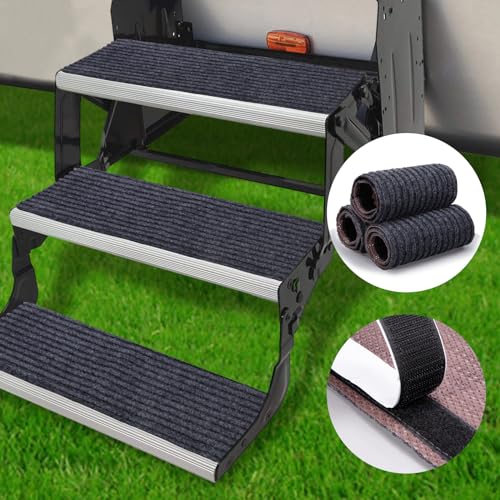
HOPEVIVA cuts its covers narrower and lighter in tone: three covers, 22 inches wide by 7.5 deep, in grey, with a non-slip claim and a title that name-checks travel trailers, mobile homes and motorhomes in one breath. The 22-inch width is the interesting decision. Plenty of older trailers and compact campers run steps slimmer than the modern 24-inch standard, and a cover that overhangs the tread edges curls, catches heels and folds badly. A true 22-inch fit avoids all of that, and grey shrugs off the dusty look that black shows after one dry weekend on a gravel pitch.
- Width stated in the title: 22 inches
- Depth stated in the title: 7.5 inches
- Pack count: three covers
- Colour named in the listing: gray
- Fastening method: none stated in the listing
Consider a compact travel trailer whose owners camp mostly at serviced sites with hard standings. Their steps see shoes rather than hiking boots, the staircase is slim, and the covers’ work is more about comfort underfoot and protecting the tread paint than about trapping serious mud. HOPEVIVA’s dimensions fit that life neatly. The grey tone also plays well with the pale steps fitted to many trailers, where a black cover looks like a patch. Because no fastening method is stated, the first journey matters: check the covers after the first fifty miles and again after the first folding cycle at a site.
Strengths
- 22-inch width suits genuinely narrow staircases
- Grey finish hides dust better than black
- Both dimensions stated plainly in the title
Trade-offs
- Too narrow for the 23- and 24-inch steps now common
- Attachment approach is left unstated in the title
- Three covers only, with no fourth for tall entries
Narrow covers expose a measurement trap worth naming: step width should be measured across the flat tread, not across the whole step assembly including its frame rails. A staircase can measure 24 inches overall while offering 22 inches of usable tread, in which case this pack fits the walking surface exactly and a wider cover would ride up on the rails. HOPEVIVA’s title gives you both numbers to work with, which makes that check possible before ordering rather than after. The non-slip wording, as elsewhere here, is the maker’s claim, offered without a published rating.
Grey has one more practical virtue on sunny pitches: it runs cooler underfoot than black carpet in direct sun. Anyone who has stepped barefoot onto a sun-baked black step cover at a beach site will understand why that matters for a product people cross in socks at midnight. It is a small comfort, but step rugs are a small product, bought precisely to collect small comforts — a quieter tread, a drier sock, a cleaner doorway — and on narrow staircases this set collects them without pretending to fit rigs it cannot.
Best for: narrow 22-inch treads on travel trailers and compact campers, particularly on hard-standing sites.
Not suited for: modern wide staircases of 23 or 24 inches, where a bare stripe of metal remains on each side.
HOPEVIVA’s grey three-pack sits here: Check price on Amazon with the 22 by 7.5 inch sizing in the title for a quick tape-measure comparison.

Unbranded Glow Step Covers 24×7.5
The unbranded closer does something none of the branded five attempt: it glows. Three covers at 24 by 7.5 inches, described as non-slip and waterproof, with a glow-in-the-dark element aimed at the oldest problem in camping — finding the steps at 2 a.m. without waking the whole van. There is no brand name in the title to lean on, so this listing stands or falls on its stated facts, and to its credit the facts are specific: full dimensions, pack count, and two performance claims that go further than its rivals’ wording.
- Width stated in the title: 24 inches
- Depth stated in the title: 7.5 inches
- Pack count: three covers
- Glow in the dark feature is named in the listing
- Brand name: not stated in the listing title
Night visibility is a genuine safety axis, not a gimmick, on a raised motorhome entry. Steps are climbed half-asleep, in the dark, often by guests who do not know the staircase, and a faintly glowing tread edge tells a foot where the step ends. The trade-off is that glow elements need light exposure to charge, so a rig parked under a dense canopy or an awning all day may deliver a dimmer show at midnight. Even so, on open pitches the feature costs nothing in daytime function: by daylight these are simply wide, shallow covers like the ESUDNT set.
Strengths
- Glow-in-the-dark element addresses night-time step finding directly
- Waterproof claim goes beyond the weather-resistant wording elsewhere
- Full 24-inch width with both dimensions stated
Trade-offs
- No brand in the title, so no maker reputation to consult
- Glow brightness and duration are not quantified in the listing
- Three-pack only, and 7.5-inch depth limits deep-tread use
Waterproof deserves the same scepticism applied to every claim in this roundup, with a twist: if the surface truly sheds water rather than absorbing it, then mud sits on top instead of soaking in, and a shake and a wipe may clean these faster than carpet-style rivals. The flip side is that a non-absorbent surface can feel slicker under a wet boot, whatever the non-slip wording says, so the first rainy climb deserves a deliberate test step. Judge this set by that test, not by the adjectives. Unbranded listings also make reordering a matching spare less certain, which argues for buying any extra cover you think you will need at the same time.
Who ends up happiest with a glowing staircase? Probably the family that camps off-grid, where there is no site lighting and the steps are used in true darkness, and the hosts who lend their motorhome to friends. For a couple on serviced pitches with floodlit avenues, the glow is a novelty layered on a competent wide cover. Either way, the listing is honest about what it is: dimensions up front, features named, no borrowed brand equity. In a roundup built on tape measures, that plainness counts for something.
Best for: 24-inch steps on rigs used in genuinely dark, unlit pitches where a glowing tread edge helps at night.
Not suited for: deep treads beyond 7.5 inches, and shaded pitches where the glow element rarely gets the daylight it needs to charge.
The glow three-pack is listed here: Check price on Amazon with waterproof and glow in the dark both claimed in its title — worth a first-night test on your own steps.
Side by side: widths, pack counts and surfaces
Lay the six side by side and the staircase in your doorway sorts them quickly. Width climbs from Camco’s 18 inches through HOPEVIVA’s 22 and the 23-inch pair to the two 24-inch sets, while depth splits the field into stated 7.5-inch covers and the 8-to-11-inch window shared by LATCH.IT and HOMEE. Pack counts run one, three, three, three, four, four. Everything else — hooks, glow, colour — is a tiebreaker layered on top of those three numbers.
| Cover | Measurements and pack | The catch |
|---|---|---|
| Camco Wrap Around Step Rug 18 | Single wrap, 18 inches, manual and electric steps | Only fits the narrowest steps |
| LATCH.IT Step Covers 23in 4-Pack | Four covers, 23 inches, 8–11 inch depth window | Fastening method unstated |
| ESUDNT Step Covers 24in 4-Pack | Four covers, 24 by 7.5 inches, black | Shallow depth on deep treads |
| HOMEE Step Covers 23 Inch | Three covers, 23 inches, hooks included per title | One short for four-step entries |
| HOPEVIVA Step Covers 22 Inch | Three covers, 22 by 7.5 inches, grey | Narrow on modern wide steps |
| Unbranded Glow Step Covers 24×7.5 | Three covers, 24 by 7.5 inches, glow feature | Unbranded; glow needs daylight |
Notice how few of these compete head-on once measurements enter the picture. A 22-inch staircase eliminates four of the six immediately, and a four-step entry eliminates the three-packs unless you buy two sets. The honest contest is usually between two finalists: LATCH.IT against HOMEE at 23 inches, where the choice is a fourth cover versus named hooks, and ESUDNT against the glow set at 24 inches, where it is a fourth cover versus night visibility. If your shortlist still has four names on it, the tape measure has not been out yet. Back at home base, the same grit eventually meets hard floors, and the machines in Best Floor Cleaner That Vacuums and Mops are the natural next read.
How do you choose an RV step rug that actually fits your staircase?
Which width matches the tread you actually walk on?
Measure the flat part of the tread, edge to edge, ignoring frame rails and any raised lip. That number, not the staircase’s overall width, is what a cover must match. A cover an inch too narrow leaves a metal stripe that collects exactly the grit you bought it to stop; a cover an inch too wide curls at the edges, and curled edges catch heels on the way down, which is the one direction nobody wants a surprise.
Steps also taper in some designs, wider at the bottom than the top. Measure two treads, not one, and if they differ, size for the narrower and accept a small margin on the wider, or look at whether a wrap-style rug like the Camco can be centred to split the difference. Write the numbers on a strip of tape inside a locker door; you will want them again when a cover eventually wears out mid-season, far from home.
Does the cover need to wrap, clip, or simply lie flat?
Folding steps punish loose covers. Every fold is a chance for a flat cover to shift, and highway vibration does the rest, so wrap-around and hooked designs earn their keep on rigs that move weekly. A caravan that sits on a seasonal pitch can happily use a simple flat cover, because its steps fold twice a year. Match the fastening to the mileage, not to the marketing.
Electric steps add one more consideration: anything wrapped or clipped adds thickness around the tread, and the mechanism needs clearance to fold. The Camco listing names electric steps outright, which is reassuring, but the sensible ritual with any cover is the same — fit one, cycle the steps twice by hand-watching, and only then fit the rest.
How many covers does your staircase really need?
Count the treads you step on, not the treads you can see. Some entries have a top platform step inside the door that never gets rained on and rarely gets dirty; covering it is optional. Most owners need the exterior treads only, which is why three-packs dominate this market and why a four-pack is a considered purchase for tall motorhome entries rather than a default.
Spares change the maths quietly. A pack with one cover more than your staircase gives you a rotation spare for the ground step, which wears at roughly twice the rate of the others. If a three-pack fits a two-step entry, the leftover is not waste; it is next year’s bottom cover, already matched in colour and batch.
What should you expect the surface to survive?
Every cover here is a sacrificial layer. It will fade, flatten and eventually fray at the front edge, and that is the product working as intended — the wear is happening to a replaceable rug instead of your step’s paint or your interior carpet. Claims about weather resistance describe how gracefully that ageing happens, not whether it happens. Covers that lift off easily for hosing and drying will outlast tougher covers that stay damp against the tread.
The ground step does three jobs at once
Spend one evening watching a campsite staircase and the ground step reveals itself as the hardest-working surface in the rig. It is a boot scraper for arrivals, a doorstep for conversations, a seat for lacing shoes, and the platform from which everything heavy — water carriers, toolboxes, dogs — gets lifted into the van. No other tread takes loads from so many angles, which is why ground-step covers flatten and fray first, and why rotating covers between steps is the single cheapest longevity habit an owner can adopt.
It is also the step that decides first impressions of safety. Guests judge the whole staircase by the first tread they meet, in the dark, carrying something. A cover that sits flat and square there, with its front edge crisp, quietly communicates that the rest of the climb is equally sorted. A curled or shifted cover does the opposite before a word is spoken. If only one cover in a set gets replaced mid-season, it should always be this one, and the demoted cover can finish its life on the sheltered top step.
Dogs deserve a sentence of their own here, because paws treat the ground step as a launchpad. Claws scuff carpet pile in a way boots never do, and a dog that hesitates on a slick metal tread will scramble, multiplying the damage. A carpeted ground step gives claws purchase and confidence, which is why so many owners report the cover ‘for the dog’ outlasted its welcome for every other reason. None of the six listings mentions pets; the benefit is a side effect of grip, freely available from any of them.
Washing covers without wrecking them
Step covers live in filth, so the wash routine matters as much as the fit. The reliable sequence is boring and effective: shake each cover hard outdoors, brush dried mud out of the pile with a stiff hand brush, then hose from the back of the cover toward the front edge so grit is pushed out the way it came in rather than ground deeper. Hang them over a fence or the bike rack, not over the steps themselves, and let them dry completely — a cover refitted damp will mildew against the tread and stain it.
Detergent is usually unnecessary and occasionally harmful, since residues left in a pile attract dirt faster afterwards, the same reason carpet cleaners warn against over-soaping interior mats. A plain-water hose handles campsite grit; save any deeper clean for the end of the season, at home, where covers can dry for a full day. While they are off, sweep the bare treads and check for the rust freckles that hide under a permanently fitted cover, especially on steel steps that live outdoors all winter.
Storage follows the same logic. Covers stored flat and dry in a locker will be ready in spring; covers screwed into a ball in a damp exterior compartment will smell like it. If your rig winters outside with steps folded, removing the covers entirely is kinder to both cover and tread, and it takes ten minutes — less for the hooked and wrap designs, which is one more quiet argument for a defined fitting over a friction fit.
What folding steps do to a cover over one season
A parked staircase is a static object, but a touring staircase is a machine that happens to have treads. Each fold slides the steps past one another, each unfold drops them into place with a small impact, and a cover lives through both motions hundreds of times a season. The wear pattern tells the story: covers on folding steps fray at the front corners first, where the tread above brushes past during the fold, while covers on fixed seasonal steps wear evenly across the middle, where boots actually land.
That difference suggests a fitting habit for touring rigs. After the first week of travel, unfold the steps somewhere quiet and look at the covers with fresh eyes: corners lifting, one side crept forward, a hook sitting at an angle. Small shifts caught early can be corrected by refitting; the same shift ignored for a month becomes a permanent set in the material, and the cover will return to its crooked position within a day of every refit. Touring covers live or die by that early inspection, not by their first fitting.
Noise is the other travelling symptom nobody warns about. A loose cover on a folding step can drum against the tread at motorway speed, a faint rattle that owners chase around the suspension for weeks before tracing it to the staircase. The cure is the same inspection: a cover that cannot be made to sit silently at rest will not sit silently at sixty. Wrap and hooked fittings exist largely to answer this, and if your rig tours long distances, their value shows up on the road rather than at the pitch.
Mileage also reframes the pack-count question. A four-pack on a touring four-step entry has no spare, and its ground cover will be ready for replacement a season before the others; buying a second identical pack early, while the listing is current, is cheaper insurance than hunting a match later. Seasonal rigs can ignore all of this — their covers age by footsteps, not by folds — which is why the same product can be a three-year purchase for one owner and a one-season consumable for another, with both verdicts honestly earned.
The doorway mat is the second line of defence
Even a perfect staircase lets some grit through, which is why the interior mat just inside the door matters more than its size suggests. The steps intercept the coarse material — gravel, mud clods, wet leaves — while the doorway mat catches the fine dust that survives the climb on boot soles. Owners who skip the step covers and rely on the mat alone discover the division of labour the hard way: the mat saturates within a weekend, starts grinding its captured grit into the floor beneath it, and the doorway becomes the dirtiest square metre in the van.
Sizing the pair together helps. A wide staircase delivering clean-ish boots to a narrow mat still sheds dirt around the mat’s edges, so the mat should span the doorway’s full width just as the covers span the treads. When both layers are doing their share, the interior floor beyond the door stays presentable for a week of touring with nothing more than a shake of the mat every couple of days — a rhythm most owners can actually keep, unlike a daily deep-clean regime that collapses by Wednesday.
There is a winter version of the same lesson. Salt and grit from serviced hard standings are finer and more corrosive than summer mud, and they ride boot soles straight past a saturated mat onto vinyl and laminate floors, where each footstep works like sandpaper. In winter the step covers earn their keep twice over, and the ground-step cover in particular deserves a mid-season rinse rather than waiting for spring, because what it holds against the tread all winter is exactly what rusts treads.
Common mistakes
Measuring the staircase frame instead of the tread
The frame rails and side plates inflate the number, and a cover bought to that width rides up on both edges from day one. Always measure the flat walking surface alone, at two different steps, and buy to the smaller figure when they disagree.
Covering only the bottom step of a tall entry
It feels economical until you notice the uncovered upper treads still drip mud onto the covered one and still deliver grit to the doorway. Dirt travels down a staircase; interception needs to happen at every tread, or the interior mat inherits the whole job.
Leaving covers fitted through winter storage
Trapped moisture between cover and tread is a rust recipe on steel steps and a mildew recipe for the cover itself. Strip them before lay-up, dry everything, and store the covers flat indoors with the rig’s soft furnishings.
Judging a cover by its first dry weekend
Almost any cover behaves on a dry serviced pitch. The honest test is a wet grass weekend followed by a fold, a drive and a refit — that cycle exposes weak fastening, curling edges and slow drying that a sunny afternoon never will.
Mixing single covers from different sets
A replacement from another brand or batch rarely matches in width, depth or shade, and a staircase in three near-matching covers looks worse than one honest worn set. Buy the rotation spare with the set, while the batch is current.
Final recommendation
Start with the tape measure, because it eliminates most of this list for you. Narrow 18- and 22-inch staircases point straight at the Camco wrap and the HOPEVIVA grey set respectively, and both are honest fits for the rigs they target. The crowded middle belongs to the 23-inch pair: LATCH.IT if your entry has four treads or unusually deep ones, HOMEE if three treads and a hooked, repeatable fitting sound like your kind of maintenance.
At 24 inches the choice is temperament. ESUDNT’s four-pack is the workhorse for wide, shallow steps and seasonal pitches, while the unbranded glow set trades the fourth cover for night visibility that genuinely helps on unlit sites. None of the six is a mistake in the abstract; each is a mistake only when bought for a staircase it was never sized for. Measure twice, fit one cover first, cycle the steps, and then commit the set.
Back inside the rig, the cab and bunk area run on small electronics too, and the bedside models in Best Bluetooth Alarm Clocks are the comparison we point travellers to.
A last word on expectations, because step rugs attract oddly strong opinions for such a humble product. No cover here will make a staircase feel like a hallway, silence a creaky folding mechanism, or rescue a tread that is already rusted thin; those are jobs for a workshop, not a rug. What a well-fitted cover does is quieter and more cumulative: cleaner socks, a surer foot in the rain, paint that survives another season, and a doorway that stops being the van’s dirt funnel. Owners who judge the purchase by those modest, daily returns are rarely disappointed, while owners expecting a transformation usually are — the staircase was never the problem, only the surface it presented to every arriving boot.
Frequently asked questions
Can one step rug fit both manual and electric steps?
The Camco listing says its wrap is made for both, which makes sense: the tread itself is similar, and it is the folding mechanism around it that differs. With any cover, fit one first and cycle electric steps twice while watching clearances before fitting the rest.
How do I know whether my steps are 22, 23 or 24 inches wide?
Measure the flat tread surface with a tape, not the whole step assembly. Do it on two steps, because some staircases taper. The smaller measurement governs, since a slightly narrow cover still works while a too-wide one curls at the edges.
Are the non-slip claims here tested ratings?
No ratings are published in any of these listings, so treat non-slip as the maker’s description of intent. Your own wet-boot test on the first rainy day is the meaningful check, and any cover that shifts under that test needs refitting or replacing.
Do glow-in-the-dark covers work under an awning?
They need daylight to charge, so a step shaded all day by an awning or canopy will glow weakly at best. On open pitches they charge fully. The covers still function as ordinary wide step rugs either way; the glow is a bonus, not the foundation.
Should covers stay on while driving?
Wrap and hooked designs are built to travel fitted, and that is their advantage. Flat covers are the risk. Whatever you fit, the pre-departure walkaround should include a glance at the staircase: covers square, nothing flapping, steps fully folded.
How often should step covers be replaced?
Judge by the ground step, because it wears first. When its front edge frays, its surface stays slick after washing, or it no longer sits flat after a refit, the set is telling you its season is over. Rotating covers between steps during the year can postpone that day considerably, since the sheltered top cover is usually good for another season at ground level.
Can step covers damage the steps underneath?
Only through neglect. A cover left damp and gritty against a steel tread all winter holds moisture and abrasive dust exactly where rust starts. Lift covers during long storage, rinse them before refitting in spring, and inspect the bare treads once a year — treated that way, covers protect the steps far more than they threaten them.
Measure the tread, respect the ground step, keep one spare cover rolled in a locker for the day the lowest one frays, and the right rug from this six is the one whose numbers match your staircase before its features ever get a vote.


