What's inside
- Where to buy a 30-inch electric cooktop
- Quick picks for the 30-inch cutout
- How these picks were chosen
- Six 30-inch surfaces, reviewed
- Radiant and induction models in one table
- Radiant or induction: which technology should you choose?
- Installation realities for a 30-inch swap
- Cooking across the bridge: what a joined zone unlocks
- Keeping ceramic glass beautiful for a decade
- Induction’s sounds, fans and other honest footnotes
- The economics of switching technologies mid-renovation
- Common mistakes when replacing a 30-inch cooktop
- Cooking the household’s signature dishes on each technology
- Warranty, service and the brand question
- The first week on a new surface
- Energy, heat and the summer kitchen
- Designing the counter around the cooktop
- When the answer is to wait
- Final recommendation
- Frequently asked questions
As an Amazon Associate I earn from qualifying purchases. This post may contain affiliate links at no extra cost to you.
As an Amazon Associate, cottageverdict.com earns from qualifying purchases.
Replacing a 30-inch cooktop is a renovation in miniature: the cutout already exists, the wiring already runs to the cabinet, and the household shopping for the best thirty inch electric cooktops wants a surface that drops into the old hole and cooks better than the one that left. The six models below split into the category’s two technologies. Four are radiant smoothtops, heating elements glowing beneath ceramic glass, the familiar and forgiving technology that accepts every pan in the cupboard. Two are induction, GASLAND and Empava, heating the pan itself through magnetism, faster and cooler to the touch, but demanding magnetic cookware. That single fork, radiant versus induction, decides more about your next decade of cooking than any other line in this guide.
Within the radiant four, personalities diverge. Frigidaire appears twice with genuinely different machines: the FFEC3025UB, a four-element black smoothtop, and the Professional FPEC3077RF, a five-burner ceramic glass model with stainless trim, the only five-burner surface here. Karinear’s 30-inch radiant answers with knob control and a protective metal frame, while Cooksir publishes the radiant class’s biggest number, 6700W, with a timer, safety lock, dual ring element and exact cut-out dimensions in its title. The induction pair then raise the stakes with bridge elements that join two zones under one large pan, boost functions and touch controls, features radiant titles do not attempt.
Where to buy a 30-inch electric cooktop
Households wanting the straightforward radiant replacement should begin with the Frigidaire FFEC3025UB 30in, four elements in black. Those needing a fifth burner will move to the Frigidaire Professional FPEC3077RF and its stainless-trimmed ceramic glass. Knob loyalists should examine the Karinear 30in Electric Knob, a radiant top with a glass protection metal frame. The Cooksir 30in Electric 6700W suits spec-driven buyers with its timer, lock and dual ring. Induction converts should compare the GASLAND 30in Induction Bridge, with its matte scratch-resistant surface, against the Empava Flex 30in Induction and its seventeen power levels and preset modes.
Quick picks for the 30-inch cutout
| Pick | Best for | Standout detail in the title |
|---|---|---|
| Frigidaire FFEC3025UB 30in | The classic four-element replacement | 30 inch smoothtop, 4 elements, black |
| Frigidaire Professional FPEC3077RF | Five burners on ceramic glass | 5-burner flat range top, ceramic glass, stainless steel trim |
| Karinear 30in Electric Knob | Knob control with a protective frame | 4 burners, knob control, metal frame, 220-240v hard wire |
| Cooksir 30in Electric 6700W | Published power plus timer and lock | 6700W, dual ring, timer, safety lock, stated cut-out size |
| GASLAND 30in Induction Bridge | Induction with a bridge element | Bridge element, boost, touch control, child lock and timer, ETL certified |
| Empava Flex 30in Induction | Presets and fine power steps | Bridge-SYNC, 17 power levels plus boost, 3 preset modes, pan sensor |
How these picks were chosen
Size discipline came first: every title states 30 inches, because the entire category exists to fit the standard cutout that most kitchens already have. Technology formed the second filter, and the list holds the market’s real proportions, four radiant models against two induction, with the induction pair chosen for their bridge elements, the feature that most changes what a 30-inch induction surface can cook. Burner count formed the third filter, recorded exactly: five titles describe four burners or elements, while the Frigidaire Professional states five, a genuine capacity difference this guide treats as significant rather than rounding away.
Controls and safety formed the remaining filters. Knobs appear on the Karinear and Cooksir radiant models, touch controls on both induction models, and the Frigidaire titles leave control style unstated. Safety locks appear on the Cooksir, GASLAND and Empava titles, timers on the same three, and certification is claimed by GASLAND as ETL and Empava as cTUVus. Power is published only by Cooksir at 6700W among the radiants, so no cross-technology wattage league table is attempted; induction and radiant numbers would not describe the same cooking experience anyway.
Six 30-inch surfaces, reviewed

Frigidaire FFEC3025UB 30in
The FFEC3025UB is the category’s baseline done properly: a 30-inch electric smoothtop with four elements in black, from the brand whose name sits on more American kitchen walls than any rival in this list. Its title is admirably plain, no wattage claims, no feature fireworks, just size, style, element count and colour. For the largest group of buyers in this category, households replacing a tired smoothtop with the same again but new, that plainness is the point. The black glass disappears into most counters, four elements cover the standard repertoire, and the Frigidaire badge carries a service network’s reassurance that unbranded rivals cannot print in a title.
What Frigidaire states about the FFEC3025UB:
- Size: 30 inch
- Type: electric smoothtop style
- Elements: 4
- Colour: black
- Controls and power: not described in the title
- Model: FFEC3025UB
Strengths
- A major brand’s standard model simplifies parts, service and resale confidence.
- Four elements in the standard layout match the muscle memory of most cooks.
- Black smoothtop styling blends into dark and light counters alike.
Trade-offs
- The title confirms no timer, lock or special element features.
- Radiant heat is slower to respond than the induction pair below.
- Buyers wanting knobs or touch specifics must look beyond the title.
The replacement scenario defines this model: the old cooktop has cracked, faded or lost an element, the cutout measures the standard 30 inches, and the household wants dinner back with minimal drama. A like-for-like Frigidaire smoothtop restores the kitchen in a single installation visit, accepts every existing pan, and asks nobody to relearn a control. Households in exactly that position should be suspicious of guides that upsell them into technology changes mid-crisis; there is a season for converting to induction, and it is not usually the week the old top dies before a family visit.
Judged against its Professional sibling, the FFEC3025UB concedes a burner and the stainless trim, and gains simplicity. Judged against the induction pair, it concedes speed and gains universal pan compatibility. Those are honest trades, plainly visible, which is why this unassuming model anchors the roundup.
Best for: households replacing a standard four-element smoothtop without changing technology. Not suited for: canning and feast-day cooking that needs a fifth burner, since this Frigidaire states four elements only. Check price on Amazon for the Frigidaire FFEC3025UB 30in.

Frigidaire Professional FPEC3077RF
The Professional is the Frigidaire that breaks the category’s pattern: a 30-inch ceramic glass electric cooktop with five burners, a flat range layout and stainless steel trim, carrying the Professional line’s name. Five burners in thirty inches is a feat of packing, and it serves a specific cook, the one whose dinners regularly stage a sauce, a vegetable, a protein and a kettle in overlapping shifts. The fifth burner is typically the small, central or warming position that absorbs the item everyone else queues behind. Stainless trim lifts the black-glass formula toward a built-in, range-style presence that suits kitchens designed around appliances as furniture.
The FPEC3077RF’s titled facts:
- Size: 30 inch
- Burners: 5, the only five-burner model here
- Surface: ceramic glass, flat range style
- Trim: stainless steel
- Line: Frigidaire Professional
- Power and controls: not stated in the title
Strengths
- A fifth burner absorbs the kettle or sauce that crowds four-burner cooking.
- Stainless trim gives the surface a deliberate, built-in elegance.
- The Professional badge aligns it with a coordinated kitchen suite.
Trade-offs
- Five burners in thirty inches means tighter pan spacing than any rival here.
- No wattage, timer or lock details appear in the title.
- Radiant technology still answers heat changes at radiant pace.
Holiday cooking explains the fifth burner better than any diagram. Four burners are spoken for by the main event, and the gravy, the kettle for coffee, the small pan of glazed carrots all contend for a nonexistent fifth position, forcing the cook into a rotation of lids and towels. The Professional abolishes that rotation. Everyday cooking uses four positions exactly as its sibling does, so the extra burner costs nothing in daily life except a slightly busier surface to wipe. Households that entertain monthly will feel the difference precisely when it matters most.
The pan-spacing caveat deserves respect rather than dismissal: five burners share the same glass as everyone else’s four, so two very large pans will still negotiate. The fifth position serves small and medium vessels, which is, in practice, exactly what the contending items are. Cooks whose feast days involve a canning kettle and a stockpot simultaneously should measure with their actual vessels, as with any cooktop in this guide.
Best for: entertaining households that regularly run out of burners on feast days. Not suited for: cooks whose two largest pans must sit side by side daily, because five burners in thirty inches tightens the spacing. Check price on Amazon to view the Frigidaire Professional FPEC3077RF.
Karinear 30in Electric Knob
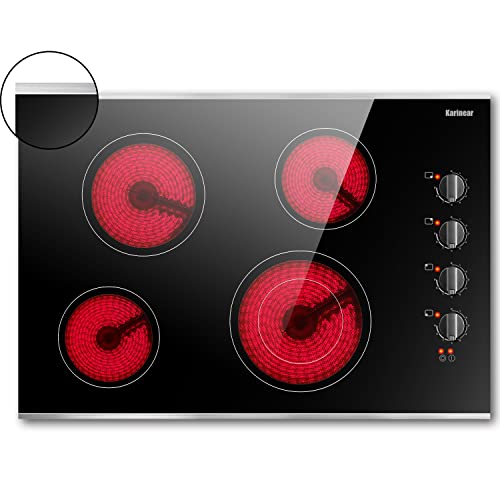
Karinear’s 30-inch radiant cooktop makes two unfashionable choices and defends them well: physical knob control, and a glass protection metal frame around the ceramic surface. Knobs are the interface many cooks actually prefer, adjustable with wet or floury hands, readable at a glance from across the room, and immune to the touch-panel tantrums that a splash of water can cause. The metal frame addresses the ceramic glass cooktop’s oldest anxiety, the chipped edge, by armoring the perimeter where pans slide off and cabinet doors swing close. Its title also promises fit with most existing cutouts and specifies 220-240v hard-wired installation, the honest electrical fine print of this whole category.
Karinear’s stated specification:
- Size: 30 inch, built-in radiant
- Burners: 4
- Controls: knob
- Protection: glass protection metal frame
- Fit claim: fits most existing cutouts
- Electrical: 220-240v, hard wire
Strengths
- Knobs work with wet hands and give instant, glanceable heat positions.
- The metal frame guards the glass edges that chips love most.
- A cutout-compatibility claim speaks directly to replacement buyers.
Trade-offs
- No timer, lock or total power figure is named in the title.
- Knobs interrupt the flush glass plane that minimalist kitchens prize.
- Hard-wired installation rules out a casual plug-in trial.
Bakers and jam makers will recognise this cooktop’s constituency. Hands dusted with flour cannot operate a touch panel reliably, and a cook mid-recipe wants to nudge heat by feel without looking down and breaking concentration. Knobs restore that older, embodied control, and the frame quietly insures the glass against the heavy preserving pan that gets dragged rather than lifted at the end of a long preserving day. In a working farmhouse kitchen, this may be the most sensibly specified radiant top in the roundup.
Against the Cooksir below, the Karinear trades published wattage and electronic extras for tactile control and edge armor. Against the Frigidaires, it trades brand familiarity for the same practical pair. Replacement buyers should note the fit claim with gratitude and still verify their cutout against the product dimensions, because most is a promise about the majority, not a guarantee about one particular kitchen built in an eccentric year.
Best for: hands-on cooks who want knobs and a frame that protects the glass edges. Not suited for: households wanting a flush, knob-free glass plane, since this Karinear’s controls stand proud of the surface. Check price on Amazon for the Karinear 30in Electric Knob model.

Cooksir 30in Electric 6700W
Cooksir writes the radiant class’s most complete title: a 30-inch, four-burner built-in rated at 6700W on 240V, with knob control, a timer, a safety lock, a dual ring element and the cut-out dimensions printed outright, 29.13 by 19.3 inches, with 220V hard-wired connection. That density of information is itself a feature for the renovation buyer, who can verify electrical capacity and cutout fit from the listing alone. The dual ring deserves translation: one burner position offers two sizes, a small inner ring for little pans and a full outer ring for large ones, which is how a four-burner top pretends, convincingly, to have a fifth size.
Everything Cooksir declares:
- Total power: 6700W, 240V built-in
- Burners: 4, including a dual ring
- Controls: knob, with timer
- Safety: safety lock
- Cut-out size: 29.13 x 19.3 inches, stated
- Connection: 220V hard wired
Strengths
- Published wattage and cut-out dimensions make remote buying genuinely informed.
- A dual ring element matches burner size to pan size, saving heat and time.
- Timer and safety lock bring electronic discipline to a knob-controlled top.
Trade-offs
- Hard-wired 220V installation needs an electrician’s visit in most homes.
- No brand service network stands behind the name as with Frigidaire.
- Ceramic radiant response remains slower than induction’s immediacy.
A kitchen renovation planned from a distance, a cottage being refitted by a contractor while the owners live elsewhere, is where the Cooksir’s title shines. The electrician can confirm the circuit against 6700W, the carpenter can check the cutout against printed dimensions, and nobody needs to guess. Once installed, the dual ring serves the household’s pan drawer honestly: espresso pots and milk pans on the inner ring, the big sauté pan on the full ring, with less wasted heat licking around small bases than a one-size burner produces.
The timer and lock extend its brief to households with children or forgetful moments, features the Frigidaire titles leave unmentioned. Set against the Karinear, its closest radiant rival, the Cooksir offers numbers and electronics where the Karinear offers a protective frame; both keep knobs, suggesting this corner of the market has decided that renovation buyers like their technology with a tactile interface. Readers comparing the wider renovation picture might also enjoy Best Rotisserie Grills for the outdoor half of a full kitchen project.
Best for: renovation buyers who verify cutout and circuit from the listing before ordering. Not suited for: households wanting a plug-in or 120V appliance, because this Cooksir is a 220V hard-wired installation. Check price on Amazon to check the Cooksir 30in Electric 6700W against your cutout.

GASLAND 30in Induction Bridge
GASLAND opens the induction half of the roundup with the feature that defines modern induction at this size: a bridge element joining two burners into one long zone for griddles and roasting pans, on a 240V four-burner top with a matte scratch-resistant surface, boost function, touch control, child lock and timer, carrying ETL certification. The matte finish is a quietly radical detail in a category of glossy glass, promising a surface that hides the micro-scratches and fingerprints that glossy tops display like trophies. Boost concentrates extra power on one zone for the fastest kettle or pasta pot the household has ever timed.
GASLAND’s titled specification:
- Technology: induction, 4 burners, 240V
- Bridge: bridge element included
- Surface: matte, scratch-resistant
- Functions: boost, timer
- Controls and safety: touch control, child lock
- Certification: ETL certified
Strengths
- The bridge zone unlocks griddles and long roasting pans on a 30-inch top.
- A matte surface forgives the scratches and smudges glossy glass advertises.
- Boost gives induction’s speed a headline gear for boiling duties.
Trade-offs
- Induction demands magnetic cookware, so some beloved pans will not work.
- Touch controls and wet hands remain uneasy partners during messy cooking.
- No total wattage is published in the title for circuit planning.
Weekend breakfast is the bridge’s showcase: a long griddle spanning two zones, pancakes in rows, bacon at the edges, all on one continuous heated field that a four-circle radiant top cannot imitate. The same zone swallows a roasting pan for gravy made across the full length of the drippings, a technique restaurant cooks treat as ordinary and home cooks on round burners treat as impossible. Add induction’s inherent calm, a surface that heats the pan rather than itself, so spills do not carbonise on contact, and the GASLAND presents the strongest lifestyle case in this half of the guide.
The cookware audit is the price of admission, and it should be performed with a fridge magnet before ordering: if the magnet grips the pan’s base firmly, the pan is induction-ready. Most cast iron and much modern stainless pass; aluminium and copper favourites fail unless they carry a magnetic base. Households whose pan drawer passes the audit gain speed, control and the bridge; households whose drawer fails should price replacement pans into the conversion honestly.
Best for: griddle breakfasts and roasting-pan sauces on an induction surface that hides scratches. Not suited for: a pan drawer built on non-magnetic aluminium and copper, which this GASLAND cannot heat at all. Check price on Amazon for the GASLAND 30in Induction Bridge.

Empava Flex 30in Induction
Empava’s Flex closes the list as the control enthusiast’s induction top: a 30-inch, four-burner drop-in, hardwired, with Bridge-SYNC, Auto RapidHeat, three preset modes, seventeen power levels plus boost, glide-touch controls and a pan sensor, under cTUVus certification. Seventeen power levels is the figure to savour, because induction’s weakness at the low end, the pulsing on-off simmer, is exactly what fine-grained levels address, letting a sauce hold a tremble rather than a negotiation. The pan sensor adds a quiet intelligence, recognising where a pan sits, and the preset modes package common jobs for cooks who prefer choosing a task to choosing a number.
Empava’s declared details:
- Technology: induction, 4 burners, drop-in, hardwired
- Bridge: Bridge-SYNC
- Power steps: 17 levels plus boost
- Modes: 3 presets, Auto RapidHeat
- Controls: glide-touch, with pan sensor
- Certification: cTUVus
Strengths
- Seventeen levels give low-heat cooking a finesse induction often lacks.
- Preset modes shorten the path for routine jobs like melting and warming.
- A pan sensor aligns the cooking zone with the vessel actually present.
Trade-offs
- The magnetic cookware requirement applies with full force here too.
- Glide-touch controls reward dry fingers and punish soapy ones.
- No total power figure is stated in the title.
The cook this suits keeps a sauce diary. Hollandaise that must not split, chocolate that must melt without seizing, a caramel that lives or dies in a two-degree window: these are the jobs where seventeen levels stop sounding like marketing and start sounding like mercy. Auto RapidHeat handles the opposite pole, the impatient pasta water, while Bridge-SYNC gives the Empava the same griddle-and-roaster theatre as its GASLAND rival. It is the most expressive control panel in the roundup, offered to the cook most likely to use expression.
Between the two induction models, the division is finish versus finesse: GASLAND’s matte, scratch-resistant surface and ETL badge against Empava’s deeper level count, presets and sensor. Households with rambunctious daily cooking and a hatred of visible scratches may lean GASLAND; households that cook delicately and often may lean Empava. Both demand the magnet test, both reward it with the fastest, coolest cooking in this guide.
Best for: precise cooks who simmer delicately and want seventeen levels of control. Not suited for: pan collections built on non-magnetic metals, since the Empava Flex heats only magnetic cookware. Check price on Amazon to explore the Empava Flex 30in Induction.
Radiant and induction models in one table
| Model | Technology | Burners | Controls and signature feature |
|---|---|---|---|
| Frigidaire FFEC3025UB 30in | Radiant smoothtop | 4 elements | Classic black replacement top |
| Frigidaire Professional FPEC3077RF | Radiant ceramic glass | 5 | Stainless trim, Professional line |
| Karinear 30in Electric Knob | Radiant ceramic | 4 | Knobs, glass protection metal frame |
| Cooksir 30in Electric 6700W | Radiant ceramic | 4, one dual ring | Knobs, timer, safety lock, 6700W stated |
| GASLAND 30in Induction Bridge | Induction | 4 | Touch, bridge element, matte surface, boost |
| Empava Flex 30in Induction | Induction | 4 | Glide-touch, Bridge-SYNC, 17 levels, pan sensor |
The table’s lesson is that burner count is nearly a tie, four against four with one five, while technology and controls carry the real differences. Choose the heating method first and the model second, and the decision usually makes itself.
Radiant or induction: which technology should you choose?
Will your pans survive an induction conversion?
Perform the magnet audit before any other deliberation, because its result can end the debate in five minutes. Test every pan you use weekly, not the showpieces: the everyday skillet, the pasta pot, the saucepan, the griddle. If the core fleet passes, induction’s speed, precision and cool surface are available to you. If the fleet fails, price the replacements honestly and add them to the induction models’ true cost, or accept radiant’s universal welcome with good grace. The Frigidaire, Karinear and Cooksir tops will heat the aluminium pan you inherited and the copper pot you splurged on with complete impartiality.
How much do you value instant response?
Radiant elements heat and cool at the pace of glowing metal under glass: respectable, predictable, and slow compared with gas or induction. A radiant cook learns to move the pan to manage heat, sliding it half off the element as cooks have done for generations. Induction answers a control change almost immediately, because the pan is the heat source, and the Empava’s seventeen levels exploit that responsiveness at the delicate end. Cooks who stir constantly and adjust by instinct tend to convert happily; cooks who set a burner and walk away notice less difference than the brochures promise.
What will the surface look like in five years?
All six surfaces are glass at heart, and glass keeps its looks according to its finish and its household. Glossy black radiant tops show scratches and demand prompt sugary-spill discipline, since burnt sugar can pit hot glass. The GASLAND’s matte, scratch-resistant claim addresses exactly this anxiety. The Karinear’s frame guards edges, the most chipped territory on any cooktop. Induction surfaces run cooler, so spills rarely bake on, which quietly preserves their appearance with less effort. Households choosing for a decade should weigh these maintenance personalities as heavily as any cooking feature. Coffee-first households renovating in stages may enjoy Best Espresso Pod Machines for the counter’s other morning appliance.
Who else cooks, and what do they need?
Children, grandparents and guests all meet the cooktop eventually. Child locks on the Cooksir, GASLAND and Empava speak to households with small explorers. Knobs speak to cooks whose hands are wet, gloved or less steady, and to anyone who distrusts touch panels on principle. Induction’s cool surface speaks to safety in a different way, since the glass itself never becomes the burner. There is no universal safest choice, only the choice that matches the household’s actual population, which is why this question belongs in a buying guide rather than a spec sheet.
Installation realities for a 30-inch swap
Every model here is a hardwired, high-voltage appliance, with the Karinear and Cooksir titles saying so explicitly at 220-240V. That means the swap is an electrician’s job in most homes, and the circuit’s capacity should be confirmed against the chosen model before the old top is removed and dinner becomes impossible. Cutouts deserve the same respect: the standard is common but not universal, which is why the Cooksir’s printed cut-out dimensions and Karinear’s fit claim deserve praise, and why every buyer should measure their own opening, width, depth and corner shape, with the old unit still in place. Counter material matters too, since a new top’s trim and weight sit differently on stone, laminate and wood.
Plan the changeover day like a small campaign: the old top’s last breakfast, a takeaway dinner budgeted without shame, and the new top’s first boil performed with the manual open. Keep the old unit until the new one has cooked successfully, because a DOA replacement with the old top already scrapped turns a renovation into a crisis. These logistics are unglamorous, and they decide whether the household remembers the swap as an upgrade or as the week without a kitchen.
Cooking across the bridge: what a joined zone unlocks
Both induction models bridge, and the feature deserves a fuller portrait than a bullet point. A bridge joins two round zones into one long field, sized for the cookware that round burners serve worst: the double griddle, the fish kettle, the roasting pan in which gravy wants to be made from the whole pan’s drippings, the long baker of lasagne that becomes its own serving dish. On a 30-inch top, bridging is the difference between a surface that cooks four round things and a surface that cooks the household’s actual celebratory food. Radiant models answer with the Frigidaire Professional’s fifth burner, a different philosophy of abundance, more positions rather than merged ones. Feast cooks should decide which philosophy matches their pans: many small vessels argue for five burners, few large vessels argue for the bridge.
Keeping ceramic glass beautiful for a decade
Glass cooktops age by accumulation: a thousand tiny scratches from pan bases, a few cloudy patches where spills baked, one dramatic chip where a jar landed. The defence is a set of small habits rather than any product. Lift pans instead of sliding them where the cook’s strength allows, because grit trapped under a base turns sliding into sanding. Wipe sugary spills the moment the surface is safe to touch, since molten sugar bonds to hot glass with unusual malice. Use the cleaner and pad the maker recommends for the first year, until the household learns its own surface’s tolerances, and keep a dedicated soft cloth at the cooktop so that the temptation to grab a scouring sponge never wins. The GASLAND’s matte finish relaxes the fingerprint half of this discipline; the Karinear’s frame absorbs the edge-chip half; every other model asks the household to supply the care itself.
Radiant and induction surfaces age differently in one respect: radiant glass endures years of direct thermal stress from the elements beneath it, while induction glass stays comparatively cool and mostly suffers mechanical wear. Neither is fragile in honest use. Both punish the cook who treats the surface as a cutting board, a landing strip for hot oven trays at careless angles, or a shelf for the week’s post. Treat the glass as the appliance’s face rather than as counter, and it will still be handsome when the kitchen around it is repainted twice.
Induction’s sounds, fans and other honest footnotes
Induction cooking has a soundscape that brochures omit. Some pans hum or tick at high power, especially lightweight or layered bases, and many induction tops run a quiet cooling fan that continues briefly after cooking ends. None of this signals a fault; it is the technology’s ordinary voice, noticeable in a silent kitchen and irrelevant in a busy one. Households with a member who is sensitive to high-frequency sound should know the phenomenon exists before converting, since it is the one induction trait that cannot be evaluated from a title. The Empava’s pan sensor and fine levels can reduce the circumstances that provoke pan noise, by matching power smoothly to the vessel, but the honest summary is that induction whispers where radiant is silent.
Radiant has its own footnotes. Elements cycle on and off to hold temperature, so a sauce’s simmer visibly pulses, and the glass retains heat long after the control is off, which is why residual-heat awareness belongs in households with children regardless of any lock. The Frigidaire pair and their radiant cousins reward cooks who plan around that thermal flywheel, starting the rice early and letting the pasta water’s boil coast. Every technology in this guide has a personality; satisfaction belongs to the household that chooses a personality it likes.
The economics of switching technologies mid-renovation
A radiant-to-radiant swap is the cheapest renovation in this guide: one appliance, one electrician, every pan retained. A radiant-to-induction conversion adds the pan audit’s consequences, which range from nothing, in a cast-iron household, to a meaningful cookware budget in an aluminium one. Against that cost, induction households typically cite speed, control and a cooler kitchen in summer as the returns, benefits collected daily rather than annually. The honest arithmetic is therefore personal: divide the conversion’s extra cost by the number of dinners in the appliance’s life, and most households find the daily premium trivial or the whole idea unnecessary, depending on how they cook. Both conclusions are respectable; what is not respectable is converting by accident, through an unexamined assumption that electric means one thing.
Resale adds a final wrinkle. In many markets a renovated kitchen with induction reads as current and premium, while a quality radiant top reads as dependable and universal. Sellers should choose for their own cooking first regardless, since they will live with the surface longest, but the observation explains why estate agents photograph cooktops at all. The Frigidaire Professional’s trim and the Empava’s sleek glide-touch both photograph beautifully, for opposite audiences.
Common mistakes when replacing a 30-inch cooktop
Measuring the top instead of the cutout. The hole governs fit; a beautiful 30-inch top over a non-standard cutout is a carpentry project in disguise.
Converting to induction without the magnet audit. Discovering that the wedding pans are aluminium after installation is an expensive order of events.
Ignoring the circuit. Hardwired 220-240V appliances need their supply confirmed before purchase, not during installation.
Choosing five burners for daily two-pan cooking. The Professional’s extra burner shines on feast days and merely crowds the wipe-down on ordinary ones.
Scraping the old top too early. Keep it until the replacement has boiled its first kettle. Hosts planning the full entertaining kitchen may also browse Best Hibachi Grills for Home Use for the garden’s contribution to feast days.
Cooking the household’s signature dishes on each technology
Take the Sunday roast as a witness. On the Frigidaire Professional, the roasting pan’s gravy finds the fifth burner while potatoes crisp on two others and greens wait on the fourth, a choreography of positions. On the GASLAND or Empava, the same gravy is made in the roasting pan itself, bridged across two zones so every inch of dripping contributes, while the potatoes occupy the remaining burners with induction’s precise hold. Both dinners succeed; the cook’s hands simply learn different movements, shuffling vessels between five homes, or merging two homes into one long one.
Weeknight stir-fry testifies differently. Radiant’s slower response asks the cook to stage ingredients and manage heat by moving the wok, a venerable technique. Induction’s boost and instant fall reward the cook who rides the control, dropping from a fierce sear to a gentle sauce toss in seconds. Neither method is more authentic; they are dialects of the same dish. Households should choose the dialect their hands already speak, or the one they are genuinely curious to learn, because a cooktop is a ten-year conversation with its cook and boredom is the only unforgivable outcome.
Breakfast, finally, belongs to whoever owns it. Pancakes favour the bridge’s long field or a big radiant element’s even patience; eggs favour induction’s low finesse or radiant’s forgiving residual warmth in a heavy pan. The household that cooks breakfast daily should let that meal vote early and loudly in this purchase, out of proportion to its simplicity, because the first cooking of the day sets the household’s opinion of the kitchen for all the others.
Warranty, service and the brand question
Titles cannot print a service network, yet ownership feels it. A national brand’s cooktop can usually summon a local technician and a parts pipeline years later, which matters for a hardwired appliance that a household cannot simply carry back to a shop. Newer names compete by publishing richer specifications and features per model, as the Cooksir, GASLAND and Empava titles demonstrate, and many owners will never need service at all. The rational buyer weighs both: the probability of needing help, which is low for a solid-state glass top with no moving parts beyond fans and controls, against the cost of being without a kitchen if help is slow. Households with a second cooking option, a barbecue, a portable burner, a tolerant attitude to takeaway, can accept more service risk than a household for whom the cooktop is the only flame-equivalent in the home.
Keep the purchase paperwork, the electrician’s invoice and a photograph of the rating label together. If the surface ever needs a part, those documents turn a week of archaeology into a single phone call. This is unglamorous advice that applies to all six models equally, and it is the kind that separates a renovation remembered fondly from one remembered as a saga.
The first week on a new surface
Day one belongs to water: boil a kettle’s worth on each burner in turn, learning where the power lives and how the controls report it. On a radiant top, note how long the glass stays warm afterwards and teach the household the new geography of residual heat. On an induction top, test the pan fleet properly at cooking power, since a pan that barely couples will announce itself with slow heating rather than with the magnet test’s optimism. Day two should be an ordinary dinner, not a performance, so the cook learns the surface under normal pressure. By the weekend, attempt the household’s signature dish, the one whose timing lives in the cook’s hands, and judge the new top by that dish alone.
Keep a short log for the first month: which burner for which pan, which setting for a simmer, how the bridge handles the griddle. Cooktops reward this apprenticeship disproportionately, because their controls are dialects rather than standards; a setting of six means something different on every model here. Households that skip the log often conclude a top is imprecise when it is merely untranslated. Households that keep it find, by the second month, that their hands have learned the new language completely and the old top is forgotten.
Energy, heat and the summer kitchen
Induction’s efficiency argument is usually made in percentages, but its lived form is simpler: less heat escapes into the room, because the energy goes into the pan. Summer kitchens feel that difference at the cook’s forehead. Radiant tops shed their heat into the kitchen as the glass cools, a genuine comfort in winter and a tax in August. Neither effect should decide the purchase alone, yet households in hot climates, or kitchens without extraction, should count the summer dividend honestly. The reverse applies in a cold-climate cottage, where a radiant top’s gentle aftermath takes the chill off the room where everyone gathers anyway.
At the level of the electricity bill, the differences between these six are small beside the household’s cooking volume and habits: lids on pans, burners matched to pan bases, and the dual ring or bridge used as intended will each save more than any model choice. The Cooksir’s dual ring exists precisely to stop a small pan wasting a large element’s output, and the Empava’s pan sensor pursues the same economy automatically. Technology sets the ceiling on efficiency; the cook decides how close to live to it.
Designing the counter around the cooktop
A cooktop does not live alone; it anchors a working triangle of preparation, cooking and cleaning, and a replacement is the rare chance to adjust that geography. Keep a landing zone of heatproof counter on at least one side, since a 30-inch top’s burners sit close to its edges and a hot pan needs somewhere to go that is not the cook’s hand. Position the utensil drawer within a pivot, the oil and salt at a distance that discourages reaching across live burners, and the pan storage below or beside rather than across the room. The Karinear’s knobs and the induction models’ flush glass suggest different counter personalities, one tactile and traditional, one seamless and minimal, and the surrounding cabinetry usually already leans one way. Let the kitchen’s existing character arbitrate close decisions between models; a cooktop that agrees with its room looks intentional for a decade.
Lighting deserves a sentence in any cooktop decision, because glass surfaces are judged by what they reflect. A pendant or under-cabinet light placed to rake across the surface reveals spills and scratches honestly, helping cleaning, while a light directly overhead turns the top into a mirror that hides a gentle simmer’s bubbles. Households renovating in full should place light for the cook’s eyes, not for the photograph, and every model in this guide will repay the consideration nightly.
When the answer is to wait
Not every reader should buy today. A household planning a full kitchen remodel within the year should endure the old top if it still cooks safely, because the remodel may change the cutout, the fuel or the entire layout, and a cooktop bought now could become the design’s constraint rather than its servant. A household whose pans are about to change, through a wedding registry or an inheritance of cast iron, should let that change land before the magnet audit is run. And a household divided between radiant loyalty and induction curiosity can stage the decision: cook on a borrowed portable induction hob for a fortnight of ordinary dinners, then vote with experience rather than with brochures. The six models here will still be the shortlist when the household is ready, and a decision made in readiness ages better than one made in haste.
Final recommendation
For a like-for-like replacement, the Frigidaire FFEC3025UB remains the calm default, and feast-day households should step sideways to the five-burner Professional instead. Knob loyalists renovating carefully will find the Karinear’s framed practicality and the Cooksir’s published numbers equally persuasive, with the Cooksir edging ahead where a timer and lock matter. Induction converts should choose the GASLAND for its matte surface and straightforward bridge, or the Empava Flex for the deepest control in the roundup. Every model here fits the same 30-inch promise; they differ in how your next decade of dinners will feel, which is the decision actually being made.
Frequently asked questions
Will a new 30-inch cooktop fit my existing cutout? Usually, since the size is a standard, but measure the opening itself: the Cooksir title even prints its cut-out at 29.13 by 19.3 inches, and the Karinear claims fit with most existing cutouts, neither of which replaces your own tape measure.
What is the real difference between radiant and induction? Radiant elements heat the glass, which heats any pan; induction heats the pan directly through magnetism, responding faster and leaving the surface cooler, but only magnetic pans work.
Is a fifth burner worth it? On the Frigidaire Professional it earns its place on feast days and busy evenings when a kettle or sauce needs a home; households cooking two pans nightly will not miss it.
What does a bridge element do? On the GASLAND and Empava it joins two zones into one long cooking field for griddles and roasting pans that round burners cannot serve evenly.
Do these cooktops plug in? No: the category is hardwired at 220-240V, as the Karinear and Cooksir titles state, so plan for an electrician as part of the purchase.
One more constituency deserves a voice before the order is placed: the household member who cleans the cooktop but rarely cooks on it. That person can testify about the old surface’s sins, the baked ring that never shifted, the control that trapped grease, the edge that chipped a fingernail. Their evidence should steer the finish and control choices more than any showroom impression, because a surface that cleans kindly gets cleaned often, and a surface cleaned often stays beautiful. The matte GASLAND, the framed Karinear and every knob-versus-touch argument in this guide look different through the cleaner’s eyes, and those eyes are expert witnesses.
Similarly, the household’s least confident cook deserves a hearing. A surface that intimidates, with cryptic touch gestures and silent zones, will quietly narrow that person’s repertoire to the microwave. Knobs invite experimentation; clear presets on the Empava invite it too, by naming tasks instead of numbers. The best cooktop for a household is the one that grows all of its cooks, not only delights its most accomplished one, and that standard, applied honestly, has settled many arguments between the radiant traditionalists and the induction enthusiasts in this roundup.
Budget honestly for the whole event, not merely the appliance: the electrician’s visit, any cutout adjustment, a possible pan or two if induction wins, and the household’s dinner on installation day. A cooktop chosen with its full entourage priced in arrives without resentment, and the first meal cooked on it tastes of relief rather than of arithmetic. Households that skip the entourage often blame the appliance for costs that were always part of the project, which is unfair to the appliance and corrosive to the renovation’s memory.
On installation day, be present for the first power-up. Watch each zone light or respond, boil the kettle under the electrician’s eye, and ask the questions that will otherwise surface at midnight: where the lock hides, how the timer speaks, what the fan’s murmur means on the induction pair. Five minutes of supervised first contact prevents a season of small uncertainties, and it lets any installation fault be caught while its author is still standing in the kitchen holding a screwdriver. Then cook something forgiving, wipe the glass with ceremony, and let the household’s next decade of dinners begin on a surface chosen with open eyes.
Resist, finally, the urge to judge the new top by its first feast. Judge it by the twentieth ordinary Tuesday, when the novelty has evaporated and only the cooking remains: the kettle’s pace, the sauce’s obedience, the wipe-down’s brevity, the cook’s unthinking reach for the right control. A cooktop that disappears into the household’s routines has succeeded completely, whatever its technology, and every model in this guide is capable of that disappearance in the right kitchen. The buyer’s whole task, across all the sections above, is simply to make sure the kitchen it disappears into is theirs.
Take a photograph of the finished installation in daylight, with the room around it, and keep it with the paperwork. Kitchens evolve, paint changes, appliances come and go, and that single image will one day be the household’s evidence of how the room once cohered, as well as a practical record of trim, fit and finish if a future repair ever needs one. It is a small, sentimental discipline, entirely in keeping with a purchase that will witness a decade of family dinners.
And when neighbours undergoing the same replacement ask which one to buy, the household that followed this guide can answer with the only honest sentence in the category: it depends on your pans, your cutout and the way your family actually cooks, and here is what each of those taught us. That sentence, passed kitchen to kitchen, is worth more than any ranking, including the careful one assembled above.
Keep the old top’s manual too, strange as that sounds, until the new one’s habits are fully learned; the comparison between the two documents, what the household tolerated for years against what it has now chosen deliberately, is a surprisingly satisfying record of progress, and it costs one folder’s thickness in a drawer.
Cook the first celebratory meal only when the ordinary ones are fluent, and invite the people whose cooking the surface must also serve, so that the inauguration is a household event rather than one cook’s recital. A cooktop shared from its first feast belongs to everyone who will ever stand at it.
Finally, note the date of installation somewhere discreet, a label inside the cabinet below, because anniversaries of good decisions deserve marking, and because every future question about age, parts or warranty will begin with that single, easily forgotten fact.
Then let the matter rest. A household that has measured, audited and chosen with this much care has earned the right to stop researching and start cooking, which is, after all, the only test any of these six surfaces was ever built to pass.
Wipe the new glass one final time, set the kettle on for the household’s first cup of tea, and let the kitchen return to its real business of feeding people well.
Measure the hole, audit the pans, choose the technology your cooking actually wants, and the new surface will feel less like a replacement than like the kitchen’s second chance at being the room everyone gathers in, morning after morning, year after year, for breakfasts, birthdays and all the ordinary dinners between them, in every season, in every year to come, without exception whatsoever.


