What's inside
- Where to buy a compact espresso machine
- Quick Picks
- How these picks were chosen
- The six machines, reviewed one by one
- Six small machines, one counter: the comparison that matters
- How do you choose a mini espresso machine that earns its counter space?
- Milk on a small machine: wands, frothers and jug room
- Descaling and the small-machine calendar
- Counter geography: where a mini machine actually lives
- Beans, freshness and the mini machine’s short path
- The honest upgrade path from a first mini machine
- Espresso for one: the solo drinker’s case for small
- Common mistakes
- Final recommendation
- Frequently asked questions
As an Amazon Associate I earn from qualifying purchases. This post may contain affiliate links at no extra cost to you.
As an Amazon Associate, cottageverdict.com earns from qualifying purchases.
Mini espresso machines promise a café ritual from a slice of counter barely wider than a toaster, and the promise splits into two very different technologies that listings rarely separate. Four of the six machines in this guide are pump machines, pushing water through ground coffee at a stated pressure of 20, 20, an unstated figure or 15 bar. Two are steam machines, building a gentler pressure from boiled water — one printing 3.5 bar in its title, the other naming no number at all and brewing four shots into a glass carafe. Anyone shopping the best mini espresso machines should decide which family they mean before comparing a single feature, because a steam machine and a pump machine make related but distinct drinks, and a buyer who orders the wrong family will blame the beans for a difference that was mechanical from the start.
Size is the second decision, and it is really about water. Tank capacities in this line-up run from 34 ounces to a 1.5-litre removable reservoir, with one listing leaving the tank unmentioned entirely. A small tank on a machine used twice a day means a daily refill ritual at the sink; a large removable tank means a weekly one. Steam wands appear on five of the six titles, a pressure gauge on exactly one, and digital controls on exactly one, so the six machines spread across the spectrum from near-manual simplicity to small-appliance sophistication while all staying inside a compact footprint.
Where to buy a compact espresso machine
All six machines are sold through Amazon, and each stakes its claim on a different corner of the small counter.
- CASABREWS CM5418 Compact Espresso: a stainless 20-bar pump machine with a built-in pressure gauge and a 34oz tank, the most instrumented of the compact pump models here.
- CASABREWS 3700 Essential Espresso: the same brand’s simpler sibling, a 20-bar Italian pump behind a 43.9oz removable tank, with the gauge left off.
- XIXUBX Compact Espresso 3.5 Bar: an 800W steam machine with a safety lock and a Tritan cup, brewing four cups at a touch for home and office.
- Mr. Coffee 4 Shot Steam Espresso: a carafe-based steam brewer from a household name, built around milk frothing and coffee-shop drinks at home.
- De’Longhi Classic Matte Black Espresso: a compact machine with preset single and double shots and rapid heat-up, from the brand its listing calls the world’s leading espresso maker.
- Chefman CraftBrew Espresso 15-Bar: the digital entry, a 15-bar pump with a steam wand and the largest water reservoir in this guide at 1.5 litres, removable.
Read the pump-versus-steam distinction into every review that follows; it decides more about the cup than any other line in any of these titles.
Quick Picks
| Pick | Best for | Standout from the listing |
|---|---|---|
| CASABREWS CM5418 Compact Espresso | Learners who want feedback | 20-bar pump, built-in pressure gauge, 34oz water tank |
| CASABREWS 3700 Essential Espresso | A bigger tank, fewer dials | 20-bar Italian pump, 43.9oz removable water tank |
| XIXUBX Compact Espresso 3.5 Bar | Office corners and gentle drinks | 800W fast heating, safety lock, one-touch 4-cup brewing |
| Mr. Coffee 4 Shot Steam Espresso | Carafe quantities of milky drinks | Glass carafe included, four-shot steam brewing |
| De’Longhi Classic Matte Black Espresso | Preset convenience in a small body | Preset single and double espresso, rapid heat-up |
| Chefman CraftBrew Espresso 15-Bar | The least refilling | 15-bar pump, digital controls, 1.5L removable reservoir |
How these picks were chosen
The first cut removed everything that was not an electric espresso machine. Stovetop moka pots, however charming, are kettles with baskets; they belong to a different keyword and a different cup. Travel brewers with thimble-sized tanks went next, since a machine that must be refilled between every two drinks is a gadget rather than an appliance. What survived had to be a countertop electric machine of compact intent, with a steam wand or frother in most cases, and the six kept here were chosen because their titles disagree about the things a buyer must weigh: pressure system, tank size, instrumentation and how much of the process the machine automates.
Two CASABREWS models appear because they are genuinely different machines — a gauged 34oz model and a gauge-free 43.9oz model — and the contrast between siblings teaches more about the brand’s range than either would alone. The two steam machines were kept deliberately and labelled honestly: a guide to mini espresso that hid the steam family would mislead the many buyers whose budget and taste actually live there. Where a title omits a figure a rival prints — the Mr. Coffee’s pressure, the De’Longhi’s tank size — the spec box says so in plain words rather than borrowing a number from a sibling model, because in this category a borrowed specification is how a buyer ends up with a machine that cannot do the one thing they bought it for.
The six machines, reviewed one by one

CASABREWS CM5418 Compact Espresso
The CM5418 is the machine in this guide most interested in teaching its owner. Its stainless body houses a 20-bar pump, a steam wand the listing calls powerful, and the detail that separates it from its own sibling: a built-in pressure gauge. That dial turns espresso’s invisible variable into a reading. A shot pulled too fast shows itself, a grind too fine announces itself, and the beginner who would otherwise blame the beans gets a needle’s worth of evidence instead. The water tank holds 34 ounces, the smallest stated capacity among the pump machines here, which suits a household pulling two or three drinks a day and refilling without resentment.
- Pump pressure in the listing: 20-bar
- Pressure gauge: built in, per the listing
- Water tank: 34oz
- Body: stainless steel
- Milk system: steam wand for cappuccino and latte
- Tank removability: not stated in the listing title
Strengths
- The gauge shortens the learning curve more than any other single feature at this size; cause and effect become visible within a week.
- Stainless construction wipes clean and shrugs off the splashes a steam wand distributes around a small counter.
- A 34oz tank keeps the machine’s footprint and weight genuinely mini while covering a morning’s drinks.
Trade-offs
- That same tank is the first to empty when guests arrive; four lattes will have you refilling mid-visit.
- A gauge invites obsession as readily as learning, and some owners will chase the needle instead of tasting the shot.
- The listing does not say the tank removes, so plan on filling it in place with a jug if your counter sits under low cabinets.
Consider who flourishes with feedback. The CM5418 suits the methodical beginner, the one who weighs the dose and times the shot and wants the machine to join the conversation. Its wand, described as powerful, rewards that temperament on the milk side too: steam with some force textures milk quickly, which means the window between silky and scalded is short, and the learner who watches and listens will produce a cappuccino to be proud of within a fortnight. Drinkers who want the machine to handle everything will find this one’s honesty about process a demand; drinkers who want to understand espresso will find it the best teacher on the page.
The compact body imposes the usual small-machine choreography — cup warming happens on top if it happens at all, the drip tray fills faster than a full-size machine’s, and the wand’s swing is limited by the counter’s edge. None of that is a flaw unique to this model; it is the physics of mini, and the CM5418 at least spends its smallness on the gauge rather than on decoration.
A word about the first month with the gauge. New owners typically discover that their shots cluster at one end of the dial — usually the fast, under-extracted end, because home grinders ship coarse and confidence ships finer slowly. The dial converts that discovery from an accusation into an adjustment: one step finer, one look at the needle, one taste. By the month’s end the CM5418 has usually taught its owner the single transferable skill of espresso, which is changing one variable at a time, and that skill will outlast the machine itself by decades and several upgrades.
Best for: a learner pulling two or three drinks daily who wants a pressure gauge to explain each shot.
Not suited for: hosting six latte drinkers at once, where a 34oz tank turns the host into a water carrier.
Check price on Amazon — for students of the shot: the gauged CASABREWS.

CASABREWS 3700 Essential Espresso
If the CM5418 is the teacher, the 3700 Essential is the colleague who just gets on with it. The listing promises a 20-bar Italian pump, a powerful steam wand and a removable water tank of 43.9 ounces — nearly ten ounces more than its sibling, and removable, which changes the refill from a jug-and-funnel operation at the counter into a walk to the sink. There is no gauge. The word Essential in the name is doing honest work: this is the same pressure idea with the instrumentation stripped away and the water supply enlarged, aimed at drinkers who have either learned already or never intended to study.
- Pump pressure in the listing: 20-bar, described as Italian
- Water tank: 43.9oz, removable
- Body: stainless steel
- Milk system: steam wand, described as powerful
- Pressure gauge: no gauge is mentioned
- Drinks named in the listing: espresso, cappuccino, latte
Strengths
- The removable 43.9oz tank is the most practical water arrangement among the compact pump machines here.
- Fewer instruments means fewer decisions before coffee, which at seven in the morning is a feature in itself.
- Stainless steel and a compact brief keep it at home on a small counter beside the kettle it replaces.
Trade-offs
- Without a gauge, a bad shot is a mystery to be solved by taste and timing alone.
- The listing names no presets, so shot volume is the puller’s judgement, every time.
- Two CASABREWS on one page means brand loyalists gain a choice, while brand sceptics gain nothing extra here.
The 3700’s natural owner has a routine and wants it respected: same beans, same dose, two drinks before work, a cappuccino on Sunday. For that owner the larger tank is not a statistic but the difference between filling on Sunday evening and filling on Wednesday, and removability means the tank can be scrubbed properly, which matters in hard-water districts where a fixed tank slowly furs. The wand’s power, unmoderated by any mention of controls, asks for the usual small-machine technique — purge, submerge, listen — and rewards it with milk textured fast enough for a weekday.
Placed beside its sibling, the 3700 clarifies the real question in compact espresso: do you want to watch the process or trust it? Neither answer is more serious than the other. Kitchens that host one coffee enthusiast and several coffee drinkers often land here, because the enthusiast can work by feel while everyone else faces a machine with nothing to misread.
Hard-water households should audition the 3700’s tank as its headline feature. A removable vessel can be filled at the filter jug rather than from the tap, soaked in descaling solution on the same schedule as the machine, and inspected against the light — three small dignities a fixed tank denies. Owners moving from a pod machine will also notice the silence where the capsule drawer used to be: no proprietary consumable, no drawer of spent pods, just beans, water and a knock box. The Essential’s economy is measured in those absences as much as in its specification.
Best for: an established two-drink routine that values a big removable tank over instrumentation.
Not suited for: a first-time learner seeking a machine showing why a shot ran fast or slow.
Check price on Amazon — with the larger tank and the quieter face: the Essential.

XIXUBX Compact Espresso 3.5 Bar
The XIXUBX must be understood on its own terms before it is judged on anyone else’s. Three and a half bar is steam pressure, not pump pressure: the machine boils water in a sealed chamber and lets the resulting pressure push the brew through, the classic steam-espresso method that predates domestic pumps. Around that method the listing builds a friendly specification — 800W fast heating, a safety lock appropriate to a chamber of boiling water, a Tritan cup, one-touch brewing of four cups, and a steam wand described as powerful, for lattes, in a black body pitched at home and office. Read honestly, this is a small steam brewer with a wand, and its drinks will be strong, hot and mellow rather than intense in the pump manner.
- Pressure in the listing: 3.5 bar, steam-driven
- Power in the listing: 800W, fast heating
- Safety feature in the listing: safety lock
- Cup material in the listing: Tritan
- Brewing format: one-touch, 4-cup
- Settings named in the listing: home and office
Strengths
- One-touch four-cup brewing makes a small round of drinks with a single fill and a single wait.
- The safety lock addresses the steam chamber’s one real hazard with a named mechanism rather than a warning sticker.
- Steam machines have few moving parts; there is no pump to tire, which suits an office corner far from repair shops.
Trade-offs
- At 3.5 bar the extraction is gentler than any pump machine here, and the crema and intensity differ accordingly.
- A steam chamber must cool before it can be opened and refilled, so back-to-back rounds carry a built-in pause.
- The listing names no tank capacity, leaving the water question for the product page to answer.
Offices explain this machine better than kitchens do. In a small workplace the XIXUBX can sit beside the kettle, heat fast on 800 watts, and produce four cups for a meeting without anyone performing a barista routine; the wand then froths milk for the colleague who takes it that way. The safety lock matters in that setting, where the user may be a distracted intern rather than the machine’s owner. At home, the same qualities suit a household whose taste runs to mellow, milky drinks and whose mornings run in parallel rather than in single file.
What the XIXUBX should never be sold as — and, to its credit, its title does not — is a cheap route to pump espresso. The 3.5 in the name is the honest centre of the product. Buyers who read it, understand it and still want the machine tend to be satisfied, because steam espresso made well is a legitimate drink with a century of drinkers behind it.
The Tritan cup deserves a footnote of its own. Tritan is a shatter-resistant, glass-clear plastic chosen for places where glass breaks and ceramics chip — offices, caravans, boats, student houses. Its presence in the title signals the XIXUBX’s intended habitats as plainly as the words home and office do: this machine expects to be knocked, moved and used by people who did not buy it. A machine designed for other people’s carelessness is a rarer and more thoughtful thing than it sounds, and it explains the safety lock’s prominence in the same short title.
Best for: a small office or a milky-drink household wanting four cups at one touch from a simple steam system.
Not suited for: a drinker chasing pump-style intensity and thick crema, which 3.5 bar cannot deliver.
Check price on Amazon — steam-driven and honest about its three and a half bar: the XIXUBX.

Mr. Coffee 4 Shot Steam Espresso
Mr. Coffee built its name on the American drip machine, and its mini espresso entry applies the same domestic logic: a steam brewer that makes four shots at a time and catches them in a glass carafe, included in the box. The listing leans on outcomes rather than engineering — milk frothing, home barista drinks, coffee-shop drinks at home, countertop appliance, everyday use — and states no pressure figure at all, which the spec box records plainly. The carafe is the tell. Pump machines brew shot by shot into a cup; a carafe machine brews a small pot, which suits households that drink their espresso as a base for a mug of milky coffee rather than as a thimble of intensity.
- Brewing format in the listing: 4 shot, steam
- Vessel: glass carafe included
- Milk system: frothing, per the listing
- Pressure figure: the title prints no number
- Positioning in the listing: countertop appliance for everyday use
- Tank capacity: not stated in the listing title
Strengths
- Four shots into a carafe serves two generous milky drinks from one brewing cycle, no second wait.
- A household name with household distribution; filters, carafes and help are easy to come by.
- The carafe format is forgiving of distracted mornings in a way shot-by-shot brewing never is.
Trade-offs
- Steam pressure without a printed figure asks the buyer to trust the class rather than a number.
- Shots sitting in a carafe lose their peak while the milk is frothed; sequencing matters.
- Drinkers who take espresso straight and small will find the whole format pointed away from them.
The everyday-use phrase in the title is the product’s thesis. This is a machine for the household that wants a latte-like drink with breakfast, every day, without a learning curve, a scale or a tamper technique — the coffee-shop drink as a home routine rather than a hobby. Its frothing serves that drink directly. Judged as a hobbyist instrument it would disappoint; judged as an appliance, in the honourable sense that a toaster is an appliance, it understands its assignment completely.
There is also a generosity to the carafe that suits couples. Two people who rise together get their drinks in the same minute, from the same brew, at the same strength — a small domestic harmony that shot-by-shot machines, for all their intensity, structurally deny. Households that drink together should weigh that harmony as a specification, because it is the one they will feel every single morning.
There is a weekend pattern the carafe format quietly enables: the slow double round. Brew four shots, froth a generous jug of milk, and two people can build a first drink, then a smaller second, without the machine cycling again — a café table’s rhythm reproduced on a cottage counter. The carafe’s glass shows the level at a glance, so the second round pours fairly. Pump owners can imitate the trick only by pulling shots in sequence and letting the first cool; the Mr. Coffee’s little pot remains the more civilised instrument for an unhurried Saturday.
Best for: a couple wanting two milky coffee-shop-style drinks from one cycle, every day, without ceremony.
Not suited for: a solo espresso drinker taking a single straight shot and prizing intensity above volume.
Check price on Amazon — Mr. Coffee’s carafe of four shots, built for the daily milky round.

De’Longhi Classic Matte Black Espresso
De’Longhi’s compact entry sells convenience engineered by the category’s biggest name — a claim the listing makes itself, calling the brand the number one worldwide espresso machine maker. The machine’s stated talents are rapid heat-up, preset single and double espresso, an easy-to-use milk frother and a compact design, finished in matte black. What the title withholds is as notable as what it grants: no pump pressure is printed, and no tank capacity either, so both are recorded as absent below. The presets are the story. A machine that meters the single and the double for you removes the variable that defeats most beginners, which is knowing when to stop the shot.
- Shot presets in the listing: single and double espresso
- Heat-up in the listing: rapid
- Milk system: frother, described as easy to use
- Finish in the listing: matte black, compact design
- Pump pressure: not stated in the listing title
- Tank capacity: the title gives no figure
Strengths
- Presets make the tenth shot resemble the first, which is the whole battle for a household of varied skill.
- Rapid heat-up respects the weekday morning, where a machine that dawdles gets bypassed for instant coffee.
- The frother’s easy-to-use billing suits households where several people make their own drinks.
Trade-offs
- A buyer comparing pump figures gets none here; the listing asks trust in the brand instead of a number.
- Presets standardise the shot, which caps the tinkering a hobbyist might want to do by volume.
- Matte black shows coffee dust and scale splashes kindly in photographs and honestly in kitchens; keep a cloth near.
The De’Longhi household is easy to picture: two or three drinkers, one of whom cares about espresso and the rest of whom care about coffee, all sharing one compact machine on a weekday schedule. Presets are the peace treaty in that kitchen. The enthusiast can adjust grind and dose; everyone else presses the single or the double and receives a drink within the machine’s competence, which, given the maker’s history in this category, is a competence with decades behind it. The frother extends the treaty to milk drinks without demanding wand technique from a teenager before school.
Rapid heat-up deserves its emphasis because it interacts with honesty: a machine ready quickly is a machine used daily, and a machine used daily justifies its counter space in a way a weekend instrument cannot. In matte black, at compact scale, this is the pick most likely to disappear into a kitchen’s design and reappear only at the moment of use — which is, for many households, exactly the ambition.
Matte black, in a kitchen, is a decision about light as much as colour. The finish absorbs the visual noise of a small counter, letting the machine sit beside a black kettle or a dark toaster as part of a set rather than as an appliance on parole. It also hides the micro-scratches that glossy black collects from mugs and portafilters within a year. Owners who choose the De’Longhi for its presets often discover they chose well twice — once at the button, and once every time they glance at a counter that looks composed at seven in the morning.
Best for: a mixed-skill household wanting preset single and double shots from a fast, compact machine.
Not suited for: a specification-led buyer seeking the pump pressure and tank size printed before purchase.
Check price on Amazon — De’Longhi’s preset-driven compact, in matte black.
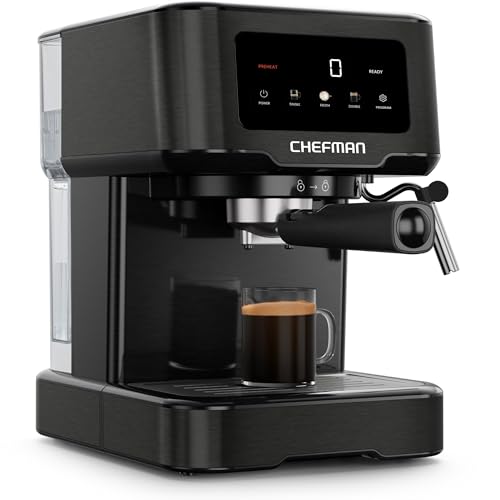
Chefman CraftBrew Espresso 15-Bar
The Chefman CraftBrew closes the guide with the largest water supply and the only digital controls in the line-up. Its pump is rated at 15 bar — the classic espresso figure, lower than the CASABREWS pair’s 20 on paper — and its reservoir holds 1.5 litres, removable, in a stainless-and-black compact body with a steam wand for lattes and cappuccinos. Digital operation in this class usually means touch controls and a display where the CASABREWS models put dials or nothing, and it suits the buyer who runs a kitchen by tapping rather than by turning. Fifteen bar deserves a calm word: espresso extraction happens at a fraction of a pump’s maximum rating, so the number is a ceiling, not a serving pressure, and 15 has been the industry’s traditional ceiling for generations of good shots.
- Pump pressure in the listing: 15-bar
- Controls in the listing: digital
- Water reservoir: 1.5L, removable
- Milk system: steam wand for latte and cappuccino
- Finish in the listing: stainless black
- Pressure gauge: no gauge is mentioned in the title
Strengths
- The 1.5L removable reservoir is the guide’s largest, turning refills into a weekly event even for two-drink households.
- Digital controls give repeatable, tappable operation that several household members can share without instruction.
- A removable tank of that size can be washed properly, a real advantage where tap water scales.
Trade-offs
- The largest reservoir makes this the least mini of the six when counter depth is measured honestly.
- Digital interfaces age differently from dials; a buyer planning a decade of service should weigh repairability.
- No gauge is mentioned, so shot feedback comes from timing and taste, as with the 3700.
The CraftBrew’s buyer is the household that drinks the most espresso in this guide’s audience: two people, two drinks each, guests at weekends. For them the reservoir is not a luxury but the removal of the category’s commonest friction, and digital repeatability means the second drinker of the morning inherits the first drinker’s settings untouched. The steam wand then serves the drink style the reservoir implies — lattes and cappuccinos in rotation, not the occasional ceremonial shot.
Chefman, as a brand, lives in the practical-appliance tier, and the CraftBrew’s specification reads accordingly: nothing decorative, every line aimed at throughput and ease. Buyers who want an heirloom object should look at the stainless CASABREWS pair; buyers who want the morning to work, at volume, with a display that tells them so, are holding the right review.
The CraftBrew’s reservoir changes guest arithmetic in a way smaller machines cannot fake. Eight drinks across an evening — the realistic demand of a dinner party that ends with coffee — draw roughly two-thirds of the tank, leaving the host pulling shots instead of performing the sink refill that breaks a party’s spell. The digital face assists there too, because a guest can be taught the machine in one sentence and sent to make their own second cup, which is the true definition of a house party machine. Throughput, not pressure, is this model’s real specification.
Best for: a high-throughput household wanting digital controls and the fewest tank refills in this guide.
Not suited for: the very smallest counters, where the 1.5L reservoir’s footprint spends space the kitchen does not have.
Check price on Amazon — Chefman’s digital CraftBrew, with the reservoir that rarely empties.
Six small machines, one counter: the comparison that matters
| Machine | System | Water, as listed | Defining feature |
|---|---|---|---|
| CASABREWS CM5418 | Pump, 20-bar | 34oz tank | Built-in pressure gauge |
| CASABREWS 3700 | Pump, 20-bar Italian | 43.9oz removable tank | Simplicity with the bigger tank |
| XIXUBX Compact | Steam, 3.5 bar | Left unstated | One-touch four-cup brewing, safety lock |
| Mr. Coffee 4 Shot | Steam, figure unprinted | Glass carafe included | Four shots brewed as a small pot |
| De’Longhi Classic | Pump, figure unprinted | Left for the product page | Preset single and double, rapid heat-up |
| Chefman CraftBrew | Pump, 15-bar, digital | 1.5L removable reservoir | Largest water supply of the six |
The table sorts the six into two families and three philosophies. Within the pump family, the CM5418 teaches, the 3700 simplifies, the De’Longhi presets and the Chefman scales. Within the steam family, the XIXUBX locks and touches, while the Mr. Coffee pours a carafe and trusts routine. A buyer who reads only one column should read the system column, because it predicts the taste of the hundredth drink better than any feature list can.
How do you choose a mini espresso machine that earns its counter space?
Settle the pump-versus-steam question first
Everything else is commentary. Pump machines extract at high pressure and make the concentrated, crema-capped drink the word espresso now means in a café; steam machines make a strong, mellow coffee that loves milk and forgives everything. Neither is a failed version of the other. Decide by the drink you actually order when someone else is making it, and let that answer eliminate half this page before price, brand or colour get a hearing.
Count drinks per day, then size the tank
Multiply your daily drinks by the people drinking them. One or two drinks a day makes the CM5418’s 34 ounces a non-issue; four or more makes the Chefman’s litre and a half the difference between a machine and a chore. Removability matters as much as volume where water is hard, since a tank that cannot visit the sink becomes a scale garden. The two listings that leave tank details unstated are not disqualified, but they transfer the question to the product page, and a careful buyer asks it there before ordering.
Be honest about who is driving
A machine shared by a household must survive its least experienced user. Presets, digital controls and one-touch brewing are not dumbing down; they are how a De’Longhi or a XIXUBX produces a decent drink in untrained hands at 6 a.m. Conversely, a solo enthusiast sharing with nobody should buy the feedback — the CM5418’s gauge — and enjoy the education. Match the interface to the actual roster of users and the machine will still be plugged in at Christmas.
Plan the milk, not just the shot
Five of these six titles promise steamed or frothed milk, yet the drinks households actually make are mostly milk drinks. Wand power, frother simplicity and the space to swing a jug under the wand decide weekday happiness more than pump figures do. If your drink is a latte, judge these machines as milk systems with espresso attached; if it is a straight shot, judge them the other way round and let the steam family go with thanks.
One last consideration belongs to the household’s future rather than its present. A machine bought for one drinker in a studio becomes, after a move or a marriage, a machine for two; a machine bought for a couple becomes a machine besieged by teenagers. Capacity and presets are how a purchase survives those transitions, and a buyer who can see the next household coming should weight the Chefman’s reservoir and the De’Longhi’s presets accordingly. The counter you are furnishing is the one you have — but the mornings are the ones you are getting.
Milk on a small machine: wands, frothers and jug room
Mini machines compress the milk workflow into inches, and technique adapts. The wand on a compact body sits lower and swings less than a café machine’s, so a smaller jug — filled no more than halfway — is not an accessory but a requirement, since milk doubles in volume as it textures and a full jug on a short wand scalds before it silks. Purge the wand for a second before the jug goes under and wipe it the moment the jug comes off; dried milk on a wand is the one maintenance failure that compounds daily, turning tomorrow’s cappuccino faintly into yesterday’s. The De’Longhi’s easy-to-use frother exists precisely for households that will not perform that ritual, trading a measure of texture for a system that rinses. Neither approach is cheating. The wand rewards practice with true microfoam; the frother rewards honesty about practice with a drink that is still good. Choose by the person you are on a February morning, not the barista you are in October.
Descaling and the small-machine calendar
Scale is the silent biography of every espresso machine, written by your tap water at a speed your postcode decides. Mini machines suffer it faster in one respect — their passages are narrower — and forgive it better in another, since a removable tank, as on the 3700 and the CraftBrew, can be emptied, soaked and inspected instead of merely flushed and hoped for. The working rhythm is simple: a descaling cycle on the calendar rather than on symptoms, because by the time a shot runs slow the boiler is already wearing a coat. Steam machines ask the same discipline of their chambers, with the added courtesy of never being forced open hot — the XIXUBX’s safety lock enforces what patience should. Owners who keep a note of descale dates on the machine’s underside, in pencil, discover that a mini machine’s lifespan is mostly a record of small kindnesses, and that the second year of any of these six tastes like the first for exactly that reason. Readers whose cleaning rounds extend beyond the kitchen counter will find the dust-collection survey at Best Shop Vacuums For Dust Collection a thorough companion for the workshop end of the house.
Counter geography: where a mini machine actually lives
The word compact is a promise made in a showroom and tested under your cabinets. Before ordering any of these six, measure three things the listings cannot know: the height from counter to cabinet underside, because tanks that lift upward need clearance the Chefman’s 1.5 litres will claim in full; the depth once the drip tray and a mug are accounted for, since a machine pushed to the wall leaves no room for the cup it fills; and the swing of the nearest cabinet door, which has ended more espresso rituals than any pump failure. Steam wands add a fourth measurement — the arc to the machine’s side where the milk jug must travel — and a wand that points at a wall is a wand that will be used twice.
Power and water complete the geography. A mini machine wants a socket it does not share with a kettle at full boil, and it wants its water source close enough that refilling is a trip of steps rather than a journey. Households that place the machine well — near the sink, under a cabinet that clears the tank, beside the cups — use it daily without thinking. Households that place it beautifully and far use it on Sundays. The six machines here are all small enough to fit somewhere sensible; the buyer’s tape measure decides whether sensible is where they land.
Beans, freshness and the mini machine’s short path
A compact machine shortens the distance between grinder and cup to a few steps, and that short path makes freshness louder. Beans a month from roast will taste tired on any machine, yet on a small pump machine — where the dose is modest and the drink is the morning’s whole event — the tiredness has nowhere to hide. The practical response is to buy smaller bags more often and to treat the freezer as a pause button for a second bag, portioned and sealed, rather than as a warehouse. Pre-ground coffee follows the same logic in miniature: a bag opened on Monday is a different ingredient by Friday, which is why so many mini-machine owners become grinder owners within a season.
Roast level interacts with the two families differently, and knowing it saves a disappointing bag. Dark, oily roasts flatter steam machines, whose gentle extraction rounds their edges into mellow, milky comfort; the same beans can bully a pump machine into bitterness at a careless grind. Lighter roasts reverse the verdict, needing the pump’s pressure to extract their brightness, and tasting thin and sour from a steam chamber. Match the bag to the family you bought and both will seem cleverer than they are; mismatch them and both will seem broken, when the only fault is a shopping decision made in the wrong aisle.
The honest upgrade path from a first mini machine
Few owners keep their first espresso machine forever, and the six here sort themselves into teachers and keepers by how they age with their owner. The CM5418 is the classic teacher: its gauge builds skill so effectively that its owner may outgrow the 34oz tank within two years, departing upward with gratitude and a trained palate. The 3700 and the CraftBrew are keepers of opposite kinds — one by simplicity, the other by capacity — and their owners tend to replace them only when they fail, which for a pump machine treated to regular descaling is a longer sentence than marketing suggests. The De’Longhi is the household keeper, replaced when the household changes rather than when the hobby deepens.
Steam machines follow a different arc. For many owners the XIXUBX or the Mr. Coffee is not a first step but a final answer, because their drink — milky, mellow, unhurried — is the drink those machines were born making. Others discover, six months in, that they have been reading pump-machine reviews at midnight, and for them the steam machine becomes the office or the caravan’s machine when the pump arrives, living a useful second life rather than a cupboard exile. There is no shame in either arc. The only genuinely wasted purchase is the one made against the buyer’s own taste, which is why this guide has repeated its one piece of advice in several costumes: know your drink first, and let the machine follow.
Accessories, when the upgrade itch comes, should be bought in the order they affect the cup: a grinder before a scale, a scale before a distribution tool, and nothing decorative until all three are earning their keep. A mini machine with fresh, well-ground coffee will outperform a large machine fed stale beans every day of the week, which is the most encouraging sentence in espresso and the reason these six small machines satisfy owners whose budgets never grew.
Espresso for one: the solo drinker’s case for small
The single-person household is the mini machine’s natural constituency, and its arithmetic deserves stating. A full-size machine heats a large boiler to make a small drink, occupies a counter run to serve one cup, and amortises its cost across a family’s consumption; a mini machine heats little, stands in a toaster’s footprint and is bought by the only person who will ever judge it. The solo drinker can also run a discipline cafés envy: one bag of beans, finished at its peak; one dose, dialled precisely; one cup, washed immediately. Every machine in this guide will serve that ritual, but the gauged CM5418 and the preset De’Longhi flatter it most — one by teaching it, the other by removing every obstacle between waking and drinking.
There is a social footnote. Solo machines travel well between life stages: to the first flat, the work-from-home desk era, the downsized kitchen where only the loved appliances survive the move. A compact espresso machine earns that survival by being carried in one box and forgiven its small tank, and owners report a fondness for these little machines out of proportion to their specifications. Sentiment is not a specification either, yet a buying guide that ignores it has never watched someone unpack the same machine in a third kitchen and smile.
Common mistakes
Buying a steam machine and expecting pump espresso. The 3.5 bar in the XIXUBX title and the carafe on the Mr. Coffee are declarations, not shortcomings. Read the system before the features, and the machine you receive will be the machine you wanted.
Grinding once for every machine in the house. A grind that suits a pump at twenty bar chokes nothing on a steam brewer and races through it instead. Each system wants its own setting; households with two machines keep two habits, or one adjustable grinder and a note on the fridge.
Letting the tank become a pond. Water left standing in a warm kitchen for a week brews a week-old taste into fresh beans. Small tanks, emptied and refilled often, quietly beat large tanks neglected — the Chefman’s reservoir earns its size only if the household actually drinks at the pace it implies.
Skipping the wand wipe. Ten seconds with a damp cloth after every milk drink is the entire difference between a wand that textures and a wand that merely heats. Every other maintenance task on this page is monthly; this one is per drink, and it is non-negotiable.
Judging the first shot. A new machine, new beans and a new hand conspire to make the first three drinks the worst a machine will ever produce. Season the burrs of your technique before reviewing the purchase; by drink ten, the machine’s true character has usually introduced itself.
Final recommendation
For most buyers, the CASABREWS 3700 Essential is the balanced answer: real pump pressure, the practical removable tank, stainless steel, no ceremony. Choose the CM5418 instead if you are learning and want the gauge’s tuition, or the Chefman CraftBrew if your household’s volume makes water capacity the governing fact and digital controls the preferred language. The De’Longhi Classic is the household peace treaty — presets, rapid heat, a frother anyone can run — and it will be the most-used machine in a mixed-skill kitchen. The two steam machines ask to be chosen knowingly: the XIXUBX for a small office’s four-cup rounds behind a safety lock, the Mr. Coffee for a couple’s daily carafe of milky drinks. None of the six is the wrong machine; each is the wrong machine for somebody, and the reviews above have tried to say for whom. When the espresso habit extends to the rest of the cleaning cupboard, the carpet surveys at Best Vacuums For Berber Carpets and Best Vacuums For Engineered Hardwood apply the same read-the-system-first logic to floors.
And if the machine will share a house with a kettle, a toaster and a microwave on one circuit, start it alone for its first week and learn what the fuse box thinks of espresso; small machines draw modest power, the XIXUBX’s 800 watts being the only figure any of these titles prints, yet old wiring keeps its own opinions.
Frequently asked questions
Is 15 bar enough, or do I need a 20-bar machine?
Fifteen is enough, and has been the classic pump rating for decades of café-grade shots. Extraction at the coffee puck happens well below a pump’s maximum figure on any of these machines; the printed number describes the pump’s ceiling, not the pressure in your cup. Grind, dose and freshness separate a good shot from a poor one far more decisively than the gap between the Chefman’s 15 and the CASABREWS pair’s 20.
What exactly does a steam espresso machine make?
A strong, hot, mellow coffee under gentle pressure — closer in spirit to a concentrated pot coffee than to a café shot, with little of the crema a pump produces. It shines in milky drinks, where its softness blends rather than fights, and it asks almost nothing in technique. The XIXUBX prints its 3.5 bar honestly and the Mr. Coffee prints no figure; both should be bought as steam machines on purpose, not discovered as one by accident.
How long do mini espresso machines take to heat up?
Small boilers and thermoblocks heat quickly by design, and the De’Longhi makes rapid heat-up an explicit claim in its title. Steam machines like the 800W XIXUBX must raise a whole chamber of water, which takes a little longer but then delivers its four cups in one run. In practice every machine here is ready within a few minutes; the honest difference is between the first drink and the fourth, where tank size and reheating between shots begin to tell.
Can these machines use pre-ground coffee, or must I buy a grinder?
Compact pump and steam machines of this class are built to accept ground coffee, and a household starting out can brew respectably with a fresh bag ground at the roaster. A grinder becomes the first upgrade rather than the first requirement, because beans ground minutes before brewing keep aromatics that a week-old bag has surrendered. Buy the machine, learn its habits on pre-ground, and let the improving shots argue for the grinder themselves.
Which of the six is quietest for early mornings?
Steam machines have no pump to buzz, so the XIXUBX and the Mr. Coffee run at a kettle’s murmur, while pump machines announce the shot with a short, purposeful hum that thin walls transmit. Households with a light sleeper beyond the kitchen door should weigh that honestly — though a pump’s noise lasts under a minute, and the De’Longhi’s rapid readiness at least keeps the disturbance brief.
Do mini machines make real café-style drinks, or a home approximation?
The pump machines here make the genuine article in miniature: espresso extracted under pump pressure, milk steamed at a wand, assembled into the same drinks a café sells, at a scale and speed suited to a household. The steam machines make the home tradition honestly — a strong, mellow base that becomes a very good milky drink. The approximation, where it exists, lies in throughput and theatre, not in the cup’s legitimacy.
How much counter space should I truly allow?
Allow the machine’s footprint, then add a mug’s width on the wand side and a hand’s height above the tank, and you have the honest territory a mini machine occupies in daily use. The Chefman claims the most of the six by virtue of its reservoir; the CASABREWS pair and the De’Longhi claim the least. If the tape measure says the territory does not exist on your counter, believe the tape measure — a machine stored in a cupboard is a machine in retirement, whatever its pressure rating.
Six machines, two families, one small square of counter: choose the system that matches the drink in your hand each morning, and the little machine will pay its rent in coffee for years.


