What's inside
- The filter you wash instead of throwing away
- Where to buy a washable filter
- Quick picks chart
- How these picks were chosen
- Six permanent filters, reviewed one by one
- All six in one table
- Will a washable filter actually fit and suit your system?
- Washing day: a practical routine
- Disposable versus washable: the honest ledger
- What repeated washing does to a filter, season by season
- Situations where the disposable still wins outright
- Spares, storage and the etiquette of the second rack
- Common mistakes
- Final recommendation
- Frequently asked questions
As an Amazon Associate I earn from qualifying purchases. This post may contain affiliate links at no extra cost to you.
As an Amazon Associate, cottageverdict.com earns from qualifying purchases.
The filter you wash instead of throwing away
Every disposable furnace filter carries a small recurring tax: remember the size, buy the multipack, store the spares, change it on schedule, bin the old one. The best washable lifetime furnace ac air filters promise to cancel that tax with a permanent frame and media you rinse, dry, and reinstall. Promise is the operative word. In the six listings below, lifetime language belongs to the sellers: lasts a lifetime, permanent, the last filter you will ever buy. Those are marketing claims printed in titles, and this guide reports them as claims — attributed, never endorsed as measured fact — because no title can prove a decades-long lifespan and no reviewer should pretend otherwise.
What titles can prove is more useful anyway: exact nominal sizes, MERV ratings as printed, construction words like electrostatic and machine washable, and one listing that even prints actual dimensions differing from its nominal size. Size is destiny with furnace filters. A washable filter in the wrong size is not a bargain at any lifespan, so this guide treats dimensions — nominal and actual — as the first specification and the lifetime rhetoric as the last.
The six split into two MERV camps and four sizes. Five listings claim MERV 8; one, the K&N, claims MERV 11. Sizes run 16x25x1, 20x25x1 twice from different brands, 20x20x1 twice, and 16x20x1 once. Two listings print actual dimensions that differ slightly from nominal, a detail worth more than any slogan because filter racks are unforgiving.
There is an environmental argument hovering over this category that deserves honest handling rather than slogans in either direction. A washable filter eliminates a stream of disposable frames and media, and that is a real reduction in household waste. Against it stand the water and energy of repeated washing, the detergents a laundry method may use, and the shipping footprint of a heavier product bought once. Titles in this guide do not quantify either side, and neither will this review. The household calculus is genuinely local: a home that washes in full laundry loads and air-dries in a dry climate keeps the washable footprint small, while a home running special hot cycles for a single filter spends more of the saving. Decide with your own laundry habits in view, not with a halo or a guilt trip supplied by marketing.
Where to buy a washable filter
The Reair 16x25x1 Washable MERV 8 leads for machine-washable convenience, described as machine washable and dryer friendly in its title.
Homes with a 20×25 slot and a preference for electrostatic media should look at the Torjim 20x25x1 Washable Electrostatic, sold as permanent and easy to install.
The UBeesize 20x25x1 Reusable Electrostatic prints its actual dimensions in the title, a transparency the careful measurer will appreciate.
Shoppers wanting the highest MERV claim in this set land on the K&N 20x20x1 Washable MERV 11 Lifetime, from a brand built on washable filtration.
Smaller 16×20 racks are served by the Nexiview 16x20x1 Washable Electrostatic, another MERV 8 permanent-framed entry.
Value seekers close with the Generic 20x20x1 Reusable Lifetime MERV 8, a two-pack of washable electrostatic filters in one listing.
Quick picks chart
| Pick | Best for | Size and rating as printed |
|---|---|---|
| Reair 16x25x1 Washable MERV 8 | Machine washing and dryer use | 16x25x1, MERV 8, Machine Washable and Dryer Friendly |
| Torjim 20x25x1 Washable Electrostatic | 20×25 electrostatic permanence | 20x25x1, MERV8, Electrostatic, Permanent |
| UBeesize 20x25x1 Reusable Electrostatic | Buyers who measure actual dimensions | 20x25x1 nominal; actual 19.75×24.65×0.82 Inch printed |
| K&N 20x20x1 Washable MERV 11 Lifetime | Highest filtration claim in the set | 20x20x1, Merv 11, actual 19.6 x 19.6 x 0.8 in printed |
| Nexiview 16x20x1 Washable Electrostatic | Compact 16×20 racks | 16x20x1, MERV8, Electrostatic, Permanent |
| Generic 20x20x1 Reusable Lifetime MERV 8 | Two filters in one purchase | 2 Pack 20x20x1, MERV 8, Permanent Electrostatic |
How these picks were chosen
Eligibility required three title-level facts: the filter must be a complete washable or reusable furnace filter, its size must be printed, and a MERV rating must be stated. Cut-to-fit media rolls and loose vent material were excluded as a different product class — they are fabric, not filters. The survivors were then arranged to cover the common residential sizes in this category, with brand variety preferred over repeating one maker across sizes, so a reader can compare philosophies rather than logos.
Claim handling followed a strict rule. Lifetime, permanent, and last-filter-you-will-ever-buy phrasings are quoted as listing language and discussed as marketing, while verifiable title facts — dimensions, MERV numbers, washability methods, pack counts — are stated directly. Two listings print actual sizes; those figures are reproduced exactly, because the gap between nominal and actual is where washable filters succeed or rattle in their racks. Electrostatic appears in four titles and is reported as a media description, not explained beyond what the word itself claims.
Health-adjacent phrases in the titles, such as breathe fresher and breathe safely, are treated as slogans. This guide makes no claim that any filter improves any person’s health; it discusses filtration ratings as printed specifications and leaves wellbeing conclusions to the reader.
A word about how to read the reviews that follow. Each one separates three kinds of sentence that titles habitually blur: facts the title prints (sizes, ratings, pack counts), claims the title asserts (permanence, easy installation, freshness slogans), and questions the title leaves open (frame construction, washing specifics, verified fit). Keeping those lanes separate is the entire discipline of this guide, and readers who adopt it will find every filter listing on the internet — not just these six — suddenly easier to judge. The spec box in each review lists the printed facts; the prose handles the claims and the open questions, in that order, every time.
Six permanent filters, reviewed one by one
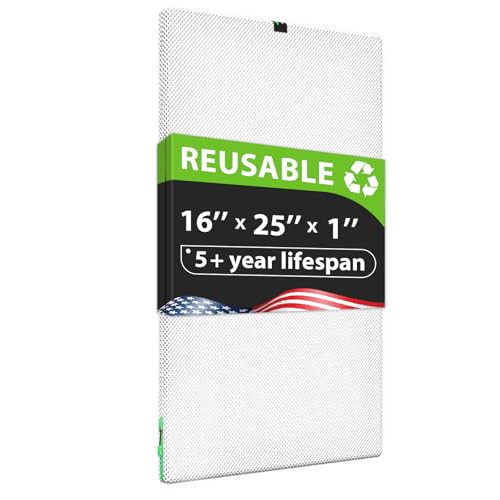
Reair 16x25x1 Washable MERV 8
Reair’s title is a model of repetition with a purpose: washable and reusable, 16x25x1 stated three times, MERV 8 stated twice, and the distinctive detail — machine washable and dryer friendly. That last phrase separates this filter from rivals that expect a hose, a sink, and a day of air-drying. A filter that can go through a laundry cycle fits households whose maintenance routines already run through the laundry room, and a dryer-friendly claim removes the wet-filter-waiting problem that makes people reinstall disposables late.
- Nominal size: 16x25x1
- Rating printed: MERV 8
- Washing method named: Machine Washable and Dryer Friendly
- System fit stated: AC HVAC Furnace
- Actual dimensions: not printed in the title
- Pack count: single filter implied by the title
Strengths
- Machine washing is the lowest-effort cleaning method claimed in this set.
- Dryer friendliness shortens the out-of-service window to hours, not a day.
- The title’s clarity about size and rating leaves little to guess.
Trade-offs
- Actual dimensions are not printed, so rack fit relies on the nominal size.
- MERV 8 is the set’s common rating, not its highest claim.
- Machine washing a filter requires a machine cycle households must be willing to run.
The ownership rhythm here is laundry logic: pull the filter on a set day, run it with a suitable wash load as the maker directs, dry it, reinstall. Households that already batch domestic chores will find that rhythm natural. The caution is mechanical rather than chemical — a washable filter’s frame and media must survive repeated cycles, and the title’s confidence on that point is a claim to test across the first year, watching for warping or media separation after each wash.
For a 16×25 rack, this is the convenience flagship of the guide. Its MERV 8 claim matches most rivals, its size is common, and its cleaning method is the one most likely to actually happen on schedule — which, in filtration, is the variable that decides real-world performance more than any rating printed on a frame.
Apartment buildings with shared laundry rooms add a scheduling wrinkle worth planning: a filter wash needs a machine slot and a drying spot that neighbours tolerate, so tie the routine to a laundry day that already exists rather than inventing a new one. There is also a hygiene etiquette to observe — a furnace filter carries a season of household dust, and running it through a shared machine inside a sealed wash bag, if the maker’s guidance permits, is the considerate version of the routine. None of that negates the convenience claim; it simply locates the convenience inside real buildings rather than brochure kitchens.
Best for: 16×25 households wanting machine-washable, dryer-friendly maintenance. Not suited for: racks needing verified actual dimensions, which this title does not print.
Open the Reair washable filter listing

Torjim 20x25x1 Washable Electrostatic
Torjim speaks the category’s standard dialect fluently: 20x25x1, MERV8, washable and reusable, electrostatic, permanent, easy install, with a breathe fresher slogan riding along as slogans do. The 20×25 size is among the most common residential furnace dimensions, which makes this listing the default comparison point for a large share of readers. Electrostatic media, as the word is used in filter titles, describes media intended to use static charge as part of its particle capture approach; the title offers the term without test data, and this review passes it on the same way.
- Nominal size: 20x25x1
- Rating printed: MERV8
- Media description: Electrostatic
- Permanence wording: Permanent — a listing claim
- Installation note: Easy Install claimed
- Actual dimensions: not printed in the title
Strengths
- The 20×25 footprint matches a very common residential rack size.
- Electrostatic media distinguishes it from plain washable constructions.
- Easy-install language suits first-time washable converts.
Trade-offs
- No actual dimensions are printed for verifying a tight rack.
- Washing method specifics are absent — no machine-washable claim like the Reair’s.
- Permanent is a marketing word here, not a measured lifespan.
Choosing the Torjim is choosing the mainstream washable proposition at the mainstream size. Its ownership questions are the category’s standard ones: how does the media respond to rinsing, how flat does the frame stay, how snug is the nominal fit in your particular rack? None of those can be answered from a title, which is why the first month with any washable filter should be treated as a fitting trial — check for bypass gaps at the edges, listen for rattle, and inspect the media after its first wash.
Against its same-size rival next in this guide, the Torjim trades dimensional transparency for a slightly simpler pitch. Readers whose racks are standard and forgiving may never miss the missing figures; readers with an older, bent, or nonstandard rack should keep reading to the UBeesize.
Landlords managing several units with the same 20×25 rack size will see this listing’s appeal from a different angle: one washable model standardised across properties simplifies the maintenance round, since a technician can carry one spare and rotate it through units while the removed filters are washed centrally. That fleet logic rewards boring consistency over per-unit optimisation, and a mainstream electrostatic MERV 8 is the definition of the category’s boring centre. The easy-install claim, unglamorous in a single home, compounds across twenty doors into real labour saved at every quarterly visit.
Best for: standard 20×25 racks wanting electrostatic washable media. Not suited for: precision-fit racks, since no actual size is printed.
See the Torjim 20×25 filter details

UBeesize 20x25x1 Reusable Electrostatic
UBeesize prints the number this guide wishes every maker printed: actual size 19.75×24.65×0.82 inch, tucked at the end of a title that also claims MERV 8, washable, lasts a lifetime, permanent, and electrostatic. That actual figure is smaller than the 20x25x1 nominal in every dimension, which is normal in this industry — nominal is a rack category, actual is the object — but seeing it in the title lets a buyer measure their rack and know. The lasts a lifetime phrase is the listing’s claim, reported as such.
- Nominal size: 20x25x1
- Actual size printed: 19.75×24.65×0.82 Inch
- Rating printed: MERV 8
- Media description: Electrostatic, Washable
- Lifespan wording: Lasts a Lifetime, Permanent — listing claims
- Settings named: Home And Office
Strengths
- Printed actual dimensions allow a tape-measure check before purchase.
- The 0.82-inch actual thickness clarifies rack depth fit precisely.
- Electrostatic washable media matches the category’s mainstream offer.
Trade-offs
- An actual size visibly under nominal may fit loosely in generous racks.
- No machine-washable claim appears, so cleaning is likely a rinse-and-dry routine.
- Lifetime phrasing is marketing, unverifiable from the title.
The measuring ritual this listing enables is worth describing for all six picks: measure the old disposable filter, not the rack label, since the object in your hand is the truth; then compare against actual dimensions where printed. A gap of a few millimetres invites air bypass — unfiltered air sneaking around the media — while an interference fit stresses the frame at every change. UBeesize’s transparency converts that ritual from guesswork into arithmetic for the 20×25 class.
Between the two 20×25 listings here, the choice is philosophical: Torjim’s simplicity against UBeesize’s disclosed measurements. For a permanent purchase — even discounting the lifetime slogan, a washable filter is a multi-year commitment — disclosed measurements are the more durable virtue.
The printed thickness deserves a second look, because 0.82 inch against a nominal 1 inch is where rack rattle is born or prevented. A filter noticeably thinner than its slot can vibrate under airflow, and that vibration is both a noise and a bypass problem; foam gasket tape, sold for exactly this, turns the UBeesize’s disclosed thinness from a risk into a planned fit. The listing’s honesty lets a buyer order the tape in the same basket — a small example of how one printed number improves an entire installation, and why this guide keeps returning to it.
Best for: 20×25 owners who measure actual fit before buying. Not suited for: racks at the generous end of nominal tolerance, where the printed actual size may sit loose.
Check UBeesize’s printed dimensions

K&N 20x20x1 Washable MERV 11 Lifetime
K&N arrives with the set’s only MERV 11 claim and its most theatrical slogan: the last HVAC filter you will ever buy. Both are reported here as the listing’s language. What grounds the entry is the brand’s long identity in washable filtration and a second actual-size disclosure — 19.6 x 19.6 x 0.8 in — attached to the 20x20x1 nominal, with model code HVC-12020 for exact reordering. A higher MERV claim implies finer filtration as the rating scale is defined, and it also raises the airflow question every higher-rated filter must answer in a real system.
- Nominal size: 20x20x1
- Actual size printed: 19.6 x 19.6 x 0.8 in
- Rating printed: Merv 11 — the highest claim in this set
- Lifespan wording: Lasts a Lifetime; the Last HVAC Filter You Will Ever Buy — listing claims
- Model code: HVC-12020
- Settings named: Home or Office
Strengths
- MERV 11 is the strongest filtration rating claimed among these six.
- Actual dimensions are printed for fit verification.
- A model code makes future reference and support conversations precise.
Trade-offs
- Higher-rated media can restrict airflow more; system compatibility deserves checking.
- Theatrical lifetime slogans should be read as marketing, not warranty terms.
- Only the 20×20 size is offered in this listing.
The airflow caveat deserves plain language. A furnace or air handler is designed around an expected filter resistance; moving from a basic disposable to a finer washable medium changes that resistance, and systems vary in how much change they tolerate. The title cannot answer for your blower. A sensible path is to install, then listen and observe across a heating or cooling cycle — short-cycling, whistling at the rack, or rooms drifting from their usual temperatures are signals to discuss with an HVAC technician rather than to endure.
For the right 20×20 household, though, this is the set’s premium proposition: the highest rating claim, disclosed dimensions, and a maker whose name is a search term in itself. The breathe safely slogan in the title is noted and set aside as marketing; the specifications are the substance.
Brand gravity is worth examining honestly with this entry. K&N’s identity was built in automotive filtration, where washable performance filters are its signature, and that heritage cuts two ways: it suggests genuine institutional knowledge of washable media, and it invites a halo that a furnace title has not independently earned. The disciplined reading is to credit the specifications — rating, dimensions, model code — and let the heritage serve only as a tiebreaker against an equivalent unknown. On specifications alone, this listing still leads its size class here, which is the strongest thing a review can say without borrowing the brand’s own thunder.
Best for: 20×20 systems whose owners want the highest MERV claim here with printed actual dimensions. Not suited for: systems sensitive to airflow restriction, where an MERV 11 claim warrants professional confirmation first.
Read the K&N lifetime filter listing

Nexiview 16x20x1 Washable Electrostatic
Nexiview covers the compact end of the size map: 16x20x1, MERV8, washable and reusable, electrostatic, permanent, easy install claimed, with the breathe fresher slogan attached. Smaller racks live in smaller systems — apartment air handlers, compact furnaces, secondary units — where the disposable-filter tax is just as real and storage for spare disposables is often scarcer. A washable filter in a flat with no utility cupboard solves a logistics problem as much as a filtration one.
- Nominal size: 16x20x1
- Rating printed: MERV8
- Media description: Electrostatic
- Permanence wording: Permanent Air Filter — a listing claim
- Installation note: Easy Install claimed
- Actual dimensions: not printed in the title
Strengths
- The 16×20 size serves compact systems the larger picks cannot fit.
- Electrostatic washable media matches the set’s mainstream construction.
- One permanent filter ends spare-filter storage in small homes.
Trade-offs
- No actual dimensions are printed for verifying fit.
- No machine-washable claim appears in the title.
- MERV8 is the common rating, not a differentiator.
Small systems reward consistency. Their filters are easy to forget precisely because the equipment is tucked away, and a washable unit converts a purchasing chore — remember size, order, wait — into a cleaning chore that can happen the day it is remembered. Renters in units where the filter is tenant-maintained will recognise the appeal, though they should confirm with a landlord before replacing any building-supplied filtration arrangement with a permanent alternative.
Within this guide, Nexiview is the size specialist: unremarkable in claims, essential in coverage. If your rack reads 16×20, it is effectively the only electrostatic washable option presented here, and its plainness becomes a virtue.
Compact systems often hide in closets that double as storage, where the filter rack sits behind paint tins and suitcases. A washable filter changes the archaeology of that closet: no sleeve of spare disposables to excavate, just one object to extract, wash, and return. For tenants, there is a documentation habit worth forming — photograph the rack and the installed filter at move-in, so a deposit conversation at move-out starts from evidence rather than recollection. The Nexiview’s plain specification sheet photographs well for exactly that purpose, one more unglamorous virtue of a listing that states its facts and stops.
Best for: compact 16×20 systems in apartments and smaller homes. Not suited for: any rack larger than 16×20, and a buyer requiring printed actual dimensions.
View the Nexiview 16×20 listing

Generic 20x20x1 Reusable Lifetime MERV 8
The closing entry competes on arithmetic: a 2 pack of 20x20x1 reusable filters, washable, MERV 8, permanent electrostatic, lasts a lifetime as the listing claims, breathe safely as its slogan adds. Two filters change the washable ownership model fundamentally, because the classic washable inconvenience — the system sitting filterless, or the household forgetting to reinstall while the filter dries — disappears when a clean spare rotates in immediately. The trade is the unnamed brand: no maker’s name appears in the title to research.
- Nominal size: 20x20x1
- Pack count: 2 Pack — two filters in one listing
- Rating printed: MERV 8
- Media description: Permanent Electrostatic
- Lifespan wording: Lasts a Lifetime — a listing claim
- Brand: none named in the listing title
Strengths
- A two-pack enables instant rotation while one filter dries.
- Two 20×20 filters can also serve two systems or two racks in one home.
- Electrostatic washable media matches the category standard.
Trade-offs
- An unnamed brand complicates support and longevity research.
- No actual dimensions are printed for either filter.
- MERV 8 trails the K&N’s MERV 11 claim at the same nominal size.
Rotation is the underappreciated washable strategy, and this listing is its only representative here. With a spare, washing stops being an appointment the HVAC system must attend; it becomes a background task done at the sink whenever convenient, with the clean filter swapped in during a thirty-second rack visit. Homes with two 20×20 systems — a main unit and a secondary air handler — get a different dividend: both convert to washable in a single purchase.
Diligence is the price of the unnamed brand. Check the seller’s identity, the stated construction, and return terms on the product page, and treat the lifetime phrasing as the marketing it is. If those checks pass, the two-pack’s workflow logic is genuinely strong.
Rotation ownership produces one more subtle benefit: comparison. With two filters alternating, a household can see how much material a month actually deposits by comparing the just-removed filter against its clean twin, calibrating the wash interval to evidence instead of habit. Heavy months — renovation dust, wildfire smoke drift, a shedding season — announce themselves on the media, and the interval can tighten accordingly. A single-filter household judges the same question from memory, which is to say it guesses. The two-pack, whatever its brand anonymity, builds measurement into the routine itself.
Best for: 20×20 owners wanting a rotation spare or two systems converted at once. Not suited for: a buyer seeking a named brand’s support and printed actual dimensions.
Inspect the two-pack 20×20 listing
All six in one table
| Filter | Nominal size | MERV claim | Distinguishing title fact |
|---|---|---|---|
| Reair | 16x25x1 | 8 | Machine Washable and Dryer Friendly |
| Torjim | 20x25x1 | 8 | Electrostatic, Easy Install |
| UBeesize | 20x25x1 | 8 | Actual size printed: 19.75×24.65×0.82 Inch |
| K&N | 20x20x1 | 11 | Actual size printed; model HVC-12020 |
| Nexiview | 16x20x1 | 8 | Electrostatic for compact racks |
| Generic 2 Pack | 20x20x1 | 8 | Two filters per listing |
The table makes the shopping order obvious: size first, because five of these six will simply not fit a given rack; MERV second, as a claim to weigh against your system’s tolerance; distinguishing fact third, as the tiebreaker among the survivors. Lifetime rhetoric appears in every row’s title and differentiates none of them, which is precisely why this guide demotes it. A claim everyone makes is a claim that selects nothing.
Homeowners mid-renovation often shop this category alongside the systems that use the air; those planning the espresso corner of a new kitchen may detour to Best Espresso Semi Automatic Machines once the ductwork arithmetic is done.
Will a washable filter actually fit and suit your system?
Measure the object, not the label
Pull the current filter and measure it with a tape: width, height, and thickness, in that order, and write all three on the furnace itself in marker for every future purchase. Compare those figures with actual dimensions where a listing prints them — UBeesize and K&N do — and treat nominal-only listings as approximations to verify during a return window. Check rack depth too; a filter thicker than the slot invites forcing, and forcing bends frames.
Think about airflow before rating
MERV numbers describe filtration fineness as the scale is defined, and finer media generally asks more of a blower. If your system is elderly, undersized, or already struggling to reach set temperatures, discuss a rating jump with a technician before buying the MERV 11 claim. If your system is modern and healthy, an MERV 8 washable is usually the like-for-like neighbourhood of common disposables — but usually is a word to verify against your current filter’s printed rating, which is the single most useful number in this whole decision.
Design the washing routine before buying
A washable filter is a chore subscription. Decide where it will be washed — laundry machine for the Reair, utility sink or hose for most others — where it will dry without blocking the household, and what the system does meanwhile. The two-pack answers that last question elegantly; single-filter households can wash on a mild day when the system can rest. Put the wash date on the same calendar as smoke-alarm batteries or another fixed ritual, because a washable filter’s enemy is not wear but forgetting.
Check the frame as carefully as the media
Titles emphasise media — electrostatic, MERV grades — but a washable filter’s working life is usually decided by its frame. The frame is what gets flexed at every removal, soaked at every wash, and gripped by every rack. Look for construction language on the product page: frame material, corner joints, whether the media is replaceable within the frame or sealed into it. A sealed unit lives or dies as one object; a framed design with serviceable media has a longer plausible story. None of the six titles here details its frame construction, which is a shared gap worth naming: it is the first question to carry to each product page, ahead of any slogan about permanence.
Read lifetime as a question
When a title says lasts a lifetime, ask: whose lifetime, under what washing method, with what exclusions? The answers live in warranty text, not titles. A filter with a clear multi-year warranty and replaceable media may out-serve a filter with a lifetime slogan and no terms. Let the slogans introduce the products; let the terms close the sale.
Washing day: a practical routine
Technique decides whether washable media survives its own maintenance. Rinse from the clean side toward the dirty side where the design allows, so debris exits the way it entered instead of being driven deeper. Use gentle water pressure; a pressure washer’s jet can damage media and void any sympathy from a warranty department. Let the filter dry completely — completely, not surface-dry — before reinstalling, because a damp filter in a dark duct is an invitation to musty odours. While it dries, vacuum the rack and inspect the frame line for gaps that a strip of filter gasket could seal.
Inspect at every wash: media tears, frame warping, corners crushed by an over-tight rack. Photograph the filter annually beside a coin for scale; comparing photographs across years turns the lifetime slogan into your own evidence, one way or the other. Households furnishing a whole property will find the same measure-first discipline applies to furniture, as Best Slim Bathroom Storage Cabinet shoppers learn in narrower rooms.
Drying logistics vary by home more than by filter. A utility room with a rack and a dehumidifier dries a filter overnight in any season; a small flat in a humid climate may need a fan aimed at the filter and a full day of patience. Plan the drying spot before the first wash, not during it, and never lean a wet filter against painted walls or inside the rack housing to finish drying in place — the system will be switched on by someone, and a damp filter in a running duct is the exact scenario the routine exists to prevent. The two-pack households skip this entire choreography, which is worth remembering when their listing’s plainness tempts you to dismiss it.
Water quality leaves a footnote too. Very hard water can deposit mineral scale in washed media over many cycles, gradually changing its behaviour; a final rinse with softer water, where available, or a gentle shake-and-air routine mitigates it. Makers rarely mention this in titles, and none does here, but households on well water will discover it empirically within a year and should not mistake the gradual stiffening for a defective product.
Disposable versus washable: the honest ledger
Washables win on waste and on never being caught without a spare filter at midnight; they cost effort, drying space, and an upfront price the titles here do not print. Disposables win on effortlessness and predictable fit; they cost a perpetual purchasing rhythm and a stream of landfill. Neither side wins on filtration by category — ratings decide that filter by filter. The household that washes on schedule gets the washable bargain; the household that knows it will not wash should buy disposables without guilt, because a neglected washable is worse than a fresh disposable every single month of the year.
There is a hybrid worth naming: washable in the main system, disposable in a rarely used secondary system where washing trips would be forgotten. The Nexiview’s compact size and the generic two-pack both slot into such mixed strategies, and the ledger above, not brand loyalty, should assign them.
Climate rewrites the washing calendar in ways titles cannot anticipate. A desert home pulling fine dust through its system may load a washable filter in weeks; a coastal home in a mild season may run a quarter on the same media. Construction nearby, a new pet, a wood stove in winter — each rewrites the load again. The mature approach is to treat the maker’s interval as a ceiling and your own inspection as the schedule: hold the filter to the light monthly, and when the media’s colour has deepened uniformly and dust shadows the frame edges, wash it regardless of what the calendar says. Washable ownership rewards that attentiveness with the very longevity the slogans promise; disposable ownership never asked for it, which is the deepest difference between the two philosophies.
Energy thinking belongs in the ledger too, stated carefully. A clogged filter of any kind makes a blower work against resistance, and a clean one restores the system’s intended airflow; that much is mechanics, not marketing. What this guide will not do is convert that mechanics into a savings figure, because no title here prints one and household systems vary too widely for honest arithmetic. The defensible claim is narrower: a washing routine that keeps media clean keeps the system breathing as designed, and the alternative — any filter, washable or disposable, left loaded for a year — taxes the equipment in ways that show up as noise, uneven rooms, and strain.
Second systems and seasonal homes deserve a paragraph of their own. A holiday property visited monthly is a poor candidate for washables that need attention on a rhythm the visits cannot keep; a disposable changed each visit is the honest fit there. Conversely, a rental with long tenancies and a cooperative tenant can run washables beautifully if the lease states who washes and when. The product is never just the filter; it is the filter plus the human system around it, and the listings in this guide succeed or fail inside that system, not inside their packaging.
What repeated washing does to a filter, season by season
A disposable filter never has to survive its own maintenance, which is why washable ownership deserves a clear-eyed account of what the washing itself costs the object over time. The first washes are the easy ones: media releases its grey load willingly, frames come out of the sink looking new, and the household congratulates itself. The informative washes are the eighth, the fifteenth, the twenty-fourth. By then a pattern has declared itself in each construction. Electrostatic media — the kind four of these six titles name — depends in part on properties that water, detergent and agitation can gradually alter, and while no title here quantifies that drift, the honest owner watches for its signature: a filter that comes out of the wash looking clean yet loads with dust noticeably faster than it did in its first year may be telling its owner that the media’s character has changed, even though its appearance has not.
Frames age on a separate timetable from media, and usually a ruder one. The frame is flexed at every extraction, knocked against the rack’s edges, soaked, dried, and flexed again at reinstallation, and plastic corners that were crisp in year one can round, crack or warp by year four — warping being the quiet failure, because a warped frame still looks like a filter while leaking unfiltered air along one edge. This is why the inspection ritual described earlier in this guide matters more than any lifespan slogan: the frame, held up to a window and sighted along its length twice a year, reports its own condition without interpretation. A frame that no longer sits flat has ended the filter’s useful life whatever the media looks like, and recognising that moment is the difference between a washable filter that served a decade and one that spent its last three years as a decorative bypass.
Drying leaves its own cumulative mark in hard-water districts, where mineral deposits stiffen media a fraction at a time until the filter’s resistance to airflow is measurably not what it was — measurably, that is, by the system’s behaviour rather than by any gauge a household owns: longer runs to reach a set temperature, a blower note that has deepened almost imperceptibly. None of this argues against washables; it argues for entering the category with the same realism a person brings to a good knife, which also lasts for years precisely because its owner sharpens, dries and stores it properly. Longevity in household objects is rarely a property of the object alone. It is a property of the partnership between the object and the routine, and the listings’ lifetime language, read charitably, is a bet placed on that partnership rather than a promise made by the factory.
Situations where the disposable still wins outright
Honest guidance about washables has to name the households that should not buy them, and there are more of those households than the category’s marketing admits. A system whose filter rack is damaged, bent or improvised belongs at the top of the list: a washable frame is less forgiving of a distorted rack than a crushable disposable, and until the rack is repaired the permanent filter will seat badly in a way no washing routine can compensate for. Homes in the middle of renovation belong there too, for the opposite reason — construction dust loads media so aggressively that a filter may need washing weekly for months, and a cheap disposable sacrificed fortnightly is simply the more rational tool for a temporary condition, with the washable purchase deferred until the dust years are over.
Households where the filter lives somewhere genuinely unpleasant to reach — a crawl space, a roof void, an attic reached by a ladder with a hatch — should think hard about who will perform a washing routine in February, because a chore that requires courage will be postponed, and a postponed washable is a clogged filter with a proud title. Multi-property owners face a version of the same arithmetic at scale: a washable in a property visited twice a year is a filter that gets washed twice a year, whatever the dust load, and the disposable changed at every visit serves that building better. Finally, there are systems under a manufacturer’s service agreement whose terms specify filter types; converting such a system to a washable without written agreement risks a warranty argument nobody needs, and the titles in this guide, for all their permanence language, say nothing that overrides a service contract. Naming these exceptions does not weaken the six listings reviewed above — it defines the ground on which they genuinely win, which is the attentive, accessible, settled household that will still be washing its filter, gladly, in year six.
Spares, storage and the etiquette of the second rack
Ownership details that never appear in titles decide how gracefully a washable filter ages in a real house, and the humblest of them is where the filter waits while it dries or rests. A washed filter stored flat in a clean, dry cupboard keeps its frame true; the same filter leaned for months behind a boiler, breathing damp air and collecting the very dust it exists to catch, starts its next tour of duty pre-loaded. Households with a rotation pair should store the resting filter in the bag or box the pair arrived in, labelled with its size, because a 20×20 and a 20×25 look identical at a glance in a dark cupboard and differ exactly where it matters. The labelling habit sounds fussy until the first time a filter is carried to the rack, offered up, and found to be its near-twin.
Homes with two systems of different sizes — a common arrangement wherever an extension or a converted attic gained its own air handler — should resist consolidating their filter shopping into a single order of a single size, however tidy that feels. Each rack keeps its own filter, its own wash rhythm and its own entry on the closet-door log, and the two systems will load their media at different rates because they serve different rooms and different lives. The attic unit filtering a guest room may need two washes a year; the main unit below it, filtering a kitchen, a dog and a wood-burning stove’s neighbourhood, may need eight. Treating them as one purchase with one calendar is how the busy system ends up neglected while its quiet sibling gets washed out of pure fairness.
Guests and house-sitters deserve a line in the log as well. A washable filter is invisible infrastructure — a sitter told only to water the plants will never think of it — yet a long trip through a dusty season can return the household to a loaded filter and a labouring blower. One sentence in the house instructions, naming the wash date and the spare’s location, transfers the routine intact across an absence, and it costs nothing but the thirty seconds spent writing it down.
Common mistakes
Ordering by nominal size alone. Nominal is a category, not a measurement. Two listings in this guide print actual sizes noticeably under nominal; a rack at either tolerance extreme can betray a buyer who never measured the object being replaced.
Reinstalling a damp filter. A filter that feels dry on its face can hold moisture in its depth, and a dark duct rewards that moisture with odour. Give the filter its full drying time, or keep a rotation spare so patience costs nothing.
Blasting media with high-pressure water. Pressure that feels efficient on a driveway tears filter media and bends fine structures. Gentle flow, patience, and a second rinse outperform force, and they keep the lifetime claim plausible.
Jumping MERV ratings without a system check. Finer filtration is not free; blowers pay for it. Match or modestly step from your current filter’s printed rating, and treat a leap to the highest claim in this set as a technician conversation.
Believing lifetime means maintenance-free. The slogan promises longevity, not neglect. A washable filter’s lifespan is earned at the sink, month after month; skip the washing and the permanent filter becomes a permanently dirty one.
Discarding the old disposable before the trial ends. Keep the outgoing disposable, if it is still serviceable, until the washable has survived its first wash and reseating. Frames that fit on day one can warp after cycle one, and a household with no fallback filter learns that lesson with its system standing open. The trial mindset costs a shelf slot for a month and buys insurance for the whole conversion.
Washing on the system’s busiest day. Pulling the filter at the start of a heatwave afternoon guarantees the house will want the air conditioning before the media is dry. Wash on a mild morning, or run a rotation spare, and let the weather rather than the laundry set the deadline.
Ignoring edge gaps after installation. Air takes the easiest path, and a two-millimetre gap around a frame can bypass more air than the media filters. Inspect the seated filter with a torch, seal gaps properly, and recheck after the first wash when frames have settled.
Final recommendation
Match size first and the winner usually names itself. For 16×25 racks, the Reair’s machine-washable, dryer-friendly routine is the most livable offer here. At 20×25, the UBeesize earns the nod for printing its actual dimensions, with the Torjim as the simpler alternative for forgiving racks. At 20×20, the K&N is the premium claim — MERV 11, actual size disclosed, a model code for the record — while the generic two-pack is the workflow winner for rotation-minded households. The Nexiview holds the 16×20 niche without competition in this set. Whichever you choose, read its lifetime language as an invitation to verify terms, and compare its class against Best Fiberglass Furnace Filters if the disposable side of the ledger still tempts you.
One refinement for households running two different sizes from this list: resist the urge to standardise on whichever filter washes easiest and force it into both racks. The Reair’s laundry convenience is real, but it belongs to a 16×25 object; a 20×25 rack fitted with anything else is a bypass machine wearing a filter costume. Size loyalty outranks brand loyalty in this category every time, and the mixed household — Reair in one system, two-pack in the other — is not an inconsistency but the correct answer to two different questions asked by two different furnaces.
Frequently asked questions
What does MERV mean in these titles? MERV is the rating scale the listings cite for filtration fineness: five of these titles claim 8, one claims 11. Higher numbers describe finer claimed filtration, with airflow implications a system check should confirm.
How often should a washable filter be washed? Titles here do not print intervals, so follow the maker’s instructions for your model and your home’s dust load; the practical rule is to wash on a fixed calendar rhythm rather than when the filter looks bad, since visible dirt means the wash is already late.
Can a washable filter really last a lifetime? That phrase is the listings’ marketing language, reproduced in this guide as a claim. Real longevity depends on media, frame, washing technique, and warranty terms — verify the terms, inspect at every wash, and let evidence accumulate.
Why do actual sizes differ from nominal sizes? Nominal dimensions name the rack category; the physical filter is made slightly smaller to slide in. Two titles here print both figures, which is why this guide keeps praising the practice.
Is electrostatic a filter rating? No. In these titles electrostatic describes the media’s approach, while MERV carries the rating. The two words answer different questions and should not be traded for each other when comparing listings.
Should both filters in a two-pack be washed together? Alternating is the point of the pack: wash the removed one while its twin serves, and the pair ages evenly. Washing both at once strands the system and throws away the rotation advantage the listing was bought for.
What if my rack size is not among these six? Then none of these listings fits, and forcing a near-size is worse than staying disposable for another cycle while you source the correct washable. Size coverage in this category is broad in the wider market; this guide’s six cover four common sizes, not every rack ever built.
A closing note on record-keeping: write the purchase date on the filter frame itself with a permanent marker, and log each wash on a card taped inside the furnace closet door. Two years later, when a guest asks whether the lifetime claim was true, you will own the only dataset that matters — your own — counted in washes survived, fits kept, and seasons served, rather than in slogans remembered.
Measure twice, wash gently, and a permanent filter can turn a recurring chore into a settled one.


