What's inside
- Where to buy these six
- The six picks in one table
- How these picks were chosen
- Side by side: format, power source and floor brief
- How do you choose a vacuum that respects engineered boards?
- Why grit, not suction, is the real enemy of a veneer floor
- Keeping the floor path clear between cleans
- Common mistakes when vacuuming engineered hardwood
- Final recommendation
- Questions buyers ask about vacuums and engineered floors
As an Amazon Associate I earn from qualifying purchases. This post may contain affiliate links at no extra cost to you.
As an Amazon Associate, cottageverdict.com earns from qualifying purchases.
Engineered hardwood asks more of a vacuum than ordinary plank flooring does. The wear layer on top is real wood, yet it is thinner than the board beneath it, so grit dragged under a stiff brush or a hard wheel leaves marks that cannot be sanded out as casually as they could on solid timber. Anyone shopping for the best vacuums for engineered hardwood is really shopping for gentle floor contact first and suction second, because the dirt that matters most on this surface is the fine, sandy kind that crunches underfoot and grinds into the finish when a machine pushes it around instead of lifting it.
There is an honesty point to settle before the picks themselves. None of the six listing titles below uses the word engineered. Each manufacturer describes its machine for hard floors or hardwood in general language, so this guide cannot promise a certification aimed at veneer flooring, and it does not try to. What the titles do reveal is the machinery that touches the boards: a soft roller built for hard surfaces on the Electrolux, canister bodies from Miele, Sanitaire and Eureka that keep the heavy motor off the floor head, and two Shark sticks whose listings pair hardwood with carpet. Read the six with that lens and the differences become practical rather than mysterious.
Format matters on this floor type in a way it does not on tile. A cordless stick gets grabbed for the ten-minute sweep after dinner, which is exactly the sweep that stops grit building up in the traffic lanes by the sink and the front door. A canister trails behind on a hose and tends to be the machine people pull out for a deliberate whole-floor clean, skirting boards included. Both approaches appear below, along with the run times, power figures and tool lists the listings actually publish, so you can match a machine to the rhythm of your own house instead of buying the strongest suction on the page and hoping the floor forgives it.
Where to buy these six
All six machines are sold through Amazon, and each name below links out from its detailed review in the second half of this guide. The short lines here exist so you can shortlist before reading the long versions.
The Electrolux WellQ7 Hard Floor Cordless is the only pick whose listing names a roller made for hard surfaces, and its 2-in-1 body with a 50-minute run time suits flats where the vacuum lives in a corner rather than a cupboard.
Shark’s Vertex Pro Cordless IZ662H answers with flexibility: the listing promises 60 minutes of runtime, a stick that bends, and a crevice tool in the box for the gaps beside cabinet plinths.
The Shark Vertex DuoClean HZ2002 is the corded counterweight, a stick whose hand vacuum weighs under three pounds according to its listing and whose head carries LED headlights for the dust line under kitchen units.
Miele’s Classic C1 Turbo Team is the traditional canister here, a bagged-style household nameplate whose title speaks to hard floors and low-to-medium pile carpet rather than deep pile.
The Sanitaire Compact Canister SL3681A keeps things deliberately plain: a professional compact canister, nothing more promised in the title, and that restraint is itself information for buyers tired of feature soup.
Eureka’s Bagless Canister NEN121WH closes the list with published numbers the others withhold: 1200W of power, a noise figure of 82 dBA or less, HEPA filtration and an automatic cord rewind.
The six picks in one table
Best-for labels below describe the household each machine fits, judged from what its listing title states. The third column sticks to a single headline fact per pick, again drawn from the title alone.
| Pick | Best for | Headline fact from the listing |
|---|---|---|
| Electrolux WellQ7 Hard Floor Cordless | Daily grit sweeps on hard floors in smaller homes | PowerPro roller built for hard surfaces |
| Shark Vertex Pro Cordless IZ662H | Mixed wood and carpet homes needing under-furniture reach | 60-minute runtime with a flexible stick |
| Shark Vertex DuoClean HZ2002 | Pet homes wanting a corded stick with a full tool set | Three named tools plus LED headlights |
| Miele Classic C1 Turbo Team | Deliberate whole-floor cleans on wood and low-pile carpet | Canister format aimed at hard floors and low-med pile |
| Sanitaire Compact Canister SL3681A | No-nonsense second machine for wood-floored flats and offices | Professional compact canister, minimal claims |
| Eureka Bagless Canister NEN121WH | Whole-home canister cleaning with published power and noise figures | 1200W, HEPA, auto cord rewind, 2-in-1 brief |
How these picks were chosen
The selection began with a floor-type filter: a listing had to describe itself for hard floors or hardwood in its own title before it could be considered at all. Machines whose titles spoke only to carpet, however powerful, were set aside, because a guide for engineered boards that pads itself with carpet specialists has failed before the first review. That filter produced more candidates than six, so the second pass sorted by format, deliberately keeping cordless sticks and trailing canisters in balance — the two cleaning styles between which real households actually choose — rather than filling the list with whichever format happened to dominate the search results.
A third pass examined what each surviving title was willing to state. Listings that named a contact mechanism, a runtime or a filtration figure were read closely; listings that stated almost nothing were not discarded, because a quiet title can hide a sound machine, but they were flagged so their reviews could mark the gaps honestly instead of papering over them. Two exclusions are worth recording: replacement soft-roller heads sold as accessories were rejected, since a part is not a vacuum, and floor-cleaning liquids were rejected as chemicals rather than machines. Every ASIN in the final six was checked against the listing data on 2026-11-27.
The last criterion was candour about the category itself. None of the six titles uses the word engineered, and rather than quietly upgrading hard-floor machines into engineered specialists, the selection kept that gap visible in every spec box. A buyer reading this guide should finish it knowing exactly which claims the manufacturers printed and which they did not — that distinction is the real product of the choosing process.

Electrolux WellQ7 Hard Floor Cordless
Electrolux built the WellQ7 around one component, and the listing puts that component in the product name: a PowerPro Roller intended for hard surfaces. A roller of that kind presents a wide, cushioned contact patch to the boards rather than a row of stiff bristles, which is the contact style engineered veneer tolerates best, because loose grit gets gathered into the roller instead of being combed across the finish under pressure. The listing gives no engineered-specific certification, so the case for this machine rests on that mechanism and nothing grander.
The rest of the title describes a 2-in-1 cordless in a Soft Sand finish, with a run time of 50 minutes and two power modes. Fifty minutes covers the ground floor of most houses in one outing if you keep moving, and the lower of the two modes is the sensible default on wood, reserving the stronger setting for the mat well and the strip by the back door where outdoor grit concentrates. The 2-in-1 layout means the upper section works as a hand unit for the stairs and the car footwells, although the listing does not enumerate extra tools, so treat the hand mode as a bonus rather than a full accessory kit.
Listing facts
- Format: cordless 2-in-1 stick vacuum
- Floor head: PowerPro Roller, described in the listing as made for hard surfaces
- Run time: 50 minutes
- Power modes: 2
- Colour: Soft Sand
- Engineered-hardwood certification: Not stated in the listing title — verify with the manufacturer’s documentation
Strengths
- The roller is the story: a hard-surface roller is the gentlest contact style named anywhere in these six listings
- 50 minutes of cordless running removes the cable-drag problem that pulls sticks sideways across veneer
- Two power modes let you keep suction modest on open boards and raise it only where grit collects
Trade-offs
- The listing names no crevice tool or dusting brush, so edge kit may need buying separately
- No weight figure appears in the title, which matters for a machine carried between floors
- Hard-surface focus leaves carpet performance undescribed beyond the hard floor brief
Engineered floors get damaged along the refrigerator gable, under the dining chairs and across the hallway runner line, where chairs scrape grit sideways all week. A soft roller rolled slowly along those lanes lifts the particles before chair legs can grind them, and the cordless body makes that slow pass a two-minute habit instead of a Saturday project. Owners of large open-plan wood floors should still measure honestly: 50 minutes sounds generous, yet a 90-square-metre ground floor with furniture to work around can eat most of it on the higher mode.
The two-mode control deserves more credit than it usually gets. On veneer, maximum suction on a sealed roller head can make the head cling and judder, which is both tiring and rough on the finish at the edges of the contact patch. Starting on the lower setting and stepping up only for the doormat zone keeps the head gliding. Because the listing stays silent on dust-cup capacity, households with a shedding dog should expect to empty mid-clean and should check the product page for the bin size before ordering.
Storage is the quiet advantage of the 2-in-1 format. A machine that stands in the kitchen corner gets used on Tuesday, not just Saturday, and engineered floors reward frequency far more than intensity. If your home is mostly carpet with one wood room, the balance tips toward the Sharks below; if wood dominates and carpet is a rug or two, this Electrolux is the natural centre of the routine.
Best for: homes where hard floors dominate and the daily enemy is tracked-in grit along kitchen and hallway lanes
Not suited for: deep-pile carpet rooms — the listing describes a hard-surface roller and gives no carpet figures at all
Check price on Amazon if the soft-roller approach matches your floors, since that roller is the detail the whole design hangs on.

Shark Vertex Pro Cordless IZ662H
The Vertex Pro’s listing leads with range and reach rather than floor-head technology: 60 minutes of runtime, a flexible stick design and a crevice tool in the box, aimed at hardwood floors and carpet alike. The flexible wand is the feature engineered-floor owners should notice first, because it lets the head slide flat beneath a sideboard or bed frame while you stay standing, and the dust that gathers under low furniture is precisely the dust that migrates out onto the boards and gets walked into the finish over the following week.
Shark describes the machine as lightweight without printing a figure, and the colour is a straightforward red. The dual brief in the title — hardwood and carpet in one breath — positions this as the household compromise pick: one cordless that handles the wood downstairs and the carpeted bedrooms upstairs, rather than a hard-floor specialist. The listing does not describe the brushroll’s construction, so anyone whose veneer is soft or whose finish is matte should ask the manufacturer’s documentation how the head treats delicate wood before committing.
Listing facts
- Format: cordless stick vacuum, model IZ662H
- Runtime: 60 minutes
- Wand: flexible stick design for reaching under furniture
- Included tool named in the listing: crevice tool
- Floor brief: hardwood floors and carpet
- Engineered-hardwood certification: Not stated in the listing title — verify with the manufacturer’s documentation
Strengths
- The bending wand reaches the dust reservoir hiding under beds and sofas without dragging furniture across the boards
- An hour of runtime is the longest figure published among the cordless picks here
- A crevice tool is actually named in the title, which several rivals leave unconfirmed
Trade-offs
- Brushroll construction goes undescribed, so its gentleness on soft veneer is unverified from the listing
- Only one accessory is named; upholstery and dusting tools are not promised
- Lightweight is claimed without a number, making comparisons with rivals guesswork
Mixed-floor homes create a specific failure mode: the wood rooms get cleaned with whatever head happens to be fitted, because swapping machines mid-round is friction nobody sustains. A single cordless that the listing explicitly aims at both surfaces removes that excuse. The crevice tool earns its keep along skirting boards, where the dust line sits just beyond a floor head’s edge and where engineered floors often meet an expansion gap that traps grit at the very perimeter of the room.
The flex wand also changes how you clean around chair legs. Instead of pulling dining chairs out — scraping their feet across the veneer in the process — you angle the head between them. That small behavioural difference, repeated weekly, is worth more to a thin wear layer than any suction figure. On the higher floor, the same machine tackles carpeted bedrooms, so the wood floor downstairs benefits indirectly: bedroom dust gets collected by the same round instead of being carried down on socks.
Where this pick asks for trust is the floor head itself. Shark sells the Vertex line on suction and pickup, and the listing for the IZ662H stays silent about soft rollers or brush shutoff. Prudent owners of softer engineered boards — oak veneer over a soft core, for instance — should read the manufacturer’s own guidance on hard-floor use before the first run, and test in a cupboard-sized patch of floor inside a wardrobe footprint where a mark would never show.
Best for: a two-storey mix of wood downstairs and carpet up, cleaned in one cordless round
Not suited for: single-surface wood homes, where a named soft roller matters more than dual-surface range — the Electrolux states its roller outright and this listing does not
Check price on Amazon when one machine has to cover both floor types without a mid-clean swap.

Shark Vertex DuoClean HZ2002
Where the cordless Sharks trade on runtime, the HZ2002 trades on equipment. Its listing names three separate tools — a pet power brush, a dusting brush and a crevice tool — alongside LED headlights, swivel steering and a hand vacuum section weighing under three pounds. It is also corded, which changes its character completely: no battery ceiling, no fading pull at the end of a long clean, but a cable to manage across the boards. For a pet household on engineered wood, the pet power brush is the headline, because hair worked into the grain lines of a textured veneer needs agitation that a plain suction pass rarely achieves.
DuoClean is Shark’s two-roller arrangement, and the listing adds the word self-cleaning beside the model name, a reference to the brushroll’s habit of shedding wrapped hair. The title claims HyperVelocity suction without publishing a measurable figure, so that phrase should be read as marketing rather than data. What can be weighed is the hand vac weight: under three pounds is genuinely light for sofa and stair work, and stairs in wood-floored homes are often wood themselves, where a light hand unit beats hauling a canister step by step.
Listing facts
- Format: corded stick vacuum, model HZ2002, Cobalt Blue
- Hand vacuum weight: under 3 lb
- Tools named in the listing: pet power brush, dusting brush, crevice tool
- Head features named in the listing: LED headlights, swivel steering, self-cleaning brushroll
- Suction claim: HyperVelocity (no figure published in the title)
- Engineered-hardwood certification: Not stated in the listing title — verify with the manufacturer’s documentation
Strengths
- The fullest tool list of any pick here, with a powered brush sized for upholstery and stair treads
- Corded power means the last room gets the same suction as the first
- Headlights expose the pale dust film on mid-tone boards that ceiling light hides
Trade-offs
- A cable across engineered boards needs managing so the plug end never drags or drops onto the veneer
- No soft-roller claim appears in the title, so head gentleness rests on the DuoClean design rather than a stated hard-floor roller
- Runtime, wattage and noise figures are all absent from the listing title
Pet hair changes the cleaning maths on wood. Hair itself does not scratch, but it traps the grit that does, forming felted pads under sofas that shed particles every time the dog shakes. The pet power brush, used on the sofa and the dog’s own bedding, attacks the reservoir rather than the symptom. Between the headlights and the swivel steering, the HZ2002 is built for working around furniture legs rather than through open floor, which suits furnished family rooms better than empty minimalist ones.
The cord deserves an honest paragraph. On a single floor with sockets in the right places, a corded stick is a non-issue and buys unlimited working time for a methodical clean, including the slow second pass along skirting that wood floors reward. Across a split-level layout, the cable becomes the chore. Judge by your sockets, not by fashion: count the rooms, note where the outlets sit, and picture the route before deciding the cord is a flaw.
Self-cleaning brushrolls matter to long-haired households for a mundane reason — a roller choked with hair stops rotating evenly and starts skating, and a skating head pushes debris ahead of it across the boards. Anything that keeps the roller clear between deep cleans keeps its contact with the floor consistent. The listing does not extend that promise to engineered floors specifically, so the same wardrobe-patch test advised for its cordless sibling applies here before the first full session.
Best for: pet owners on one level who want powered tools for furniture and no battery limit on long cleans
Not suited for: split-level homes with few sockets — the cord, not the suction, becomes the limiting factor on every round
Check price on Amazon if the tool set, especially the pet brush, matches the hair problem in your rooms.

Miele Classic C1 Turbo Team
The Miele’s listing title is the shortest of the six and, in its way, the most disciplined: a Classic C1 Turbo Team vacuum for hard floors and low-to-medium pile carpet. No runtime, no wattage, no decibel figure. What the format itself tells you is that the motor and dust container ride in a body that trails behind on its own wheels while a comparatively light floor head does the work at the end of a hose. On engineered boards that separation is valuable, because the part gliding across the veneer carries little weight, and the heavy part follows on wheels designed to roll rather than be dragged sideways.
Turbo Team in Miele’s naming points to an air-driven turbo brush among the floor heads, intended for the low-pile side of the brief; the hard-floor side of a C1 outfit is traditionally served by a smooth parquet-style head. The listing title does not itemise the heads in the box, so that breakdown should be confirmed on the product page rather than assumed. What the title does settle is the pile ceiling: low-to-medium. A household whose rugs are deep shag is outside this machine’s stated territory.
Listing facts
- Format: corded canister vacuum, Classic C1 Turbo Team
- Floor brief in the listing: hard floors and low-to-medium pile carpet
- Power, weight and noise: the title publishes no figures
- Included floor heads: not itemised in the listing title
- Configuration name: Turbo Team
- Engineered-hardwood certification: Not stated in the listing title — verify with the manufacturer’s documentation
Strengths
- Canister layout keeps motor weight off the floor head, so contact pressure on veneer stays low and even
- The stated brief covers the two surfaces most wood-floored homes actually combine: boards plus low-pile rugs
- Miele’s C1 line is a long-running platform, which bodes well for bags, filters and heads staying available
Trade-offs
- The title publishes almost no numbers, so comparison shopping has to happen on the product page
- A trailing canister body needs doorway awareness on thresholds between wood and tile
- Corded, cupboard-stored machines get used less spontaneously than grab-and-go sticks
There is a cleaning style the canister suits and the stick does not: the methodical Saturday circuit, room by room, skirting boards and under radiators included, with the floor head swapped when the surface changes. Engineered floors benefit from that thoroughness at the edges, because the grit line along a skirting board is where bare feet pick up particles and carry them back across the room. A hose-led head reaches that line without the body of the machine ever crossing the boards at an angle.
The turbo brush question deserves care. Air-driven brushes spin from the suction airflow and are meant for carpet pile; on hard floors the correct move is the smooth head, not the turbo. Since the listing does not enumerate the box contents, a buyer whose home is ninety percent wood should verify the hard-floor head is included before ordering, rather than discovering a carpet-leaning kit on delivery day.
Running costs follow the canister pattern: bags and filters are consumables the stick picks mostly avoid, and the listing title says nothing about either. For owners who keep appliances a decade, the arithmetic of a replaceable bag versus a replaceable battery pack is a genuine deciding factor, and it is one the product page, not the title, will have to answer.
Best for: owners who clean thoroughly on a schedule and pair their boards with low-pile rugs rather than deep carpet
Not suited for: shag or high-pile rooms — the listing caps the carpet brief at low-to-medium pile in plain words
Check price on Amazon for the canister’s low-pressure floor contact and the C1 platform’s longevity.
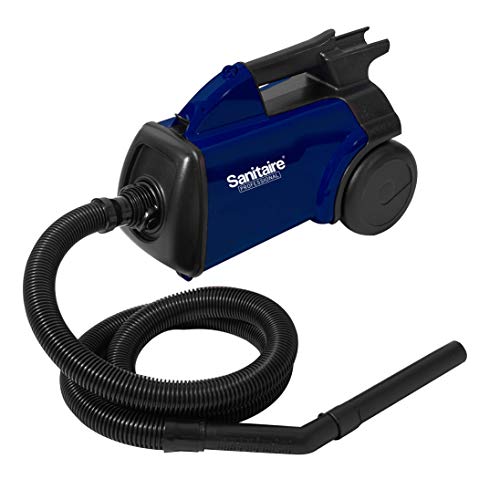
Sanitaire Compact Canister SL3681A
Sanitaire’s listing is the most terse of the six: a professional compact canister vacuum cleaner, model SL3681A, full stop. No floor type is named at all, which cuts both ways. The professional label signals a machine built for contract cleaners who work across mixed surfaces all day, and compact signals a body sized for flats, small offices and quick deployment. But a title that never mentions hard floors, let alone engineered ones, leaves the buyer to establish floor-head suitability from the product page and the manufacturer’s documentation rather than from anything quoted here.
That restraint can be read positively. Nothing in this listing overpromises: no trademarked suction slogan, no runtime boast. Buyers who have been burned by feature soup may find a plainly described canister refreshing, and the canister format carries the same structural advantage described for the Miele — the working head stays light while the body trails. The difference is information. Where Miele at least states a floor brief, Sanitaire states a use class, professional, and leaves the rest to be checked.
Listing facts
- Format: corded compact canister vacuum, model SL3681A
- Line: Sanitaire Professional
- Floor brief: the title names no floor type at all
- Power, weight and noise: the title publishes no figures
- Included tools: the title does not itemise them
- Engineered-hardwood certification: Not stated in the listing title — verify with the manufacturer’s documentation
Strengths
- Compact canister body stores in the shallow cupboards typical of flats with wood floors throughout
- Professional positioning implies parts and service availability aimed at working machines
- The listing makes no inflated claims, so expectations are set by documentation rather than slogans
Trade-offs
- Hard-floor suitability is not confirmed anywhere in the title — the biggest information gap of the six picks
- No accessory list means edge and upholstery capability is unknown until checked
- Compact bodies usually mean compact dust capacity, though the title gives no figure to confirm it
Consider who this machine quietly suits: the owner of a wood-floored flat who already owns a main vacuum and wants a light canister that lives near the kitchen for the daily crumb-and-grit circuit, or the landlord furnishing a tenancy where a simple, repairable machine outlasts a fashionable one. In both cases the buying decision should start with a single question the title cannot answer — what floor head ships in the box, and is a smooth hard-floor head among the options. That answer, from the product page, decides everything about this pick.
Professional machines earn their keep through boring virtues: cords that take a beating, bodies that shrug off door frames, filters that can be sourced years later. None of that appears in a title, which is why this review refuses to invent it. What can be said from the format alone is that a compact canister on engineered boards behaves like its larger cousins — light head, trailing body — and that its small footprint suits homes where storage, not floor space, is the scarce resource.
Treat the SL3681A as the shortlist’s research project. If the documentation confirms a hard-floor head and the accessory set covers a crevice tool, it becomes a rational, unglamorous buy for wood floors. If the box leans toward carpet nozzles, walk away and take the Miele or the Eureka instead, because on veneer the head matters more than the motor behind it. No other pick in this six asks as much homework of its buyer, and none rewards it as directly when the homework checks out.
Best for: a compact second machine for a wood-floored flat, once the product page confirms a hard-floor head in the box
Not suited for: a purchase that must be justified from the listing alone — this title confirms no floor suitability, in either direction
Check price on Amazon after the documentation check, if a plain professional canister is what your cupboard has room for.

Eureka Bagless Canister NEN121WH
Eureka publishes what Sanitaire withholds. The NEN121WH listing states 1200W of power, a noise ceiling of 82 dBA, HEPA filtration, an automatic cord rewind and a 2-in-1 brief spanning hard floors, carpets and pet hair. For engineered hardwood the interesting figure is the noise one, oddly enough: a stated decibel ceiling lets you judge whether early-morning cleaning is realistic in a flat with neighbours below, and 82 dBA sits at the louder end of domestic machines, so this is a daytime cleaner in thin-floored buildings. The power figure, meanwhile, describes the motor, not the gentleness of the head, and should not be read as a floor-safety claim.
Bagless canister design splits the difference between the stick and bagged-canister worlds: no bags to buy, a bin to empty, and a trailing body that keeps the floor head light. The automatic rewind is a small mercy on wood floors specifically, because it removes the moment where a loose cord gets pulled hand over hand across the boards with the plug swinging at ankle height. WhirlWind is Eureka’s name for the model line, and the finish is white.
Listing facts
- Format: corded bagless canister vacuum, model NEN121WH, White
- Motor power: 1200W
- Noise: 82 dBA or less, as stated in the listing
- Filtration: HEPA, per the listing
- Cord handling: automatic cord rewind
- Engineered-hardwood certification: Not stated in the listing title — verify with the manufacturer’s documentation
Strengths
- The only canister here publishing both power and noise figures in its title, which makes planning honest
- Automatic cord rewind keeps a loose plug from being dragged across the veneer at the end of a clean
- Bagless bin removes the ongoing bag cost that the bagged canister format carries
Trade-offs
- 82 dBA is loud enough to rule out early or late cleaning in flats with thin floors
- Floor-head construction goes undescribed in the listing, so its contact style on wood is unconfirmed
- Pet hair is in the brief, yet no powered pet tool is named among the features
A 1200W motor in a canister gives you suction headroom that shows up at the edges of the room, where a hose-led head works along skirting and into the corners a stick rides over. On engineered boards the value of that headroom is not raw pull on open floor — any of these six lifts loose grit — but extraction from the bevelled grooves between boards, where fine dust settles into the V-joint and a weaker machine leaves a grey line that mopping then smears. Work the grooves slowly, across their direction, and the difference between adequate and strong suction becomes visible.
HEPA filtration in the listing refers to the exhaust side: fine particles captured rather than blown back into the room to resettle on the boards. For wood floors this matters more than for carpet, because everything airborne eventually lands on a hard surface where it is visible and walkable. The trade is maintenance — a bagless bin and its filters need regular emptying and washing rhythms the title does not detail, and a neglected filter strangles the suction the 1200W figure promises.
Place this Eureka against the Miele and the choice sharpens. The Miele offers a stated hard-floor pedigree and a quiet reputation the title does not quantify; the Eureka offers numbers, a rewind and no bags, with a noise figure that will not suit every building. Neither listing certifies anything for engineered veneer, so the decision comes down to cleaning style: scheduled thorough cleans with a bin you empty over the outside bin, in a house where daytime noise is nobody’s problem, point straight at the NEN121WH.
Best for: detached or well-insulated homes wanting one bagless canister for boards, carpets and pet hair in a single round
Not suited for: thin-floored flats where an 82 dBA machine at breakfast time would strain relations with the neighbours below
Check price on Amazon if the published figures, rather than promises, are how you prefer to choose.
Side by side: format, power source and floor brief
The table compresses each listing into the four facts that separate these machines. Where a title publishes nothing, the gap itself is recorded, because a missing figure is a fact about the listing even when it is not a fact about the machine.
| Machine | Format and stated figures |
|---|---|
| Electrolux WellQ7 Hard Floor Cordless | Cordless 2-in-1 stick, PowerPro roller, 50-minute run time, 2 power modes |
| Shark Vertex Pro Cordless IZ662H | Cordless stick, flexible wand, crevice tool included, 60-minute runtime, red finish |
| Shark Vertex DuoClean HZ2002 | Corded stick, DuoClean head, hand vac under 3 lb, pet power brush, dusting brush, crevice tool |
| Miele Classic C1 Turbo Team | Corded canister, hard floor and low-to-medium pile carpet brief, Turbo Team configuration |
| Sanitaire Compact Canister SL3681A | Corded compact canister, professional line, model SL3681A, no figures published in title |
| Eureka Bagless Canister NEN121WH | Corded bagless canister, 1200W, ≤82 dBA, HEPA filtration, automatic cord rewind, white |
Read down the power-source column and the six split into three camps: two cordless Sharks and the cordless Electrolux for grab-and-go work, the corded HZ2002 stick for unlimited sessions in one area, and three corded canisters — Miele, Sanitaire, Eureka — for hose-led thoroughness. Engineered floors do not favour one camp outright; they favour whichever camp you will actually use three times a week, since frequency is what keeps grit from ever building into a grinding layer.
The floor-brief column is where honesty matters most. Only the Electrolux names a hard-surface roller, only the Miele confines itself to hard floors plus low-pile carpet, and the Sanitaire names no floor at all. Every machine here is a hard-floor machine by its listing; none is an engineered-hardwood machine by its listing, and any guide that blurs that distinction is selling you certainty the manufacturers themselves have not printed.
How do you choose a vacuum that respects engineered boards?
Start from the floor’s weakness rather than the vacuum’s strength. A veneer wear layer cannot be refinished as many times as solid wood, so every decision below is really a decision about contact, grit and how often the machine will realistically come out of its cupboard.
What touches the floor: roller, brush or smooth head?
The contact patch decides how grit behaves in the half-second before suction lifts it. A soft roller, like the PowerPro named in the Electrolux listing, gathers particles into a cushioned surface. A spinning brushroll can flick particles ahead of the head if it is stiff, which is why the Sharks’ listings deserve a documentation check on brush construction before they meet soft veneer. A smooth canister head on a hose simply hovers and draws, the oldest and still one of the gentlest arrangements, provided its underside is kept clean of trapped stones.
Whichever head you choose, build one habit: tip it over before the first run of the day and look at the underside. A single piece of gravel lodged in a wheel or a brush housing will score a line across a room in one pass, and no listing’s promises protect against a dirty head. The thirty-second check is the cheapest floor insurance in this entire guide.
How much do runtime and power figures actually tell you?
Runtime tells you whether one charge covers your floor plan: 50 minutes for the Electrolux, 60 for the Vertex Pro. Measure your own home honestly — time a normal clean once with a phone timer — rather than guessing, because furniture density matters more than square metres. Wattage, where published, describes the motor’s appetite: the Eureka’s 1200W promises strong draw for groove extraction but says nothing about how the head treats the surface.
Noise is the third figure and the one most specific to wood-floored buildings, where sound carries through the structure. Eureka’s stated ceiling of 82 dBA or less is the only noise datum in the six listings. If your floors are also your neighbour’s ceiling, that number deserves as much weight as any suction claim.
Cordless stick or trailing canister for a wood-floored home?
Sticks win on frequency: a machine leaning in the kitchen gets used for the two-minute grit patrol that protects veneer best. Canisters win on thoroughness and edge work, and they keep weight off the head. Many wood-floored homes end up with one of each over time, but if the budget allows one, choose by your honest habit. A thorough cleaner who vacuums properly twice a week should take the canister; a tidier who sweeps daily and deep-cleans rarely should take the stick and use it exactly that way.
If the home mixes surfaces, let the minority surface arbitrate. Mostly wood with low-pile rugs points to the Miele’s stated brief or the Eureka’s 2-in-1 claim. Wood downstairs and carpeted bedrooms point to the Vertex Pro’s dual brief and hour of runtime. The floor you clean worst is the one that should choose the machine.
What should you verify before any of these touches your floor?
Three checks, in order. First, the manufacturer’s own documentation for hard-floor guidance on the exact model, since no listing title here certifies engineered use. Second, the box contents on the product page — which heads and tools actually ship — because the Sanitaire and Miele titles leave that open. Third, returns terms: the first real test is your own floor, in the wardrobe patch, and a painless return is the backstop if the head’s behaviour disappoints.
For a wider look at automated help with the same floors, the guide to Best Mapping Robot Vacuums covers machines that patrol on a schedule, which is a different answer to the same grit problem. And because everything a vacuum misses eventually becomes airborne dust that resettles, readers with caged birds in wood-floored rooms may also want Best Air Purifiers For Bird Dander, which deals with feather dust at the cage rather than the floor.
Why grit, not suction, is the real enemy of a veneer floor
Engineered boards fail cosmetically long before they fail structurally. The wear layer dulls in traffic lanes because each footstep presses shoe-borne sand into the finish and twists. A vacuum’s job in that story is removal before the footstep happens, which reframes the buying question entirely: the best machine is the one that intercepts grit at the door, the sink and the hallway most often, not the one with the most dramatic suction number. This is why the cordless picks punch above their specifications in real homes — they get used at the moment the grit arrives.
It also explains the value of the unglamorous details in these listings. Headlights on the HZ2002 show the grit line under units before it spreads. A crevice tool on the Vertex Pro clears the expansion-gap perimeter where particles lodge. The Eureka’s suction headroom empties the bevel grooves where dust hides from a casual pass. None of these features photographs as heroically as a runtime figure, yet each maps onto a specific way veneer gets damaged, and choosing by that map beats choosing by wattage.
Mopping discipline completes the picture. Vacuum first, always, because a mop over unvacuumed grit is a sanding pad with a handle. The six machines here are dry vacuums by listing, so the routine they enable is a dry pass thorough enough that the mop afterwards only lifts film, never particles. If your current routine mops more often than it vacuums, reversing that ratio will do more for your floor than upgrading any single machine in this list.
Keeping the floor path clear between cleans
Felt pads under chair and table legs are the silent partners of every vacuum in this guide: they stop furniture from grinding the particles that fall between cleans. Replace pads when they compress or pick up embedded grit, and lift — never drag — the heavier pieces when you do move them. Door mats at both entrances, long enough for two full strides, intercept the majority of outdoor sand before it reaches the boards at all.
Readers comparing filtration for the dust that vacuuming stirs up may find Best Air Purifiers With Reusable Filters useful, since washable pre-filters suit households that would rather rinse than rebuy. Small systems, repeated, are what a thin wear layer actually asks of you.
Common mistakes when vacuuming engineered hardwood
Every mistake below is one that a listing cannot protect you from, because each lives in the routine rather than the machine. They are ordered by how much quiet damage they do over a year.
Running a stiff brushroll at full chat on soft veneer
A brush designed to beat carpet pile has no business spinning against a thin wear layer at maximum speed. Where a machine offers power modes, the lower setting is the wood setting; where the head is a turbo brush like the Miele’s carpet side, keep it on the carpet it was named for and use the smooth head on boards. If a listing does not describe its brush at all, that absence is your cue to check the manual before the first run, not after the first dull patch.
Vacuuming on a schedule instead of on grit
Saturday-only cleaning leaves five days of door grit to be ground in by weekday feet. The floor does not care about your calendar; it cares about the particles under the hall runner tonight. Short, frequent passes with a cordless — the exact use the Electrolux and Vertex Pro are built around — protect veneer better than one heroic weekly session, and they take less total time across the week.
Skipping the perimeter because the head does not reach it
The dust line along skirting boards and the grit trapped at expansion gaps sit precisely where a floor head’s seal is weakest. Ignoring them means every subsequent pass redistributes edge dirt across the room. A crevice tool, named in both Shark listings, exists for this line; on canister machines the hose head works the same edge. Thirty seconds per wall is the whole cost.
Mopping first and vacuuming second
Wet grit is abrasive paste. Mopping an unvacuumed engineered floor drags that paste across the finish under the mop’s full pressure, and the boards dull in lanes that mirror your mopping route. The order is dry, then damp, every time — and on a floor that gets a proper dry pass, the mop can be barely damp, which the veneer and its joints prefer anyway.
Judging a machine by its loudest number
Wattage, suction slogans and runtime all describe the motor or the battery; none describes the half-inch where rubber, roller and board meet. Buyers who choose on headline numbers alone end up with powerful machines they use carefully and rarely, which is the worst combination for a veneer floor. Choose on contact style and your own habits first, then let the numbers break the tie.
Final recommendation
If one machine has to be named for engineered boards, the Electrolux WellQ7 takes the role on the strength of a single stated fact: its roller was made for hard surfaces, and no other listing in this six names its contact patch so directly. Add the 50-minute cordless freedom and the two-mode control, and it fits the frequent, gentle routine that veneer rewards. Its unlisted weight and unnamed tool set are the homework to finish on the product page before ordering.
The Shark Vertex Pro IZ662H is the answer for the mixed house, where carpet upstairs disqualifies a hard-floor specialist and the bending wand earns its place under every bed. The HZ2002 serves the pet household that wants a powered brush for the sofa and a cord that never fades mid-clean. Between the canisters, the Miele C1 is the purist’s scheduled clean on boards and low-pile rugs, the Eureka NEN121WH is the numbers-forward bagless alternative for homes unbothered by an 82 dBA ceiling, and the Sanitaire SL3681A is the compact professional wildcard whose value depends entirely on the floor head its documentation confirms.
None of these listings certifies its machine for engineered veneer, and this guide has not pretended otherwise at any point. What separates a good outcome from a dull floor is not a badge but a match: contact style to surface, format to habit, and a buyer willing to run the wardrobe-patch test before the first full clean.
Questions buyers ask about vacuums and engineered floors
Does any vacuum here carry an engineered-hardwood certification?
Not according to the listing titles. All six describe themselves for hard floors or hardwood generally, and the word engineered appears in none of them. The spec boxes in this guide mark that gap explicitly for every pick. Certification, if a manufacturer offers it, will live in the model’s own documentation, which is the document to trust before a first run on a new floor.
Is a soft roller genuinely safer than a brushroll on veneer?
The mechanism argues yes: a cushioned roller gathers grit into its surface, while stiff bristles can flick loose particles ahead of the head or press them momentarily into the finish. That is reasoning from design, not a test result, and a soft roller kept dirty loses the advantage. Whichever head you run, the underside check before each session matters more than the category the head belongs to.
Can one machine cover engineered floors and carpet honestly?
Two listings claim exactly that dual brief: the Shark Vertex Pro for hardwood and carpet, and the Eureka as a 2-in-1 for hard floors, carpets and pet hair. The Miele sets a ceiling instead, naming low-to-medium pile. Deep pile remains outside every brief printed here, so homes with thick carpet should treat these as wood-first machines with carpet ability, not the reverse.
How often should engineered hardwood be vacuumed?
As often as grit arrives, which for most homes means the entry and kitchen lanes every day or two and whole rooms twice a week. That rhythm favours a cordless kept within reach. A canister household can match it by leaving the machine parked where the grit lands rather than in a distant cupboard — storage location is a cleaning feature, even though no listing prints it.
What is the wardrobe-patch test and why does it matter?
Run the new machine for one minute on the floor inside a wardrobe or under a large rug, where the boards are the same veneer but a mark would never be seen. Inspect under a lamp at a low angle for new dullness or fine lines. Every pick in this guide benefits from it, because listing titles describe intentions, and the patch test measures behaviour on your specific finish, which is the only surface that counts.
Choose the machine whose contact with the board you understand best, keep it close to where the grit lands, and your veneer will keep its sheen long after stronger vacuums have been retired to the garage.


