What's inside
- Where to buy the six mapping robots
- Six mapping robots at a glance
- How these picks were chosen
- The six compared: mapping, emptying and run time
- What should you check before choosing a mapping robot?
- Why the first week with a mapping robot decides the next five years
- Robots and the rest of the household routine
- Common mistakes when buying and running a mapping robot
- Final recommendation
- Mapping robot questions, answered plainly
As an Amazon Associate I earn from qualifying purchases. This post may contain affiliate links at no extra cost to you.
As an Amazon Associate, cottageverdict.com earns from qualifying purchases.
A robot vacuum without a map cleans like a beetle: it bumps, turns and eventually covers most of the floor, repeating some strips three times and missing others until the battery gives out. The best mapping robot vacuums replace that wandering with a floor plan, and the difference is not a luxury. A machine that knows the room layout cleans in deliberate rows, returns to the corner it missed, and can be told which rug to avoid and which room matters most before guests arrive. Mapping is the feature that turns a robot from a novelty into a schedule you can trust.
The six listings below all claim some form of mapping, but they do not claim the same form. Five name LiDAR — a spinning laser sensor that measures the room — in their titles. One, the Tikom L8000 Pro, says Smart Mapping and leaves the sensing method unnamed, and this guide respects that gap rather than filling it with an assumption. Beyond the sensor, the titles divide on the questions that decide daily life with a robot: whether it empties itself into a base, how many days that base holds, how long it runs between charges, and whether it mops as well as vacuums.
Suction figures in these titles range from 6,000Pa on the Tikom to 15,000Pa on the VONKO, with run times clustering at 150 minutes. Read those numbers as the manufacturers’ own claims, useful for ranking within this list and meaningless beyond it, because test conditions differ between brands. What the numbers cannot tell you — how the map behaves after you move a sofa, whether the app respects a no-go zone — the titles cannot tell you either, and the reviews below are careful to separate what is printed from what must be checked on the product page.
Where to buy the six mapping robots
Each robot below is sold through Amazon, and the long version of every verdict sits further down. These single lines are a shortlist first, an argument second.
The Tikom L8000 Pro pairs a vacuum-and-mop body with Smart Mapping and a 150-minute ceiling, pitched squarely at pet hair on hard floors and carpets.
ILIFE’s A30s is the vacuum-only purist: LiDAR navigation, home mapping, no-go zones and 10,000Pa of claimed suction, with app, voice and remote control all named.
The iRobot Roomba 105 Vac keeps its title short — LiDAR navigation, multi-surface cleaning, neat rows — and leans on the Roomba name rather than a long feature list.
Shark’s AI Ultra AV2511AE combines LiDAR mapping with a Matrix Clean navigation pattern, HEPA filtration and an anti-hair-wrap design in a Wi-Fi body.
The VONKO is the hands-free maximalist: self-emptying for up to 60 days by its listing’s claim, multi-level maps and the highest suction figure in this six at 15,000Pa.
The generic 90-day robot undercuts the VONKO’s emptying interval and beats it, claiming a base that holds 90 days of debris alongside LiDAR mapping and 150 minutes of runtime.
Six mapping robots at a glance
Best-for labels reflect the household each listing seems built for, judged from title claims alone. The third column gives the one mapping or emptying fact that defines each machine.
| Pick | Best for | Defining claim from the listing |
|---|---|---|
| Tikom Robot Vacuum L8000 Pro Mapping | Pet homes wanting vacuuming and mopping in one mapped pass | Smart Mapping with vacuum-and-mop combo body |
| ILIFE A30s Robot Vacuum LiDAR Mapping | Carpet-and-pet homes wanting no-go zones and no mop compromises | LiDAR mapping with no-go zones, vacuum only |
| iRobot Roomba 105 Vac LiDAR | Buyers who want the Roomba platform and tidy row cleaning | LiDAR navigation, cleans in neat rows |
| Shark AI Ultra AV2511AE LiDAR Mapping | Long-hair and pet homes troubled by brushroll tangles | LiDAR mapping with anti-hair-wrap design and HEPA |
| VONKO Robot Vacuum LiDAR Navigation | Multi-storey homes wanting weeks between bin duties | Self-emptying up to 60 days, multi-level maps, 15,000Pa claim |
| Generic Robot Vacuum LiDAR Mapping 90-Day | Hands-free value seekers wanting the longest claimed emptying interval | 90-day self-emptying base claim with LiDAR mapping |
How these picks were chosen
The entry condition was a mapping claim printed in the listing title itself. Robots described only with phrases like smart navigation or intelligent route were passed over unless the title named mapping or the sensor behind it, because this guide’s premise is that a floor plan — stored, reusable and editable — is what separates the category from ordinary robot vacuums. That condition admitted more than six candidates, and the surplus was resolved by spreading the selection across the category’s real dividing lines rather than by ranking suction claims: vacuum-only against vacuum-and-mop, hand-emptied against self-emptying, single-floor maps against multi-level storage.
Specification honesty shaped the final six as much as features did. Listings that published their runtime, suction or emptying interval were favoured for the clarity they give a buyer, but two deliberately quieter listings — a brand platform model and a systems-led model — were kept because real shoppers meet them on the same results page and deserve them assessed rather than ignored. One exclusion deserves a note: a well-known robot whose title claimed only a trademarked navigation phrase, without naming mapping or LiDAR, was left out under the entry condition, even though its maker is a household name.
Every mapping statement in the reviews that follow is traceable to a title: five listings name LiDAR, one names smart mapping without a sensor, and none of the six was credited with an editing feature, an obstacle system or an app capability its title does not mention. Where a title was silent — on runtime, on bin size, on remapping behaviour — the review records the silence as homework for the product page instead of filling it with the category’s usual assumptions.

Tikom Robot Vacuum L8000 Pro Mapping
Tikom’s L8000 Pro is the only pick whose mapping claim arrives without a sensor name attached. The listing says Smart Mapping, full stop, and pairs it with a vacuum-and-mop combo body, a 6,000Pa suction claim and a maximum runtime of 150 minutes. For a buyer, the unnamed sensor is not automatically a flaw — camera-based and gyroscope systems can hold a usable map — but it does mean the mapping method must be confirmed on the product page if the precision of LiDAR is what you are paying for. This review takes the mapping as claimed and the mechanism as unknown, because that is what the title supports.
The rest of the brief is aimed at pet households: the title names pet hair, hard floors and carpets as its territory. A combo body that mops after vacuuming suits hard-floor homes where paw prints and water-bowl drips are the daily mess, though the listing gives no mopping detail — no pad type, no water control — so the mop should be read as a light maintenance wipe rather than a scrubbing system until the product page says more.
Listing facts
- Format: robot vacuum and mop combo, model L8000 Pro
- Mapping: Smart Mapping, as claimed in the listing; sensing method not named in the title
- Suction claim: 6,000Pa
- Runtime: 150 minutes maximum, as stated
- Floor brief: pet hair, hard floors and carpets
- Self-emptying: not mentioned in the listing title
Strengths
- Vacuum and mop in one mapped pass covers the hard-floor maintenance loop in a single outing
- 150 minutes matches the longest runtimes in this six, enough for large single-storey layouts
- The brief names pet hair first, signalling where Tikom expects the machine to earn its keep
Trade-offs
- Mapping hardware is unnamed, so map precision cannot be compared with the LiDAR picks from the title
- Lowest suction claim of the six at 6,000Pa, on the manufacturers’ own figures
- No self-emptying is mentioned, so the onboard bin sets the emptying rhythm
The honest way to place the Tikom is as the value-shaped all-rounder whose paperwork needs one check. If the product page confirms a capable mapping sensor and the map supports room selection, the combination of 150 minutes, mopping and pet-hair intent covers most family homes. If the mapping turns out to be a basic bounce-and-remember system, the LiDAR picks below justify their existence immediately, because every other feature in this category depends on the map being right.
Pet hair on hard floors is a kinder test than pet hair in carpet, and the Tikom’s brief spans both. On hard floors the robot’s job is gathering without scattering — hair’s lightness makes it flee a fast-moving machine — while on carpet the 6,000Pa claim will be worked harder. Homes that are mostly hard floor with rugs will find the balance friendlier than homes wall-to-wall in carpet, where the ILIFE’s 10,000Pa vacuum-only focus or the VONKO’s 15,000Pa claim speaks louder.
Mopping combos carry one housekeeping duty buyers forget: the pad and tank need rinsing after use, or yesterday’s dirty water becomes today’s smell. No mop hardware is described in the listing, so plan on the simple version of that chore. Set against it, a mapped mop pass twice a week keeps hard floors at a baseline that makes the monthly deep clean shorter, which is the real product a robot sells — time, not suction.
Best for: pet homes with mostly hard floors that want one mapped machine to vacuum and wipe in the same round
Not suited for: a purchase that depends on knowing the mapping sensor upfront — this title never names it, and the LiDAR picks do
Check price on Amazon once the product page has answered the sensor question to your satisfaction.
ILIFE A30s Robot Vacuum LiDAR Mapping
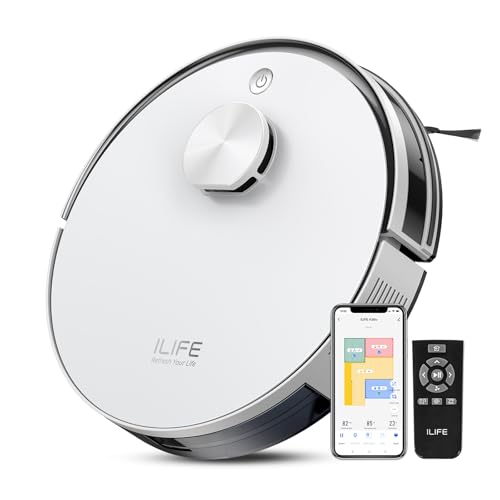
ILIFE’s A30s makes a decision the combo machines avoid: it vacuums only. The listing says so in plain words, and the space that decision frees up goes to the vacuuming brief — a 10,000Pa maximum suction claim, LiDAR navigation with home mapping, and no-go zones you can draw to keep the robot out of the Lego corner, the pet’s water station or the tangle of cables behind the television. For homes where mopping is a separate, deliberate job, a vacuum-only robot is not a lesser machine; it is a machine with one job described well.
Control options are unusually complete in this title: app, voice and a physical remote are all named. The remote matters more than it sounds — a grandparent, a child or a guest can start a clean without an account, a phone or a password. Runtime matches the Tikom at 150 minutes, and the floor brief covers hard floor, carpet and pet hair without singling one out.
Listing facts
- Format: robot vacuum only, model A30s — no mopping function claimed
- Navigation: LiDAR, with home mapping
- Mapping feature named in the listing: no-go zones
- Suction claim: 10,000Pa maximum
- Runtime: 150 minutes
- Controls named in the listing: app, voice and remote control
Strengths
- No-go zones are named outright, the mapping feature pet and family homes use most
- Vacuum-only design spends its whole budget on the one job, with a 10,000Pa claim to show for it
- Three control routes, including a remote that needs no phone or account
Trade-offs
- No mopping at all — hard floors still need a separate wet pass on your own schedule
- No self-emptying base is mentioned, so bin duty stays with the owner
- Voice control depends on an assistant ecosystem the title does not specify
No-go zones sound like a settings-menu detail until you live with a robot that lacks them. The first week with any mapping robot is a survey of your home’s traps: the shag rug that swallows wheels, the floor-length curtains, the charging-cable reef behind the sofa. A robot that lets you fence those areas on the map converts daily supervision into a one-time setup, and the A30s puts that capability in its title rather than its small print. That placement suggests ILIFE expects the feature to be used, not discovered.
The vacuum-only stance also simplifies the machine’s relationship with carpet. Combo robots must keep a wet pad off the rugs they cross, a problem solved variously by lifting, sensing or avoidance, none of which this listing needs to solve because there is no pad. If your floors are half carpet, the A30s crosses its whole territory with a single-mindedness the combos cannot match, and the 150-minute runtime gives it the legs for a full circuit of a family-sized floor.
What the title leaves open is the emptying rhythm and the bin size, neither of which is stated. A pet home generating a bin of hair every second day will feel that omission as a chore; a low-shedding household will not notice it for a fortnight at a time. Judge the A30s by your own debris rate, and if that rate is high, compare it honestly against the self-emptying VONKO and generic picks before the ILIFE’s mapping clarity wins you over.
Best for: homes with defined no-go territory — play corners, cable reefs, pet stations — and a separate mopping routine
Not suited for: homes expecting the robot to handle wet cleaning too; the listing says vacuum only in so many words
Check price on Amazon if a single-purpose machine with proper map control is the brief.

iRobot Roomba 105 Vac LiDAR
The Roomba 105 Vac’s listing is the most economical of the six: a charging base, 7,000 Pa of what iRobot calls power-lifting suction, LiDAR navigation, multi-surface cleaning and a promise that it cleans in neat rows. That last phrase is the mapping made visible. Rows are what a robot with a floor plan produces — parallel passes with deliberate overlap — as opposed to the random arc pattern of a mapless machine, and for owners who watch the first clean the way you watch a new cleaner work, rows are the reassurance that the map exists and is being used.
Equally notable is what the title omits. No runtime is published, no self-emptying is claimed, no app or voice control is named. The base is described as a charging base, so the working assumption is that the bin empties by hand. iRobot’s restraint may reflect a listing written for a brand whose app ecosystem buyers are expected to know, but this guide scores what is printed: on paper, the 105 Vac is a LiDAR vacuum with a mid-pack suction claim and the shortest spec sheet here.
Listing facts
- Format: robot vacuum with charging base, Roomba 105 Vac
- Navigation: LiDAR
- Suction claim: 7,000 Pa power-lifting suction
- Cleaning pattern claimed in the listing: cleans in neat rows
- Floor brief: multi-surface cleaning
- Runtime and self-emptying: not mentioned in the listing title
Strengths
- Neat-row cleaning is the visible signature of a working map, promised in the title itself
- The Roomba platform brings a mature accessory and parts ecosystem behind the machine
- LiDAR navigation matches the sensor standard set by the strongest picks in this list
Trade-offs
- No runtime figure is published, so floor-plan coverage per charge cannot be judged from the listing
- The base is for charging; no self-emptying is claimed, unlike two rivals here
- App, voice and mapping features beyond navigation go unnamed in the title
Brand platforms matter in robots more than in stick vacuums, because a robot is software with a motor attached. Maps are stored, edited and acted on inside an app, and the quality of that app decides whether mapping is a daily tool or a demo. iRobot has been iterating that software longer than most names in this list, which is a legitimate reason to shortlist the 105 Vac — but it is a reason drawn from the company’s history, not from this listing, and the listing’s own silence on app features means a buyer who cares about room-by-room scheduling should verify it on the product page.
The 7,000 Pa claim sits between the Tikom’s 6,000Pa and the ILIFE’s 10,000Pa on the brands’ own scales. In practice, robot cleaning quality is governed as much by brush design and pass overlap as by the suction peak, and the neat-rows claim speaks to exactly that overlap discipline. A methodical robot at moderate suction commonly out-cleans a powerful wanderer, which is the entire premise of buying a mapping machine in the first place.
Choose the Roomba if your priority is a known platform, row cleaning and LiDAR at a spec level that covers a typical flat or single storey, and if hand-emptying a bin is a chore you already accept from your current vacuum. Choose against it if your home is large enough that the missing runtime figure becomes a genuine risk, or if a self-emptying base is the feature your schedule actually depends on — in which case the VONKO and the generic 90-day machine are built around your life rather than the other way round.
Best for: flats and single-storey homes that value the Roomba platform and visible row-by-row coverage
Not suited for: large homes, where coverage planning needs a published runtime — this listing prints none, and guessing helps nobody
Check price on Amazon for the platform and the rows, once the product page fills in the runtime gap.

Shark AI Ultra AV2511AE LiDAR Mapping
Shark’s AV2511AE listing reads like a checklist of robot-vacuum grievances, answered one by one. Hair wrapping the brushroll: an anti-hair-wrap design. Dust blown back into the room: HEPA filtration. Random coverage: Matrix Clean navigation layered on LiDAR mapping. The Matrix Clean name describes a grid pattern — the robot works a room in a precise matrix of passes rather than a single perimeter-and-cross — and combined with LiDAR it positions this machine as the methodical option in the six, aimed at carpet, hard floors and pet hair in a black and silver body with Wi-Fi aboard.
What the title withholds is every number. Suction is described as powerful without a Pascal figure, and no runtime, bin size or self-emptying claim appears. Shark’s choice mirrors iRobot’s: a brand listing that sells systems instead of statistics. The consequence for comparison is real, though — on the printed evidence alone, this pick cannot be ranked against the VONKO’s 15,000Pa or the ILIFE’s 150 minutes, and a buyer who shops by figures will have to visit the product page to finish the comparison.
Listing facts
- Format: robot vacuum, model AV2511AE, Black/Silver
- Mapping: LiDAR mapping, with Matrix Clean navigation pattern
- Filtration: HEPA, per the listing
- Brushroll feature named in the listing: anti-hair wrap
- Connectivity: Wi-Fi
- Suction and runtime figures: not stated in the listing title
Strengths
- Anti-hair wrap answers the maintenance chore that makes owners abandon robot vacuums
- Matrix Clean grid passes on top of LiDAR mapping promise systematic rather than hopeful coverage
- HEPA filtration suits homes where the robot runs daily and airborne dust is a standing concern
Trade-offs
- No suction or runtime figures are published, so spec-led comparison stalls at this listing
- No self-emptying is claimed, and the base is not described in the title at all
- Mopping is absent from the brief — vacuum duties only, as far as the title states
Hair wrap is the silent killer of robot ownership. A brushroll wound with hair loses its combing action within a fortnight in a long-hair household, suction falls, and the robot begins leaving the very debris it was bought to collect — while the owner, who bought a robot precisely to avoid chores, acquires a new one involving scissors. An anti-hair-wrap design, if it performs as the name suggests, protects the machine’s cleaning quality across months rather than days, which is worth more than a suction peak measured on day one.
The Matrix Clean pattern deserves a word about carpets specifically. A single pass lifts surface debris; a grid, crossing the same ground from two directions, works pile fibres from both sides and frees grit that one direction presses flat. On hard floors the grid matters less, on carpet it is a plausible reason this listing names carpet first in its floor brief. Pet hair on carpet is the hardest everyday test any of these six faces, and the Shark’s combination — grid pattern, HEPA, anti-wrap — reads as engineered for exactly that test.
Wi-Fi in the title confirms app control exists, though scheduling, mapping edits and voice assistants go unnamed. The fair summary is that the AV2511AE asks to be judged on systems rather than statistics: if your home’s problem is hair, carpet and coverage discipline, its answers are all in the title; if your problem is a huge floor plan or a month between bin duties, the listings that publish their numbers answer more directly.
Best for: long-hair and pet households with carpet, where brushroll tangles have killed previous robots
Not suited for: spec-led buyers — with no Pascal or minute figure printed, this listing cannot win a numbers comparison it refuses to enter
Check price on Amazon if hair management, not headline suction, is your household’s deciding issue.

VONKO Robot Vacuum LiDAR Navigation
The VONKO listing makes the boldest set of claims in this six, and it makes them in numbers. A 15,000Pa suction claim — the highest here — a self-emptying base rated by the listing at up to 60 days of hands-free running, LiDAR navigation with smart mapping, app control, and multi-level maps for homes where the robot works more than one floor. It vacuums and mops, it is finished in Onyx Black, and its brief covers pet hair, carpet and floors generally. If the category has a maximalist, this is it.
Multi-level maps deserve unpacking, because they solve a real problem. A robot that stores one map must relearn a floor every time it is carried upstairs, losing its no-go zones and room divisions in the process. Stored maps per level mean the machine can be set down in the upstairs hallway and know where it is. The listing does not say how many levels it holds, and the 60-day emptying figure, like all such figures, assumes a debris rate the manufacturer chose — a shedding dog will shorten it. Both claims are the listing’s own, stated here as claims.
Listing facts
- Format: robot vacuum and mop with self-emptying base, Onyx Black
- Suction claim: 15,000Pa
- Self-emptying interval claimed in the listing: up to 60 days hands-free
- Navigation: LiDAR, with smart mapping and app control
- Map storage named in the listing: multi-level maps
- Runtime: not stated in the listing title
Strengths
- Self-emptying stretches bin duty from days to weeks, the single biggest lifestyle change a base can offer
- Multi-level maps suit homes where one robot serves two floors in rotation
- The 15,000Pa claim tops this list on the manufacturers’ own figures, with mopping included as well
Trade-offs
- Runtime is not published, an odd gap in a listing that publishes everything else
- The 60-day figure depends on debris rate; heavy-shedding homes will empty sooner
- A self-emptying base is a larger piece of furniture than a charging dock and needs its own floor space
Self-emptying changes the owner’s job description. Without a base, you are the robot’s bin crew, and the chore is small but relentless — and a bin left full quietly degrades cleaning, because a robot with nowhere to put debris stops collecting it well. With a base claiming up to 60 days, the chore becomes seasonal: check the base bag when the seasons change, roughly. For busy households and for owners with limited mobility, that difference is not convenience garnish; it is the difference between a system that runs itself and a gadget that needs staff.
The combination of mopping and self-emptying in one listing is rarer than it should be, because the two features serve the same philosophy — lengthen the interval between human interventions. Add multi-level maps and the VONKO is aimed at the largest homes in this comparison: two floors, mixed surfaces, pets, and an owner who wants to supervise by app rather than by hand. The missing runtime figure is the one number such a buyer genuinely needs, since a big floor plan on an unknown battery is a plan with a hole in it; the product page has to supply it.
Claims discipline matters most exactly where claims are biggest. Fifteen thousand Pascals is a manufacturer’s figure under that manufacturer’s conditions, and the honest comparison is ordinal — this listing claims more suction than its five rivals claim — not absolute. Similarly, hands-free for up to 60 days is a ceiling, not a diary date. Buy the VONKO for the architecture of its offer — base, maps, mop, LiDAR — and let the numbers be a supporting argument rather than the foundation.
Best for: two-storey pet homes that want one robot, one base and a bin interval measured in weeks
Not suited for: small flats where a full self-emptying base is furniture the floor plan cannot spare
Check price on Amazon if the base-and-maps architecture fits the size of your home.

Generic Robot Vacuum LiDAR Mapping 90-Day
This unbranded listing competes on a single spectacular figure: a self-emptying base claimed to hold 90 days of debris, half again the VONKO’s interval, in a black vacuum-and-mop combo with LiDAR mapping, anti-hair wrap, 150 minutes of runtime and dual-band Wi-Fi covering both 5G and 2.4G networks. Suction is described as powerful without a Pascal figure. The absence of a brand name in the title is itself a datum — this is a white-label style listing — and it shifts the buyer’s homework toward the seller’s page, replacement bags for the base, and the app that the Wi-Fi implies.
Dual-band Wi-Fi is a more practical feature than it first appears. Many robots speak only 2.4G, and households whose routers broadcast a merged network name sometimes struggle to pair them. A robot that accepts both bands removes a whole category of setup frustration. The listing does not name an app, a voice assistant or a mapping feature beyond LiDAR mapping itself — no no-go zones, no multi-level storage — so the map should be assumed basic until the product page demonstrates otherwise.
Listing facts
- Format: robot vacuum and mop combo with self-emptying base, Black, no brand name in the listing
- Self-emptying interval claimed in the listing: 90 days
- Mapping: LiDAR mapping
- Runtime: 150 minutes
- Connectivity named in the listing: 5G and 2.4G Wi-Fi
- Suction: described as powerful; no figure stated in the listing title
Strengths
- The 90-day base claim is the longest hands-free interval in this six by a wide margin
- Anti-hair wrap and LiDAR mapping match features the branded rivals headline
- Dual-band Wi-Fi sidesteps the pairing problems that plague 2.4G-only robots
Trade-offs
- No brand name in the title, so parts, base bags and app longevity need checking before purchase
- No suction figure is published, leaving its power ranked by adjective rather than number
- Mapping features beyond basic LiDAR mapping — zones, levels, room naming — are not claimed
The 90-day claim deserves the same reading given to the VONKO’s 60: it is a ceiling set by the seller’s assumed debris rate, and a home with two shedding dogs will not see it. Even halved by real life, though, a base that asks for attention every six weeks rather than every six days restructures the chore completely. The question that decides this pick is not the interval but the ecosystem behind it — whether base bags are standard and stocked, whether the app is maintained, whether a replacement brush exists. Those answers live on the product page and in the seller’s storefront, and they matter more for an unbranded machine than for any rival here.
On features per listing line, the generic machine is quietly complete: LiDAR, anti-wrap, mopping, a long runtime and both Wi-Fi bands. What it lacks is the mapping vocabulary of the ILIFE and VONKO — no named no-go zones, no multi-level maps — which suggests a map you can view more than a map you can edit. For an open-plan home without delicate zones to fence, that may be no loss at all; for a home with a Lego corner and a cable reef, it is the loss that decides the purchase.
Risk placement is the honest frame. The branded picks charge, in part, for continuity: a company that will still sell you a filter next year. This listing charges less, in part, by leaving continuity unexamined. A buyer comfortable verifying bag availability and app support before ordering can rationally take the 90-day base and the complete feature list; a buyer who wants the purchase to be the end of the research should stay with a name they can find again.
Best for: open-plan homes that prize the longest claimed emptying interval and will verify base-bag supply before ordering
Not suited for: homes whose map must be editable with fenced zones — this title claims LiDAR mapping and nothing more specific
Check price on Amazon once the bag-and-app homework checks out in the seller’s favour.
The six compared: mapping, emptying and run time
Three questions separate these robots in daily life: how they map, how often they need emptying, and how long they run. The table answers all three strictly from the listing titles, with gaps recorded as gaps.
| Robot | Mapping, emptying and runtime per the listing |
|---|---|
| Tikom Robot Vacuum L8000 Pro Mapping | Vacuum and mop combo, Smart Mapping (sensor unnamed), 6,000Pa claim, 150 min max runtime |
| ILIFE A30s Robot Vacuum LiDAR Mapping | Vacuum only, LiDAR navigation, home mapping, no-go zones, 10,000Pa max claim, 150 mins |
| iRobot Roomba 105 Vac LiDAR | Vacuum with charging base, LiDAR navigation, 7,000 Pa claim, neat-row cleaning, no runtime stated |
| Shark AI Ultra AV2511AE LiDAR Mapping | Vacuum, LiDAR mapping, Matrix Clean navigation, HEPA filtration, anti-hair wrap, Wi-Fi, no figures stated |
| VONKO Robot Vacuum LiDAR Navigation | Vacuum and mop, self-emptying base, up to 60 days hands-free claim, LiDAR, multi-level maps, 15,000Pa claim |
| Generic Robot Vacuum LiDAR Mapping 90-Day | Vacuum and mop combo, 90-day self-emptying base claim, LiDAR mapping, anti-hair wrap, 150 minutes runtime |
The emptying divide is the sharpest in the table. Two machines empty themselves into bases with claimed intervals of 60 and 90 days; the other four leave the bin to you, and only the Shark and Roomba listings do not even describe their bases. Households that have owned a robot before usually know which side of that divide they belong on, because the bin chore is the one that decides whether the robot still runs daily in month six.
Mapping divides more subtly. LiDAR is named by five of the six, and the Tikom’s unnamed Smart Mapping is the outlier to investigate rather than dismiss. Feature depth then separates the LiDAR crowd: no-go zones on the ILIFE, multi-level storage on the VONKO, a grid pattern on the Shark, rows on the Roomba. A map you can edit is worth more than a map you can only watch, and the listings that name their editing features have told you something real about their software.
What should you check before choosing a mapping robot?
A mapping robot is a small computer that cleans, and it should be bought like one: platform first, figures second. The checks below follow the order in which owners actually get disappointed — map behaviour, emptying, then power.
Can the map be edited, or only viewed?
A viewable map proves the robot knows the room. An editable map lets you act on that knowledge: fence the cable corner, name the kitchen, send the machine to the hallway only. The ILIFE names no-go zones in its title and the VONKO names multi-level maps, which are the two editing features owners use most. Where a listing says mapping and nothing more, assume the map is informational until the product page shows editing tools, and weigh that honestly if your home has traps.
Ask also what happens when furniture moves. Maps are not permanent truths; a robot that adapts its stored plan gracefully will survive a new sofa, while one that clings to a stale map wastes runs relearning. No title in this six addresses remapping behaviour, which makes it a product-page question for every pick here — and a good test to run in the first week, while returns are still simple.
How many days can pass before the robot needs you?
Add up the interventions: emptying the bin or base, rinsing a mop pad, untangling a brushroll, rescuing a stuck machine. Self-emptying bases attack the first item, with claimed intervals here of up to 60 and 90 days. Anti-hair-wrap designs, named by the Shark and the generic pick, attack the third. Combo mops add an intervention of their own — the pad rinse — which their convenience must repay. The right robot is the one whose remaining chores fit your tolerance, not the one with the fewest chores on paper.
Homes with pets should be pessimistic about intervals. Hair volume, not floor area, fills bins and bags, and manufacturer day-counts assume a tidier animal than yours. Halve every claimed interval in your planning and the comparison stays honest.
Do suction figures decide anything real?
Within this list, claimed suction runs from 6,000Pa to 15,000Pa, with two listings declining to publish a figure at all. Treat the numbers as each brand’s internal ranking, not as laboratory results: brush design, sealing and pass pattern move real cleaning as much as the Pascal peak. A mapped robot already gains its biggest advantage from coverage discipline — the Roomba’s neat rows and the Shark’s Matrix grid are claims about pattern, and pattern is what separates a mapped clean from a random one.
Runtime is the figure with practical teeth. One hundred and fifty minutes, claimed by three picks here, covers most single floors without a mid-clean recharge; a missing runtime figure, as on the Roomba, Shark and VONKO listings, is a genuine unknown for large homes and should be resolved on the product page before ordering, not discovered on the first Saturday.
What else lives on the same floors?
Robots share the home with everything else in this guide’s world. A scheduled robot is a promise the house has to keep, and the same reliability question — what happens when the power blinks overnight — is the entire subject of Best Power Failure Alarm Clocks, where battery backup decides whether the morning alarm survives a cut. The robot and the alarm clock are distant cousins in that sense: both are bought for what they do while nobody is watching.
Airborne dust is the other half of the floor story, since what the robot misses eventually settles or drifts. Readers sensitive to airborne chemicals from new furniture or craft work will find a different filtration problem examined in Best Air Purifiers For Vocs, where carbon, rather than suction, does the work.
Why the first week with a mapping robot decides the next five years
A mapping robot’s first runs are a survey, and treating them as such pays compound interest. Walk the home at robot height before the first clean: lift the cable reef into a cable box, note the rug whose fringe eats wheels, the chair legs spaced exactly a robot-width apart that will trap it twice a week. Then let the machine map, and spend ten minutes editing that map while the layout is fresh — naming rooms, fencing the traps, splitting the open plan into zones that match how you actually live.
There is a second, quieter dividend to that first week: the map teaches you your own home. Owners are routinely surprised by the robot’s floor plan — a hallway longer than they pictured, a dining area smaller, a dead pocket behind the armchair that no furniture quite fills. That corrected mental picture improves every later decision, from where the charging base should live to which rug is worth replacing with a lower-pile one the robot can climb without drama. Several of the listings here store that map in an app you will open weekly at first and monthly later, and the households that thrive with a robot are the ones whose map stays a living document rather than a screenshot from installation day.
Owners who skip that week get a robot that technically maps and practically wanders into the same three problems forever, and they conclude mapping is a gimmick. Owners who invest it get a machine that can be sent to the kitchen after dinner from the sofa. The listings in this guide differ in the editing tools they name, which is why those named features — zones, levels, patterns — carry more weight in the reviews above than any suction figure printed beside them.
Robots and the rest of the household routine
A robot changes the economics of every other cleaning tool in the house. The deep clean becomes monthly instead of weekly, the stick vacuum becomes a spot tool, and the mop — or the robot’s own mop mode — works on floors that never accumulate a week’s grit. Scheduling is the multiplier: a robot that runs at noon on weekdays, when the house is empty, cleans in a peace that no weekend machine enjoys, and its noise never competes with conversation or sleep.
There is also a quieter benefit for the home’s other systems. Floors kept at a daily baseline shed less dust into the air and onto every horizontal surface, which is why robot owners often report dusting less. For a different corner of domestic order entirely, readers setting up a household from scratch may enjoy Best Simple Alarm Clocks — a reminder that not every useful machine in a home needs an app, a map or a laser to earn its place.
Common mistakes when buying and running a mapping robot
Robots fail in predictable ways, and most of the failures are arranged by their owners in the first month. These five mistakes account for the majority of returned machines and abandoned schedules.
Judging the first run instead of the fifth
The first run is a mapping exercise: slower, more hesitant, full of exploratory bumps. Buyers who verdict-shop on that run return machines that would have settled into efficient row patterns by the end of the week. Give any pick here its mapping runs, edit the map, and judge the fifth clean — the one that represents the next several years.
Leaving the floor unprepared and blaming the robot
A robot is a vacuum, not a tidying service. Shoes, cables, socks and toy bricks on the floor turn a mapped clean into an obstacle course, and the resulting missed patches get blamed on the mapping. A two-minute floor lift before a scheduled run is the cheapest performance upgrade in the category, and no sensor named in any listing here excuses skipping it.
Ignoring the bin because the robot hides it
A robot with a full bin keeps driving and stops collecting, and because it works unsupervised, weeks can pass before anyone notices the floors are no longer improving. Self-emptying bases exist precisely because this mistake is universal; owners of the four picks without bases should tie bin checks to an existing habit — the Friday bins, the Sunday reset — rather than to memory.
Drawing no-go zones in anger and never revisiting them
Zones drawn around a temporary problem — a drying rack, a renovation corner — become permanent blind spots after the problem leaves. Review the map when the seasons change or the furniture moves. The ILIFE’s named no-go feature and the VONKO’s multi-level maps are only as good as their last edit, and a stale fence is a dirty room with extra steps.
Buying the biggest suction claim for a mostly hard-floor home
On hard floors, coverage and brush behaviour collect the debris; suction peaks matter in carpet pile. A hard-floor household that pays for a 15,000Pa headline while neglecting emptying architecture has bought the wrong superlative. Match the machine to the surface and the chore you hate, in that order, and the Pascal figure can safely come last.
Final recommendation
For most homes, the ILIFE A30s is the easiest recommendation in this six: LiDAR mapping with named no-go zones, a clear vacuum-only brief, 150 minutes of runtime and three ways to control it. It asks only that you keep mopping separately, and it answers the mapping question — can I edit the map? — more directly than any rival. Homes that need the mop built in should start from the VONKO instead, whose self-emptying base, multi-level maps and class-leading suction claim build the most complete hands-free case here, once its product page supplies the missing runtime.
The Shark AV2511AE is the hair specialist, the pick for homes where brushroll tangles and carpet pile define the problem, and the Roomba 105 Vac is the platform choice for buyers who trust iRobot’s software lineage and want tidy rows without a long spec sheet. The generic 90-day machine is the value gamble with the longest claimed emptying interval and the most pre-purchase homework attached, while the Tikom L8000 Pro is the all-round combo whose value hinges on one product-page answer about its mapping sensor.
Mapping is the feature that justifies a robot’s existence, so buy the map first: editable, storable, suited to your floors. Suction, runtime and bases arrange themselves sensibly once the map is right, and every pick above can be the correct one for the home whose priorities match its listing.
Mapping robot questions, answered plainly
What does LiDAR mapping actually do that a camera cannot?
LiDAR measures distance with laser pulses, building the room’s geometry directly and working in the dark without recording images. Five of the six listings here name it. The practical gains are faster, more stable maps and reliable row navigation at night. A camera or gyroscope system can still map usefully — the Tikom’s unnamed Smart Mapping may — but the buyer cannot know its method from the title, which is why this guide flags the gap rather than guessing.
Is a self-emptying base worth the floor space it takes?
It depends on your debris rate and your chore tolerance. The claimed intervals here run to 60 days for the VONKO and 90 for the generic pick, and even discounted for pet hair they convert a twice-weekly bin chore into a monthly one. In a small flat, the base is furniture and must earn its footprint; in a family house, it usually does within the first month.
Can one robot really serve two floors?
Only if it stores more than one map, which the VONKO’s listing claims explicitly with multi-level maps. A single-map robot carried upstairs must relearn the layout and loses its zones in the process. Note that no robot here climbs stairs — serving two floors means being carried between them, with the base staying on the main floor.
Do I still need a normal vacuum if I buy a mapping robot?
For stairs, upholstery, car interiors and the inside of a wardrobe, yes — a robot’s territory is open floor. Most robot households keep a stick or canister for everything vertical and treat the robot as the baseline keeper. The pairing works because each tool does the job the other cannot, and the robot’s daily passes mean the upright comes out for detail work rather than rescue missions.
What runtime does a typical home actually need?
Work backwards from your floor plan. A robot cleans roughly a square metre a minute at ordinary pace, so a 90-square-metre single floor sits comfortably inside the 150-minute claims made by the Tikom, ILIFE and generic picks, even allowing for furniture detours and a recharge-free margin. Larger or split layouts should insist on a published figure, which is why the missing runtimes on three listings here are flagged as homework rather than waved through.
Buy the map you can edit, the base that matches your tolerance for chores, and the robot whose listing answers your questions in print — then let it hold the baseline while you spend your cleaning time on the corners no robot will ever reach.


