What's inside
- Where to buy these six purifiers
- The six in one table, VOC status included
- How these picks were chosen
- Side by side: who claims VOCs, who claims carbon, who claims neither
- How do you shop for VOC filtration without fooling yourself?
- Ventilation first: the purifier is the second line, not the first
- Reading a purifier listing like an auditor
- Common mistakes when buying a purifier for VOCs
- Final recommendation
- VOC purifier questions buyers actually ask
As an Amazon Associate I earn from qualifying purchases. This post may contain affiliate links at no extra cost to you.
As an Amazon Associate, cottageverdict.com earns from qualifying purchases.
Volatile organic compounds are the invisible half of indoor air. They drift out of fresh paint, new furniture, adhesives, cleaning sprays and craft resins, and they announce themselves mostly as smell — the sharp note of a renovated room or a newly unboxed cabinet. Shoppers looking for the best air purifiers for vocs are usually chasing that smell and the chemistry behind it, and the first thing an honest guide must say is that ordinary particle filters do not catch gases. VOCs are molecules, far smaller than dust or pollen, and the tool that addresses them in a purifier is carbon, which adsorbs gases onto its surface. A purifier with no carbon stage has no VOC story, whatever its particle numbers look like.
That principle sorts this list of six into two honest halves. Three listings name VOCs or TVOC directly: the AIRDOCTOR AD3500, which pairs its VOC claim with a premium carbon filter; the Resiners AirPure, a small machine for epoxy resin work with a real-time TVOC display; and a generic large-room unit whose title lists VOCs among its targets alongside a carbon filter. The other three — the Aurora AR100W, the KNKA APH4000 and the PuroAir 240 two-pack — do not mention VOCs in their titles at all. They are included because buyers cross-shop them, and each review below states plainly that its VOC performance goes unclaimed, so nobody buys one on a promise its maker never printed.
Everything in this article is a listing claim, attributed as such. Coverage areas, CADR figures and filtration descriptions come from the titles, and no claim here should be read as a health promise: this guide describes what the machines say they filter, not what any person’s symptoms will do. With that frame set, the six divide by room size and by job — whole-room carbon work, resin-desk duty, and general particle cleaning for buyers whose VOC question may be smaller than they feared.
Where to buy these six purifiers
All six are sold through Amazon, with full reviews further down. Read these lines with the carbon question in mind, because it decides which half of the list belongs to you.
The AIRDOCTOR AD3500 is the whole-room VOC pick: its listing names VOCs outright and backs the claim with a premium carbon filter and UltraHEPA stage for rooms up to 2,520 square feet.
Resiners’ AirPure is the specialist, built for epoxy resin work with a real-time TVOC display and a stated space of just 151 to 344 square feet — a desk machine, not a lounge machine.
The generic 3500-square-foot unit pairs an H13 True HEPA with a carbon filter and names VOCs in its title, adding a 235 CADR figure and a 30dB quiet claim.
Aurora’s AR100W covers up to 1,100 square feet with 3-stage purification aimed at mould, smoke, dust and odours — a general cleaner whose title never raises VOCs.
KNKA’s APH4000 White brings an AHAM-verified badge, a washable pre-filter and an AQI display for rooms up to 1,695 square feet, again with no VOC claim in its listing.
The PuroAir 240 comes as a two-pack with a CarbonTech filter and a sensor-driven auto mode, sized at 1,000 square feet per unit in the listing — carbon aboard, VOCs unmentioned.
The six in one table, VOC status included
The third column answers the only question this category truly asks: what does the listing itself say about gases? Where the answer is silence, the table prints silence.
| Pick | Best for | VOC position per the listing title |
|---|---|---|
| AIRDOCTOR AD3500 Air Purifier | Large rooms where VOC removal is the stated priority | VOCs named, with premium carbon filter and UltraHEPA |
| Resiners AirPure TVOC Air Purifier | Epoxy resin crafters wanting a live TVOC reading at the desk | Real-time TVOC display, built for epoxy resin spaces |
| Generic Hepa Air Purifier 3500 Ft VOCs | Large-space buyers wanting named VOC coverage and a CADR figure | VOCs named with carbon filter; 235 CADR and 30dB claims |
| Aurora AR100W Air Purifier | General particle and odour cleaning in mid-size rooms | 3-stage purification for up to 1,100 ft²; VOCs not claimed |
| KNKA APH4000 White Air Purifier | Bedrooms wanting verified ratings, an AQI display and a pet mode | AHAM VERIFIED, washable pre-filter, AQI display; VOCs not claimed |
| PuroAir 240 HEPA 2PK CarbonTech | Two-room households wanting carbon-bearing units in a pair | Two-pack with CarbonTech filter and sensor auto mode; VOCs not named |
How these picks were chosen
Selection for this guide started with a deliberately uncomfortable rule: a purifier could only be presented as a VOC machine if its listing title named VOCs or TVOC itself. That rule admitted three of the final six outright — one naming VOCs beside a premium carbon filter, one built for epoxy resin with a TVOC display, and one unbranded unit naming VOCs beside a carbon filter and a CADR figure. It also framed the guide’s second half. Three further machines that buyers constantly cross-shop in this category were included as themselves — general purifiers whose titles make no VOC claim — with that status printed in their spec boxes, because a guide that quietly omits the cross-shopped alternatives leaves buyers to meet them unbriefed elsewhere.
Whole categories of product were excluded before the final six took shape. Replacement carbon filters sold as accessories were rejected, since a filter cartridge is not a purifier. Ozone generators were rejected outright: a device that produces ozone is not a room air purifier for occupied spaces, whatever its marketing implies, and none appears here. Machines whose titles leaned entirely on unverifiable superlatives without a single checkable figure were ranked below those offering a CADR, a verified badge or an honestly small coverage range.
The surviving six were then checked for the claims this article repeats: every coverage area, CADR value and filter description below is quoted from a listing title, and every removal statement is attributed to its maker rather than asserted by this guide. No health outcome is claimed anywhere in what follows, for any machine — the article describes filtration as the listings describe it, and leaves bodies out of the argument entirely.

AIRDOCTOR AD3500 Air Purifier
The AD3500 is the only machine in this six whose listing builds its whole case in the right order for a VOC buyer: it names VOCs among the things it removes, and it names the hardware that could plausibly do it — a premium carbon filter — alongside an UltraHEPA stage for particles. That pairing matters, because the two filter types do different jobs and a VOC shopper should refuse to buy either one alone. The coverage claim is medium and large rooms up to 2,520 square feet, and the listing adds an air quality sensor with auto and sleep modes, so the machine can react to the room rather than run blind.
UltraHEPA is AIRDOCTOR’s own name for its particle stage, and the listing’s removal list — smoke, dust, pet hair, allergens, mould and VOCs — should be read as the manufacturer’s claim, presented here as such. What the title does not publish is any carbon weight, CADR figure or gas-specific test result, and carbon weight is the number VOC performance quietly depends on: a thin carbon sheet exhausts quickly, while a substantial bed keeps adsorbing for months. That figure is the first thing to hunt on the product page.
Listing facts
- Format: room air purifier, model AD3500
- Coverage claimed in the listing: medium/large rooms up to 2,520 ft²
- Filtration named in the listing: UltraHEPA and premium carbon filter
- VOC position: VOCs named in the listing’s removal list
- Controls named in the listing: air quality sensor, auto mode, sleep mode
- Carbon weight and CADR: the title publishes neither
Strengths
- The VOC claim and the carbon hardware appear in the same title, which is the minimum honesty a VOC buyer should accept
- The largest stated coverage of the dedicated VOC picks, aimed at open-plan living spaces
- A sensor with auto mode lets the machine answer a paint or cooking event without being told
Trade-offs
- Carbon quantity — the figure that decides how long VOC adsorption stays effective — is not published in the title
- No CADR appears in the listing, so air-change rate in a given room cannot be computed from the title
- Replacement carbon filters are a running cost the title does not price or describe
Place the AD3500 in the scenario it was listed for: a freshly painted open-plan room, new flat-pack furniture curing in the corner, windows closed against winter. The particle stage handles the dust that renovation stirs, while the carbon bed works on the paint and adhesive emissions that make the room smell new. The sensor-driven auto mode suits this pattern well, because emissions spike during the day as warmth rises and fall overnight, and a machine that follows the room’s condition spends its filter life where the load actually is.
The 2,520-square-foot figure should be read as a ceiling under the maker’s assumptions, not a promise. VOC work is slower than particle work — air must pass the carbon repeatedly — so a buyer with a genuinely large space should treat the claim as an upper bound and consider placement near the emission source, where each pass counts for more.
Against the rest of this list, the AD3500 is the default recommendation for a buyer whose VOC concern is real and room-scale: renovation fumes, a new-build smell that will not fade, a hobby that lives in the living room. Its unanswered questions — carbon weight, filter cost, CADR — are product-page questions, but they are questions about degree. The other dedicated picks answer smaller rooms or narrower jobs, and the three silent picks do not answer the VOC question at all.
Best for: open-plan rooms with a genuine gas load — fresh paint, new furniture, adhesives — needing carbon and particle stages together
Not suited for: a single craft desk, where the Resiners covers the actual workspace at a fraction of the scale
Check price on Amazon after checking the carbon weight on its product page, since that number carries the VOC claim.

Resiners AirPure TVOC Air Purifier
The AirPure is the most specialised machine in this six, and its listing is admirably blunt about scale: an applicable space of 151 to 344 square feet, an H13 True HEPA filter, and a purpose stated in the product name itself — epoxy resin. Resin work is one of the few household activities that produces a concentrated, localised VOC load at a known spot, and this machine is built for exactly that geometry: it sits near the pour, and its real-time TVOC display shows a number for the gases in its immediate air, which no other pick here offers. A display does not remove anything by itself, but it tells the crafter when the air near the desk has cleared enough to unmask the workspace and when it has not.
The title also lists a real-time temperature and humidity display and an auto mode; humidity readouts matter to resin work separately, since moisture affects curing. Notably, no carbon filter is named. Its VOC story is the TVOC measurement plus whatever the product page adds; the HEPA stage addresses particles, including dust from sanding cured resin.
Listing facts
- Format: compact air purifier for epoxy resin work
- Applicable space stated in the listing: 151-344 ft² (14-32 m²)
- Filtration named in the listing: H13 True HEPA filter
- VOC position: real-time TVOC display named in the listing; a carbon filter is not named in the title
- Displays named in the listing: TVOC, temperature and humidity, all real-time
- Modes named in the listing: auto mode
Strengths
- A live TVOC number turns an invisible exposure into a reading you can act on session by session
- Purpose-built scale: it works on the desk and its immediate air rather than pretending to serve a hall
- Temperature and humidity displays double as curing information for the resin work itself
Trade-offs
- The stated space tops out at 344 square feet, so it cannot substitute for a room purifier
- No carbon stage is named in the title, leaving its gas adsorption unconfirmed from the listing
- Outside resin and similar craft work, its specialisation buys little over a general machine
Resin crafters work in a pattern general purifiers are not designed around: a two-hour pour and cure session that loads the air, followed by days of nothing. A desk-scale machine with a TVOC display fits that rhythm — run it hard during and after the session, watch the number fall, and let it idle between projects. The display also disciplines ventilation habits: crafters learn quickly which combination of window, fan and purifier actually clears their particular room, because the number reports back honestly instead of letting them guess by smell, and smell is a notoriously poor instrument that fatigues within minutes.
Sanding day is the AirPure’s second job. Cured resin is sanded, drilled and polished, and the fine dust from that work is a particle problem squarely in the H13 HEPA stage’s territory as the listing describes it. A crafter choosing between this and a larger general machine should weigh how much of their air problem is session gas versus sanding dust; the AirPure is the only pick here that even attempts to show the gas half of the answer.
The limits are printed in its own title and should be respected. Three hundred and forty-four square feet is a small studio room, and a crafter working in an open-plan living space will move air well beyond this machine’s reach. In that layout the honest pairing is the AirPure at the desk for measurement and local capture, with a carbon-bearing room machine — the AD3500 above — handling the wider volume. Neither machine’s listing promises more than that, and this guide will not promise it for them.
Best for: a dedicated resin or craft desk in a small room, where the TVOC display can report on the actual workspace
Not suited for: whole-flat VOC coverage — the listing caps its own space at 344 square feet in plain figures
Check price on Amazon if a live TVOC reading at the pour desk is the tool your craft has been missing.
Generic Hepa Air Purifier 3500 Ft VOCs
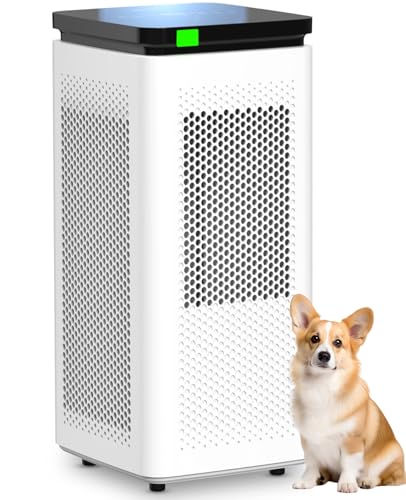
This unbranded listing does something the branded silent picks do not: it names VOCs in its target list and names a carbon filter in its hardware, and it publishes a CADR figure — 235 — that lets a buyer do actual air-change arithmetic. Coverage is claimed up to 3,500 square feet, the H13 True HEPA stage is paired with the carbon filter, and the title adds an air quality display, an auto mode and a 30dB quiet-operation claim. On paper, it is the most completely specified VOC listing in the six. The counterweight is the missing brand name, shifting trust from a manufacturer’s reputation to the listing’s own detail and the seller behind it.
A note of context belongs in this review: listings in this generic family resemble one another closely, and a near-twin of this unit has circulated with a slightly different coverage figure. That is not a defect in the machine, but it is a reason to read the delivered product’s own documentation rather than assuming every number on the page survived from a sister listing. The claims assessed here are the ones printed in this title: 3,500 square feet, 235 CADR, VOCs, carbon.
Listing facts
- Format: large-room air purifier, no brand name in the listing
- Coverage claimed in the listing: up to 3,500 ft²
- CADR stated in the listing: 235
- Filtration named in the listing: H13 True HEPA with carbon filter
- VOC position: VOCs named in the listing’s target list
- Noise claim in the listing: 30dB quiet operation; air quality display and auto mode also named
Strengths
- Publishes a CADR, the figure that turns coverage claims into checkable air-change maths
- Names both the VOC target and the carbon hardware, the pairing this category demands
- The 30dB quiet claim, if it holds at sleep speeds, suits bedroom duty in a way few large units attempt
Trade-offs
- No brand stands behind the listing, so filter availability in two years is a product-page research task
- Carbon weight appears nowhere in the title, leaving the duration of VOC adsorption unknown
- The 3,500 ft² ceiling and the 235 CADR sit in tension — large spaces will see modest air-change rates
Do the arithmetic this listing invites. A CADR of 235 in a modest bedroom delivers several air changes an hour and genuinely works the room; spread across anything approaching 3,500 square feet, the same output becomes a gentle background influence rather than a treatment. That is not dishonesty so much as the physics of the whole category, and this listing at least prints the number that exposes it. Buyers with a big open plan should read the CADR as the machine’s true size and the square footage as marketing weather.
For VOC duty specifically, the carbon filter’s presence in the title earns this unit its place in the dedicated half of the list, and the air quality display plus auto mode give it the reactive behaviour the AD3500 also offers. What cannot be compared from titles is carbon quantity against the AIRDOCTOR’s premium carbon claim — neither publishes a weight — so a buyer choosing between them is choosing between a branded programme with an unquantified premium filter and an unbranded unit with a quantified CADR. Both listings leave the decisive VOC figure unstated, and honesty requires saying so in both reviews.
The 30dB figure deserves its own sentence, because quiet claims are speed-specific: expect it at the lowest setting, not at the speed that delivers 235 CADR.
Best for: bedrooms and mid-size rooms in homes that want named VOC coverage, a carbon stage and a published CADR to plan around
Not suited for: a true 3,500-square-foot open plan expecting rapid air changes — the stated 235 CADR cannot deliver them, whatever the headline says
Check price on Amazon if the published CADR, rather than the coverage headline, matches the room you measured.

Aurora AR100W Air Purifier
The Aurora AR100W opens the honest second half of this list. Its listing describes a white purifier with 3-stage purification covering up to 1,100 square feet, aimed at mould, smoke, dust, odours, pollen, allergens and germs. Nowhere in that list do VOCs appear, and no carbon stage is named among the three stages. This review therefore makes no VOC claim for the machine at all: it is a general room cleaner that buyers cross-shop against VOC models, and it deserves assessment on the work its listing actually describes.
Odours are the interesting word in its target list, because odour reduction and VOC removal are cousins, not twins. A purifier can blunt a smell while leaving the underlying gas chemistry largely untouched, depending on what its stages contain — and since the listing does not itemise the three stages, even the odour mechanism is unconfirmed from the title. What is stated is a sensible mid-size coverage figure and a target list centred on the particle and nuisance problems most rooms actually have.
Listing facts
- Format: room air purifier, model AR100W, White
- Coverage claimed in the listing: up to 1,100 ft²
- Filtration named in the listing: 3-stage purification (stages not itemised in the title)
- Targets named in the listing: mold, smoke, dust, odors, pollen, allergens and germs
- VOC performance not stated in the listing title
- Sensor, CADR and noise figures: the title publishes none of them
Strengths
- A mid-size coverage claim that matches ordinary lounges and large bedrooms without inflation
- A broad target list covering the everyday particle load most homes actually generate
- Three-stage purification suggests a pre-filter plus main stages, the standard architecture for mixed duty
Trade-offs
- No VOC claim and no named carbon stage — the defining gap for readers of this particular guide
- The three stages are not itemised, so the filter types must be confirmed on the product page
- No sensor or auto mode is mentioned, suggesting manual speed control only
There is a buyer this machine serves well, and it is worth describing them accurately: a household whose air problem is dust on shelves, cooking smoke that lingers, a musty spare room, a dog. Those are particle and nuisance problems, and the AR100W’s listing speaks to all of them at a room size that covers most lounges. If that household arrived at this guide because a search engine grouped all purifiers together, the useful service is to tell them their problem may not need carbon at all — and that if it does, this is not the machine that claims to solve it.
The mould word in the target list should be read with care. A purifier can capture airborne spores as particles, which is the claim a listing like this can support; it cannot remediate the damp patch growing them, and no purifier in this guide should be bought as a substitute for fixing moisture. Within those bounds, a 1,100-square-foot machine running in a spare room is a reasonable part of a mould-spore routine alongside ventilation and repair.
Choose the Aurora knowingly and it is a defensible buy: mid-size, generalist, plainly listed. Choose it accidentally — as a VOC machine, on the assumption that all purifiers handle gases — and it will disappoint through no fault of its own, because its maker never printed the promise the buyer imagined. The spec box above records the gap, and the product page can be checked for any carbon detail the title omitted.
Best for: mid-size rooms whose problem is dust, smoke and lingering odours rather than gas-phase emissions
Not suited for: VOC duty of any kind — the listing does not state it, and this review does not infer it
Check price on Amazon for the general cleaning brief its own title describes, no more and no less.
KNKA APH4000 White Air Purifier
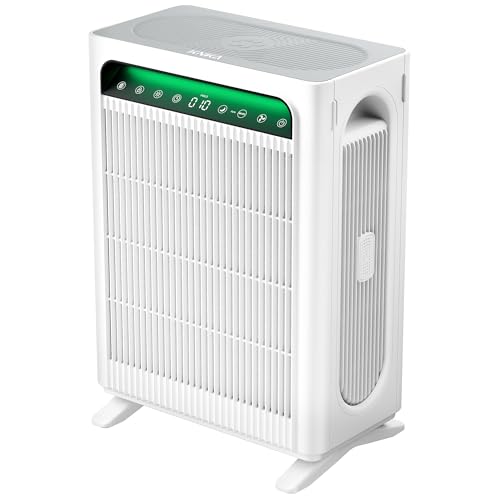
The KNKA APH4000 in white is the credentialled generalist of this six. Its listing carries an AHAM VERIFIED badge — a third-party verification programme for purifier performance claims — and frames its coverage with unusual precision: up to 1,695 square feet in one hour. It adds a washable pre-filter, an AQI display, a HEPA sleep mode and a pet mode aimed at dander, dust and pollen. VOCs appear nowhere in the title, and no carbon filter is named. Like the Aurora, it is assessed here as a particle machine, with its VOC silence stated rather than smoothed over.
The washable pre-filter is a running-cost feature worth noticing. A pre-filter that rinses clean catches the hair and coarse dust before they load the main HEPA stage, stretching the main filter’s life and removing one consumable from the budget. In a pet household — the audience its pet mode names — that coarse load is exactly what clogs lesser machines, so the washable layer is a practical answer to a real pattern rather than a bullet point.
Listing facts
- Format: room air purifier, model APH4000, White
- Coverage claimed in the listing: up to 1,695 ft² in 1 hour
- Verification named in the listing: AHAM VERIFIED
- Filtration named in the listing: HEPA stage with washable pre-filter
- Features named in the listing: AQI display, sleep mode, pet mode
- VOC performance not stated in the listing title
Strengths
- AHAM verification gives its performance claims an outside referee the other listings do not cite
- The washable pre-filter cuts consumable costs and protects the main stage in hairy households
- An AQI display plus a dedicated pet mode suit the bedroom-with-a-dog brief precisely
Trade-offs
- No VOC or carbon claim appears in the title, ruling it out of dedicated gas duty on the printed evidence
- The one-hour coverage framing needs care — it describes a rate, not a room-size promise for continuous use
- This white unit is a colour sibling of a black version sold under the same model line, so check which listing you are ordering
AHAM verification deserves a paragraph of its own. Most purifier titles are the manufacturer’s word alone; an AHAM VERIFIED mark means the model’s CADR claims have passed an independent testing programme the buyer can look up. It does not extend to VOCs — the verification speaks to particle performance — but in a category full of unrefereed numbers, a refereed number is the strongest trust signal printed in any of these six titles.
The pet mode and AQI display pair sensibly. Dander load in a bedroom is episodic — the dog shakes, the bedding is changed, the door opens — and a display that shows the room’s condition lets the owner see the machine respond rather than trust a light. Sleep mode with HEPA filtration addresses the bedroom’s other requirement, which is acoustic: a purifier that cannot run quietly at night will be switched off at night, and a switched-off purifier has a CADR of zero.
None of this converts the APH4000 into a VOC machine, and this review will not pretend the pet mode or the verification badge implies gas capability. Its place in this guide is as the benchmark generalist: the machine a VOC buyer should measure dedicated picks against for build, verification and bedroom manners, and the machine a particle buyer can choose with more confidence than most. If your VOC load is a fresh wardrobe’s smell that will fade in a month anyway, this KNKA may honestly be the wiser purchase.
Best for: pet-owning bedrooms that want verified particle performance, a washable pre-filter and a readable AQI display
Not suited for: renovation or new-furniture gas loads — nothing in this listing claims carbon or VOC capability
Check price on Amazon for its verified particle brief, with the VOC gap understood before you order.
PuroAir 240 HEPA 2PK CarbonTech
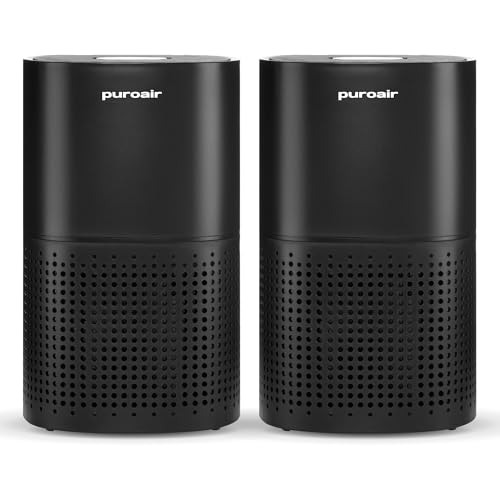
The PuroAir 240 listing occupies the most interesting middle ground in this six. It is sold as a two-pack of black units, each described for 1,000 square feet, with a certified HEPA stage and a CarbonTech filter — carbon, present and named — aimed at smoke and odour. Yet the word VOCs never appears in the title. Carbon aboard without a VOC claim is a common and genuinely ambiguous position: the hardware family is right, the promise is unprinted. This guide records it exactly that way. The spec box records that VOC performance goes unclaimed, and the prose credits the CarbonTech stage only with what the listing claims for it: smoke and odour work.
The rest of the specification is strong. A PuroIQ sensor drives an auto mode, a quiet sleep mode is named, and the intake draws from 360 degrees, which frees placement — the units can sit in a corner or mid-wall without a dead side. Two units invite a two-room strategy: one in the bedroom, one where the household actually lives, each working a modest space properly instead of one large machine straining at a whole floor.
Listing facts
- Format: two-pack of room air purifiers, PuroAir 240, Black
- Coverage claimed in the listing: 1,000 ft² (per unit, as listed for home/bedroom use)
- Filtration named in the listing: certified HEPA plus CarbonTech filter
- Targets named in the listing: smoke and odor
- Features named in the listing: PuroIQ sensor with auto mode, quiet sleep mode, 360° intake
- VOC performance not stated in the listing title
Strengths
- Two units let you place filtration where people actually breathe — bedroom and living room — instead of compromising on one spot
- A carbon-bearing filter stage is present and named, unlike the other two silent picks
- Sensor-driven auto mode and a 360° intake make the units easy to place and forget
Trade-offs
- VOC removal is not claimed in the title despite the carbon stage, so gas duty rests on inference this guide will not make
- Two units mean two sets of replacement filters on the running-cost ledger
- Coverage per unit is the joint-smallest here, so open-plan spaces are outside the pair’s comfortable reach
The two-pack strategy deserves respect on fluid-dynamics grounds alone. Air does not turn corners well, and a single purifier in the hallway serves the hallway. A unit in the closed-door bedroom, where a person spends eight still hours, and a second in the living room will outperform one hero machine of twice the rating in most real houses. The PuroAir listing is the only one here that sells that strategy as the product, and for households whose rooms have doors, it is a legitimately clever allocation of the same money.
Now the carbon question, handled carefully. CarbonTech is PuroAir’s name for its carbon-bearing filter, and carbon as a material class adsorbs gases — that is general knowledge about the material, not a claim extracted from this listing. What the listing claims is smoke and odour work. A buyer whose VOC concern is mild and odour-led — cooking smells, a smoker’s porch drifting in, a musty rental — may find that claim sufficient. A buyer with a renovation-scale gas load should buy a listing that prints the VOC promise and the carbon hardware together, which in this six means the AIRDOCTOR or the generic unit.
Sensor auto mode ties the package together: each unit idles quietly and surges when its room changes. As a pair of set-and-forget room machines with a carbon stage aboard, the 240 two-pack is easy to recommend for general duty. Its position in a VOC guide is the honest borderline — closer to the gas question than the Aurora or KNKA, and still, by its own title’s wording, not an answer to it.
Best for: two closed-door rooms needing sensor-driven general cleaning with a carbon stage aboard for smoke and odour
Not suited for: a stated VOC-removal requirement — the listing never makes that claim, and inference is not a warranty
Check price on Amazon if the two-room placement strategy fits your floor plan better than one large unit would.
Side by side: who claims VOCs, who claims carbon, who claims neither
This table is the guide in miniature. Three columns of the VOC story — the claim, the carbon, the coverage — are laid out per machine, strictly as the titles print them.
| Purifier | VOC claim, carbon hardware and coverage per the listing |
|---|---|
| AIRDOCTOR AD3500 Air Purifier | Rooms up to 2,520 ft² per listing; VOCs named; UltraHEPA plus premium carbon filter; air quality sensor |
| Resiners AirPure TVOC Air Purifier | Desk-scale unit for 151-344 ft²; H13 True HEPA; real-time TVOC display; temp and humidity display |
| Generic Hepa Air Purifier 3500 Ft VOCs | Coverage claim up to 3,500 ft²; H13 True HEPA with carbon filter; VOCs named; 235 CADR; 30dB quiet claim |
| Aurora AR100W Air Purifier | Coverage up to 1,100 ft²; 3-stage purification; targets mould, smoke, dust, odours, pollen; VOC not stated |
| KNKA APH4000 White Air Purifier | Up to 1,695 ft² in 1 hr per listing; AHAM VERIFIED; washable pre-filter; AQI display; pet mode; VOC not stated |
| PuroAir 240 HEPA 2PK CarbonTech | Two-pack; 1,000 ft² per listing; certified HEPA plus CarbonTech filter; PuroIQ sensor auto mode; 360° intake |
Only two listings print the complete sentence a VOC buyer needs — VOCs named and carbon named: the AIRDOCTOR AD3500 and the generic 3,500-square-foot unit. The Resiners prints a third kind of honesty, a TVOC display that measures the gas load at a resin desk without naming a carbon stage. The PuroAir prints carbon without the VOC word, and the Aurora and KNKA print neither, while bringing other virtues — simplicity in one, third-party verification in the other — that particle buyers should value on their own terms.
Coverage figures should be compared last and distrusted first. They span 151 square feet of stated desk territory to a 3,500-square-foot headline, computed under assumptions no title discloses. The figures that survive scrutiny are the checkable ones: the generic unit’s 235 CADR, the KNKA’s AHAM verification, the Resiners’ modest and therefore believable room range. Buy the claim you can verify, at the scale of the room you measured.
How do you shop for VOC filtration without fooling yourself?
VOC shopping fails in predictable places: in the gap between particle filtration and gas adsorption, and in the gap between a coverage headline and a real room. The questions below close both gaps in the order a buyer meets them.
Does the listing name VOCs and carbon in the same breath?
This is the threshold test, and it is deliberately crude. Gases need an adsorbent; in this category that means carbon. A listing that names VOCs but no carbon is asking you to trust an unnamed mechanism, and a listing that names carbon but not VOCs — the PuroAir position — is selling hardware without the promise. The two listings here that pass the full test do so in print. Apply the test before any other, because no sensor, display or verification badge compensates for the wrong filter physics.
Carbon quantity is the follow-up question no title here answers. Adsorption capacity scales with the amount of carbon and the contact time, so a substantial carbon bed outlasts a carbon-dusted sheet by months. Since neither dedicated pick publishes a weight, the product page and the replacement filter’s own description become the deciding documents — check them before the order, not after the smell returns.
Is your problem actually a gas problem?
Dust on the shelves, pollen in spring, pet hair on the sofa: particles, handled by every machine in this list. The smell of fresh paint that lingers for weeks, the sharp note from a new cabinet, fumes from a resin pour: gases, handled only where carbon is claimed. Many households have both, in different rooms, which is why the honest answer is sometimes two different machines — a verified particle unit in the bedroom and a carbon unit near the source — rather than one compromise in the hallway.
Smell alone is a treacherous guide. Noses fatigue within minutes, so a room can seem cured while its chemistry is unchanged; the Resiners’ TVOC display exists because measurement beats impression. If you cannot measure, use time and ventilation as your instruments: gases from furnishings decay over weeks, and a purifier’s carbon should be sized for that whole decay, not for the first dramatic day.
What room size should you actually plan around?
Measure the room, then read coverage claims as ceilings under unknown assumptions. The checkable anchors in this list are the generic unit’s 235 CADR and the KNKA’s AHAM-verified ratings; the Resiners’ 151-to-344-square-foot range is believable precisely because it is modest. For gas duty, favour placement over power: a purifier beside the emitting source, where concentration is highest, removes more per hour than a stronger machine across the room diluting what reaches it.
For a sense of how the same household-thinking applies to a different appliance category entirely, the guide to Best Electric Cooktops With Downdraft Ventilation examines capturing cooking emissions at the source with a vent — the kitchen’s version of the placement principle this section argues for.
What will the filters cost you over two years?
A purifier is a subscription wearing an appliance’s clothes. HEPA stages, carbon beds and pre-filters all expire, and carbon expires silently — a saturated bed stops adsorbing while the machine hums on, which is why replacement intervals matter more for VOC duty than for dust. The KNKA’s washable pre-filter is the one running-cost mercy in this list. For every pick, price the replacement set before buying the machine, and treat a listing with cheap, available filters as a feature on par with its CADR.
Households that cook seriously generate their own indoor chemistry daily, and the companion read on Best Manual Drip Coffee Makers is a reminder of the gentler end of kitchen routine — while Best Duo Coffee Makers covers the households brewing for a crowd, whose kitchens earn their ventilation honestly.
Ventilation first: the purifier is the second line, not the first
No purifier in this guide outruns an open window. Gases dilute with fresh air faster than any domestic carbon bed adsorbs them, and the cheapest VOC strategy ever devised is to air a newly painted room, cure resin where air moves, and let new furniture off-gas in a ventilated space before it joins the bedroom. The purifier’s role is the hours and seasons when windows stay shut — winter nights, pollen weeks, flats whose windows face a road — and judged in that role, the dedicated picks here are properly equipped.
Source control outranks even ventilation. Low-emission paints, cured adhesives and finished furniture reduce the load before any machine meets it, and the resin crafter who seals leftovers and cures under a cover has done more than any filter can. Buy the machine for the residue that source control and ventilation cannot reach, and it will be sized honestly and replaced on time.
Reading a purifier listing like an auditor
Titles in this category reward a cold eye. Separate the target list from the hardware list: targets are aspirations, hardware is capability, and the two must rhyme — VOCs with carbon, dander with HEPA, odours with something named that could plausibly adsorb or trap them. Note what is quantified (a CADR, a verified badge, a stated room range) against what is adjectival, and let the quantified claims set your shortlist. This article has applied that reading to all six listings, including the three whose silence on VOCs is printed in their spec boxes rather than left for you to discover after delivery.
Finally, remember what no listing can claim responsibly: an outcome in a human body. These machines filter air as their makers describe; they do not treat conditions, and this guide has attributed every filtration statement to its listing for exactly that reason. Judge them as appliances, maintain them as appliances, and let fresh air and source control carry the rest.
Common mistakes when buying a purifier for VOCs
Each mistake below is a way to spend real money and keep the smell. They are common because the category’s marketing invites every one of them.
Buying a particle machine for a gas problem
The most expensive mistake in this category is also the simplest: choosing on HEPA credentials when the problem is paint fumes. A superb particle filter leaves gases untouched, and the room keeps its chemical smell while the shelves stay dustless. The Aurora and KNKA in this list are good machines whose titles never claim otherwise — the mistake belongs to the buyer who assumes, not to the listing that stayed silent.
Trusting your nose as the measuring instrument
Olfactory fatigue makes a room smell cured within twenty minutes of entering it, whatever its actual chemistry. Decisions about filter replacement and machine sizing made by nose are decisions made blind. A TVOC display, like the Resiners unit’s, or simple calendar discipline about carbon replacement dates, both beat the nose that assured you the spare room was fine.
Sizing by the headline square footage
Coverage ceilings assume conditions no title discloses, and a machine stretched across its maximum area delivers a fraction of the air changes its buyer imagines. The generic pick’s own figures prove the point: a 235 CADR is a bedroom-scale engine wearing a 3,500-square-foot hat. Measure the room, work from CADR or verified ratings where they exist, and let the headline be the last number you believe.
Letting a saturated carbon bed run for years
Carbon does not clog loudly like a particle filter; it fills silently and then simply stops adsorbing, while the fan and the lights carry on as if nothing changed. A VOC machine with an ancient carbon stage is a fan with a story. Note the replacement interval at purchase, write the date on the filter itself, and treat that date as part of the machine’s specification.
Expecting a purifier to fix a source that is still emitting
A purifier beside a curing resin pour or a freshly glued floor is bailing a boat with the leak open. It helps — capture near the source is the best placement there is — but it cannot substitute for curing time, sealing and ventilation. Buyers who expect otherwise conclude purifiers do not work, when the truth is that no filter outruns a source at full emission.
Final recommendation
The AIRDOCTOR AD3500 is this guide’s answer for a genuine, room-scale VOC problem: it names the gases, names the carbon, covers the largest stated area of the dedicated picks and adds a sensor to follow the load. The generic 3,500-square-foot unit is its unbranded rival, trading the AIRDOCTOR’s programme for a published CADR and a quiet claim, and it earns its place for buyers who plan by numbers. The Resiners AirPure stands apart as the desk instrument — buy it for the resin bench, for the TVOC number it shows you, and for nothing larger than the small room its title honestly specifies.
The other three are recommended only under their own descriptions. The KNKA APH4000 is the verified particle benchmark with the washable pre-filter and the pet mode; the PuroAir two-pack is the two-room generalist with a carbon stage that its title aims at smoke and odour; the Aurora AR100W is the plain mid-size cleaner for dust and nuisance duty. Each of their spec boxes records that VOC performance is unclaimed in the listing, and a buyer who needs that performance should choose from the first three and not negotiate with the wording.
Sort your own problem before you sort the machines: gas or particle, source room or whole floor, measured or guessed. The listings, read coldly, will then choose themselves — and the carbon, where it is claimed, will be fresh enough to matter.
VOC purifier questions buyers actually ask
Does a HEPA filter remove VOCs?
No — and this distinction is the spine of the whole guide. HEPA media trap particles: dust, pollen, dander, smoke particulates. VOCs are gas molecules that pass through particle media, and the technology listings name for them is carbon, which adsorbs gases onto its surface. That is why this article credits VOC capability only where a title names VOCs together with carbon hardware, and marks the rest as unclaimed.
How long does a carbon filter keep working on gases?
Until its adsorption sites fill, which depends on the carbon quantity and the gas load — neither of which any title here publishes. A heavy load, like daily resin work or a full renovation, saturates a bed far faster than background duty in a furnished room. Because saturation is silent, calendar discipline beats waiting for the smell to return: note the maker’s stated interval on the product page and replace on schedule.
Is a TVOC display useful or a gimmick?
Useful, within its limits. The Resiners unit’s real-time TVOC display reports a combined gas reading for its immediate air, which tells a crafter whether the workspace has cleared and whether ventilation is working. It does not identify individual compounds and it does not remove anything by itself. As a feedback instrument for habits and timing, it earns its place; as a safety certification, it should not be asked to serve.
Can one purifier handle a whole open-plan floor’s VOCs?
Slowly, and only with realistic expectations. Gas removal is a rate, not an event: air must cycle through the carbon repeatedly while sources keep emitting. The AD3500’s stated 2,520-square-foot ceiling and the generic unit’s 235 CADR describe the two ends of that honesty — a coverage claim and a computable rate. For a large floor with a strong source, placement near the source plus ventilation will outperform any single machine’s headline figure.
Why are three machines in a VOC guide if they do not claim VOCs?
Because buyers meet them on the same search results page and assume the category implies the capability. The Aurora, KNKA and PuroAir listings are printed here with their VOC status stated in their spec boxes precisely so that assumption gets corrected before purchase rather than after. Two of the three are strong general machines; the guide’s job is to make sure they are bought for the work they claim to do.
Match the filter physics to the chemistry of your problem, keep the carbon fresh, and let the listings that print their promises — and their silences — tell you which machine has actually answered your question.


