What's inside
- Where to buy these six downdraft cooktops
- Six downdraft cooktops in one table
- How these picks were chosen
- Compared: width, wattage, technology and vent path
- What decides a downdraft purchase: vent, power or glass?
- What a downdraft can and cannot do, stated physically
- Living with glass: the radiant surface after the first month
- Common mistakes when buying a downdraft cooktop
- Final recommendation
- Downdraft cooktop questions, answered from the listings
As an Amazon Associate I earn from qualifying purchases. This post may contain affiliate links at no extra cost to you.
As an Amazon Associate, cottageverdict.com earns from qualifying purchases.
A downdraft cooktop solves a layout problem that range hoods cannot. On a kitchen island, in a galley with low ceilings, or under a window you refuse to cover, an overhead hood is either impossible or a visual slab hanging where the room’s light used to be. The best electric cooktops with downdraft ventilation pull steam and cooking fumes downward, through a vent built into the cooking surface itself, so the air above the pan stays clear without anything suspended over it. The physics are less forgiving than a hood’s — hot vapour wants to rise, and a downdraft must win that argument at the surface — which is exactly why the details in these six listings matter more than their headlines.
Five of the six are radiant ceramic cooktops, heating the glass from below with elements that glow through it. The sixth, the generic 30-inch model that closes the list, is an induction cooktop with a downdraft exhaust — a fundamentally different machine that heats the pan itself magnetically and only works with magnetic cookware. This guide keeps that distinction in front of you throughout, because a buyer who orders the induction unit for a beloved aluminium stockpot has made an expensive mistake that no vent specification can soften. All six are four-burner units between 30 and 36 inches wide, hardwired at 220-240 volts, and every one of them names its downdraft or recirculating vent in its title.
Ventilation language needs a careful read in this category. Several listings describe ductless or recirculating operation — air drawn down, filtered and returned to the room — and one states outright that no exhaust pipe is required. Recirculation handles grease and much of the odour at the surface; it does not remove heat and moisture from the kitchen the way a duct to the outside does. Neither arrangement is a fraud, but they are different purchases, and the reviews below report each listing’s own wording so you know which one you are buying before the cabinet is cut.
Where to buy these six downdraft cooktops
Each model below is sold through Amazon, with the full review further down the page. These short lines flag the one decision each model asks you to make.
The Karinear 30-inch is the feature maximalist: a ventilation system with a 9-speed fan, ductless mode, a bridge element, a dual-ring burner and 7,400W of ceramic radiant power.
Noxton’s 30-inch radiant answers with simplicity — 6,000W, nine heat settings, a 99-minute timer and a title that states plainly that no exhaust pipe is required.
The GASLAND Chef Collection stretches to 31.5 inches and adds a sync bridge element and a hot-surface indicator, the safety detail several rivals leave unmentioned.
Cooksir’s 36-inch is the wide body of the list, pairing 7,400W of cooking power with a 135W downdraft range hood figure — the only listing that quantifies its vent motor.
GTKZW’s 30-inch keeps the formula tight: 6,600W, a BBQ bridge burner, a recirculating vent and the safety lock and timer the category treats as standard.
The generic 30-inch induction unit is the technology outlier — 6,600W of induction, a 3-speed downdraft exhaust and a hardwired, no-plug installation.
Six downdraft cooktops in one table
Best-for labels describe the kitchen each listing fits. The third column gives the vent arrangement exactly as the title states it, because that wording decides the installation.
| Pick | Best for | Vent arrangement per the listing |
|---|---|---|
| Karinear 30 Inch Downdraft Electric Cooktop | Island kitchens wanting fan control and bridge cooking | 9-speed downdraft fan with ductless mode, 7,400W ceramic |
| Noxton 30in Electric Cooktop Downdraft | Retrofits where running an exhaust pipe is not an option | No exhaust pipe required, stated in the title |
| GASLAND 31.5in Electric Downdraft Cooktop | Kitchens between standard sizes, wanting a hot-surface warning | 31.5-inch width, sync bridge, hot surface indicator |
| Cooksir 36 Inch Electric Cooktop Downdraft | Wide counters and big pans, with a quantified vent motor | 36-inch top; downdraft hood motor stated at 135W |
| GTKZW 30in Electric Cooktop Downdraft 6600W | Standard 30-inch installs wanting a bridge burner and recirculation | 6,600W radiant with BBQ bridge burner and recirculating vent |
| Generic 30in Induction Cooktop Downdraft | Induction converts wanting downdraft extraction in a standard cut | Induction — not radiant — with a 3-speed downdraft exhaust |
How these picks were chosen
The entry condition for this list was printed evidence of the vent: a listing title had to name downdraft, a ventilation system or a recirculating vent before its cooktop could be considered, because the vent is the entire reason the category exists and a buyer should not have to excavate a manual to confirm it. That condition produced a long candidate pool, which was then cut on a point of integrity this guide feels strongly about: one manufacturer’s family of near-identical listings, repeated across multiple product codes with titles differing by almost nothing, was excluded as a family, since filling slots with what appears to be the same machine relisted would counterfeit the choice the guide claims to offer.
Technology was balanced deliberately after that. Radiant ceramic is the category’s mainstream and takes five of the six places, across the three widths the market actually cuts counters for — 30, 31.5 and 36 inches — and across power budgets from 6,000W to 7,400W. The sixth place was reserved for the strongest induction entry, because induction-with-downdraft is a genuinely different purchase that a complete guide must present as different, cookware condition and all, rather than blending it into the radiant crowd. A second induction variant from a maker already represented in the radiant five was passed over to keep the six makers distinct.
Finally, each surviving title was read for what it quantifies. Fan speeds, a vent motor’s wattage, timer lengths and ducting statements were recorded exactly as printed, and their absences were recorded too. The reviews that follow therefore compare not only six cooktops but six levels of listing candour — and in a category where no title publishes an extraction rate, the candour itself becomes one of the few reliable buying signals a shopper has.

Karinear 30 Inch Downdraft Electric Cooktop
Karinear’s listing is the most forthcoming of the six about its ventilation, and ventilation is the reason this category exists. The title names a ventilation system with a ductless mode and a 9-speed fan, which tells you two things the other listings leave vague: the extracted air can be handled without ductwork, and the fan’s effort can be trimmed across nine steps rather than slammed between off and roaring. Nine speeds matter at a downdraft more than at a hood, because the fan sits in the room’s acoustic centre — on an island, it is competing with conversation on both sides of the counter, and a speed you can lower for a simmering pan is a speed you will actually use.
The cooking side is equally loaded: 7,400W across four burners on a 240V supply, a BBQ bridge element that links two burners under a griddle or grill pan, and a dual-ring burner that adjusts its heated diameter to the pan on it. Timer, child lock and a pause function complete a title that reads like the category’s full checklist. Pause deserves its sentence: on a glass radiant top, pausing holds the cooking state while you answer the door, which is a small mercy that prevents the scorched sauce every cook knows.
Listing facts
- Format: 30-inch built-in radiant ceramic cooktop, 4 burners
- Total power stated in the listing: 7,400W; supply 240V
- Ventilation named in the listing: downdraft ventilation system with ductless mode
- Fan speeds stated in the listing: 9
- Elements named in the listing: BBQ bridge element and dual-ring burner
- Controls named in the listing: timer, child lock, pause function
Strengths
- The 9-speed fan is the finest vent control claimed in this six, suited to island cooking at conversation distance
- Bridge and dual-ring elements cover the two pan shapes ordinary burners serve badly: griddles and small saucepans
- Ductless mode is stated outright, so an island without a duct route is a planned install, not a surprise
Trade-offs
- Ductless recirculation returns heat and moisture to the room, unlike a ducted path outside
- No extraction rate is published, so the fan’s real appetite can only be judged by its speed range
- 7,400W at 240V is a serious electrical commitment that an older kitchen’s circuit may not already meet
Picture the island dinner party this machine is built around: scallops searing on one side of the counter, guests holding glasses on the other, and the plume from the pan threatening the whole arrangement. A downdraft that can be trimmed — high for the sear’s first smoky minute, low while the pan rests — keeps the air clear without shouting over the table. The bridge element then earns its place at breakfast, when a griddle spanning two burners cooks for the same guests in one batch instead of three.
The dual-ring burner is the quiet problem-solver. Radiant elements waste their heat and scorch their sauces when the pan is much smaller than the ring; a ring that contracts to the pan’s base keeps the energy where the food is. On a four-burner top, that flexibility effectively adds a fifth configuration, and households that cook small pans on big burners out of habit will taste the difference in the first week, in sauces that simmer instead of catching.
Installation honesty closes the review. Ductless mode simplifies the cabinet work enormously — no duct run through the island’s base — but the buyer should picture where the filtered air exits and what it carries with it: warmth and humidity stay in the kitchen. For a household that blackens fish twice a week, the ducted question deserves an answer from the product page before the Karinear’s convenience wins the argument.
Best for: island and open-plan kitchens cooking socially, where a trimmable fan and a griddle bridge both earn their keep weekly
Not suited for: kitchens needing heat and steam physically removed from the building — ductless mode, by the listing’s own wording, keeps them indoors
Check price on Amazon if the nine fan speeds match the way your island actually gets used at dinner parties.

Noxton 30in Electric Cooktop Downdraft
Noxton’s listing contains the five most reassuring words in this category for a renovator: no exhaust pipe required. Printed right in the title, the phrase settles the installation question that sinks downdraft projects — the vent recirculates, so the cooktop can drop into an island or a peninsula where no duct route exists. What remains is the category’s sensible core: a 30-inch radiant top, four burners, 6,000W total, nine heat settings per burner, a timer that runs to 99 minutes, pause and child lock, hardwired at 220-240V.
Six thousand watts is the lowest total in this six, and the honest reading is that it trims the extremes rather than the everyday. Four burners share that budget, so the scenario to picture is not four pans at full blast — few households cook that way — but two working burners and two at a simmer, which the figure covers comfortably. The 99-minute timer is the longest explicit timer claim here, suited to the slow braise that radiant tops handle well once their heat settles.
Listing facts
- Format: 30-inch radiant cooktop, 4 burners, hardwired
- Total power stated in the listing: 6,000W; supply 220-240V
- Ventilation named in the listing: downdraft vent; no exhaust pipe required
- Heat settings stated in the listing: 9 per burner
- Timer stated in the listing: 99 minutes maximum
- Controls named in the listing: pause and child lock
Strengths
- The no-pipe statement removes the single largest installation risk in the downdraft category
- A 99-minute timer outlasts every rival’s stated figure for slow, unattended braises
- Nine heat settings per burner give radiant control a finer grain than the usual low-medium-high
Trade-offs
- 6,000W is the smallest power budget here, so four-burner feasts will share heat rather than surge
- Fan speeds and extraction rate go unmentioned — the vent is described by its plumbing, not its power
- Recirculation, like all ductless designs, leaves the kitchen’s heat and humidity indoors
The retrofit scenario defines this machine. A kitchen refresh that keeps the cabinets, swaps the old coil top for glass, and wants the island free of a hanging hood lives or dies on whether a duct can be threaded through finished carpentry. Noxton’s answer — it cannot need one — converts a builder’s project into an electrician’s visit plus a cut-out. For renters-turned-owners and phased renovations, that difference is the whole purchase, and it is printed in the title rather than buried in a manual.
Radiant cooking at 6,000W rewards a particular style: pans matched to rings, lids on, heat anticipated rather than chased. Radiant elements cycle to hold a temperature, so a simmer on the Noxton is a rhythm of glows, and cooks who learn that rhythm produce excellent slow food. What the top will not do is flash-sear with the violence of the 7,400W units; a heavy pan and patience stand in for wattage, and most weeknight cooking never notices the substitution.
The unasked question is the fan. A downdraft vent with no published speed count or extraction figure must be taken on the listing’s faith, and the buyer’s protection is the returns window plus a first-week test with the smokiest dish in the repertoire. If it cannot, no timer length compensates — which is true of every pick here, and stated here because this listing gives the fewest vent numbers to hide behind.
Best for: renovations keeping existing cabinets, where a ductless drop-in is the difference between possible and abandoned
Not suited for: four-burner power cooking at full tilt — 6,000W shared four ways is the tightest budget in this list
Check price on Amazon when the absence of ductwork, not the wattage, is your project’s real constraint.
GASLAND 31.5in Electric Downdraft Cooktop
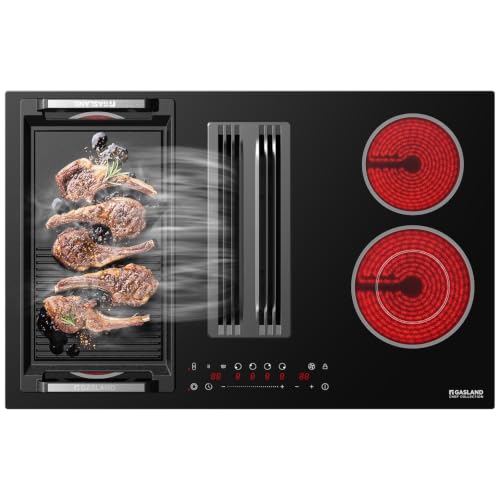
GASLAND’s Chef Collection unit is the dimensional outlier: 31.5 inches wide, a size that exists for kitchens whose cut-outs were made for something between the standard 30 and the generous 36. That extra inch and a half over a 30-inch top buys breathing room between burners — the difference between a stockpot and a saucepan crowding each other and sitting in clear space. The listing names a sync bridge element and a flexible cooking zone, a child lock, and two details this guide wishes every rival printed: a hot surface indicator and an explicit easy-to-clean note for the glass.
The hot surface indicator matters on radiant glass more than on any other cooking surface, because a radiant zone stays dangerous long after its glow fades, and it looks identical to a cold one. An indicator light is the difference between a resting hand and a safe one, and its presence in the title — while absent from several rival titles — is a genuine point in GASLAND’s favour. What the listing withholds is the total wattage: no power figure appears, which leaves the top’s ceiling unjudged from the title and sends the power question to the product page.
Listing facts
- Format: 31.5-inch electric downdraft cooktop, 4 burners, Chef Collection
- Supply stated in the listing: 240V
- Total power: the title publishes no figure
- Elements named in the listing: sync bridge element, flexible cooking zone
- Safety features named in the listing: child lock and hot surface indicator
- Ventilation named in the listing: downdraft (the title adds no mode or fan details)
Strengths
- The 31.5-inch width fills non-standard cut-outs that strand owners between the 30 and 36-inch standards
- A hot surface indicator is named outright — the burn-prevention detail radiant glass needs most
- Sync bridge plus a flexible zone gives griddle and odd-pan cooking two ways to arrange itself
Trade-offs
- No wattage is published in the title, so the power ceiling is unknown until the product page answers
- Vent details are the thinnest here: downdraft is named, but no mode, speed or ducting statement follows it
- A non-standard width cuts both ways — if this unit is ever replaced, the cut-out will demand the same size again
Measure-first kitchens are this machine’s natural home. Plenty of remodels inherit a counter cut for an older, wider cooktop, and the choice is usually between filler strips that collect crumbs and a unit actually made for the hole. At 31.5 inches the GASLAND is that unit for one specific hole, and the bridge element then converts the extra width into function: a synced pair of burners under a grill pan, with the flexible zone absorbing the odd roasting tin that never sits centred on a ring.
The vent deserves the same scrutiny this guide gives the wattage. Downdraft is in the product name, so the function exists; everything quantitative about it — speeds, extraction, ducted or recirculating — is absent from the title. A buyer for whom the vent is the whole point of the purchase should treat this listing as an introduction and finish the research on the product page, asking specifically whether the unit ducts out or recirculates, because the cabinet design forks on that answer.
Balanced against its silences, the GASLAND prints the two most domestic details in the category: it warns you the glass is hot, and it promises the glass cleans easily. Radiant ownership is a daily negotiation with spills that bake onto a hot surface, and a top designed to wipe down without a ritual is a top that stays presentable. Households choosing between this and the Karinear are choosing between kitchen-practical virtues and vent-and-power specification depth — both legitimate, and the deciding factor should be whether your cut-out even gives you the choice.
Best for: a remodel with a wider-than-standard cut-out and a household that values the hot-surface warning every single day
Not suited for: a vent-led buyer requiring ducting mode and fan data in the listing itself — this title offers neither figure
Check price on Amazon if your counter’s cut-out measures closer to this width than to the standard sizes.

Cooksir 36 Inch Electric Cooktop Downdraft
Cooksir’s 36-inch is the only listing here that puts a number on its ventilation motor: a downdraft range hood rated at 135W, built into a 7,400W four-burner top. A wattage for the vent is not an extraction rate, and this guide will not pretend otherwise — but it is a measurable commitment where rivals offer adjectives, and it lets a buyer at least compare the motor’s appetite across models. The vent is described as a recirculating air vent, so the installation story matches the Noxton and Karinear pattern: filtered air returns to the room, and no duct run is implied by the title.
Thirty-six inches changes the cooking geometry more than the burner count suggests. Four burners spread across the wider glass means a 28-centimetre sauté pan and a stockpot can work side by side without their handles negotiating, and the counter gains landing space at both ends of the top. The electrical side is stated plainly: 220-240V, hardwired, no plug. Timer and safety lock round out a listing that is unusually complete about installation and unusually quiet about burner-level detail — no heat-setting count, no bridge element, no dual ring is named.
Listing facts
- Format: 36-inch built-in electric cooktop, 4 burners, hardwired
- Total cooking power stated in the listing: 7,400W; supply 220-240V
- Ventilation named in the listing: recirculating air vent with downdraft range hood
- Vent motor figure stated in the listing: 135W
- Controls named in the listing: timer and safety lock
- Burner configurations (bridge, dual ring) and heat-setting count: not stated in the listing title
Strengths
- The only vent motor figure in the six — 135W — gives buyers one hard number for the feature that defines the category
- Thirty-six inches of glass gives big pans simultaneous room that no 30-inch top can offer
- Recirculating design is stated in the title, so the ductless installation is a known quantity from the start
Trade-offs
- No bridge element is named, so griddle cooking across burners is unconfirmed despite the width
- Heat-setting granularity goes unmentioned, leaving control finesse to the product page
- A 36-inch cut is a commitment: it needs the counter depth and the cabinet width to match
The wide-top buyer is usually cooking for more people or with bigger vessels: the preserving kettle, the paella pan, the double batch of soup stock. On a 30-inch top those vessels evict every other burner; on this Cooksir they share the glass with a sauce at a simmer. The 7,400W budget, equal highest in this list, supports that style without the sharing compromises of the Noxton. If your cooking is genuinely two-pan weeknight work, the width is wasted money and counter — but if a big pan lives on your stove most days, width is the feature everything else decorates.
Recirculation at 36 inches deserves a practical note. A wider top generates its plume across a wider front, and the downdraft slot must gather from the full span. The 135W motor figure tells you the fan’s size class; it cannot tell you the capture geometry, which is decided by the slot’s placement and the vent’s internal path. The first-week smoky test advised elsewhere in this guide applies with extra force here: cook the dish that smokes most, at the front burners, and watch whether the room’s far corners stay clear.
Hardwired installation at this size is a two-person, half-day affair with an electrician’s visit inside it, and the safety lock plus timer suggest Cooksir expects family kitchens rather than studio flats. Set against the Karinear — the other 7,400W unit — the choice is width and a quantified vent motor against fan speeds and burner flexibility. Kitchens with the counter for it and pans that need it will take the width every time.
Best for: big-pan, batch-cooking households with a 36-inch cut-out and a preference for a vent motor stated in numbers
Not suited for: griddle cooks requiring a named bridge element — at this width its absence from the title is a question to settle before ordering
Check price on Amazon when counter width, not features, is the luxury your cooking actually runs out of.

GTKZW 30in Electric Cooktop Downdraft 6600W
GTKZW’s listing is the category’s formula written cleanly: a 30-inch radiant top at 6,600W, four burners, a BBQ bridge burner, a timer, a safety lock and a recirculating vent, hardwired at 220-240V. Nothing in the title reaches for a superlative, and nothing important to a standard install is missing from it either. The bridge burner is the feature with daily consequences — it joins two burners under a grill pan or griddle — and its presence at this power level puts the GTKZW in direct conversation with the Karinear, which adds fan speeds and a dual ring at a higher wattage.
Recirculating vent is stated as a plain fact, which this guide counts as a virtue: the buyer knows before the cabinet is designed that the air stays in the room, filtered. What the title does not state is any fan speed count or extraction figure, continuing the category’s pattern of describing vents by their plumbing rather than their performance. The safety lock language matches the Cooksir’s, and the timer arrives without a stated maximum, where the Noxton prints 99 minutes and the Karinear leaves its timer unquantified too.
Listing facts
- Format: 30-inch built-in radiant cooktop, 4 burners
- Total power stated in the listing: 6,600W; supply 220-240V
- Ventilation named in the listing: downdraft with recirculating vent
- Element named in the listing: BBQ bridge burner
- Controls named in the listing: timer (maximum not stated) and safety lock
- Fan speeds and extraction rate: the title publishes neither
Strengths
- Bridge burner included at a mid-pack power figure, covering griddle breakfasts without a separate appliance
- The recirculating arrangement is declared in the title, keeping installation planning honest
- 6,600W sits in the category’s comfortable middle — enough headroom for family cooking without the Noxton’s tightness
Trade-offs
- No fan data of any kind: speeds, extraction and motor size all await the product page
- Timer maximum is unstated, so slow-cook timing cannot be compared from the listing
- No hot-surface indicator is named, a small safety silence beside the GASLAND’s explicit one
The GTKZW is the pick for the standard kitchen executed without drama: a 30-inch cut, a family that grills indoors on a bridge pan at weekends, and a vent requirement created by an island or a window wall. Its 6,600W divides more generously than the Noxton’s budget across four burners, and radiant heat at this level handles the weeknight repertoire — pasta water, a fry-up, rice at a simmer, veg at a rolling boil — without the power-sharing choreography the smallest unit demands.
Bridge burners repay a moment’s thought about cookware. A bridge is only as good as the pan that spans it: a heavy, flat griddle distributes the joined heat evenly, while a thin pan telegraphs the gap between the two elements as a cool stripe down the middle of your pancakes. Budget the pan into the purchase and the feature sings; improvise with a roasting tin and it disappoints for reasons that have nothing to do with the cooktop. The listing names the bridge a BBQ bridge, which hints at grill pans and ridged surfaces — exactly the cookware that benefits.
Against the Karinear, the GTKZW concedes the fan’s nine speeds, the dual ring and 800W, and asks less research of its buyer in return: no modes to decode, no ductless-versus-ducted ambiguity, just a stated recirculation. Households that read manuals cover to cover will prefer the Karinear’s depth. Households that want the category’s core promise — glass top, bridge, vent, no hood — with the fewest open questions will find this listing’s plainness restful, and there is no shame in choosing restful for an appliance that must work for a decade.
Best for: standard 30-inch family kitchens wanting bridge cooking and a declared recirculating vent without feature overload
Not suited for: vent researchers seeking fan speeds or a motor figure before committing — this title publishes none of them
Check price on Amazon for the category’s core formula, stated plainly and completely enough to plan a kitchen around.

Generic 30in Induction Cooktop Downdraft
This final pick must be introduced with its difference in capital letters: it is an induction cooktop, the only one in this six. Its 6,600W does not heat glass elements; it generates heat inside the pan itself through a magnetic field, which means the cookware must be magnetic — cast iron and most stainless steel qualify, aluminium and copper do not unless they carry an induction base. Everything else about its listing follows the category pattern: 30 inches, four burners, a downdraft range hood with a 3-speed exhaust system, timer, safety lock, hardwired at 220V with no plug.
Induction changes the downdraft’s job in an interesting way. Because the glass around the pan stays comparatively cool, less ambient heat rises off the surface, and the plume is mostly the food’s own steam and smoke rather than a column of element-heated air. A 3-speed exhaust is a coarser instrument than the Karinear’s nine speeds, but induction’s instant control — heat that stops the second the pan lifts — gives the cook a second way to tame a plume: kill the boil-over at the control before the vent is overwhelmed. The listing does not state whether its vent ducts out or recirculates; the word exhaust suggests a path, and the product page must confirm it.
Listing facts
- Format: 30-inch built-in INDUCTION cooktop, 4 burners — magnetic cookware required
- Total power stated in the listing: 6,600W; supply 220V, hardwired, no plug
- Ventilation named in the listing: downdraft range hood with 3-speed downdraft exhaust system
- Controls named in the listing: timer and safety lock
- Ducted or recirculating path: the title leaves the route open
- Bridge element and heat-setting count: the title names neither
Strengths
- Induction response: heat changes land instantly, so boil-overs can be killed at the control before the vent is tested
- The glass stays cooler around the pan, so spills bake on less and the surface wipes down sooner after cooking
- A 3-speed exhaust with named speeds is more vent information than several radiant rivals publish
Trade-offs
- Non-magnetic cookware simply will not heat — a pan audit is part of this purchase, like it or not
- The vent’s ducting path is unstated, leaving the biggest installation question open
- No brand name in the title, so documentation and support rest on the seller’s page
The pan audit deserves its own paragraph because it decides this purchase emotionally as well as practically. Take a fridge magnet to every pot you own before ordering. The cast iron skillet, the enamelled Dutch oven, most modern stainless sets: fine. The aluminium stockpot from a wedding list, the copper jam pan, the cheap non-stick from student days: silent on an induction field, and replacing them is a second purchase hiding inside the first. Cooks whose collection is already magnetic get induction’s benefits for free; cooks whose is not should price the pans into the comparison against the radiant five.
Those benefits are real and daily. Water boils with a speed that rearranges weeknight habits, a simmer holds without the radiant cycle’s surge, and the flat glass — heated only by contact with the pan — releases spills that a radiant top would have carbonised. For the downdraft brief specifically, the cooler surface produces a lazier plume, and the 3-speed fan’s job is correspondingly lighter than the same fan’s job over radiant elements at full glow. The listing’s pairing of induction with a downdraft is, on reflection, the most physically coherent design in this six.
The open questions are the seller and the duct. An unbranded listing at this price class asks the buyer to verify support, documentation and the exhaust path with more care than the branded five demand, and the no-plug hardwired note means an electrician is in the budget regardless. None of that disqualifies the machine; it relocates the diligence. A cook who does the pan audit, confirms the duct route and accepts the seller homework gets the only induction option here — and for many kitchens, that technology gap outweighs every feature the radiant picks stack against it.
Best for: cooks with magnetic cookware who want induction’s control and a downdraft in a standard 30-inch cut
Not suited for: aluminium and copper pan collections — on an induction field they do not heat at all, and no vent feature compensates
Check price on Amazon after the fridge-magnet test has passed every pan you care about.
Compared: width, wattage, technology and vent path
Four facts organise this category: how wide the glass is, how much power it shares, whether it heats by radiant element or induction field, and where the vented air goes. The table states all four per model, from the titles alone.
| Cooktop | Width, power, technology and vent per the listing |
|---|---|
| Karinear 30 Inch Downdraft Electric Cooktop | 30in radiant ceramic, 7,400W, 240V; downdraft ventilation system with ductless mode and 9-speed fan |
| Noxton 30in Electric Cooktop Downdraft | 30in radiant, 6,000W, 220-240V hardwired; downdraft vent, no exhaust pipe required per listing |
| GASLAND 31.5in Electric Downdraft Cooktop | 31.5in radiant, 240V, wattage not stated; downdraft; sync bridge element; hot surface indicator |
| Cooksir 36 Inch Electric Cooktop Downdraft | 36in radiant, 7,400W, 220-240V hardwired; recirculating air vent; downdraft hood 135W per listing |
| GTKZW 30in Electric Cooktop Downdraft 6600W | 30in radiant, 6,600W, 220-240V; recirculating vent; BBQ bridge burner; timer and safety lock |
| Generic 30in Induction Cooktop Downdraft | 30in INDUCTION, 6,600W, 220V hardwired, no plug; 3-speed downdraft exhaust system; timer and safety lock |
The technology line is the one that must not blur. Five of these cooktops are radiant: they will heat any flat-bottomed pan, glow visibly and stay hot after switching off. One — the generic 30-inch — is induction, with a magnetic-cookware condition attached. A comparison that averaged the six into a single type would mislead exactly where it matters, so the table keeps the word induction in the row where it belongs and nowhere else.
Vent paths divide the radiant five. Karinear states a ductless mode, Noxton states no exhaust pipe, Cooksir and GTKZW state recirculation, and GASLAND’s title stops at the word downdraft. Four of the five, on their own wording, keep the kitchen’s air indoors after filtering; the fifth leaves the question open. Buyers with a genuine duct route available should note that none of these listings promises to use it, and should ask the ducted question directly of any model they favour.
What decides a downdraft purchase: vent, power or glass?
Buyers in this category usually arrive with one priority — the vent — and leave having been decided by another, usually the cut-out or the cookware. The questions below run in the order that prevents regrets: installation first, technology second, features last.
Can your kitchen take the vent path each listing describes?
Start under the counter, not above it. A recirculating or ductless unit needs cabinet room for its vent body and a path for filtered air to re-enter the room; that is the whole requirement, and it is why the Noxton, Cooksir, GTKZW and Karinear listings suit islands and renovations. If your kitchen already has a duct to the outside and you want cooking heat and moisture to leave the building, none of these titles promises that route — raise it with the seller before the order, because retrofitting a recirculating unit for ducting is rarely the simple job it sounds.
Electrical capacity is the second installation gate. These tops ask for 220-240V hardwired supplies and up to 7,400W; a kitchen wired for a plug-in countertop burner is not ready for any of them. The electrician’s assessment belongs before the purchase, not after the delivery, and its cost belongs in the comparison alongside the cooktop’s own.
Radiant or induction: which physics suits your pans and habits?
Radiant is the universal donor: any flat pan works, heat arrives with a glow you can see, and the surface stays hot enough to demand respect after the cooking ends — the GASLAND’s hot surface indicator exists for this reason. Induction is the precision instrument: instant response, a cooler surface, energy delivered into the pan rather than the room, and a hard condition on magnetic cookware. Neither is the upgrade of the other; they are different answers, and your pan cupboard plus your patience for radiant’s rhythm should cast the vote.
For a broader kitchen-appliance comparison in the same spirit, the guide to Best Slim Bathroom Storage Cabinet is obviously a different room — but readers mid-renovation often plan both, and its narrow-cabinet measurements reward the same measure-first discipline this section preaches.
How much power do four burners actually need?
Divide honestly. A 7,400W top running two burners hard and two gently never strains; a 6,000W top asked for four simultaneous maximums shares and slows. Most households live in the first pattern — one lead burner, supporting acts at a simmer — which is why the Noxton’s 6,000W is a workable budget rather than a disqualification, and why the joint-highest figures on the Karinear and Cooksir matter mainly to batch cooks and big-pan households. Count your simultaneous pans on your busiest regular night, not your annual feast, and size to that.
Vent power follows the same logic. Fan speeds and motor watts in these listings — nine speeds on the Karinear, three on the induction unit, 135W of motor on the Cooksir — describe effort ranges, not capture guarantees. Capture is geometry plus habit: lids on pans, back burners for the smokiest work where the vent’s draw is strongest, and the fan started a breath before the sear rather than after the room fills.
Which controls will you still be using in year three?
Timers, locks and pause functions survive the novelty period because they solve recurring moments: the braise that must not overrun, the toddler who reaches, the doorbell during a sauce. Bridge elements survive if the griddle pan exists in the cupboard. Heat-setting counts and dual rings survive in proportion to how finely you actually cook. Rank the listings by the features your last month of cooking would have used, and the ranking will look different from the titles’ own emphasis — usually in favour of the plainer machines.
Renovation readers planning the rooms around the kitchen as well may find Best Fiberglass Furnace Filters relevant to the house’s other airflow system, and those equipping a new coffee corner after the builders leave can detour through Best Hand Blenders For Soup for the small-appliance end of the same project.
What a downdraft can and cannot do, stated physically
A hood wins its argument with distance and buoyancy: fumes rise into it because rising is what hot air does. A downdraft must reverse that instinct at the pan’s rim, which is why capture is strongest for the steam and splatter of ordinary cooking and weakest for the tall, fast plume of a wok sear or a flambé. Every listing in this guide is therefore best understood as an excellent solution for the ninety percent of cooking that simmers, fries gently and boils — and a compromise for the ten percent that smokes like a chimney. Cooks whose style lives in that ten percent should weight the fan specifications heaviest and test hardest in the first week.
Recirculation adds a second honesty. Filtering returns air to the room minus grease and much of its odour load, but the water vapour from a rolling boil and the heat from four burners remain in the kitchen, because no filter in these listings condenses steam or exports warmth. In winter that retained heat is a small gift; in a summer kitchen it is a real cost, and it belongs in the decision alongside the ductless convenience that causes it. The listings state their arrangements plainly enough for this trade to be made with open eyes, which is all a buyer can ask of a title.
Living with glass: the radiant surface after the first month
Glass tops reward a cleaning rhythm and punish its absence. Sugary spills are the enemy — left to bake through another session, they can pit the surface as they are scraped away — so the routine is a cool-top wipe after dinner and a scraper kept in the drawer beside the hob. The GASLAND’s easy-to-clean claim and the induction unit’s cooler glass both speak to this daily reality.
Pan discipline completes the picture. Flat bases, lifted rather than slid, keep the glass unmarked on radiant and induction alike; cast iron, beloved of both technologies, should be set down rather than dragged. None of this is in any listing title, and all of it decides whether a downdraft cooktop still looks like the renovation’s centrepiece when the kitchen is five years old.
Common mistakes when buying a downdraft cooktop
The category’s regrets are remarkably consistent, and most of them happen before the box is opened. These five are the ones installers and owners recount most often.
Ordering before measuring the cut-out
Standard is a word that conceals multitudes: this list alone contains 30, 31.5 and 36-inch tops, and a counter cut for one will not gracefully accept another. Filler strips collect crumbs and shame in equal measure. Measure the existing hole in millimetres, compare it with the product page’s cut-out specification, and only then fall in love with a feature list.
Assuming downdraft means ducted
Four of these five radiant listings describe recirculating or ductless operation in their own words. A buyer who pictures steam leaving the building will be disappointed by a machine that filters and returns it, however well it does so. The vent path is a title-level fact in most of this list — read it there, and where it is absent, as with the GASLAND and the induction unit, ask before ordering.
Buying induction for a non-magnetic pan collection
The induction unit in this list is an excellent machine for the cookware it can heat and a glass ornament for the cookware it cannot. Aluminium and unclad copper simply do not respond to the field. The fridge-magnet audit takes ten minutes and should precede the order, not the first failed breakfast after installation.
Sizing the electrics by optimism
A 7,400W hardwired appliance is not a plug-and-play upgrade. Kitchens with older consumer units, shared circuits or aluminium wiring may need real work before any of these tops can run at full draw, and discovering that with the old cooktop already removed is the most expensive sequence in the category. The electrician visits first; the order follows the verdict.
Testing the vent with a gentle dish
A downdraft bought untested is a downdraft believed, not known. In the first week, cook the smokiest thing in your repertoire at the front burners with the fan at full draw and judge the room honestly. Every pick here deserves that test while the returns window is open, because vent performance is the one specification no title in this category fully publishes.
Final recommendation
Name the default first: for the island or window-wall kitchen that defines this category, the Karinear is the most completely specified radiant downdraft here — nine fan speeds to trim against conversation, a stated ductless mode, bridge and dual-ring flexibility, and the joint-highest power figure. It asks for a 240V supply and a household that cooks socially, and it answers with the deepest vent control in the list. The Cooksir is its wide alternative: the same 7,400W across 36 inches, a vent motor stated in watts, and room for the pans that crowd every narrower top.
The Noxton is the renovator’s shortcut, its no-exhaust-pipe promise converting an impossible duct into a non-issue at a gentler 6,000W. The GTKZW covers the standard family brief — bridge, recirculation, mid-pack power — with the least research demanded of its buyer. The GASLAND is the measure-first pick for the in-between cut-out, carrying the hot-surface indicator every radiant top should have. And the generic induction unit stands alone on technology: for a magnetic pan collection, its response and cool glass may outweigh every feature the radiant five can stack, provided its duct path and seller check out.
Whichever name survives your measurements, decide in the order this guide has argued: cut-out, vent path, electrics, technology, features. A downdraft cooktop is a decade-long fixture cut into a counter, and the listings here contain every fact needed to choose it well — in the titles, in the gaps between them, and in the questions those gaps tell you to ask.
Downdraft cooktop questions, answered from the listings
Does a downdraft vent work as well as an overhead hood?
For ordinary cooking — boiling, simmering, gentle frying — a well-matched downdraft keeps the room clear, which is the workload these six listings are built around. For tall, fast plumes from wok searing or flambéing, rising vapour has physics on its side and a hood holds the advantage. The honest test is your own repertoire: if nine of your ten regular dishes are pan-and-lid cooking, a downdraft serves them fully; if the tenth is a weekly smoke event, weight fan specifications and first-week testing accordingly.
What does recirculating actually mean for my kitchen?
The vent draws air down, filters it and returns it to the room — the arrangement the Noxton, Cooksir and GTKZW titles state, and the Karinear’s ductless mode matches. Grease is captured in the filtration path; heat and water vapour stay indoors. Kitchens that cook gently notice little; kitchens that boil pasta daily in summer will feel the retained humidity, and should weigh it against the installation freedom recirculation buys.
Can I install one of these where a normal cooktop sat before?
Sometimes, and the gates are the cut-out dimensions, the cabinet depth for the vent body and the electrical supply. Widths here run 30 to 36 inches, all are hardwired at 220-240V, and none plugs into a socket. A like-for-like width with an adequate circuit can be a straightforward swap; anything else is an electrician-and-carpenter conversation that should happen before the order, as the mistakes section argues.
Why does the induction model need special pans?
Induction heats the pan directly through a magnetic field, so the pan must be magnetic to couple with it. Cast iron and most stainless steel work; aluminium and plain copper do not unless built with an induction base. The test is a fridge magnet on the pan’s base. This applies only to the generic 30-inch induction pick — the five radiant models heat any flat-bottomed pan, which remains radiant’s simplest advantage.
Which fan figure should I trust: speeds, watts or extraction rate?
None of the listings here publishes an extraction rate, so the comparison must run on what exists: the Karinear’s nine speeds describe control range, the Cooksir’s 135W describes motor size, the induction unit’s three speeds describe its steps. Treat each as a partial signal, prefer the machine whose maker quantifies anything at all, and let the first-week smoky test — front burners, full draw, honest judgement — be the deciding measurement while returns are still open.
Measure the hole, settle the vent path, audit the pans, and the downdraft that remains on your list will keep the air above your island as clear as the listings promise — because you chose it with the cabinet door open, not just the brochure.


