What's inside
- Real espresso, far from a kitchen counter
- Where to buy these six portable espresso machines
- Quick picks at a glance
- How these picks were chosen
- The six portable espresso machines, reviewed one by one
- Specification snapshot: power, format and heating compared
- How to choose a portable espresso machine for your trips?
- Water, grind and the travel shot ritual
- Packing the coffee kit: what travels alongside the machine
- Cleaning and care for machines that live in bags
- Two travellers, two kits: matching machine to itinerary
- Common mistakes when buying a portable espresso machine
- Final recommendation
- Frequently asked questions
As an Amazon Associate I earn from qualifying purchases. This post may contain affiliate links at no extra cost to you.
As an Amazon Associate, cottageverdict.com earns from qualifying purchases.
Real espresso, far from a kitchen counter
Hotel rooms, campsites, fishing boats and cramped office kitchens share one disappointment: the coffee. The best portable espresso machines exist to close that gap, and the six gathered here split into two clear families. On one side stand the electric travellers — self-heating, USB-C charged machines from OutIn and Fanttik that boil their own water and pull a shot at the press of a button. On the other stand the manual instruments from Wacaco and Cafflano, which need no electricity or batteries at all and turn hand pressure into espresso wherever hot water can be found. Choosing between those families is the real decision in this category; everything else is refinement.
Pressure figures need a calm reading before the reviews begin. Listings in this group quote numbers such as 21 bar and 20 bar, and those figures are the makers’ claims as printed in their titles — this guide reports them as listing claims, not as independently measured results, and treats them as one detail among many rather than a league table. What actually shapes a travel shot is more practical: whether the machine heats its own water or expects a kettle, whether it drinks ground coffee or sealed capsules, how many cups a charge delivers, and how much of a suitcase corner it surrenders. The two OutIn generations illustrate the pace of change here — the newer Nano 2 states nine cups per charge and a 21 bar claim where the original Nano’s title speaks more simply of self-heating travel duty for ground coffee and NS capsules.
Capsule compatibility deserves an early warning, because one pick depends on it entirely: the Wacaco Minipresso NS works with original NS capsules and nothing else, a fact its title states outright. Ground-coffee machines ask for a grinder or pre-ground coffee on the road; capsule machines ask for a stocked bag of pods. Neither answer is wrong, but packing the wrong one ruins a trip’s mornings with impressive consistency.
Where to buy these six portable espresso machines
Every pick below links to its own Amazon listing for the full specification and current configuration. The OutIn Nano opens the electric family, a self-heating USB-C machine in space gray built for ground coffee and NS capsules across camping, RV, hiking and office use. Its successor, the OutIn Nano 2, adds stated figures: nine cups per charge, a 5000mAh battery, 45W USB-C fast charging and a 21 bar claim. Wacaco’s Nanopresso represents the manual camp in its bundled-with-case form, finished here in Elements Moss Green. The Minipresso NS follows as the capsule-only manual option, promising up to 45 ml of espresso per the listing. Cafflano’s Kompresso is the purist’s hand press, needing no electricity or batteries whatsoever. Fanttik’s Cafein 11 closes the list with the most feature-dense title of the six: a 20 bar claim, 135-second rapid heating, IP65 rating and a triple-cell battery arrangement.
Quick picks at a glance
| Pick | Best for | Standout from the listing |
|---|---|---|
| OutIn Nano Portable Electric Espresso Machine | Self-heating shots for camping, RV and office | USB-C, ground coffee and NS capsules, space gray |
| OutIn Nano 2 Portable Espresso Machine | Longer trips between charges | 9 cups per charge, 5000mAh, 45W fast charging |
| Wacaco Nanopresso Portable Espresso Maker | Manual espresso with a protective case | Bundled case, upgrade of Minipresso line, moss green |
| Wacaco Minipresso NS Portable Espresso Machine | Capsule drinkers travelling light | Original NS capsules only, up to 45 ml per shot |
| Cafflano Kompresso Portable Espresso Maker | Zero-power brewing anywhere | Manual hand press, no electricity or batteries |
| Fanttik Cafein 11 Portable Espresso Maker | Feature-rich electric travel brewing | 20 bar claim, 135s heating, IP65, USB-C |
How these picks were chosen
Portability was audited first and ruthlessly: every machine here is designed to travel, not merely to be small on a counter. The second filter was honesty about energy. Electric picks had to heat their own water — a machine that still needs a kettle is only half portable — while manual picks had to need genuinely nothing, no batteries hiding in the small print of the concept. The Cafflano title states that independence outright, and the Wacaco pair operate by hand as their listings describe.
Fuel flexibility formed the third test. Ground coffee and capsules divide travellers sharply, so the group deliberately includes both, with the Minipresso NS representing the capsule-only extreme and the OutIn pair covering drinkers who switch between grounds and pods. Generational clarity mattered too: the Nano and Nano 2 are sold side by side, so both are reviewed and separated strictly on the figures their titles print — cups per charge, battery size, charging speed, the bar claim — rather than on assumed upgrades. Finally, stated extras had to be real: a bundled protective case, an IP65 rating, a named shot volume. Where a title stays silent, the spec boxes below record the silence. Trip-planning readers outfitting a whole travel kitchen may also want the Best Non Tarnish Copper Kitchen Sinks guide for the home base these machines escape from.
The six portable espresso machines, reviewed one by one

OutIn Nano Portable Electric Espresso Machine
The original Nano is the machine that made self-heating travel espresso feel ordinary: a compact electric unit, finished in space gray, that heats its own water, charges over USB-C, and brews from ground coffee or NS capsules. The listing pitches it at camping, RV travel, hiking and office desks, and doubles down on the travel framing by calling it a car coffee maker as well. Self-heating is the pivotal feature — cold water goes in, espresso comes out, no kettle, no stove, no campsite negotiation. For travellers whose mornings happen in lay-bys, tents and site offices, that single capability outweighs every statistic that follows it.
- Type: electric, self-heating
- Charging: USB-C
- Coffee formats: ground coffee and NS capsules
- Colour: space gray
- Settings named: camping, RV, hiking, office, car
- Battery capacity and cups per charge: not stated in the listing title
Strengths
- Heats its own water, so no kettle is needed
- Accepts both ground coffee and NS capsules
- USB-C charging matches modern travel kits
Trade-offs
- Battery size goes unprinted in the listing title
- Cups per charge are not given in the title
- Electric format means charge planning on long trips
Daily travel life with the Nano revolves around a simple rhythm: charge it with the same cable as a phone, fill, press, drink. The dual-format brewing forgives inconsistent supplies — grounds from a local roaster one week, capsules from a petrol station the next. What the title withholds, the Nano 2’s title supplies, which makes the comparison below unusually clean: anyone needing stated endurance figures has a sibling that prints them. Judged on its own stated ground, the original remains the flexible all-rounder of the electric family, and its space gray finish survives the inside of a travel bag with dignity.
Road-trip mornings show the Nano at its most persuasive. Plugged into a vehicle or charged the night before, it turns a service-station stop into a café break: water heats inside the machine, a capsule or a dose of grounds goes in, and the shot lands in a real cup rather than a paper one. RV travellers build a small shrine around that reliability — machine, cups, coffee, all within one cupboard — because the alternative is driving to find coffee before coffee has happened, a errand nobody enjoys in pyjamas.
Office use deserves its own mention, since the listing names it and the fit is genuine. A desk-drawer espresso machine changes the texture of a working afternoon more than its size suggests, and capsule compatibility keeps the drawer tidy where loose grounds would not survive a week. Colleagues will ask; the machine’s compact theatre tends to attract an audience. What owners should plan for is the rinse routine between shots and a home for spent grounds or pods, small logistics that separate a delightful desk ritual from a messy one by Friday.
Best for: campers, RV travellers and office desks wanting self-heating espresso from grounds or capsules. Not suited for: fully off-grid weeks without any charging access — it is an electric machine.
Check price on Amazon for the Nano in space gray.

OutIn Nano 2 Portable Espresso Machine
Second-generation figures headline this listing: nine cups per charge, a 5000mAh battery described with a 3S configuration, 45W USB-C fast charging, self-heating, and a 21 bar figure that — like every pressure number in this guide — is the maker’s claim as printed. Compatibility covers Nespresso Original capsules and ground coffee, keeping the family flexibility intact. The generational story, told strictly by the titles, is endurance and charging speed: more cups between charges, a stated battery, and fast charging to refill it. Travellers who brew for a partner as well as themselves will feel the nine-cup figure most, since two shots per morning halves the practical range of smaller claims.
- Type: electric, self-heating
- Cups per charge: 9, per the listing
- Battery: 5000mAh, 3S, per the listing
- Charging: 45W USB-C fast charging
- Pressure: 21 bar as claimed in the listing title
- Coffee formats: Nespresso Original capsules and ground coffee
Strengths
- Nine cups per charge stated plainly
- Fast charging shortens turnaround between outings
- Keeps the grounds-or-capsules flexibility of the original
Trade-offs
- Pressure figure is a listing claim, not a measurement
- Battery care becomes part of trip preparation
- Capsule fit is specified for the Original line, per the title
Fast charging changes trip logistics more than any other single figure here. A battery that refills during a lunch stop or an hour in a café resets the machine for the next leg, where slower charging would demand an overnight plan. The 45W figure in the title signals that intent clearly. Hikers counting grams will still weigh the electric format against the manual Wacaco and Cafflano options below, because batteries are weight that manual presses simply do not carry. For road trips, van life and multi-day site work, though, the Nano 2’s printed endurance makes it the electric pick to beat in this group.
Endurance arithmetic becomes vivid on a two-person trip. Nine cups per charge, as the listing states, covers four mornings of paired shots with one to spare, or a long weekend of solo brewing with margin for an afternoon round. That margin is the luxury the second generation actually sells: not a different drink, but freedom from counting. The 45W fast charging compounds it, because a top-up during a shower-and-breakfast hour restores a meaningful share of the battery instead of demanding a dedicated overnight window.
Van lifers and site workers will recognise the deeper pattern — appliances earn their place by disappearing into routine, and charging speed plus cup count are precisely the figures that decide whether a gadget disappears or nags. The 21 bar wording in the title should be filed where this guide files every such number: as the maker’s claim, noted and weighed lightly beside the concrete endurance figures. On those concrete figures, the Nano 2 is the most trip-proof electric machine in this line-up, and the sibling comparison is refreshingly free of guesswork because both titles print their hands openly.
Best for: longer trips needing nine cups per charge and fast USB-C refills. Not suited for: ultralight packing where battery weight counts against every gram.
Check price on Amazon to read the Nano 2’s stated figures in full.
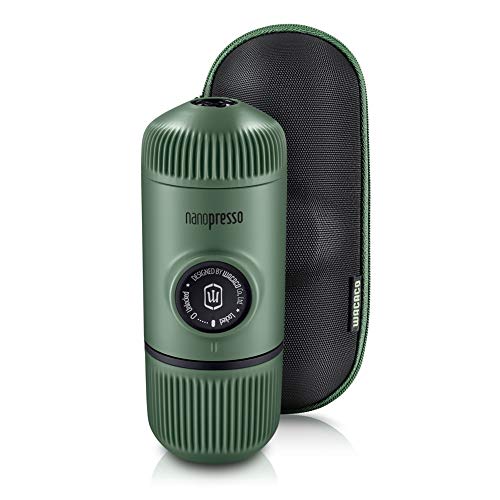
Wacaco Nanopresso Portable Espresso Maker
The Nanopresso is the manual family’s flagship here: a hand-powered espresso maker, bundled with a protective case, described in its listing as the upgrade version of the Minipresso, and finished in Elements Moss Green. It brews with ground coffee, asks for hot water from whatever source the traveller has — kettle, stove, café counter — and asks for nothing electrical at all. The bundled case matters more than it sounds: manual machines live in bags, and a case that organises the parts turns a loose collection of pieces into a single grab-and-go unit. Camping, travel and office use are the settings the title names.
- Type: manual, hand-operated
- Coffee format: ground coffee
- Included: protective case bundled, per the listing
- Colour: Elements Moss Green
- Power needs: no electricity required for operation
- Water heating: requires a separate hot water source
Strengths
- No charging, no battery, no cable to forget
- Protective case included for organised packing
- Ground coffee keeps running costs and waste low
Trade-offs
- Hot water must come from a kettle or stove
- Hand pumping is part of every single shot
- Capsules are not the format this model is built around
Routine defines the Nanopresso experience. Where hot water already exists — a campsite stove at breakfast, an office kitchen, a hotel kettle — the manual ritual adds perhaps a minute of pumping to the morning and subtracts every charging concern from the trip. The moss green finish distinguishes it in a category of black cylinders, and the case keeps that finish presentable. Travellers comparing slow rituals across categories often pair this kind of brewer with unhurried home equipment too; the Best Thermal Teapots guide serves that same temperament at the other end of the day.
Technique rewards the Nanopresso owner within the first week. Pumping rhythm, water temperature and grind size each move the shot visibly, and because the machine adds no electronics between the hand and the extraction, cause and effect stay legible — a sour shot teaches something specific, and the next one improves. That legibility is why manual brewers develop loyalists: the ritual is not a compromise endured for portability but a skill practised daily, with breakfast as the reward.
The bundled case shapes travel behaviour in a quieter way. Parts that live together get packed together; the case turns the Nanopresso into a single item on the packing list rather than four small ones scattered through a bag. Moss green, the finish on this version, also survives the aesthetics of a kit bag better than glossy colours, hiding scuffs gracefully. Travellers whose trips always include a kettle — glamping sites, camper vans with stoves, hotels, offices — lose nothing to the manual format and gain a machine that will still be working, unchanged, on trips taken years from now.
Best for: travellers with a kettle or stove handy who want manual espresso in a cased kit. Not suited for: brewing from cold water alone — this machine does not heat water.
Check price on Amazon for the Nanopresso bundle in moss green.

Wacaco Minipresso NS Portable Espresso Machine
One sentence in this listing governs everything about the machine: it is built for original NS capsules. Not ground coffee, not refillable pods — sealed capsules, popped in, pumped by hand, producing up to 45 ml of espresso per the title’s own figure. That specialisation is a feature for the right traveller. Capsules travel without mess, dose without scales, and taste identical in a tent and in a hotel, which is why capsule drinkers defend the format fiercely. The Minipresso NS is manually operated, described as easy to use and clean, finished in black, and sized for travel above all else.
- Type: manual, hand-operated
- Coffee format: original NS capsules only
- Shot size: up to 45 ml per the listing
- Colour: black
- Power needs: none — manually operated
- Ground coffee: not compatible, per the capsule-only design
Strengths
- Capsule consistency with zero measuring or mess
- Manual operation means nothing to charge
- Cleaning is simpler than ground-coffee chambers
Trade-offs
- Locked to original NS capsules entirely
- Hot water still needs a separate source
- 45 ml ceiling defines a single, classic shot size
Packing for this machine is a study in simplicity: a sleeve of capsules, the unit itself, and access to hot water wherever the night is spent. Hotel travellers rate that combination highly, because a kettle is the one appliance hotel rooms reliably provide. The discipline required is supply — running out of capsules in a remote town ends the espresso until a shop appears, whereas ground-coffee travellers can buy beans almost anywhere. Neither discipline is superior; they are different relationships with planning. For a committed capsule drinker, the Minipresso NS is the most honest machine in this guide: it does one thing, states it plainly, and does it anywhere.
Capsule discipline has an underappreciated upside: packing mathematics. Each day of travel costs a known number of capsules, each capsule weighs almost nothing, and the spent ones pack out flat and clean. A week of mornings fits in a jacket pocket’s worth of space, leaving the bag’s serious volume for clothes and kit. Hotel stays amplify the advantage, because the kettle is guaranteed and the capsule shot tastes the same in every city — a small, reliable constant in trips that are otherwise improvisations.
Cleaning, or the near-absence of it, completes the capsule case. Without loose grounds, the rinse is quick and the parts stay free of the gritty residue ground coffee leaves in seals and chambers, which the listing’s easy-to-clean wording reflects. The counterweight remains supply: capsule availability thins exactly where travel gets interesting, and a prudent owner packs the full trip’s supply from home rather than gambling on a village shop. For drinkers already stocked with original NS capsules at home, the decision is nearly automatic — the machine simply extends an existing habit to everywhere else on the map.
Best for: capsule drinkers wanting manual, mess-free espresso of up to 45 ml. Not suited for: ground coffee in any form — the design takes NS capsules only.
Check price on Amazon for the Minipresso NS in black.

Cafflano Kompresso Portable Espresso Maker
The Kompresso is the minimalist manifesto of this group: a manual handheld coffee press that the listing states plainly needs no electricity or batteries, intended for travel, camping and home alike. Squeeze-driven by hand, it strips espresso making down to coffee, hot water and pressure generated by the user’s own grip. There is no battery to degrade across seasons, no charging standard to chase as cables evolve, and nothing electronic to fail at altitude or in damp weather. Among six machines, it is the one whose working life is measured in years of mechanical simplicity.
- Type: manual handheld press
- Power: no electricity or batteries, per the listing
- Settings named: travel, camping, home
- Heating: requires a separate hot water source
- Battery: none
- Pressure figure: not given in the listing title
Strengths
- Total independence from power sources
- Mechanical simplicity promises long service
- Equally at home in a kitchen or a rucksack
Trade-offs
- Hand effort is required for every extraction
- No pressure figure is printed in the title
- Hot water logistics remain the traveller’s problem
Home use is the surprise in this listing’s framing, and it makes sense on reflection: a press that lives in a drawer gives apartment dwellers espresso without surrendering counter space to a machine, and gives enthusiasts a travel unit that also serves as a weekend toy. The technique rewards practice — grind, dose and squeeze consistency all show in the cup — which enthusiasts count as engagement rather than labour. Paired with a simple stove kettle at a campsite, the Kompresso completes the most self-reliant coffee kit in this guide, owing nothing to any grid, battery or capsule supply chain.
Squeeze pressure is the Kompresso’s whole interface, and it teaches a tactile lesson electric machines hide: resistance in the hand corresponds to what is happening in the basket. Too fine a grind announces itself immediately, too coarse a one runs through with telltale ease, and the user adjusts by feel within a shot or two. That feedback loop turns beginners into attentive brewers quickly, and it costs nothing in batteries, cables or firmware. Backpackers counting every component also notice what is absent — there is simply less to break, lose or leave charging in the previous night’s accommodation.
Home drawers may be this machine’s stealth market. City kitchens with no counter to spare can still hold a Kompresso in a cutlery drawer, ready for the occasional solo espresso without a permanent appliance colonising the worktop. Guests never need to see it; it appears, performs and vanishes. Combined with its stated freedom from electricity and batteries, that drawer-friendly nature makes the Kompresso the pick most likely to still be in service, unmodified and uncharged, a decade after purchase — a claim none of its battery-powered rivals can honestly echo.
Best for: campers and minimalists wanting espresso with no electricity or batteries at all. Not suited for: push-button convenience — every shot is pressed by hand.
Check price on Amazon to see the Kompresso’s listing.

Fanttik Cafein 11 Portable Espresso Maker
Fanttik’s Cafein 11 arrives with the densest title in the group: a 20 bar figure — reported here as the listing’s claim — USB-C charging, 135-second rapid heating, a phrase the maker calls golden-cup extraction, an IP65 rating, and a battery described as 4500mAh times three. The settings list runs from travel, fishing and hiking to parties, the gym and the office, the widest lifestyle spread of any pick here. Rapid heating is the headline behaviour: a machine ready in a little over two minutes suits travellers whose coffee happens in car parks and trailheads, where waiting on a kettle was never part of the plan. The IP65 rating, stated in the title, speaks to weather resistance that outdoor use genuinely tests.
- Type: electric portable espresso maker
- Pressure: 20 bar as claimed in the listing title
- Heating: 135 seconds rapid heating, per the listing
- Rating: IP65 stated in the title
- Battery: 4500mAh x3 per the listing
- Charging: USB-C
Strengths
- Fastest stated heating time in this group
- IP65 rating suits outdoor, splash-prone settings
- Triple-cell battery description suggests generous capacity
Trade-offs
- Bar and extraction phrases are maker claims in the title
- Coffee format details need the full product page
- Feature density means more to learn than a manual press
Anglers and gym-goers appear in this listing’s world alongside the usual campers, and the spec sheet supports the breadth: weather resistance for the riverbank, rapid heating for the early start, battery capacity for a full day away from sockets. The honest caveats are about verification rather than capability — the title does not spell out capsule or ground compatibility in the detail the OutIn listings provide, so that point belongs on the pre-purchase checklist. Travellers kitting out a whole vehicle or cabin, down to details like the heating covered in the Best Furnace Filters 18x30x1 guide, will recognise the Fanttik’s approach: specify generously, then verify the two or three figures the trip actually depends on.
Speed is a flavour of its own on cold mornings, and 135-second heating is the Cafein 11’s argument in a single figure. An angler setting up before dawn or a driver breaking a long night stretch does not experience heating time as a statistic; it is the difference between coffee now and coffee eventually, between a ritual that fits the moment and one postponed past it. The IP65 rating in the title extends that moment outdoors with confidence — drizzle, spray and damp grass are the native weather of fishing and hiking, and a machine rated for them belongs in that world rather than borrowing it.
The battery description, 4500mAh times three, suggests Fanttik expects the machine to work a full day away from sockets, across the gym, office, party and trail settings the title lists. Verification homework remains: capsule and ground compatibility should be confirmed on the full listing before purchase, since the title’s density still leaves that door open. Travellers who prize a feature-rich, fast, weather-ready electric machine — and who enjoy learning a capable gadget’s full repertoire — will find the Cafein 11 the most ambitious design in this group, aimed squarely at days that refuse to stay indoors.
Best for: outdoor travellers wanting 135-second heating and an IP65-rated electric machine. Not suited for: zero-power brewing — this is a battery machine that needs charging.
Check price on Amazon for the Cafein 11’s full listing.
Specification snapshot: power, format and heating compared
| Model | Power style | Coffee format | Heats water? | Stated headline |
|---|---|---|---|---|
| OutIn Nano | Electric, USB-C | Ground coffee and NS capsules | Yes — self-heating | Car, camping, RV, office use |
| OutIn Nano 2 | Electric, 45W USB-C fast charge | Ground coffee and Nespresso Original capsules | Yes — self-heating | 9 cups per charge, 5000mAh |
| Wacaco Nanopresso | Manual | Ground coffee | No | Bundled protective case |
| Wacaco Minipresso NS | Manual | Original NS capsules only | No | Up to 45 ml per shot |
| Cafflano Kompresso | Manual | Ground coffee format press | No | No electricity or batteries |
| Fanttik Cafein 11 | Electric, USB-C | See listing for format detail | Yes — 135s rapid heating | IP65 rating, 20 bar claim |
Two questions organise the whole table: does it heat, and what does it eat? Electric machines that heat their own water collapse the travel kit into a single device, while manual presses trade that convenience for permanent readiness. Format — grounds, capsules or one label’s capsules alone — then decides the shopping list that follows the traveller from home.
How to choose a portable espresso machine for your trips?
Electric self-heating or manual press — which matches the journey?
Start where the coffee will actually happen. Trips with sockets, vehicles or site power make electric machines effortless: the OutIn pair and the Fanttik heat water themselves and ask only for a charge. Trips beyond the grid — multi-day hikes, remote camps, boats without spare power — belong to the manual trio, whose readiness never expires. Mixed travellers should count charging opportunities honestly rather than hopefully; a battery machine with no charge is heavier than a manual press and considerably less useful.
Grounds or capsules on the road?
Ground coffee offers variety, lower running waste and beans available in almost any town, at the cost of measuring and mess. Capsules offer sealed consistency and zero cleanup, at the cost of supply planning — a discipline the Minipresso NS turns into an absolute, since original NS capsules are its only fuel. The OutIn machines hedge the bet by accepting both formats according to their titles, which suits households whose habits change between home and road. Decide by the supply chain of the actual itinerary, not by ideology.
What do bar numbers and battery figures really tell you?
Pressure numbers in these listings are claims printed by the makers — 21 bar for the Nano 2, 20 bar for the Fanttik — and should be read as part of each maker’s description rather than as laboratory results. Battery figures are more concrete: nine cups per charge and a 5000mAh cell on the Nano 2 translate directly into mornings covered, while the Fanttik’s triple-cell description and 135-second heating speak to capacity and pace. Manual machines replace all of that arithmetic with a simpler question — is hot water available where the shot will happen?
Water, grind and the travel shot ritual
Portable espresso still obeys espresso’s old rules. Water just off the boil protects flavour; water boiled hard and left standing in a flask for hours flattens it. Ground-coffee travellers get the best from a small hand grinder used minutes before brewing, though pre-ground coffee in a sealed tin remains the pragmatic choice for short trips. Capsule travellers skip that entire debate, which is precisely the format’s charm. Tamping and distribution matter even in palm-sized machines: an even bed of coffee resists the water evenly, and the difference between a rushed shot and a settled one is visible in the cup before it is tasted. A small ritual — rinse the parts, warm the cup where possible, brew, knock out the grounds, rinse again — keeps flavours clean across a trip and stops yesterday’s shot haunting today’s.
Packing the coffee kit: what travels alongside the machine
A portable espresso machine is the centre of a kit, not the whole of it, and the supporting cast decides whether travel coffee feels like a ritual or a faff. Ground-coffee travellers need a way to dose — a small scoop lives happily in any bag — and a sealed container that keeps grounds fresh and the luggage unperfumed. Capsule travellers need only the sleeves and a plan for spent pods. Everyone needs a cup that suits the machine’s spout height, a cloth for the inevitable drips, and water arrangements: electric self-heating models simplify that to any clean source, while manual kits depend on the destination’s kettle, stove or café.
Weight and bulk deserve an honest audit before departure. Electric machines carry batteries, and batteries are the densest thing in a coffee kit; hikers feel that truth uphill, while drivers never feel it at all. Manual presses invert the equation, weighing little yet demanding a heat source that may itself weigh more than a battery would. There is no universal winner — only the traveller’s own transport, distance and water reality can settle it. The travellers who report the deepest satisfaction are consistently those who rehearsed the full routine at home first: machine, water, coffee, cup, cleanup, packed away again. A kitchen rehearsal exposes every missing piece while the shops are still open.
Backup thinking belongs in the same rehearsal. A forgotten cable strands an electric machine; a forgotten capsule sleeve strands the Minipresso NS; a cold-water-only destination strands every manual press. Each failure mode has a cheap insurance — a spare cable in the vehicle, capsules counted twice, a small stove or immersion heater where kettles are uncertain. None of this diminishes the romance of espresso at a trailhead. It is what makes the romance repeatable, trip after trip, instead of a story about the one time the coffee worked.
Cleaning and care for machines that live in bags
Travel is hard on coffee equipment in specific ways: grounds left in a sealed machine during a warm drive home, water standing in a reservoir across a week of storage, seals drying out between seasons. The defence is a closing ritual as consistent as the brewing one. Knock out grounds or remove the capsule immediately, rinse every part that coffee touched, dry before packing, and store the machine with airflow rather than sealed damp. Capsule machines forgive lapses more readily, having no loose grounds to stale, yet their piercing and brewing parts still reward a rinse.
Battery care governs the electric trio’s lifespan. Charges taken little and often suit travel patterns better than deep drains followed by months in a drawer, and a machine stored half-charged in a cool place wakes up healthier in spring than one abandoned empty after the last autumn trip. USB-C’s universality helps here: the same cable that tops up a phone can revive the coffee machine during the drive to the trailhead. Manual machines ask for none of this, which is their deepest long-term advantage — a Kompresso or Nanopresso stored dry simply waits, unchanged, for the next journey, however distant.
Descaling and seal checks complete the calendar. Any machine heating hard water accumulates scale, electric models fastest because they boil internally, and a traveller in a hard-water region should follow the maker’s guidance on the product page at intervals rather than waiting for flow to weaken. Seals and gaskets on manual presses age with heat and pressure cycles; inspecting them at season’s start costs minutes and prevents the one failure that ruins a trip’s mornings outright. Care at this level sounds fussy only until the first dawn shot depends on it.
Two travellers, two kits: matching machine to itinerary
Imagine the long-distance driver first: nights in motels, mornings that start before the town wakes, coffee needed in the room and again at a rest stop by mid-morning. Sockets are everywhere in that life, water comes from taps, and the enemy is mediocrity rather than logistics. An electric self-heating machine — the Nano for flexibility, the Nano 2 for endurance, the Fanttik for speed — converts every stop into a café of one. Capsules keep the vehicle clean; grounds keep it interesting. The kit lives in the boot, charges from the same cables as everything else, and never once asks the traveller to find fire.
Now picture the walker: three days between villages, a stove the size of a fist, water from streams treated and boiled for dinner. Every gram argues, every battery is a debt, and hot water exists exactly when the stove is lit for a meal. Manual machines were born for this itinerary — a Nanopresso riding beside the stove, a Kompresso needing nothing the walker does not already carry, or the Minipresso NS if the walker’s heart belongs to capsules and the resupply points are known. Breakfast espresso after a stove-lit morning is not a luxury in that world; it is the ceremony that makes the miles feel chosen.
Most travellers live between those portraits, mixing driven and walked days across a year, which is why format flexibility and honest self-knowledge matter more than any single specification. The household that camps by car in summer and hikes in autumn may rationally own the decision twice — or choose the OutIn hedge, electric yet capsule-and-grounds fluent, accepting battery weight on the walked days as the price of one machine. What no itinerary rewards is the unexamined purchase: the capsule machine bought for a grounds household, the manual press bought for a kettle-free office. The listings in this guide state their natures plainly, and believing them is the entire skill.
Common mistakes when buying a portable espresso machine
Buying a capsule machine for a ground-coffee household. The Minipresso NS states its capsule-only design in its title, yet travellers still pack grounds for it. Read the format line twice; it is the most consequential line in any of these listings.
Treating a bar claim as a measured result. Pressure figures here are the makers’ own printed claims. Judge machines by the full picture — heating, format, endurance, size — rather than by the largest number on the page.
Forgetting the hot water half of a manual kit. The Nanopresso, Minipresso NS and Kompresso all need hot water from somewhere. A trip without a kettle, stove or café turns a fine press into luggage.
Ignoring charge planning for electric models. Nine cups per charge sounds endless until two people drink twice a day at a remote site. Match the stated endurance to the itinerary’s sockets before departure, not during it.
Expecting café volume from a travel tool. These machines make shots one at a time, by design. A round of drinks for six friends is a pleasant ritual, not a service — plan the moment accordingly.
Final recommendation
Flexible travellers who want one machine for grounds and capsules alike should start with the OutIn Nano, whose self-heating design covers camping, RV and office life without fuss. Longer journeys between sockets belong to the Nano 2 and its stated nine cups per charge with fast refills. Manual loyalists with a kettle always nearby will find the cased Nanopresso the most complete ground-coffee kit, while committed capsule drinkers have exactly one honest answer here, the Minipresso NS. Absolute independence from power is the Kompresso’s territory, and outdoor pace — fast heating, weather resistance — is where the Fanttik Cafein 11 stakes its claim. Match the machine to the journey’s power, water and coffee supply, and the morning shot becomes the most reliable pleasure of the trip.
Gifting a portable espresso machine follows the same logic as choosing one: the recipient’s journeys, not the giver’s, set the answer. A colleague facing a year of site work deserves self-heating electric convenience; a sibling walking a long trail deserves manual lightness; a capsule-committed parent deserves the Minipresso NS and a starter sleeve of pods, never a ground-coffee machine and a hopeful note. Include the receipt, mention the format clearly when handing it over, and the gift stands a chance of being used daily rather than admired once. The best travel coffee gifts are the ones that disappear into someone else’s routine within a week.
Seasonal timing shapes satisfaction too. A machine bought in spring gets a full summer of trips to bed into its owner’s habits, its quirks learned while the stakes are low and the weather kind. The same machine bought the night before a flagship expedition arrives untested, its owner learning the ritual at altitude, in the rain, with an audience. Rehearsal at the kitchen counter — unglamorous, essential — is the difference between those two stories, and it costs one evening and a handful of shots.
Cost of ownership divides along the same family line as everything else in this guide. Capsule travellers pay per shot, forever, in exchange for consistency and cleanliness; ground-coffee travellers pay in time and attention, buying beans at grocery prices and grinding as they go. Electric owners eventually face battery ageing, the slow arithmetic of all rechargeable things, while manual owners face only seals and their own enthusiasm. None of these ledgers should frighten anyone — the sums are small beside travel itself — but the traveller who chooses a format with eyes open never resents the machine for costs that were printed, in effect, on the box.
Environmental arithmetic follows a parallel track. Capsules generate a small, visible waste stream that responsible travellers pack out and recycle where schemes exist; grounds compost gracefully almost anywhere; batteries concentrate their footprint into a single component that lasts years and should be recycled at the end of them. Manual machines, needing no power and generating only grounds, post the lightest ongoing footprint of the six — one more reason the Kompresso and the Wacaco pair suit travellers whose journeys are motivated by the landscapes they move through.
Learning curves deserve a final honest paragraph. A first portable shot is rarely a great one, whatever the machine, because dose, grind, water temperature and technique all calibrate together across the first dozen attempts. Electric machines forgive more of that calibration, holding temperature and timing steady while the user learns the coffee side. Manual machines teach faster precisely because they forgive less. Either way, the traveller who brews five practice shots at home arrives at the first campsite already competent, and competence — not equipment class — is what fellow travellers taste in the cup.
Sharing changes the social maths of travel coffee in ways solo travellers never anticipate. One machine at a campsite becomes the morning’s gathering point, and a round of shots for four people takes four cycles of whichever ritual the machine demands. Electric models pace that round with heating and extraction times; manual models pace it with pumping arms that may rotate between volunteers. Planning for company means packing coffee for company — capsules counted per head, grounds weighed generously — because running out at the third cup of four is a small social tragedy entirely avoidable at the packing stage.
Altitude and cold, the twin saboteurs of outdoor brewing, deserve respect in kit planning. Water boils cooler in the mountains, batteries hold less in the cold, and hands pump less enthusiastically with gloves on. None of these facts disqualifies any pick here; they simply argue for margin — a machine whose stated endurance exceeds the plan, a manual press whose simplicity survives numb fingers, warm storage for batteries inside the sleeping bag’s foot. Travellers who build that margin in report that high camps and winter mornings produce the most memorable shots of all, precisely because the environment tried to argue.
Documentation is the traveller’s quiet ally. Photograph each machine’s listing figures before the first trip — cups per charge, battery size, format compatibility — and keep the maker’s instructions in the same phone folder as the booking confirmations. When a question arises at a trailhead, about capsule fit or charging, the answer is already in a pocket rather than dependent on a signal that mountain valleys rarely provide. Support conversations, if ever needed, also move faster with model names and purchase details recorded rather than remembered approximately.
Second trips are the true review of any purchase in this category. First trips run on novelty; second trips run on merit, with the packing list edited by experience — the unused accessory left behind, the extra capsules added, the cup swapped for one that fits the spout properly. A machine that survives that editing process unchanged has earned its place permanently. All six picks here were chosen to have a plausible route through that filter, each for a different kind of traveller, and the reviews above are written to help readers predict the second trip, not merely enjoy the first unboxing.
One last consideration belongs to the home between trips. A portable machine that also serves the household — the Kompresso from a drawer, the Nano on a small counter, the Nano 2 as a second station for guests — justifies itself across the whole calendar rather than only during holidays. Dual-duty thinking rescues travel gadgets from the cupboard of good intentions, where equipment bought for three weeks a year quietly expires. Choose the machine whose home life is as plausible as its travel life, and the cost per shot collapses gratifyingly across hundreds of ordinary mornings.
Taste, in the end, is personal in the literal sense: the same shot reads bright to one traveller and sharp to another, and no listing figure can arbitrate between palates. What the figures can do — format, endurance, heating, stated claims weighed as claims — is narrow the field to machines whose nature fits the journey. Palate then makes the final call across the first week of shots, adjusting grind, dose and water until the cup matches the memory of the best café at home, reproduced improbably at a trailhead.
Keep the original box through the first season of trips. Travel gear occasionally reveals a flaw only under real conditions — a seal that weeps in a hot car, a charger that sulks in the cold — and exchanges proceed far more smoothly with packaging intact and the purchase record filed beside it.
A traveller’s notebook, kept honestly across a season, becomes the most trustworthy review of all: which mornings the machine delighted, which it complicated, and what the packing list looked like by the final trip of the year.
Frequently asked questions
Is a portable espresso machine really making espresso?
These machines are designed and sold as espresso makers, using pressure to extract a concentrated shot; the pressure figures in their listings are the makers’ claims. Taste and texture vary with coffee, grind and technique, as with any espresso method.
Does the Minipresso NS work with ground coffee?
No. Its listing states it is built for original NS capsules, and this guide treats that as absolute: pack capsules, not grounds, for this machine. Ground-coffee travellers should look at the Nanopresso or Kompresso instead.
What about AeroPress-style brewers for travel espresso?
They are not part of this guide’s picks, and despite frequent comparisons, an AeroPress-style brewer does not produce espresso in the true sense — it makes a strong, short coffee by immersion and light pressure rather than a genuine espresso extraction. Travellers wanting actual espresso should choose from machines designed for it, like the six above.
Which picks need no electricity at all?
The three manual machines: the Wacaco Nanopresso, the Wacaco Minipresso NS and the Cafflano Kompresso, whose listing states outright that it needs no electricity or batteries. All three still require a separate source of hot water.
How many cups does the OutIn Nano 2 make per charge?
Nine, according to its listing, from a 5000mAh battery with 45W USB-C fast charging. The original Nano’s title does not print a cups-per-charge figure, one of the clearest generational differences between the two.
Wherever the road ends tonight, a real shot at dawn makes the whole journey feel deliberately chosen.


