Our Top Picks
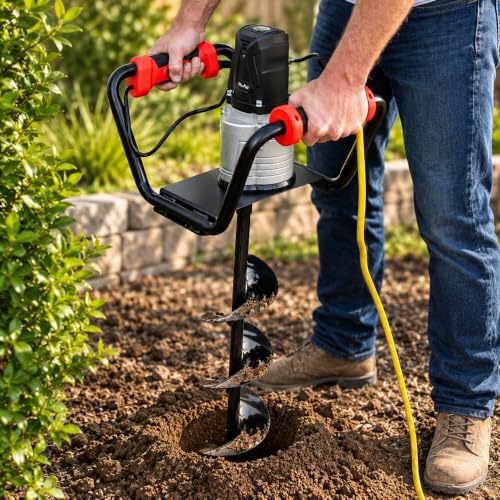 XtremepowerUS 1500W Electric Post Hole DiggerElectric Auger w/ 6" Bit17 x 33 x 13 inches28.3 PoundsCheck on Amazon
 173cc Hole Digging Machine for Two-Person Operation45.28 x 45.28 x 53.55 inches94.79 poundsCheck on Amazon
 JACKCHEN 1500W Electric Post-Hole Digger with 6-Inch Auger1500W+6"Auger Drill, Red23.2 x 16.1 x 12.6 inches1 poundsCheck on Amazon


What's inside
- How to read this guide
- Power sources: petrol, electric, battery and muscle
- Bit diameter, depth and extension shafts
- Torque, gearing and what actually turns the bit
- The ground decides: soil types and machine limits
- Kickback and the discipline of safe operation
- One operator or two
- Choosing bit diameter, project by project
- Bit care: edges, flights and points
- Four archetypes worth shortlisting
- Marking out, alignment and keeping holes vertical
- Depth control and checking the finished hole
- Setting the post: packing, concrete and drainage
- Hiring, borrowing and the economics of ownership
- Working through the seasons
- Questions operators ask before the first hole
- When the hole is finished: backfilling around services and roots
- A note on noise, neighbours and working hours
- A pre-start inspection worth the two minutes it takes
- Transport, storage and the life of the machine between projects
- Check prices on Amazon
- Related reading and a closing sequence
As an Amazon Associate I earn from qualifying purchases. This post may contain affiliate links at no extra cost to you.
How to read this guide
When readers buy through links on this page, the site may receive a commission via the Amazon Associates Program, and that support never changes the buyer’s price. It also never enters the comparisons that follow. Every figure in this guide is drawn from published manufacturer documentation for earth augers and post-hole digging machines: engine and motor ratings, gearbox ratios, stated bit diameters and digging depths, extension shaft specifications, and the safety instructions printed in operator manuals for petrol, electric, battery and manual machines.
A hole digging machine in this guide means an earth auger: a helical bit, driven by hand, by an engine or by a motor through a reduction gearbox, that bores a round hole for a fence post, a gate post, a young tree, a shrub, a sign or a deck footing. It does not mean a drain auger, which clears pipes, nor a trencher, nor a mini excavator. Keeping that boundary clear matters, because the specifications that decide success here — bit diameter, torque at the bit, depth per pass and the operator’s ability to control reaction forces — belong to this one tool family and to no other.
The honest way to read auger specifications is to treat diameter, depth and soil as a single equation rather than three separate boasts. A machine that will turn a wide bit in loose garden loam may stall or kick violently with the same bit in dry clay, and a machine rated for an impressive depth achieves it only with extension shafts, in stages, in ground that lets the spoil rise out of the hole. This guide works through the power sources first, then the numbers, then the ground itself, and finishes with the safety discipline and maintenance that keep a powerful, torque-heavy tool boring straight and true season after season.
Power sources: petrol, electric, battery and muscle
Petrol engines, two-stroke and four-stroke
Petrol earth augers divide into two-stroke and four-stroke camps, and the published differences are practical rather than tribal. Two-stroke powerheads, commonly in the region of 40 to 65 cc for one- and two-person machines, are lighter for their output and tolerate being tilted at any angle while working, because their fuel and oil travel together; they ask the operator to mix fuel accurately, they are louder, and their power arrives with the rising, eager character typical of the design. Four-stroke powerheads of similar displacement are heavier, run more quietly and cleanly, sip fuel from a plain tank without mixing, and must be kept reasonably upright so their separate oil supply can do its work — a real consideration when a hole must be started on sloping ground.
Either engine drives the bit through a reduction gearbox, and the gearbox, not the engine’s headline revolutions, decides how the machine behaves in soil. Published reduction ratios for the class commonly fall between roughly 30:1 and 50:1, turning engine speeds of several thousand revolutions per minute into bit speeds in the region of 100 to 200 revolutions per minute, with torque multiplied by the same factor. A buyer comparing two powerheads should therefore read the ratio and any published torque figure at the bit before reading the engine size, because a modest engine behind a deep reduction can out-dig a larger engine geared too fast, and will do so with far better manners.
Electric and battery machines
Corded electric augers occupy a modest corner of the market: light, simple, instantly started, and limited by cable length and by the modest torque their motors deliver through small gearboxes. They suit small-diameter holes in cultivated soil — planting bulbs and bedding, setting light garden edging or small posts in soft ground — and their documentation usually says so in plain language. Battery machines have moved well beyond that corner. Modern cordless powerheads built on high-voltage garden tool platforms publish torque figures that rival small petrol units, run one bit in the 150 to 250 mm range credibly in ordinary soil, and bring two decisive advantages: no fuel, no fumes and almost no starting ritual, plus a reverse function that is often better implemented than on petrol machines, which matters greatly when a bit must be backed out of roots or clay.
Battery endurance is the honest limit. Published guidance commonly expresses it as holes per charge in a stated diameter and soil type, and numbers in the range of a few dozen holes in soft ground are typical for a single pack. A fencing run of forty post holes in mixed soil is therefore a two- or three-battery project, or a petrol project, and buyers should cost the extra packs as part of the machine rather than discovering the arithmetic at the far end of a field. Weight distribution differs too: a battery powerhead carries its mass high, in the pack, which some operators find tiring across a long run of holes.
Manual post-hole diggers
The manual family deserves its place in this guide rather than a footnote. It includes the scissor-action post-hole digger, whose two blades bite and lift soil in small mouthfuls; the hand auger, a T-handled helix turned by arm power in modest diameters; and the digging bar that loosens what neither blade nor helix can shift. Manual tools dig quietly, precisely and cheaply, they work in corners and against walls where a powerhead cannot stand, and their depth in reasonable soil surprises many first-time users. Their cost is paid in time and effort per hole, and in clay or stony ground that cost rises steeply. For two holes, they are the rational choice; for twenty, they are a character-building one; for a fence line, they are a reason to hire, borrow or buy a powered machine.
Bit diameter, depth and extension shafts
Published bit diameters for earth augers span a wide range, from slender 40 or 50 mm planting bits up through the fencing staples of 100, 150 and 200 mm, to 250 and 300 mm bits for gate posts, large shrubs and small trees. The diameter that matters is the diameter of the hole the project actually needs: a post wants a hole roughly 75 to 100 mm wider than the post itself, leaving room to plumb the post and pack or concrete around it, and no more, because every extra millimetre of width is soil the bit must cut, lift and clear, multiplied by the full depth of the hole. Choosing a bit one size too large is the most common self-inflicted hardship in this category.
Depth is governed by bit length and by extensions. A standard bit typically carries an effective digging length in the region of 700 to 800 mm, which covers most fence posts, whose buried portion usually sits between 450 and 750 mm depending on post height and ground. Extension shafts, commonly 300 or 500 mm each, stack between powerhead and bit to reach deeper for gate posts, deep-planted trees or footings. Each extension adds flex, adds a joint that must be pinned securely, and makes the assembly harder to keep vertical and harder to withdraw, because a long string of steel loaded with spoil is heavy, awkward and eager to bend if it is levered sideways while turning.
Spoil behaviour decides how depth is actually achieved. An auger does not drill like a twist drill in wood; its flights lift loose soil toward the surface only while the soil is dry or crumbly enough to ride the helix. In practice, deep holes are dug in stages: bore a few hundred millimetres, withdraw the bit while it turns slowly, shake or scrape the spoil clear at the surface, and descend again. Documentation that explains this rhythm, and bits whose flighting is pitched to lift rather than merely stir, mark the difference between a machine that reaches its published depth in real ground and one that reaches it only in the loose, sieved soil of a demonstration.
Torque, gearing and what actually turns the bit
Torque at the bit is the specification that predicts whether a machine will keep turning when the hole gets difficult. As bit diameter grows, the cutting edges sweep a wider circle, engage more soil per revolution and meet roots and stones across a broader front, so the torque demanded rises steeply — faster than the diameter itself. This is why manufacturers publish a maximum recommended bit size for each powerhead, and why exceeding it produces a recognisable misery: the bit slows, the engine labours or the motor strains, the hole walls polish instead of cutting, and reaction forces at the handles climb toward the edge of what the operator can hold.
Gearbox design mediates all of this. A deeper reduction ratio trades bit speed for turning force and control; a shallower ratio spins the bit faster in easy soil but stalls sooner in hard going. Some two-person machines add a second gearbox stage or a larger case to carry the load of wide bits, and some designs incorporate a slip or shear arrangement intended to protect the gearbox when the bit strikes something immovable — although operators should read such claims carefully, because many machines protect the engine with a centrifugal clutch that simply disengages at low speed, which does nothing to absorb a sudden stop at full working speed.
Published torque figures, where given, deserve comparison in like units and at the bit rather than at the engine shaft, and a healthy scepticism toward any listing that quotes engine torque alone for a machine whose whole purpose is reduction gearing. The more useful documentation habit, seen in better manuals, is a pairing table: this powerhead, with this bit, in this class of soil, for this many operators. A buyer who finds such a table has found a manufacturer describing the tool as it will actually be used, and that description is worth more than any single heroic number.
The ground decides: soil types and machine limits
Start with Loose garden loam and topsoil, the ground every demonstration is filmed in. Here almost any machine in this guide will bore its rated diameter at a comfortable pace, spoil rides the flights freely, and the main risks are overshooting depth and wandering off vertical through inattention rather than resistance. In going like this, sharp edges and shallow stages turn a morning of holes into routine work rather than a contest.
Then consider Firm clay when moist, a sterner proposition that rewards patience. In this ground the bit cuts in ribbons that cling to the flights, withdrawal grows heavy, and the winning technique is shallow stages with frequent clearing, while torque demand climbs enough to expose any powerhead that was bought on engine size alone. Here the operator who clears the flights every few hundred millimetres will finish straighter holes than the one who simply pushes harder.
Dry, baked clay is close to the practical limit of the category. What the operator meets is this: the cutting edges skate and polish before they bite, dust replaces spoil, progress falls to centimetres per pass, and experienced operators either wait for rain, soften the line of holes with water the day before, or accept that a digging bar must open each hole before the auger can work in it. Dry clay rewards the planner who wets the line a day ahead far more than it rewards any increase in engine size.
A line of holes will eventually meet Sandy and gravelly soil, easy to cut and hard to keep. There, the bit descends willingly but the walls slump as fast as they are bored, spoil will not ride the flights cleanly, and holes often need to be finished promptly or lined, with the operator resisting the temptation to over-widen a collapsing hole by stirring it. Sandy walls argue for digging and setting on the same day, before the hole quietly returns half its soil to the bottom.
Start with Stony ground and rubble-filled soil, the territory of the kickback stories told later in this guide. Here buried stones deflect the bit sideways, jam it between obstructions, or stop it dead, and the machine’s honest limit arrives quickly: a few stones can be worried loose and lifted out by hand, but a hole line across old rubble is a job for different equipment or a different fence line. Stones teach the day’s real lesson quickly: patience and a bar beside the machine are worth more than a wider bit.
Then consider Ground threaded with tree roots, deceptively gentle until it is suddenly not. In this ground fine roots shave away without drama, but a root of wrist thickness can catch a flight and wind the machine around it, so operators near trees should probe the line first, expect to cut roots with a spade or pruning saw as they are exposed, and never treat the auger as a root grinder. Near trees, the spade and the pruning saw are not interruptions to the auger’s work but the tools that keep it honest.
Wet, heavy soil after rain is a compromise that cuts both ways. What the operator meets is this: cutting grows easier as the ground softens while lifting grows harder as spoil turns to paste that coats the flights and doubles the weight of every withdrawal, and holes may fill with water at the bottom, hiding the true depth from a casual glance down the shaft. Wet ground asks for lighter, more frequent lifts and a realistic count of holes before the light or the operator fades.
A line of holes will eventually meet Chalk and soft rock bands, the outer edge of what a garden auger should attempt. There, a fresh bit with sound cutting edges will scratch its way down slowly in soft chalk, but flint bands and true rock stop the category altogether, and the correct response is to move the hole, break the band with a bar in small work, or bring in machinery designed for rock rather than destroying a light gearbox against it. Chalk marks the boundary where a sensible crew changes method, moves the line, or hires heavier equipment without regret.
Kickback and the discipline of safe operation
Kickback is the defining hazard of earth augers, and it deserves plain language. When a turning bit strikes a buried stone, a thick root or the edge of a buried slab, the bit can stop almost instantly. The torque that was turning the bit then turns the powerhead instead, swinging the handles around with force that scales with the machine’s gearing — the same reduction that gives the bit its strength gives the reaction its violence. Handles can strike the operator, wrists can be wrenched, and a machine can tear itself from a tired grip. Every serious manual in this category warns about exactly this event, and every technique in this section exists to reduce its likelihood or its force.
Preparation removes much of the risk before the engine starts. The hole line should be checked for buried services with the enquiries and scanning tools appropriate to the area, because an auger that finds a cable or a pipe has failed in a way no technique can excuse. The line should be probed with a bar where rubble or roots are suspected, loose clothing and jewellery kept away from the machine, and firm footwear and eye protection treated as standard. The operator should stand with balanced footing, never straddling the hole line, holding the handles with both hands and a grip that expects a snatch rather than hoping to avoid one.
Technique during the bore matters as much as preparation. The throttle should be fed in gradually as the bit bites, rather than opened fully against uncut soil; the machine should be allowed to descend at the rate it is cutting, never forced down by body weight hung from the handles, because a bit that is cutting freely can be stopped by its operator, while a bit wedged by force cannot. Lifting the bit slightly and re-entering when it begins to labour clears spoil before it packs around the flights and binds. If the bit does jam, the correct response is to shut the machine down or let the clutch disengage, then free the bit by rocking it gently, reversing it where a reverse is fitted, or digging down to the obstruction — never by applying a larger burst of power to a stuck tool.
Fatigue is a safety specification that no manufacturer can print. Reaction forces that feel trivial on the third hole of the morning are genuinely dangerous on the thirtieth hole of the afternoon, because grip strength and attention are the components that absorb them. Sensible operators plan breaks, swap roles on a two-person machine, and treat the last holes of a long run with the same ceremony as the first. A fencing project measured in days rather than hours is not a failure of ambition; it is the pace at which powerful augers and human operators coexist safely.
One operator or two
One-person augers carry handles arranged for a single operator, moderate published torque, and a maximum sensible bit size that commonly tops out around 200 to 250 mm in friendly soil. They start holes quickly, move along a fence line without coordination overhead, and suit the common run of garden and smallholding work: posts for a modest fence, planting holes for shrubs and small trees, holes for washing-line poles, signposts and bird tables. Their limit is written in the operator’s forearms: when the soil hardens or the bit widens, there is only one pair of hands to absorb what the ground sends back.
Two-person machines answer with a second set of handles, a heavier gearbox and published bit capacities that reach 300 mm and beyond. The second operator is not merely extra strength; the pair can brace against reaction from two directions, share the lifting of a spoil-loaded bit out of a deep hole, and spell each other before fatigue builds. The arrangement demands communication, though — one agreed person controls the throttle, starts and stops are called aloud, and both operators must be free to release the machine rather than ride it if a severe jam throws it. Used that way, a two-person auger is often the safer tool for wide holes, precisely because its power is matched by the crew assigned to govern it.
Choosing between the formats is therefore a question about the worst hole on the project, not the average one. A run of thirty holes in loam with two gate posts in clay argues for the one-person machine for the line and patience, a bar and perhaps a borrowed heavier unit for the gates. A run of wide holes in mixed, stony soil argues for the two-person machine throughout, or for hiring equipment a class above either. Buyers should be suspicious of any one-person machine whose published bit range reads like a two-person specification; the gearbox may turn the bit, but the specification sheet will not be there to hold the handles.
Choosing bit diameter, project by project
A standard closeboard fence post calls for 100 mm square timber set in a 200 mm hole. The point of that pairing is room to plumb the post, adjust its face to the line, and pack concrete or compacted aggregate around it without voids, at a depth near a third of the post’s length. Matched this way, the hole needs no apology and no second attempt a hand’s breadth to the left.
A gate post calls for a heavier section of timber in a 250 to 300 mm hole. The point of that pairing is the mass of concrete that a swinging gate demands if the post is not to creep out of plumb across a season of use, which is why gate holes, not line holes, usually set the machine requirement for a whole fencing project. Here the mid-size bit proves its worth, because the crew stays inside the envelope the documentation describes from first hole to last.
A young orchard or ornamental tree calls for a root ball commonly 300 to 450 mm across, in a hole wider than the ball rather than deeper. The point of that pairing is space for the roots to be teased outward into loosened soil, with the auger doing the centre work and a spade squaring and widening the top, since a deep narrow cylinder is the wrong shape for a tree however satisfying it is to bore. Oversizing this hole would only multiply the concrete, the spoil and the fatigue in equal, pointless measure.
Shrubs and hedging plants calls for root balls in the 150 to 250 mm range, along a line that may hold dozens of plants. The point of that pairing is a rhythm of identical, evenly spaced holes that a mid-size bit on a one-person machine produces happily, and where consistent depth matters more than any other dimension because a hedge betrays every shallow plant in its line within a year. A line of these holes rewards rhythm above all: mark, bore, clear, check, and move on while the ground is still friendly.
Deck or pergola footings calls for holes of 200 to 300 mm carried down to firm, undisturbed ground. The point of that pairing is a clean cylindrical shaft whose depth the building inspector or the plans actually specify, where extension shafts earn their keep and where each hole should be checked at the bottom with a bar before concrete is mixed. For footings, the tape mark on the shaft and a probing bar at the bottom are worth more than any extra power at the top.
Clothes-line poles, rotary dryers and garden structures calls for sockets and posts in holes of 100 to 150 mm. The point of that pairing is a quick, tidy bore that a small bit makes almost casually, provided the operator remembers that these shallow holes sit exactly where buried services and old garden rubble like to hide. Small holes like these are where a compact machine shines, provided the operator still probes for what gardens bury and forget.
Bit care: edges, flights and points
An auger bit is a cutting tool, and it dulls like one. The replaceable cutting edges at the bottom of the flights do the real work, shaving soil at the circumference and feeding it onto the flights; the centre point or fishtail pilot keeps the bit tracking straight and starts the cut. Published parts guidance for better bits treats both as consumables: edges unbolt and renew, pilot points swap when they bend or wear asymmetric. A bit with one edge dulled by a season of stones cuts in a slow spiral of its own, wandering off vertical, overloading one side of the gearbox and teaching the operator to lean against a fault that a modest spare part would have cured outright.
Flight condition matters almost as much as edge condition. Flights bent by levering a stuck bit sideways — a temptation every manual forbids and every operator feels — no longer lift spoil evenly, and a bit that leaves its spoil at the bottom of the hole forces the operator to lift the whole column of soil by hand on the shaft. After use, bits should be cleaned of packed clay before it sets hard, given a light coat of oil for storage, and hung or laid where the edges cannot be knocked against concrete or other tools. In stony districts, a spare set of edges in the toolbox is the difference between finishing a fence on Saturday and finishing it next weekend.
Engine and motor care follow the manuals of their respective platforms: fuel fresh and correctly mixed where mixing applies, air filters cleaned on the schedule that dusty work demands — which is to say more often than the booklet’s gentle default — gearbox grease checked where a filler is provided, and battery packs stored at the partial charge their platform recommends. The through-line is that digging machines live a dusty, vibrating, shock-loaded life, and every fastener on the machine should be checked for tightness as a matter of routine, because vibration loosens what the factory tightened with complete reliability.
Four archetypes worth shortlisting
One recognisable archetype is The compact battery powerhead: a cordless unit on a mainstream garden platform, geared for bits up to about 200 mm, with a proper reverse and published holes-per-charge figures. It fits gardeners and smallholders whose projects arrive a dozen holes at a time in ordinary soil. What defines it in practice is silent starting, clean storage and gentle manners, balanced against battery arithmetic on long runs and torque that honest documentation confines to friendly ground. On the criteria developed in this guide — torque at the bit, honest pairings and a proper reverse — it belongs on a shortlist when its paperwork supports the work.
One recognisable archetype is The mid-size two-stroke petrol auger: a powerhead in the 50 cc class behind a deep reduction, rated for bits to 250 mm and built for one operator. It fits the general-purpose fencing and planting machine of this guide, and the format most rural households end up owning. What defines it in practice is genuine all-day independence from chargers and cables, paid for with noise, mixing discipline and reaction forces that demand respect in stony soil. Its shortlist claim rests on the pairing table its maker publishes, and on safety documentation that treats kickback with the seriousness the phenomenon deserves.
One recognisable archetype is The two-person four-stroke machine: a heavier powerhead, a two-stage gearbox and twin handle frames, published for bits to 300 mm and beyond. It fits gate posts, footings and tree planting in mixed ground, where width and depth arrive together. What defines it in practice is governed power and shared lifting, set against weight, cost and the need for a second adult whose attention is as committed as the operator’s. For wide work, the decisive documents are the gearbox specification and the crew guidance printed beside it, not the engine badge on the cowling.
One recognisable archetype is The manual digging kit: a scissor-action digger, a small T-handle hand auger and a digging bar, bought as a set and stored in a corner. It fits small numbers of holes, tight corners, quiet gardens and ground where buried services make powered boring unwise. What defines it in practice is precision, silence and near-zero running cost, exchanged for time and effort that scale brutally with hole count and clay content. Judged by parts availability and the clarity of its manual, this simplest archetype often outlives machines with ten times its complexity.
Marking out, alignment and keeping holes vertical
An auger bores where it is started, and it bores in the direction it is held, so the quality of a fence is decided with string lines and a tape before the engine ever starts. A line strung between the two end posts, offset by half the post’s width, gives every intermediate hole a reference; marking each position with a peg or a splash of marker paint, then stepping back to view the whole run, catches the peg that sits a hand’s breadth out of line while correction is still free. Operators who skip this ceremony produce the familiar wavy fence whose posts lean in gentle disagreement with one another, and no quality of machine can rescue a hole bored in the wrong place.
Verticality needs the same deliberateness. A hole started square can still wander if the bit meets harder ground on one side, deflecting toward the softer path, or if the operator leans the powerhead to correct a perceived tilt and over-corrects in the opposite direction. A helper standing back at a right angle to the operator, calling the tilt as the bore begins, is the traditional and effective answer for important posts; a small spirit level rested against the shaft before the first cut, and again at shallow depth, serves a solo operator well. Once a hole has reached half its depth off-vertical, straightening it means widening it, so the first two hundred millimetres deserve a disproportionate share of the day’s attention.
Depth control and checking the finished hole
Published digging depth is a maximum, not a target, and most projects specify a depth the operator must actually hit: a fence post buried to a third of its length, a footing taken down to undisturbed ground, a tree planted no deeper than its root ball. Marking the bit or an extension with a band of bright tape at the required depth converts guesswork into a glance, and withdrawing the bit for the final check, then probing the bottom with a bar, reveals whether the last portion of the hole is truly open or merely bridged by packed spoil that collapsed from the walls. A hole that measures deep to a tape but shallow to a post is a hole full of loose soil wearing a disguise.
Loose spoil at the bottom deserves a decision rather than neglect. For a post set in concrete, a modest layer of compacted gravel at the base aids drainage and gives the post a firm seat; for a post packed with rammed aggregate, the bottom soil should be tamped so the post does not settle in its first wet season. Trees ask the opposite treatment: a loosened, unglazed base and sides scored with a spade so roots can leave the hole, because an auger in clay polishes the walls into a glazed cylinder that behaves like a buried pot, holding water and turning roots inward. Recognising when the machine’s neat finish is actually the problem is part of the craft this guide exists to pass on.
Setting the post: packing, concrete and drainage
The hole is only half the structure. A post can be fixed by ramming aggregate or soil around it in layers, each layer compacted with the end of a bar before the next is added, or by surrounding it with concrete mixed and placed while the post is held plumb and braced. Rammed aggregate drains freely and lets a post be removed or adjusted years later; concrete holds harder, suits gate posts and soft ground, and punishes error, because a post that sets out of plumb in concrete is a permanent exhibit. In either case the post should be checked for plumb on two adjacent faces as the filling proceeds, not after it, since the last adjustment is only possible while the fill is still loose enough to move.
Drainage decides how long the buried timber survives. Water that collects in a hole and stands against the post shortens its life at exactly the ground-line zone where rot concentrates, so holes in heavy soil benefit from a deeper sump of gravel beneath the post, and concrete should be crowned at the surface so rain sheds away from the timber rather than pooling against it. The auger’s contribution to all of this is a hole of the intended width: too tight, and there is no room for a proper thickness of fill around the post; too wide, and the fill volume, the concrete bill and the disturbance to the surrounding ground all grow for no structural gain.
Hiring, borrowing and the economics of ownership
Augers are classic hire-shop machines, and the arithmetic deserves a paragraph in any honest guide. A household that fences once and plants occasionally may find that hiring a two-person petrol machine for a weekend, with the holes marked and the posts ready before collection, costs less than owning a small machine that then sits in a shed for a decade. Ownership wins when projects recur — phased fencing, an orchard going in over several seasons, a smallholding with gates, pens and repairs arriving every year — and when the convenience of boring two holes on a Tuesday evening, without a hire desk’s hours, is worth real money to the household. The second-hand market, as with cappers, is informative: designs that survive in it are the designs whose gearboxes and parts endured.
Borrowing sits between the two and carries its own etiquette and risk. A borrowed auger should be returned with a sharp bit, a clean air filter and a full account of any stone strike that might have bent a flight or cracked a gearbox case, because the lender’s next hole depends on damage the borrower may not have noticed. Buyers weighing a used machine should inspect exactly those points: cutting edges for symmetry, flights for bends, the gearbox for leaks and play at the output shaft, and the handles for the looseness that vibration eventually works into every joint. A used machine that passes that inspection, from a maker whose parts are still listed, can be a wiser purchase than a new machine from a maker whose parts never were.
Working through the seasons
Ground changes its character with the calendar, and experienced operators schedule digging accordingly. Spring soil, moist through its depth, is the auger’s favourite: cutting is willing, spoil lifts cleanly, and holes stand open long enough to be filled the same day. High summer bakes clay toward the limit described earlier in this guide and turns dust into a genuine nuisance that coats filters and operators alike; autumn restores workable moisture before winter waterlogging makes holes into wells. Frozen ground closes the season for this category altogether in colder districts, since a light auger has no answer for soil locked by frost, and attempting it only dulls edges and strains gearboxes.
Season also governs what the holes are for. Planting done into moist spring or autumn ground gives roots the longest friendly run before stress arrives; fencing done in drier months gives posts holes that stay open and fill that compacts predictably. A household planning a year of projects can therefore sequence the auger’s work to the ground rather than fighting it, hiring or buying in time for the kind season instead of the desperate one. The machine itself is indifferent to the calendar, but everything it touches — soil, timber, roots and the operator’s patience — is not, and the best-kept secret of people who dig many holes is simply that they dig them at the right time of year.
Questions operators ask before the first hole
Asked how deep a post hole should be, the honest answer is a proportion rather than a number: roughly a third of the post’s total length belongs underground for ordinary fencing, more for tall, exposed or gate-carrying posts, and local practice in very soft or very windy ground may push the fraction higher. Asked whether a bigger bit makes the job easier, the answer runs the other way: the smallest bit that leaves proper room around the post is the easiest on machine, operator and fill material alike. Asked whether an auger can dig through roots, the answer distinguishes shaving fine roots, which it does without comment, from severing structural roots, which it should not be asked to do, both for the tree’s sake and for the operator’s wrists when the flight catches and winds.
Asked how many holes a day is reasonable, experienced operators answer with the ground attached: dozens in loam with a one-person machine and a helper moving posts, a hard-won handful in baked clay or rubble regardless of equipment. Asked whether to choose petrol or battery, the answer follows the project’s shape — long runs far from the house favour petrol’s independence, while short, frequent jobs favour the battery machine that starts the instant its trigger is pulled and goes back on the shelf without ceremony. None of these answers appears on a specification sheet, yet together they describe the ownership experience more truthfully than any table of figures, which is why this guide has treated published numbers as the beginning of the decision rather than its end.
When the hole is finished: backfilling around services and roots
Not every hole ends with a post in it, and the holes dug for planting near established trees carry a responsibility that pure fencing holes do not. Structural roots uncovered by the bit should be cut cleanly with a saw or loppers where they must be cut at all, rather than left torn by the flights, because a clean cut calluses more predictably and invites less decay into the tree. Backfill around a new plant should return in layers, firmed gently rather than stamped, with the original topsoil kept for the upper portion of the hole where roots will feed first, and subsoil from the depths placed where it disturbs the feeding zone least. A watering immediately after planting settles the fill against the roots and reveals any hidden voids while they can still be corrected with a handful of soil and a minute of patience.
Holes that must be abandoned — and every long project produces a few, where a boulder, a service run or a change of plan defeats the original position — should be filled and firmed the same day rather than left open. An open hole is a trap for ankles, for wildlife and for rainwater that turns it into a soft spot in the ground for seasons. Filling in layers and tamping each one restores the ground’s bearing honestly, whereas tipping the whole spoil heap in at once leaves a mound that settles into a hollow by winter. The discipline sounds minor beside gearboxes and torque figures, yet landowners judge a digging job by exactly these traces: a finished line of posts, ground that reads as undisturbed between them, and no forgotten craters waiting for the first visitor who walks the fence at dusk.
A note on noise, neighbours and working hours
Petrol augers are loud in a way that carries across gardens and fields, and the sound is not a trivial consideration for a machine that may run, on and off, for an entire weekend. Published noise figures for petrol powerheads sit in the range where hearing protection is standard advice for the operator, and neighbours within earshot experience the same sound without the satisfaction of the fence. Battery machines change this social arithmetic completely, running quietly enough for early starts and close boundaries, which is a practical advantage no torque table captures. Households choosing between power sources in a settled neighbourhood do well to count goodwill among the specifications, because a machine that can be used at civilised hours, without apology, is a machine that actually gets used — and projects finished with a quieter tool have a way of outnumbering projects merely planned around a louder one.
A pre-start inspection worth the two minutes it takes
Before the first hole of any session, a short inspection repays itself many times over. The bit’s cutting edges should be checked for symmetry and tightness, the pilot point for bends, the extension pins, where extensions are fitted, for full engagement, and the gearbox output for any new play or weeping of lubricant that was not there last season. Fuel, where fuel applies, should be fresh; a battery, where a battery applies, should start the day full rather than hopeful; and the throttle and stop control should be worked once with the engine silent, so the operator’s hands rehearse the stop before they ever need it in earnest. Handles deserve a firm shake, because vibration loosens their fasteners across a season in a way that announces itself only gradually, and a handle that shifts in the grip during a kickback is a hazard added to a hazard. None of this requires a workshop, a manual open on the bench or any particular talent — only the habit of treating two quiet minutes at the start as part of the digging itself, a habit that separates operators who finish long projects without incident from those who merely intend to.
Transport, storage and the life of the machine between projects
Earth augers spend most of their lives not digging, and how they spend that time decides how they dig when called upon. A powerhead stored with stale fuel in its tank and carburettor is a machine negotiating its own retirement; the manuals of petrol models counsel running the system dry or using stabilised fuel for long rests, and either discipline is cheaper than the repair bill for gummed components. Bits stored wet with clay still packed between their flights rust exactly where their strength matters, while bits cleaned, oiled and hung on a wall arrive at the next project ready. Battery packs prefer a cool shelf at partial charge to a freezing shed at full one, and a charger kept with the machine, rather than in a different building, is the difference between a spontaneous hour of digging and a postponed project.
Transport deserves the same forethought. A bit carried loose in a vehicle bed arrives with its edges knocked against everything else in the load, and a powerhead carried by its handles alone can bend the very alignment the operator depends on for straight holes. Better practice, reflected in the handling notes of most manuals, is to separate bit from powerhead for travel, cap or guard the cutting edges, and secure the assembly so it cannot roll. These habits sound like fussiness until the first hole of a new project wanders because an edge was dulled in transit; after that, they read as what they are — the cheapest accuracy a digging crew can buy.
Check prices on Amazon
Live listings for the shortlist in this guide are pulled from Amazon below, so prices and availability are always current at the moment you look.


Related reading and a closing sequence
Hole digging usually belongs to a larger garden project rather than standing alone, and readers planning the space these holes will serve may enjoy our companion guide to outdoor cooking areas, since a well-placed cooking spot changes where fences and screens ought to run best backyard pizza ovens. The ground underfoot deserves the same planning as the posts above it, and a washable, weather-tolerant rug can finish a new terrace once the digging is done best affordable outdoor rugs. For readers whose finished garden hosts gatherings, seating chosen for long evenings outdoors is worth comparing carefully best chairs for outdoor concert. And when the project list finally empties, the most rewarding seat in the garden is usually the one designed purely for lying back best comfortable outdoor lounge chairs.
The closing sequence for choosing a digging machine runs in a fixed order. First, walk the ground and describe it honestly, soil by soil, because the ground is the specification that cannot be upgraded later. Second, size the holes from the posts and plants themselves, and let the largest true requirement, not the average, set the bit list. Third, match powerhead to bit using the manufacturer’s own pairing table where one exists, counting operators as part of the match. Fourth, read the safety sections of the manual before the price sections of the listing, and treat any machine sold without a serious kickback warning as a machine whose maker has not thought hard enough about the tool. Fifth, budget for the unglamorous companions — spare cutting edges, an extension, a digging bar and protective kit — because they are what turn a powerful purchase into a finished fence.
Every clean, plumb hole along a finished fence line is a small argument that the right machine, honestly specified and patiently handled, was chosen before the first throttle was ever opened.