Our Top Picks
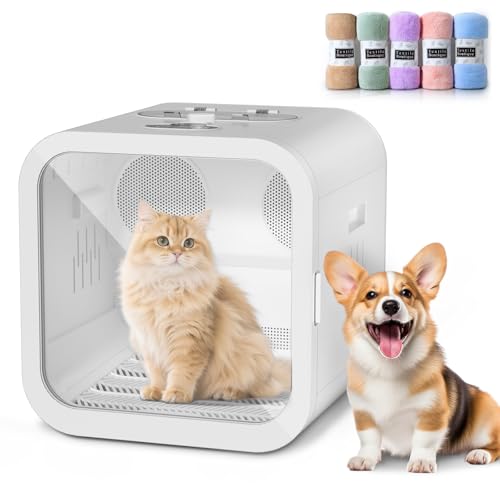
 FINFINLIFE 65L Class Pet Dryer Box Cat Dryer65L20.05 x 15.75 x 13.39 inches13.2 poundsCheck on Amazon



What's inside
- Why airflow matters more than heat for a double coat
- Variable speed against fixed steps
- Reading motor and output figures without being misled
- Nozzles and what each shape does to the undercoat
- Noise, vibration and feline stress
- Hose length, body weight and one-handed working
- Intake filtration and the loose hair problem
- How long drying a full Persian coat really takes
- Overheat protection and temperature safety
- Combining brushing and drying without creating mats
- Matching machine class to household patterns
- Setting up the drying space
- Cleaning the machine and the room after a session
- Common mistakes that make drying harder
- Questions owners ask most often
- Seasonal changes in the coat and the drying plan
- Check prices on Amazon
- Disclosure
As an Amazon Associate I earn from qualifying purchases. This post may contain affiliate links at no extra cost to you.
A Persian coat looks calm while it is dry and combed, yet after a bath it behaves like two different fabrics layered over the same small body. The outer guard hairs are long, silky and comparatively quick to shed water, while the undercoat beneath them is dense, soft and slow to release moisture once it has been pressed flat by shampoo and rinsing. A dryer chosen for that structure has to move a large volume of air through a thick insulating layer without cooking the skin, flattening the coat into ropes, or frightening a cat that already tolerates grooming only within clear limits. That is why this guide treats airflow as the main event and heat as a supporting tool, and why speed control, nozzle shape, noise, hose handling and filtration matter as much as the headline power figure on a box.
Readers who keep a Persian at home usually dry in short, interrupted sessions on a table, a bathroom counter or a grooming arm setup, not in a professional salon with a separate drying room. The cat may accept ten quiet minutes and then decide the session is over, so a machine that reaches useful airflow quickly, restarts at a gentle setting and lets the handler keep one hand on a brush is more valuable than a louder unit whose only advantage appears at maximum output. Published specifications give a starting point for comparing classes of machine, but the way those numbers interact with coat length, room size and a particular cat’s temperament decides whether drying ends with a loose, separated coat or with damp undercoat hidden beneath a dry surface.
Why airflow matters more than heat for a double coat
Water leaves a Persian coat in two ways. Moving air physically pushes droplets off hair shafts and lifts separated strands so that damp air can escape from the undercoat, while warmth raises the rate at which remaining moisture evaporates from hair and skin. Airflow does the heavy work in the first and longest phase because the undercoat holds water mechanically, trapped between fine fibres that lie close together. Warmth alone cannot dislodge that trapped water efficiently, and raising temperature to compensate for weak airflow creates the least desirable combination for this breed: a hot surface layer, a still-damp base and skin that has been exposed to concentrated heat for longer than necessary.
Manufacturers describe airflow in cubic feet per minute or in cubic metres per hour, and air speed in miles per hour, kilometres per hour or metres per second. The two figures answer different questions. Volume describes how much air the machine moves across the coat as a whole, which governs how quickly a broad section stops feeling wet. Speed describes how forcefully that air leaves the nozzle, which governs whether the stream can part long hair and reach the base of the coat on the chest, belly and hindquarters. A high speed figure paired with modest volume can feel fierce at one narrow spot while leaving neighbouring sections untouched, and a generous volume figure paired with low exit speed can feel pleasant yet fail to open the coat where it is thickest.
For a full adult Persian coat, the useful comparison is therefore between machines that sustain strong volume at a moderate, controllable speed rather than machines that advertise a single peak speed measured close to a narrow nozzle. Peak figures are commonly recorded under favourable conditions that do not resemble a hose, a filter partly loaded with loose hair and a nozzle held at working distance from a moving cat. A dryer that holds its output steadily through a twenty minute session will finish sooner than a stronger-on-paper unit whose flow drops as the motor warms and the filter loads. Consistency also makes the cat’s experience predictable, and predictable sessions are the ones most cats learn to accept.
Heat settings deserve a similarly careful reading. Many force dryers offer no added heat, low heat or ambient air warmed only by the motor, while some add a heating element with one or two steps. For Persian grooming the ambient and low settings cover almost every situation, because the goal is to keep the air comfortable at skin level while volume does the drying. Air that feels merely warm at the nozzle can feel considerably hotter after several minutes on one patch of a dark or dense coat, since the hair itself traps warmth. Moving the nozzle constantly, checking the base of the coat with fingertips and treating heat as a finishing aid for the last damp areas are habits that matter more than the number of heat steps provided.
Variable speed against fixed steps
A continuously variable dial changes drying in ways that a two or three step switch cannot imitate. At the start of a session the handler can begin far below the level the coat ultimately needs, letting the cat register the sound and the first touch of air on the less sensitive back and sides before any attempt is made near the chest or legs. Output can then rise in small increments as the cat settles, instead of jumping between a setting that barely parts the hair and a setting that arrives with a startling surge. Small increments also suit the geography of the cat, because the tail, armpits and belly need different force from the broad panels of the back.
Fixed step machines are simpler and can be entirely adequate for a confident cat with a shorter pet trim, especially where the handler values a control that can be found by feel without looking down. Their weakness appears with long show-style coats and nervous animals. The low step often lacks the volume to open the undercoat, so the handler spends longer on each section, and the high step may be more than the cat accepts near the head, which tempts the handler to hold the nozzle farther away and lose the parting effect that justified the higher setting in the first place. Total session time can end up longer on the apparently stronger machine.
Dial quality matters as well as dial presence. A control that turns smoothly, holds its position when the hose moves and does not drift when the machine vibrates lets the handler make fine adjustments with the same hand that steadies the dryer body or the hose. Detents that click loudly beside a sound-sensitive cat are a minor flaw that becomes a real one when every adjustment startles the animal. Where published material describes the control, note whether speed and heat are adjusted independently, because linked controls force compromises: accepting more heat in order to obtain more air is exactly the trade a Persian coat does not need.
Ramp behaviour is a quieter detail in the same family. Some motors reach a chosen setting almost instantly, which is efficient on a table of equipment and unsettling on a cat. Others rise over a second or two, giving the animal a moment to register the change. Neither behaviour appears prominently in specification tables, yet handlers notice it in the first session. When comparing classes of machine from published descriptions and owner guidance, a gentle start and a stable low end are worth real weight, because the lowest usable setting decides how much of the face-adjacent work, ear fringe and tail can be dried mechanically instead of left to air dry and tangle.
Reading motor and output figures without being misled
Wattage and horsepower describe electrical input and motor class, not the amount of air that reaches the coat. Two machines with similar input figures can deliver noticeably different airflow because fan design, housing shape, hose diameter and nozzle losses all intervene between the motor and the cat. Treat power figures as a rough indication of the size of machine you are considering and of the load it will place on a household circuit, then move on to airflow, speed and the physical design. A compact single-motor unit in a typical home range and a larger twin-motor class machine occupy different roles: the first suits maintenance baths and moderate coats, the second suits full coats, multi-cat households and handlers who dry several animals in sequence.
Circuit behaviour belongs in the decision for older homes. A high-output dryer on its highest setting can draw enough current to share a circuit unhappily with a heater or other large appliance, and a tripped breaker midway through drying leaves a wet cat and a handler starting again. Checking the rated draw against the circuit that serves the grooming area is unglamorous preparation that prevents a common failure. Extension leads, where a manual permits them at all, need to match the load and lie where neither cat nor handler will catch them with a foot or a paw.
Duty cycle is the other figure that rarely appears where buyers look first. Home dryers are generally built for sessions measured in tens of minutes rather than continuous salon use, and a Persian bath day fits that pattern for one cat. Households drying three or four long-coated cats in a row should look for published guidance about continuous running, cooling and motor protection, because the third cat of the afternoon is where an undersized machine begins to lose output, grow hotter and sound strained. Choosing one class up in size for a multi-cat home is usually a comfort decision for the animals as much as a speed decision for the handler.
Nozzles and what each shape does to the undercoat
A nozzle set is not a bundle of accessories to be counted and forgotten; each shape changes the relationship between air speed, coverage and coat behaviour. A narrow round nozzle concentrates the stream, raises local speed and parts long hair down to the skin, which makes it the tool for the dense ruff, the trousers on the hind legs and the undercoat behind the ears where moisture lingers. Used carelessly at close range it can also whip long guard hairs around fine undercoat and manufacture the very tangles the session is meant to prevent, so distance and angle decide whether concentration helps or harms.
A wider flat nozzle spreads the stream into a blade of air that sweeps across the back and sides, moving water along the hair shafts and covering ground quickly during the first phase when the whole coat is uniformly wet. That shape is forgiving for a cat that dislikes a focused blast, and it pairs naturally with a slicker brush drawn slowly through the section being dried. Its limit appears in the deep areas: a broad stream skims a thick ruff rather than opening it, so finishing with the flat nozzle alone can leave the base damp while the surface looks complete. Experienced handlers treat the flat nozzle as the opening tool and the narrower shapes as the finishing tools, changing ends as the coat changes state rather than hunting for one shape that does everything.
Cone and tapered nozzles sit between those extremes and often become the default for the chest, belly and legs, where the coat is long but the body curves and the skin is thinner. A tapered stream can be feathered across a sensitive area by holding it slightly farther away, and its edges are soft enough that a cat shifting position does not meet a sudden jet. Some sets add a brush or comb attachment that promises to dry and detangle at once. Such attachments can help on a tolerant cat with a light coat, but on a full Persian they tend to drag through undercoat that has not yet been separated by air, and they make it harder to feel with fingertips whether the base is truly dry. A separate brush in the free hand gives better information and better control.
Attachment security sounds trivial until a nozzle loosens mid-session and drops beside a wet cat. Twist-lock and firmly friction-fitted ends both work when they are fully seated, and both fail when they are pushed on hastily with wet hands. Making a habit of seating the nozzle, giving it a short pull and only then switching on saves interruptions. Heat tolerance of the nozzle material matters on low-heat settings during long sessions, since an end that becomes uncomfortably warm to hold is also delivering warmer air than the handler may realise to the coat in front of it. Published descriptions that mention heat-resistant materials or insulated grips are describing a genuine working quality, not decoration.
Noise, vibration and feline stress
Published noise figures for pet dryers commonly fall in a broad band from the mid fifties to the low eighties in decibels, depending on setting and measurement distance, and that spread is large in lived experience because decibels are logarithmic. A difference of ten decibels is heard as roughly a doubling of loudness, so a machine rated modestly lower can feel like a different category of appliance to a cat. The character of the sound matters alongside its level. A low, steady hum is easier for most cats to habituate to than a high whine that rises and falls with every adjustment, and motor tones that change pitch under load draw attention each time they shift.
Measurement conditions vary between manufacturers, which makes small differences between models almost meaningless and large differences informative. A figure recorded at a distance in an open space will read lower than one recorded close to the nozzle in a tiled bathroom, and the bathroom is where the cat actually meets the machine. Hard surfaces reflect sound back at the animal, soft furnishings absorb some of it, and a dryer body resting on a hollow counter can add a drumming resonance that no specification sheet mentions. Placing the body on a folded towel, keeping it off the grooming surface where possible and drying in the softest furnished room available are practical steps that reduce the experienced noise without changing the machine at all.
Vibration travels with noise as a second stress channel. A cat standing on a surface that buzzes under its paws receives a continuous signal that something is wrong, even when the sound itself is moderate. Heavier bodies, rubber feet and hoses that do not transmit motor movement to the handler’s hand all reduce that effect. Handheld units concentrate the problem because the vibrating body is close to the animal and the handler’s grip tightens as the session goes on, telegraphing tension. For a nervous Persian, a canister body set on the floor with a flexible hose is often the calmer architecture even when its headline noise figure matches a handheld alternative.
Behavioural signs should govern the session more than any dial. A cat that flattens its ears, licks its lips repeatedly, tries to turn away from the stream or begins panting is communicating overload, and continuing at the same setting to save a few minutes usually costs more time later in resistance at the next bath. Lowering output, moving to a less sensitive area, pausing with the machine off while a hand rests calmly on the cat, and resuming at a gentler level preserve the long-term project, which is a cat that accepts drying as a routine event. The fastest dryer on paper is slow in a household where every bath begins with a chase.
Because loose hair control around the room affects how pleasant the whole routine feels for everyone involved, a household already managing shedding on hard floors may also want to compare machines built for daily pickup, and the comparison notes collected under best affordable vacuums pet hair sit naturally beside the grooming questions covered here.
Hose length, body weight and one-handed working
Drying a Persian is a two-handed job in which one hand is rarely free. One hand holds the brush or parts the coat with fingers while the other directs air, and the cat may need steadying at any moment. Equipment that demands a third hand, in effect, will be fought by its owner. Hose length decides where the body can live during that work. A longer hose, commonly in the region of two to three metres on canister designs when fully extended, lets the body stay on the floor away from the cat while the nozzle reaches around the grooming table. A short hose forces the body onto the table or into the handler’s other hand, bringing noise, vibration and heat closer to the animal.
Hose behaviour is more than length. A hose that expands under pressure and contracts when output falls can tug at the nozzle hand in a rhythm the cat learns to dislike, and a stiff hose in a cold room resists being draped out of the way. Flexibility, a cuff that rotates where the hose meets the nozzle and a grip section that stays comfortable when wet all shape how precise the air stream feels at the coat. Precision matters because Persian drying is mostly small movements: lifting a section, directing air at its base, releasing it and moving on. Equipment that turns those movements into wrestling makes sessions longer and coats worse.
Weight figures need the same practical translation. A handheld dryer in a typical home class may weigh around one to two kilograms, which sounds trivial until it is held at arm’s length, angled downward, for the length of a full drying session. Fatigue changes technique before the handler notices: the nozzle drifts farther from the coat, sections get less attention and the last quarter of the cat is dried worse than the first. Canister designs move that weight to the floor and leave only the nozzle and hose section in the hand, which is why they dominate long-coat work despite taking more storage space. Wall-mounted and stand arrangements remove even the hose management from the handler in dedicated grooming spaces, at the cost of fixing the drying location.
Controls belong in this handling discussion. A dial or switch that can be reached by the nozzle hand without setting anything down allows the small, frequent adjustments that Persian work requires. Controls placed on a canister body are acceptable when the hose is long enough that the body sits within easy reach, and awkward when reaching them means stepping away from a wet cat on a table. Foot switches, where offered, suit handlers who keep both hands on the animal and brush, though they demand a stable floor position and a cable route that stays clear of feet and paws.
Intake filtration and the loose hair problem
Every minute of force drying fills the grooming area with loose undercoat, and the machine breathes that air. An intake filter is therefore not a minor maintenance feature but the component that protects airflow over the life of the dryer. Foam and mesh filters in home machines catch hair and dust before they reach the motor, and as they load, output falls and motor temperature rises. The early sign is a dryer that seems weaker than it was at the previous bath, and owners often blame the motor for what a clogged filter is doing. Published guidance about filter access tells you how likely maintenance is to happen: a filter that lifts out without tools will be cleaned, and one hidden behind screws will be cleaned eventually.
Cleaning frequency for a Persian household is higher than generic guidance suggests, because the volume of fine hair released in one session can coat a filter visibly. Rinsing or brushing the filter after each bath day, letting it dry fully before refitting and keeping a spare where the manufacturer offers one are small habits that preserve both output and motor life. A damp filter refitted in a hurry restricts airflow more than a dirty dry one and can carry a stale smell into the next session’s air stream, which the cat will notice at close range even if the handler does not.
Filter design also interacts with noise and heat protection. A partly blocked intake makes the motor work harder for the same output, which raises its temperature and can bring thermal protection into play mid-session. It also changes the sound, usually toward a strained higher pitch that unsettles the cat at exactly the moment drying is going slowly. When a session begins to feel wrong in several ways at once, the filter is the first thing to check once the machine is off and cool. Spare filter availability in published product information is worth weighing at purchase, because a filter that cannot be replaced turns a maintenance item into a lifespan limit.
The same loose hair that loads the filter settles on bedding, rugs and the cat’s resting places during the days after a bath, which is why some owners coordinate grooming with a wider refresh of the rooms the cat uses most, and the selection points gathered in best area rugs for cats can help when a favourite resting spot needs replacing rather than another deep clean.
How long drying a full Persian coat really takes
Session length depends on coat density, how thoroughly water was blotted out before the dryer started, room warmth and the cat’s cooperation, but realistic planning helps owners choose a machine class and schedule a bath without rushing the finish. For a full adult coat that has been towelled and gently blotted with an absorbent cloth, active drying commonly occupies somewhere between twenty and forty five minutes, with dense coats on large cats and humid rooms pushing toward the longer end. A pet trim shortens that considerably. Figures far below that range usually describe a surface pass rather than drying to the base, and the difference shows up a day later as musty smell, clumping and mats forming where damp undercoat was left to dry slowly against itself.
The towel stage deserves more respect than it usually receives. Pressing and holding an absorbent towel section by section, rather than rubbing, removes a surprising share of the water the dryer would otherwise have to move, and rubbing is a reliable way to push long hair into tangles before drying begins. Some handlers add a second dry towel partway through the session for the belly and hindquarters, which release water late as the coat is parted. Every minute spent blotting is returned with interest, because airflow works fastest on a coat that is damp rather than saturated, and the cat spends less time in front of the noise it dislikes.
Working order shapes the clock as well. Starting with the back and sides, where cats tolerate air best and the coat area is largest, removes the bulk of the water while the animal is freshest. The chest and ruff follow, then the belly and legs, which need parting and patience, and the tail and ear fringes come last with the gentlest settings. Handlers who begin with the difficult areas spend the cat’s best cooperation on a small share of the coat and meet resistance during the long middle sections. A written order kept with the grooming kit sounds excessive until a tired owner at the end of a bath day realises a dry-looking cat still has a wet belly.
Knowing when to stop is a skill built on touch rather than appearance. Dry Persian hair looks finished well before it is, because guard hairs shed water first and catch the light. The reliable check is fingertips worked down to the skin in several places, especially behind the ears, in the armpits, along the belly and at the base of the tail. Those points should feel dry and cool rather than dry and warm; residual dampness often reads as a faint coolness once the air stream moves away. Giving the coat a short rest and checking again after a few minutes catches moisture that migrates outward from the base as the surface cools.
Overheat protection and temperature safety
Thermal protection in a pet dryer usually takes the form of a sensor or cut-out that reduces heat or stops the motor when internal temperature passes a threshold, resetting after the machine cools. Its presence matters for two distinct reasons. It protects the motor during the long, filter-loading sessions that long coats impose, and it limits how hot the air stream can become if a nozzle is held in one place or the intake is obstructed by a towel drawn against it on a crowded table. Published descriptions that name automatic shut-off or overheat protection are pointing at a safeguard worth having, particularly in households where a session may be interrupted and the machine set down while still running at a low setting.
No safeguard replaces distance and movement. Skin beneath a dense coat cannot signal overheating quickly, and a cat may endure discomfort quietly before moving suddenly. Keeping the nozzle in slow motion, holding it at the distance the coat length dictates rather than close to the skin, and resting fingertips in the air stream periodically give the handler live information that no sensor provides. Low or ambient settings near the face, ears and any area of thin or healing skin are a rule without exceptions in careful grooming practice. Kittens, elderly cats and animals recovering from illness also regulate temperature less robustly, and their sessions should be shorter, warmer-room based and built around ambient air.
Storage and cool-down complete the safety picture. A dryer put away hot, with its hose coiled tightly against a warm body, ages its components faster and can carry a scorched smell into the next use if hair was resting against a hot surface. Letting the machine run briefly on its coolest setting at the end of a session, where the design allows, clears warm air from the housing and hose. Cables deserve inspection as part of the same routine, because grooming tables involve water, movement and equipment being repositioned, and a damaged cable near a wet cat is a hazard that has nothing to do with drying quality.
Combining brushing and drying without creating mats
The central technique of Persian drying is that air and brush work on the same section at the same time. Air parts the coat, the brush draws the separated hair straight as it dries, and the section is left loose rather than pressed flat. Drying without brushing lets long hair fall back onto damp undercoat in overlapping layers that lock together as they dry, producing a coat that looks smooth from above and is felted at the base. Brushing without enough air is equally unproductive, since a brush dragged through saturated undercoat pulls, hurts and breaks hair. The pairing, done section by section, is what produces the characteristic floating finish and, more importantly for a pet cat, a coat that a comb can pass through the following week.
Tool choice for the brush hand is conservative. A slicker with fine, gentle pins suits most of the body work during drying, a steel comb checks whether a section is genuinely separated, and a dematting tool belongs to problem areas rather than general use. Line brushing adapts naturally to the dryer: lift the hair above a small section, direct air at the exposed base, brush that layer down as it dries, then release the next layer. The method is slow in description and surprisingly brisk in practice once the rhythm is learned, because each layer dries quickly when the air actually reaches it.
Problem zones follow predictable patterns. Behind the ears, friction from collars and the cat’s own grooming start tangles early; the armpits combine fine hair, warmth and movement; the belly resists because the cat objects to being positioned for it; and the trousers collect litter and moisture in daily life. During drying these areas deserve the narrow nozzle, the lowest comfortable speed and disproportionate time. Working a small tangle while it is damp and being separated by air is far kinder than attacking the same tangle dry a week later. Where a mat has already formed tightly against the skin, clipping it out carefully or seeking a groomer’s help is safer than prolonged pulling, and no drying technique in this guide should be read as encouragement to work through a painful mat.
Products sometimes enter this discussion, and restraint is the useful principle. A light detangling or conditioning spray made for cats can help a brush pass through a long coat, but heavy application before drying slows evaporation and can leave the coat feeling coated rather than clean. Anything used should be applied sparingly, kept away from the face and chosen for feline use, since cats groom what lands on their hair. Owners who find themselves relying on product to get through every session usually have a technique or timing issue upstream: baths spaced too far apart for the coat type, insufficient combing between baths or drying that stops at the surface.
Matching machine class to household patterns
A single Persian in a small flat, bathed monthly, points toward a compact variable-speed unit with a decent hose, a cleanable filter and a noise profile the cat accepts, because storage and calm matter more than raw throughput. A household with several long-coated cats, or an owner who helps friends and family with their animals, points toward the larger canister class with stronger sustained airflow and a motor built for back-to-back sessions. A cat with a documented noise sensitivity points toward the quietest architecture available even at some cost in speed, because a machine that cannot be used near the cat dries nothing at all.
Show and breeding households add another consideration: coat condition over a season. Repeated drying with excessive heat or violent airflow damages long hair gradually, showing up as brittleness and split ends that no single session explains. Gentler settings, thorough but unhurried technique and equipment that achieves dryness through volume rather than temperature protect the coat across many baths. Pet households can borrow that logic without adopting the schedule, since the same gentleness is what keeps a family cat’s coat manageable between less frequent baths.
Budget framing in this category is best done by class rather than by chasing a particular figure. Entry home machines cover light coats and occasional use, mid-range variable-speed canisters cover most full Persian coats comfortably, and the professional-leaning class buys sustained output, sturdier housings and longer service expectations. Replacement filters, hoses and nozzles extend the useful life of the middle and upper classes, so published information about spare parts is a fair proxy for how long the manufacturer expects the machine to be kept. A dryer that matches the household and lasts is better value than a stronger machine that frightens the cat into hiding at the sound of its case opening.
Indoor air carries the other half of the grooming story, because fine hair and dander released during a bath linger long after the coat is dry, and owners comparing room units for that background load will find the relevant criteria collected at best air purifiers for dust and pet hair for the everyday rooms where the cat sleeps and sits.
Setting up the drying space
Room preparation repays the few minutes it takes. A non-slip surface under the cat, towels within reach rather than across the room, brush and comb laid out in order, the dryer body positioned where its intake cannot pull against a towel or curtain, and a door closed against escape routes together remove most mid-session improvisation. Warm rooms help because ambient air supports evaporation and a wet cat chills quickly once the stream stops, especially on the belly where the coat is thinner over the skin. A small room also concentrates noise, so the trade-off between warmth and echo is worth thinking about in a tiled bathroom; a bath mat under the machine and towels hung nearby soften reflections noticeably.
Positioning the cat is a handling skill before it is a drying task. Most Persians accept standing on a raised surface with a hand resting lightly at the chest, and many tolerate lying on one side for belly work if the session has built trust gradually over several baths. Scruffing or pinning a cat to complete a drying session damages the routine for months, and a partially dried cat that is released calmly will usually accept a second short session later the same day. Treats, a familiar blanket and a consistent sequence of events all teach the animal what to expect, and predictability is a genuine grooming tool for this breed.
Children and other pets belong outside the drying room. A dog investigating the hose, a toddler reaching for the nozzle or a second cat strolling across the table introduces movement at exactly the moments the handler’s attention is inside the coat. The closed door also keeps the considerable cloud of loose hair in one cleanable space rather than distributed through the home by an open doorway and a running air stream pointed in the wrong direction at the wrong moment.
Cleaning the machine and the room after a session
Post-session cleaning starts with the filter, while the amount of hair it caught is visible evidence rather than a forgotten intention. Shake or brush the loose hair into a bin, wash the filter where the manufacturer’s guidance permits washing, and set it somewhere it will dry completely before the next bath day rather than sealing it damp into the machine. Wipe the nozzle ends, which have been close to a wet, shampooed coat, and check the hose cuff for trapped hair that will otherwise be blown back out at the start of the next session. The body vents deserve a quick visual check for hair drawn against them during use.
The room itself holds more hair than intuition suggests. Loose undercoat settles on horizontal surfaces, gathers along skirting and clings to the towels used during the session. Shaking towels outside or directly into a laundry load, wiping surfaces with a damp cloth that captures rather than redistributes fine hair, and running a vacuum over the floor before the room returns to normal use keep the grooming area from becoming a permanent source of hair for the rest of the home. Owners sensitive to litter-area odours as well as general dander often run separate equipment for that corner of the house, and the distinctions that matter for that job are laid out under best air purifiers for cat litter smell for anyone equipping both spaces at once.
- Empty and clean the intake filter after every bath day, and refit it only when fully dry.
- Inspect nozzles and hose cuffs for trapped hair before storing the machine.
- Wipe the grooming surface and launder towels promptly so loose undercoat does not spread.
- Check the cable and plug for damage while the equipment is being put away.
- Comb the cat once more the following day, when any missed damp patch will have announced itself as a clump.
Storage completes the routine. A hose coiled loosely rather than kinked, a body kept in a dry cupboard rather than a damp bathroom corner and nozzles stored with the machine rather than in a general drawer all mean the next bath day starts with equipment that works. Damp storage is a quiet enemy of foam filters and motor housings alike, and the bathroom that hosts the bath is usually the worst room in the house to keep the dryer in permanently. A hall cupboard or a shelf in the room where the cat is groomed serves better.
Common mistakes that make drying harder
The most frequent error is stopping at a dry surface. It is understandable, because a Persian in full coat looks magnificent halfway through a proper session, and a tired handler with a restless cat wants to believe the job is done. The cost arrives within days as deep tangles that resist combing and may need cutting out. Building the fingertip check into the routine, at set points rather than as an afterthought, is the single change that improves outcomes most for owners who already own an adequate machine.
The second error is using maximum output as the default. High settings feel efficient and are occasionally appropriate on the broad, tolerant areas of a confident cat, but as a habit they raise noise, whip hair into tangles, dry the surface ahead of the base and teach the cat that bath day is an ordeal. Most of a good session happens in the middle of the range, with brief rises for stubborn sections and falls for sensitive ones. A variable dial earns its place precisely in that middle territory, which is why its quality matters more than the peak figure beside it in a specification table.
A third error is bathing without combing first. Water tightens existing tangles, shampoo works them deeper and drying sets them, so a coat that goes into the bath with a week of neglected undercoat comes out with problems that no dryer can solve. A thorough comb-through on the dry coat, working down to the skin in layers and dealing gently with what is found, is part of the drying process in everything but timing. Owners who adopt that order usually find their drying sessions shorten as well, because separated hair releases water far more readily than hair that enters the bath already clumping.
Questions owners ask most often
Can a human hair dryer substitute for a pet force dryer?
A human dryer moves less air at higher heat, which is the opposite of what a Persian coat needs, and its concentrated hot stream held at human scalp distance can overheat feline skin quickly. In an emergency, the coolest setting at a generous distance is safer than leaving a cat wet and chilled, but as a routine tool it dries slowly, noisily at close range and with the wrong balance of heat to volume. The classes of machine covered in this guide exist because the requirements genuinely differ.
How often does a Persian need a bath and full dry?
Intervals vary with coat, lifestyle and skin condition, and a veterinarian’s advice governs any cat with a diagnosed skin issue. Many pet Persians are bathed every four to eight weeks, with combing between baths carrying most of the maintenance load. Whatever the interval, the drying standard does not change: a coat that is washed must be dried to the base the same day, because leaving a dense undercoat damp is worse for skin and tangles than postponing the bath until there is time to finish properly.
What if the cat will not tolerate drying at all?
Build tolerance in stages separated from bath day. Let the cat investigate the switched-off machine, then hear it briefly at its lowest setting in another part of the room, then feel gentle air on the body for seconds at a time, pairing each stage with food rewards and stopping before distress. Over several short sessions many cats accept a working routine, especially with a quiet machine and a long hose keeping the body distant. A cat that remains panicked despite gradual work deserves a conversation with a veterinarian or a professional groomer about alternatives rather than escalating restraint at home.
Seasonal changes in the coat and the drying plan
A Persian coat is not the same garment in every month of the year. During the heavier shedding periods that many indoor cats experience in spring and again toward autumn, the undercoat releases large amounts of loose hair, and a bath scheduled in the middle of that release will fill the water, the towels and the dryer filter with fibre that was already leaving. Combing thoroughly on the days before a bath during those weeks removes much of that material while it is still dry and easy to lift out, and the drying session that follows is shorter because the air is moving through a coat that has already shed its dead weight. Owners who notice that a familiar machine suddenly seems weaker in shedding season are usually meeting a filter and a coat both loaded with loose undercoat rather than a failing motor.
Winter brings the opposite set of pressures. Homes are heated, indoor air is dry and static becomes a real handling problem, with long guard hairs clinging to brushes, sleeves and themselves in ways that make a clean finish hard to judge. Static also makes loose hair drift and settle across the grooming room, so the clean-up described earlier takes longer even when the coat itself dries quickly in the dry air. Working at moderate airflow rather than maximum output reduces the charge that builds on the hair, and finishing a section with air that carries a little warmth from the motor rather than dry blasting helps the coat settle. A cat dried in winter should also be checked for comfort rather than simply dryness, because heated rooms can leave skin feeling tight and itchy under a heavy coat, which the animal may answer by scratching at the ruff and undoing careful work within the hour.
Summer and humid climates reverse the problem again. Moisture leaves the coat slowly because the surrounding air is already carrying water, sessions lengthen, and the temptation to add heat grows at exactly the time when a wet cat in a warm room is least able to shed extra warmth. Planning baths for the coolest part of the day, drying in the room with the best air movement and accepting a longer session at gentle settings are the sound adjustments. In persistently humid homes, splitting the work into two shorter sessions with a rest between them can suit the cat better than one prolonged effort, provided the coat is kept combed and separated during the interval so that the second session resumes on hair that has not settled into clumps.
Age changes the plan as surely as season does. A kitten’s coat is shorter, finer and quicker to dry, and the priority at that age is not speed at all but the lessons the young cat absorbs about bath day, which is why the gentlest settings and the shortest sessions belong to the first year even when the coat could tolerate more. A senior Persian may have thinner skin, less tolerance for standing and medical considerations that shorten the time it can spend on a table, so drying may need to happen in stages with the cat resting between them, lying on a familiar blanket rather than standing throughout. Adjusting the session to the animal in front of you, rather than to a schedule written for a healthy adult in its prime, is the habit that keeps grooming humane across a whole lifetime with the same breed.
Check prices on Amazon
Live listings for the shortlist in this guide are pulled from Amazon below, so prices and availability are always current at the moment you look.


Disclosure
Grooming equipment earns a place in a home slowly, through ordinary bath days rather than first impressions, and that long view shapes how the classes and specifications in this guide were weighed. As an Amazon Associate we earn from qualifying purchases. That relationship does not change the standards applied here, which rest on published specifications, manufacturer guidance and the handling realities of a long double coat described throughout the preceding sections.
For a Persian, the right dryer is ultimately the one whose air can be trusted at the base of the coat while the cat stands calmly enough to let the work finish, and a machine that earns that calm will be reached for willingly on every bath day for years.