Our Top Picks
 PONGBOT Table Tennis Robot: APP Control 264 Drills18.31*6.93*13.38"13.38 x 7.32 x 24.13 inches8.81 poundsCheck on Amazon
 Suz S201 Table Tennis Robot with Machine Recycling34.65 x 16.14 x 15.75 inches21.6 poundsCheck on Amazon


What's inside
- Why solo practice changes when a machine feeds the balls
- Ball frequency: how many balls per minute you actually need
- Spin: topspin, backspin, sidespin, and how much is enough
- Oscillation: how the head covers the table
- Hopper capacity and the rhythm of a session
- Recycling nets: the feature that changes everything
- Table compatibility and mounting
- Controls: wired panels, remotes, and apps
- Balls: the 40+ standard and why uniformity matters
- Programmed drills and building your own
- Noise, vibration, and living with the machine
- Maintenance: wheels, feed paths, and rubber surfaces
- Matching a machine class to a player
- Room setup, lighting, and the wider practice space
- A buying sequence that avoids the common mistakes
- Safety notes for a machine that fires projectiles
- When deliveries go wrong: a short diagnostic order
- Serve practice and the robot’s supporting role
- Check prices on Amazon
- Disclosure
As an Amazon Associate I earn from qualifying purchases. This post may contain affiliate links at no extra cost to you.
Why solo practice changes when a machine feeds the balls
A table tennis robot turns a folded table in a garage, basement, or spare room into a practice partner that never tires, never complains about an early start, and never hits the ball somewhere you did not ask for. That consistency is the entire point. When a human partner feeds balls, every delivery carries small accidents of timing and placement, and those accidents are valuable in a match but wasteful when the goal is to groove one specific stroke. A robot removes the accidents. It places the same ball, at the same speed, with the same spin, in the same corner, forty times in a row, so the only variable left in the room is your own footwork and timing.
That repeatability explains why robots have moved from club equipment into homes. Modern table tennis robots are compact heads or freestanding units that clamp to the end of a table, hold a reservoir of balls, and fire them through a spinning wheel or a pair of wheels. The better designs add a collection net behind the player, so balls that cross the table roll back into a return channel instead of scattering across the floor. A session that once ended with ten minutes of picking balls out from under furniture becomes a continuous loop of hitting, collecting, and firing again.
Choosing among machines is mostly a matter of matching four things to your practice goals: how fast the balls arrive, how much spin the head can impose, how widely the head sweeps across the table, and how the collection system keeps the session moving. Around those four sit practical questions of table compatibility, controls, ball quality, noise, and maintenance. This guide works through each of them using manufacturer specifications, published manuals, and technical documentation, so the comparisons rest on stated figures rather than impressions.
One caution belongs at the front. A robot rewards structured practice and punishes mindless repetition. Grooving a forehand drive against an identical feed builds timing, but it can also build a stroke that only works against that exact ball. The drills sections later in this guide explain how to vary feeds, mix spin, and program changes of pace so the machine trains adaptability rather than a single rehearsed swing.
Ball frequency: how many balls per minute you actually need
Manufacturers state delivery rate as balls per minute, and the published ranges are wide. Basic single-wheel heads often start around twenty balls per minute at their slowest setting and climb toward sixty or seventy. Mid-range and advanced dual-wheel machines commonly quote maximum rates near ninety to one hundred balls per minute, and a few performance models publish figures above that. Those headline numbers deserve a second look, because the useful question is not the maximum a motor can spin but the rate at which you can play good strokes without rushing your recovery.
For most solo drills, a working band between thirty and sixty balls per minute covers nearly everything. Slow feeds around twenty to thirty per minute suit beginners learning contact point and stroke shape, players returning from a break, and anyone drilling a new technique such as a first backhand flick. The middle band, roughly thirty-five to fifty, matches the rhythm of steady rally practice, where each stroke includes a full recovery step back to a ready position. Rates above sixty compress recovery time sharply and belong to footwork conditioning, reaction work close to the table, and short-burst drills measured in dozens of balls rather than hundreds.
Adjustment granularity matters as much as range. A control that steps through five fixed speeds leaves gaps exactly where many players want to train, while a dial or digital control with fine increments lets you nudge the feed up by two or three balls per minute as a drill becomes comfortable. Fine control also matters at the bottom of the range: some machines cannot feed cleanly below a certain rate because the wheel speed and the ball-release mechanism fall out of sync, producing occasional double feeds or pauses. Manuals for better designs state a clean minimum rate, and that figure is worth more than a spectacular maximum.
Frequency interacts with hopper capacity and session design. At fifty balls per minute, a one-hundred-ball reservoir empties in two minutes of continuous fire, which is why recycling systems, covered later, change the character of practice so completely. Without recycling, high frequency settings mostly shorten the time between ball-collection breaks. With recycling, frequency becomes a genuine training variable you can set and forget for a ten-minute drill block.
Reading frequency claims in a specification sheet
Specification sheets are not standardized across brands, so the same phrase can describe different measurements. Some makers quote the rate at the fastest wheel setting with the release gate fully open; others quote a sustained rate measured over a full hopper. A few list separate figures for single-ball drills and for random modes, because random placement slows the mechanism that aims the head. When two machines both claim one hundred balls per minute, the one that sustains that rate in random mode with spin applied is the stronger performer, and only the manual, not the box, usually says which figure is which.
Spin also taxes frequency. Heavy topspin or backspin requires wheel speed differentials that can reduce the maximum clean feed rate, and some machines pause fractionally between balls when switching spin direction in programmed sequences. If your practice centers on spin changes, look for documentation that describes sequencing behavior rather than a single top speed, and treat any rate quoted without a spin condition as a best-case figure for plain, low-spin deliveries.
- Slow band, about 20–30 balls per minute: stroke shaping, new techniques, younger players, and relaxed warm-up sequences.
- Middle band, about 35–50 balls per minute: rally rhythm, combined forehand and backhand drills, and most structured solo training.
- Fast band, about 60 balls per minute and above: footwork conditioning, close-to-table reaction work, and short intense drill bursts.
- Finer adjustment steps are worth more than a higher maximum, because most training lives in the middle band.
Spin: topspin, backspin, sidespin, and how much is enough
Spin is where robots divide into classes. A single-wheel head throws the ball by friction from one rotating wheel, which limits it to one spin family at a time and usually modest spin levels. The ball leaves with topspin or backspin depending on wheel position and direction, but the mechanism cannot combine spin types or reach the heavy rotation a strong loop or a biting chop produces. For early practice that limitation is acceptable; for players training against serious spin, it is the ceiling that ends the machine’s usefulness.
Dual-wheel heads changed the category. Two counter-rotating wheels grip the ball from opposite sides, and the speed difference between them sets both velocity and spin. Run the top wheel faster and the ball leaves with topspin; slow it relative to the bottom wheel and the ball carries backspin; offset the wheels on some designs and a sidespin component appears. Because spin comes from a speed differential rather than a separate mechanism, dual-wheel machines can shift from heavy topspin to heavy backspin between consecutive balls in a programmed sequence, which single-wheel designs cannot do cleanly.
Manufacturers describe maximum spin in revolutions per second or per minute when they describe it at all, and many simply use words like strong or heavy. Published figures for capable dual-wheel machines reach spin rates that genuinely trouble an unprepared receiver: enough topspin to make the ball dive and kick forward off the bounce, and enough backspin to float the ball and check its forward travel after pitching. The practical test is behavioral. Heavy topspin should force you to close the bat angle; heavy backspin should punish a lazy push by dropping the return into the net. A machine whose maximum settings do not force those adjustments is delivering mild spin regardless of its marketing vocabulary.
Sidespin deserves separate attention because it is the least common capability. Many robots produce a small incidental sidespin when the head oscillates, but deliberate, adjustable sidespin, including combined topspin-sidespin and backspin-sidespin, appears mainly on advanced heads with independently controlled wheels or an adjustable wheel angle. If you struggle against pendulum serves or wide curling loops, deliberate sidespin practice is a strong reason to step up a class. If your game is built around straight drives and counters, pure topspin and backspin range will serve you longer.
Spin variety inside one drill
The most valuable spin feature is not maximum rotation but change. Match play rarely offers ten identical balls; it offers a heavy backspin push followed by a float ball that looks similar and is not. Robots with programmable spin per ball, or at least per segment of a drill, let you rehearse reading and adjusting. Simpler machines change spin only when you stop and reset a control, which still allows useful block practice: ten minutes against topspin, ten against backspin, and a final set against the no-spin float balls that expose lazy bat angles.
No-spin delivery is itself a setting worth checking. Some single-wheel machines always impart noticeable rotation, so the float ball, one of the most deceptive deliveries in the real game, cannot be practiced. Dual-wheel designs can equalize wheel speeds to send a genuinely dead ball. When comparing specifications, look for an explicit no-spin or zero-spin capability rather than assuming the middle of a spin dial produces one.
Oscillation: how the head covers the table
Oscillation is the side-to-side sweep that moves deliveries across the width of the table. A fixed head sends every ball to the same spot, which is perfect for grooving one stroke and useless for footwork. An oscillating head distributes balls across a chosen span, from a narrow two-point pattern that alternates forehand and backhand corners to a full-width sweep that sends the player corner to corner. The control is usually expressed as a number of landing positions or as a sweep range, and better machines let you set both the width of the sweep and its center, so practice can concentrate on the backhand half, the middle, or the wide forehand.
Two oscillation styles behave differently. Stepped oscillation pauses at defined points, delivering a set number of balls to each position in sequence or at random among them. Continuous sweep moves the head smoothly, so the landing point travels and the player tracks a moving target. Stepped patterns suit structured drills because the player can anticipate the set of possible positions while still reacting to order. Continuous sweep suits movement training and feels closer to the flow of a rally, though at high frequency it can outrun a player’s recovery and turn practice into lunging.
Random modes sit on top of oscillation. A random setting chooses the next landing point unpredictably within the sweep, which forces genuine reading and first-step reaction rather than memorized choreography. Randomness quality varies: some machines shuffle among fixed points, which a player unconsciously learns within a session, while others vary placement more freely. Either way, random delivery at moderate frequency is the closest a solo session comes to the uncertainty of an opponent, and it is the mode most likely to expose a stroke that only works when the ball arrives exactly where expected.
Oscillation speed must keep pace with frequency. At high ball rates with a wide sweep, the head has a fraction of a second to travel between positions, and underpowered aiming mechanisms lag, bunching deliveries toward the center. Documentation for stronger machines specifies oscillation behavior at maximum frequency; silence on that point usually means the wide-and-fast corner of the settings map is where accuracy fades. For most home players, moderate frequency with a well-controlled sweep delivers better training than maximum settings in both dimensions at once.
Hopper capacity and the rhythm of a session
The hopper, also called the ball reservoir or bucket, sets the natural length of a drill when balls are not recycled. Capacities in published specifications range from around fifty balls on compact heads to two hundred or more on freestanding units with large buckets. The number interacts with frequency in simple arithmetic: one hundred balls at forty per minute is two and a half minutes of fire. That sounds short, yet many focused drills are exactly that length, and the pause to reload doubles as a rest interval and a moment to reset the drill settings.
Hopper design matters beyond raw count. A wide, open bucket is easy to load by the handful and easy to stir when balls settle into a stable pack that resists feeding. Steep internal slopes keep balls flowing toward the feed mechanism as the level drops, while shallow or flat-bottomed reservoirs strand the last dozen balls out of reach of the pickup. Some designs accept an extension collar or a larger accessory bucket, which is worth knowing if you plan long sessions, though added height can make loading awkward for shorter players and can crowd a low ceiling when the unit sits on the table.
Feed reliability at low ball levels is a quiet specification worth hunting for. Agitator arms, rotating stirrers, and vibrating feed paths exist because a near-empty hopper is where double feeds and dry fires cluster. A machine that feeds cleanly down to its last few balls wastes less of every session than one with a bigger bucket that misbehaves below a quarter full. Manuals that describe the agitator mechanism in detail usually belong to designs that took the problem seriously.
Ball storage habits also play a part. Balls left in a sunlit hopper in a hot garage age faster, growing brittle and inconsistent, and dust from a workshop floor collects in an open bucket and transfers to the wheels. A lid, a cover, or simply emptying the hopper into a closed box after sessions keeps the feedstock, and therefore the deliveries, consistent week after week.
Recycling nets: the feature that changes everything
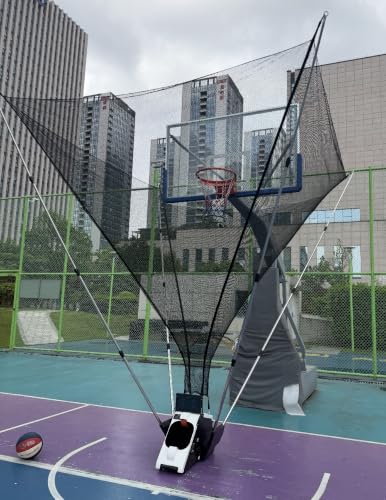
A recycling system captures the balls you hit and returns them to the hopper automatically. The typical arrangement is a large net suspended behind and around the far end of the table from the player’s side, sloping down to a collection channel that feeds balls back to the robot’s reservoir. Balls struck past the robot, into the net, or rolling off the table edges within the net’s span funnel down by gravity and rejoin the supply. The result is a closed loop: the same stock of balls circulates for as long as you care to practice.
The training effect is difficult to overstate. Without recycling, solo practice is a series of short bursts separated by gathering balls from corners, under radiators, and beneath the table. With recycling, a drill can run ten or twenty minutes continuously, long enough for footwork patterns to settle, for breathing and recovery habits to form, and for the mild fatigue that reveals technical flaws to arrive while the drill is still running. Coaches value recycling systems for exactly this reason: they turn a robot from a stroke machine into an endurance and consistency tool.
Recycling nets have costs, and they are mostly spatial and visual. The net assembly extends the footprint of the setup, typically adding depth behind the table and height above it, which matters in a low-ceilinged basement or a room where the table folds away daily. Setup time grows from clipping on a head to tensioning a frame and net, and the net itself must be kept reasonably taut and free of tears, because a slack pocket traps balls instead of returning them and a torn mesh leaks them onto the floor behind the table where they are hardest to retrieve.
Not every machine offers recycling, and not every net fits every robot. Some brands sell the net as an accessory matched to particular models; others build the return channel into a freestanding design. Freestanding floor units that sit behind the table often integrate collection more elegantly than clamp-on heads with add-on nets. If continuous sessions are your goal, decide on recycling first and choose the robot around it, rather than buying a head and discovering later that no return system exists for it.
Setting up a recycling net so it actually returns balls
Gravity does the work, so slopes decide success. The collection channel needs an unbroken downhill path to the hopper, with no level section where balls stall and no sharp junction where two balls arriving together wedge. During setup, roll a few balls by hand from the farthest corners of the net and watch their path before the first real session. Balls that stop reveal a flat spot that a small adjustment to frame tension or channel angle will fix, and finding that flat spot by hand is far easier than diagnosing it mid-drill.
Net height and overhang deserve the same care. A net set too low lets strong loops sail over it onto the floor; too high, and it crowds lights or a ceiling fan’s pull chain. Side wings matter as well, because wide balls off the table edges are the ones that otherwise travel farthest across the room. Most systems include adjustable wings or panels; extending them fully costs a little room and saves a great deal of chasing.
Table compatibility and mounting
Robots attach to the table in one of three ways: a clamp that grips the table edge beneath the playing surface, a bracket that hooks over the end, or a freestanding frame that stands on the floor behind the table and needs no attachment at all. Clamp designs are the most common and the most sensitive to table construction. Table tops vary in thickness, commonly around half an inch for portable rollaway tables up to an inch or more for heavy competition frames, and the underside may carry aprons, cross braces, or folding mechanisms exactly where a clamp wants to sit.
Before choosing a clamp-on head, measure your table’s top thickness at the center of the end where the robot will sit, and inspect the underside for obstructions within the clamp’s reach. Published compatibility notes usually state a thickness range, and a table outside that range either will not hold the clamp securely or will hold it at an angle that tilts every delivery. A tilted head does not merely aim high or low; it skews the sweep, so balls drift toward one corner as the head oscillates.
Freestanding units trade attachment worries for floor space. They stand behind the table, fire over its end, and suit tables whose edges cannot take a clamp, including outdoor tables and thin folding designs. Their height adjustment must match the table height so the trajectory clears the net and lands at the intended depth. Because nothing connects them to the table, they also tolerate the table being moved or folded without removing the robot, a real convenience in multi-use rooms.
Net clearance is the third compatibility question. The ball must pass over the net with the trajectory the head produces at its lowest useful arc. Very flat, fast deliveries from a head mounted low can clip the net on their way to deep landing positions. Manuals sometimes specify a mounting height or a minimum distance behind the table end for the head; following that geometry keeps the full range of speed and spin settings usable instead of only the lobbier half.
Controls: wired panels, remotes, and apps
Control design decides how easily you can change a drill without walking around the table. The simplest machines carry a wired control box on a cable long enough to rest on the table near the player or hang from the net post. Wired boxes are unfashionable and excellent: they respond instantly, never need charging, and put start, stop, frequency, and spin within reach of the hand that is not holding the bat. Their weakness is the cable itself, which must be routed where feet and folding table legs will not snag it.
Wireless remotes remove the cable and add the risk of a lost or flat remote. Better remotes mirror the main controls fully, including drill selection and oscillation, rather than offering only start and stop. Pocket-sized remotes that clip to a waistband or sit on the table edge keep adjustments at the player’s end, which is where they are needed: most drill changes are decided in the three seconds after a sequence ends, not from behind the robot.
App control, offered on a growing number of mid-range and advanced machines, moves the interface to a phone or tablet connected by Bluetooth or Wi-Fi. Apps earn their place when they do things a panel cannot: saving named drills, building sequences ball by ball, updating firmware, and sharing drill files. They are weaker as moment-to-moment controls, because a phone screen sleeps, a glove of sweat makes touchscreens unreliable, and picking up a phone breaks practice rhythm. The strongest setups combine both: an app for building and storing drills, and a simple physical or remote control for running them.
What good drill controls share
Across all three control styles, a few qualities separate satisfying machines from frustrating ones. A pause that stops delivery without resetting the drill is essential. A countdown or delayed start gives you time to walk to the playing end and settle into a ready position before the first ball. Controls that change one variable at a time, without stepping through menus, let you raise frequency slightly while spin and placement stay fixed. And a clearly reachable stop matters when a drill goes wrong: balls fired at an empty table while you chase a stray are balls subtracted from the hopper and added to the floor.
Memory is the other quiet divide. Machines that remember the last drill, or store a handful of favorites, get used more, because the friction of rebuilding settings every session quietly shortens practice. If you train in short daily slots, preset memory may matter more to your long-term progress than any spin figure on the box.
Balls: the 40+ standard and why uniformity matters
Modern table tennis balls are the 40+ size, nominally forty millimeters in diameter and made of plastic rather than celluloid. Robots are built around that standard, and their feed mechanisms, wheel gaps, and hopper channels are sized for it. Older forty-millimeter celluloid balls and the smaller thirty-eight-millimeter antiques belong in a display case, not a hopper: undersized or inconsistent balls slip through feed gates in pairs, jam wheel housings, and produce deliveries whose speed and spin vary from ball to ball, defeating the robot’s purpose.
Uniformity matters more than pedigree. A robot does not need competition-grade three-star balls, and using them is an expensive way to fill a two-hundred-ball hopper. It needs balls that are round, evenly seamed, and consistent in diameter and hardness, because the feed mechanism meters them one at a time and the wheels grip each one identically. Training-grade balls sold in bulk are made for exactly this role. The ones to avoid are the cheapest novelty balls, whose visible seams, soft spots, and out-of-round shapes cause the misfeeds their owners then blame on the machine.
Mixing ball types in one hopper undermines consistency in ways that are easy to miss. Balls of slightly different hardness take spin differently from the same wheel settings, so a drill set for medium topspin quietly alternates between medium and mild. Balls of different surface wear behave differently too: a glossy new ball grips the wheel differently from a matte, match-worn one. Serious practice setups keep one ball model in the hopper and retire cracked or dented balls immediately, since a cracked ball not only flies erratically but can shed a sharp edge into the feed path.
Quantity planning follows from the system you choose. A non-recycling setup benefits from a large stock, because every ball in the hopper is a ball you do not have to gather mid-session; two to three hundred training balls is a common working stock. A recycling setup circulates a smaller stock continuously, and one to two hundred balls keeps the loop full without crowding the collection channel. Either way, buy balls from one production batch when you can, and add replacements in groups rather than one novelty ball at a time.
Programmed drills and building your own
Pre-programmed drills are sequences stored in the machine: combinations of placement, spin, and frequency designed around common training goals. Typical libraries include forehand consistency patterns, backhand-to-forehand transitions, two-point and three-point footwork patterns, push-and-loop sequences against backspin, and blocking drills against topspin. The quality of a library matters more than its size. Twenty drills with sensible progressions teach more than a hundred variations that differ only in speed.
Custom drill building is where advanced machines justify themselves. A ball-by-ball editor lets you specify each delivery in a sequence: landing position, spin type and strength, speed, and the pause before the next ball. With that control you can reproduce the patterns that trouble you in matches, such as a short backspin serve to the forehand followed by a deep topspin to the backhand corner, and rehearse the exact footwork and stroke choices those patterns demand. Sequences can usually be saved, named, and recalled, building a personal library aimed at your own weaknesses rather than a generic syllabus.
Randomization within drills bridges set patterns and match chaos. Many machines can take a programmed sequence and shuffle the order of its positions, or vary each delivery within limits you set for spin and speed. That controlled randomness is a sophisticated training tool: the family of balls stays relevant to the skill being trained, while the predictability that lets a player cheat the drill drains away.
Structuring a solo session that transfers to matches
A productive session has a shape. Begin below your comfort level with a fixed placement and moderate frequency until contact feels clean, then change one variable: widen the sweep, add spin, or raise the rate. Work in blocks short enough that technique survives to the end of each block, and rest by changing the drill rather than by stopping entirely. Finish with a random mode at a frequency slightly below your best, because ending on reactive play reconnects the grooved strokes to decision-making.
Keep a simple written log of settings that worked: drill name, frequency, spin level, sweep, and how the last block felt. Robot settings are otherwise forgotten between sessions, and the log turns scattered practice into a progression. It also exposes plateaus honestly. When the same settings have felt comfortable for two weeks, the log is the evidence that it is time to widen, speed up, or complicate the feed.
Noise, vibration, and living with the machine
A robot is a motor, a fan-like wheel or wheels, and a stream of hard plastic balls striking a table, and it sounds like exactly that. Published noise figures are rare, but the character of the sound is predictable: a steady motor hum, a rhythmic thock as each ball is released and struck, and the patter of balls landing in a collection net. In a detached garage this is nothing. In an apartment with a neighbor below, the table itself becomes a sounding board, and session timing and a mat under the table legs matter as much as the machine’s own volume.
Vibration travels with noise. Clamp-on heads transmit motor vibration into the table, which can slowly walk a lightweight table across a smooth floor during a long session and can loosen a marginal clamp. A thin rubber pad between clamp and table, sold for the purpose or cut from a drawer liner, damps both the buzz and the creep. Freestanding units isolate vibration better but add their own floor contact points to pad.
Balls in a recycling net are quieter than balls on a hard floor, one more argument for the net in shared living spaces. Balls that escape and roll across hardwood announce themselves to the whole household. Keeping the stock inside the loop is a courtesy as much as a convenience.
Maintenance: wheels, feed paths, and rubber surfaces
The throwing wheels do the work and take the wear. Their rubber or foam surfaces grip each ball by friction, and they accumulate a film of plastic dust and skin oil that gradually reduces grip. The first symptom is inconsistency: spin levels drift, occasional balls slip and arrive slower or straighter than the setting promises. Manufacturers’ care guidance generally calls for wiping the wheels with a cloth lightly dampened with water, and warns against solvents that attack rubber compounds. Cleaning intervals depend on use, but a monthly wipe for a regular player, and an immediate wipe when deliveries feel inconsistent, covers most cases.
Wheel wear is the longer story. A wheel that has thrown hundreds of thousands of balls develops a polished track and eventually flat spots or cracking, at which point spin range narrows no matter how clean the surface is. Better machines treat wheels as replaceable parts and document the replacement procedure; parts availability is a fair question to ask of any brand you consider, because a robot with a worn wheel and no replacement path is a robot at the end of its life.
The feed path needs simpler care. Dust and grit entering with floor-gathered balls abrade the channel and collect around the release gate, so balls should be wiped or at least shaken clean before returning to the hopper after time on a dirty floor. Jams should be cleared with the power off and fingers out of the wheel housing, following the manual’s access procedure rather than improvisation. A soft brush kept with the machine handles most of the housekeeping in a minute.
Storage and off-season care
Store the machine dry, out of direct sun, and with the hopper emptied into a closed container. Ultraviolet light and heat age wheel rubber and ball plastic alike, and a garage that bakes in summer shortens both lives. If the robot lives on the table permanently, a simple dust cover over the head keeps grit out of the feed path between sessions. Cables should be coiled loosely rather than wound tight around the control box, and remotes should have their batteries removed for long storage to protect contacts from leakage.
Matching a machine class to a player
Beginners and returning players need clean, slow, predictable feeds more than they need spin range. A simple single-wheel or entry dual-wheel machine with a modest hopper, a wired control, and a narrow, controllable sweep covers the first year of stroke building for most players. The money saved against advanced models buys balls, a net, and table time, all of which contribute more at that stage than programmable drills.
Intermediate players training specific weaknesses benefit most from dual-wheel spin control and at least stepped oscillation with a random option. This is the class where recycling nets begin to pay for themselves, because intermediate practice sessions run longer and drills repeat more. Control memory and a handful of presets suit the player who trains in regular short slots before work or after dinner.
Advanced players and coaches should look at ball-by-ball drill editing, wide spin range including deliberate sidespin, fine frequency control, and app-based drill storage. At this level the machine is a rehearsal tool for specific match problems, and its value is measured in how precisely it can reproduce the ball that beat you last weekend. Parts availability and documented wheel replacement matter here too, because advanced use accumulates ball counts that wear mechanisms honestly.
Households choosing a machine for children should weight safety and simplicity: enclosed wheel housings, a stop control a child can reach and understand, stable mounting that survives an excited collision, and balls in quantity, because young players lose balls into every corner a room contains. A recycling net in a family room earns its space the first week.
Room setup, lighting, and the wider practice space
A robot needs less room than a match does, because only one player moves, but it still needs honest space. Allow room behind the playing end for your full backswing and at least a couple of steps of retreat for deep balls, and side room for the wide footwork that full-sweep drills demand. A setup squeezed against a wall teaches cramped strokes that fail on a full court. If space is short, narrow the sweep deliberately rather than letting the walls narrow your technique by accident.
Lighting deserves a thought because spin reading depends on seeing the ball early. Even, glare-free light from above and slightly behind the player keeps the ball visible against the far background. A dark curtain or a plain wall behind the robot end improves contrast more than extra brightness does. Players who practice serves against the robot’s returns, or who record sessions on a phone to review footwork, will find a consistent background helps both the eye and the camera.
Furniture choices around the practice room are part of the setup too. When a basement practice corner shares space with seating for family film nights, the chairs get moved, dragged, and occasionally struck by a sprinting player, so sturdy seating that tolerates repositioning matters more than delicate pieces. If you are furnishing that shared corner, our guide to best cafeteria chairs and tables covers durable, stackable seating and tables that survive being rearranged often. A practice room that resets in two minutes gets used; one that needs twenty minutes of furniture negotiation gets skipped.
Dining spaces double as practice rooms in many homes, since the table tennis table often shares the floor with the household’s eating arrangements. Choosing dining chairs that stack or slide easily keeps the conversion painless, and the round-table seating discussed in best dining chairs for a round table is a good example of furniture chosen to flex between daily meals and open floor space. The principle is the same throughout this guide: the best practice setup is the one that survives contact with ordinary domestic life.
The head of a dining table, when the room converts back, usually takes the most wear from dragged equipment and stored robot cases. Reinforced seating for that spot is worth its own look, and best chairs for head of dining table examines chairs built to anchor a table setting while tolerating heavier use. Keeping the room’s furniture as deliberate as the robot’s settings protects both the practice habit and the room itself.
Finally, many players split their training between the table and video study at a desk, reviewing recorded drills and logging settings on a computer. Long sessions in that chair deserve the same ergonomic attention as footwork, and best chairs for computer gamers looks at seating built for hours of focused sitting. Practice is a system: table, machine, room, and the chair where you plan the next session all belong to it.
A buying sequence that avoids the common mistakes
Start by deciding on recycling, because that choice narrows the field more than any specification. Then set your spin requirement honestly: if you compete against strong spin players, dual wheels are not a luxury. Next, check your table’s thickness and underside against the mounting system of any clamp-on candidate. Only then compare frequency ranges, drill libraries, and controls, in that order, because those are refinements of a machine that already fits your room, table, and game.
The common mistakes repeat across households. Buying maximum frequency and never training above the middle band. Buying a sophisticated app-controlled machine and then leaving the phone in another room. Filling a precision feed mechanism with the cheapest novelty balls available. Mounting a head on an unmeasured table and blaming the machine for skewed deliveries. Each mistake is avoidable with the checks in this guide, and none of them requires spending more, only sequencing the decision correctly.
Budget language deserves a plain word. Machines separate into broad tiers by mechanism rather than by small differences in trim: single-wheel heads at the accessible end, dual-wheel machines with recycling in the middle, and programmable performance systems at the top. Within a tier, prices move with control systems, net inclusion, and parts support. Spending within the tier that matches your spin and session-length needs is sound; spending across a tier boundary for a feature you will not program is not.
Safety notes for a machine that fires projectiles
Table tennis balls are light, but a robot fires them at speeds that can sting an eye, and children treat any machine that launches things as an invitation. Keep faces out of the firing line during operation, switch the machine off before reaching into the hopper or clearing a jam, and teach younger players that the stop control is the first thing to learn, before any drill. Wheels keep spinning briefly after power is cut, so the manual’s warning to wait for a full stop before opening the housing deserves respect rather than familiarity.
Electrical safety is ordinary but real. Run the power supply away from the playing area where feet move fast, keep drinks off the table and away from the control box, and inspect cables that live under folding table legs for pinch damage. A machine used in a damp basement or garage should plug into a protected outlet, and any unit with a damaged cord should be retired from service until repaired.
When deliveries go wrong: a short diagnostic order
Most robot faults announce themselves as changed deliveries rather than total failure, and a calm diagnostic order finds the cause faster than random adjustment. Start with the balls. One cracked or out-of-round ball in the hopper produces a periodic fault that repeats each time it cycles through, which feels like a machine problem but is a stock problem. Empty the hopper, roll every ball across a flat surface, and discard any that wobble, click, or show a seam ridge you can feel with a fingernail. Refill with a single ball model and check whether the fault survives.
If deliveries remain inconsistent on clean stock, look at the wheels. A visible polished band, a film you can smear with a fingertip, or one wheel noticeably smoother than its partner explains spin drift and occasional slipping balls. Clean both wheels as the manual directs, let them dry fully, and run a fixed drill at a moderate setting. Spin that returns to consistency after cleaning was a maintenance issue. Spin that stays weak on a clean, dry wheel points to wear, and the maker’s parts documentation becomes the next document to read.
Placement faults have their own order of causes. Deliveries that skew to one side during oscillation usually trace back to mounting: a clamp seated on an apron edge, a head tilted by an uneven table edge, or a freestanding frame standing on an uneven floor. Deliveries that land shorter as a session progresses suggest balls warming and softening in a hot room, or a hopper running low enough that the feed agitator works harder than the mechanism prefers. Work through mounting, then ball condition, then hopper level before suspecting the aiming motor, which is the least common culprit and the most expensive guess.
Serve practice and the robot’s supporting role
A robot cannot return your serve, but it supports serve practice in two practical ways. First, its collection net, when positioned at the far end, gives serves a forgiving target area and returns the balls, so a hundred practice serves do not become a hundred trips around the table. Second, several machines offer a short, low feed that approximates the second ball after a serve, letting you rehearse the third-ball attack pattern: serve to a practice target, step in, and meet the robot’s backspin feed with the loop you intend to play in matches. The rhythm is artificial, but the footwork sequence, out to the serve position and back into the ready stance, is exactly the movement matches demand.
Session length deserves the same planning as drill content. Continuous robot practice concentrates repetitions in a way rally practice never does, and shoulders and elbows notice the difference. Shorter blocks with genuine pauses, a weekly rhythm that leaves rest days after heavy footwork sessions, and an honest stop when contact quality collapses all protect both joints and technique. The machine will happily feed balls long after your strokes have degraded into arm-waving; the discipline to end a session belongs to the player, and it is part of what the machine is there to teach.
How long a machine should last, and what wears first
Service life is best estimated in balls thrown rather than years owned, because a club machine can throw in a month what a home machine throws in a year. The components that wear are predictable: wheel surfaces first, then the feed agitator and release gate, then belts or gears in the aiming mechanism on oscillating models. None of these is exotic, and designs that document their replacement parts, publish exploded diagrams in the manual, and sell wheels and gates as spares are signaling that the machine was built to be maintained rather than replaced. That signal is worth weighing alongside any specification, because the difference between a five-year machine and a fifteen-year machine is rarely the motor; it is whether a worn wheel can be swapped on a kitchen table in twenty minutes.
Usage pattern shapes the estimate too. Long continuous sessions heat motors and wheels more than the same ball count spread across a week, and machines with a stated duty cycle, a recommended rest after a period of continuous fire, are being honest about that physics. Respecting the stated cycle costs nothing during home practice, where a pause to change drills or refill a drink is natural, and it is the cheapest longevity measure available. A machine treated within its duty cycle, fed clean uniform balls, and wiped down monthly has no mechanical reason to be the weak link in a practice habit that lasts for years.
Check prices on Amazon
Live listings for the shortlist in this guide are pulled from Amazon below, so prices and availability are always current at the moment you look.


Disclosure
Solo practice equipment is usually bought once and judged for years, so this guide separates verifiable specifications from everything else and says plainly where its information ends. As an Amazon Associate we earn from qualifying purchases. The figures discussed here come from manufacturer specifications, published manuals, and technical documentation for the machine classes described; no individual product was supplied for this guide, and delivery rates, spin behavior, and capacities vary by model, by ball condition, and by setup, so confirm the exact figures for any specific machine against its own documentation before relying on them.
A robot will not fix a flawed grip or invent footwork you never practice, but the right one, matched to your table and your patience, quietly removes every excuse between you and the ten thousand deliberate returns that turn a hopeful stroke into a reliable one.