What's inside
- Key Takeaways
- Quick Picks
- How Did We Choose These Picks?
- Comparison Table
- What Should You Measure Before Buying Cafeteria Chairs and Tables?
- Round or Square: Which Table Shape Suits Your Room?
- How Do You Clean and Maintain Cafeteria Furniture?
- What Are the Most Common Mistakes When Furnishing a Cafeteria Space?
- How Many Sets Does Your Space Actually Need?
- How Should You Arrange Tables for Service, Queues and Conversation?
- What Makes a Stack Chair Good, Beyond Stacking?
- How Do Cafeteria Needs Differ Between Schools, Offices and Halls?
- What Should You Budget Beyond the Sets Themselves?
- How Do You Handle Accessibility in a Cafeteria Layout?
- How Long Should Cafeteria Furniture Last, and What Shortens Its Life?
- What About Noise? The Cafeteria Sound Nobody Budgets For
- How Do You Trial a Set Before Committing a Whole Room?
- How Should You Seat Children, Elders and Everyone Between?
- What Role Does Colour Play Across a Whole Room?
- How Do You Move and Store Tables Without Damage?
- How Do You Furnish a Cafeteria Corner in a Small Business?
- What Should Landlords and Venue Hirers Ask?
- How Does Seasonality Change a Cafeteria’s Furniture Needs?
- Final Recommendation
- Frequently Asked Questions
- Related Guides
As an Amazon Associate I earn from qualifying purchases. This post may contain affiliate links at no extra cost to you.
cottageverdict.com is reader-supported. When you buy through links on our site, we may earn an affiliate commission.
Where to buy: each set with a link below opens its Amazon listing, where you can check price on Amazon and confirm table dimensions against your floor plan. The sixth option, a long bench-seat cafeteria unit of the kind institutions order from specialist suppliers, is covered in prose only.
The best cafeteria chairs and tables are rarely bought for a cafeteria alone. They furnish church halls and training rooms, staff breakrooms and scout huts, wedding overflow and the corner of a warehouse where a team actually eats lunch. What unites those rooms is a rhythm of hard use and fast change: chairs stacked to free the floor, tables wiped down between sittings, furniture dragged by whoever is nearest rather than carried by whoever is careful. Buying for that rhythm is a different discipline from buying dining furniture, and it rewards shoppers who think about storage and cleaning before they think about colour.
Every set in this guide pairs a table with four stack chairs, because that bundle is how most small and mid-sized spaces actually expand their seating. The variations are in the details that decide daily life: round against square tops, 36 inches against 48, grey laminate against mahogany or maple finishes, X-bases that stay steady on imperfect floors. A sixth, prose-only pick describes the long attached-bench units that true high-volume cafeterias use, for readers whose headcount has outgrown four-at-a-time thinking.
Before the picks, one measurement exercise is worth the ten minutes it takes. Sketch your room, mark the door swing and the serving counter or kitchen hatch, then draw your tables at scale with a walking lane of at least a yard between rows. More cafeteria furniture disappoints through geometry than through quality: a 48-inch round table is a delight in a hall and a barricade in a narrow breakroom, and no finish option fixes a room you cannot move through with a tray in your hands.
One more framing note before the furniture itself: cafeteria sets are bought by organisations as often as by households, which means the decision usually has to survive a committee, a budget line and a caretaker’s opinion. The reviews below therefore speak to all three audiences at once — the diner who sits, the treasurer who signs, and the person who will stack the chairs on a wet Tuesday in February when everyone else has gone home. A set that pleases only the first of those three will not stay pleasing for long.
Key Takeaways
- Stack chairs are the working heart of these sets; how they store matters as much as how they sit.
- Round tops ease movement in tight rooms, while square tops push together into longer shared runs.
- The Regency Cain 42-inch set is the balanced default for a standard breakroom or small hall.
- Melamine tops shrug off the daily wipe-down routine that real cafeteria service demands.
- Measure walking lanes before choosing between 36, 42 and 48-inch tables — geometry outranks finish.
- True high-volume rooms should look at the prose-only bench units before multiplying small sets.
Quick Picks
| Pick | Badge | Why it earns its place |
|---|---|---|
| Regency Cain 42 Round Table and 4 Zeng Stack Chairs | Best Classic Breakroom Set | A 42-inch round top on a steady X-base with four stack chairs in black — check price on Amazon. |
| Breakroom Table Set Square and 4 Stack Chairs | Best Compact Square Set | A square melamine top and metal stack chairs with built-in handles for quick restacking — check price on Amazon. |
| Cain 48 Round Table and 4 Restaurant Stack Chairs | Best for Bigger Groups | Six extra inches of top buy elbow room for laptops, board games and serving dishes — check price on Amazon. |
| 36 Square Breakroom Table Set Mahogany | Best Warm Finish | A mahogany-toned scratch-resistant top warms up rooms that feel institutional — check price on Amazon. |
| Maykoosh 36 Square Breakroom Table Set | Best Light Maple Look | A maple finish and the same compact footprint suit bright, small cafeteria corners — check price on Amazon. |
| Institutional Bench-Seat Cafeteria Unit | Best for True Cafeteria Rows | Long tables with attached benches, ordered from specialist suppliers at the premium institutional tier. |
How Did We Choose These Picks?
We judged these sets the way a caretaker would, because caretakers are who live with them. First came the chairs: stack chairs earn their keep in the stack, so we looked for frames that stack cleanly, handles or hand-holds that make lifting natural, and seats shaped for a thirty-minute lunch rather than a three-hour conference. A chair that only stacks with swearing will eventually be left out in rows, and the room loses the flexibility it bought the set for.
Tables were judged on their tops and their feet. Melamine and laminate surfaces dominate this category for honest reasons — they tolerate hot mugs, disinfectant wipes and the scouring pad of an enthusiastic volunteer — and every linked pick here uses one. Bases mattered next: an X-base keeps a round table steady when someone leans on its edge with a tray, and it leaves knee room unobstructed by a thicket of legs at exactly the points where sitters slide in.
We also kept the sets honest about scale. Each linked set seats four, and we say so, rather than dressing them up as banquet solutions. Readers feeding sixty people at once are directed to the bench-unit discussion and to multiplying sets deliberately, with the storage arithmetic done in advance. A guide that helps you buy the right amount of furniture serves you better than one that simply helps you buy furniture.
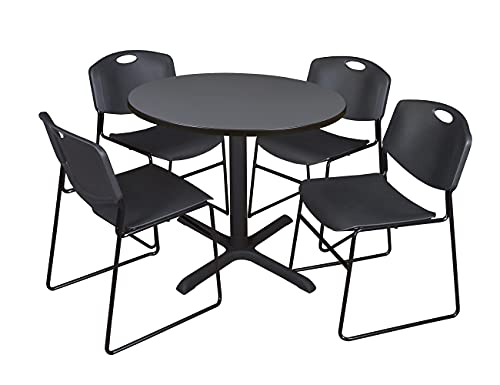
Regency Cain 42 Round Table and 4 Zeng Stack Chairs — Best Classic Breakroom Set
If a committee had to furnish a thousand breakrooms by Friday, this is roughly the set it would choose, and that is a compliment. The Cain table pairs a 42-inch round grey top with an X-base, a combination that has survived decades of office life because it solves the ordinary problems well: no corners to catch hips in a small room, a base that does not rock when the floor is old, and a neutral finish that tolerates whatever wall colour the last renovation left behind. Forty-two inches seats four adults with plates and mugs in genuine comfort, and two people with laptops and paperwork when the breakroom doubles as overflow workspace.
The Zeng stack chairs are the quiet workhorses: black, stackable, and shaped for the half-hour sit that cafeteria chairs actually serve. Stacked, four chairs occupy the footprint of one, which is the trick that lets a small hall be a lunchroom at noon and a meeting room at two. The set’s plainness is worth naming as a feature — replacement chairs in this pattern are easy to source years later, so a damaged chair does not orphan the whole set. Buy it as the default against which the other picks must argue their case.
- Table: 42-inch round top, grey, X-base
- Chairs: 4 Zeng stack chairs, black
- Setting: breakrooms, small halls, classrooms
- Storage: chairs stack to a single footprint
Strengths
- A round top keeps traffic flowing in rooms where square corners would snag every passer-by.
- The X-base stays composed on uneven floors that make four-legged tables wobble theatrically.
- Standard styling makes future replacement chairs simple to match and source.
Trade-offs
- Round tables cannot be pushed together into a long banquet run when events demand one.
- Grey-on-black is serviceable rather than warm; decorative rooms may want the wood finishes below.
- Four chairs is a starting kit — larger rooms must budget for several sets from the outset.
Best for: offices, churches and clubs furnishing a first flexible eating space. Not suited for: venues that regularly need one long communal table.

Breakroom Table Set Square and 4 Stack Chairs — Best Compact Square Set
Square tables are the modular thinkers of the cafeteria world. Alone, this set gives four people a compact place to eat against a wall or in a corner that a round top would waste. Pushed together in twos and fours, the same tables become a serving line, a craft surface or a training-room row — a trick round tables simply cannot perform. The listing describes a durable X-base table with a melamine top, and metal stack chairs with built-in handles, a small phrase that conceals a daily blessing: chairs with handles get stacked, because the person clearing the room can lift them one-handed without hunting for a grip.
The black finish across table edge and chairs keeps the set looking unified even as pieces migrate between rooms, which in real buildings they always do. Consider this the pick for spaces that reconfigure weekly — classrooms that host evening classes, halls that alternate between toddler groups and committee meetings. Its compactness is also its ceiling: four adults with winter coats and bags will find a square this size companionable rather than spacious, and groups that eat together daily in larger numbers should step up to the 48-inch round or multiply sets from the start.
- Table: square top, melamine, X-base
- Chairs: 4 metal stack chairs with built-in handles
- Finish: black throughout
- Strength: sets combine into longer runs
Strengths
- Square tops tile together for events, serving lines and training layouts without gaps.
- Built-in chair handles turn the end-of-day stack from a chore into a one-minute habit.
- A compact footprint fits the wall-side and corner spots that round tables waste.
Trade-offs
- Four adults with laptops and lunch trays will feel the edges of a compact square quickly.
- Corners, unlike a round top, catch hips and tray corners in busy through-routes.
- An all-black scheme can read stark under harsh lighting in rooms without windows.
Best for: multipurpose rooms that rearrange often and small teams eating in shifts. Not suited for: a fixed, generous dining layout where nobody ever moves the furniture.

Cain 48 Round Table and 4 Restaurant Stack Chairs — Best for Bigger Groups
Six inches of diameter does not sound like a design philosophy until you watch four adults eat around both sizes. At 48 inches, elbows leave the negotiation, serving dishes can live in the middle without colonising anyone’s place setting, and a laptop plus a lunch tray stop being a zero-sum game. This Cain set takes the same formula as its 42-inch sibling — grey round top, X-base, four black stack chairs described by the maker as restaurant stack chairs — and simply gives the gathering more room to happen in.
The larger top earns its keep in rooms that host: potluck committees, family gatherings that overflow the dining room, training days where each seat carries a binder, a bottle and a plate. The cost is measured in floor plan, not money — a 48-inch circle with chairs pulled out claims a generous disc of room, and walking lanes around it shrink accordingly. In a hall, that is nothing. In a narrow galley breakroom, it is the difference between a table people use and a table people squeeze past while holding their trays vertical, which ends with the table exiled and the set resented.
- Table: 48-inch round top, grey, X-base
- Chairs: 4 restaurant stack chairs, black
- Setting: halls, training rooms, larger breakrooms
- Seats: four with genuine elbow room
Strengths
- Extra diameter converts directly into comfort for groups that eat and work at the table.
- Shared serving space in the centre suits communal meals and shared documents alike.
- The same stackable-chair storage logic as the smaller Cain keeps clear-up simple.
Trade-offs
- Claims the most floor space of any linked set once chairs are pulled out for use.
- Still only four chairs; the bigger top tempts overcrowding that the chair count forbids.
- Round format cannot join with other tables for banquet-style seating runs.
Best for: halls and generous breakrooms where four people regularly share food and paperwork. Not suited for: narrow rooms where circulation space is already contested.

36 Square Breakroom Table Set Mahogany — Best Warm Finish
Institutional furniture has an image problem: rooms furnished entirely in grey and black can feel like they are apologising for existing. This set answers with a mahogany-toned top on a 36-inch square table, a finish that borrows the visual warmth of a dining room while keeping the working surface honest — the listing describes a scratch-resistant melamine top, which means the warmth is a colour, not a veneer you must protect from every mug ring and key scratch.
Thirty-six inches is the intimate end of cafeteria sizing: two people with generous space, four with friendly economy, and a footprint that fits the alcoves, bay windows and converted corners where small cafés and bed-and-breakfast breakfast rooms actually live. The black stack chairs keep the set grounded and easy to extend. Choose this finish when the room has a mood to protect — wood floors, warm lighting, a space that hosts clients as well as staff — and accept that the compact square will ask big groups to book a second set rather than squeeze.
- Table: 36-inch square, mahogany finish
- Top: scratch-resistant melamine, per the listing
- Chairs: 4 stack chairs, black
- Setting: small cafés, breakfast rooms, offices with clients
Strengths
- A warm wood tone lifts rooms that standard institutional finishes leave feeling cold.
- Scratch-resistant melamine means the good looks survive daily commercial treatment.
- The small footprint furnishes alcoves and corners that reject larger tables entirely.
Trade-offs
- The 36-inch top is the tightest squeeze in this guide for four full place settings.
- Mahogany tones commit the room’s palette; future chairs must harmonise or clash.
- Square corners in a busy servery route will collect their share of hip bumps.
Best for: small hospitality spaces and offices where atmosphere matters alongside durability. Not suited for: high-turnover canteens feeding large groups in waves.

Maykoosh 36 Square Breakroom Table Set — Best Light Maple Look
Maple is the optimist’s finish: pale, bright and forgiving of the low-light rooms where cafeteria corners so often hide. The Maykoosh set pairs a 36-inch square maple table with four black restaurant stack chairs, and its listing aims it squarely at cafeterias, dining spaces and offices — the same compact, rearrangeable format as the mahogany set above, wearing a lighter mood. In a basement hall or a north-facing staff room, that pale top genuinely changes how the corner feels at eight in the morning.
Light finishes carry a practical reputation problem they do not deserve. Coffee rings and scuffs show on any colour; on maple they show honestly and wipe away from melamine just as readily, while the scratches that accumulate over years read as patina on a pale wood tone rather than damage on a dark one. Pair this set where the room needs lifting rather than grounding. Two of these sets in a small café create a coherent, airy seating plan that a single larger table cannot match for flexibility, since parties of two and four can be seated without rearranging the whole room.
- Table: 36-inch square, maple finish
- Chairs: 4 restaurant stack chairs, black
- Setting: cafés, bright breakrooms, small dining spaces
- Strength: pale top brightens low-light rooms
Strengths
- A maple top reflects light into corners that darker furniture leaves gloomy.
- Compact squares let small venues seat mixed party sizes without moving walls of furniture.
- Black chairs against pale wood give a deliberate, café-like contrast rather than a matched-set blandness.
Trade-offs
- Ink, beetroot and turmeric will announce themselves on a pale top until wiped.
- Thirty-six inches remains a four-person maximum, and a friendly one at that.
- The light finish shows dust on the table edges sooner between cleanings.
Best for: small cafés, bright offices and breakfast corners short on natural light. Not suited for: messy workshop canteens where the top will be a workbench by Friday.
Institutional Bench-Seat Cafeteria Unit — Best for True Cafeteria Rows
There is a point — usually somewhere past forty regular diners — where four-person sets stop being a solution and become a traffic jam of chair legs. Schools, camps and works canteens cross that point into a different furniture species entirely: the long cafeteria unit, a rectangular table with benches attached to its frame, seating eight to twelve along both sides with no loose chairs to stack, steal or leave scattered. These are ordered from institutional furniture suppliers rather than marketplace listings, so this pick is prose-only, sitting at the premium tier where delivery arrives on a pallet and assembly is a facilities job.
The virtues are operational. A room of bench units clears in minutes because there is nothing to stack; the benches swing or fold with the table in many designs, and the whole unit can roll aside for cleaning or events. Children cannot tip chairs that do not exist, and headcounts become visible at a glance down the row. The costs are equally real: nobody can adjust their seat, latecomers squeeze in along a bench rather than pulling up a chair, and the units demand long, rectangular rooms. If your lunches are waves of many mouths on a timetable, this is the honest furniture. If they are lingering and social, stay with the sets above.
- Format: long rectangular table, benches attached
- Capacity: typically eight to twelve per unit
- Availability: institutional suppliers; premium tier
- Storage: units fold or roll aside as single pieces
Strengths
- No loose chairs means clear-up, headcounts and floor cleaning all speed up dramatically.
- Bench seating maximises diners per metre of room in timetable-driven spaces.
- Institutional construction is specified for years of twice-daily heavy use.
Trade-offs
- Fixed benches suit nobody perfectly and cannot adapt to individual diners’ needs.
- Premium-tier pricing plus freight delivery puts these beyond casual purchase.
- Long units need long rooms; they punish any space that is nearly square.
Best for: schools, camps and canteens serving set waves of diners on a schedule. Not suited for: social eating spaces where people arrive, linger and rearrange freely.
Comparison Table
| Pick | Table | Finish | Defining feature |
|---|---|---|---|
| Regency Cain 42 Round Table and 4 Zeng Stack Chairs | 42-inch round | Grey | The balanced all-round default |
| Breakroom Table Set Square and 4 Stack Chairs | Square | Black | Handles on chairs; sets tile together |
| Cain 48 Round Table and 4 Restaurant Stack Chairs | 48-inch round | Grey | Most elbow room per seat |
| 36 Square Breakroom Table Set Mahogany | 36-inch square | Mahogany | Warm tone, scratch-resistant top |
| Maykoosh 36 Square Breakroom Table Set | 36-inch square | Maple | Brightens darker rooms |
| Institutional Bench-Seat Cafeteria Unit | Long rectangle | Varies by supplier | Attached benches, no loose chairs |
What Should You Measure Before Buying Cafeteria Chairs and Tables?
The room decides more than the catalogue does. Begin with the clear floor: subtract the serving counter, the door swing, the fire-exit route that must never be furniture, and any serving hatch queue space. What remains is your true furnishing budget, and it is always smaller than the room’s brochure dimensions suggest. Allow a walking lane of roughly a yard between table edges wherever people carry trays, and more where wheelchairs or pushchairs are part of ordinary life — a lane that works for a person alone fails the same person holding lunch.
Then measure the storage, because cafeteria furniture lives two lives. Count the stacked height of your chosen chairs against the cupboard or wall bay they will occupy, and confirm the stack fits through the doorway between the eating room and that store. Tables that cannot leave the room dictate the room forever; if your hall hosts weddings, exams and exercise classes, the honest question is not where the tables sit at lunch but where they go at everything else.
Round or Square: Which Table Shape Suits Your Room?
Round tables are peacemakers. Nobody sits at the head, conversation crosses the middle naturally, and traffic flows around them without corner collisions — which is why both Cain sets in this guide sell steadily to halls and breakrooms. Their weakness is combinability: two round tables pushed together create a peanut, not a banquet. Rooms whose events calendar includes long shared meals, serving lines or exam rows will feel that weakness monthly.
Square tables are collaborators. Alone they are compact and wall-friendly; together they become whatever the day requires, including the long run that round tops refuse. Their corners demand respect in tight circulation, and a lone square can look marooned in a big round-friendly hall. The mature answer for many venues is a majority of one shape with a minority of the other — squares for the reconfigurable end of the room, rounds where people settle — rather than a doctrinaire single shape throughout.
How Do You Clean and Maintain Cafeteria Furniture?
Melamine tops forgive almost everything except complacency. Wipe spills the day they happen, because sugary drinks dry into a tack that grinds dirt into the surface with every subsequent wipe. Use ordinary detergent solutions rather than abrasive scouring creams, which dull the finish into a matte patch that then holds stains more eagerly — the scratch-resistant tops in this guide resist scratches, not chemistry. Chair seats and backs want the same wipe-down weekly in food spaces, with attention to the underside rim where hands actually grip.
Frames reward a twice-yearly inspection round. Tighten table-base bolts, check the X-base feet for missing glides, and run a hand along chair stacking points for the burrs that scratch the chair below. Stack chairs in the maker’s intended orientation and never beyond the stack height the design suggests; a leaning tower of chairs is a storage accident rehearsing itself. Ten minutes of this attention per term keeps a set looking institutional in the good sense — cared for — rather than the other kind.
What Are the Most Common Mistakes When Furnishing a Cafeteria Space?
Buying to the photograph is the first: a set that looks serene in a styled room may be the wrong scale for yours, and dimensions skipped in the excitement return as daily irritations. The second is seating arithmetic done in optimism — counting chairs rather than sittings, forgetting that staff, visitors and the person running the kitchen all need a seat in the same twenty minutes. Buy for the busiest quarter hour of the busiest day, or accept the standing eaters with open eyes.
The third mistake is forgetting the stack. Buyers fall for a chair’s sit and never ask how it stores, then discover the hall’s cupboard holds half the chairs and the rest live permanently in the corridor, breeding complaints. Fourth comes finish regret: choosing a colour for the opening day rather than for the thousandth wipe-down. The finishes in this guide — grey, black, mahogany, maple — were each picked for how they age under cleaning, and that, more than first impressions, is the test your own choice must pass.
How Many Sets Does Your Space Actually Need?
Work backwards from the peak. Count the most people who will sit simultaneously on your busiest ordinary day — not the annual party, which can rent furniture, and not the quiet Tuesday, which will forgive anything. Divide by four for the linked sets here, then add one set if your room hosts groups that must sit together, because a party of six does not split gracefully across two four-tops without a spare. The result is your working fleet; write it on the order before enthusiasm or thrift edits it.
Storage gets the final vote. If the fleet you calculated cannot stack into the storage you measured, the room is telling you something: either the bench-unit route suits you better, or the space needs a storage solution bought alongside the furniture, such as a chair trolley that turns a stack into a movable object. Ignoring the vote does not repeal it; it merely moves the chairs into corridors, where they become everyone’s problem and no one’s lunch seat.
How Should You Arrange Tables for Service, Queues and Conversation?
A cafeteria has currents. Diners flow from door to counter, counter to table, table to clearing station, and furniture placed against those currents creates the collisions and tray-balancing acts that make a room feel chaotic at exactly its busiest moment. Walk the route yourself with a tray before the furniture arrives and place tables so the natural walking lines stay open; the linked sets in this guide are light enough to trial in two arrangements across a week, and the better arrangement will announce itself by lunchtime on day one.
Within the seating area, mix orientations deliberately. Rows of identical squares read as efficient and suit training days, while rounds scattered at slight angles invite lingering and conversation — choose per zone if the room serves both moods. Leave one table near the counter deliberately smaller in company, for the solo diner and the pair who want quiet; not every seat in a cafeteria must be socially optimised. The rooms people praise as welcoming are usually the ones where somebody thought about the person eating alone.
What Makes a Stack Chair Good, Beyond Stacking?
A stack chair spends its life in three states: sat on, stacked, and being moved between the two. Judge all three. Sat on, it should support a meal’s length without a numbing edge at the front of the seat, and its back should meet the sitter’s back rather than hovering behind it. Stacked, it should nest without rocking, protect the chair beneath from scratches at the contact points, and come apart without the wrestling grip that discourages whoever clears the room. In transit, it should carry by a handle, a top rail or a frame member that the hand finds naturally — the built-in handles on the square set’s chairs in this guide exist precisely because designers watched people carry chairs badly for decades.
Weight is a virtue in moderation. A chair too light feels flimsy and skates on smooth floors when a sitter shifts; a chair too heavy makes the stack a two-person job and quietly stops being stacked at all. The sweet spot is a chair one adult can lift onto a stack repeatedly without thinking about it, because furniture that requires thought gets left out, and furniture left out defines the room whether you planned it or not.
How Do Cafeteria Needs Differ Between Schools, Offices and Halls?
Schools optimise for supervision and speed: sightlines across the room, sittings that turn over on a bell, and furniture that survives being treated as playground infrastructure by Friday. That is bench-unit territory at scale, or many small sets that let staff rearrange between year groups. Offices optimise for the opposite: adults lingering over laptops, meetings bleeding into lunch, and a room that must look respectable when a client is walked through it — the territory of the Cain rounds and the warmer finishes in this guide.
Community halls live the hardest double life, hosting a toddler group at ten, a lunch club at noon and a wedding at seven. Their furniture must stack into the least possible storage, roll or carry easily by volunteers of every age, and look neutral against bunting, banners and funeral flowers alike. If that is your room, weight the stack-and-store qualities above every finish question in this guide, and buy the chair trolley in the same order rather than as a later apology to your volunteers’ backs.
What Should You Budget Beyond the Sets Themselves?
The sets are the headline cost, not the whole bill. A chair trolley or dolly, where stacks must travel, pays for itself in volunteer goodwill within a term. Spare glides for table feet and chair legs cost little and prevent the floor damage that costs much. A small stock of cleaning supplies dedicated to the room — cloths, a detergent spray, a bin that lives beside the clearing point — keeps the wipe-down routine frictionless enough to actually happen between sittings.
Hold back a little for the inevitable second order. Almost every venue discovers, within a month, that it needs two more chairs than the arithmetic said, or one more table for the corner nobody expected to be popular. Buying the same set again is painless precisely because these are standard patterns; that continuity is an unglamorous argument for the mainstream picks in this guide over a one-off bargain design that vanishes from sale by spring.
How Do You Handle Accessibility in a Cafeteria Layout?
Accessibility is geometry plus courtesy. Keep at least one route through the room wide enough for a wheelchair user carrying nothing and another diner passing with a tray, and resist letting stacked-chair storage colonise that route on busy days. Round tables, like the Cain sets here, welcome a wheelchair user at any point of their circumference without a corner dictating position, and an X-base leaves the knee space beneath a top unusually clear compared with four corner legs.
Keep some seating with arms in any larger installation, even though the stack chairs in these sets are armless by design: arms are the difference between independence and assistance when a diner with limited leg strength sits down or stands. A mixed fleet — stack chairs for the many, a few armed chairs for whoever needs them — is the arrangement that serves a whole community without singling anyone out, and it is worth planning from the first order rather than retrofitting after the first difficult lunch.
How Long Should Cafeteria Furniture Last, and What Shortens Its Life?
A melamine top in daily service should look respectable for years, and a steel stack-chair frame can outlast the building’s paint several times over. What shortens life is rarely the sitting; it is the handling. Chairs dragged by one leg, stacks dropped the last two inches, tables pivoted on one base foot across gritty floors — these small violences accumulate into wobbles and chips that no specification can prevent. Venues that brief their volunteers on lifting rather than dragging get visibly more years from identical furniture.
Sunlight deserves a mention it rarely gets. A set parked permanently in a south-facing window will fade unevenly, with the window-side chairs ageing a different colour from their stack-mates kept in the store. Rotate chairs between the stack and the floor monthly, and the whole fleet ages together, which matters in rooms where mismatched furniture reads as neglect. When a single chair does fail, replace it from the same standard pattern promptly; one odd chair is a story, three odd chairs are an atmosphere.
What About Noise? The Cafeteria Sound Nobody Budgets For
Chair legs on hard floors are the soundtrack of every institutional meal, and in a room with a low ceiling the scrape-and-clatter can push conversation volume up until the space feels frantic. Felt glides or intact factory feet on every chair leg make a measurable difference, and checking them belongs in the same twice-yearly round as bolt-tightening. A room that sounds calm gets described as pleasant even by diners who cannot say why.
Table surfaces contribute too: melamine is honest and hard, so mugs land with a clack that carpeted or wooden rooms soften naturally. Venues hosting both toddlers and pensioners in the same week might add simple table mats for the quieter sittings rather than refurnishing. None of this appears in any product listing, yet regular diners will judge your cafeteria by its sound almost as much as by its seats — worth remembering while the furniture is still a decision rather than a fact.
How Do You Trial a Set Before Committing a Whole Room?
Buy one set first and live with it through a full cycle of your room’s life: the busy lunch, the evening event, the clean-up afterwards, the stack in its intended home. Sit in the chair with a meal, not for a showroom minute. Watch who clears the room and whether the stack happens willingly. That single-set trial, which the standardised sets in this guide make cheap to run, has saved more venues from a roomful of wrong furniture than any review — including, we would say with appropriate humility, this one.
If the trial set passes, order the fleet promptly while the same pattern is current, and keep the trial set in service as part of it. If it fails, it fails small: one set can migrate to a smaller room, a staff corner or a store-room duty where its weaknesses do not matter. Either way, the room ends up furnished by evidence rather than by hope, which is the only method that has ever worked at scale.
How Should You Seat Children, Elders and Everyone Between?
A community cafeteria serves bodies across a sixty-year span at the same tables, and the furniture has to mediate. Stack chairs of standard height suit most adults and older children well; younger children will kneel, perch and eventually settle, which is normal and not a furniture failure. What matters for them is stability — a chair that does not tip when climbed into backwards — and the steel-framed stack chairs in these sets are reassuringly planted in exactly that scenario.
At the other end of the span, seat height and a firm seat matter more than cushioning: a diner with arthritic knees needs to sit and stand without sinking into foam or hauling against a low frame. Keep your few armed chairs, mentioned in the accessibility section, near the door and the counter to shorten the journey. A room that quietly works for its youngest and oldest diners will work for everyone in between without further thought, which is the definition of good institutional design.
What Role Does Colour Play Across a Whole Room?
Single sets are judged alone; rooms are judged whole. The grey and black sets in this guide recede, letting banners, table flowers and people supply the colour, which suits halls that change purpose weekly. The mahogany set commits a room to warmth, and the maple set to brightness — commitments that pay off in dedicated dining spaces and chafe in multipurpose ones. If your room has a strong existing palette in its floor or curtains, choose the set that argues least with it; furniture that fights the room loses every day, quietly.
There is also a maintenance truth in colour: mid-tones hide the most life. Pure black shows every crumb and dusting of flour, while pale maple shows every splash until wiped, and the grey of the Cain tops sits forgivingly between those extremes. None of this should overrule the room’s mood, but buyers furnishing a space cleaned by volunteers once a week rather than staff once an hour might let forgiveness rank higher in their decision than it would for a café.
How Do You Move and Store Tables Without Damage?
Tables suffer most in transit between their two lives. A round X-base table should travel tilted and rolled on its edge by two people, or on a trolley where the venue owns one — never dragged upright across the floor, which grinds the base feet and loosens the very bolts that keep it steady. Square tables tempt people to flip them onto their tops for stacking; resist unless the design intends it, because melamine edges chip when tops bear weight they were not shaped for, and a chipped edge then snags every cloth that wipes it.
Store tables in the driest part of the building, off any floor that floods or sweats in winter, with tops protected from the grit that accumulates in store rooms. A venue that treats storage as part of the furniture system — labelled bays, a trolley, glides in a drawer — will find its sets presentable at the tenth anniversary of the opening day. A venue that treats storage as an afterthought will be shopping again, and blaming the furniture, considerably sooner.
How Do You Furnish a Cafeteria Corner in a Small Business?
Not every cafeteria is a hall. The corner of a workshop, salon or small warehouse where a handful of people eat is its own furnishing problem, governed by theft of space: every square foot given to lunch is taken from work. Here the 36-inch square sets in this guide earn their existence, tucking against a wall with two chairs in daily use and two stacked in reserve, expanding only when a birthday or a training day demands it. The mahogany finish suits customer-visible corners; the maple brightens the windowless ones that small businesses so often inherit.
Small corners also live or die by the clearing routine. A bin within reach of the table, a cloth stored beneath it, and a chair stack that takes thirty seconds are what keep a lunch corner from becoming a lunch landscape of abandoned mugs. Furnish the routine, not just the corner, and even four seats will feel like a proper little cafeteria rather than an apology squeezed between the stock shelves.
What Should Landlords and Venue Hirers Ask?
If you hire your hall out, your furniture is part of the product, and hirers judge it in the first ninety seconds: does the room set up fast, do the chairs look cared for, does anything wobble during the toast? Sets like the ones in this guide, with standard patterns and honest finishes, photograph well and behave predictably, which is what a hirer is really buying. Keep a simple inventory — how many tables, how many chairs, where they live — on the hall wall, and setup stops depending on whoever remembers.
Damage deposits and house rules should name the furniture realities plainly: stack chairs on the trolley, never stand on them, tables rolled not dragged. Hirers respect rules they understand, and a laminated card explaining the stack takes one volunteer out of the policing business entirely. The venues with the best-kept furniture are rarely the strictest; they are the ones whose systems make the careful thing the easy thing.
How Does Seasonality Change a Cafeteria’s Furniture Needs?
Rooms breathe across the year. The lunch club that fits one set in September hosts a harvest supper in October and a pantomime audience in December, and the furniture fleet must stretch without permanently furnishing for the peak. This is the deepest argument for standard, re-orderable sets like the ones in this guide: the fleet can grow by two sets for the busy season and the additions will match, stack and store with the originals instead of arriving as visual cousins. Hiring remains the right answer for the single biggest night of the year; owning is right for the forty busiest ordinary days.
Seasonality also argues for the trial-set method described earlier, run in your busiest month rather than your quietest. A chair that survives the Christmas rota will survive anything the spring term invents, and a stack that fits the store when the decorations are also in it has passed the only storage test that matters.
Final Recommendation
Most buyers should start where this guide starts: the Regency Cain 42-inch round set is the balanced default for a standard breakroom or small hall, and it takes a specific reason to move away from it. That reason might be reconfiguration, which points to the square black set; elbow room, which points to the 48-inch Cain; or atmosphere, which the mahogany and maple 36-inch sets supply in warm and bright directions respectively. Rooms feeding diners in timetable waves should skip the sets entirely and talk to an institutional supplier about bench units. Measure the room, count the busiest quarter hour, respect the storage — and the set you choose will still be earning its floor space long after the opening-day compliments are forgotten, which is the only verdict cafeteria furniture is ever really given.
Committees sometimes ask whether to furnish gradually — two sets now, two more next budget year — and the honest answer is that standard sets make gradual furnishing safe in a way bespoke furniture never does. The Cain and square sets in this guide are continuing patterns rather than seasonal designs, so a fleet assembled across two financial years will still stack, match and read as one room. What gradual buying cannot survive is changing your mind about shape halfway: decide round or square as the room’s backbone first, then let the fleet grow along that decision.
Frequently Asked Questions
How many people can sit at a 42-inch round table?
Four adults comfortably, with plates, mugs and elbows in reasonable harmony — that is the size’s natural company. Five can squeeze for cake and coffee in a friendly emergency, and two people with laptops will find it positively generous. If your ordinary lunch is five or more at one table, step up to the 48-inch round or plan on two tables from the start rather than training everyone to eat in a permanent squeeze.
Do stack chairs stay comfortable through a long meeting?
Stack chairs are engineered around the meal-length sit: thirty to sixty minutes of genuine comfort, shaped by a moulded seat and back rather than deep cushioning. For trainings that run all morning, they remain serviceable, especially with breaks, but they will not rival a padded conference chair by hour three. Match the chair to the longest ordinary sitting in your room, not the longest imaginable one.
Can these sets live outdoors on a patio?
They are designed as indoor furniture, and that is where their finishes and frames will last. An occasional dry-day appearance on a terrace will do no harm if everything comes back inside, but permanent outdoor life invites rust at frame joints and moisture damage at top edges. Readers furnishing a true outdoor eating area should shop the outdoor category deliberately rather than borrowing breakroom sets into the weather.
What is the advantage of an X-base over four legs?
An X-base concentrates support at the centre, which steadies the table against edge-leaning and leaves the perimeter free of legs exactly where sitters slide their knees in. It also copes gracefully with slightly uneven floors, since the base contacts the ground at defined points rather than rocking between four. The trade-off is a heavier table to move and a fixed centre footprint that cannot straddle obstacles.
How high can stack chairs be stacked safely?
Follow the maker’s guidance for the specific chair, and stop well short of any stack that leans, wobbles or requires lifting above shoulder height to build. In practice, modest stacks that one person can assemble without straining are the safe working rule, stored against a wall or in a bay rather than freestanding in a thoroughfare. A chair trolley, where the budget allows, converts stacking from a lifting exercise into a rolling one.
Related Guides
Furnishing a room where people gather usually raises the next question before the first boxes are opened. Readers seating larger bodies in comfort should continue to Best Camp Chairs for 500 Pounds for the heavy-duty end of the seating world, while anyone fighting worn floors under rolling chairs will find Best Carpet Mats for Office Chairs directly relevant. For the textile side of a welcoming room, see Best Blanket Bindings and Satin Trim, and for the standard a well-run dining space quietly aspires to, Best Hotel-Quality Blankets is worth an evening’s read.


