What's inside
- Key Takeaways
- Quick Picks
- How Did We Choose These Picks for the Best Carpet Mats for Office Chairs?
- Comparison Table
- How Do You Measure Your Carpet’s Pile Before Choosing?
- How Do You Flatten and Place a New Chair Mat?
- What Mistakes Do People Make with Carpet Chair Mats?
- Chair Mat, Low Rug or Bare Carpet: What Are the Real Alternatives?
- How Does a Mat Change the Way the Chair and Sitter Feel?
- Why Do Renters and Home Sellers Think About Mats Differently?
- How Do You Clean Under and Around a Chair Mat?
- How Thick Is Thick Enough? Climbing the Mat Ladder in the Right Order
- What Is Different About a Mat Under a Gaming Chair?
- What Should You Expect in the First Month of Ownership?
- Final Recommendation
- Frequently Asked Questions
- Related Guides
As an Amazon Associate I earn from qualifying purchases. This post may contain affiliate links at no extra cost to you.
cottageverdict.com is reader-supported. When you buy through links on our site, we may earn an affiliate commission.
Where to buy: every linked mat below leads to its Amazon listing, where you can check price on Amazon and confirm the exact dimensions, thickness and whether the underside is studded for carpet before ordering. One pick is discussed in prose only, because tempered glass mats are heavy freight items whose delivery and placement deserve a conversation with the seller rather than a doorstep surprise.
The best carpet mats for office chairs solve two problems that arrive together and worsen each other. The first is damage: five chair casters concentrate your weight onto five small contact patches, and every roll grinds those patches into the carpet pile, crushing fibres, wearing traffic lanes and, on rented floors, quietly spending your deposit. The second is effort: casters that sink into pile turn every reach for the printer into a small workout, and the dragging resistance twists chair bases, loosens caster stems and tires the sitter long before the work does. A good mat removes both problems with one flat, firm, unglamorous sheet.
Choosing well comes down to matching three variables to your room. Pile height decides the mat’s required stiffness and thickness — low pile forgives, deep pile defeats flimsy mats entirely. The underside decides grip: mats for carpet use short studs or cleats that anchor into the pile without piercing the backing, and a smooth-backed mat on carpet will travel around the room like a slow glacier. Size decides coverage: the mat must contain not just the chair at rest but the chair rolled back at full stretch, which is a bigger rectangle than most people first measure. The five linked picks below span the sensible combinations of those variables, and the prose-only sixth covers the glass alternative for those who want a permanent answer.
Key Takeaways
- Match the mat to your pile height first; deep pile defeats thin mats no matter how large they are.
- Carpet mats need a studded or cleated underside — smooth backs are for hard floors and will wander on carpet.
- Measure the chair rolled fully back, not parked at the desk, when sizing your mat.
- A lip tucks under the desk to protect the carpet where your feet and casters spend the day.
- The quarter-inch-thick pick here is the heavy-duty answer for plusher carpet and heavier use.
- Every mat arrives with a flattening ritual; warm it, weight it, and give it a day before judging it.
Quick Picks
| Pick | Badge | Why it earns its place |
|---|---|---|
| BesWin Chair Mat for Carpet 30 x 48 | Best Compact Clear Mat | A clear, sturdy 30-by-48 rectangle for low carpet and smaller desks. |
| HON Office Chair Mat for Carpet 36 x 48 | Best from an Office Furniture Maker | Extended lip and ramped edges from a brand that builds the chairs too. |
| YumHome Chair Mat for Carpet Floors | Best Anti-Slip Focus | Heavy-duty mat for low and no-pile floors with an emphasis on staying put. |
| Vicwe Chair Mat for Carpet with Studs | Best Studded Grip in Black | Studded underside and an opaque black finish for gaming and studio setups. |
| Chair Mat for Low Pile Carpet 1/4 Thick | Best Heavy-Duty Thickness | A full quarter-inch of material with a lip, for low pile that still fights back. |
| A Tempered Glass Chair Mat, Discussed Generically | Prose-Only Premium | The premium-tier permanent surface; no studs, no curl, freight delivery. |
How Did We Choose These Picks for the Best Carpet Mats for Office Chairs?
We began with the failure mode that defines the category: the mat that cracks, curls or creeps. Listings were favoured when they stated thickness, underside type and intended pile height in plain terms, because those three specifications predict nearly everything about ownership. Mats that hid their thickness behind adjectives, or that claimed to suit every floor from shag to marble, were treated with suspicion — a mat genuinely optimised for carpet grips with studs, and a mat genuinely optimised for hardwood must not have them, so universal claims usually mean the compromise is yours to discover.
Size coverage shaped the shortlist next. The picks span compact rectangles for single-desk rooms through lip-equipped designs that protect the under-desk zone, because the right answer depends on how far a chair actually travels in your working day. We also weighed edge design: ramped or bevelled edges are not cosmetic, since a caster catching a square mat edge twenty times a day will eventually chip it, trip the chair or both.
Finally, we considered the room’s appearance honestly. Clear mats disappear and let the carpet show through; black mats make a deliberate visual statement and hide the scuffs of gaming chairs and studio work. Neither is better — but they are different purchases, and this guide keeps them labelled as such rather than pretending transparency is a universal virtue.
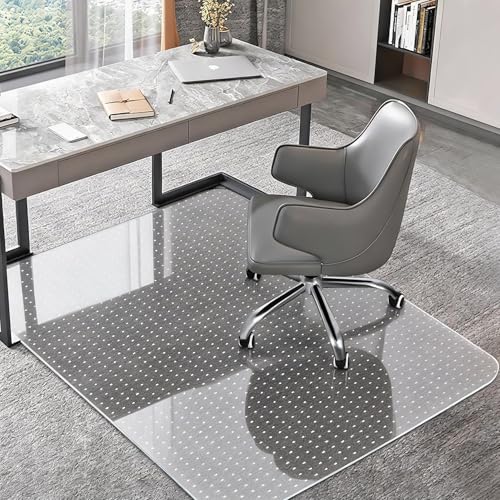
BesWin Chair Mat for Carpet 30 x 48 — Best Compact Clear Mat
The BesWin is the straightforward answer for the most common home-office situation: a single desk, low-pile carpet, and a chair whose travels are modest. Its 30-by-48-inch footprint covers the working arc of a standard task chair without annexing the whole room, and the clear finish keeps the carpet visible — a real consideration in rented homes and spare bedrooms where the floor is part of the décor rather than a surface to be hidden. The listing describes it as heavy duty, built to lie flat without curling, and those two claims are the ones to test in your first week: a mat that resists its rolled shipping memory quickly is a mat whose material has been specified honestly.
Low pile is the operative phrase in this pick’s brief. On short, dense carpet — the loop and cut piles fitted in most apartments and modern offices — a mat of this class spreads the caster load well enough that the chair glides rather than ploughs. Push the same mat onto a plush bedroom carpet and physics reasserts itself: the mat flexes into the pile, the casters sit in soft hollows, and rolling becomes a series of small climbs. That is not a defect in the BesWin; it is the category’s central rule, and it is why the thicker pick further down this guide exists.
One more ownership note belongs to compact mats generally: they reward a tidy rolling habit. A smaller field asks the chair to stay mostly within its borders, and sitters who treat the mat’s edge as a boundary rather than a suggestion will get years of clean service from a mat this size. Households where the chair roams — to a bookshelf, a window, a second desk — should read that as a sizing instruction rather than a criticism, and take their cue from the measuring guidance further down this page: the mat must fit the roaming, not the other way round.
Daily life with a clear mat has one recurring footnote: visibility. A transparent mat on a similar-toned carpet can be nearly invisible to a walking foot, and its edge — however low — announces itself to bare toes at least once in every household. Ramped edges soften the encounter, and most owners adapt within days, but households with toddlers or elderly visitors should place the mat with the same care they’d give a rug’s edge. Within its brief — low pile, single desk, tidy footprint — the BesWin is the pick that asks the least of its owner.
- Size: 30 x 48 inches, rectangular
- Finish: clear, carpet shows through
- Intended floor: low-pile carpet per listing
- Design aim: flat-lying, curl-resistant, easy glide
Strengths
- Compact footprint suits smaller rooms and single-desk setups.
- Clear finish preserves the look of the carpet underneath.
- Straightforward rectangle is easy to position and replace.
Trade-offs
- Not the answer for medium or plush pile carpets.
- Smaller coverage can strand a caster off the edge on big roll-backs.
- Clear edges are easy to forget with bare feet.
Best for: low-pile home offices and renters who want protection without visual change. Not suited for: plush carpets, wide-ranging chairs or large L-shaped desk layouts.
Check price on Amazon.

HON Office Chair Mat for Carpet 36 x 48 — Best from an Office Furniture Maker
HON makes the chairs, desks and storage that fill contract offices, and its chair mat carries that institutional DNA: a 36-by-48-inch clear mat with an extended lip and ramped edges, specified for low-pile use. The lip is the design’s centre of gravity. It slides beneath the desk so the protected zone extends into the space where the chair actually spends its hours — tucked in, feet on the floor, casters nudging forward and back in small adjustments all day. Rectangular mats protect where the chair parks; lipped mats protect where the chair lives.
Ramped edges deserve their own sentence because they are the difference between a mat and an obstacle. The caster that rolls off a ramped edge descends a slope; the caster that drops off a square edge lands with a jolt that, repeated thousands of times, is how mats crack at their borders and how chair stems loosen in their sockets. HON’s office heritage shows in treating that transition as engineering rather than trim. The extra width over the compact picks also matters in practice: 36 inches across gives a chair room to angle toward a side table or a second monitor without a wheel wandering onto carpet mid-task.
There is a small ritual worth performing with any lipped mat, this one included: before the desk’s cables, drawers and neighbouring furniture settle into their final positions, slide the lip in and sit through a full rehearsal of your working movements. The lip’s depth decides where the mat’s main field begins, and a lip pushed too far under a deep desk can steal coverage from the roll-back zone where it is needed most. Two minutes of rehearsal now is worth a month of a caster finding the mat’s rear edge at the exact moment you lean back with a full mug.
Who should choose the institutional option? Anyone furnishing a dedicated office — home or otherwise — who expects the mat to be a decade-long fixture rather than a seasonal experiment, and anyone whose chair is a full-size executive model whose footprint mocks smaller mats. The clear finish keeps it visually quiet in formal rooms. Its low-pile specification should be honoured as strictly as any other pick’s: HON’s honesty about the intended pile is a feature, and the correct response to a deeper carpet is a thicker mat, not optimism.
- Size: 36 x 48 inches with extended lip
- Edges: ramped for smooth caster transitions
- Finish: clear
- Intended floor: low-pile carpet per listing
Strengths
- Lip extends protection into the under-desk working zone.
- Ramped edges protect both mat borders and caster stems.
- Generous width suits full-size executive chairs.
Trade-offs
- Lip shape fits standard desk depths better than corner desks.
- Specified for low pile; plush carpet needs a different class.
- Larger mat is heavier to position and to store.
Best for: dedicated offices, executive chairs and anyone who wants the under-desk zone protected. Not suited for: deep-pile rooms or corner-desk layouts where a lip cannot tuck in.
Check price on Amazon.

YumHome Chair Mat for Carpet Floors — Best Anti-Slip Focus
The YumHome mat leads with the complaint every carpet-mat owner eventually makes: the mat moved. Its listing describes a heavy-duty desk chair mat for low and no-pile carpeted floors, sized 48 by 30 inches, with anti-slip behaviour as the headline promise. Mat creep is a subtle failure — a centimetre a day, always in the direction of your rolling — until the mat’s edge is under the desk leg, the chair sits half on and half off, and the whole arrangement feels haunted. A mat engineered to resist that drift is solving the problem that actually ends ownership of lesser mats.
The no-pile half of its brief is worth pausing on. Plenty of modern workspaces have carpet tiles, loop-pile commercial carpet or effectively bare low coverings where the challenge is not caster sink but mat slide: a smooth floor covering offers little for a mat to grip. In those rooms the anti-slip underside matters more than thickness, and the YumHome’s orientation makes sense. On genuinely soft residential low pile it still performs the standard mat duties — spreading load, restoring glide — but its natural home is the hard-wearing, low-textured end of the carpet spectrum.
There is a maintenance corollary to the anti-slip promise worth knowing: a mat that grips well also gathers the room’s dust against its underside edges, where the seal is tightest. The periodic lift-and-vacuum ritual described later in this guide matters slightly more for this pick than for its rivals, and it is also easier to verify — a mat that has truly stayed put lifts to reveal a clean rectangle of carpet with a dusty border drawn around it, like a tide line. Treat that border as the mat’s signature that it has been doing its job.
Its rectangular 48-by-30 shape mirrors the BesWin’s footprint with the dimensions transposed in emphasis — length along the desk rather than depth away from it — which suits long desks and dual-monitor setups where the chair travels sideways more than backwards. Sideways travel is the pattern anti-slip design serves best, because lateral rolling is what walks a mat across a floor. If your workday is a slow traverse between two monitors and a filing drawer, this is the pick shaped like your problem.
- Size: 48 x 30 inches, rectangular
- Intended floor: low and no-pile carpet per listing
- Design aim: anti-slip stability with heavy-duty build
- Layout fit: long desks and lateral chair travel
Strengths
- Anti-slip focus tackles the creep that ruins lesser mats.
- Suits carpet tiles and no-pile commercial coverings.
- Long format matches dual-monitor, side-travelling work patterns.
Trade-offs
- Depth is modest for chairs that roll far back.
- Plush pile remains outside its design brief.
- No lip, so the under-desk zone relies on placement.
Best for: carpet-tile offices, long desks and anyone whose previous mat migrated. Not suited for: deep-pile rooms or chairs with a long backward travel.
Check price on Amazon.

Vicwe Chair Mat for Carpet with Studs — Best Studded Grip in Black
The Vicwe makes two declarations at once. The first is underneath: a studded underside, the carpet-mat mechanism in its classic form, where rows of short cleats settle into the pile and anchor the mat against the shear forces of rolling. Studs are the correct answer on carpet precisely because they do not try to grip the surface — they engage the pile’s depth, which is why a studded mat stays put in rooms where smooth-backed mats go wandering. The listing pairs that underside with a heavy-duty 48-by-36-inch body described as anti-slip and waterproof, aimed at rolling chairs in gaming, home and office settings.
The second declaration is the colour. Black, opaque and unapologetic, this mat is furniture rather than invisibility, and in the right room that is the better choice: gaming setups with dark décor, studios where a clear mat would show every scuff as a grey ghost, and workspaces where the mat’s boundary being visible is a safety feature rather than a flaw. An opaque mat also hides the compressed-pile shadow that develops under any long-serving mat, which on light carpets can look like a stain even after the mat is lifted and the pile vacuumed back to life.
Waterproofing, mentioned in the listing, sounds like a footnote until the first coffee incident at desk height. A mat that shrugs off spills protects the carpet beneath from the one category of damage no amount of caster-spreading can prevent, and it wipes clean without the spill migrating to the mat’s edge and under it. Combined with the studs, the Vicwe’s character is clear: this is the mat for rooms that work hard and look dark — esports dens, music studios, workshop offices — where the floor protection needs to be as deliberate as the equipment above it.
- Size: 48 x 36 inches, rectangular
- Underside: studded for carpet grip
- Finish: opaque black, waterproof surface per listing
- Settings: gaming, studio and home office
Strengths
- Studded underside anchors positively into carpet pile.
- Black finish hides scuffs and suits darker rooms.
- Waterproof surface contains desk-height spills.
Trade-offs
- Studs are for carpet only — never use on hard floors.
- Opaque mat hides the carpet some owners want to display.
- Bold colour will not blend into a formal, light-toned office.
Best for: gaming and studio rooms with low-to-medium carpet and energetic rolling. Not suited for: hard floors, or rooms where the mat should disappear visually.
Check price on Amazon.

Chair Mat for Low Pile Carpet 1/4 Thick — Best Heavy-Duty Thickness
Thickness is the blunt instrument of this category, and this pick wields it openly: a full quarter-inch of material, the dimension stated right in its name, with a lip and a semi-transparent finish. On low-pile carpet that still has some give — the dense residential piles that make thinner mats flex and pool under the casters — that extra substance is the difference between a mat that behaves like a floor and a mat that behaves like a heavy blanket. The chair rolls on the mat’s own stiffness rather than negotiating the carpet’s softness through it.
The physics are worth stating plainly, because they explain the whole category. A caster presses down with a share of the sitter’s weight on a patch the size of a coin. A thin mat spreads that load a little; a thick, rigid mat spreads it across a plate-sized area of carpet, and the pile beneath is compressed gently and evenly instead of being speared at five points. That is why the quarter-inch class is also the recommendation for heavier sitters, for chairs with hard narrow casters, and for mats that will live under a desk for years — the material has more to give before it begins to crack, craze or take a permanent set.
The semi-transparent finish splits the difference between the clear picks and the Vicwe’s black: the carpet’s colour softens through it without the mat pretending to be absent. The lip repeats the HON’s under-desk logic. What you accept in exchange is weight and handling — a quarter-inch mat is a serious object to unroll, position and, one day, store — and a price tier above the thinner field, expressed here only as positioning: this is the premium end of the plastic mat range, below only the glass alternative that closes this guide. Buy it when your carpet, your chair or your working hours have defeated a thinner mat, or when you would rather skip that defeat entirely.
- Thickness: 1/4 inch, stated in the listing
- Shape: lipped, semi-transparent finish
- Intended floor: low-pile carpet per listing
- Role: heavy-duty, long-service installations
Strengths
- Quarter-inch body resists flexing and caster pooling.
- Best load-spreading here for heavier sitters and chairs.
- Lip protects the under-desk zone like the HON.
Trade-offs
- Heavy and awkward to unroll, position and store.
- Sits in the premium tier of polymer mats.
- Even this thickness has limits on genuinely plush pile.
Best for: low-pile rooms that defeated thinner mats, heavier users and permanent desk installations. Not suited for: deep shag or plush pile, or anyone who moves their office seasonally.
Check price on Amazon.
A Tempered Glass Chair Mat, Discussed Generically — Prose-Only Premium
Above the polymer field sits a different material altogether: the tempered glass chair mat, a rigid panel that turns the chair’s patch of carpet into something closer to a section of showroom floor. Glass does not flex into pile, does not curl at the corners in summer, does not craze or yellow, and presents casters with a surface so smooth that the chair’s glide becomes the story of the room. It is the premium tier of this category by a clear margin, and we discuss it in prose because its weight makes delivery, placement and any future move a planned operation rather than an unboxing.
Owners who make the jump usually report one unexpected pleasure: silence of a different order. Polymer mats are quiet; glass is quieter still, with a faint, smooth roll that reads as quality every time the chair moves, the way a heavy door’s close reads as quality in a house. It is an indulgence, plainly, but it is an indulgence exercised hundreds of times a week, which is the kind that amortises fastest. If the rest of a permanent office has been built to a high standard, the glass panel is rarely the purchase its owner regrets.
The practicalities deserve respect. A glass mat arrives heavy, needs two people and a clear path, and once placed it is effectively a fixture — which is precisely its appeal for a permanent office and its drawback for anyone whose furniture migrates. It needs no studs, since its own weight anchors it, and it suits carpet and hard floors alike. On carpet it still compresses the pile beneath over years, as any mat does, but the rolling surface itself will outlast several generations of the chairs above it. For a forever desk in a forever room, glass is the honest endgame of this entire product category.
- Material: tempered glass panel
- Tier: premium; freight-style delivery and two-person placement
- Grip: weight-anchored, no studs, suits carpet or hard floors
- Role: permanent installations
Strengths
- Smoothest rolling surface in the category, permanently.
- Never curls, crazes or yellows with age.
- One purchase can outlast several chairs.
Trade-offs
- Heavy delivery and placement; effectively a fixture once down.
- Premium tier pricing by a wide margin.
- Moving house with it is a planned operation, not an afterthought.
Best for: permanent home offices where the desk will not move for years. Not suited for: renters, seasonal rearrangers or anyone who dreads heavy deliveries.
Comparison Table
| Pick | Size / shape | Underside / build | Defining feature |
|---|---|---|---|
| BesWin Chair Mat for Carpet 30 x 48 | 30 x 48, rectangle | Clear, low-pile build | Compact and visually invisible |
| HON Office Chair Mat for Carpet 36 x 48 | 36 x 48, lipped | Ramped edges, low-pile build | Under-desk lip protection |
| YumHome Chair Mat for Carpet Floors | 48 x 30, rectangle | Anti-slip focus | Stays put on low/no-pile floors |
| Vicwe Chair Mat for Carpet with Studs | 48 x 36, rectangle | Studded underside, black | Positive grip, spill-proof surface |
| Chair Mat for Low Pile Carpet 1/4 Thick | Lipped, semi-transparent | Quarter-inch body | Heaviest-duty polymer build |
| Tempered Glass Chair Mat (prose-only) | Various panels | Rigid glass, weight-anchored | Permanent, smoothest glide |
How Do You Measure Your Carpet’s Pile Before Choosing?
Pile height sounds like a specification you need a laboratory to find, but a coin and thirty seconds will do. Press a fingertip into the carpet beside the desk until you feel the backing, then compare that depth against the edge of a coin: if the fibres barely reach the coin’s rim, you are in low-pile territory and most of this guide applies directly. If the pile swallows half the coin or more, you are shopping at the heavy-duty end — quarter-inch polymer or glass — and you should be sceptical of any thin mat’s promises, including promises made in this category’s advertising generally.
Density matters alongside height. A short but sparse pile over a soft underlay can behave like a taller carpet under a caster, because what defeats mats is total softness beneath the wheel, not fibre length alone. The kneel test is the honest field method: kneel where the chair sits and judge how far you sink and how slowly the spot recovers. Rooms over plush underlay deserve the same respect as visibly deep carpet. And if your home office sits on carpet tiles or commercial loop pile, rejoice quietly — you own the easiest floor in this entire guide, and even the compact picks will behave like premium products on it.
How Do You Flatten and Place a New Chair Mat?
Polymer mats ship rolled, and they arrive with the roll’s memory as their first opinion about shape. Unroll yours in a warm room — warmth is the material’s negotiator — and lay it curve-down on the floor with weight distributed across the resisting corners: a stack of books, the chair itself parked overnight, patience measured in a day rather than an hour. Some owners reverse-roll the mat briefly before laying it; gentle warmth from the room, never from a heat gun or radiator blast, is the safe accelerant. Judge flatness after twenty-four hours, not after twenty minutes, and do not let a first-evening curl talk you into a return the mat does not deserve.
Placement is the second half of the ritual. Slide the mat into position before the desk’s other furniture settles around it, align the lip under the desk if your pick has one, and confirm with the chair itself: sit, roll to your furthest reach in every direction, and check that no caster crosses an edge in normal work. Edges should be crossed only by intention, never by routine. Once placed, give the studs or underside a day of the chair’s weight to settle into the pile; grip improves as the mat and carpet agree on their arrangement, and a mat nudged repeatedly in its first hours never gets the chance to settle at all.
What Mistakes Do People Make with Carpet Chair Mats?
Buying by desk size instead of chair travel is the classic error: the mat matches the desk’s footprint beautifully and abandons the chair’s casters exactly where the rolling actually happens, a foot behind it. The second mistake is floor confusion — a smooth-backed hard-floor mat skating on carpet, or, worse, a studded carpet mat placed on hardwood, where the studs become the damage the mat was bought to prevent. The underside and the floor must be a matched pair, and swapping rooms means re-checking the pairing.
Measuring errors have their own hall of fame. Owners measure the desk, then measure the chair parked, then order with confidence — and discover the working truth that a chair in use occupies a travelling ellipse far larger than its parked footprint, especially once a human leans, reaches and rolls in it. The reliable method is embarrassingly theatrical: sit in the chair, work for ten honest minutes, then look down and note where the casters have actually been. Chalk, painter’s tape or a partner with a phone camera all work. The rectangle that contains that honest ten minutes, with a margin for enthusiasm, is the mat you need.
Expectation errors follow. A thin mat laid over plush carpet will pool under the casters and may crack along the flex lines, and its owner will blame the mat for a mismatch the listing stated plainly. Mats also suffer from being forgotten: grit trapped beneath a mat grinds the carpet it protects, so lift and vacuum under yours occasionally, and let the pile recover. And the quietest mistake is patience failure on day one — returning a good mat for its shipping curl before warmth and weight have had their day to work. Most mats in this guide are better than their first evening suggests.
Chair Mat, Low Rug or Bare Carpet: What Are the Real Alternatives?
Every home office eventually stages this three-way argument. The low rug is the decorator’s candidate: a flatweave rug under the desk looks intentional, feels warmer than polymer and protects the carpet beneath from caster wear by sacrificing itself instead. Its weakness is rolling resistance — even a flatweave adds drag compared with a mat’s hard surface, and rug edges curl, creep and catch casters in ways a bevelled mat edge is designed not to. A rug also bunches under a rolling chair over weeks, migrating in the direction of travel until it meets a desk leg. As a style choice with a chair that barely moves, a rug can work; as an engineering answer for a chair that travels metres a day, it is a compromise wearing nice colours.
Bare carpet is the default that this entire category exists to correct, but it deserves a fair hearing for one specific case: the chair that stands on carpet tiles in a commercial-grade installation, where the tiles themselves are the sacrificial surface and can be replaced individually when a caster lane wears. If your floor is genuinely modular and you hold spare tiles, the mat’s protection is redundant — though the rolling-effort argument remains, because even carpet tile offers more resistance than a mat’s surface. In every residential case we have considered, bare carpet loses on both counts: the wear is real, the effort is real, and neither announces itself until the damage is done.
The mat wins the argument wherever rolling is frequent and the floor is worth keeping, which describes most desks where a person earns a living. Its honest costs are aesthetic — a sheet of polymer is never the prettiest object in a room — and the small rituals of flattening and occasional lifting. Clear mats minimise the aesthetic cost to nearly nothing; black and glass mats convert it into a design statement. Choose with your eyes open about which cost you are paying, and the category holds no disappointments.
How Does a Mat Change the Way the Chair and Sitter Feel?
The first change is effort, and it is larger than expected. On carpet, a surprising share of the small fatigue of a working day is not posture but propulsion: the constant low-grade pushing against caster resistance to reach, turn and return. Remove the resistance and the chair becomes what its designers intended — a seat that repositions at a nudge. People consistently describe the first day on a mat as the chair feeling “lighter,” though nothing about the chair changed; the floor stopped arguing. For anyone with shoulder, wrist or back sensitivity, that reduction in daily pushing is not a luxury but the practical core of the purchase.
The second change is acoustic. Casters on a mat make a smooth, low sound; casters grinding through pile and underlay make a muffled crunch that downstairs neighbours and sleeping households learn to recognise. In flats and shared houses, a mat is partly a courtesy device. The third change is subtler: stability at rest. A chair on carpet creeps and settles as the pile shifts; a chair on a mat stays where it was left, which matters for the small choreography of sitting down with a hot drink in one hand. None of these effects appear on a specification sheet, and together they are why mats, once bought, are almost never removed voluntarily.
Why Do Renters and Home Sellers Think About Mats Differently?
For a renter, the mat is deposit insurance with a daily dividend. Caster lanes are exactly the kind of wear that end-of-tenancy inspections photograph well: directional, localised and clearly attributable to the tenant’s furniture. A mat costing a modest sum stands between the chair and a deduction many times its size, and unlike most insurance it also makes every working day easier while it protects. The discipline that completes the strategy is photographic: take a dated picture of the carpet before the mat goes down and after it comes up, and the conversation with any landlord starts from evidence rather than memory.
Sellers think in the opposite direction — the mat as concealment’s honest cousin. A mat that has protected a home-office carpet for years lets that room present as a bedroom again at sale time, with pile that has not been machined into lanes by a decade of deadlines. Even where some compression shadow remains, it reads as furniture’s footprint, which buyers accept, rather than machinery’s track, which they price. If you work from home in a house you may sell, the mat is quietly protecting the room’s second identity as well as its floor.
How Do You Clean Under and Around a Chair Mat?
Put the mat on the same schedule as the room’s deeper cleans — every month or two in ordinary homes, more often where pets or garden doors feed the grit supply. Roll the chair off, lift the mat from one corner (the thicker picks will remind you of their weight; bend your knees), and vacuum both the carpet beneath and the mat’s underside. What you find will justify the habit: a fine abrasive dust that migrated under the edges and would otherwise be ground into the pile by the mat’s own micro-movements. Wipe the mat’s top surface with a damp cloth and mild cleaner; avoid solvents, which can cloud clear polymers.
While the mat is up, give the carpet its recovery moment. Vacuum the compressed area slowly against the pile’s direction, and let it stand uncovered for a few hours if the room allows; pile that is regularly relieved recovers more completely than pile compressed for unbroken years. Check the mat’s edges and underside at the same time — cracks begin at borders, studs wear, and a mat inspected twice a year never surprises you mid-roll. Then relay it, let it settle under the chair’s weight again, and return to a working day that will feel, briefly and pleasantly, like the first day the mat arrived.
How Thick Is Thick Enough? Climbing the Mat Ladder in the Right Order
Buyers often ask for a single number, and the honest answer is a ladder rather than a number. The first rung is the standard clear mat, appropriate where pile is low, underlay is firm and the chair is an ordinary task chair with an ordinary sitter: this covers the majority of apartments, spare rooms and commercial offices, and it is where the BesWin, HON and YumHome picks live. The second rung is the heavy-duty quarter-inch class, for low pile with real give, heavier sitters, chairs with hard narrow casters, or any room where a first-rung mat has already demonstrated flex and pooling. The third rung is glass, where the question stops being thickness at all and becomes permanence.
Climbing in order is economical, but skipping a rung is sometimes the smarter economy. If your carpet defeated a thin mat in a previous home, or your kneel test sinks deep over plush underlay, the lesson has already been taught and paid for once; buy the rung your floor demands rather than re-enrolling in the same experiment. Conversely, owners of carpet tiles and firm low pile who buy glass for rolling performance are purchasing permanence they may not need — delightful, but the first rung would have rolled nearly as well in that room. The ladder’s purpose is matching, and matching is the whole skill this category asks of you.
One more variable can move you a rung without changing the mat: the chair’s casters themselves. Larger, softer wheels spread load and bridge pile, and a chair upgraded with quality casters can make a first-rung mat behave like a second-rung one. That interplay is why this guide’s Related Guides point so deliberately at the casters comparison — mat and wheels are one system wearing two shopping lists, and the cheapest rung-climb is sometimes a set of wheels rather than a thicker sheet.
What Is Different About a Mat Under a Gaming Chair?
Gaming chairs roll differently. Their sitters recline, surge forward, swivel hard and plant their feet to push off in ways a task-chair sitter rarely does, and the sessions run longer — an evening’s play can exceed a working day’s rolling in a fraction of the hours. The mat beneath takes that energy as shear, which is why the gaming case argues for grip first: studs or a serious anti-slip underside, because a mat that survives lateral enthusiasm without migrating is the mat still protecting the carpet in month six. It is no accident that the Vicwe, this guide’s gaming-shaped pick, leads with its underside and its spill-proof top.
The room’s other habits matter too. Gaming setups attract drinks at elbow height, snack debris and the occasional celebratory lurch, so a surface that wipes clean in seconds is a practical feature rather than a garnish. Aesthetically, the gaming room is where the black mat stops being a compromise and becomes the obvious choice: it disappears into the room’s palette, hides the scuff archaeology of hard use, and its visible boundary actually helps a chair’s owner sense the mat’s edge during the kind of movement that happens with eyes fixed on a screen. Match the mat to the room’s real behaviour, and gaming duty stops being the category’s stress test and becomes just another well-fitted desk.
What Should You Expect in the First Month of Ownership?
Week one is negotiation. The mat flattens by degrees, the studs or underside settle into the pile, and you will probably nudge the position twice before it agrees with your chair’s habits — a caster that clips an edge at your favourite working angle is information, and moving the mat two inches is the correct response rather than a failure of the purchase. By the end of the week the rolling should feel like the room’s new normal, and the faint novelty of gliding instead of dragging will have stopped registering consciously, which is the surest sign it is working.
Weeks two to four reveal the mat’s character. This is when creep, if your underside and floor are mismatched, announces itself as a slow rotation or drift; when a too-thin mat on giving pile begins to show its pooling under the casters at your main position; and when edge behaviour — how the chair crosses on and off during your real routines — proves either invisible or irritating. All three discoveries are still cheap at this stage: positions can be corrected, a mat can be exchanged for the next rung of the ladder, and expectations can be matched to the floor you actually have. The owners who end up hating chair mats are usually those who ignored month one’s evidence and let a mismatch harden into a grievance.
By the end of the month, a well-matched mat disappears from attention entirely, which is the category’s definition of success. It will reappear in your awareness only at the edges of experience: the day you roll silently across the room for a book instead of standing, the visit from a landlord who finds the carpet innocent, the afternoon you lift it for cleaning and see the pile beneath still standing. Judge your purchase at that horizon — not at the first evening’s curl — and the picks in this guide will have been given the trial they were designed to pass.
Final Recommendation
Let your carpet cast the deciding vote. On low pile in a modest room, the BesWin’s clear compact sheet is all the mat most desks will ever need; step up to the HON when the under-desk zone and ramped edges matter, and to the YumHome when creep has been your enemy or your floor is carpet tile. The Vicwe owns the darker, harder-working rooms with its studs and spill-proof black finish, while the quarter-inch lipped mat is the heavy-duty answer when thinner sheets have flexed and failed you. And if the desk is permanent and the budget stretches, the glass panel ends the conversation for good. Whichever you unroll, measure the chair’s real travel, match the underside to the floor, and give the mat its day to lie flat — because a chair that glides silently over a protected carpet is one of those small daily mercies that a good home office quietly runs on.
Frequently Asked Questions
Can I use a carpet chair mat on a hard floor?
Not if it is studded: the cleats that grip carpet pile will mark and can damage hardwood, laminate and vinyl, sometimes in a single afternoon of rolling. Hard floors need smooth-backed mats designed specifically for them. The exception in this guide is the glass panel, whose weight-anchored, stud-free design suits either surface.
Why does my chair still feel hard to roll on the mat?
Usually the pile beneath is winning: the mat flexes into soft carpet and each caster sits in a shallow hollow, so every roll begins with a small uphill push that your shoulders register long before your eyes do. The cures are a thicker, stiffer mat — the quarter-inch class or glass — or larger chair casters, which bridge softness better. Check also that the mat has fully flattened after installation; a lingering curl adds invisible slopes to every crossing.
How long will a chair mat last?
It depends on thickness, chair weight and rolling volume. Thin mats on busy chairs may craze or crack within a few years; heavy-duty polymer lasts far longer, and glass effectively does not wear out as a rolling surface. Cracking at the edges or permanent caster dents are the retirement signals to act on. A mat retired promptly matters more than it sounds: a cracked edge sheds sharp fragments into the carpet and catches casters hard enough to stress their stems, so the end of a mat’s life should be a planned replacement, not an accident you roll over one morning.
Will a mat damage my carpet over time?
A mat protects against caster wear, which is the aggressive damage in any office, but any long-placed mat compresses pile and can shade the covered area differently from surrounding carpet. Lift it periodically, vacuum and groom the pile, and the trade remains overwhelmingly in the carpet’s favour — unprotected caster lanes are permanent in a way compression shadows rarely are.
What size mat do I need for an L-shaped desk?
Measure the chair’s travel, not the desk: sit and roll to every working position, note the furthest caster positions, and choose coverage that contains them all — often a larger lipped mat for the main run, accepting that the return of the L may need its own smaller mat. Two honest rectangles beat one heroic guess. If the two mats meet, butt their edges tightly on the same pile so the chair crosses a seam rather than a step, and expect to re-seat that seam occasionally as the room settles into its routines.
How do I stop my mat from moving?
Start with the right underside — studs for pile, anti-slip design for low and no-pile floors — then let the mat settle under the chair’s weight for a full day without nudging it into place again. Persistent creep on correct undersides usually means the mat is slightly small, so its edges are being ridden over and levered; a larger mat often stays put where a smaller one wandered.
Related Guides
Rolling smoothly is only half of a kind floor; the wheels themselves are compared in Best Casters for Office Chairs on Carpet, the home’s softer furnishings continue with Best Blanket Colors for a Brown Bed Set, the dining end of the chairs category is covered by Best Hunting Blind Chairs, and the sound-dampening side of a quiet room is explored in Best Acoustic Blankets.


