What's inside
- Where to Buy Machines That Publish Their Numbers
- Key Takeaways
- Quick Picks
- How Did We Choose Picks Around Verified Ratings?
- Comparison Table
- What Is CADR, and Why Does It Matter More Than Brand Claims?
- What Does AHAM Verifide Actually Verify?
- How Should You Read a Purifier’s Coverage Claim?
- What Can’t Lab Ratings Tell You About a Purifier?
- What Mistakes Do Shoppers Make With Ratings and Reviews?
- How Does a CADR Test Actually Happen Inside the Chamber?
- What Do HEPA Grades and Filter Labels Really Certify?
- How Do Energy and Noise Ratings Fit Into a Verified Decision?
- How Can You Verify a Purifier Yourself in Five Minutes?
- Why Do Ratings Differ Between Countries and Standards Bodies?
- How Do Magazine Test Programs Differ From the Directory?
- Can You Trust the Air-Quality Number on the Machine’s Own Display?
- Final Recommendation
- Frequently Asked Questions
- Related Guides
As an Amazon Associate I earn from qualifying purchases. This post may contain affiliate links at no extra cost to you.
cottageverdict.com is reader-supported. When you buy through links on our site, we may earn an affiliate commission.
Where to Buy Machines That Publish Their Numbers
All six picks below are sold through Amazon, where you can check price on Amazon and compare the verified figures quoted on each listing against the registries described in this guide. A quick disclosure of method before anything else: this site is not a testing laboratory, and it is not affiliated with any consumer magazine or ratings organization. When readers search for the best air purifiers consumer reports style investigations would uncover, what they usually want is the discipline those investigations apply: independently measured performance, verified by a body with no stake in the sale. That discipline exists in this industry, it has names and public directories, and this guide is built around it, favoring machines whose key claims can be checked by anyone in under five minutes.
Key Takeaways
- CADR, the Clean Air Delivery Rate, is the core lab measurement for purifiers, expressing how much filtered air a machine delivers against dust, pollen, and smoke-sized particles.
- AHAM Verifide is the independent verification program that tests CADR claims and publishes them in a public directory you can search yourself.
- The classic sizing rule pairs a machine’s smoke CADR with at least two-thirds of the room’s square footage for standard ceiling heights.
- Manufacturer coverage claims based on one air change per hour are not comparable to verified CADR room sizes; the directory figure is the one to trust.
- Every pick in this guide carries verification or long-standing independently confirmed performance, which is why the list looks different from a typical roundup.
- Lab numbers measure particle delivery, not odor chemistry, noise comfort, or ownership cost, so they should anchor a decision rather than make it alone.
Quick Picks
| Pick | Badge | Why it is here |
|---|---|---|
| Coway Airmega Mighty AP-1512HH | Best Verified All-Rounder | A decade-defining machine whose CADR figures have been independently confirmed so often it has become a reference point for the category. |
| Winix 5520 | Best Verified Value With a Sensor | Strong verified delivery for large rooms plus a real air-quality monitor, at a price that undercuts the premium tier. |
| Levoit Core 400S | Best Verified Smart Mid-Size | AHAM Verifide status, smart controls, and honest mid-large room numbers from the most mainstream brand in the field. |
| Blueair Blue 211i Max | Best Verified for Big Rooms | Very high verified delivery for large spaces with unusually low noise, from a maker that publishes its test basis openly. |
| Honeywell HPA304 AllergenPlus | Best Verified Legacy Design | A long-running, independently listed workhorse whose inexpensive filters make verified performance cheap to keep. |
| Medify MA-40 | Best Verified Tower Format | A slim tower with substantial hourly coverage claims and HEPA hardware that suits rooms where floor space is tight. |
Every machine here earned its place through checkable numbers first and features second. Where a pick’s marketing coverage and its verified room size disagree, we follow the verified figure and say so in its section.
Before the picks themselves, one framing note may help readers arriving from a magazine mindset. This guide deliberately ranks by fitness for stated jobs rather than by a single composite score, because composite scores smuggle in weights that may not match your household. A family room with a wood stove, a bedroom for a light sleeper, and a workshop full of sawdust all want verified delivery, but they want it wearing different manners, at different volumes, and at different filter budgets. The sections below keep those jobs separate on purpose, and the comparison table gathers the shared facts in one place for readers who prefer to do their own weighting.
How Did We Choose Picks Around Verified Ratings?
The selection rule for this guide was stricter than for our other roundups. A machine had to offer performance claims that an independent party has tested, through the AHAM Verifide program’s public directory or through a long public record of third-party measurement consistent with its claims. Models with only internal, unpublished testing were set aside no matter how appealing their design, because a guide about verified ratings that relied on unverifiable numbers would be a contradiction in terms.
Within that verified pool, we balanced the things laboratories do not measure. CADR says nothing about how a machine sounds at two in the morning, how its filters price out over five years, or whether its carbon stage is a serious bed or a scented sheet. So the six picks spread across those ownership profiles deliberately: a reference all-rounder, a sensor-led value pick, a smart mainstream model, a big-room specialist, a legacy design with cheap filters, and a tower for tight floors. The lab figures got them into the room; the ownership analysis arranged their order.
A note on what this guide refuses to do: it does not publish invented scores, star tables of our own manufacture, or rankings attributed to any publication. When we describe a machine as highly rated by independent measurement, we mean its verified CADR and room-size figures stand up in the registry, and we encourage every reader to confirm that in the directory themselves. That five-minute check is the entire spirit of this article, and it is more valuable than any verdict we could hand down.

Coway Airmega Mighty AP-1512HH — Best Verified All-Rounder
Few appliances in any category have been measured as often, by as many independent hands, as the Airmega Mighty. It has been on the market for years, and across that span its published CADR figures, in the mid-200s across dust, pollen, and smoke categories, have been confirmed repeatedly, which is why it functions as a de facto benchmark: new machines are routinely described as faster or slower than the Mighty, the way new cars are compared to a class standard. Its AHAM room-size rating sits in the mid-300 square foot range, a number worth memorizing because the marketing coverage on its box, up to 1,748 square feet, describes a far gentler air-change assumption.
That gap between the two numbers is the most useful lesson in this guide, and the Mighty teaches it honestly because both figures are printed in its materials. The verified rating assumes the brisk air changes a sensitive sleeper wants; the headline figure assumes roughly one change an hour. Neither is a lie, but only one belongs in a buying decision for a bedroom that matters. Readers who learn to ask which assumption a coverage claim uses will never be misled by a purifier box again.
As an ownership proposition, the Mighty pairs its verified delivery with a washable pre-filter, a HEPA and carbon combination filter on an annual rhythm, an air-quality indicator, and auto and eco modes that have been refined over a long production life. It is not the quietest, smartest, or cheapest machine here. It is the one whose numbers you can check in the most places, and for a guide about verified performance, that makes it the natural first pick.
- Filtration: HEPA and carbon combination with washable pre-filter
- Verified room size: mid-300 sq ft class under AHAM assumptions
- Format: compact floor unit, auto and eco modes, air-quality indicator
- Ownership note: annual filter rhythm keeps running costs predictable
Strengths
- The most independently corroborated performance record in its class.
- Balanced CADR across particle types suits mixed household loads.
- Long production life means filters and parts stay easy to source.
Trade-offs
- Design and interface feel dated beside newer smart rivals.
- Headline coverage figure invites misunderstanding without the verified context.
- Carbon stage is a combination sheet, not a deep odor bed.
Best for: buyers who want the safest, most checkable purchase in the category. Not suited for: very large rooms or shoppers prioritizing app features.
Check price on Amazon.
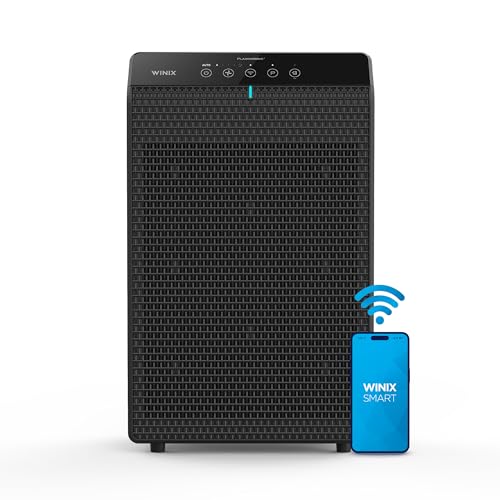
Winix 5520 — Best Verified Value With a Sensor
The Winix 5520 pairs verified large-room delivery with the feature that makes lab numbers livable: a genuine air-quality monitor that lets the machine respond to the room rather than to a schedule. Its published performance covers rooms up to roughly 1,882 square feet on an hourly basis, with verified ratings placing its comfortable territory in the large-bedroom and living-room class. The combination of true HEPA media and a high-deodorization carbon filter gives it a broader brief than most verified peers, which tend to be particle specialists with token odor stages.
The sensor deserves scrutiny in a guide about verification, because onboard sensors are not lab instruments. The 5520’s monitor is best understood as a trend reader: it notices cooking events, dust disturbances, and open-window pollen days, and it adjusts fan speed accordingly. That is genuinely useful automation, and it is a different claim from measurement accuracy. We include the distinction because readers of this particular guide are exactly the readers who will appreciate it: the directory verifies what the machine delivers, while the sensor merely decides when to deliver it.
Value completes the case. The 5520 typically sells below the premium tier while offering verified delivery in the same conversation as machines costing considerably more, and its filter sets are priced in the mainstream band. Households that want the verified approach without the flagship bill, in a room large enough to embarrass compact models, will find this the most efficient spend in the guide.
- Filtration: true HEPA plus high-deodorization carbon filter
- Coverage: large rooms, hourly figure up to about 1,882 sq ft
- Format: floor unit with air-quality monitor and auto mode
- Ownership note: mainstream-priced filter sets on a regular cycle
Strengths
- Verified delivery and a real sensor at a mid-market price.
- Deodorization carbon broadens it beyond pure particle duty.
- Auto mode converts lab capacity into effortless daily use.
Trade-offs
- Onboard sensor indicates trends rather than laboratory-grade readings.
- PlasmaWave feature will be switched off by purists, reducing the feature list.
- Styling is functional rather than furniture-grade.
Best for: large bedrooms and living rooms wanting verified performance with automation. Not suited for: buyers who distrust sensors or want the deepest carbon beds.
Check price on Amazon.

Levoit Core 400S — Best Verified Smart Mid-Size
Levoit’s Core line is where most households meet air purification, and the 400S is the model’s honest middle: AHAM Verifide, sized for rooms up to about 1,718 square feet on the hourly convention, with a verified room rating in the low-to-mid hundreds of square feet where it will actually be used. Its presence in this guide matters because it proves verification is not a premium-tier hobby. The most mainstream smart purifier in America submits to the same public directory as the specialists, and its numbers can be checked by anyone before purchase.
The smart layer is competently done. App control, voice assistant compatibility, a laser particle sensor feeding an auto mode, and a display that reports air quality in plain terms make the 400S the easiest verified machine to hand to a non-technical household member. In verification terms, note the division of labor again: the directory confirms the machine’s delivery, while the laser sensor, though better than the infrared guessers in cheap units, remains a household indicator rather than a calibrated instrument.
Filter economics follow the Levoit pattern: a 3-in-1 cartridge on a twice-yearly rhythm in typical use, widely available and competitively priced. For a family that wants verified performance, smart convenience, and no specialist vocabulary at the dinner table, the 400S is the guide’s most frictionless recommendation, provided the room is honestly sized to its verified rating rather than its box headline.
- Filtration: 3-in-1 cartridge, HEPA and carbon stages
- Verification: AHAM Verifide, large-room hourly figure to about 1,718 sq ft
- Format: smart floor unit, app and voice control, laser sensor
- Ownership note: cartridges are common, competitively priced, widely stocked
Strengths
- Mainstream price and availability with genuine independent verification.
- Smart features that non-technical households actually use.
- Quiet sleep mode suits the bedrooms its verified size targets.
Trade-offs
- Combination cartridge carbon is modest for serious odor problems.
- Hourly coverage headline flatters it relative to verified room size.
- App dependence for some features may annoy minimalists.
Best for: families wanting verified, smart purification for bedrooms and mid-size living rooms. Not suited for: smoke-heavy homes or very large open spaces.
Check price on Amazon.

Blueair Blue 211i Max — Best Verified for Big Rooms
Blueair built its reputation on a heresy that turned out to be engineering: its HEPASilent approach combines mechanical and electrostatic capture to move large volumes of air at lower noise and energy than conventional HEPA-only designs. The Blue 211i Max is the big-room expression of that idea, with hourly coverage claims up to about 3,235 square feet and AHAM-verified delivery that places it among the strongest machines in this guide for genuinely large spaces. Independent listings have repeatedly treated the Max line as a large-room reference, which is why it anchors this end of our list.
The number that sells this machine in practice is not CADR but decibels at working speed. Large rooms tempt buyers into industrial machines that clean brilliantly and converse terribly. The 211i Max delivers its verified air changes at a volume a family room can tolerate through a film, because its filtration method does not need to force air through dense media at high pressure. Verification culture helps here too: noise claims are as checkable as CADR claims, and Blueair publishes both with unusual openness.
Ownership caveats are real. Replacement filters for the Max line are premium-priced, the unit’s footprint is substantial, and its electrostatic-assisted approach means buyers committed to purely mechanical HEPA filtration on principle should choose elsewhere in this guide. For the big, open, lived-in room that defeats lesser machines, though, the 211i Max offers the rarest combination in the category: verified power you can hold a conversation over.
- Filtration: HEPASilent mechanical-electrostatic hybrid with fabric pre-filter
- Verification: AHAM Verified, hourly coverage to about 3,235 sq ft
- Format: large floor unit, Wi-Fi and auto mode
- Ownership note: premium-priced filters, washable pre-filter extends intervals
Strengths
- Verified delivery scaled for genuinely large rooms.
- Unusually quiet at the speeds its ratings assume.
- Energy efficiency suits the continuous running big rooms require.
Trade-offs
- Hybrid filtration approach will not suit mechanical-only purists.
- Filter replacements sit at the premium end of the market.
- Large physical presence demands a planned position.
Best for: open-plan living areas and large family rooms needing verified, quiet power. Not suited for: small bedrooms or strict HEPA-only shoppers.
Check price on Amazon.

Honeywell HPA304 AllergenPlus — Best Verified Legacy Design
The HPA304 represents the old school of verified purification: a boxy, unglamorous machine from a brand that has published AHAM-listed ratings since long before smart features existed. Its hourly coverage figure reaches about 2,250 square feet, its design has been sold for years with minimal change, and that longevity is itself a form of verification. A machine does not survive a decade of independent listings, retailer scrutiny, and owner reviews with invented numbers; the market audits legacy products continuously.
Its ownership economics are the best argument in this guide for readers who think in five-year totals. The HPA304 uses widely available HEPA and carbon pre-filter components that are inexpensive, stocked everywhere, and simple to replace without tools or apps. The carbon element is a replaceable pre-filter sheet, modest in depth but honest in price, and the main HEPA elements run long intervals. Spread across years, verified performance from this machine costs less to maintain than any other pick here.
What you surrender is refinement. There is no app, no sensor-driven auto mode in the smart sense, no sleep-whisper engineering story, and the fan at high speed announces itself plainly. In a workshop, a big bedroom, a rental property, or any room where the purifier is infrastructure rather than furniture, those surrenders cost nothing. The HPA304 is the verified pick for pragmatists, and pragmatists are this guide’s favorite readers.
- Filtration: HEPA elements with replaceable carbon pre-filter
- Coverage: hourly figure up to about 2,250 sq ft, long AHAM-listed history
- Format: floor unit, manual controls, allergen-focused design
- Ownership note: the cheapest verified filter ecosystem in this guide
Strengths
- Long independently listed track record and mature, proven design.
- Replacement filters are inexpensive and available everywhere.
- Simple controls and no connectivity to fail or go obsolete.
Trade-offs
- No smart features, sensors, or app control of any kind.
- Fan noise at high speed is plainly audible.
- Carbon pre-filter is a light sheet, not an odor-fighting bed.
Best for: large rooms, rentals, and workshops wanting verified performance at the lowest running cost. Not suited for: light sleepers or smart-home households.
Check price on Amazon.

Medify MA-40 — Best Verified Tower Format
The MA-40 earns its place by answering a spatial question the other picks ignore: what does verified performance look like when the room has no spare floor for a wide cabinet? Medify’s tower stands slim against a wall, draws air through a substantial HEPA filter with a carbon stage, and quotes hourly coverage around 1,793 square feet, figures the brand submits to the standard rating conventions of the industry. In apartments and narrow bedrooms, that format decides purchases more honestly than any feature list.
Medify also speaks the language of this guide more plainly than most. Its materials discuss particle sizes and coverage assumptions in terms a careful reader can cross-check, and the MA-40’s real-world reputation, built across years of owner scrutiny, tracks its claims without the inflation scandals that follow some tower brands. We rate it as the format pick rather than a performance champion: the Coway out-verifies it for history, the Blueair out-delivers it for size, but neither fits where the MA-40 fits.
Expect mainstream manners: quiet low speeds for sleeping, touch controls, a timer, and a child lock, with filter replacements priced in the middle band and needed on the usual cycle. Under smoke or heavy odor loads its carbon stage is the first thing to tire, as with all combination designs. As a verified-leaning tower for a tight room, it is the most defensible choice in its shape.
- Filtration: HEPA filter with activated carbon stage
- Coverage: up to about 1,793 sq ft in one hour
- Format: slim tower, touch controls, timer and child lock
- Ownership note: mid-priced filters on a standard replacement cycle
Strengths
- Tower footprint suits apartments and narrow rooms.
- Substantial coverage claims stated in checkable industry terms.
- Quiet, simple operation for bedrooms and studies.
Trade-offs
- Carbon stage tires quickly under heavy odor loads.
- Verification history is shorter than the legacy picks.
- Touch controls are less tactile than physical dials.
Best for: space-tight rooms wanting credible, rated performance in a tower. Not suited for: heavy smoke duty or maximum-carbon needs.
Check price on Amazon.
Comparison Table
| Pick | Verification basis | Hourly coverage claim | Strongest suit |
|---|---|---|---|
| Coway Airmega Mighty AP-1512HH | AHAM-listed, long third-party record | Up to ~1,748 sq ft | Checkable all-round performance |
| Winix 5520 | Verified ratings plus onboard monitor | Up to ~1,882 sq ft | Value with automation |
| Levoit Core 400S | AHAM Verifide | Up to ~1,718 sq ft | Smart mainstream rooms |
| Blueair Blue 211i Max | AHAM Verified | Up to ~3,235 sq ft | Quiet big-room delivery |
| Honeywell HPA304 AllergenPlus | Long AHAM-listed history | Up to ~2,250 sq ft | Lowest running costs |
| Medify MA-40 | Industry-standard rated claims | Up to ~1,793 sq ft | Slim tower format |
Read the hourly claims as marketing dialect and the verification column as the language of record. The next sections teach the translation, because once you can read a CADR line properly, you no longer need roundups to tell you which machines are fast.
What Is CADR, and Why Does It Matter More Than Brand Claims?
CADR, the Clean Air Delivery Rate, answers the only question that physically matters about a purifier: how much cleaned air does it hand back to the room each minute? It is measured in a sealed test chamber, where a machine must clear introduced particles of three representative types, tobacco smoke for the finest, dust for the middle, and pollen for the largest. The results are expressed in cubic feet per minute for each particle type, and together they describe a machine’s real throughput far more honestly than wattage, fan speeds, or the size of its filter, none of which guarantee delivered clean air.
The elegance of CADR is that it collapses two variables into one honest number. A purifier can have magnificent filter media and a feeble fan, or a hurricane fan and a sieve for a filter; both fail in practice, and CADR exposes both, because it measures the combination as the room experiences it. This is why laboratories and verification programs organize the entire category around it, and why a machine’s CADR line deserves more of your attention than its feature list combined.
From CADR comes the sizing rule used throughout this guide: for standard eight-foot ceilings, a smoke CADR of at least two-thirds of the room’s square footage delivers roughly five air changes an hour, the brisk rate sensitive sleepers and busy family rooms benefit from. A 300 square foot bedroom therefore wants a smoke CADR around 200 or better. Every pick above can be checked against that arithmetic in the directory, and we would rather teach you the arithmetic than ask you to trust our shortlist.
What Does AHAM Verifide Actually Verify?
AHAM, the Association of Home Appliance Manufacturers, runs the Verifide program as the industry’s independent referee. Manufacturers submit models, accredited laboratories test them under the standard CADR protocol, and the results, CADR by particle type plus a recommended room size, are published in a searchable public directory. The listing is not an award and it is not advertising; it is a measurement with a paper trail, and any shopper can look up a model in it before spending a cent.
Understanding what Verifide does not do is as important as what it does. The program verifies air delivery for particles. It does not grade odor removal, because gas adsorption resists a single fair number; it does not certify noise, energy use, or filter life; and it does not test the extra technologies, ions, lights, and plasma features, that decorate modern machines. A Verifide badge therefore tells you the machine moves and cleans air as claimed, full stop. Everything else still requires the judgment the rest of this guide tries to supply.
The directory also disciplines the whole market quietly. Brands know their claims can be checked in minutes, which is why the machines in this guide, whatever their other differences, tend to publish figures that survive scrutiny. When you meet a purifier with no directory presence and spectacular claims, the absence is information. It does not prove the machine is poor, but it means its numbers are promises, and promises should be priced differently from measurements.
How Should You Read a Purifier’s Coverage Claim?
Coverage claims are where honest machines and marketing departments part company, and the translation skill is simple once learned. A claim like covers 1,700 square feet almost always assumes one air change per hour, the gentlest possible convention, sometimes in a room with ceilings lower than yours. The AHAM room-size figure for the same machine assumes roughly five changes an hour and will be three to five times smaller. Both numbers derive from the same CADR; the difference is how hard you intend the machine to work.
Decide your assumption by room purpose. A bedroom for someone who reacts to dust and pollen deserves the brisk assumption, because overnight hours are when sustained clean air pays. A rarely used guest room or a storage space can live with the gentle one. Living rooms sit between, depending on occupancy and whether cooking, pets, or smoking add a continuous load. The error to avoid is comparing two machines by different assumptions: a rival’s headline figure against our pick’s verified figure is not a comparison, it is a category mistake with a price tag.
Ceiling height quietly rewrites all of it. Ratings assume roughly eight-foot ceilings; a vaulted living room holds half again as much air per square foot of floor, and the machine must be sized for volume, not area. Measure honestly, apply the two-thirds rule to your real dimensions, and let the directory arbitrate. That five-minute discipline is the closest thing this oddly technical category has to a genuine consumer superpower.
What Can’t Lab Ratings Tell You About a Purifier?
Odor performance heads the list of laboratory blind spots. Carbon quantity, quality, and saturation behavior decide how a machine handles cooking smells, smoke, and chemical odors, and no standard public rating captures it. This is why our smoke-focused guide ranks machines so differently from this one despite overlapping hardware: the verified particle champions include combination-filter models whose carbon stages are supporting actors. A reader with an odor-led problem should treat CADR as the entry ticket and carbon depth as the deciding vote.
Noise in real rooms is the second blind spot. Laboratory sound measurements are honest but context-free; a machine measured in an anechoic chamber meets your hardwood floors, bare walls, and two-in-the-morning silence as a different animal. Filter aging is the third: ratings describe a machine with fresh media, while your machine spends most of its life with a filter halfway to replacement, delivering somewhat less than its certificate promises. None of this invalidates lab ratings. It defines their jurisdiction, which is delivery of clean air when new, and leaves comfort, chemistry, and time to the buyer’s judgment.
Finally, ratings cannot measure fit. A verified giant that crowds a small bedroom will be run less, cleaned around, and eventually unplugged, while a verified modest machine that suits the room works every night. The best-rated purifier is always the one whose numbers, noise, and size your household will actually live with, which is a sentence no laboratory can print on a certificate.
What Mistakes Do Shoppers Make With Ratings and Reviews?
The commonest mistake is treating every five-star-shaped object as equivalent. A verified CADR listing, a magazine’s test program, a retailer’s review average, and an influencer’s enthusiasm are four different species of evidence with four different relationships to the truth. Shoppers blur them into a warm feeling of ratedness and buy accordingly. Keep them carefully separate in your mind: directories verify delivery, test programs compare under stated methods, owner reviews reveal reliability and annoyances over time, and enthusiasm reveals enthusiasm.
The second mistake is trusting onboard air-quality displays as measurements. A purifier’s own sensor reporting that its air is clean is a machine grading its own homework; useful for automation, meaningless as verification. Third is its mirror image: dismissing all manufacturer figures as lies. In a directory-disciplined market, the major brands’ CADR claims are usually accurate, because they know they will be checked. Skepticism should be aimed precisely, at coverage assumptions and unlisted models, not sprayed at the entire category.
Fourth, shoppers forget that ratings age. A model verified years ago may have been silently revised, and a directory listing describes the tested configuration. Buying the current version of a long-lived design is generally safe, as our legacy picks show, but checking the listing’s model number against the box takes one minute and closes the loophole entirely.
How Does a CADR Test Actually Happen Inside the Chamber?
The test behind every figure in this guide follows a protocol worth picturing, because picturing it explains both its authority and its limits. The purifier is placed in a sealed chamber of standardized size. Technicians introduce a controlled quantity of test particles, cigarette smoke for the fine fraction, dust for the middle, pollen for the coarse, and mix the chamber air with fans. They then measure how quickly the particle concentration falls with the purifier running, and compare it against the natural decay measured with the machine off. The difference, expressed as a delivery rate, is the CADR.
Several features of that ritual matter to a shopper. The chamber is small and sealed, so the test measures the machine in ideal conditions: no doors opening, no cooking plume arriving mid-test, no dog shaking off a walk’s worth of dust beside the intake. Your room is messier, which is why the sizing rule builds in headroom rather than matching CADR to room volume exactly. The test also uses fresh filters, which is why a machine’s real-world delivery sags gently across each filter’s life and recovers at replacement.
The protocol’s conservatism is its strength. Because every listed machine endures the same chamber, the same particles, and the same arithmetic, the directory supports genuine comparison in a way that manufacturer brochures, each written to its own conventions, never can. When two brands argue about whose machine is faster, the chamber has already settled the question for anyone willing to look it up.
What Do HEPA Grades and Filter Labels Really Certify?
The word HEPA is regulated in some contexts and decorative in others, and the difference explains a shelf full of confusing boxes. True HEPA media is defined by capture efficiency at the most penetrating particle size, around 0.3 microns, where a genuine HEPA filter removes at least 99.97 percent of particles in a single pass. The phrase HEPA-type, by contrast, has no such definition; it signals a filter built in HEPA’s style with efficiency that may be several percentage points lower, which sounds trivial until you remember that the escaping fraction, not the captured one, is what reaches your lungs, and 3 percent escaping is a hundred times more than 0.03 percent.
European grading adds another dialect, with H13 and H14 classes that map roughly onto the same territory at slightly different test conventions. A shopper comparing an H13 claim against a true HEPA claim is comparing two honest measurements made under different rulebooks, and the practical difference at household scale is smaller than the label anxiety suggests. What matters more is whether the whole machine is sealed: a superb filter in a leaky housing lets air bypass the media entirely, which is why whole-machine delivery tests like CADR outrank filter-only certificates in this guide’s hierarchy of evidence.
Activated carbon has no equivalent public grading, which is the quiet scandal of the category. Two machines can both advertise carbon filtration while differing by pounds of media and by whether that media is granular or a scented coating. Until a directory exists for gas removal, the shopper’s tools are weight, filter dimensions, and the manufacturer’s willingness to describe the stage in concrete terms, all of which our smoke guide applies on the reader’s behalf.
How Do Energy and Noise Ratings Fit Into a Verified Decision?
A purifier is one of the few appliances expected to run twenty-four hours a day, so its electricity appetite compounds quietly. Energy certification programs for room air cleaners exist precisely because the category’s always-on nature makes efficiency a real household variable, and the verified machines in this guide generally sip rather than gulp, particularly the hybrid-filtration Blueair and the eco-moded Coway. The arithmetic is worth doing once: multiply the wattage at your usual speed by the hours in a year, and the efficient machine’s advantage stops being abstract.
Noise follows a similar pattern of honest numbers meeting dishonest contexts. Manufacturers measure sound under laboratory conditions at stated speeds, and those figures are comparable between brands in a way that impressions are not. The shopper’s task is matching the figure to the speed the sizing rule demands: a machine that must run at its loudest setting to serve your room will be turned down and then off, while an oversized machine cruising at its quiet middle delivers more clean air and less complaint. This is the practical reason this guide keeps recommending headroom.
Together, energy and noise explain why the highest-CADR machine is not automatically the verified recommendation for a bedroom. The certificate measures delivery; the household experiences delivery plus sound plus the electricity bill, across years. A complete verified decision uses the directory for the first variable and the kind of ownership analysis in our pick sections for the other two.
How Can You Verify a Purifier Yourself in Five Minutes?
The routine is short enough to do on a phone in a store aisle. First, note the exact model number from the box or listing, including suffix letters, because ratings attach to configurations rather than to marketing names. Second, open the AHAM Verifide directory and search that number. Third, read the three CADR figures and the recommended room size, and set them beside the claims on the packaging. Agreement within a reasonable rounding is what an honest listing looks like; a box claiming double the directory’s room size is using the gentle air-change convention and should be compared on the directory’s terms.
Fourth, apply the sizing rule to your own room: multiply the room’s square footage by two-thirds and ask whether the smoke CADR clears it. Fifth, leave the directory and price the replacement filter, because verification ends at the showroom while ownership continues for years. Those five steps, none requiring expertise beyond arithmetic, reproduce the core of what professional test programs do before their longer evaluations begin, and they transfer to every purifier you will ever consider, including the ones in this guide.
Keep one caveat pinned to the routine: absence from the directory is not proof of failure. Some excellent specialist machines, particularly gas-focused designs whose strengths the CADR protocol does not measure, sit outside it, and some small brands cannot justify the testing fees. Absence means unverified, and unverified claims should simply be discounted rather than believed or condemned outright. The directory is a floor of certainty, not a complete map of quality.
Why Do Ratings Differ Between Countries and Standards Bodies?
Readers who cross-shop international listings meet a second dialect problem. The American CADR system expresses delivery in cubic feet per minute against three particle types. Many other markets express the same physics in cubic meters per hour under their own chamber protocols, and the European tradition leans on filter-class grading alongside whole-machine figures. The numbers are convertible, roughly, but the test particles, chamber sizes, and decay conventions differ enough that a converted figure is an estimate wearing a lab coat.
The practical advice is to compare within one system at a time. A machine’s American directory listing should be judged against other American listings; its overseas figures belong to a separate conversation. Global brands like several in this guide publish for multiple regimes, and the consistency of their story across regimes is itself a soft form of verification: a company whose numbers survive translation between rulebooks is a company whose engineering department outranks its marketing department.
Certifications for electrical safety and emissions travel yet another track, and one deserves a shopper’s specific attention: ozone. Machines using ionization or plasma features may carry emissions certifications from regional air authorities, and checking for such a listing is a reasonable step for buyers who plan to run those features in bedrooms. Filtration-only operation, available on every hybrid pick in this guide, sidesteps the question entirely, which is one reason we note the option wherever it exists.
How Do Magazine Test Programs Differ From the Directory?
Independent magazine testing, the kind readers picture when they type the search that led here, adds layers the directory deliberately omits. A test program buys machines anonymously, runs them through chamber protocols similar to the standard one, then extends the work into territory a certificate never visits: noise at ear height across speeds, energy draw on a meter, filter handling, control logic, and sometimes long-duration runs that reveal how delivery decays as media loads. The verdicts that emerge blend measurement with editorial judgment about which compromises matter, which is why two honest programs can rank the same verified machines in different orders without either being wrong.
That blending is both the value and the limit of such programs. Their scores compress many variables into one ranking, and compression always hides the weights. A program that prizes quiet will crown a different winner from one that prizes raw delivery, and a reader whose bedroom cares about the first and whose workshop cares about the second needs the underlying measurements more than the final order. This is why our guide cites the directory as the floor and treats program verdicts as informed opinion layered on top, rather than the other way around.
There is also a coverage reality: test programs examine a few dozen machines a year in a category with hundreds of models, and paywalls keep their full data from casual searchers. The directory, free and comprehensive within its narrow jurisdiction, is the tool a shopper can apply to any machine, including the long tail of models no magazine will ever test. Learn the free directory first, and magazine verdicts become a welcome bonus rather than a dependency.
Can You Trust the Air-Quality Number on the Machine’s Own Display?
Many modern purifiers report a particle count or an air-quality index on their own screens, and readers of a ratings guide naturally ask whether those numbers are verified too. They are not, in the directory sense, and understanding why improves how you use them. The sensors inside consumer purifiers are compact optical devices that estimate particle concentration from scattered light. They drift with age, they respond differently to different particle types, and their placement inside the machine measures the air at the intake rather than across the room where you breathe.
None of that makes them useless. As relative instruments they are genuinely informative: they spike when you shake a rug, climb when the windows open on a pollen day, and settle as the machine works, which is exactly the feedback loop auto mode needs. The error is treating the display as a laboratory reading, or worse, as proof the machine is performing. A sensor can report clean air while a saturated carbon stage does nothing for odors, because the sensor never measured gases in the first place.
The verified way to think about onboard displays is as instrumentation for behavior, yours and the machine’s, rather than as evidence. Let the directory certify delivery, let the display guide scheduling and speed, and let your own senses arbitrate the rest. Readers who keep those jurisdictions separate will get more from both the free registry and the glowing number on their machine than readers who ask either to do the other’s job.
Final Recommendation
If you buy one machine from this guide and never think about ratings again, buy the Coway Airmega Mighty: its verified record is the deepest in the class, and its balance of delivery, manners, and running costs suits the widest range of rooms. Step to the Blueair Blue 211i Max when the room is genuinely large, to the Winix 5520 when a sensor and value matter, to the Levoit Core 400S for the smart mainstream bedroom, to the Honeywell HPA304 when five-year filter costs lead the decision, and to the Medify MA-40 when the floor plan votes for a tower.
More than any single model, take the method with you: look the machine up, check the CADR against your room’s arithmetic, and price the filters before the features. A shopper who can do those three things is functionally un-foolable in this category. The directory is free, the arithmetic takes a minute, and the clean air that follows is the kind you never have to take anyone’s word for.
One more verification habit is worth adopting from the test programs: check the machine’s figures again at the moment of purchase rather than relying on research done months earlier. Listings get revised, bundles change filter configurations, and a model name can persist across a quiet hardware update. The directory search takes a minute, and doing it at the checkout stage, with the exact model number in view, is the difference between research and ritual.
There is a final, quieter benefit to buying from the verified end of the market: resale and hand-me-down value. A machine whose directory listing a second owner can check in a minute sells faster and gifts better than an unknown quantity, because the verification transfers with the hardware. College-bound children inherit these machines, spare rooms receive them when bedrooms upgrade, and the numbers that justified the original purchase keep justifying each subsequent placement. Unverified gadgets, by contrast, tend to be landfilled at the first move, their claims unprovable to anyone who did not witness the original marketing. Buying checkable performance is, among its other virtues, the sustainable choice in a category full of disposable plastic.
Frequently Asked Questions
Where can I check a purifier’s verified ratings myself?
The AHAM Verifide directory is public and searchable by brand and model. Look up the CADR figures for dust, pollen, and smoke-sized particles plus the recommended room size, and compare them against the claims on the retail listing. A mismatch between the directory and the box, beyond ordinary rounding and model-year revisions, is a reason to walk away and spend your money with a manufacturer whose paperwork agrees with itself.
Is a higher CADR always better?
Only up to the point where your room’s air is being changed at a healthy rate. Beyond roughly five changes an hour, extra CADR mostly buys you the ability to run a bigger machine at a lower, quieter speed. Undersizing is the real error; oversizing modestly is a comfort feature, not a waste.
Why do two listings give the same machine different room sizes?
Because they are using different air-change assumptions. One listing quotes the gentle one-change-per-hour convention, another quotes the verified room size based on brisk changes. The machine’s CADR is identical in both. Always ask which assumption a coverage number uses before comparing it to anything.
Do lab ratings cover odor and smoke smell removal?
No. Standard verification measures particle delivery, and smoke CADR describes fine particle capture, not the gases that carry the smell. Odor performance depends on carbon quantity and type, which you must assess from the filter design itself. Our smoke-specific guide exists precisely because the lab sheet cannot answer that question.
Are expensive purifiers always better rated?
No, and the directory proves it. Some mid-priced machines post verified figures matching premium rivals, while some expensive designs spend their budget on styling, sensors, and quietness rather than raw delivery. Price buys many things in this category; CADR is only one of them, and it is the one you can check for free.
How often should I re-check ratings after buying?
You do not need to. Verification describes the machine you bought, and your ongoing job is filter maintenance, because an aging filter quietly erodes the delivery the certificate promised. Revisit the free directory when you shop for the next room or the next machine, not to audit the one already working.
Related Guides
Pet households will want the hair-and-dander perspective in Best Air Purifiers for Dogs, where verified delivery meets the realities of shedding. Readers fighting the combined load of reactions and damp should see Best Air Purifiers for Allergies and Mold for the two-front approach. And for the broader tour of the category beyond the lab sheet, Best Air Cleaners and Purifiers covers the full landscape of machine types.


