What's inside
- Key Takeaways
- Quick Picks
- How Did We Choose These Barista Machines?
- What Do Pump Pressure, Pre-Infusion, and Boiler Design Actually Mean?
- How Does Each Machine Behave Across a Real Week?
- Comparison Table
- How Do You Decide Between Two Finalists?
- What Should You Look for in a Barista Machine?
- Which Beans Suit a Home Barista Machine Best?
- How Do You Pull a Better Shot at Home?
- What Does the First Month of Ownership Teach You?
- Which Common Mistakes Ruin Home Espresso?
- How Do Running Costs Compare With the Café Habit?
- Final Recommendation
- What Changes When Guests Arrive?
- How Should You Set Up an Espresso Corner That Stays Pleasant?
- What Does a Second Year of Ownership Look Like?
- When Does a Barista Machine Beat a Bean to Cup Machine?
- Frequently Asked Questions
- Related Guides
As an Amazon Associate I earn from qualifying purchases. This post may contain affiliate links at no extra cost to you.
cottageverdict.com is reader-supported. When you buy through links on our site, we may earn an affiliate commission.
Where to buy: each machine below is sold through Amazon, and every product name in this guide links to its listing so you can check price on Amazon and confirm the current configuration before ordering. If you have been hunting for the best barista machines to bring real espresso home, the honest starting point is this: a barista machine is not a pod brewer with a fancier badge. It asks you to grind, dose, tamp, and steam, and it rewards that small ritual with shots that taste like the café down the street rather than the break room at work. The six machines gathered here span the full learning curve, from a forgiving first machine with a grinder already inside the housing to a traditional Italian manual machine that expects you to bring your own grinder and your patience. None of them is a fully automatic bean-to-cup unit, and that distinction matters, because the pleasure of this category is the hands-on craft itself.
Key Takeaways
- A built-in grinder removes the single biggest extra purchase; three of these six machines include one, and the other three need a separate burr grinder budgeted alongside.
- Portafilter size shapes your upgrade path, since the Gaggia’s 58mm basket accepts the widest range of aftermarket tampers and baskets.
- Automatic milk texturing on the Bambino Plus and Barista Touch suits households where several people want lattes without learning wand technique.
- Manual steam wands reward practice with silkier microfoam, and the La Specialista Arte Evo and Stilosa both keep you in charge of the pitcher.
- Counter depth is a real constraint in cottage kitchens, so measure the space under your cabinets before falling for the largest machine here.
- Every pick uses a portafilter and freshly ground beans, which means a knock box and a small scale quickly become worthwhile companions.
Quick Picks
| Pick | Badge | Why it earns its place |
|---|---|---|
| Breville Barista Express Espresso Machine | Best Overall | The complete starter bench, with grinder, tamper, and milk jug all living in one footprint. |
| Breville Bambino Plus Espresso Machine | Best Compact | Heats up almost immediately and textures milk on its own, yet leaves a small counter mostly free. |
| De’Longhi La Specialista Arte Evo Espresso Machine | Best Guided Tamping | Its tamping station takes the guesswork out of the puck so beginners pull consistent shots sooner. |
| Gaggia Classic E24 Espresso Machine (RI9380/46) | Best for Purists | A traditional manual machine with a commercial-style group that tinkerers can modify for years. |
| De’Longhi Stilosa Espresso Machine | Best Budget | Keeps the essentials honest — pump, portafilter, frother — and skips everything decorative. |
| Breville Barista Touch Espresso Machine | Best Touchscreen | A guided screen walks new users through each drink while the grinder stays built in. |
How Did We Choose These Barista Machines?
We started by drawing a firm line around the category. A barista machine, for this guide, brews through a portafilter, lets the user control dose and tamp, and steams milk with either a manual wand or an assisted texturing system. Fully automatic machines that grind, brew, and froth behind a single button were left to our bean-to-cup coverage, because they teach a different habit and suit a different morning. Within that boundary we looked for spread: spread of price, spread of footprint, and spread of how much each machine helps a beginner versus how much freedom it hands an experienced home barista.
Grinding arrangements carried heavy weight in the ranking. Fresh grinding matters more to shot quality than almost any electronic feature, so a machine with a competent built-in grinder scored well for households starting from nothing, while machines without one had to justify themselves through build quality, temperature stability, or an unusually honest price. We also weighed heat-up time, because a machine that needs half an hour before the first shot will quietly lose weekday mornings to the kettle. Milk systems were judged on the texture they can produce and on how painless they are to purge and wipe down afterward.
Finally, we considered what ownership looks like after the honeymoon. Portafilters, baskets, and group gaskets are wear items, so parts availability and a long production history counted in a machine’s favor. The Gaggia Classic line, for instance, has been revised rather than replaced for decades, and that continuity means seals and shower screens remain easy to source. Newer designs earned their spots by solving a specific frustration — inconsistent tamping, slow boilers, cramped drip trays — rather than by adding novelty for its own sake.

Breville Barista Express Espresso Machine — Best Overall
The Barista Express has introduced more people to home espresso than any other machine on this page, and the reason is completeness. Its built-in conical burr grinder feeds a 54mm portafilter, the dose can be trimmed with the included tool, and a pressure gauge on the front panel turns the abstract idea of extraction into something you can watch while the shot runs. That gauge is a teaching instrument disguised as decoration: when the needle parks in the middle zone and the stream runs like warm honey, you know the grind and tamp agreed with each other. When it falls short, you adjust one variable and try again, which is exactly how café baristas learned before screens entered the picture.
Steam performance is honest rather than spectacular. The single thermocoil system means you brew or steam, not both at once, and the wand needs a short purge before the pitcher goes under. In return the milk it produces is genuinely textured by your hand, so the skill you build here transfers to any commercial machine you might meet later. The drip tray is roomy, the water tank lifts out from the front, and the whole unit wipes down without a fight — small mercies that matter at seven in the morning.
- Format: semi-automatic espresso machine with portafilter
- Grinder: built-in conical burr grinder with dose control
- Milk: manual steam wand for hands-on texturing
- Feedback: analog extraction pressure gauge
- Extras in the box: tamper, milk jug, filter baskets for single and dual wall
Owners settling into the Express often describe a particular milestone: the first shot pulled for a skeptical friend who then asks, twice, how the machine did that. The gauge deserves the credit for the speed of that education, since it converts every extraction into a visible argument. It is also worth noting how gracefully the machine handles households mid-learning — the pressurized baskets keep drinks pleasant while technique catches up, so nobody drinks punishment coffee during the apprenticeship.
Strengths
- Everything a first-time owner needs arrives in one box, so the first shot happens the same afternoon.
- Dual-wall baskets forgive uneven grinding while you learn, then single-wall baskets let you graduate.
- The pressure gauge gives immediate, truthful feedback that shortens the learning curve considerably.
Trade-offs
- Brewing and steaming cannot happen simultaneously, which slows back-to-back lattes for guests.
- The 54mm basket size narrows the range of third-party accessories compared with 58mm machines.
- Grinder steps are adequate rather than fine, so very light roasts can sit between two settings.
Best for: first-time espresso households wanting one complete, proven machine. Not suited for: hosts who regularly make four milk drinks in a row and hate waiting between steps.

Breville Bambino Plus Espresso Machine — Best Compact
The Bambino Plus answers the most common objection to this whole category: there is no room. Its narrow body leaves space for a kettle and a toaster on the same run of counter, yet it still pulls shots through a proper 54mm portafilter and heats its water almost as soon as you switch it on. That near-instant readiness changes the machine’s role in the house. Instead of a weekend project, espresso becomes a weekday habit, because the gap between wanting a flat white and drinking one shrinks to a couple of minutes.
Its signature trick is automatic milk texturing. You pour cold milk into the jug, rest the jug on the temperature sensor, and the wand steams to your chosen temperature and foam level while you tidy the puck out of the portafilter. Purists may sniff, but the texture is reliably silky, and for parents making two drinks while a toddler negotiates breakfast, reliability wins arguments. The catch is the missing grinder: this machine assumes you own a burr grinder or buy one alongside, and pre-ground coffee through the dual-wall basket is a compromise you will taste.
- Format: compact semi-automatic espresso machine
- Grinder: none built in — pair with a separate burr grinder
- Milk: automatic texturing with adjustable temperature and foam level
- Heat-up: very fast thermojet-style heating for weekday use
- Footprint: narrow body suited to small counters
There is a quieter virtue to the Bambino Plus worth naming: it respects the espresso ritual’s smallest unit, the single drink. Many machines feel designed for production and merely tolerate a solitary cappuccino; this one heats, brews, and textures for one cup with no sense of anticlimax or waste. Solo drinkers, night-shift workers, and anyone whose coffee moment happens alone at dawn will feel that design sympathy every time they use it.
Strengths
- Automatic milk texturing delivers café-style foam without any wand technique from the user.
- Fast heat-up makes single drinks practical on rushed mornings.
- Small footprint fits galley kitchens and apartment counters where rivals simply cannot sit.
Trade-offs
- No built-in grinder means a second purchase before the machine reaches its potential.
- The compact drip tray fills quickly and asks for frequent emptying.
- Manual control over milk is limited compared with a traditional wand.
Best for: small kitchens and milk-drink lovers who want automation where it counts. Not suited for: buyers expecting an all-in-one box with grinding included.

De’Longhi La Specialista Arte Evo Espresso Machine — Best Guided Tamping
Ask a room of new home baristas what ruins their shots and tamping tops the list — too light, too heavy, or tilted so the water carves a channel through one side of the puck. The La Specialista Arte Evo attacks that problem directly with its tamping station: you dock the portafilter, pull a lever, and the machine applies a level, repeatable tamp every time. Paired with its built-in grinder and a dosing funnel that keeps grounds off your counter, the Arte Evo removes the two messiest beginner errors before they happen, which is why its first-week results tend to flatter its owners.
Beyond the tamping trick, this is a thoughtfully arranged machine. The barista toolkit in the box includes a tamping mat and distribution tools, preset recipes give you starting points for espresso and longer drinks, and the steam wand produces proper microfoam once you learn to keep the tip near the surface for the first few seconds. It also turns out cold extraction drinks, a party piece that makes more sense in July than January but genuinely broadens what the machine does at brunch. The footprint runs larger than the Bambino, so bring a tape measure to the decision.
- Format: semi-automatic machine with guided tamping station
- Grinder: built-in grinder with anti-static dosing funnel
- Milk: manual steam wand with strong steam pressure
- Recipes: preset drink options including cold extraction styles
- Kit: barista toolkit with tamping mat included
Spend a week with the Arte Evo and a subtler strength emerges: repeatability across different hands. Because the grinder doses into a funnel and the lever tamps to the same stop, a second household member’s shots land remarkably close to the first member’s — a property shared households usually only get from automatic machines. The cold extraction drinks, initially a curiosity, tend to become the machine’s summer identity, served over ice with the confidence of a café that knows its menu.
Strengths
- Guided tamping produces level pucks and removes the most common beginner fault.
- Built-in grinder and funnel keep the whole workflow tidy and contained.
- Cold extraction presets add iced drinks that most rivals here cannot attempt.
Trade-offs
- The tamping station adds width, so the machine claims more counter than its brew group suggests.
- Proprietary portafilter sizing limits some aftermarket basket choices.
- Owners who love total manual control may find the guided steps slightly constraining.
Best for: learners who want café technique with training wheels that actually work. Not suited for: minimalists shopping for the smallest possible espresso footprint.
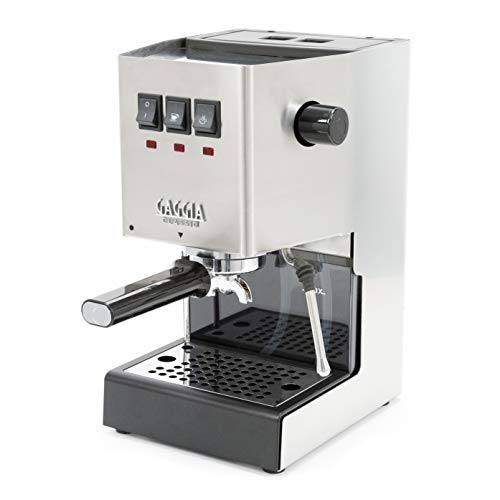
Gaggia Classic E24 Espresso Machine (RI9380/46) — Best for Purists
The Gaggia Classic E24 is the machine the other five quietly respect. It follows the pattern of a traditional Italian manual espresso machine: a 58mm commercial-style portafilter, a three-way solenoid valve that dries the puck after the shot, a proper steam wand, and switches instead of menus. The E24 revision brings an updated boiler coating and the same stubbornly mechanical character owners have praised for decades. Nothing here holds your hand. There is no grinder inside — you must pair it with a capable separate burr grinder, and that pairing is not optional garnish but the difference between sweet shots and sour ones.
Why choose a machine that demands more of you? Because it also gives more back. The 58mm ecosystem means precision baskets, tampers, and distribution tools from every serious maker fit without adapters. The solenoid valve leaves pucks dry enough to knock out cleanly, which keeps a morning routine brisk. A large community of owners has documented every modification worth doing, from pressure adjustments to gauge additions, so the machine can grow with your skill for a decade. If your instinct is to learn the craft properly rather than have it mediated, this is the bench to learn on.
- Format: traditional manual espresso machine, made in Italy
- Grinder: none — a separate quality burr grinder is required
- Portafilter: 58mm commercial style with solenoid valve
- Milk: manual steam wand with a single-hole tip
- Character: mechanical switches, highly modifiable platform
The Gaggia’s ownership culture deserves a paragraph of its own. Few appliances inspire owners to learn their boiler’s behavior, time their warm-up, and discuss gasket materials with genuine affection, yet the Classic has done exactly that for decades. That culture is a practical asset: any question a new owner can formulate has been answered in public, usually with photographs. Buying this machine is partly buying membership in the most documented hobbyist community in home espresso.
Strengths
- Commercial 58mm group unlocks the deepest accessory and basket market in home espresso.
- Simple mechanical design is repairable and supported by an enormous owner community.
- Dry pucks from the solenoid valve knock out cleanly and speed up repeat shots.
Trade-offs
- Requires a separate grinder purchase, raising the true cost of getting started.
- Temperature surfing is part of ownership, since there is no digital temperature display.
- Steam readiness takes a pause after brewing, as with most single-boiler designs.
Best for: hobbyists who want the classic craft and a machine that rewards tinkering. Not suited for: anyone hoping to make good espresso without buying a grinder.
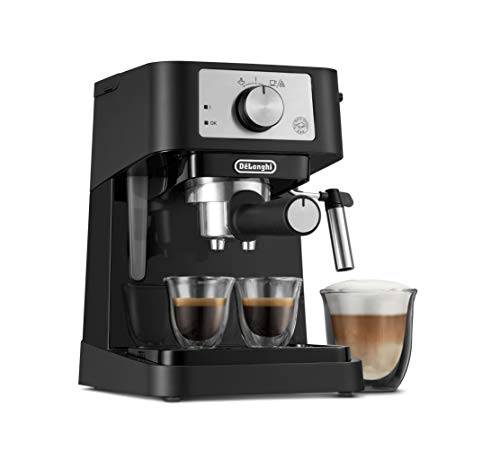
De’Longhi Stilosa Espresso Machine — Best Budget
The Stilosa exists for the reader who wants to find out whether home espresso is for them before committing serious money or counter space. It is a compact manual machine built around a 15 bar pump and a stainless steel boiler, with a portafilter that takes ground coffee or ESE pods and a manual milk frother of the panarello style. That frother will not pour latte art, but it heats and foams milk for cappuccinos and lattes with very little technique, which is the right trade at this level: the drink tastes like the thing you ordered, even if the top looks rustic.
Expectations should be set by its honest spec sheet. There is no grinder, no pressure gauge, and no programmable anything; you time shots with your phone and judge them by taste. Yet the fundamentals are sound — a real portafilter, a boiler instead of a cheap thermoblock substitute in spirit, and a two-cup filter for households that drink in pairs. Many owners start here, discover they love the ritual, and later graduate to the Barista Express while the Stilosa retires to a holiday cottage. As a low-risk first chapter, it earns its place.
- Format: compact manual espresso and cappuccino machine
- Pump: 15 bar pump pressure with stainless steel boiler
- Grinder: none built in — pre-ground coffee or a separate grinder
- Milk: manual panarello-style frother, forgiving for beginners
- Compatibility: ground coffee and ESE pods both accepted
The Stilosa also plays an underappreciated role: the second-home and first-apartment machine. Its modest needs — a small counter corner, ground coffee or pods when fresh grinding is impractical, a frother that forgives — suit places where espresso is an amenity rather than a shrine. Guests at a rental cottage who find a Stilosa beside the kettle consistently rate the morning higher, and owners replacing one rarely throw it away; it migrates to the next small kitchen in the family.
Strengths
- The lowest-commitment route into genuine portafilter espresso on this page.
- Panarello frother produces drinkable foam with almost no learning curve.
- Compact body stores easily in small kitchens, rentals, and holiday homes.
Trade-offs
- Foam texture stays coarse compared with a true steam wand, so latte art is out.
- No gauges or guidance means progress depends on your own tasting notes.
- Plastic-heavy construction feels less substantial than the metal machines above it.
Best for: curious beginners testing the espresso hobby on a modest budget. Not suited for: experienced drinkers chasing fine microfoam and precise control.

Breville Barista Touch Espresso Machine — Best Touchscreen
The Barista Touch takes the Express formula — built-in grinder, 54mm portafilter, real steam — and replaces the dials and gauge with a color touchscreen that coaches each drink step by step. You pick a latte from the menu, and the screen sequences grinding, brewing, and automatic milk texturing, with sliders for milk temperature and foam. For a household where one person is an enthusiast and everyone else just wants a good cappuccino without a tutorial, that division of labor is genuinely valuable: the enthusiast can still intervene, while guests can operate the machine unchaperoned.
Automatic milk texturing here matches the Bambino Plus approach, sensing the jug and stopping at your chosen temperature, and the results pour with a gloss that manual beginners take weeks to reach. Personalized drink profiles can be saved, so a short, hot flat white and a tall, cooler latte coexist as one-touch options. The premium over the Express buys guidance and convenience rather than a different class of shot — the underlying extraction hardware is closely related — so the decision between them is really about how your household learns.
- Format: semi-automatic machine with touchscreen guidance
- Grinder: built-in conical burr grinder
- Milk: automatic texturing with temperature and foam adjustment
- Profiles: savable personalized drinks for different household members
- Interface: step-by-step animated drink instructions
What the Touch teaches a household is who its coffee drinkers actually are. The saved profiles accumulate into a census: the short hot one, the tall cool one, the weekend experimenter. Hosts find the guest mode quietly diplomatic — visitors make their own drinks correctly the first time, and the machine absorbs the social risk of a bad cup. For homes where coffee is hospitality as much as habit, that diplomacy is the feature that justifies the screen.
Strengths
- Touchscreen coaching lets non-enthusiasts make proper drinks without supervision.
- Automatic milk texturing is consistent across users and mornings.
- Saved profiles remember how each person in the house takes their coffee.
Trade-offs
- Costs more than the Barista Express while sharing much of its extraction hardware.
- Screen-driven workflow can feel slower to owners who prefer physical dials.
- Automatic milk still cannot match a skilled hand for competition-level microfoam.
Best for: mixed-skill households wanting guidance built into the machine. Not suited for: traditionalists who distrust screens between them and their espresso.
What Do Pump Pressure, Pre-Infusion, and Boiler Design Actually Mean?
Listings shout about bar pressure, so let us put the number in its place. Espresso extracts properly at around nine bars of pressure at the puck; the fifteen or nineteen bars on a box describe the pump’s maximum capability, not the pressure your coffee experiences, and a pressure-relief valve trims the excess on any competently designed machine. What matters more is whether that pressure arrives steadily and whether the machine wets the puck gently first. Pre-infusion — a few seconds of low-pressure soaking before the full ramp — swells the grounds evenly and dramatically reduces the channeling that produces sour, watery shots. Several machines in this guide include it, and learning to recognize its effect in the cup teaches you more about extraction than any gauge.
Boiler architecture shapes your morning rhythm just as much. Single-boiler and thermocoil machines, which include most of this guide, brew and steam from one heat source at two temperatures, so a short pause separates pulling the shot from steaming the milk. Heat-exchanger and dual-boiler designs erase that pause at a higher price and a larger footprint, and none appears here because this guide’s households rarely queue four lattes deep. The honest question is how many milk drinks you make back to back on your busiest morning; if the answer is two, the single-system machines will never make you wait long enough to matter.
Portafilter diameter, the third spec worth understanding, decides your accessory future. The 58mm standard on the Gaggia accepts precision baskets, tampers, and shower screens from every serious maker, while the 54mm Breville ecosystem is smaller but well served by Breville’s own parts and a healthy third-party scene. De’Longhi’s proprietary sizing sits between: baskets and tampers exist, but you will shop more deliberately. None of these is a defect; they are ecosystems, and choosing one is closer to choosing a camera lens mount than choosing a kettle.
How Does Each Machine Behave Across a Real Week?
Monday morning tells the truth about the Barista Express: it asks for grinding, tamping, and a minute of attention, and returns a drink good enough to justify the ritual to a skeptic. By Friday its owner has a dialed-in grind setting and opinions about beans. The Bambino Plus lives differently — it is the machine of the twelve-minute turnaround, switched on while the shower runs and producing an automatically textured flat white before a coat is on. Households that bought it for size discover they kept it for tempo.
The Arte Evo’s week is tidier than most. Its dosing funnel keeps grounds off the counter, its tamping lever makes the puck a solved problem, and its owners report the peculiar satisfaction of a bench that looks café-professional without the café mess. The Gaggia’s week is the hobbyist’s: a scale lives beside it, a notebook accumulates, and Sunday afternoon becomes experimentation time — a new basket, a different dose, a roast from the place across town. It is less an appliance in that house and more an instrument, treated accordingly.
The Stilosa’s week is unpretentious: pre-ground coffee on workdays, a proper attempt with fresh beans on Saturday, milk frothed without ceremony for whoever is around. It asks little and is forgiven much. The Barista Touch, meanwhile, becomes the household diplomat — the machine the teenager uses for an after-school latte and the grandparent operates successfully on a first visit, because the screen narrates every step. Different machines, different domestic personalities; matching yours matters more than any ranking, including this one.
Comparison Table
| Machine | Grinder | Milk system | Best suited to |
|---|---|---|---|
| Breville Barista Express | Built in | Manual wand | Complete starter setup |
| Breville Bambino Plus | Separate | Automatic texturing | Small counters, fast mornings |
| De’Longhi La Specialista Arte Evo | Built in | Manual wand | Guided, tidy tamping |
| Gaggia Classic E24 | Separate, required | Manual wand | Purists and tinkerers |
| De’Longhi Stilosa | Separate or pre-ground | Panarello frother | First taste of the hobby |
| Breville Barista Touch | Built in | Automatic texturing | Guided touchscreen drinks |
How Do You Decide Between Two Finalists?
Reduce the decision to the drinks and the bench. Write down the two drinks your household will make most, and ask which finalist serves them with less friction: the milk question usually decides it, since automatic texturing and manual wands produce different mornings more surely than any extraction nuance. Then measure the bench honestly — depth under cabinets, room for the grinder if one is separate, space for the scale and knock box that will inevitably join the arrangement. A machine that fits the ritual and the counter will be used daily; a theoretically superior machine exiled to a cupboard brews nothing at all.
Finally, weigh the learning you want. Some buyers are purchasing a hobby that happens to produce coffee, and for them the Gaggia’s demands are the product. Others are purchasing coffee that happens to require a little technique, and for them the guided Breville and De’Longhi designs are the honest match. Naming which purchase you are making — hobby or beverage — settles nearly every tie in this guide, and it is a question no specification sheet can answer for you.
What Should You Look for in a Barista Machine?
Start with the grinder question, because it quietly decides your total spend and your shot quality. Integrated grinders, as fitted to the Breville Barista Express, keep the bench tidy and the budget contained, and their adjustment range covers the medium and darker roasts most households drink. A separate grinder costs more and eats counter space, yet it grinds more uniformly and can be upgraded without replacing the machine — the route the Gaggia demands and rewards. Either way, insist on burrs rather than blades; blade-ground coffee extracts unevenly no matter how good the machine downstream of it happens to be.
Next, think honestly about milk. If most drinks in your house wear foam, the texturing system matters as much as the brew group. Automatic systems suit households in a hurry and produce consistent results across different users, while manual wands offer a higher ceiling and a steeper first fortnight. Households split between black coffee and lattes can compromise happily on a manual wand, since the black-coffee drinker never waits for it. Also check the drip tray depth and water tank access: tanks that lift from the front behave better under low cabinets than tanks that slide out the back.
Temperature stability is the quiet specification nobody advertises well. Machines that hold brew water steady through the shot produce sweeter, more repeatable results, and pre-infusion — a gentle wetting of the puck before full pressure — reduces the channeling that makes shots taste thin and sour. You will not find laboratory numbers on most listings, so lean on design clues: metal group heads, stated pre-infusion, and a community of owners reporting consistent results across years of production.
Which Beans Suit a Home Barista Machine Best?
Freshness outranks pedigree. A modest bean roasted ten days ago will out-pour a famous bean roasted four months ago on every machine in this guide, because espresso’s small dose and high pressure expose staleness without mercy. Buy from roasters who print dates, in quantities your household finishes within three weeks of opening, and treat the supermarket’s coffee aisle as an emergency resource rather than a supplier. Medium roasts are the forgiving starting point: they extract across a wider window, forgive a grind setting that is a notch off, and carry the chocolate and nut flavors most households mean when they say coffee should taste like coffee.
Single-origin beans reward the curious once the basics hold. A washed Ethiopian coffee through the Gaggia will taste startlingly different from a Brazilian natural through the same basket, and that contrast is the hobby’s enduring pleasure. Keep a house blend as the daily driver while experimenting on weekends, so a disappointing experiment never ruins a Monday. Whatever you buy, let very fresh beans rest several days after roasting; coffee needs to release gas before it extracts evenly, and shots pulled from beans roasted yesterday foam and sputter their way to a sour cup.
How Do You Pull a Better Shot at Home?
Begin with a repeatable recipe rather than vibes. Weigh your dose — roughly eighteen grams for a double basket on the larger machines here — distribute the grounds evenly, tamp level, lock in immediately, and time the shot from pump start. Aim for a window around twenty-five to thirty-five seconds for a yield near double the dose by weight, then taste before touching anything. Sour and thin usually means the water rushed through: grind finer. Bitter and harsh usually means it crawled: grind coarser. Change one variable per shot, or you will chase your tail around the kitchen.
Milk technique follows a similar discipline. Start with cold milk and a cold jug, purge the wand, submerge the tip just below the surface to introduce air early with a gentle tearing sound, then sink it deeper to roll the milk into a glossy whirlpool. Stop at the temperature where the jug feels hot but still holdable, wipe the wand immediately, and purge again. On the Breville Bambino Plus the machine handles this sequence for you, but watching what it does with the jug teaches the same lessons in reverse.
Fresh beans tie the whole practice together. Buy whole beans with a roast date, rest them a few days after roasting, and use them within a few weeks; supermarket bags without dates are the single most common reason a capable machine gets blamed for dull espresso. Store beans in an airtight canister away from the machine’s heat, and never in the hopper for a fortnight at a time if you only brew on weekends.
What Does the First Month of Ownership Teach You?
Week one is calibration, and it humbles everyone equally. The shots run fast, then slow, then — after a grind adjustment you almost remember making — pour like the videos. This is not the machine misbehaving; it is the normal cost of mapping a new grinder’s settings to a particular bag of beans. Owners who keep a small notebook, noting dose, grind setting, and time for each attempt, compress that week into days. Owners who adjust by mood repeat week one for a month, and their frustration says more about method than machinery.
Week two belongs to milk. Manual-wand owners discover that the tearing-paper sound of proper aeration happens in the first few seconds, and that the rest is a quiet whirlpool; automatic-texturing owners discover which temperature setting their household actually prefers, which is rarely the default. By week three, the drinks have names and regulars: the machine’s output stops being “espresso” and becomes “Dad’s flat white” and “the small strong one before the school run.” That personalization is the true product this category sells.
Week four is when maintenance enters the rhythm — the first backflush, the first group-head scrub, the realization that the drip tray needs emptying before it announces itself. None of it is onerous, and all of it is cheaper than the café habit the machine replaced. Owners who reach the end of month one with a notebook, a bean they trust, and a cleaning rhythm own a skill, not just an appliance, and the distinction shows in every cup afterward.
Which Common Mistakes Ruin Home Espresso?
The classic error is upgrading the machine while neglecting the grinder. A premium machine fed by a cheap blade grinder produces expensive disappointment, because extraction magnifies grind inconsistency. The second error is neglecting water: scale builds silently in boilers and thermocoils, so descale on the schedule your manual sets and use filtered water if your tap runs hard. Third, many beginners change dose, grind, and beans simultaneously after one bad shot, destroying the evidence they needed to improve.
Storage mistakes matter too. Beans left in a sunlit hopper stale within days, and a portafilter left locked into a hot group cooks its gasket and shortens its life. Finally, there is the mistake of judging a machine by its first morning. Every pick here has a learning curve measured in a week of shots, not an afternoon, and the households that persist through that week are the ones writing fond reviews a year later.
How Do Running Costs Compare With the Café Habit?
The arithmetic of home espresso is forgiving. Beans and milk for a home cappuccino cost a fraction of the café equivalent in any city, and the machine’s purchase price typically crosses the café habit’s cumulative spend within the first year or two of daily use — sooner in households serving several drinkers. The ongoing consumables are modest: descaler on schedule, a replacement group gasket eventually, filters if your water demands them. None of the six machines here hides an expensive proprietary consumable, which is a deliberate omission from this guide; pod ecosystems and locked accessories were excluded at the selection stage.
The less visible saving is time. A home machine converts a twenty-minute round trip into a four-minute ritual, and for households with small children or rural addresses, that conversion is the actual purchase. Against those gains, set the honest costs: counter space permanently surrendered, a learning month, and beans bought in quantities that punish indecision. Readers for whom those costs sound trivial are this category’s natural owners.
One last consideration belongs to the household’s future self. Espresso is a hobby that deepens: the owner who begins with the Stilosa’s pods may be weighing a prosumer machine in five years, while the Gaggia owner may simply buy better beans forever. Every machine here can be resold, gifted onward, or retired to a second home without embarrassment, because each was chosen for a real job rather than a trend. Buy for the mornings you have, and the upgrade path — if it ever matters — will take care of itself.
Final Recommendation
Most households should start with the Breville Barista Touch if several people will use the machine, or the Barista Express if one keen learner will drive it. Choose the Bambino Plus when counter space is the binding constraint, the Arte Evo when tamping inconsistency has frustrated you before, the Stilosa when you are simply testing the waters, and the Gaggia Classic E24 when you want the traditional craft with a serious grinder beside it. Whichever bench you build, remember that the machine is only the instrument — the beans, the grinder, and your first month of patient repetition are what turn a kitchen corner into the café your household actually prefers.
What Changes When Guests Arrive?
Guest service is the stress test every home barista machine eventually faces, and the six here handle it with different graces. The Touch and the Arte Evo shine socially: guidance and repeatable tamping mean a second pair of hands can be deputized without a training seminar, and drinks emerge in a rhythm the conversation can absorb. The Express keeps pace in a practiced owner’s hands but queues milk drinks behind its single heat source, so the wise host pulls all the shots first, then steams in a batch, accepting a small quality trade for a large social one.
The Gaggia turns guest service into theatre, which some hosts count as the entire point: the ritual performed at the counter, the conversation gathering around it, the cups arriving as events rather than refreshments. The Bambino Plus, quietly, is the diplomat’s second machine for exactly these evenings, its automatic milk freeing the host to talk while it textures. And the Stilosa, asked to serve six, simply does — more slowly, with less gloss, and with a humility that guests tend to find charming rather than lacking. Choose your machine partly for the evenings you host, because those are the cups people remember.
How Should You Set Up an Espresso Corner That Stays Pleasant?
Give the machine a home with water and power within easy reach, because a machine that must be dragged out of a cupboard will be used monthly instead of daily. Leave headroom above the hopper or tank — several machines here fill from the top — and park a small scale, a knock box, and a cloth within arm’s reach. The cloth matters more than it sounds: a steam wand wiped in the first five seconds never becomes the crusty archaeology project that puts people off manual milk. Keep beans in a sealed canister beside the machine rather than in the hopper if you brew only on weekends, since hopper-stored beans stale against the machine’s warmth.
Water deserves a permanent decision. If your tap water is hard, a simple filter jug or an in-tank filter stretches the interval between descaling from weeks to months and keeps flavors clean. Descale on the manufacturer’s rhythm regardless of how the machine seems to be behaving; scale is a debt that collects silently and presents its bill as a repair. A small tray under the work zone catches the drips and grounds that espresso inevitably sheds, and turns cleanup into a weekly lift-and-rinse instead of a daily scrub.
What Does a Second Year of Ownership Look Like?
By the second year, the machine has stopped being a purchase and become infrastructure, and its owner’s questions change character. The debate is no longer grind settings but bean subscriptions, a second basket size for a preferred dose, perhaps a bottomless portafilter bought to watch extractions and diagnose channeling with the eyes. These small upgrades cost little and renew the hobby’s interest precisely when novelty would otherwise fade. The machines in this guide all accept that second-year curiosity gracefully, which is a quiet argument for buying within ecosystems that have room to grow.
Wear announces itself honestly at this age: a group gasket that no longer seals with the old quarter-turn confidence, a shower screen due for replacement, a steam tip that wants a soak. Each is a consumable with a known price and a ten-minute remedy, and owners who treat them as scheduled maintenance rather than failures report machines that feel new at year three. The café habit, by comparison, never sends a gasket bill — it simply charges more, forever, for every cup. The arithmetic and the affection both favor the bench.
When Does a Barista Machine Beat a Bean to Cup Machine?
Choose the barista route when the making is part of the pleasure — when you want to taste the difference a finer grind makes, steam milk to a gloss you control, and improve at something measurable across a season. The ceiling is higher here: a skilled owner of the Gaggia or the Express will out-pour any automatic machine in this price territory, and the skill transfers to every café machine on earth. Choose bean to cup instead when the household wants café drinks at a button press with no learning curve, accepting a lower ceiling in exchange for total convenience; our cappuccino-machine coverage exists for exactly that reader.
Households also split by drink. Straight espresso and americano drinkers gain the most from the manual craft, because extraction nuance is the whole drink. Heavy latte households split by patience: those who enjoy the wand ritual thrive here, while those who want five lattes before the school run should weigh automatic milk more heavily than any other single factor. Neither answer is more sophisticated; they are different mornings, honestly described.
Frequently Asked Questions
Do barista machines include a grinder?
Some do and some do not, and the split runs right through this guide. The Barista Express, Barista Touch, and La Specialista Arte Evo grind their own beans, while the Bambino Plus, Gaggia Classic E24, and Stilosa all expect a separate grinder. Budget for that second appliance whenever a machine lacks one, because fresh grinding is not an optional refinement in espresso.
Are any of these machines fully automatic?
No. Every machine here is a hands-on barista design built around a portafilter: you grind or dose, tamp, lock in, and manage the milk. Two of them automate milk texturing and one guides the tamp, but none grinds, brews, and froths a cappuccino from a single button press. Readers wanting that experience should look at bean-to-cup machines instead.
How long does it take to learn?
Most people pull a drinkable shot within their first few attempts and a genuinely good one within a couple of weeks of daily practice. Guided machines shorten the early phase, since tamping and milk are handled for you, while the Gaggia stretches it in exchange for a higher eventual ceiling. Keep notes on dose and grind setting; memory lies, notebooks do not.
What else should I buy with my first machine?
A small digital scale, a knock box, and a milk jug if one is not included cover the essentials. Add a water filter if your tap water is hard, plus a group-head brush and detergent for backflushing where the manual calls for it. A distribution tool can wait until your basic technique settles.
Can these machines make regular coffee?
They make espresso and espresso-based drinks such as americanos, which many households happily adopt as their regular coffee. They do not brew filter coffee by the pot. If your mornings demand a large batch of drip for a crowd, keep a separate brewer for that job and let the espresso machine do what it does best.
How much counter space does a barista setup really need?
Plan for the machine’s footprint plus a working apron in front of it roughly the size of a cutting board, where the portafilter, scale, and milk jug will live during use. Machines with top-filling tanks or hoppers also need vertical clearance to open fully under cabinets. If the apron cannot exist permanently, a small tray that corrals the tools lets the whole station slide aside in one motion, which preserves both the counter and the habit.
Is a barista machine a good gift?
For the right recipient, it is a superb one — the coffee enthusiast who lingers in café doorways and talks about extraction unprompted. For the merely coffee-drinking, it risks becoming an obligation with a steam wand. Match the gift to the person: guided models like the Arte Evo and Barista Touch forgive a recipient’s inexperience, while the Gaggia should only be gifted to someone who has expressed the hobbyist ambition out loud.
Related Guides
Readers building out a craft corner of the kitchen often pair espresso with a capable sewing setup for aprons, café curtains, and cushion covers, so our guide to Best Basic Computerized Sewing Machines is a natural next read. When the drinks are for a crowd rather than a couple, step up to Best Biggest Coffee Machines, and for the quick weekday reheating that surrounds any coffee ritual, see Best Affordable Microwave Ovens.


