What's inside
- Key Takeaways
- Quick Picks
- How We Chose These Picks
- How is an affordable everyday microwave different from a small 700-watt one?
- Comparison Table
- Where does the microwave live in a small kitchen?
- What should you check before choosing an affordable microwave?
- How do you get the best from an everyday microwave?
- What Are the Most Common Mistakes?
- Final Recommendation
- Frequently Asked Questions
- Related Guides
As an Amazon Associate I earn from qualifying purchases. This post may contain affiliate links at no extra cost to you.
cottageverdict.com is reader-supported. When you buy through links on our site, we may earn an affiliate commission.
Affordable stops meaning tiny the moment you step up from the smallest class. The best affordable microwave ovens in this guide run from 0.9 to 2.2 cubic feet and from 900 to 1,250 watts — the sizes and speeds that cook a family’s leftovers at the pace the packet instructions actually assume. If the 700-watt guide was about accepting limits gracefully, this one is about everyday sufficiency: dinner plates that fit, defrosting that finishes, reheating that does not need a time-conversion chart taped to the fridge.
Value here is not the lowest number on a price tag — it is the most capability per unit of money, from brands whose support you can find. Two picks bring inverter technology down into this bracket, two are honest 900-watt workhorses from household names, and every one of the six can check price on Amazon against your budget before you commit.
Where to buy: each model links to its Amazon listing, where current finishes and dimensions can be confirmed. Measure your counter depth with particular care for the two large Toshibas and the Panasonic — capacity you cannot house is not capacity at all.
Read the six reviews as a ladder. The 0.9 cubic foot models serve couples and apartments beautifully; the 1.6 and 2.2 cubic foot models serve families. Choosing your rung honestly matters more than choosing the brand, because the wrong size in a good brand disappoints faster than the right size in any of them.
A word about what affordable excludes here. We left out the anonymous ultra-cheap models whose panels fade, whose latches loosen and whose makers cannot be found a year later, and we left out combination and built-in ovens whose prices belong to a different conversation. What remains is the honest middle: six machines a household can buy once, use daily and expect to keep.
Key Takeaways
- The everyday sweet spot is 0.9 cu ft and 900 watts — full dinner plates, packet-accurate times, modest counters.
- Inverter models (both Toshibas’ bigger sibling and the Panasonic) reheat gently without on-off pulsing.
- Sensor cooking, on the Toshiba 1.6 and Panasonic, judges doneness from steam instead of your guesswork.
- Mute functions and LED lighting make the small Toshiba the apartment specialist of the group.
- Brand support is a value feature: GE, Sharp, Panasonic and Toshiba all have findable parts and service.
- Measure counter depth before choosing the 1.6 or 2.2 cu ft models — they are deeper than they look in photos.
Quick Picks
| Pick | Badge | Why it earns its place |
|---|---|---|
| TOSHIBA 1.6 Cu Ft Inverter Countertop Microwave | Best all-round family size | A 1.6 cu ft cavity, inverter power and a smart sensor make this the affordable oven that behaves like a much pricier one. |
| Panasonic Inverter Countertop Microwave | Inverter pioneer, family capacity | Panasonic’s Cyclonic Wave inverter system and Genius Sensor, in a 2.2 cu ft countertop-or-built-in frame, reward cooks who reheat seriously. |
| BLACK+DECKER 0.9 Cu Ft Microwave 900W | Dependable mid-size value | Nine-tenths of a cubic foot and 900 watts hit the sweet spot for couples — six auto presets and a push-button door on a stainless front. |
| TOSHIBA 0.9 Cu Ft Microwave Oven | Compact with a mute button | The smaller Toshiba pairs 900 watts with six auto menus, LED lighting and a mute function in black stainless — apartment manners included. |
| GE 0.9 Cu Ft Countertop Microwave 900W | Trusted name, simple panel | Seven convenience cook settings and one-touch controls from a brand with a service network in every town — the safe-pair-of-hands pick. |
| Sharp SMC0962KS 0.9 Cu Ft Countertop Microwave | Carousel heritage, honest basics | Sharp’s 900-watt, 0.9 cu ft oven keeps faith with the original Carousel turntable idea — even reheating without frills or fuss. |
How We Chose These Picks
We defined affordable by capability per cost rather than by the cheapest sticker: countertop ovens from established makers, large enough for a dinner plate, powerful enough to follow standard cooking times. That admitted the 900-watt class as the floor and let two inverter models in at the top, where their prices still sit far below built-in or combination ovens.
Each pick was checked against its manufacturer’s listing for capacity, wattage and the features we describe — inverter type, sensor presence, turntable size, mute and lock functions. We weighted reheating evenness and defrost behaviour above novelty features, because those are the jobs an everyday microwave actually performs, and we favoured models whose controls a whole household can share.
We also deliberately included two sizes of answer. Not every affordable buyer is a family; the apartment cook and the couple are served by the 0.9 cubic foot picks, and pretending otherwise would push them into capacity they cannot house. The guide is a ladder, and the choosing notes under each pick say which rung it belongs on.
How is an affordable everyday microwave different from a small 700-watt one?
Power, first of all. At 900 watts and above, packet instructions start telling the truth: the times printed for a ready meal assume roughly this class, so cooking becomes a matter of following directions rather than converting them. Frozen vegetables steam in their bag on schedule, and a plate of leftovers returns to the table hot through the middle, not just at the rim.
Capacity changes the cooking, too. A 0.9 cubic foot cavity accepts the standard dinner plate that the 0.7 class makes you tilt and negotiate, and the 1.6 and 2.2 cubic foot models accept the serving bowls and casserole dishes that family reheating actually involves. Less decanting means fewer dishes, less spillage and food that stays in the arrangement it was served in.
The feature set matures at this level. Sensors appear, to judge reheating by steam rather than by timer; inverter power appears, to hold a gentle setting steady instead of pulsing; auto menus multiply beyond the token few. None of these is a gimmick when the oven is used six times a day — each one removes a small daily friction, and affordable family appliances live or die by accumulated friction.
What does not change is the physics of microwaves themselves. Food still heats from the outside in, thick portions still need stirring and standing, and no sensor yet invented browns a crust. The everyday class is not magic; it is simply the point where the compromises stop being daily events and become occasional ones.
The everyday class also changes who cooks. A microwave that follows packet times and fits real plates is one a teenager can be trusted with, a grandparent can operate without a tutorial, and a tired parent can use one-handed with a child on the other hip. Appliances that widen the circle of competent users change a household’s evenings more than any single programme on the panel.
One more everyday scene decides more purchases than any showroom visit: the Sunday-night fridge audit, when the week’s leftovers must become Monday’s lunches. An oven that reheats a deep bowl evenly, without turning its rim to rubber, turns that audit from a chore into a system — and systems, in a busy kitchen, are what affordable appliances are really for.

TOSHIBA 1.6 Cu Ft Inverter Countertop Microwave — Best all-round family size
Family kitchens ask a microwave to do contradictory things: reheat a single mug gently, then cook a deep bowl of pasta for four without a volcanic rim and a raw middle. The Toshiba answers with the two features that matter most at this level — a genuinely roomy 1.6 cubic foot cavity and inverter power, which delivers low settings as a steady stream rather than pulses of full blast. Scrambled eggs stay tender, butter melts instead of exploding, and leftovers reheat without the rubbery edges that give microwaves a bad name.
The smart sensor takes the other daily gamble away. Instead of guessing minutes for a jacket potato or a plate of rice, you let the oven read the steam coming off the food and judge for itself, which in practice means fewer interrupted cycles and less standing around adding thirty seconds at a time. The 13.6-inch turntable swallows a family dinner plate and most mixing bowls, so the decanting dance that smaller ovens demand simply disappears from the routine.
Auto defrost handles the weeknight rescue — mince forgotten in the freezer at breakfast — with more grace than a timer alone, especially if you turn the meat and break it apart when prompted. Nothing here is exotic, and that is the point: this is the affordable end of the market quietly offering the two technologies, inverter and sensor, that used to separate premium ovens from the rest.
Counter space is the honest cost. A 1.6 cubic foot cabinet is a substantial object, deeper than many counters expect, and households in small flats should measure with the door open before falling for the capacity. The black stainless finish also asks for a regular wipe where small fingers land. Neither complaint survives contact with a family of four reheating Sunday’s roast on a Tuesday, which is the workload this oven was plainly built around.
There is a longevity argument, too. Toshiba’s microwave line has been a fixture of this category for years, the controls are conventional enough that any family member can drive them, and the cavity light and display are sized for tired eyes at midnight. Affordable should mean inexpensive to buy, not expensive to live with, and on that second measure this model is the most convincing of the six.
Choose it if your microwave is a true second cooker — reheating family portions, defrosting the week’s meat, softening and melting with some finesse. It is the pick that makes the fewest apologies, and in an affordable roundup that is the highest praise available.
Breakfast is where the sensor quietly proves itself across a month. Porridge that used to boil over on a guessed timer emerges ready, because the oven watched the steam rather than the clock, and reheating yesterday’s pancakes stops being a choice between leathery and cold. None of these moments makes a brochure, but together they are the lived difference between a microwave you tolerate and one you trust with the morning routine.
A note for bakers: inverter low power is the closest a microwave comes to a gentle proving drawer and a civilised butter melter. Chocolate seized by pulsed full power is a familiar small tragedy; the steady warmth here avoids it, and cake bakers who melt and soften daily will find this single trait justifies the model over cheaper rivals within the first month of use.
Set against its rivals, the big Toshiba is the pick that asks the fewest behavioural changes of its owners. You do not learn conversion factors, you do not decant into smaller bowls, you do not hover to rescue reheating from its own unevenness. An affordable appliance that removes habits instead of imposing them has understood its job, and that understanding is why it leads this guide despite not being the cheapest name on it.
- Capacity: 1.6 cu ft
- Power: 1250 watts, inverter
- Sensor: smart sensor cooking
- Turntable: 13.6 inch
- Defrost: auto defrost
- Finish: black stainless steel
Strengths
- Inverter power reheats gently and evenly
- Roomy cavity fits family plates and bowls
- Smart sensor removes timing guesswork
Trade-offs
- Large footprint needs a deep counter
- Black stainless shows fingerprints
- Overkill for a single-person household
Best for: Families who reheat full meals and defrost weekly.
Not suited for: Dorm rooms and tiny counters where size rules.
Panasonic Inverter Countertop Microwave — Inverter pioneer, family capacity
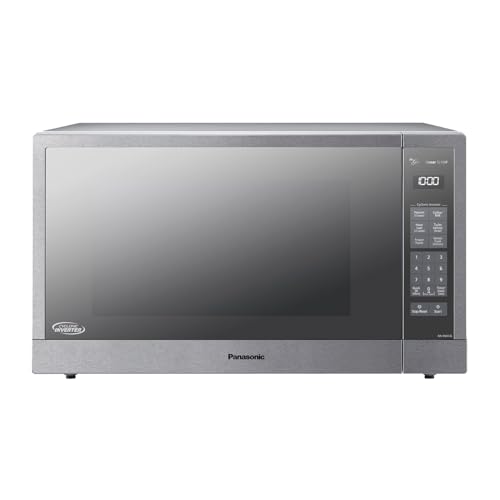
Panasonic invented the inverter microwave, and this big NN-SN97JS shows what decades of refinement look like. The cavity is the largest here at 2.2 cubic feet — big enough for a casserole dish that would defeat every other pick on this page — and the Cyclonic Wave system is designed to push energy into the corners where ordinary turntables leave cold spots. For households reheating a whole dish rather than a plate, that evenness is not a luxury; it is the difference between dinner and a geology lesson in hot and cold layers.
The Genius Sensor is the other half of the proposition, adjusting time and power as food gives off steam. Reheated rice comes back fluffy rather than welded, and a bowl of soup heats through without the skin-and-eruption routine. Because the unit can also be built in with a trim kit, it suits kitchens being refitted on a budget, where today’s countertop oven becomes next year’s integrated one without a second purchase.
Honesty requires noting the scale of the thing. At 2.2 cubic feet this is a microwave that dominates a counter, and its appetite for depth will not suit galley kitchens. It is also the most ambitious machine here, priced at the top of what affordable can stretch to mean — check price on Amazon and judge it against your actual reheating workload rather than its spec sheet.
For the right household, though, the workload justifies it. A family that reheats a full family meal several nights a week, or a keen cook who proofs, softens and melts with low, steady inverter power, will use capabilities here that the smaller picks simply do not have. The stainless cabinet is handsome in a professional way, and the controls assume an adult who cooks rather than a guest who reheats.
Where it asks patience is in its learning curve: sensor programmes reward reading the manual once, properly, and the sheer size means the turntable and cavity need a bigger wipe-down after a splashing incident. Those are the taxes on capacity, and most big households pay them gladly.
Pick the Panasonic if your affordable microwave must double as a genuine second oven for family quantities. It stretches the definition of the category in the useful direction — more room, steadier power, smarter sensing — while staying on the right side of the price line that defines this guide.
The built-in option deserves a second look from anyone planning a kitchen refresh in stages. Buying the Panasonic now as a countertop unit, then adding a trim kit when the cabinets are replaced, spreads the cost across two projects and keeps the same familiar oven at the centre of both kitchens. Few appliances in this bracket offer that kind of continuity, and it quietly raises the model’s value beyond its reheating scores.
Large cavities change cleaning maths as well as cooking maths. There is room to work a cloth around the walls, the turntable lifts out without a puzzle, and a whole splashed casserole’s worth of sauce is visible rather than hidden in corners. Big ovens are sometimes accused of being harder to keep; in practice this one is easier to clean thoroughly, because nothing about its interior is cramped.
The Panasonic will suit the household that cooks in earnest and reheats in earnest, treating the microwave as a working second oven rather than a warming box. Its scale is its statement: bring it a family dish and it behaves as if family dishes were the point all along. Kitchens with the counter to house it rarely regret giving that counter up.
- Capacity: 2.2 cu ft
- Power: 1250 watts, Cyclonic Wave inverter
- Sensor: Genius Sensor
- Installation: countertop or built-in
- Turntable: large family size
- Finish: stainless steel
Strengths
- Largest cavity in this group by far
- Cyclonic Wave targets cold corners
- Can be built in later with a trim kit
Trade-offs
- Dominates a standard countertop
- Top of the affordable bracket
- Manual rewards a proper first read
Best for: Large families reheating whole dishes regularly.
Not suited for: Small flats where counter depth is precious.
BLACK+DECKER 0.9 Cu Ft Microwave 900W — Dependable mid-size value
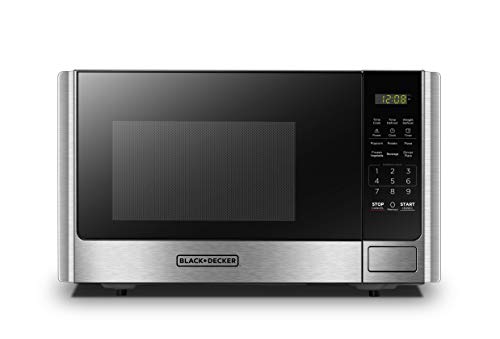
If the 700-watt class is a deliberate compromise, this BLACK+DECKER is where compromise ends. At 0.9 cubic feet and 900 watts it reheats a couple’s dinner at something close to packet-instruction speed, fits a standard dinner plate without negotiation, and still sits comfortably on an ordinary counter. For a two-person household it is the size that stops being a conversation — the Goldilocks footprint of the affordable market.
Six auto cook presets cover the foods that actually pass through a microwave in a week, and the push-button door keeps the one-handed, bowl-in-the-other-hand routine that makes countertop ovens pleasant. The stainless front matches the brand’s smaller sibling in the 700-watt guide, but the resemblance is only skin deep: the extra two hundred watts and the larger cavity change the daily experience completely, cutting the added-time arithmetic that small-oven owners learn by heart.
Defrosting is competent rather than clever — timed and powered sensibly, best helped by turning food when you remember — and the ten power levels give enough range for the delicate jobs, from softening butter to warming a baby bottle’s water bath. Nothing about the panel will surprise anyone who has used a microwave in the last twenty years, which in a shared flat is a feature, not a failure of imagination.
The compromises are the honest ones of the mid-size class. A large casserole still will not fit, a whole chicken remains somebody else’s job, and there is no sensor to rescue a distracted cook. What you get instead is maturity: a design language the brand has refined across millions of units, parts and support that exist in the real world, and a price position that leaves money in the kitchen budget for things that matter more.
Couples furnishing a first proper kitchen together will find this the easiest recommendation on the page to live with. It asks for no new habits, forgives beginner cooking, and reheats the takeaway on Friday exactly as well as it cooks the vegetables on Monday.
In short, this is the affordable microwave for people who do not want a relationship with their microwave. It simply works, at the size and speed most small households actually need, and it will still be working when fancier fashions have moved on.
Think about who else uses this oven besides its buyer. The push-button door and the unfussy panel make it the rare appliance that a visiting parent, a new flatmate or a teenage cousin can operate correctly on the first attempt, without the small humiliation of asking. In shared homes that social ease is worth real money, because an appliance everyone can drive is an appliance that never becomes one person’s chore.
It also travels well between life stages. Bought for a couple’s flat, it remains adequate when the flat becomes a house and a highchair joins the kitchen, because 0.9 cubic feet reheats a child’s portion and a parent’s plate in sequence without complaint. Appliances that survive transitions get replaced less often, and that — more than any preset — is what affordable is supposed to mean.
There is a reason the mid-size BLACK+DECKER format keeps reappearing across decades of this category: it is the shape of most people’s actual need. Not the smallest, not the largest, not the cleverest — just sufficient, in every dimension, for the reheating life of a small household. Sufficiency, reliably delivered at an affordable level, is an underrated form of excellence.
- Capacity: 0.9 cu ft
- Power: 900 watts
- Presets: 6 auto cook presets
- Levels: 10 power levels
- Door: push-button release
- Safety: child safety lock
Strengths
- Right size and speed for couples
- Familiar controls need no learning
- Stainless front suits most kitchens
Trade-offs
- No sensor cooking programmes
- Large casseroles still will not fit
- Defrosting needs manual turning
Best for: Couples and small households wanting fuss-free reheating.
Not suited for: Families needing to reheat whole dishes.

TOSHIBA 0.9 Cu Ft Microwave Oven — Compact with a mute button
Apartments teach you that an appliance’s manners matter as much as its muscle, and this smaller Toshiba was clearly designed by people who had lived in one. The mute function silences the end-of-cycle chorus that carries through thin walls, the LED lighting lets you check on food without opening the door, and the black stainless cabinet looks deliberate rather than cheap in a small, visible kitchen.
At 0.9 cubic feet with 900 watts it sits in the same practical class as the BLACK+DECKER above, but the character differs. The six auto menus are tuned for the apartment repertoire — reheating a plate, cooking noodles, defrosting a single portion — and the 10.6-inch turntable takes a dinner plate while the cabinet stays compact enough for the counter corner that larger ovens cannot claim. Toshiba positions it explicitly for apartment life, and the details back the claim.
The child lock is worth more in a small flat than in a big house, because the microwave lives within toddler reach of everything else. Controls are touch-based and wipe clean, which matters when the kitchen is also the hallway and every splash is on display. Reheating performance is what 900 watts promises: brisk for single portions, honest about its limits with anything frozen into a brick.
What it will not do is grow with a family. Two adults and a baby become three adults’ worth of reheating faster than expected, and the 0.9 cavity will feel its ceiling then. Buy it for the household you have now, in the flat you live in now, and it will repay you in quiet, unshowy service.
There is a pleasing coherence to the design — nothing sticks out, nothing beeps unless asked, nothing demands a manual. Among the affordable picks it is the one most clearly designed for a specific life rather than a generic kitchen, and specific lives recognise themselves in it immediately.
Choose the small Toshiba if your kitchen is compact, your walls are thin and your reheating is mostly for one or two. It is the apartment specialist of this group, and it wears that title with unusual completeness.
The LED lighting sounds like decoration until the first time you check a sauce at midnight without opening the door. Every opening costs heat and time, and in a small cavity the cost is proportionally larger; a clear view through the door, properly lit, keeps the cycle closed and the reheating honest. It is a small feature with a daily dividend, exactly the kind this price bracket should be hunting.
There is also a rental-deposit argument for this model. Its footprint and weight suit the counter corners that landlords’ kitchens actually provide, its finish photographs well at inspection time, and its quiet operation will not become the subject of a neighbour’s complaint. Appliances live in social contexts as much as in kitchens, and this Toshiba seems to have been designed by someone who understood both.
Small flats punish loud, deep, demanding appliances and reward compact, quiet, undemanding ones. The little Toshiba collects those rewards systematically — muted alerts, a modest footprint, a plate-sized turntable, a finish that looks considered. It is the pick that most clearly improves the room it sits in, rather than merely occupying it.
- Capacity: 0.9 cu ft
- Power: 900 watts
- Menus: 6 auto menus
- Extras: mute function, LED lighting
- Turntable: 10.6 inch removable
- Safety: child lock
Strengths
- Mute function respects thin walls
- LED light and tidy touch controls
- Apartment-sized without feeling toy-like
Trade-offs
- Capacity ceiling arrives with a family
- Touch panel needs deliberate presses
- No inverter for gentle low power
Best for: Apartment dwellers cooking for one or two.
Not suited for: Growing families reheating in bulk.

GE 0.9 Cu Ft Countertop Microwave 900W — Trusted name, simple panel
Some buyers choose a microwave the way they choose a plumber: by asking who will still answer the phone in five years. The GE makes that case. It is a 0.9 cubic foot, 900-watt countertop oven — squarely the practical class — backed by one of the largest appliance service networks in the country, and designed with the plain competence that reputation is built on. Seven convenience cook settings handle the weekly repertoire, and one-touch controls mean the first press is usually the only press.
The glass turntable and stainless cabinet are unremarkable in the best sense: standard sizes, easy cleaning, no proprietary anything. GE lists it for kitchens, dorms, offices and apartments alike, and the design reads that way — an appliance meant to be bought in a hurry, installed in minutes and understood by whoever walks up to it, including the colleague in the office kitchen who has never seen it before.
Performance follows the class script. Reheating is brisk, defrosting is serviceable with the usual turning, and the convenience settings are calibrated for ordinary portions rather than banquet trays. There is no inverter and no sensor, so the cook’s judgement remains part of the system; households who want the oven to think will look at the two inverter picks above instead.
Where the GE quietly wins is in the unglamorous long term. Control panels that stay legible, door latches that stay aligned, a brand whose replacement parts exist — these are the things that decide whether an affordable appliance was actually cheap. A microwave replaced in year two costs more than a better one kept for six.
Renters furnishing a place for a fixed term, landlords equipping a flat, offices replacing a dead unit by Friday: the GE is built for all of them. It will not be the most interesting object in your kitchen, and it is not trying to be.
If your priority is a known name, a simple panel and a microwave that any household member can operate without instruction, this is your pick. Affordable here means total cost of ownership, and GE understands that arithmetic deeply.
Offices are the hidden second market for this GE, and it is easy to see why. A break-room microwave is used by dozens of people who will never read its manual, cleaned by whoever loses the argument, and replaced only when it stops entirely. One-touch controls, a glass turntable that survives the dishwasher and a brand that a facilities manager can reorder without research — that is the office brief, met completely.
At home, the same virtues translate into calm. The GE does not ask to be the smartest object in the kitchen; it asks to be the one that reheats lunch. Households drowning in app-connected appliances often find that a relief, and there is a growing, sensible market for appliances whose entire connectivity requirement is a wall socket.
Buying the GE is a vote for infrastructure over novelty. Behind the plain panel sits a company that stocks parts, trains servicers and publishes manuals people can actually find, and over a decade of ownership those things are worth more than any single feature a rival can name. Affordable, properly understood, includes the cost of the years after the first one.
- Capacity: 0.9 cu ft
- Power: 900 watts
- Settings: 7 convenience cook settings
- Controls: one-touch, electronic
- Turntable: glass
- Safety: child lock technology
Strengths
- Service network behind the brand
- One-touch controls suit shared spaces
- Standard parts and glass turntable
Trade-offs
- No sensor or inverter technology
- Design is plain beside Toshiba rivals
- Mid-size cavity limits big dishes
Best for: Buyers who value brand support and simplicity.
Not suited for: Feature hunters wanting sensor cooking.

Sharp SMC0962KS 0.9 Cu Ft Countertop Microwave — Carousel heritage, honest basics
Sharp put the turntable into the home microwave — the Carousel name is theirs — and the SMC0962KS is that heritage distilled into an affordable modern oven. The removable 10.6-inch Carousel does the even-heating work that fancier electronics promise, rotating food through the energy field so reheating comes out consistent without a sensor in sight. At 900 watts and 0.9 cubic feet it is the same practical size as its closest rivals, executed with a pioneer’s confidence in simple mechanics.
The stainless cabinet is neat, the panel is legible, and the whole appliance has the air of a design that was finished rather than merely released. For buyers suspicious of feature inflation — who have watched a touch panel fail on an otherwise sound appliance — the Sharp’s restraint reads as wisdom. There is less here to go wrong, and what is here has been understood for decades.
Cooking results follow the physics: single plates reheat evenly thanks to the turntable, frozen portions need the usual patience and a mid-cycle turn, and delicate jobs depend on your use of the lower power levels rather than any inverter smoothness. None of that distinguishes it negatively from the other 900-watt picks; it simply earns its evenness mechanically instead of electronically.
The removable carousel earns its keep at cleaning time, lifting out for a proper wash rather than a wipe around a fixed hub, and the cavity proportions accept the standard dinner plate that defines this class. In an office or a rental, where the microwave’s users rotate and its cleaner is whoever drew the short straw, that practicality compounds.
Sharp’s name also carries weight with older buyers who remember when the brand defined the category, and there is no shame in that: institutional memory is a rational buying signal in a market full of badges that appeared last year. Support, manuals and parts for a Sharp are findable things.
Choose the Sharp if you want the mid-size affordable class in its most mechanical, least gimmicky form. It reheats honestly, cleans easily and asks you to trust a turntable rather than a microchip — a trade plenty of cooks will make happily.
The Carousel idea repays a moment’s respect. Rotating the food through a fixed energy pattern was the breakthrough that made home microwaves practical, and Sharp has had half a century to refine the mechanics — the turntable runs smoothly, seats positively and removes without tools. In an era of software features that expire, a mechanical virtue that cannot be deprecated has a particular charm.
It is also the pick most likely to be understood by the widest age range. Grandparents who learned on a Sharp in the eighties will find this panel familiar in its bones, and children learning now will find nothing to fear in it. Intergenerational usability is rarely listed as a specification, but in family kitchens it decides which appliances get used and which get worked around.
The Sharp closes the list by reminding us that reheating is a solved problem when the basics are executed well. A sound turntable, honest power, a cleanable cavity and a panel that says what it does — assembled by the brand that pioneered the format. For many kitchens, solved is exactly what they are shopping for.
- Capacity: 0.9 cu ft
- Power: 900 watts
- Turntable: removable 10.6 inch Carousel
- Finish: stainless steel
- Controls: straightforward electronic panel
- Class: countertop, mid-size
Strengths
- Carousel turntable reheats evenly
- Removable plate simplifies cleaning
- Heritage brand with findable support
Trade-offs
- No sensor or inverter refinements
- Feature list is deliberately short
- Styling is conservative
Best for: Pragmatists who trust mechanics over menus.
Not suited for: Buyers wanting the latest smart features.
Comparison Table
| Pick | Headline trait | Watch out for |
|---|---|---|
| TOSHIBA 1.6 Inverter Microwave | Inverter power reheats gently and evenly | Large footprint needs a deep counter |
| Panasonic Inverter Microwave | Largest cavity in this group by far | Dominates a standard countertop |
| BLACK+DECKER 0.9 Microwave | Right size and speed for couples | No sensor cooking programmes |
| TOSHIBA 0.9 Microwave | Mute function respects thin walls | Capacity ceiling arrives with a family |
| GE 0.9 Microwave | Service network behind the brand | No sensor or inverter technology |
| Sharp SMC0962KS | Carousel turntable reheats evenly | No sensor or inverter refinements |
Where does the microwave live in a small kitchen?
Counter depth is the measurement that decides this class, and it is the one buyers most often guess. Family-size cabinets run deeper than the standard counter’s comfortable zone once the door swing and the rear vent are counted, so tape the footprint onto the counter and live with the tape for a day before ordering. If the tape steals your only chopping space, a 0.9 cubic foot model is the honest answer.
Height matters in kitchens with wall cabinets. Leave the clearance the manual asks for above the oven; heat and steam need somewhere to go, and a microwave tucked tight under a cabinet will steam the cabinet’s underside daily. In rentals, a freestanding shelf unit sometimes houses a mid-size oven better than the counter ever will.
Power access finishes the picture. These ovens draw more than the 700-watt class, so a sound wall socket matters, and running one on the same circuit as a kettle and a toaster invites the breaker to join the conversation. Plan the socket when you plan the spot, not after the box arrives.
What should you check before choosing an affordable microwave?
Match capacity to your largest routine job, not your largest imaginable one. If the biggest thing you reheat is a dinner plate, 0.9 cubic feet is your size and the extra counter depth of a family model is wasted. If Sunday’s casserole regularly returns on Tuesday, measure the dish and buy for it — the Toshiba 1.6 and Panasonic exist for exactly that household.
Decide whether inverter power matters to your cooking. If you melt, soften, proof or gently reheat delicate food often, the steady low power of an inverter is a genuine daily improvement. If your microwave reheats robust food at full power, a conventional 900-watt oven will serve you identically for less money, and the savings are better spent elsewhere in the kitchen.
Check the human details: a mute function if your walls are thin, a child lock if toddlers visit, a turntable that lifts out if you hate cleaning around a hub, and a panel your least technical household member can operate at midnight. Affordable appliances get used by everyone, and the best specification is the one the whole household can drive.
Finally, weigh the brand’s afterlife. A control board or door latch may fail in year three; the makers represented here have parts channels and service networks that anonymous badges do not. In the affordable bracket, that support is often the real difference between the two finalists on your shortlist.
Delivery and setup deserve ten minutes of thought in this class. Family-size models are bulky for one person to lift onto a counter, so clear the surface first, keep the packaging until the oven has run a mug of water successfully, and register the warranty while the paperwork is still on the table rather than in a drawer. These small acts of order are the difference between an appliance that settles in and one that generates a fortnight of niggles.
Consider the door and the display as a pair. A push-button door suits one-handed use; a clear display, readable from the doorway, suits a cook whose hands are full. These sound like trivialities at the shop and become the substance of satisfaction at home, because you will open that door thousands of times and glance at that display on most of them.
Energy labels tell a modest story in this class: the difference between models in active use is small, and the bigger saving comes from using a microwave instead of a main oven for small jobs. Reheating a portion in any of these six uses a fraction of the energy of bringing a full-size oven to temperature, which is one more reason the everyday microwave earns its counter space.
How do you get the best from an everyday microwave?
Use the sensor programmes for what they are good at. Reheating a plate of mixed leftovers is exactly the job steam sensing was built for — cover the food loosely, let the oven judge, and resist opening the door mid-cycle, because every peek dumps the steam the sensor is reading and confuses its arithmetic.
Keep the turntable’s lesson even in big cavities: arrange food in an even layer, leave a hollow in the middle of dense dishes like rice or mashed potato, and stir sauces halfway. The larger ovens here are more forgiving than the 700-watt class, but forgiving is not the same as exempt, and thirty seconds of arranging saves minutes of corrective reheating.
Defrost in stages and finish early. Let the auto defrost run, turn and separate pieces when prompted, and pull food out while it still feels cold and slightly stiff; ten minutes on the counter equalises it more gently than another cycle. Cook defrosted meat promptly, and never refreeze what the microwave has warmed through.
Clean little and often. Steam from a splashed sauce softens if you run a mug of water for two minutes before wiping, and a weekly wipe of the door seals keeps the latch honest. Everyday ovens die of neglect more often than of defects, and the neglect is almost always a dirty cavity and a blocked vent.
Rotate your repertoire through the power levels for a week and the oven will teach you its own cookbook. Fish at a moderate setting, sauces lower still, vegetables at full power with a spoonful of water — the pattern generalises, and once it is in your hands the microwave stops being the appliance of last resort and becomes the fastest route to a weeknight plate that tastes deliberately cooked.
Learn your own three timings. Every household has a mug, a plate and a frozen portion it reheats constantly; spend one week noting the times that work for those three in your oven, and the daily guesswork ends. Manufacturers’ charts are averages across kitchens; your three numbers are knowledge.
Keep a microwave-safe lid or plate for covering food. Covering traps steam, speeds reheating, evens the result and keeps the cavity clean — four benefits from the cheapest accessory in the kitchen. Vented covers made for the job cost little and repay it within a fortnight of splashed soup avoided.
What Are the Most Common Mistakes?
Buying the biggest cavity for a small counter
A 2.2 cu ft oven on a shallow counter crowds out the chopping board it was meant to serve. Measure depth with the door open before ordering any family-size model.
Paying for features your cooking never uses
Sensor and inverter technology earn their cost only in daily use. Robust reheating alone does not need them, and the simpler 900-watt picks will not punish you for saving the difference.
Ignoring the mute and lock in a flat
In shared and family housing, the beeper and the toddler are real constraints. A model without a mute or a lock can be the wrong model even with a perfect specification otherwise.
Assuming affordable means disposable
These are appliances with service networks behind them. Register the warranty, keep the manual, and treat a first-year fault as a claim, not as a reason to buy a replacement.
Blocking the vents with storage
Countertop ovens vent to the sides and rear. Using the top as a shelf for cookbooks and cereal boxes starves the cooling and shortens the oven’s life noticeably.
Reheating everything on full power
Delicate food — eggs, fish, sauces, anything with cheese — suffers at maximum power even in a big oven. The lower levels exist for control, and thirty extra seconds at a gentler setting routinely saves a dish that full power would have split or toughened.
Final Recommendation
Most households should start with the Toshiba 1.6: inverter gentleness, sensor judgement and family capacity in one affordable cabinet is a combination none of the others quite matches. Couples and apartment cooks are better served one rung down, where the small Toshiba’s mute button or the BLACK+DECKER’s easy familiarity will fit both the counter and the routine, while the Panasonic is the stretch pick for families whose reheating genuinely involves whole dishes.
The GE and the Sharp make their case to the pragmatists — support networks, simple panels, mechanics over menus — and in a category where appliances are replaced too casually, that case deserves its hearing. Whichever pick you take home, buy the size your routine actually needs and let the packet times start telling you the truth again; a family microwave that simply keeps up with family life is the quiet definition of money well spent.
One final filter for the undecided: imagine the oven in your kitchen at seven on a wet Tuesday, when everyone is hungry and nobody is patient. The right pick is the one whose size fits that evening’s plates, whose controls the tiredest person present can operate, and whose beeping will not start an argument. By that test, one of these six usually steps forward on its own.
Start your shortlist with the TOSHIBA 1.6 Inverter Microwave, weigh it against the Panasonic Inverter Microwave, and keep the BLACK+DECKER 0.9 Microwave in view before you decide.
Frequently Asked Questions
What size microwave does a family need?
For reheating family portions and standard casserole dishes, 1.6 cu ft is the comfortable size, with 2.2 cu ft as the generous option. Couples reheating plates are well served at 0.9 cu ft, provided their largest dinner plate fits the turntable.
Is inverter technology worth paying for?
If you often melt, soften or reheat delicate food, yes — steady low power avoids the scorched edges and cold centres of pulsed power. For straightforward full-power reheating, a conventional oven performs the same job for less.
How long should an affordable microwave last?
With vents kept clear and the cavity cleaned regularly, a countertop oven from an established brand should serve for many years of daily use. Door latches and control panels are the usual first failures, which is why brand support matters at purchase time.
Can these microwaves replace an oven?
They can carry a surprising share of weeknight cooking — vegetables, rice, eggs, fish and reheating — but they cannot brown or roast. Treat the microwave as the oven’s partner for speed and reheating, not as its successor.
Why does my reheated food still have cold spots?
Microwave energy penetrates food shallowly, so thickness is the enemy in any oven. Arrange food evenly, hollow out the centre of dense dishes, stir halfway and let portions stand — the techniques matter at 1,250 watts just as they do at 700.
Are bigger microwaves much more expensive to run?
Running costs per job remain small in every class here, and a larger oven reheating a family dish once is more efficient than a small oven running three sequential plate loads. Standby draw and sensible sizing matter more than wattage to the annual bill.
Should I buy a microwave with a trim kit option?
Only if a built-in installation is genuinely in your plans. The Panasonic’s convertibility is valuable to staged kitchen refits; for everyone else it is a capability that will sit unused, and the countertop-only picks will serve identically.
Related Guides
Stepping between classes is the theme of the neighbouring guides as well: Best Affordable Pizza Ovens applies the same value-first logic to a very different countertop oven, Best 30 Inch Electric Ranges covers the full-size cooker these microwaves partner with, and Best Basic Sewing and Quilting Machines shows what thoughtful entry-level buying looks like beyond the kitchen.


